万华化学

Search documents
亨斯迈MDI装置意外停车,己内酰胺减产逐步落地价格拉涨 | 投研报告
Zhong Guo Neng Yuan Wang· 2025-12-04 02:03
Industry Overview - The chemical sector's overall performance ranked 13th this week (2025/11/24-2025/11/28) with a change of 2.98%, positioned in the upper-middle of the market. The Shanghai Composite Index rose by 1.40%, while the ChiNext Index increased by 4.54%. The Shenwan Chemical sector outperformed the Shanghai Composite by 1.58 percentage points but underperformed the ChiNext by 1.56 percentage points [1]. Key Insights - The chemical industry is expected to continue its trend of divergence in 2025, with recommendations to focus on synthetic biology, pesticides, chromatography media, sweeteners, vitamins, light hydrocarbon chemicals, COC polymers, and MDI [1]. Synthetic Biology - A pivotal moment for synthetic biology is anticipated, driven by energy structure adjustments. Traditional chemical companies will face competition based on energy consumption and carbon tax costs. Companies that adopt green energy alternatives and leverage integrated and scaled advantages are likely to reduce energy costs and expand into larger overseas markets. The demand for bio-based materials is expected to surge, leading to potential profitability and valuation increases. Key companies to watch include Kasei Bio and Huaheng Bio [1]. Refrigerants - The implementation of quota policies is expected to usher in a high-growth cycle for third-generation refrigerants. Starting in 2024, the supply of these refrigerants will enter a "quota + continuous reduction" phase, while second-generation refrigerants will be phased out more rapidly. The demand for refrigerants is projected to grow steadily due to the development of heat pumps, cold chain markets, and the expansion of the air conditioning market in Southeast Asia. Companies with high quota shares, such as Juhua Co., Sanmei Co., Haohua Technology, and Yonghe Co., are expected to benefit significantly [2]. Electronic Specialty Gases - Electronic specialty gases are critical to the electronics industry and represent a core component of domestic industrialization. The domestic market is experiencing rapid upgrades in wafer manufacturing, but there is a mismatch with the fragmented and insufficient capacity of high-end electronic specialty gases. Companies that establish high-end capacity and possess substantial technical reserves are likely to seize opportunities for growth. Demand is driven by integrated circuits, displays, and photovoltaics. Key players include Jinhong Gas, Huate Gas, and China Shipbuilding Gas [3]. Light Hydrocarbon Chemicals - The trend towards light raw materials in the global olefin industry has been significant over the past decade, with a shift from heavy naphtha to lighter low-carbon alkanes like ethane and propane. This transition is characterized by shorter processes, higher yields, and lower costs. Light hydrocarbon chemicals also align with global low-carbon and energy-saving initiatives. Companies in this sector, such as Satellite Chemical, are expected to see their values reassessed [4]. COC Polymers - The industrialization of COC/COP (cyclic olefin copolymer) is accelerating in China, driven by domestic companies achieving breakthroughs after years of R&D. The shift of downstream industries, such as consumer electronics and new energy vehicles, to domestic sources is increasing the demand for these materials. The market is currently constrained by high prices, but domestic companies are expected to break through and expand market space. Key company to watch is Acolyte [5]. Potash Fertilizers - Potash fertilizer prices are expected to rebound as the industry enters a destocking cycle. Canpotex has withdrawn new quotes, and Nutrien has announced production cuts, leading to a short-term decline in supply. The termination of the Black Sea Grain Export Agreement has increased the prices of wheat and corn, boosting the demand for potash fertilizers. Companies like Yara International, Salt Lake Potash, and Zangge Mining are positioned to benefit from this trend [6]. MDI Market - The MDI market is characterized by oligopoly, with demand steadily improving due to the expansion of polyurethane applications. The global MDI production capacity is concentrated among five major chemical giants, which account for 90.85% of total capacity. Despite current price fluctuations, MDI remains a high-margin product. Companies like Wanhua Chemical are expected to benefit from a favorable supply structure as demand recovers [7]. Price Tracking - The top five price increases this week included methanol (East China) at 6.27%, NYMEX natural gas (futures) at 5.90%, and caprolactam (East China CPL) at 5.49%. The top five price decreases included liquid chlorine (East China) at -7.82% and propylene oxide (East China) at -5.85% [8]. Supply Side Tracking - This week, 168 chemical enterprises had their production capacities affected, with 9 new repairs and 3 restarts reported [9].
中银晨会聚焦-20251204
Bank of China Securities· 2025-12-04 01:55
Core Insights - The report highlights that China National Airlines is the only flag carrier in China and has entered the top tier of global air transport companies, with a comprehensive international route network and a balanced domestic and international presence [1][5][6] - The growth rate of China's civil aviation fleet is showing a "step-down" trend, influenced by global supply chain disruptions, leading to a decline in major aircraft manufacturers' order fulfillment capabilities [1][8] - The continuous recovery of the tourism market is expected to boost air travel demand, with the average price of aviation kerosene decreasing compared to the same period last year, enhancing the company's profitability [1][8] Company Overview - China National Airlines was established in October 2002 through the merger of China International Airlines, China Aviation Corporation, and China Southwest Airlines, and it went public in Hong Kong and London in December 2004, followed by a listing on the Shanghai Stock Exchange in August 2006 [6] - The company's main business is air passenger services, which typically accounts for nearly 90% of total revenue, projected to be 91% in 2024 [6] - Revenue for 2024 is expected to reach CNY 166.699 billion, representing an 18.14% year-on-year growth, with a gross profit margin of 5.11% [6] Industry Performance - Over the past 15 years, the air passenger transport volume has increased by 172.8%, with domestic passenger transport volume expected to reach 730 million in 2024, a year-on-year increase of 17.86%, marking a historical high [7][8] - The cargo and mail transport volume is projected to reach 8.983 million tons in 2024, reflecting a year-on-year growth of 22.15% [7] - The commercial aviation market in China is dominated by three major airlines: China National Airlines, China Eastern Airlines, and China Southern Airlines, which together accounted for 62.64% of total transport turnover in 2024 [7] Key Factors Influencing Performance - Aircraft supply is constrained due to the "step-down" growth trend of China's civil aviation fleet and disruptions in global supply chains affecting aircraft manufacturers' order fulfillment [8] - Travel demand is expected to rise as per capita flight frequency in China has room for improvement compared to developed countries, alongside a steady increase in GDP and a recovering tourism market [8] - Oil prices and exchange rates are critical factors affecting airline profitability, with the average price of aviation kerosene at USD 86.01 per barrel in the first ten months of 2025, down 10.90% year-on-year [8] Financial Projections - Revenue projections for China National Airlines from 2025 to 2027 are CNY 174.715 billion, CNY 188.020 billion, and CNY 205.245 billion, with year-on-year growth rates of 4.8%, 7.6%, and 9.2% respectively [9] - The expected net profit attributable to shareholders for the same period is CNY 1.561 billion, CNY 6.503 billion, and CNY 10.265 billion, with earnings per share (EPS) of CNY 0.09, CNY 0.37, and CNY 0.59 [9]

合成橡胶早报-20251204
Yong An Qi Huo· 2025-12-04 01:31
Report Overview - Report Title: Synthetic Rubber Morning Report [2] - Research Team: Energy and Chemicals Team of the Research Center [3] - Report Date: December 4, 2025 [3] 1. BR (Butadiene Rubber) Futures Information - On December 3, the BR12 main contract price was 10,575, down 110 from the previous day and up 175 from the previous week [4]. - Open interest was 38,986, down 6,617 from the previous day and down 19,843 from the previous week [4]. - Trading volume was 122,663, down 48,624 from the previous day and up 40,181 from the previous week [4]. - Warehouse receipt quantity was 15,450, down 40 from the previous day and unchanged from the previous week [4]. - The virtual - real ratio was 12.62, down 2 from the previous day and down 6 from the previous week [4]. Basis/Spread Information - The butadiene rubber basis was -75, up 110 from the previous day and down 75 from the previous week [4]. - The 12 - 01 spread was -65, down 10 from the previous day and down 40 from the previous week [4]. - The 01 - 02 spread was 5, up 20 from the previous day and unchanged from the previous week [4]. - The RU - BR spread was 4,635, down 40 from the previous day and down 245 from the previous week [4]. - The NR - BR spread was 1,510, down 35 from the previous day and down 295 from the previous week [4]. Spot and Price Information - The Shandong market price was 10,500, unchanged from the previous day and up 100 from the previous week [4]. - The Transfar market price was 10,400, unchanged from the previous day and up 70 from the previous week [4]. - The Qilu ex - factory price was 10,600, unchanged from the previous day and up 200 from the previous week [4]. - CFR Northeast Asia was 1,300, down 25 from the previous day and down 25 from the previous week [4]. - CFR Southeast Asia was 1,575, down 25 from the previous day and down 25 from the previous week [4]. Profit Information - Spot processing profit was 727, up 77 from the previous day and down 130 from the previous week [4]. - Import profit was -390, up 199 from the previous day and up 317 from the previous week [4]. - Export profit was 1,356, down 176 from the previous day and down 281 from the previous week [4]. 2. BD (Butadiene) Spot and Price Information - The Shandong market price was 7,425, down 75 from the previous day and up 225 from the previous week [4]. - The Jiangsu market price was 7,250, unchanged from the previous day and up 250 from the previous week [4]. - The Yangzi ex - factory price was 7,100, unchanged from the previous day and unchanged from the previous week [4]. - CFR China was 850, up 30 from the previous day and up 30 from the previous week [4]. Profit Information - The ethylene cracking profit data was unavailable [4]. - The carbon four extraction profit data was partially unavailable [4]. - The import profit was 309, down 240 from the previous day and up 21 from the previous week [4]. - The export profit was -1,155, unchanged from the previous day and down 438 from the previous week [4]. - The styrene - butadiene production profit was 1,563, unchanged from the previous day and up 200 from the previous week [4]. - The ABS production profit data was unavailable [4]. - The SBS production profit was -335, down 30 from the previous day and down 30 from the previous week [4].
137页|化工上市公司发展报告(2025)
Sou Hu Cai Jing· 2025-12-04 00:47
Overall Overview - As of August 31, 2025, there are 431 chemical companies listed on A-shares, covering 1 primary industry, 7 secondary industries, and 33 tertiary industries [4][5] - The chemical industry is currently in a new phase of innovation-driven and globalization development, with significant differentiation in sub-sectors, where chemical products occupy a core position [1][19] - The regional distribution shows that Zhejiang, Shandong, and Jiangsu are leading, forming a tiered distribution [1][19] Market Performance - Chemical prices experienced fluctuations in 2024 and continued to operate at low levels in 2025, with significant price spread volatility [1][19] - Stock prices underperformed compared to the broader market, with valuations remaining at historical lows [1][19] - There is a notable divergence in market capitalization, with leading companies and high-growth stocks performing prominently [1][19] Operating Conditions - Revenue shows resilience in scale, but net profit attributable to shareholders exhibits structural differences, with profit growth still negative but significantly narrowing [1][19] - Profitability is under pressure, reflecting a transitional phase in the industry, with operational capabilities showing significant differentiation [1][19] - The asset-liability ratio has increased, indicating that financial strategies are gradually adapting to the needs of industrial upgrades [1][19] Capital Operations - IPOs and additional issuances have contracted significantly, with capital focusing on quality tracks and core projects [2][12] - Bond financing has seen a mild recovery, with funds concentrating on quality projects and leading enterprises [2][12] Capacity Construction - Capital expenditures have contracted year-on-year, with fixed asset growth slowing down, and significant differences exist among various sub-sectors [2][12] - The construction of ongoing projects is steadily increasing, but the growth rate is slowing, highlighting a pronounced concentration effect among leading enterprises [2][12] Technological Innovation - Overall investment in technological innovation has increased, with resources concentrating on high-end fields and specialized enterprises [2][12] - The proportion of R&D personnel continues to rise, with significant differentiation between industries and companies [2][12] International Development - Overseas revenue is steadily recovering, but performance varies across sub-sectors, with leading companies deeply integrated into the global market [2][12] - The structure of foreign investment holdings is increasingly differentiated, with high-tech companies receiving focused allocations [2][12] Policy Guidance - Encouraging policies focus on green low-carbon, high-end, and park-intensive development, while restrictive policies strengthen the clearance of backward production capacity and inefficient layouts [2][12] - Capital market policies support high-end green transformation, guiding capital towards strategic fields [2][12] Case Insights - Wanhua Chemical builds a scale moat through integrated layout and global expansion, while New Hecheng achieves counter-cyclical growth through technological barriers and specialized routes [2][12] - Upstream New Materials shows a speculative premium disconnected from fundamentals, highlighting the importance of profit realization for valuation support [2][12]

中原证券晨会聚焦-20251204
Zhongyuan Securities· 2025-12-04 00:20
Core Insights - The report emphasizes the gradual recovery of the chemical industry, with profit declines slowing down and demand gradually rebounding, particularly in sub-sectors like agricultural chemicals and fluorochemicals [22][23] - The AI application in various industries is accelerating, with significant advancements in hardware and software, leading to a reshaping of the global landscape [24][25] - The food and beverage industry is experiencing a slowdown in revenue growth, with rising costs impacting profit margins, yet there are emerging opportunities in niche markets like snacks and soft drinks [27][28] Domestic Market Performance - The A-share market is showing signs of stabilization, with the Shanghai Composite Index and the ChiNext Index trading at average P/E ratios above their three-year median, indicating a suitable environment for medium to long-term investments [9][13][15] - The coal and non-ferrous metals sectors are leading the market, while sectors like internet services and software development are underperforming [9][13] Industry Analysis - The electric power and public utilities sector is rated "stronger than the market," with a focus on stable returns and shareholder value, particularly in large hydropower companies and high-dividend coal enterprises [20] - The photovoltaic industry is facing challenges with overcapacity and price stability, but there is potential for recovery as the market undergoes structural adjustments [30][33] Investment Strategies - The report suggests a balanced investment strategy, focusing on high-dividend assets like banks and utilities for defensive positioning, while also considering growth opportunities in technology and AI sectors [12][24] - Specific recommendations include monitoring companies in the chemical sector that are well-positioned to benefit from supply-demand dynamics and regulatory changes [22][23]

12月4日早餐 | 美股机器人概念大涨;铜价再创历史新高
Xuan Gu Bao· 2025-12-03 23:59
Group 1: Market Overview - The market is currently experiencing adjustments without panic, indicating a normal range fluctuation, with potential for rebound if favorable news emerges from upcoming significant meetings [3] Group 2: Data Element Market - The National Bureau of Statistics emphasizes the importance of data elements in empowering AI development, urging increased investment in the data sector [4] - The data trading market is projected to grow to 211.54 billion yuan by 2024, with an expected compound annual growth rate of 20.3%, reaching 284.09 billion yuan by 2025 and potentially exceeding 715.9 billion yuan by 2030 [4] Group 3: MDI Market - Hungarian company BorsodChem announced a price increase of 300 euros/ton for all MDI products, driven by supply constraints due to maintenance at major production facilities [5] - The MDI market is expected to see price rebounds due to unexpected supply reductions, despite current low demand in downstream sectors [5] Group 4: Copper Market - Copper prices reached a historical high of 11,434 USD/ton, driven by a weaker dollar and supply concerns, with expectations for further increases potentially reaching 12,000 USD/ton [6] - Global copper production forecasts remain uncertain due to frequent accidents at major copper mines [6] Group 5: Aluminum Market - The average market price for prebaked anodes rose to 5,638 yuan/ton, marking a 5.82% increase, with a cumulative rise of over 15% since July [8] - High raw material costs and strong demand from the electrolytic aluminum sector are expected to support continued price increases for prebaked anodes [8] Group 6: Company Announcements - Macro Construction made strategic investments in robotics technology, with plans to release new products in the coming year [10] - Zhibang Home intends to repurchase shares worth between 80 million to 110 million yuan [10]


意外停产叠加行业检修潮,MDI巨头宣布每吨涨价2400元
Xuan Gu Bao· 2025-12-03 23:26
Group 1 - Hungary's BorsodChem announced a price increase of €300 per ton (approximately 2400 RMB) for all MDI products starting December 1 [1] - Hunstman’s MDI facility in Rozenburg, Netherlands, with a capacity of 280,000 tons/year, unexpectedly went offline for maintenance around November 21, with expected downtime of at least one month [1] - The MDI industry is entering a period of intensive maintenance, leading to supply contraction and prompting price increases from major players like BASF and Wanhua Chemical [1] Group 2 - Wanhua Chemical, a leading player in the global MDI industry and the largest MDI manufacturer in China and the Asia-Pacific region, has a production capacity of 3.8 million tons [2] - Wanhua Chemical announced a price increase of $200 per ton for its polymer MDI and pure MDI products in Southeast Asia and South Asia starting December 1 [2] - Chlor-alkali Chemical holds a 30% stake in Shanghai Hunstman Polyurethane and a 15% stake in Shanghai Lianheng, with Shanghai Hunstman having an MDI capacity of 38,000 tons and Shanghai Lianheng having 590,000 tons of MDI mother liquor and 220,000 tons of MDL distillate products [2]

倒计时8天!中石化/万华/中资环集团/金发/惠城环保/霍尼韦尔/伊士曼/恒逸/精工/利安德巴赛尔......
DT新材料· 2025-12-03 16:04
Core Insights - The article emphasizes the significance of polymer recycling as a crucial method to alleviate global resource scarcity and environmental pressure, with many countries implementing mandatory policies for the use of recycled polymers [3] - The establishment of the new state-owned enterprise, China Resource Recycling Group, marks a strategic advancement for China's polymer recycling industry [3] - The upcoming Third Polymer Recycling Conference will focus on policy trends, chemical and physical recycling technologies, and high-value applications of recycled materials across various sectors [3] Event Overview - The Third Polymer Recycling Conference will be held from December 11-13, 2025, in Ningbo, Zhejiang [3] - The conference will gather international leading companies, experts, government representatives, and capital to explore the path of polymer recycling [3] Key Highlights - Highlight 1: The conference will provide insights into global plastic recycling policies and China's 14th Five-Year Plan for plastic recycling, exploring new technologies, collaborations, and production capacities [12] - Highlight 2: Advanced recycling technologies for low-value mixed plastics, waste rubber, and composite materials will be shared, focusing on pyrolysis and depolymerization techniques [12] - Highlight 3: The conference will address the challenges of balancing performance, compliance, and sustainable development in various fields such as textiles, home appliances, and automotive [12] Special Activities - A Youth Forum will be held to discover promising teams and technologies in advanced recycling, featuring over 10 presentations to facilitate efficient communication and collaboration [4] - The forum will include presentations on topics such as enhanced toughness and recycling of hyperbranched polymers, and the degradation and recycling of polymers [4] Agenda Overview - The conference will feature a macro forum on the polymer recycling industry, advanced recycling technology sessions, and case studies on PCR/PIR polymer recycling [14][21] - The agenda includes discussions on chemical recycling, physical recycling, and the application of recycled materials in various industries [14][21] Participation Details - Registration fees are set at 3,500 RMB for corporate representatives and 2,800 RMB for academic representatives [16]
富时罗素指数调整!涉及这些股票
Zhong Guo Zheng Quan Bao· 2025-12-03 14:32
Group 1 - FTSE Russell announced quarterly adjustments to its China stock index series, including FTSE China 50, FTSE China A50, FTSE China A150, FTSE China A200, and FTSE China A400, effective after market close on December 19 [1][2] - The FTSE China 50 Index will include three companies: China Hongqiao, CATL (300750), and Hengrui Medicine (600276), while excluding CITIC Securities (601066), Great Wall Motor (601633), and Li Auto [2] - The FTSE China A50 Index will add Luoyang Molybdenum (603993) and Sungrow Power Supply (300274), removing Jiangsu Bank (600919) and SF Express (002352) [2] Group 2 - Foreign investors remain optimistic about Chinese assets, with expectations of a resilient economic growth and a positive global macro environment leading into 2026 [3] - Matthew Quaife from Fidelity International highlights that easing monetary and fiscal policies, along with strong corporate earnings, make equities attractive, particularly in emerging markets like China, South Korea, and South Africa [3] - Breakthroughs in AI in China are expected to support the performance of technology stocks, driven by a robust domestic market, favorable policies, and an expanding tech consumer base [3]
化工股逆市崛起!化工ETF(516020)盘中上探1.39%!板块近5日吸金189亿元,机构高呼行业景气或边际回暖
Xin Lang Ji Jin· 2025-12-03 12:01
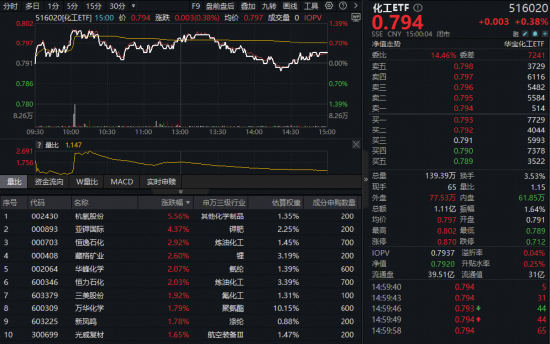
Group 1 - The chemical sector experienced a counter-market rise on December 3, with the chemical ETF (516020) showing a maximum intraday increase of 1.39% and closing up 0.38% [1] - Key stocks in the sector included Hangyang Co., which surged by 5.56%, and Yara International, which rose by 4.37%, along with several others gaining over 2% [1] - The basic chemical sector attracted significant capital inflow, with a net inflow of 1.877 billion yuan on the day, ranking third among 30 major industries [3] Group 2 - The chemical ETF (516020) has shown a year-to-date increase of 28.13%, outperforming major indices such as the Shanghai Composite Index (15.7%) and the CSI 300 Index (15.15%) [4] - The basic chemical sector has seen a cumulative net inflow of 18.977 billion yuan over the past five days, ranking second among the 30 major industries [3][5] Group 3 - The chemical industry is expected to benefit from ongoing "anti-involution" policies, which may strengthen supply-side constraints and gradually reverse the overcapacity situation [6] - The overall profitability of the chemical sector is anticipated to recover from its bottom due to a slowdown in fixed asset investment and demand recovery [6] - The current price-to-book ratio of the chemical ETF (516020) is 2.33, indicating a relatively low valuation compared to the past decade, suggesting good long-term investment potential [6] Group 4 - Looking ahead, the chemical industry is projected to experience a cyclical upturn starting in 2026, driven by a combination of supply-side contraction and increased demand [7] - The demand recovery in downstream sectors such as automotive, home appliances, and textiles is expected to continue, supported by macroeconomic improvements and consumption stimulus policies [7] - The chemical ETF (516020) provides a diversified investment opportunity across various sub-sectors, with nearly 50% of its holdings in large-cap leading stocks [7]