古茗

Search documents
东吴证券晨会纪要-20250529
Soochow Securities· 2025-05-29 03:23
Macro Strategy - The report indicates that the recent interest rate cuts on deposits may exacerbate the pressure on banks' liabilities, with the one-year fixed deposit rate decreasing by 15bps to 0.95% and the three-year and five-year rates down by 25bps to 1.25% and 1.30% respectively [11][12] - The 10-year US Treasury yield has risen to 4.51%, driven by concerns over liquidity and the sustainability of US fiscal conditions, leading to significant declines in the stock market [12][16] - The report highlights that the recent US-China tariff negotiations have positively impacted market confidence, resulting in a substantial increase in US stock prices and a rise in bond yields [16] Fixed Income - The report suggests focusing on the value of interbank certificates of deposit following the recent cuts in deposit rates, as banks may increase the issuance of these instruments to manage liability pressures [3][11] - It notes that the issuance of green bonds totaled approximately 9.46 billion yuan this week, a decrease of 0.853 billion yuan from the previous week, while the trading volume of green bonds increased by 2 billion yuan to 55 billion yuan [5] Industry Insights - The report recommends investing in leading tea brands like Mixue Group, which is expanding its domestic store network and pursuing overseas expansion, as well as other restaurant brands that are expected to benefit from a recovery in consumer spending [7] - In the automotive sector, the report emphasizes the importance of smart vehicle technology, predicting that 2025 will be a pivotal year for the adoption of Level 3 automation, with a projected increase in penetration rates from 10% to over 80% by 2027 [8] - The report identifies key automotive companies and components suppliers that are expected to benefit from the ongoing shift towards smart vehicles, including AI chips and electronic control systems [8][9]
政策效应不断显现企业赴境外上市持续升温
Zhong Guo Zheng Quan Bao· 2025-05-28 20:35
Group 1 - The recent surge in Chinese companies listing abroad, including major firms like CATL and Hengrui Medicine, reflects a growing trend in cross-border IPOs driven by improved regulatory efficiency and support from authorities [1][2][3] - As of May 28, 2023, 35 Chinese companies have gone public in the US, surpassing last year's total of 25, while 20 companies have listed in Hong Kong, exceeding last year's 16 [1] - The China Securities Regulatory Commission (CSRC) has significantly reduced the review time for overseas listing applications from over 100 days to under 60 days, with CATL achieving a record approval time of just 25 days [1] Group 2 - Consumer-oriented companies, particularly in the new beverage sector, are leading the wave of overseas listings, with several brands like Gu Ming and Mi Xue Group successfully listing in Hong Kong and the US [2] - There are currently 168 companies in the overseas listing application process, with 133 in the "supplementary materials" stage and 35 "accepted," primarily in sectors like new consumption, biomedicine, and new energy [2] - Deloitte predicts that by 2025, around 80 new stocks will be listed in Hong Kong, raising between HKD 130 billion to 150 billion, mainly from large A-share companies and tech firms [2] Group 3 - The "A+H" listing model is expanding, with companies like Muyuan Foods and Hengrui Medicine recently applying for H-share listings in Hong Kong, highlighting a trend of dual listings [3] - The increase in A-share companies listing in Hong Kong is attributed to strategic international expansion, regulatory conveniences, and improved liquidity in the Hong Kong market [3] Group 4 - The CSRC has introduced policies to enhance the overseas listing process, including the "惠港5条" policy, which aims to optimize the scope of stocks eligible for trading through the Shanghai-Hong Kong Stock Connect [3] - The Hong Kong Stock Exchange has lowered the listing thresholds for "A+H" shares and introduced a special channel for tech companies, encouraging more mainland firms to list in Hong Kong [3] Group 5 - The regulatory environment for overseas listings is expected to improve further, with the CSRC focusing on enhancing transparency and communication with international investors [4][5] - The People's Bank of China and the State Administration of Foreign Exchange are working on policies to facilitate cross-border financing for domestic companies, addressing concerns about the efficiency of fund management during overseas listings [5] Group 6 - International institutions are expressing support for the globalization of Chinese companies, with the Singapore Exchange enhancing its secondary listing framework to attract Chinese firms listed in Hong Kong and the US [6]


大爆发!5月逾80只港股,新高!
证券时报· 2025-05-28 13:09
Core Viewpoint - The Hong Kong stock market has shown remarkable performance in May, with over 80 stocks reaching historical highs, primarily driven by consumer and financial stocks [2][5]. Group 1: Market Performance - Since May, the Hong Kong market has seen more than 80 stocks hit historical highs, with consumer stocks leading the way [2][4]. - The "new consumption trio" consisting of companies like Mixue Group, Pop Mart, and Lao Pu Gold has gained significant attention, with their stock prices outperforming the broader market [3][5]. Group 2: Sector Analysis - Among the stocks reaching new highs, over 30 belong to the non-essential and essential consumer sectors, indicating a consumer-driven market rally [5][6]. - Financial stocks also performed well, with 18 stocks from various sub-sectors such as banking, insurance, and securities reaching new highs [6]. Group 3: Company Performance - Of the 80+ stocks that reached new highs, 66 reported positive year-on-year revenue growth for 2024, with several companies like Lao Pu Gold and Pop Mart showing revenue growth exceeding 100% [8]. - Notably, Lao Pu Gold achieved a revenue of 8.506 billion HKD, a 167.5% increase, while Pop Mart reported 13.04 billion HKD, marking a 106.9% growth [8]. Group 4: Volatility and Market Dynamics - Despite the positive performance, the stocks that reached new highs have begun to experience increased price volatility, as evidenced by significant drops in stock prices for Pop Mart and Mixue Group on May 28 [9].


连锁餐饮行业框架(一):规模与格局,逆周期下的连锁化浪潮
Soochow Securities· 2025-05-28 11:02
Investment Rating - The report maintains an "Accumulate" rating for the chain restaurant industry [1] Core Insights - The Chinese restaurant market is projected to reach CNY 5.6 trillion in 2024, with a five-year CAGR of 3.6% [4][17] - The chain restaurant sector is experiencing a continuous increase in chain rate, which rose from 12% in 2015 to 20% in 2024, contributing 38% to the growth of the restaurant market [20][41] - The report emphasizes the importance of supply-side drivers, including product innovation and service level enhancement, in sustaining industry growth [32][27] Summary by Sections 1. Industry Overview - The restaurant industry encompasses various formats, including fast food, casual dining, and leisure dining, catering to diverse consumer needs [10] - The market is characterized by a high degree of segmentation, with traditional Chinese cuisine dominating, accounting for 77.1% of the market [12][13] 2. Market Dynamics - The restaurant market's growth is driven by demographic changes, rising incomes, and innovations in food offerings [23][24] - The report notes that the online restaurant market has grown significantly, with a CAGR of 25% from 2015 to 2024, although growth has slowed post-pandemic [20] 3. Competitive Landscape - The concentration of the top 10 chain restaurants (CR10) has increased from 23.7% in 2015 to 30.3% in 2024, indicating a trend towards greater market consolidation [41][42] - Fast food and tea beverage segments are leading in standardization and market share among the top players [41] 4. Segment Analysis - Fast food is experiencing robust growth, with major brands like KFC and McDonald's maintaining significant market presence and expanding their store counts [45][46] - The hot pot segment, led by brands like Haidilao, showcases high standardization and strong social attributes, contributing to its resilience and expansion into international markets [52] 5. International Expansion - The report highlights the potential for Chinese restaurant brands to expand internationally, supported by a large overseas Chinese population and increasing local consumer interest [3][6]
古茗推出1元冰杯,加入新茶饮反卷便利店大战
Xin Lang Cai Jing· 2025-05-28 06:45
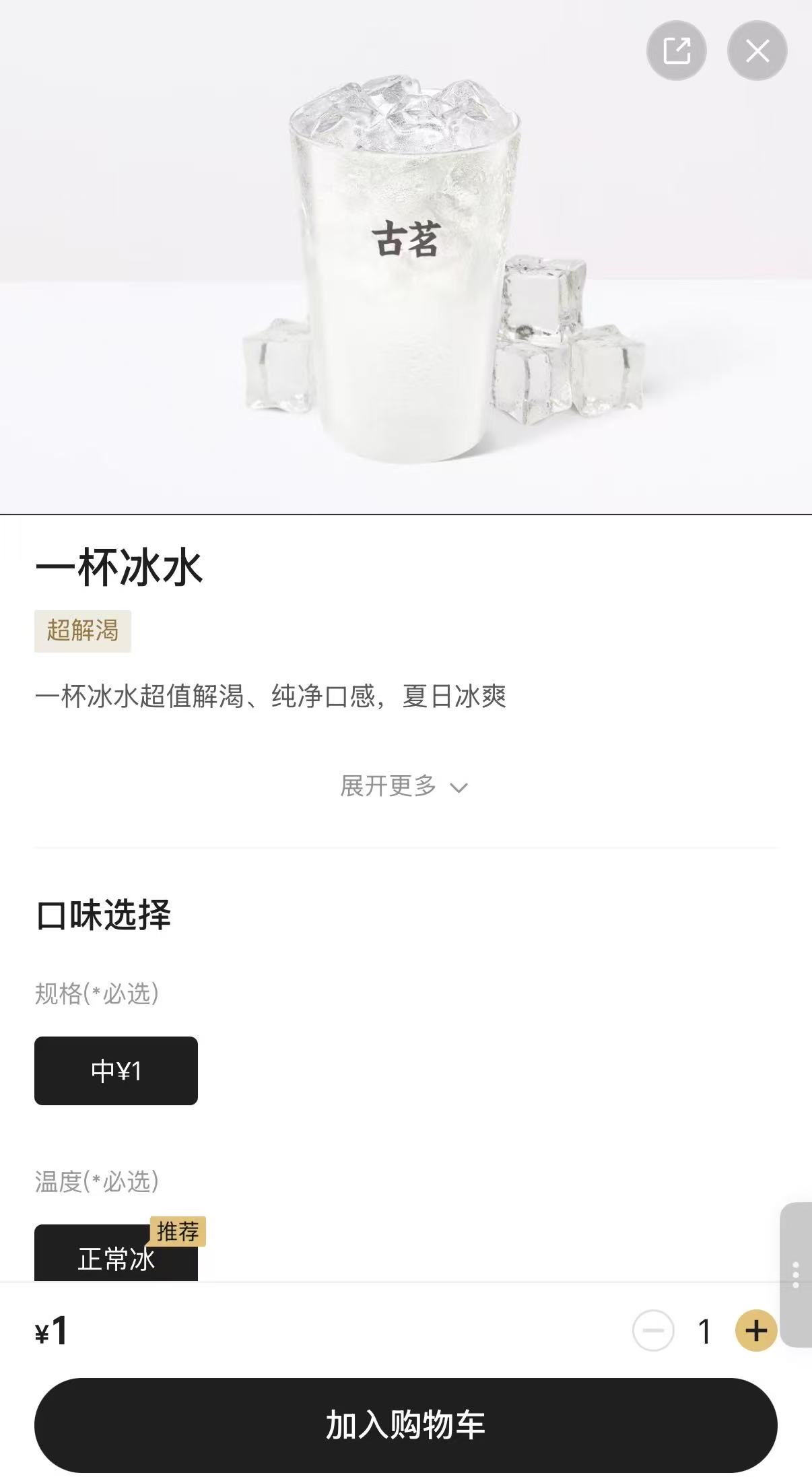
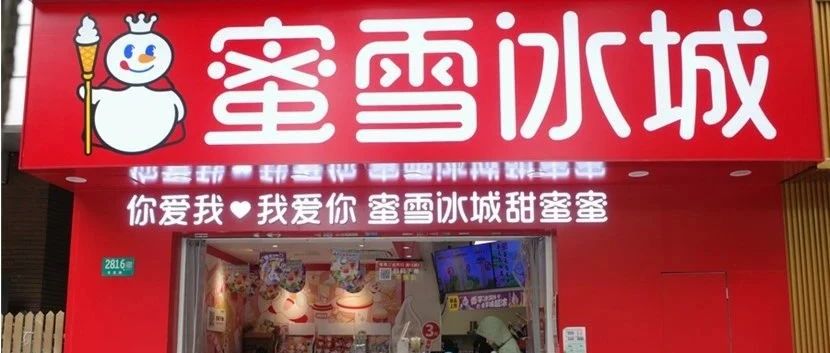
Group 1 - The core idea of the articles revolves around the introduction of new beverage products by the brand Gu Ming, specifically the "1 Yuan Ice Water" and "Fresh Lemon Water," which are aimed at providing high cost-performance drinks during the summer season [1][7] - Gu Ming's "1 Yuan Ice Water" is a 500ml medium cup filled with ice, priced at 1 Yuan, while the "Fresh Lemon Water" is priced at 3 Yuan, with a promotional price of 2.5 Yuan [1][7] - The introduction of these products aligns with Gu Ming's strategy to offer high value beverages, not just focusing on absolute pricing [1] Group 2 - The popularity of ice cups has surged among young consumers, with a reported 350% year-on-year increase in delivery volume for ice cups around the summer season [7] - Competitors like Mixue Ice City have also entered the market with their own 1 Yuan ice cup offerings, indicating a trend towards affordable ice beverages [7] - The ice beverage market is projected to grow significantly, with an expected increase in instant retail sales of ice products to over 63 billion Yuan by 2026, highlighting the potential for ice beverages to become a key category in instant retail [8]
陆家嘴财经早餐2025年5月28日星期三
Wind万得· 2025-05-27 22:47
Group 1 - The Chinese government aims to strengthen partnerships with ASEAN and the Gulf Cooperation Council, focusing on high-quality Belt and Road initiatives, infrastructure, and cooperation in energy, agriculture, AI, digital economy, and green low-carbon sectors [3] - A private equity firm in the US is planning to acquire the Darwin Port in Australia, currently owned by a Chinese company, with the Chinese government asserting that the company's rights should be protected [3] Group 2 - The total net asset value of public funds in China has surpassed 33 trillion yuan, marking a historical high, with significant growth in equity, bond, and money market funds [4] - Xiaomi Group reported a 47.4% year-on-year increase in total revenue for Q1, reaching 111.3 billion yuan, with adjusted net profit rising 64.5% to 10.68 billion yuan, exceeding market expectations [4] Group 3 - In April, profits of large-scale industrial enterprises in China increased by 3% year-on-year, with rapid profit growth in new energy sectors such as smart vehicle equipment and drones [5] - The 2025 Lujiazui Forum is scheduled for June 18-19, 2025, focusing on high-level economic and financial discussions [5] Group 4 - The Chinese stock market saw fluctuations, with the Shanghai Composite Index closing down 0.18% at 3340.69 points, while the Hong Kong Hang Seng Index rose 0.43% [7] - A total of over 120 billion yuan has been allocated for stock buybacks and increases in shareholdings by A-share listed companies, with the electronics sector leading in the number of companies involved [8] Group 5 - Kuaishou reported Q1 revenue of 32.61 billion yuan, a 10.9% year-on-year increase, with adjusted net profit rising 4.4% [8] - The stock price of Mixue Group surged to a historical high, with a market capitalization exceeding 219.8 billion yuan, significantly outperforming other beverage brands [8] Group 6 - The Chinese government is focusing on digital financial development and regulatory policies, emphasizing the need for a digital transformation in financial supervision [6] - The State Council's expert advisory group on anti-monopoly and unfair competition is prioritizing the establishment of a unified national market and enhancing competition regulation [6] Group 7 - The latest survey indicates that 15.37% of Chinese citizens possess scientific literacy, with a total of 440 million people meeting the basic scientific literacy criteria [6] - The Guangzhou Real Estate Agency reported a year-on-year increase in second-hand residential transactions in May, with significant growth in both volume and area [14]


热门板块,普涨!
Zhong Guo Ji Jin Bao· 2025-05-27 11:59
【导读】港股市场三大指数收涨,医药、新消费、科技板块上涨 见习记者 纪瑶 5月27日,港股市场三大指数由跌转涨。截至收盘,恒生指数涨0.43%,报收于23381.99点;恒生科技指数上涨0.48%,报收于5182.6点,国企指数上涨 0.38%,报收于8469.97点。板块方面,医药、新消费、科技等上涨,黄金股受金价调整影响下跌,汽车板块普跌。 | 序号 | 代码 | 名称 | 现价 | 涨跌 | 涨跌幅 | 成交额 | 年初至今 | | --- | --- | --- | --- | --- | --- | --- | --- | | 2 | HSI | 恒生指数 | 23381.99 | 99.66 | 0.43% | 2032.68亿 | 16.56% | | 3 | HSCEI | 恒生中国企业指数 | 8469.97 | 32.33 | 0.38% | 770.16亿 | 16.19% | | 4 | HSCCI | 恒生香港中资企业指数 | 3964.33 | 24.29 | 0.62% | 65.96亿 | 4.85% | | 5 | SSSSS | 恒生可持续发展企业指数 | 2851.44 ...

市值超越"白酒巨头"!5元奶茶凭什么?
第一财经· 2025-05-27 11:38
Core Viewpoint - The article highlights the remarkable market performance of Mixue Group, which has surpassed traditional liquor giants in market capitalization, indicating a shift in consumer valuation of beverage brands [1][2]. Group 1: Market Performance - As of May 27, Mixue Group's stock price reached 579 HKD, with a total market capitalization exceeding 219.8 billion HKD, surpassing Luzhou Laojiao and more than double that of Yanghe [1][4]. - Since its listing on March 3, Mixue Group's stock has increased by over 160%, significantly outperforming the Hang Seng Index during the same period [2]. - The company's price-to-earnings (P/E) ratio stands at 45, which is considerably higher than many leading liquor brands, indicating a premium valuation in the market [4]. Group 2: Factors Driving Stock Price - Short-term catalysts for Mixue Group's stock price increase include a competitive subsidy war initiated by major delivery platforms like JD.com, which has boosted same-store sales [6]. - The average daily retail sales per store for Mixue Group showed a slight decline in growth rates, with figures of 4,127.8 CNY and 4,184.4 CNY for 2023 and 2024 respectively, indicating a potential slowdown in sales growth [8]. - Long-term stock price appreciation is attributed to supply chain advantages and a concentrated shareholding structure, with the controlling shareholders holding approximately 82% of the shares, resulting in limited market liquidity [10]. Group 3: Competitive Landscape - Mixue Group has established itself as a leading player in the new tea beverage market, with a significant number of stores globally, surpassing Starbucks to become the largest chain [10]. - The valuation of Mixue Group is compared to that of Kweichow Moutai, a leading liquor brand, suggesting that it is viewed as a premium brand within the tea beverage sector [4].
指数基金投资+:华鑫量化全天候刷新历史新高
Huaxin Securities· 2025-05-27 08:23
Quantitative Models and Construction Methods 1. Model Name: XinXuan ETF Absolute Return Strategy - **Model Construction Idea**: The strategy aims to achieve absolute returns and long-term relative returns against A-share equities by selecting and holding ETFs from the XinXuan ETF pool[11] - **Model Construction Process**: 1. The strategy uses the "drawer method" to test the in-market equity ETF pool 2. The portfolio is optimized for absolute and relative returns through ETF trading 3. Key metrics include annualized return, maximum drawdown, Sharpe ratio, and volatility[11] - **Model Evaluation**: Demonstrates strong performance with low drawdowns and high Sharpe ratios, outperforming equal-weighted ETF benchmarks[11] 2. Model Name: All-Weather Multi-Asset Multi-Strategy ETF Risk Parity Strategy - **Model Construction Idea**: Combines industry rotation, style rotation, and risk parity to enhance returns while reducing portfolio volatility by diversifying across assets and strategies[15][17] - **Model Construction Process**: 1. Incorporates multiple asset classes: commodities (gold ETFs), US equities (S&P 500 ETFs), domestic equities (industry/style/size rotations), and domestic bonds (10-year and 30-year bond ETFs) 2. Allocates assets based on risk parity principles to balance portfolio risks[17] - **Model Evaluation**: Improves precision in ETF usage and achieves higher returns with lower volatility compared to traditional risk parity strategies[15][17] 3. Model Name: China-US Core Asset Portfolio - **Model Construction Idea**: Combines trend-following RSRS timing strategy and technical reversal strategies to optimize a portfolio of four strong-trend assets: liquor, dividends, gold, and Nasdaq[21] - **Model Construction Process**: 1. Selects assets based on strong trend signals 2. Applies RSRS timing and technical reversal strategies to adjust holdings dynamically 3. Portfolio details and methodology are elaborated in prior reports[21] - **Model Evaluation**: Outperforms equal-weighted indices with high annualized returns and Sharpe ratios, while maintaining moderate drawdowns[21] 4. Model Name: High Prosperity/Dividend Rotation Strategy - **Model Construction Idea**: Rotates between high-growth and dividend strategies based on market signals, dynamically adjusting ETF allocations[24] - **Model Construction Process**: 1. Allocates 50% to Growth ETFs (e.g., ChiNext, STAR 50) during high-growth signals 2. Allocates 50% to Dividend ETFs (e.g., Low Volatility Dividend, Central SOE Dividend 50) during dividend signals 3. Adjusts allocations based on signal changes, with detailed methodology in prior reports[24] - **Model Evaluation**: Demonstrates superior returns and risk-adjusted performance compared to equal-weighted indices, albeit with higher volatility[24] 5. Model Name: Dual Bond LOF Enhanced Strategy - **Model Construction Idea**: Enhances bond-heavy portfolios by dynamically adjusting weights between dual bond LOFs and other assets based on volatility normalization[27] - **Model Construction Process**: 1. Divides assets into dual bond LOFs and other products 2. Calculates weekly returns and volatilities for each group 3. Normalizes the inverse of volatilities to determine weights, ensuring higher allocation to bonds due to their lower volatility[27] - **Model Evaluation**: Achieves stable returns with minimal drawdowns and low volatility, outperforming the dual bond LOF benchmark[27] 6. Model Name: Structured Risk Parity Strategy (QDII) - **Model Construction Idea**: Enhances traditional risk parity by incorporating QDII products, domestic bonds, and dividend ETFs for diversified exposure[28][30] - **Model Construction Process**: 1. Allocates assets across commodities (gold ETFs), QDII equities (e.g., Nasdaq, Nikkei, DAX), domestic bonds (5-year, 10-year, 30-year ETFs), and dividend ETFs 2. Balances risks across asset classes to achieve structural diversification[28][30] - **Model Evaluation**: Delivers high returns with low drawdowns and volatility, showcasing strong risk-adjusted performance[30] --- Model Backtest Results 1. XinXuan ETF Absolute Return Strategy - Total Return: 33.49% - Annualized Return: 24.14% - Maximum Drawdown: -6.30% - Volatility: 17.58% - Sharpe Ratio: 1.20[11][33] 2. All-Weather Multi-Asset Multi-Strategy ETF Risk Parity Strategy - Total Return: 19.69% - Annualized Return: 14.40% - Maximum Drawdown: -3.62% - Volatility: 4.48% - Sharpe Ratio: 2.58[15][33] 3. China-US Core Asset Portfolio - Total Return: 59.80% - Annualized Return: 42.03% - Maximum Drawdown: -10.86% - Volatility: 17.16% - Sharpe Ratio: 2.02[21][33] 4. High Prosperity/Dividend Rotation Strategy - Total Return: 48.99% - Annualized Return: 34.78% - Maximum Drawdown: -22.04% - Volatility: 34.79% - Sharpe Ratio: 0.96[24][33] 5. Dual Bond LOF Enhanced Strategy - Total Return: 9.08% - Annualized Return: 6.73% - Maximum Drawdown: -2.26% - Volatility: 3.41% - Sharpe Ratio: 1.34[27][33] 6. Structured Risk Parity Strategy (QDII) - Total Return: 23.59% - Annualized Return: 17.18% - Maximum Drawdown: -2.38% - Volatility: 4.92% - Sharpe Ratio: 2.84[30][33]
“国补”携手618,大消费攻势再起!贯穿全年的投资主线?
Ge Long Hui· 2025-05-27 07:39
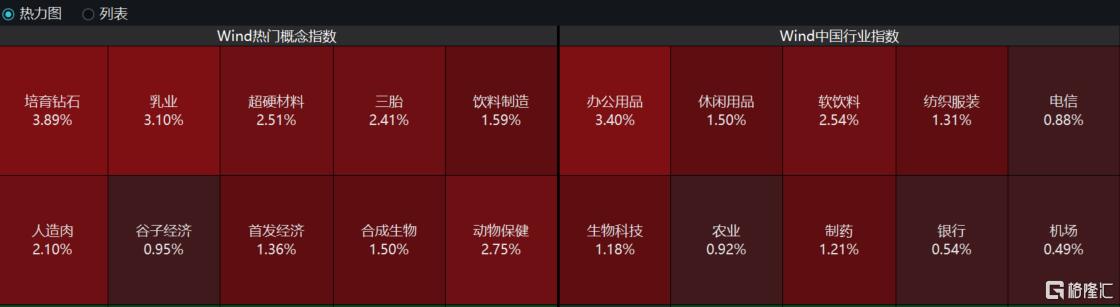
市场热点快速切换,今天轮到大消费这条主线。 周二,A股食品饮料、白酒、乳业、互联网电商、宠物经济等大消费领衔上攻,IP经济、珠宝等新兴消费迎强势上涨。 个股方面,科拓生物、均瑶健康、保龄宝、会稽山、有友食品、创源股份、广博股份等一批个股涨停。 | ● 热力图 ○列表 | | | | | | | | | | | --- | --- | --- | --- | --- | --- | --- | --- | --- | --- | | | | Wind热门概念指数 | | | | | Wind中国行业指数 | | | | 培育钻石 3.89% | 乳业 3.10% | 超硬材料 2.51% | 三胎 2.41% | 饮料制造 1.59% | 办公用品 3.40% | 休闲用品 1.50% | 软饮料 2.54% | 纺织服装 1.31% | 电信 0.88% | | 人造肉 | 谷子经济 | 首发经济 | 合成生物 | 动物保健 | 生物科技 | 农业 | 制药 | 银行 | 机场 | | 2.10% | 0.95% | 1.36% | 1.50% | 2.75% | 1.18% | 0.92% | 1.21% ...