
华锡有色

Search documents
锡:强预期与弱现实博弈下盘面高位宽幅震荡:锡期货2026年2月报告-20260202
Fang Zheng Zhong Qi Qi Huo· 2026-02-02 06:57
Report Industry Investment Rating - Not provided in the content Core Viewpoints - In January 2026, the Shanghai tin futures market rose rapidly under the boost of capital, with the long - term structural improvement in demand and macro - liquidity easing as the main driving forces. The price broke through the historical high and continued to strengthen, and is currently fluctuating widely at a high level [59]. - In 2026, the tight supply of tin ore will gradually ease, showing a pattern of tight supply in the first half and loose in the second half. The operating rate of smelters will improve after the holiday. The processing fee, which has been at a low level, increased in January and has room for further growth. However, the secondary tin smelting industry still faces problems such as an inefficient waste recycling system and uncertain recycling policies [59]. - In terms of demand, the tin solder sector, which performed well in 2025, is expected to continue its good growth trend in 2026, benefiting from the rapid development of the semiconductor industry due to computing power demand. In addition, the external demand in the traditional tin - plated sheet field is expanding, offsetting some of the negative impact of the decline in domestic demand. The future development of Sino - US trade frictions remains the biggest uncertainty [59]. - In 2026, the global interest - rate cut cycle will continue, and the non - ferrous metal sector will cyclically improve. The supply side is likely to gradually loosen, while the downstream demand also has some bright spots. The supply and demand of tin are likely to remain in a tight - balanced situation. It is expected that tin prices will remain strong in 2026, with the Shanghai tin futures price mainly ranging between 350,000 - 450,000 and the LME tin price mainly between 45,000 - 60,000 [59]. Summary by Directory Part I: Market Review and Macroeconomic Impact - **Market Review**: In January 2026, the Shanghai tin futures market accelerated its upward rush, and the overall center of gravity shifted significantly. The main driving forces were the long - term structural improvement in demand and macro - liquidity easing, while the impact of the current fundamentals was relatively weak [8]. - **Macroeconomic Situation**: Geopolitical situations are complex and changeable. The EU is considering imposing tariffs on US goods worth 93 billion euros and restricting US companies from entering the EU market. The US will impose a 10% tariff on goods imported from eight European countries starting February 1, 2026, and the tariff rate will increase to 25% starting June 1. The Fed kept interest rates unchanged in January, and the candidate for the new Fed chair is undetermined. Since January, the US dollar index first rose and then fell, putting pressure on the non - ferrous metal sector [11]. Part II: Tin Supply - Side Analysis - **Tin Ore Supply**: China's tin ore production has been declining in recent years due to over - exploitation, low - grade reserves, and limited new resource discoveries. In 2025, the production of tin concentrates in China showed a slight increase. In December 2025, the import volume of tin concentrates in China increased significantly month - on - month. With the gradual increase in tin ore exports from the Wa State in Myanmar, the import volume is expected to increase in 2026 [17]. - **Refined Tin Production**: In 2025, the price of tin concentrates showed an upward trend, and the processing fee was weak. In 2026, with a slight improvement in ore supply, the processing fee was raised. In December 2025, the output of refined tin by domestic sample enterprises increased both month - on - month and year - on - year. It is expected that in 2026, the supply growth rate of refined tin will be slightly higher than that in 2025, but the output in January may decrease month - on - month [20]. - **Refined Tin Import and Export**: In 2026, there is a trend of opening the refined tin import window. In December 2025, both imports and exports of refined tin increased. In 2025, China's net exports of refined tin were nearly 3,500 tons [23]. Part III: Tin Demand - Side Analysis - **Tin - Plated Sheet**: In 2024, China's tin - plated sheet production increased steadily. However, in 2025, due to the substitution of chrome - plated sheets and the decline in domestic demand, the production decreased significantly. In 2025, the export of tin - plated sheets increased, but the future export situation is affected by the Sino - US trade war [29]. - **Lead - Acid Batteries**: The production of lead - acid batteries has been growing in recent years, but the growth rate has slowed down. In 2025, the export of lead - acid batteries decreased year - on - year due to the impact of the trade war [30]. - **Electronic Products**: The growth cycle of electronic products is approaching the end. In 2025, the production growth rate of electronic products turned negative. It is expected that the production and sales of computers and mobile phones will decline in 2026 [35]. - **Integrated Circuits**: Since 2024, China's integrated circuit production has increased significantly. With the recovery of the global semiconductor industry, it is expected that the production and sales of integrated circuits will continue to grow rapidly in the medium and long term [36]. - **PVC and Glass**: The production of PVC has been increasing, while the production of glass has been decreasing. Each ton of glass consumes about 22 grams of tin [41]. - **Photovoltaic Industry**: The photovoltaic industry is transforming from a high - speed development stage. In 2025, there was a rush to install photovoltaic capacity. In 2026, the industry will face resource integration, and the global new photovoltaic installation is expected to reach 665GW. The new tin demand in the global photovoltaic industry is expected to reach 43,000 tons, and about 20,000 tons in China [44]. - **New Energy Vehicles**: In 2025, the production and sales of new energy vehicles continued to grow, but the growth rate slowed down. It is expected that the growth rate in 2026 will be between 15% - 20% [48]. - **Inventory and Supply - Demand Balance**: As of December 1, 2025, the combined inventory of tin in the two major exchanges was at a relatively high - middle level. The global tin market has been in a supply - shortage situation for most months since 2018. In 2025 and 2026, the supply and demand are expected to remain in a tight - balanced situation [51][55]. - **Seasonal Analysis**: Historically, tin prices are weakest in June, and the probability of decline is high in March and October. The probability of increase is high in January, April, July, and December, and the increase is relatively significant. The probability of decline in August is slightly higher than that of increase, while the probability of increase in November is higher [57]. - **Related Stocks**: The stocks of related tin industries have shown significant increases in both monthly and annual terms, such as Tin Industry Co., Ltd., Xingye Co., Ltd., etc. [58]


稀土板块进入击球区,继续看多锡钨锑钼
Zhong Guo Neng Yuan Wang· 2026-02-02 03:34
Group 1: Rare Earths - The price of praseodymium and neodymium oxide is 748,700 CNY/ton, an increase of 11.03% month-on-month [3] - The price of dysprosium oxide is 1,330,000 CNY/ton, a decrease of 10.74% month-on-month [3] - The price of terbium oxide is 6,100,000 CNY/ton, a decrease of 4.98% month-on-month [3] - The processing fee for yttrium-rich europium ore has risen to 41,000 CNY/ton, indicating ongoing optimization in the smelting industry [3] - December's rare earth permanent magnet exports decreased by 3% month-on-month but increased by 7% year-on-year, reaching a historical high for the month [3] - The rare earth sector is expected to see valuation and performance improvements, with 2026 being a critical year for resolving industry competition [3] Group 2: Tin - The price of tin ingots is 423,600 CNY/ton, an increase of 2.17% month-on-month [4] - The upward price trend is supported by lower-than-expected supply from Indonesia and Myanmar [4] - The demand side is expected to benefit from AI advancements and the recovery of the semiconductor industry [4] - Recommended stocks include Huaxi Nonferrous Metals and others [4] Group 3: Tungsten - The price of tungsten concentrate is 600,700 CNY/ton, an increase of 19.24% month-on-month [4] - The price of ammonium paratungstate is 890,600 CNY/ton, an increase of 19.49% month-on-month [4] - The establishment of a $2.5 billion "strategic resilience reserve" in the U.S. may increase tungsten's priority [4] - Recommended stocks include Zhongtung High-tech and others [4] Group 4: Antimony - The price of antimony ingots is 164,100 CNY/ton, an increase of 1.26% month-on-month [5] - The price of antimony concentrate is 141,000 CNY/ton, an increase of 2.27% month-on-month [5] - December's antimony exports increased by 4% month-on-month but decreased by 71% year-on-year [5] - The global antimony price trend remains upward due to supply shortages and steady demand [5] Group 5: Molybdenum - The price of molybdenum concentrate is 4,010 CNY/ton, remaining stable month-on-month [6] - The price of molybdenum iron is 256,000 CNY/ton, an increase of 0.79% month-on-month [6] - The ongoing low inventory levels and increased defense spending may further support molybdenum prices [6] - Recommended stocks include Jinduicheng Molybdenum and Guocheng Mining [6]
有色金属:鹰派扰动,价格巨震
GUOTAI HAITONG SECURITIES· 2026-02-02 02:02
股票研究 /[Table_Date] 2026.02.02 鹰派扰动,价格巨震 [Table_Industry] 有色金属 | [姓名table_Authors] | 电话 | 邮箱 | 登记编号 | | --- | --- | --- | --- | | 李鹏飞(分析师) | 010-83939783 | lipengfei2@gtht.com | S0880519080003 | | 魏雨迪(分析师) | 021-38674763 | weiyudi@gtht.com | S0880520010002 | | 刘小华(分析师) | 021-38038434 | liuxiaohua@gtht.com | S0880523120003 | | 王宏玉(分析师) | 021-38038343 | wanghongyu@gtht.com | S0880523060005 | | 梁琳(分析师) | 021-23185845 | lianglin@gtht.com | S0880525070014 | | 李阳(分析师) | 021-23185618 | liyang7@gtht.com | S088052504 ...
华锡有色跌停,华安基金旗下1只基金重仓,持有101.5万股浮亏损失574.49万元
Xin Lang Cai Jing· 2026-02-02 01:51
Group 1 - The core point of the news is that Guangxi Huaxi Nonferrous Metals Co., Ltd. experienced a significant drop in stock price, reaching a limit down at 50.95 yuan per share, with a total market capitalization of 32.229 billion yuan [1] - The company was established on June 15, 1998, and listed on July 12, 2000, primarily engaged in the exploration, mining, and processing of nonferrous metals such as tin, zinc, lead, and antimony [1] - The main revenue composition of the company includes 91.82% from nonferrous metal products, 4.61% from deep processing of nonferrous metals, 2.43% from engineering supervision and other services, 0.89% from other supplementary services, and 0.25% from surveying, design, and consulting services [1] Group 2 - From the perspective of fund holdings, Huaxi Nonferrous is a significant position in the Huaxin Fund, with the Huaxin Advantage Leading Mixed A Fund holding 1.015 million shares, accounting for 2.03% of the fund's net value, making it the fourth-largest holding [2] - The estimated floating loss for the fund today is approximately 5.7449 million yuan [2] - The Huaxin Advantage Leading Mixed A Fund was established on October 31, 2025, with a current scale of 723 million yuan and a year-to-date return of 7.03%, ranking 3205 out of 9000 in its category [2]
有色金属周报:美联储主席更替,贵金属波动放大
SINOLINK SECURITIES· 2026-02-02 00:45
Investment Ratings - The report indicates a positive outlook for copper and aluminum sectors, with expectations of stable production and demand recovery [2][3][13] Core Insights - Copper prices increased by 3.98% to $13,650.5 per ton on LME, while domestic prices rose by 2.31% to 103,700 CNY per ton. Supply constraints and stable production rates are noted, with a slight decrease in operating rates expected due to seasonal demand fluctuations [2][14] - Aluminum prices rose by 1.75% to $3,229.0 per ton on LME, with domestic prices at 24,600 CNY per ton. The report highlights a seasonal decline in production rates and a high operating rate in alumina plants, despite a slight increase in inventory levels [3][15] - Gold prices surged by 8.58% to $5,410.8 per ounce, driven by geopolitical risks and market volatility. The report emphasizes the impact of U.S. monetary policy on gold prices [4][16] - The rare earth sector shows a positive trend, with prices for praseodymium and neodymium oxide increasing by 11.30%. The report anticipates a favorable demand outlook due to easing export restrictions [5][34] - Tungsten prices rose by 12.99%, supported by strategic stockpiling initiatives in the U.S. and increasing demand in military applications [5][36] Summary by Sections Copper - LME copper price increased by 3.98% to $13,650.5 per ton, with domestic prices at 103,700 CNY per ton. Supply constraints are evident, with a decrease in copper processing fees [2][14] - Operating rates for copper cable enterprises increased to 59.46%, indicating stable production driven by prior orders [2][14] Aluminum - LME aluminum price rose by 1.75% to $3,229.0 per ton, with domestic prices at 24,600 CNY per ton. The report notes a decrease in operating rates due to seasonal factors [3][15] - The overall aluminum processing rate recorded at 59.4%, reflecting a seasonal decline in demand [3][15] Precious Metals - Gold prices increased significantly due to geopolitical tensions, with COMEX gold price reaching $5,410.8 per ounce. The report discusses the implications of U.S. monetary policy on gold market dynamics [4][16] Rare Earths - The price of praseodymium and neodymium oxide rose by 11.30%, with expectations of increased demand due to favorable export conditions [5][34] - The report highlights the potential for price increases in the rare earth sector driven by supply constraints and demand recovery [5][34] Tungsten - Tungsten prices increased by 12.99%, supported by strategic stockpiling initiatives and military demand [5][36] - The report suggests that the tungsten sector may benefit from ongoing geopolitical tensions and increased defense spending [5][36]
推动产业由“大”转“强”——广西成立研究院开展关键金属科研攻关
Xin Lang Cai Jing· 2026-02-01 23:26
Core Insights - The establishment of the Guangxi Critical Metals Research Institute aims to address key technological challenges in the critical metals sector and promote the high-end, intelligent, green, large-scale, and park-based development of Guangxi's critical metals industry [1][2] Group 1: Industry Overview - Guangxi is a significant resource-rich area for critical metals in China, with the non-ferrous metals industry projected to reach a value of 393.7 billion yuan by 2024, making it the largest industrial sector in the region [2] - The non-ferrous metals industry faces challenges of being "large but not strong" and "coarse but not refined," prompting the need for innovation and development [2] Group 2: Research Institute Objectives - The Guangxi Critical Metals Research Institute will focus on five key areas: efficient resource exploration and green mining, low-carbon smelting technology, high-purity metal and compound preparation, high-end materials and device development, and resource recycling and pollution prevention [3] - The institute aims to create a comprehensive innovation ecosystem that promotes the overall upgrade of the industry from resource extraction to product development [3] Group 3: Innovation and Collaboration - The institute will serve as a platform for precise and efficient matching of technological achievements with enterprise needs, facilitating collaboration between research teams and companies [4] - A regular communication mechanism will be established to ensure that research efforts are aligned with real industry challenges, with over 60 dual-employed researchers already engaged in diagnostics across more than 50 key enterprises in Guangxi [5] Group 4: Talent Development and Future Goals - The institute plans to attract high-level talent through competitive compensation, high-quality platform construction, and supportive policies, aiming to cultivate over 100 high-level talents and establish more than 10 technology-based enterprises by 2030 [3][5] - By 2030, the institute aims to overcome more than 50 key technologies and support an additional industrial output value of over 80 billion yuan, positioning Guangxi as a national hub for critical metals innovation [3]
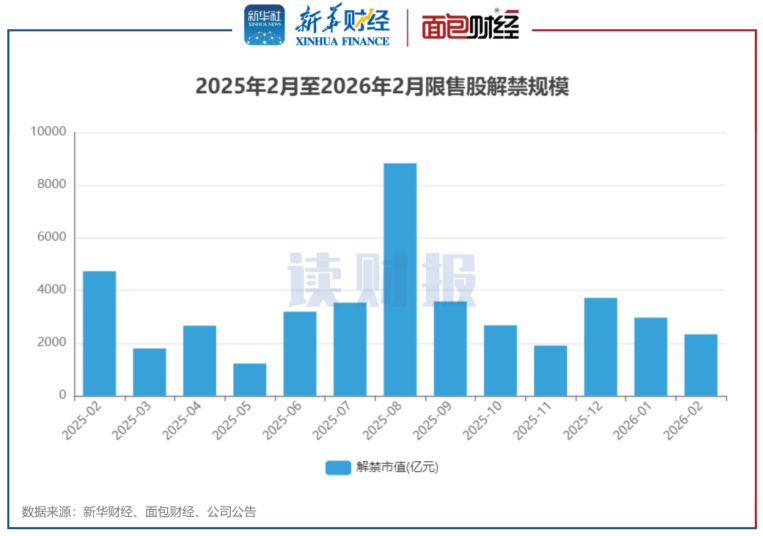
【读财报】A股2月逾2300亿元解禁 信达证券、湖南裕能解禁规模居前
Zhong Guo Jin Rong Xin Xi Wang· 2026-02-01 23:21
Summary of Key Points Core Viewpoint - In February 2026, a total of 111 companies in the A-share market will face the unlocking of restricted shares, with a total unlocking volume of approximately 12.902 billion shares and an unlocking scale of 233.584 billion yuan, representing a month-on-month decrease of about 21.32% and a year-on-year decrease of about 50.63% [1][3]. Group 1: Unlocking Scale and Key Companies - The largest unlocking scale is attributed to Xinda Securities, with an unlocking market value exceeding 40 billion yuan [1][3]. - Five stocks will have an unlocking market value exceeding 10 billion yuan, with Xinda Securities, Hunan YN, and Huaxi Nonferrous Metals leading the list [3][4]. - Xinda Securities will unlock 2.5514 billion shares on February 2, with an unlocking market value of approximately 44.93 billion yuan, accounting for 78.67% of its total share capital [3][4]. Group 2: Industry Distribution - The industries with the highest unlocking market values are non-bank financials, electronics, and power equipment [1][9]. - In the non-bank financial sector, Xinda Securities has a significant unlocking scale, while in the electronics sector, Zhongwei Semiconductor has a notable unlocking scale [9][10]. Group 3: Additional Notable Unlockings - Hunan YN will unlock 374 million shares on February 9, with an unlocking market value of approximately 24.179 billion yuan, accounting for 49.13% of its total share capital [7][9]. - Huaxi Nonferrous Metals will have an unlocking volume of 357 million shares, representing 56.47% of its total share capital, with an unlocking market value of approximately 22.47 billion yuan [7][9]. - Honghai Technology will have its anniversary unlocking in February, with an unlocking volume of approximately 137 million shares and a market value of about 1.955 billion yuan [9][10].



有色金属周报:美联储主席更替,贵金属波动放大-20260201
SINOLINK SECURITIES· 2026-02-01 14:57
Investment Rating - The report indicates a positive outlook for copper and aluminum sectors, with expectations of stable production and demand recovery in the near term [2][3][13]. Core Insights - Copper prices increased by 3.98% to $13,650.5 per ton on LME, while domestic prices rose by 2.31% to 103,700 CNY per ton. The overall production stability in the copper industry is noted, with a slight decrease in operating rates expected due to seasonal demand fluctuations [2][14]. - Aluminum prices saw a 1.75% increase to $3,229.0 per ton on LME, with domestic prices at 24,600 CNY per ton. The report highlights a seasonal decline in aluminum processing rates, indicating a shift towards the off-peak season [3][15]. - Gold prices surged by 8.58% to $5,410.8 per ounce, driven by geopolitical risks and market volatility. The report emphasizes the impact of U.S. monetary policy on gold prices [4][16]. - The rare earth sector shows a positive trend, with prices for praseodymium and neodymium oxide rising by 11.30%. The report anticipates a favorable demand outlook due to easing export restrictions [5][32][34]. Summary by Sections Copper - LME copper price increased by 3.98% to $13,650.5 per ton, with domestic prices at 103,700 CNY per ton. Copper inventory decreased by 2.24% week-on-week, while total inventory increased by 4.97% year-on-year [2][14]. - The operating rate for copper cable enterprises rose to 59.46%, indicating stable production driven by prior orders [2][14]. Aluminum - LME aluminum price rose by 1.75% to $3,229.0 per ton, with domestic prices at 24,600 CNY per ton. The overall aluminum processing rate recorded a decline to 59.4% [3][15]. - Domestic aluminum oxide production capacity remains high, but the operating rate decreased by 1.66% to 77.31% [3][15]. Precious Metals - Gold prices increased significantly due to geopolitical tensions, with a notable rise in SPDR gold holdings remaining stable at 1,086.53 tons [4][16]. - The report discusses the implications of U.S. monetary policy on gold price fluctuations, particularly in light of recent geopolitical developments [4][16]. Rare Earths - The price of praseodymium and neodymium oxide rose to 748,700 CNY per ton, reflecting a strong demand outlook. The report notes a 7% year-on-year increase in rare earth permanent magnet exports [5][32][34]. - The report suggests that the rare earth sector is poised for growth, driven by easing export restrictions and increased global demand [5][32][34]. Tungsten - Tungsten prices increased by 12.99%, with strategic reserves being a focus in the U.S. market, indicating a potential for continued price support [5][36]. Tin - Tin prices showed a slight decrease of 0.03%, but the report maintains a positive long-term outlook due to supply constraints from Indonesia and Myanmar [5][37]. Lithium - Lithium carbonate prices increased by 7.15% to 171,000 CNY per ton, with production slightly declining. The report highlights a robust demand outlook despite recent price fluctuations [5][57]. Cobalt - Cobalt prices increased by 1.8% to 445,000 CNY per ton, with supply constraints expected to support price stability in the near term [5][58].
宏观情绪降温,金属价格普调
GOLDEN SUN SECURITIES· 2026-02-01 11:16
Investment Rating - The report provides a "Buy" rating for several companies in the non-ferrous metals sector, including Shandong Gold, Zijin Mining, and China Hongqiao [9]. Core Views - The macroeconomic sentiment has cooled, leading to a general decline in metal prices, particularly in precious metals where silver and gold experienced significant drops [1]. - The report highlights the ongoing supply constraints in the copper market, with major mining companies reducing their production forecasts due to capacity limitations [2]. - The aluminum market is expected to experience short-term fluctuations due to geopolitical tensions and macroeconomic policies, with demand anticipated to recover as the peak season approaches [3]. - Nickel prices have shown volatility, influenced by macroeconomic sentiment and supply-side cost pressures, with expectations of limited downside due to rising production costs [4]. - Tin prices are supported by macroeconomic factors and supply chain bottlenecks, although demand remains weak ahead of the Chinese New Year [5]. - Lithium prices have retreated from highs due to regulatory impacts and market liquidity tightening, but there is expected support from supply-side maintenance and pre-holiday stocking [6]. Summary by Sections Precious Metals - Significant declines in silver and gold prices were noted, with silver dropping 36% and gold falling over 12% in a single day [1]. - Companies to watch include Xinyi Silver, Shengda Resources, and Zijin Mining [1]. Industrial Metals - Copper inventories increased globally, with a notable rise in U.S. stocks, while Chinese inventories decreased [2]. - The report suggests monitoring companies like Zijin Mining and Luoyang Molybdenum [2]. - Aluminum production is stable, but demand is fluctuating due to seasonal factors and geopolitical issues [3]. - Nickel prices fell by 5.4% due to macroeconomic sentiment, with supply-side cost pressures expected to limit further declines [4]. Energy Metals - Lithium prices have decreased, with battery-grade lithium carbonate dropping 5.6% to 160,000 CNY/ton [5]. - The report indicates that companies like Ganfeng Lithium and Tianqi Lithium should be monitored [5]. Cobalt - Cobalt prices have stabilized, with a slight increase in electrolytic cobalt prices [8]. - Companies to focus on include Huayou Cobalt and Liyuan Resources [8]. Company Announcements - Zijin Mining announced a significant acquisition of a gold mining company, which could enhance its resource base [36]. - Huayou Cobalt signed a cooperation agreement for an integrated battery supply chain project in Indonesia [36]. - Tianqi Lithium reported progress on its lithium production expansion project [36].




受市场恐慌情绪影响本周多数金属价格下跌,后续仍看好关键金属全面行情
HUAXI Securities· 2026-02-01 11:10
Investment Rating - The industry rating is "Recommended" [3] Core Views - The report expresses optimism for key metals in the future despite recent price declines due to market panic [1] - Supply tightening expectations remain for nickel, cobalt, antimony, lithium, rare earths, tin, tungsten, and uranium, which may support prices in the coming months [1][2][8][11][13][14][22] Nickel and Cobalt Industry Summary - As of January 30, LME nickel settled at $17,540 per ton, down 5.85% from January 23, with total LME nickel inventory increasing by 0.90% to 286,284 tons [1] - Supply constraints are expected due to increased rainfall in Indonesia affecting mining and shipping operations, alongside regulatory pressures leading to conservative sales strategies [1] - The Indonesian government plans to reduce nickel mining quotas to 250-260 million tons, which is anticipated to support nickel prices [1][16] - Cobalt prices are expected to rise due to supply tightness, with electrolytic cobalt priced at 446,000 yuan per ton as of January 30, up 1.83% [2][17] Antimony Industry Summary - Antimony prices have increased, with antimony ingot averaging 162,500 yuan per ton as of January 29, up 1.25% [6] - Supply constraints are expected to persist due to production halts at Hunan Zhenqiang Antimony Industry, which may reduce output by over 2,000 tons [6][19] Lithium Industry Summary - Lithium carbonate prices fell to 160,400 yuan per ton as of January 30, down 6.22% [8] - Supply disruptions are anticipated due to environmental assessments delaying mining operations in Jiangxi, impacting future supply [8] - Demand is expected to remain strong, potentially stabilizing prices despite recent declines [8][19] Rare Earth Industry Summary - The report highlights tightening supply expectations for rare earths, particularly due to new regulations in Vietnam and ongoing geopolitical tensions [20] - The global rare earth supply chain remains heavily reliant on China, which continues to dominate production capabilities [20] Tin Industry Summary - Tin prices are supported by uncertainties in overseas supply, with LME tin settling at $54,000 per ton as of January 30, down 0.37% [11] - Supply concerns persist due to slow recovery in Myanmar and ongoing regulatory actions in Indonesia [11][12] Tungsten Industry Summary - Tungsten prices have seen significant increases, with white tungsten concentrate priced at 597,500 yuan per ton as of January 30, up 11.58% [13] - Supply constraints are expected to continue due to strict mining quotas and environmental regulations [13][21] Uranium Industry Summary - Uranium prices remain high, with global market prices at $63.51 per pound, supported by ongoing supply tightness and geopolitical factors [14][22] - The report indicates a persistent supply-demand gap in the uranium market, with expectations for continued price support [14][22]
