蔚来

Search documents
2026必追趋势!KOS/KOC全员共创管理指南,高效协同稳赢增长
Sou Hu Cai Jing· 2026-01-05 04:19
当行业步入存量竞争,平台持续整治低质同质化内容,"僵尸号矩阵"早已沦为企业负资产,2026年的新媒体增长破局点,必然藏在KOS/KOC全员共创中。 这种"专业权威+真实口碑"双轮驱动的共创模式,既能通过KOS的垂直专业度构建品牌信任,又能借KOC的生活化表达引发用户共鸣,形成全链路营销闭环 ——这样的共创管理,谁能不爱?但想要解锁其价值,关键在于破解"管得太死缺活力,放得太松失调性"的困境,实现协同效率与内容质量的双重提升。 驭影KOS/KOC共创管理 先搞懂:2026年,为何必须做KOS/KOC全员共创? 从用户端看,KOC以"真实用户"身份输出场景化内容,凭借去中心化传播打破用户对广告的戒备心,实现"信任裂变";KOS则以销售顾问、行业专家等专业 人设,输出深度内容解答用户决策疑虑,缩短转化路径。正如顾家家居联动门店KOS以"家居顾问"人设创作内容,成功打通线上种草到线下到店的转化链 路,用专业信任撬动实际消费。 从品牌端看,共创模式能破解内容产能不足的行业痛点。新榜数据显示,60%的矩阵运营企业曾受困于内容产出难题,而KOS/KOC全员共创可借助群体力 量,形成"多元内容供给",同时通过人设化运营打造差 ...


汽车以旧换新补贴政策如期落地,26年新能源车同比增速有望维持高个位数增长:电力设备
Huafu Securities· 2026-01-05 03:45
Investment Rating - The industry investment rating is "Outperform the Market" [8][30]. Core Insights - The new vehicle replacement subsidy policy has been implemented as expected, with continued support for mid-to-high-end vehicles [2][13]. - The expected year-on-year growth rate for new energy passenger vehicles in 2025 is approximately 18%, with a forecasted high single-digit growth rate for 2026 [4][15]. - The performance of leading new energy vehicle companies is showing significant differentiation, with brands like Leap Motor, Xpeng, and NIO performing well [5][19]. Summary by Sections Investment Highlights - The 2026 vehicle replacement subsidy policy includes changes such as a shift from fixed subsidies to price-linked subsidies, with scrapping subsidies set at 12% for electric vehicles and 10% for gasoline vehicles, with caps of 20,000 and 15,000 yuan respectively [3][13]. - The overall subsidy policy is expected to stabilize, with a gradual reduction in subsidies for vehicles priced below 200,000 yuan, while maintaining support for those above this price point [3][13]. Market Dynamics - In the narrow passenger vehicle market, the cumulative wholesale volume from January to November 2025 is approximately 26.726 million units, representing a year-on-year increase of 11.2% [4][15]. - The cumulative wholesale volume for new energy vehicles during the same period is about 13.742 million units, with a year-on-year growth of 28.2% [4][15]. - The retail penetration rate for new energy vehicles is expected to reach approximately 54.1% in 2025, reflecting a year-on-year increase of 6.5 percentage points [4][15]. Investment Recommendations - The report suggests focusing on brands with strong mid-to-high-end potential, such as Geely, Seres, JAC Motors, and NIO, as well as export brands with sustained high growth, including BYD, Leap Motor, and Great Wall Motors [6][20].
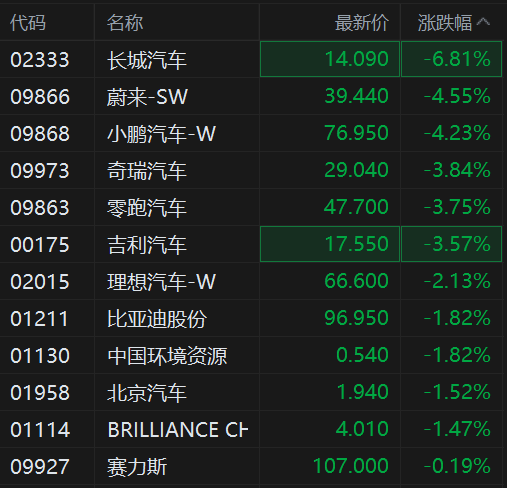
港股异动丨汽车集体走低,长城汽车跌近7%,“蔚小理”齐跌
Ge Long Hui· 2026-01-05 02:39
Group 1 - The Hong Kong automotive stocks collectively declined, with Great Wall Motors falling nearly 7%, NIO and Xpeng down over 4.2%, and other companies like Chery, Leap Motor, and Geely dropping close to 4% [1] - A report from CICC indicates that by 2026, the domestic automotive industry in China will face certain challenges in internal demand, while overseas sales are expected to grow steadily. The investment strategy favors auto parts over complete vehicles, focusing on opportunities in AI-related sectors such as robotics, intelligent driving, and data center liquid cooling [1] - A separate report forecasts that global electric vehicle sales growth will reach its lowest level since the pandemic began in 2020, with an expected increase of only 13% to 24 million units by 2026, significantly lower than the 22% growth anticipated for 2025 due to a slowdown in the European market and a rapid decline in the U.S. market [1] Group 2 - The latest stock prices and changes for major automotive companies are as follows: Great Wall Motors at 14.090 (-6.81%), NIO at 39.440 (-4.55%), Xpeng at 76.950 (-4.23%), Chery at 29.040 (-3.84%), Leap Motor at 47.700 (-3.75%), Geely at 17.550 (-3.57%), Li Auto at 66.600 (-2.13%), BYD at 96.950 (-1.82%), and others showing minor declines [2]


申万宏源研究晨会报告-20260105
Shenwan Hongyuan Securities· 2026-01-05 01:24
Group 1: Nanshan Aluminum (南山铝业) - Nanshan Aluminum is positioned as a rare growth target in the electrolytic aluminum sector, with a focus on dividends and share buybacks, reflecting confidence in its growth potential [4][12] - The company is expected to achieve net profits of CNY 5.0 billion, CNY 5.46 billion, and CNY 5.84 billion for the years 2025, 2026, and 2027, respectively, corresponding to P/E ratios of 12x, 11x, and 10x [4][12] - The report anticipates a 15% upside potential based on a target P/E of 13x for 2026, indicating a favorable valuation compared to peer companies [4][12] - Key assumptions include increased alumina production from Indonesia, with projected sales volumes of 2.76 million tons in 2025, 4.36 million tons in 2026, and 4.56 million tons in 2027 [12] - The report highlights that domestic electrolytic aluminum capacity is nearing its peak, while global supply growth is slowing, suggesting a favorable supply-demand balance for the industry [12] Group 2: Hanhigh Group (悍高集团) - Hanhigh Group is expected to achieve revenues of CNY 3.595 billion, CNY 4.525 billion, and CNY 5.653 billion for 2025, 2026, and 2027, respectively, with net profits of CNY 706 million, CNY 942 million, and CNY 1.237 billion [4][15] - The company is rated as "Buy" based on its current valuation being below the average of comparable companies for 2026 [4][15] - Hanhigh Group's growth is driven by cost reduction and brand strength, with a CAGR of 29% in revenue and 59% in net profit from 2019 to 2024 [12][13] - The company focuses on product innovation and cost efficiency, leveraging its own production capacity to enhance profitability [12][13] Group 3: Market Overview and Investment Strategy - The report identifies a favorable market environment for the spring season, with expectations of continued upward momentum in the stock market due to improved economic indicators and liquidity [22] - The "Top Ten Gold Stocks" for January 2026 include companies like Hualu Hengsheng, Lingyi Zhi Zao, and Alibaba, indicating a diversified investment strategy across sectors [14][22] - The automotive industry is highlighted for its recovery potential, particularly with the introduction of new subsidies and the expected improvement in demand for mid-range vehicles [24]
帝国理工VLA综述:从世界模型到VLA,如何重构自动驾驶(T-ITS)
自动驾驶之心· 2026-01-05 00:35
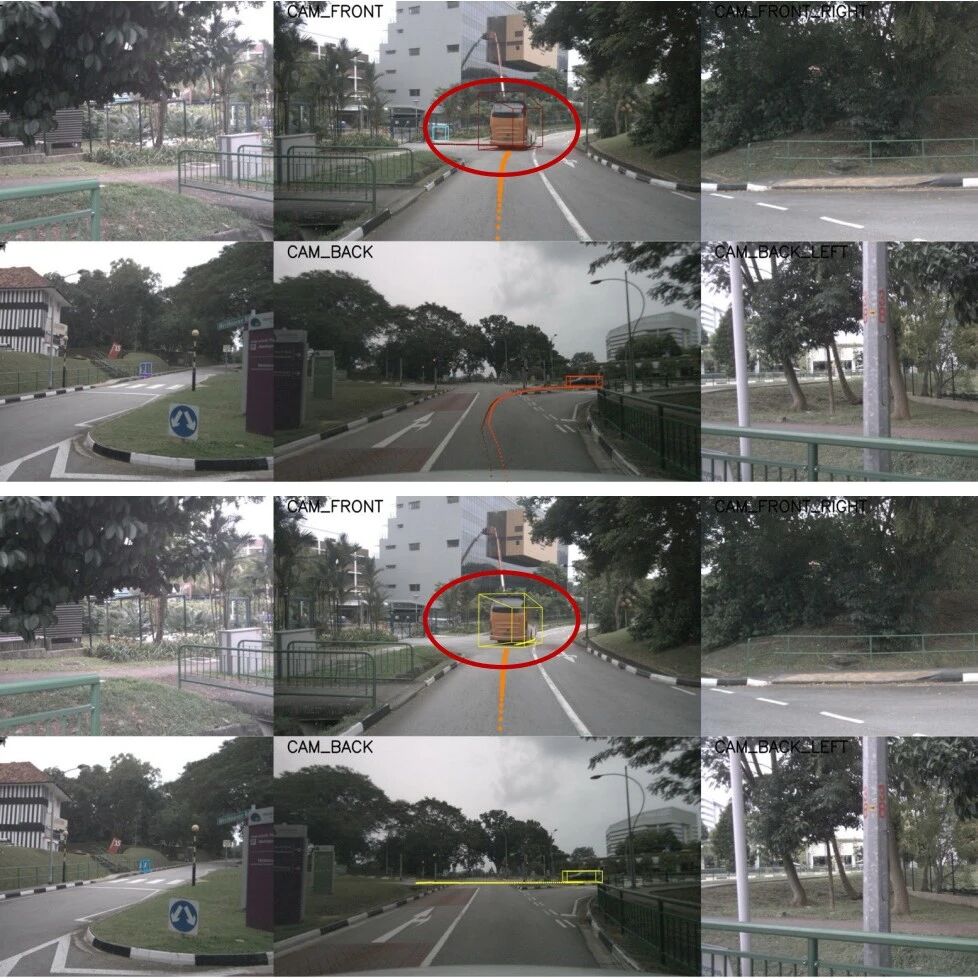
Core Insights - The article discusses the transition of autonomous driving technology from "perception-planning" to an end-to-end Vision-Language-Action (VLA) paradigm, highlighting the significance of world models and generative simulation in this evolution [2][3]. Group 1: Technological Evolution - The review article from Imperial College London systematically analyzes 77 cutting-edge papers up to September 2025, focusing on three main dimensions: end-to-end VLA, world models, and modular integration, providing a comprehensive learning roadmap for developers [2]. - The emergence of VLA signifies a shift from simple multi-modal fusion to a collaborative reasoning flow between vision and language, directly outputting planning trajectories [10]. - The article emphasizes the importance of world models in leveraging generative AI to address corner cases in autonomous driving [6]. Group 2: Modular Integration - Despite the popularity of end-to-end architectures, modular solutions are experiencing a resurgence, demonstrating the potential of large models in traditional perception stacks, such as semantic anomaly detection and long-tail object recognition [7]. - The review highlights models like Talk2BEV and ChatBEV that utilize Vision-Language Models (VLM) for enhanced perception capabilities [7]. Group 3: Challenges and Solutions - The article identifies three major challenges facing VLM deployment in autonomous vehicles: reasoning latency, hallucinations, and computational trade-offs [9][13]. - Solutions discussed include visual token compression, chain-of-thought pruning, and optimization strategies for NVIDIA OrinX chips to address latency issues [12]. - To mitigate hallucination problems, techniques like "hallucination subspace projection" and rule-based safety filters are proposed [15]. Group 4: Future Directions - The review outlines four unresolved challenges in the field: standardized evaluation, edge deployment, multi-modal alignment, and legal and ethical considerations [17]. - It emphasizes the need for a unified scoring system for VLA safety and hallucination rates, as well as the importance of ensuring semantic consistency across different modalities in complex scenarios [17]. Group 5: Resource Compilation - The paper includes nine detailed classification tables and a review of key datasets and simulation platforms, such as NuScenes-QA and CARLA, to support community research and highlight the transition from open-loop metrics to closed-loop evaluations [14][16].
比亚迪年度销量首超特斯拉,后者2025年交付量下滑近9%
Xin Lang Ke Ji· 2026-01-05 00:32
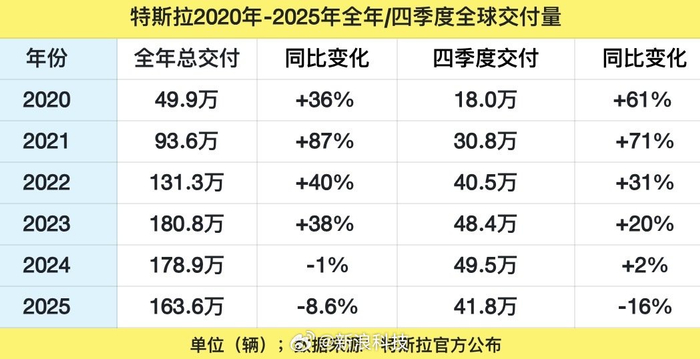
【#比亚迪年度销量首超特斯拉##特斯拉2025年交付量下滑近9%#】当地时间1月2日,特斯拉公布其 2025年第四季度及全年汽车交付数据。数据显示,特斯拉2025年交付量为163.6万辆。同期,比亚迪的 纯电动汽车销量已达到225.67万辆。比亚迪在年度销量上首次超越特斯拉,意味着特斯拉失去长期占据 的"全球纯电动车销量冠军"宝座。 据《每日经济新闻》记者观察,特斯拉2025年四季度和全年的销量均出现大幅下滑。2025年第四季度, 特斯拉交付量较2024年同期减少约16%,产量较2024年同期下降5.5%。就2025年全年来看,特斯拉的交 付量由2024年的178.9万辆下降8.6%至163.6万辆。 虽然特斯拉此次没有发布区域销量,但数据显示,除了美国,特斯拉在欧洲的销量同样有所放缓。据欧 洲汽车制造商协会(ACEA)发布的数据,2025年前11个月,特斯拉在欧洲的注册量下降了39%,而其 竞争对手比亚迪在欧洲的注册量则增长了240%。 自2014年进入中国市场以来,特斯拉经历了从快速崛起到面临激烈竞争的完整周期。数据显示,最初三 年,特斯拉累计交付2.12万辆汽车;2017年,其单年销量即达到此前总和,此 ...


小米汽车41万辆收官+首次盈利,雷军立55万Flag,四款新车轰炸增程市场
3 6 Ke· 2026-01-04 23:58
Core Insights - Xiaomi's CEO Lei Jun openly addressed controversies during the New Year live stream, emphasizing transparency and accountability in marketing practices [1][4] - In 2025, Xiaomi's automotive division exceeded its delivery target, achieving 410,000 units against an initial goal of 300,000, showcasing strong market performance despite skepticism [3][4] - The company plans to invest 200 billion yuan (approximately 28.5 billion USD) over the next five years in R&D, focusing on core technologies and generative AI to enhance vehicle performance and user experience [5][9] Delivery and Sales Performance - Xiaomi's automotive division adjusted its delivery target from 300,000 to 350,000 units mid-year, ultimately delivering 410,000 units [3] - The Xiaomi SU7 was the best-selling car in the 200,000 yuan and above segment, while the newly launched YU7 contributed significantly with over 150,000 units delivered [3][4] - The Q3 financial report indicated that Xiaomi's smart electric vehicles and AI innovations achieved profitability for the first time in a single quarter [3] R&D Investment and Strategic Focus - The planned 200 billion yuan investment will average 40 billion yuan annually, targeting advancements in battery technology, electric drive, and smart driving [5][9] - Generative AI will be integrated into all business operations to enhance user interaction and overall smart experience [5][9] - The automotive industry is increasingly relying on AI for efficiency and competitiveness, with companies like Geely and Seres demonstrating significant improvements through AI integration [8][9] Upcoming Product Launches - Xiaomi plans to launch four new vehicles in 2026, including an updated SU7 and two range-extended SUVs, aiming to capture the high-end family market [13][19] - The new models are expected to enhance user experience with features like increased cabin space and advanced technology [16][19] - The introduction of these vehicles aligns with Xiaomi's strategy to leverage its ecosystem and supply chain advantages [21] Production Capacity and Market Strategy - Xiaomi's combined production capacity is projected to reach 300,000 units annually, with potential to increase to 450,000 units through double-shift operations [25] - The company is preparing to enter the competitive large SUV market, targeting established players like Li Auto and Aion [25][26] - Xiaomi's strategy emphasizes understanding consumer needs and delivering value, which is crucial for competing in the high-end market [21][25] Future Outlook - The next five years will be critical for Xiaomi as it aims to solidify its position in the domestic market while preparing for international expansion by 2027 [27][28] - The company's ability to meet its ambitious delivery targets will be essential for building brand reputation and product strength ahead of global market entry [27][28]


【光大研究每日速递】20260105
光大证券研究· 2026-01-04 23:04
Group 1 - The A-share market experienced a steady upward trend in December, with major indices showing increased trading volume and a gradual recovery in market sentiment, indicating a shift from trading factors to fundamental factors dominating the market [4] - The total outstanding credit bonds in China reached 31.29 trillion yuan by the end of December 2025, with a net financing of 176.67 billion yuan for the month, despite a 17.19% month-on-month decline in issuance [4] - The new public fund sales regulations released by the China Securities Regulatory Commission on December 31, 2025, are expected to impact bank wealth management asset allocation behaviors, with public funds held amounting to 1.34 trillion yuan as of Q3 2025 [5] Group 2 - The Hong Kong insurance sector is anticipated to benefit from a strong "opening red" performance, driven by favorable sales in January and a positive investment return outlook due to a stable equity market [6] - The direct and indirect exports of steel, copper, and aluminum are projected to account for 24%, 17%, and 21% of domestic production in 2024, with expectations of improved export conditions in 2026 due to easing US-China trade tensions [6] - The annual long-term electricity price in Guangdong for 2026 is expected to reflect current operating costs of thermal power, with average profitability estimated at 0.02 yuan per kilowatt-hour based on average coal prices from 2025 [7] Group 3 - Tesla's Q4 2025 deliveries fell short of expectations, while NIO regained the top position among new energy vehicle manufacturers in December, with the continuation of the trade-in subsidy policy likely to boost sales in 2026 [8]

车企去年销量“成绩单”出炉:目标完成度分化明显
Zheng Quan Ri Bao· 2026-01-04 16:59
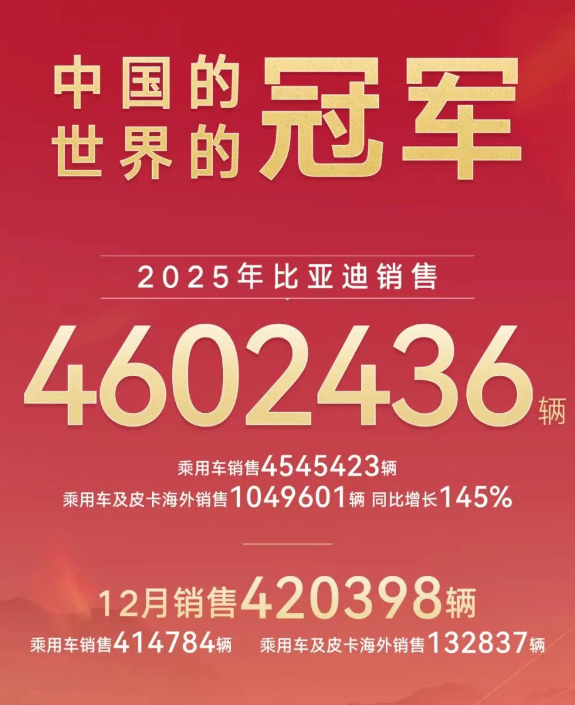
本报记者 刘钊 新年伊始,汽车行业2025年度销量数据陆续揭晓。 具体来看,比亚迪全年纯电动汽车销量首次超越特斯拉,成为全球第一。与此同时,吉利汽车、长安汽车、奇瑞汽车等传 统汽车集团在"新能源+出海"双主线下加速追赶,新势力车企则呈现"强者恒强、分化加剧"的竞争格局。 多维布局谋增长 从年度销量排行看,头部车企的位次变化首先来自"规模差距"的再度拉大。 其中,比亚迪2025年新能源汽车销量为460.24万辆,同比增长7.73%,其中纯电车型全年累计销量为225.67万辆,同比增长 27.86%。以纯电口径衡量,比亚迪已在年度销量上超过特斯拉,后者全年交付约164万辆。 这一"新旧王者"的更替,意味着全球纯电市场的竞争焦点正从单一明星车型驱动,转向以成本、供应链与产品矩阵为核心 的体系化竞争。比亚迪的成功背后,是其"双轮驱动+全链布局"战略的支撑。在产品结构上,比亚迪坚持"纯电+插混"并行策 略,DM-i系列纯电续航超125km,冬季续航达成率为86%,解决了消费者的里程焦虑。在技术层面,比亚迪凭借垂直整合的全 产业链优势,实现了较好的成本控制,再叠加刀片电池的安全优势,形成了核心竞争力。 整体来看,2025 ...
车企2025年产销量放榜 突破多个“里程碑”
Zheng Quan Shi Bao Wang· 2026-01-04 14:38
Core Insights - Major automotive companies in China, including BYD, Changan Automobile, and Geely, reported significant sales growth for 2025, with a notable increase in overseas sales and milestones achieved by new energy vehicle manufacturers [1][2][5][7]. BYD - BYD's total sales for 2025 reached 4.6024 million units, a year-on-year increase of 7.73%, with pure electric vehicle sales growing nearly 28% and commercial vehicle sales increasing by approximately 162% [2]. - BYD's overseas exports of new energy vehicles totaled 133,200 units in December 2025, with annual overseas sales surpassing 1 million units, reflecting a 145% year-on-year growth [4]. - The total installed capacity of BYD's power batteries and energy storage batteries was approximately 285.634 GWh, marking a nearly 47% increase from the previous year [4]. Changan Automobile - Changan's total sales for 2025 reached 2.913 million units, a year-on-year growth of 8.54%, with self-owned brand sales increasing by 10.86% and new energy vehicle sales growing by about 50% [5]. BAIC Blue Valley - BAIC Blue Valley achieved significant production and sales growth, with total production reaching 206,300 units, a year-on-year increase of 127.17%, and total sales of 209,600 units, up 84.06% [6]. Geely Automobile - Geely's total vehicle sales for 2025 were 3.0246 million units, a 39% increase compared to the previous year, exceeding its annual sales target [7]. - Geely set a sales target of 3.45 million units for 2026, representing a growth of approximately 14% from 2025, with a new energy vehicle sales target of 2.22 million units, up 32% [7]. NIO - NIO reported a delivery of 48,100 units in December 2025, a year-on-year increase of 54.6%, with total deliveries for the year reaching 326,000 units, up 46.9% [8]. Li Auto - Li Auto delivered 44,200 new vehicles in December 2025, with a historical cumulative delivery surpassing 1.5 million units, expanding its market presence in Central Asia and Africa [9]. XPeng - XPeng delivered 37,500 smart electric vehicles in December 2025, with total annual deliveries of 429,400 units, reflecting a year-on-year growth of 126% [10]. - The company expanded its overseas market presence with 45,000 units delivered abroad, a 96% increase, and established 1,100 new charging stations, bringing the total to 3,000 [10].