极氪

Search documents
杀进最卷赛道的沃尔沃,没把新势力放眼里
3 6 Ke· 2025-05-08 03:37
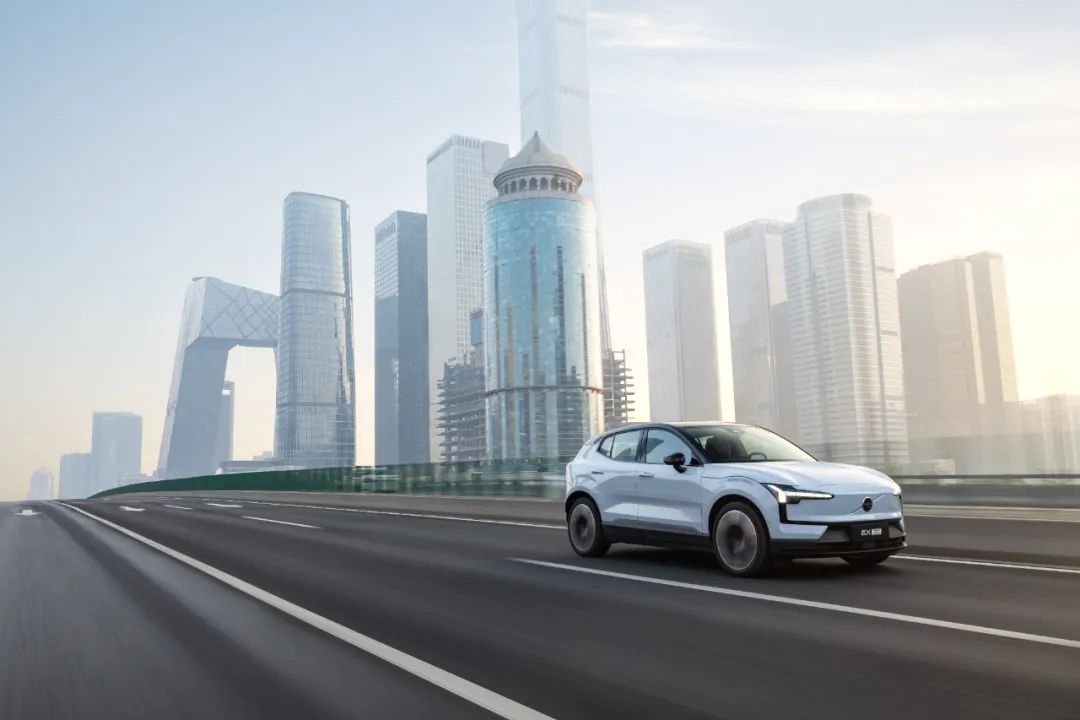
Core Insights - Volvo aims to expand its market share in the luxury plug-in hybrid (PHEV) segment, where it currently holds a 40% share, by launching the new XC70 based on the SMA super hybrid architecture [1][15] - The overall penetration rate of traditional luxury brand electric vehicles in China is below 7%, significantly lower than the overall market rate of 47.6%, indicating a gap that Volvo seeks to exploit [2][4] - In 2024, Volvo's global sales reached 763,400 units, with 46% being electric vehicles, highlighting its position as a leading player in the luxury electric vehicle market [2][4] Market Opportunity - The Chinese automotive market is projected to exceed 30 million units in production and sales in 2024, with new energy vehicles (NEVs) surpassing 12 million units, making China a global leader in the NEV sector [2] - The sales growth rate for plug-in hybrid vehicles in China is expected to reach 87% in 2024, while pure electric vehicle sales are projected to grow by only 28%, indicating a shift in consumer preference towards PHEVs [11][13] - The luxury PHEV market is relatively underserved, providing an opportunity for Volvo to capture a larger share by offering competitive products that meet consumer demands [6][15] Product Strategy - The new XC70 will feature a pure electric range of over 200 km and will be Volvo's longest-range plug-in hybrid to date, catering to both two-wheel and four-wheel drive needs [8][9] - Volvo plans to launch seven new models in 2025, including three updated fuel vehicles and two pure electric models, alongside the XC70, which will be a key part of its strategy to achieve full electrification in China [9][10] - The SMA platform is designed to integrate the latest electric vehicle technologies and optimized internal combustion engine technologies, positioning Volvo's offerings as superior to current luxury brand PHEVs [9][10] Competitive Landscape - The PHEV market is becoming increasingly crowded, with traditional and new automakers alike recognizing the potential of this segment, which was previously viewed as a transitional technology [10][13] - Major competitors, including traditional luxury brands and new entrants, are also planning to introduce PHEV models, intensifying competition in the market [13][15] - Volvo's strategy focuses on retaining traditional luxury vehicle customers by offering PHEVs that align with their expectations for luxury and performance [15]

吉利整合,剑指新能源霸主
Huan Qiu Wang· 2025-05-08 02:55
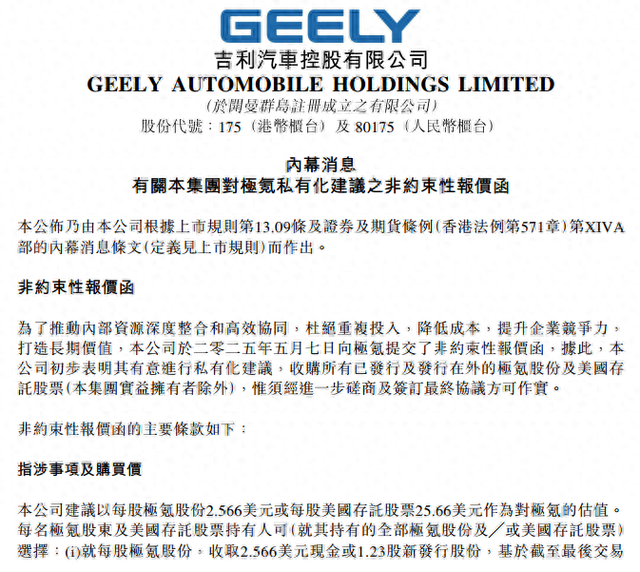
来源:环球网 【环球网消费综合报道】吉利汽车(00175.HK)5月7日宣布,计划收购极氪(ZK.NYSE) 已发行全部股 份,建议购买价为每股极氪股份2.566美元或每股美国存托股票25.66美元。目前,吉利汽车持有极氪约 65.7%的股份;如交易完成,极氪将成为吉利汽车的全资附属公司,并从纽交所退市。消息一出,吉利 汽车盘后股价、极氪盘前股价出现上涨,后者一度大涨超10%。 对于私有化极氪的考量,吉利汽车在公告中解释称,此举是进一步落实吉利控股集团2024年9月推出的 新战略《台州宣言》,聚焦汽车主业,提升资源利用效率,深化品牌协同的重要步骤,将强化吉利汽车 在智能新能源汽车领域的全球竞争力。记者就私有化事项向吉利控股集团和极氪方面了解相关情况。双 方均表示,目前暂无更多信息透露。 2024年,中国贡献了世界新能源乘用车市场95%的增量,英国、巴西、美国、印尼贡献了剩余5%的增 量。可见中国车市是世界新能源汽车领域竞争的核心阵地,机遇与挑战并存。 根据吉利官方公布的数据,2024年,吉利控股集团累计销量达到333.65万辆,其中新能源汽车销量约为 148.80万辆,占比达到45%。今年一季度,其累计销售新 ...

中泰国际:“一行一会一会”举办国新办发布会的政策支撑下,港股大幅高开,政策公布后体现“消息兑现”的获利
ZHONGTAI INTERNATIONAL SECURITIES· 2025-05-08 02:39
Market Overview - On May 7, the Hang Seng Index opened significantly higher due to policy support from the "One Bank, One Commission, One Bureau" press conference, reaching a peak of 23,197 points before closing at 22,691 points, a slight increase of 30 points or 0.1%[1] - The Hang Seng Tech Index fell by 0.8%, closing at 5,200 points, with total market turnover exceeding HKD 240.1 billion and a net outflow of HKD 7.87 billion from the Stock Connect[1] Sector Performance - Major state-owned enterprises in banking, insurance, and telecommunications supported the market, with four major banks rising between 0.4% and 2.0%[1] - AIA (1299 HK) saw its stock price increase by 2.9% over four consecutive trading days following the release of Q1 operational data[1] - REITs like Link REIT (823 HK) and Prosperity REIT (778 HK) rose by 6.7% and 2.7%, respectively, after the announcement of including REITs in the Shanghai-Hong Kong Stock Connect[1] Policy Impacts - The People's Bank of China announced a 0.25 percentage point reduction in the personal housing provident fund loan rate, lowering the five-year first home loan rate from 2.85% to 2.6%[3] - The China Securities Regulatory Commission emphasized enhancing the role of the National Social Security Fund to stabilize the market, indicating a proactive approach to financial regulation[2] Real Estate Market Dynamics - New home transaction volume in 30 major cities reached 149 million square meters, a year-on-year increase of 42.2%, indicating a rebound in the real estate market[9] - The inventory-to-sales ratio for major cities was 98.4, higher than last year but lower than the previous week, suggesting a tightening market[11] Automotive Sector Insights - Li Auto (2015 HK) reported sales of 11,400 vehicles for the week ending May 4, up from 8,600 the previous week, indicating strong demand ahead of the launch of new models[4] - Geely Auto (175 HK) proposed a privatization offer for Zeekr (ZK US) at a 20% premium to its 30-day average price, which is expected to positively impact Geely's stock price[4]
未知机构:极氪私有化点评一个吉利完成关键步骤自2024年9月台州宣-20250508
未知机构· 2025-05-08 02:20
Summary of Conference Call Records Company and Industry Involved - The records focus on Geely Group and its subsidiary, Zeekr, within the automotive industry, particularly in the electric vehicle (EV) sector. Core Points and Arguments 1. **Strategic Integration Post-Announcement** Since the release of the "Taizhou Declaration" in September 2024, Geely Group has focused on "strategic integration and core business focus," completing significant measures such as brand and product line integration, smart driving technology and R&D system integration, and optimization of supply chain and procurement systems. The privatization of Zeekr is seen as a step to deepen the implementation of the "Taizhou Declaration" to better compete in the passenger car market [1][1][1]. 2. **Strengthening Competitive Position** Geely possesses strong manufacturing, R&D, and supply chain advantages. The "Taizhou Declaration" is expected to maximize these advantages, thereby providing greater assurance for Geely's market share [1][1][1]. 3. **Financial Implications of Privatization** The privatization of Zeekr is anticipated to avoid redundant investments and reduce internal brand positioning and resource allocation issues due to overlapping price segments. The clearer organizational structure is expected to enhance trust in the capital market. However, Geely may face some short-term financial pressure, as it holds approximately 65.7% of Zeekr shares, requiring a payment of about $2.566 per share, totaling approximately $2.24 billion (around 16.2 billion RMB). The company's cash and equivalents at the end of 2024 are projected to be 40.87 billion RMB, indicating that the financial pressure remains manageable [2][2][2]. 4. **Focus on Core Business Post-Privatization** Privatization is expected to help Zeekr distance itself from market noise and focus on cutting-edge technology. Previous market concerns regarding Zeekr's product positioning and resource allocation within the group have led to stock price volatility. Post-privatization, Zeekr is anticipated to concentrate on its core business and solidify its position as a leader in high-end smart electric vehicles [3][3][3]. Other Important but Potentially Overlooked Content - The strategic moves by Geely are part of a broader effort to enhance its competitive edge in the rapidly evolving EV market, which is characterized by intense competition and technological advancements. The emphasis on integrating various aspects of the business suggests a long-term vision for sustainable growth and market leadership.
新能源汽车的商场门店时代:繁华将尽还是方兴未艾?
3 6 Ke· 2025-05-08 02:07
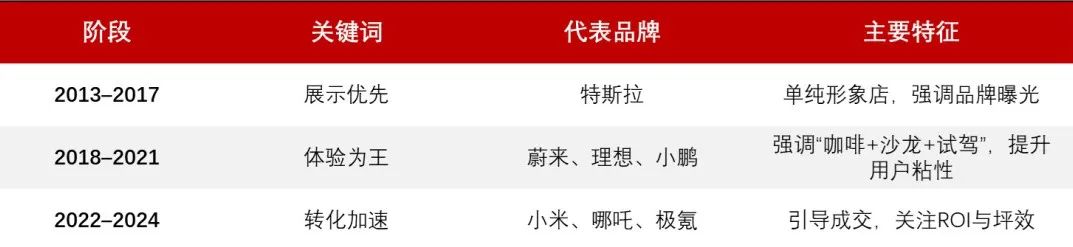
Core Insights - The article discusses the evolution of the relationship between new energy vehicles (NEVs) and shopping malls, highlighting the shift from traditional 4S dealerships to mall-based showrooms, driven by changes in consumer experience and retail models [1][2][3]. Group 1: Historical Context and Evolution - The entry of NEVs into shopping centers represents a significant shift in consumer engagement, transforming malls into venues for automotive experiences rather than just retail spaces [2]. - NEV brands have strategically abandoned traditional dealership models in favor of mall locations to enhance customer experience, improve service quality, and increase brand visibility [3][4]. Group 2: Store Model and Performance - NEV showrooms in malls have evolved into complex spaces that combine display, interaction, and light sales, moving through stages of brand exposure, user experience, and sales conversion [4][5]. - As of the end of 2024, over 2,500 NEV stores are present in shopping centers, with leading brands like NIO, Xpeng, and Li Auto dominating the market [5][6]. Group 3: Economic Impact and Value Proposition - NEVs have demonstrated superior "坪效" (sales per square meter) compared to traditional retail, with some brands achieving sales figures that exceed those of high-end jewelry and fashion [6][15]. - The rental model for NEV stores often includes a combination of base rent and sales commissions, allowing for a more flexible and mutually beneficial relationship with shopping centers [11][17]. Group 4: Challenges and Future Outlook - Despite their initial success, NEV brands face challenges such as market saturation, increased competition for prime mall space, and the need to maintain customer engagement in a crowded environment [20][21]. - The relationship between NEVs and shopping centers is evolving, with a focus on creating content-driven experiences and integrating data systems to enhance operational efficiency and customer engagement [28][34].


科技风向标丨小米汽车深夜致歉;谷歌股价逆势大跌7.51%;人形机器人运动会要来了
2 1 Shi Ji Jing Ji Bao Dao· 2025-05-08 02:06
Group 1: Technology Sector Developments - Google's stock price fell by 7.51% to $152.8 per share, attributed to a decline in Safari's search volume as users shift towards AI search engines [2] - Uber is set to invest an additional $100 million in WeRide, marking its largest investment in the autonomous driving sector to date [4] - Mistral AI launched a new model, Mistral Medium 3, which performs at or above 90% of Claude Sonnet 3.7's benchmarks at a lower cost [4] Group 2: Automotive Industry Updates - Xiaomi Auto issued an apology regarding the SU7 Ultra's horsepower limitations and the carbon fiber hood, acknowledging user confusion and promising updates [3] - Li Auto's CEO commented on Tesla's Full Self-Driving (FSD) capabilities, noting significant gaps in performance compared to Tesla's latest models [5] - Geely announced a non-binding offer to privatize Zeekr, aiming to enhance resource efficiency and brand synergy [13] Group 3: Market Trends and Financial Insights - 33 Chinese companies made it to the global mobile game publisher revenue list for April, collectively earning $2 billion, which accounts for 38.4% of the total revenue [7] - Nvidia's CEO highlighted the potential $50 billion market for AI in China over the next two to three years, emphasizing the importance of serving this market [9] - BVI Storage expects over 500% year-on-year growth in revenue from AI glasses by 2025, driven by partnerships with major brands like Meta [9] Group 4: Corporate Financing and IPOs - Bluecore Technology completed a C+ round financing led by Kunpeng Fund, with plans to invest in 3D vision sensors and humanoid robot AI technology [11] - Torrens Precision Manufacturing has initiated its IPO process, aiming to list on the ChiNext board [12] - Silizhen Chip Technology secured several million yuan in financing to advance quantum computing chip development [12]

今日份热点大集合,快进来吃瓜!
Sou Hu Cai Jing· 2025-05-08 01:12
Group 1: Corporate Responses and Market Dynamics - Li Auto clarified that the reported salary of 639 million yuan for CEO Li Xiang primarily consists of stock-based compensation, with the actual salary being only 2.66 million yuan [1] - Moutai Cultural Tourism officially announced Zhang Yixing as its spokesperson, indicating a strategic move to target the younger market [3] - The People's Bank of China announced a 0.5 percentage point reduction in the reserve requirement ratio and lowered the housing provident fund loan interest rate, benefiting homebuyers [3] Group 2: Major Corporate Events - Harman International, a subsidiary of Samsung, acquired Masimo's audio business for 350 million USD, signaling a strong intent to expand in the audio market [4] - Nayuki Tea has rebranded with a new logo and name, reportedly in preparation for entering the European and American markets [4] - Geely proposed to privatize Zeekr, leading to a more than 10% increase in Zeekr's pre-market stock price [4] Group 3: Technological Innovations - Google released the Gemini 2.5 Pro "I/O" model, achieving the top position in AI rankings, showcasing its technological prowess [4] - Lenovo introduced "Super Intelligent Agent" technology, indicating advancements in smart living solutions [4] - Baidu announced a patent for animal language translation, hinting at future possibilities for communication with pets [4] Group 4: Investment and Financing Highlights - Pet food retail brand "Pet Fresh" completed a 25 million USD angel round financing, reflecting the ongoing growth in the pet economy [4] - Yujing Technology secured several million yuan in Series A financing, focusing on BeiDou satellite navigation technology, indicating promising future prospects [4] Group 5: Earnings Reports Overview - Uber reported a 14% increase in revenue for the first quarter, with net profit turning positive, marking a significant achievement [4] - Disney's second-quarter revenue also grew by 7%, reinforcing its status as an entertainment giant [4] - Novo Nordisk's first-quarter performance was strong, with its star product, semaglutide, contributing significantly to revenue [4]

4 月中国电动车卖爆了!90 万辆、33% 增长、51% 渗透率…麦格理推荐关注这些股票
Zhi Tong Cai Jing· 2025-05-08 01:02
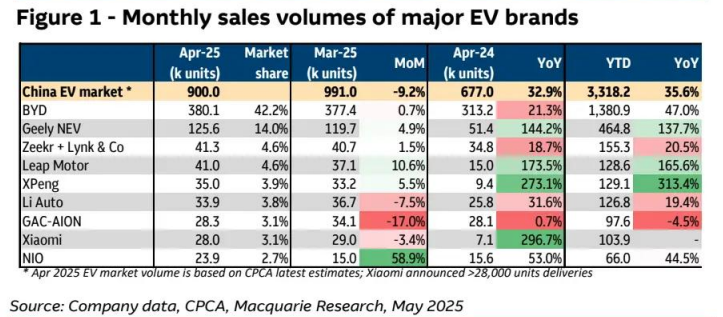
Core Insights - Macquarie updated its report on China's electric vehicle (EV) sales, predicting that the mass market will continue to outperform the high-end market in May [1] Industry Overview - In April, plug-in electric vehicle sales reached 900,000 units, a year-on-year increase of 33%, while the overall automotive market grew by 14%; the EV penetration rate remained at 51% [1] - The low-cost new energy vehicle startups (Xpeng, Leap Motor) maintained growth momentum, while high-end electric vehicles lagged behind [1] - BYD showed strong export performance, but demand for plug-in hybrid electric vehicles (PHEVs) is slowing [1] Company Performance - **BYD**: Sales increased by 21% year-on-year, driven by a record export volume of 79,000 units, with a year-to-date increase of 105%. Domestic sales grew by 11% year-on-year, lagging behind market performance due to slowing PHEV demand [3] - **Geely**: April sales remained flat month-on-month, but year-to-date sales increased by 49%, exceeding the company's annual growth target of 25%. April new energy vehicle sales reached 126,000 units, a significant year-on-year increase of 144% [4] - **Xpeng**: April sales exceeded 30,000 units, with a year-to-date increase of 313%, reflecting strong demand for popular models M03, P7t, and the refreshed G6 and G9 [5] - **Li Auto**: Sales decreased by 8% month-on-month, with a year-to-date increase of only 20%, falling behind the 36% growth rate of the new energy vehicle market [6] - **NIO**: Sales rebounded by 59% month-on-month, with brand sales increasing by 90% to 19,500 units, benefiting from increased promotions and the launch of the ET9 model [7] - **Zeekr**: Total sales for Zeekr and Lynk & Co increased by 19% year-on-year, slightly lagging behind the overall new energy vehicle market [8] - **Xiaomi**: Demand for the SU7 sports sedan remained strong, with April sales exceeding 28,000 units, reaching maximum production capacity [9] Sales Data Summary - In April 2025, the total EV market in China was 900,000 units, a decrease of 9.2% from March 2025, but a year-on-year increase of 32.9% [10] - BYD accounted for 42.2% of the market share with 380,100 units sold, a year-on-year increase of 21.3% [10] - Geely's new energy vehicle sales reached 125,600 units, a year-on-year increase of 144.2% [10] - Xpeng sold 35,000 units, reflecting a year-on-year increase of 273.1% [10] - Li Auto's sales were 33,900 units, with a year-on-year increase of 31.6% [10] - Xiaomi's sales were 28,000 units, a year-on-year increase of 296.7% [10]

极氪:上市不到一年,“纯电黑马” 为何选择私有化退市?
海豚投研· 2025-05-08 00:58
Core Viewpoint - Geely Auto has submitted a privatization proposal for Zeekr, aiming to acquire the remaining 34.4% of shares to make Zeekr a wholly-owned subsidiary and delist it from the NYSE, with a proposed purchase price of $25.66 per share, representing a 13.6% premium over the last closing price of $22.6 [1][2][18]. Summary by Sections Acquisition Details - Geely currently holds approximately 65.7% of Zeekr's equity and plans to buy the remaining shares from minority shareholders [1]. - The acquisition price of $25.66 per share is a significant premium compared to Zeekr's recent trading price [1]. - Shareholders have the option to receive cash or exchange their shares for Geely stock at a ratio of 12.3 shares of Geely for each Zeekr ADS [1][2]. Reasons for Privatization - Zeekr's valuation is perceived to be significantly lower than that of other new energy vehicle companies, with a P/S ratio of 0.9 compared to competitors like Xiaopeng at 1.5 [3][5]. - The market has consistently undervalued Zeekr, leading to the decision for privatization as a means to address this issue [5]. - Zeekr's reliance on Geely for resources and production has resulted in a high debt-to-asset ratio, which is unattractive to investors [6][8]. Financial Implications - The total acquisition cost is estimated at $2.24 billion, which could exert cash flow pressure on Geely, as it represents 37% of its cash flow as of the end of 2024 [18]. - Geely plans to finance the privatization through a combination of new stock issuance, cash reserves, and debt financing if necessary [2][18]. Strategic Considerations - Geely aims to enhance internal resource integration and operational efficiency post-privatization, addressing internal conflicts and improving competitiveness [17]. - The merger with Lynk & Co. has not gone as planned, with ongoing production of fuel vehicles potentially confusing the brand's positioning in the electric vehicle market [10][16]. - Zeekr's declining sales and competitive position in the market have raised concerns about its future viability, necessitating a strategic overhaul [12][15].
特朗普将取消全球芯片限制;极氪宣布私有化退市,李书福回应:回归一个吉利;曝华为智能辅助驾驶继续下探,杀入20万内丨雷峰早报
雷峰网· 2025-05-08 00:58
Group 1 - Zeekr announces privatization and delisting, with Geely proposing to acquire all outstanding shares at $2.57 per share, representing a 13.6% premium over the last trading price [2] - Geely's chairman Li Shufu emphasizes the need for integration and innovation in the automotive sector to create long-term value and maintain communication with international capital markets [4] Group 2 - Baidu's CEO Li Yanhong expresses confidence in the company's ability to adapt to new technologies and competition, viewing it as a positive force for market maturity [6] Group 3 - Xiaohongshu partners with Alibaba to allow merchants to embed product links directly in posts, enhancing the shopping experience and integrating advertising [10][11] Group 4 - Huawei plans to introduce a new SUV model under Baojun brand featuring its advanced driving assistance system, targeting a price range of 150,000 to 250,000 yuan [12] Group 5 - Xiaomi apologizes for changes in the SU7 Ultra model's performance unlock conditions and clarifies the functionality of its carbon fiber hood, acknowledging communication shortcomings [14][15] Group 6 - Jiuxian AIR, a new vehicle from Jiuxian Automotive, is launched with prices starting at 147,800 yuan, featuring a design inspired by commercial aircraft and advanced operating systems [20] Group 7 - Uber plans to invest an additional $100 million in autonomous driving company WeRide, marking its largest investment in this sector to date [23] Group 8 - OpenAI reportedly plans to reduce revenue sharing with Microsoft to below 10% by 2030, indicating a significant shift in its financial strategy [27]