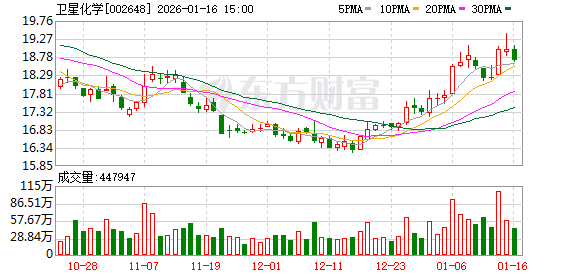
卫星化学

Search documents
再论2026年化工行业投资机会
2026-01-19 02:29
Summary of Key Points from the Conference Call Industry Overview - The chemical industry is expected to recover to standard or even overweight allocation levels due to improved industry sentiment and performance indicators such as revenue, profit, and gross margin starting from Q2 2025 [1][3][4]. Core Insights and Arguments - **Current State of Chemical Sector**: The basic chemical and petrochemical sectors are currently under-allocated, although there has been a recent uptick. Historical data suggests that these sectors typically outperform the market in the first two quarters following the initiation of a five-year plan [3][4]. - **Impact of European Capacity Closures**: Europe has closed approximately 11 million tons of chemical production capacity since 2023, alleviating supply-demand pressures in both domestic and international markets [1][6]. - **Investment in Infrastructure**: The State Grid's planned investment of 4 trillion RMB over the next five years is expected to drive demand in related chemical sectors [1][6]. Subsector Highlights - **Refrigerants**: The refrigerant sector is anticipated to maintain high levels of profitability due to the ongoing implementation of quota schemes. Prices are expected to stabilize at high levels, with shorter procurement cycles for downstream air conditioning manufacturers [1][5]. - **Phosphate Chemicals**: Phosphate rock prices remain stable, supported by unexpected demand in energy storage. Recent price increases in glyphosate and other pesticide varieties indicate a positive outlook for this sector [1][7]. Oil Price Projections - Oil prices are projected to stabilize between $55 and $60 per barrel in 2026, with potential geopolitical factors causing temporary spikes. The overall sentiment regarding oil prices remains optimistic, which is crucial for the petrochemical sector [2][11]. Potential Investment Opportunities - **High-Performing Sectors**: The refrigerant and phosphate chemical sectors are highlighted as areas of sustained high sentiment and favorable market expectations for investment in 2026 [1][5][17]. - **Recovery Potential**: Sectors currently experiencing low sentiment, such as refining and polyester, organic silicon, and PVC, may see a rebound due to limited new capacity and price elasticity [17][12]. - **Traditional Chemical Stocks**: Companies with reasonable or undervalued valuations, such as Wanhua Chemical and Huayu Chemical, may present opportunities for valuation recovery if industry sentiment improves [13][17]. Emerging Trends - **New Materials**: The new materials sector is expected to see continuous demand growth driven by applications in robotics, aerospace, and biofuels. Key areas include electronic chemicals and lightweight materials [14][18]. - **AI and Semiconductor Growth**: The development of AI applications and semiconductor chips is anticipated to drive sustained demand growth in the coming years [15]. Conclusion - The chemical industry is poised for recovery, with specific subsectors like refrigerants and phosphates showing strong potential. Investment strategies should focus on both high-performing sectors and those with recovery potential, while keeping an eye on emerging trends in new materials and technology applications [1][17].
国际油价小幅上涨,丁二烯、环氧丙烷价格上涨 | 投研报告
Sou Hu Cai Jing· 2026-01-19 01:41
Core Viewpoint - The report highlights the current trends in the chemical industry, focusing on price movements, supply-demand dynamics, and investment opportunities in undervalued leading companies amid a backdrop of strong downstream demand and geopolitical tensions [1][3][7]. Industry Dynamics - In the week of January 12-18, 49 out of 100 tracked chemical products saw price increases, while 20 experienced declines, and 31 remained stable. The average price of 49% of products rose month-on-month, while 39% fell [2]. - The average price of WTI crude oil futures increased by 0.54% to $59.44 per barrel, and Brent crude oil futures rose by 0.66% to $63.76 per barrel during the same week [3]. - As of January 9, U.S. crude oil production averaged 13.753 million barrels per day, a decrease of 58,000 barrels from the previous week but an increase of 2.72 million barrels compared to the same period last year [3]. Price Movements - The price of butadiene rose to 9,663 yuan per ton, up 4.04% week-on-week and 25.98% month-on-month, although it is down 20.8% year-on-year [4]. - Epoxy propane prices increased to 8,620 yuan per ton, reflecting an 8.84% rise week-on-week and a 9.88% increase year-on-year [5][6]. Investment Recommendations - As of January 18, the price-to-earnings (P/E) ratio for the basic chemical sector is 14.68, while the oil and petrochemical sector stands at 13.44, indicating potential investment opportunities in undervalued leading companies [7]. - The report suggests focusing on sectors benefiting from strong downstream demand, including electronic materials and certain new energy materials companies, as well as companies that are well-positioned amid supply-side reforms [7]. - Recommended stocks include Wanhua Chemical, Hualu Hengsheng, and others, with a focus on companies in emerging fields such as semiconductor materials and OLED materials [7][8].
南华期货丙烯产业周报:PDH检修增加-20260118
Nan Hua Qi Huo· 2026-01-18 13:27
1. Report Industry Investment Rating - Not provided in the document. 2. Core Views of the Report - The core contradictions affecting the propylene trend include cost support with receding geopolitical sentiment, improved supply - demand situation of downstream PP but still with pressure, and expected supply contraction due to increased PDH maintenance. The propylene 03 contract is expected to fluctuate in the range of 5,800 - 6,200 yuan/ton in the short term [2][3]. - In the near - term, the propylene futures price increase is influenced by cost and supply - demand factors. Overseas propane remains strong, PDH maintenance increases, and the fundamentals of downstream PP improve marginally. In the long - term, there are expectations of propylene capacity expansion, PP over - supply pressure, and cost pressure from increased supply of crude oil and LPG [5][9]. 3. Summary by Relevant Contents 3.1 Core Contradictions and Strategy Recommendations 3.1.1 Core Contradictions - Cost support: Geopolitical disputes after the festival brought risk premiums to crude oil and supported propane prices. Iran exported an average of 960,000 tons of LPG per month in 2025, with about 80% going to China. Although the geopolitical situation cooled down at the end of the week, the impact still remains [2]. - Supply - demand of downstream PP: The PP operating rate this week was 75.62%, slightly down from the previous high of nearly 80%. Spot trading improved marginally, but overall, supply - demand pressure still exists [2]. - Supply contraction: Nationally, the supply - demand gap was still loose, but in the Shandong market, the gap narrowed due to maintenance at Jinneng and Wanhua, leading to a stronger spot price. With continuous PDH losses, more maintenance is expected, and attention should be paid to potential load - reduction of cracking units due to naphtha consumption tax issues [3]. 3.1.2 Trading Strategy Recommendations - **Market positioning**: The market is expected to fluctuate and rise. The price range for PL03 is 5,800 - 6,200 yuan/ton. The unilateral strategy is to buy at low prices, as it is affected by cost and supply - demand. PDH maintenance provides stronger support, but the price may correct with the decline of crude oil risk premiums [15]. - **Basis, calendar spread, and hedging arbitrage strategies**: The basis strategy is to expect the spread to widen. The spot price is strengthening due to supply - demand gap contraction, while the futures price may correct with the decline of geopolitical risks. For the PP - PL spread and PL/PG ratio, it is recommended to wait and see [16][17]. 3.1.3 Industrial Customer Operation Suggestions - For inventory management, if the finished product inventory is high, enterprises can short - sell propylene futures at high prices to lock in profits and sell call options to reduce costs. For procurement management, if the inventory is low, enterprises can buy propylene futures at low prices to lock in procurement costs and sell put options to reduce costs [18]. 3.2 This Week's Important Information and Next Week's Events to Watch 3.2.1 This Week's Important Information - **Positive information**: Tensions in Iran and low PG shipments from the Middle East supported CP prices. Poor PDH profits led to increased maintenance of PDH units this week [19]. - **Negative information**: The long - term trading theme in the crude oil market may be oversupply, and the suspension of US military action against Iran led to a decline in risk premiums [20]. 3.2.2 Next Week's Events to Watch - January 19: China's Q4 GDP; January 20: China's LPR; January 22: US PCE index [21]. 3.3 Futures Market Interpretation 3.3.1 Price, Volume, and Fund Analysis - The PL03 contract fluctuated and rose this week. The net positions of major profitable seats increased, with no significant changes in the top 5 long and short positions in the dragon - tiger list. Foreign investors slightly reduced their net long positions, and retail investors slightly increased their net long positions. Technically, it shows an upward trend but may face short - term correction pressure [23]. 3.3.2 Basis and Calendar Spread Structure - The propylene 03 basis was 95 yuan/ton this week, with the spot price rising steadily and the futures price fluctuating. The 02 - 03 calendar spread was - 97 yuan/ton, compared with - 7 yuan/ton last week. The 03 contract had a larger increase, and the calendar spread showed a reverse arbitrage trend [26]. 3.4 Valuation and Profit Analysis 3.4.1 Upstream Profits - The gross profit of major refineries this week was 762 yuan/ton (+85), and the gross profit of Shandong local refineries was 280 yuan/ton (-89). The cracking end declined slightly, and Fujian Refining had a short - term shutdown [28]. 3.4.2 Mid - stream Profits - Propane cracking profit fluctuated at a low level, and LPG cracking was less economical than naphtha. The PDH profit based on FEI was 88 yuan/ton, and the PDH profit based on CP was - 218 yuan/ton [30]. 3.4.3 Downstream Profits - The spread between PP raffia and propylene was 305 yuan/ton, and the spread between PP powder and propylene was 285 yuan/ton, both slightly narrowing. Epoxy propane chlorohydrin method profit was 323 yuan/ton. Acrylonitrile had a large loss of - 2,362 yuan/ton. Acrylic acid profit was - 415 yuan/ton, and its profit was weakening. Butanol and octanol had profits, while phenol - acetone had a loss of - 1,026 yuan/ton [33]. 3.4.4 Import and Export Profits - The Sino - Korean propylene spread remained stable recently, with CFR China at 785 US dollars (+35) [46]. 3.5 Supply - Demand and Inventory Forecast 3.5.1 Shandong Market Supply - Demand Balance Sheet Forecast - In the Shandong market this week, supply decreased and demand increased. The supply - demand gap narrowed due to maintenance at Jinneng and Wanhua [50]. 3.5.2 Market Supply and Forecast - Due to maintenance of some units this week, propylene production was 1.2315 million tons (-10,500 tons), and the operating rate was 75.23% (-0.72%). PDH, MTO, and steam cracking units all had maintenance situations [53]. 3.5.3 Demand and Forecast - **PP**: The spread between PP pellets/powder and propylene slightly rebounded, and the pellet operating rate slightly decreased. Some PP units had maintenance or production - switching, and the operating rate continued to decline, but the spread has returned to the normal range [65][70]. - **Epoxy propane**: The overall load of epoxy propane slightly decreased but remained at a high level, with some enterprises having short - term shutdowns or load - reduction [71]. - **Acrylonitrile**: There were no significant changes this week [73]. - **Butanol and octanol**: The butanol operating rate increased by 4% due to increased loads at some enterprises. The 450,000 - ton unit of Bohua Yongli is expected to start trial production in February, and Shandong Jianlan is operating normally with a 70,000 - ton unit at a low load [79][81]. - **Acrylic acid**: The acrylic acid capacity utilization rate decreased but remained at a high level, and there was a divergence between production and profit [82]. - **Phenol - acetone**: Some enterprises increased their loads, while Wanhua decreased its load [84]. - **Shandong regional demand**: Demand in the Shandong region increased this week, mainly due to the resumption and increased loads of PP, PO, acrylonitrile, and octanol [85].

国泰君安期货能源化工合成橡胶周度报告-20260118
Guo Tai Jun An Qi Huo· 2026-01-18 08:12
1. Report Investment Rating - No investment rating information is provided in the report. 2. Core Viewpoints - The synthetic rubber market is expected to remain in a high - level volatile range in the short term. The price is supported by cost, and the downside space is limited [2][4][5]. - The upward trend of butadiene prices is expected to slow down. Although the short - term absolute price is relatively low, which stimulates downstream replenishment and the prices in Asia and Europe are relatively strong, the spot market trading is weakening [6]. 3. Summary by Directory 3.1 Synthetic Rubber 3.1.1 Supply - During the cycle, the high - cis butadiene rubber plants of Maoming Petrochemical and Dushanzi Petrochemical continued to shut down, while the load of some butadiene rubber plants increased. The production capacity utilization rate remained at an absolute high level. The production of high - cis butadiene rubber in this cycle was 32,000 tons, a week - on - week increase of 0.68% [5]. - The domestic butadiene rubber plants are expected to have limited changes in the next cycle [5]. 3.1.2 Demand - In terms of rigid demand, the output of tire enterprises increased week - on - week as the production of overhauled enterprises stabilized. The capacity utilization rate of semi - steel tire sample enterprises increased due to increased foreign trade orders, while the capacity utilization rate of all - steel tire enterprises was restricted by inventory control [5]. - In terms of substitution demand, the price difference between NR - BR main contracts is gradually narrowing, and the substitution demand remains high, so the overall demand of butadiene rubber maintains a high year - on - year growth rate [5]. 3.1.3 Inventory - As of January 14, 2026, the domestic butadiene rubber inventory was 34,900 tons, a week - on - week increase of 5.50%. Both sample production enterprises' inventory and sample trading enterprises' inventory increased to varying degrees [5]. 3.1.4 Valuation - The current static valuation range of butadiene rubber futures fundamentals is 11,600 - 12,100 yuan/ton. The valuation logic has shifted from cost - side support to NR - BR price difference support [5]. 3.1.5 Strategy - Unilateral trading: The price will fluctuate at a high level, with the upper pressure at 12,000 - 12,100 yuan/ton (dynamically rising following the spot price of butadiene rubber), and the lower support at 11,500 - 11,600 yuan/ton (supported by NR - BR price difference and butadiene cost) [5]. - Cross - variety trading: The price difference between NR - BR is gradually narrowing [5]. 3.2 Butadiene 3.2.1 Supply - The estimated weekly production of Chinese butadiene industry sample enterprises in the current cycle (January 9 - 15, 2026) was 110,500 tons, a week - on - week decrease of 2.70%. It is expected to increase slightly to about 113,000 tons next week [6]. - Butadiene production capacity is in a continuous expansion state to match the expansion of downstream industries, and the expansion speed is slightly faster than that of downstream industries in stages [13][15]. 3.2.2 Demand - In the medium term, the operating rates of butadiene rubber and styrene - butadiene rubber remain high, and the demand for butadiene maintains a high year - on - year level. In the short term, the rigid demand for butadiene from synthetic rubber is expected to remain high [8]. - ABS has large inventory pressure, and the demand for butadiene is expected to remain constant with limited incremental demand [8]. - The operating rate of SBS has increased slightly, and the demand for butadiene remains at the rigid demand level with little change [8]. 3.2.3 Inventory - In the current cycle (January 8 - 14, 2026), the domestic butadiene inventory increased slightly, with the total sample inventory increasing by 1.93% week - on - week. The sample enterprise inventory decreased by 6.05% week - on - week, while the sample port inventory increased by 7.99% week - on - week [8]. 3.2.4 Viewpoint - Short - term low absolute prices drive downstream phased replenishment, and the trading situation has improved. Overall, butadiene remains relatively strong in the short term, but the upward trend is expected to slow down due to the weakening of spot market trading [6].
BZ、EB周报:短期EB高位震荡-20260118
Guo Tai Jun An Qi Huo· 2026-01-18 07:45
1. Report Industry Investment Rating - Not provided in the content 2. Core Viewpoints of the Report - Short - term EB will experience high - level fluctuations. There is a situation of weak pure benzene and strong styrene, with the price difference remaining at a high level. The short - term styrene export has continuously exceeded expectations, and the downstream restocking cycle has begun, leading to a rapid market rebound, which will mainly be in a high - level oscillation in the short term [3][68]. 3. Summary by Relevant Catalogs Supply Pure benzene domestic supply - In December, 110,000 tons of pure benzene production capacity were under maintenance, and the maintenance in January remained at 110,000 tons (assuming a reduction of 45,000 tons due to the maintenance of Zhejiang Petrochemical). Major plants with large - scale maintenance include Sinochem Quanzhou, LIDONG, and Zhejiang Petrochemical. Some Shandong local refineries will increase their production loads after solving quota issues to make up for part of the production losses. Attention should be paid to the new pure benzene output brought by the new production of BASF Zhanjiang in January [3][68]. Pure benzene import supply - Although the overseas inventory pressure is still high, the overall import volume has decreased. The average monthly import volume of pure benzene from January to March 2026 is about 430,000 tons. The US - South Korea tariff still exists, but the US - Asia aromatics logistics may continue after the Spring Festival, which is estimated to affect 30,000 - 40,000 tons of pure benzene per month [3][68]. Demand Styrene demand - In December, 85,000 tons of styrene production capacity were under maintenance, and in January, 65,000 tons were under maintenance. After December, the plant operation gradually recovered. Attention should be paid to the incremental output brought by the operation of Shandong Guoen Chemical's plant. The demand for the downstream 3S of styrene exceeded expectations. After the market rose rapidly last week, downstream factories entered the restocking cycle, and home appliance factories are preparing for the post - Spring Festival boom, stimulating the restocking process of the industrial chain [3][68]. Caprolactam demand - The negative feedback of CPL has begun, and factories are gradually reducing their loads. It is estimated that 40,000 tons of production capacity were under maintenance in December, and 60,000 tons will be under maintenance in January, mainly at Fujian Yongrong, Tianchen, Hualu Hengsheng, and Xuyang Cangzhou. Attention should be paid to the commissioning of the Hengyi Qinzhou project in December and the expansion of Shaanxi Yangmei in January. Also, pay attention to whether the recent profit recovery of caprolactam will lead to the early restart of the plants [3][68]. Phenol demand - The operation rate of phenol is gradually rising. In December, 30,000 tons of production capacity were under maintenance, and in January, 10,000 tons were under maintenance. The commissioning of the new Shandong Ruilin plant may be postponed [3][68]. Aniline demand - In December, 70,000 tons of aniline production capacity were under maintenance, mainly at Ningbo Wanhua, Shanghai Covestro, and Chongqing BASF, with a maintenance loss of 77,000 tons. Some plants extended their maintenance plans, and the operation rate in January may be lower than expected [3][68]. Valuation - Absolute price valuation: Based on the crude oil price of $60 per barrel, the reasonable valuation of the BZ2603 contract is 5,300 - 5,500 yuan/ton. EB processing fee: The profit will expand in the short term [3][68]. Strategy - Unilateral: Pay attention to the opportunity of short - selling BZ on rallies. - Inter - period: Pay attention to the reverse spread of EB02 - 03. - Inter - variety: Take short - term profit in PX - BZ [3][68].
基础化工周报:万华宁波MDI二期装置复产,聚氨酯价格下滑-20260118
Soochow Securities· 2026-01-18 05:11
Report Summary 1. Report Industry Investment Rating No information provided in the content. 2. Core Viewpoints of the Report - This week, the average prices of pure MDI, polymerized MDI, and TDI in the polyurethane industry were 17,843 yuan/ton, 14,014 yuan/ton, and 14,188 yuan/ton respectively, with week - on - week decreases of 200 yuan/ton, 157 yuan/ton, and 290 yuan/ton. Their respective gross profits also declined [2]. - In the oil - gas - olefin sector, prices of raw materials such as ethane, propane, etc. had different changes this week. The average prices of polyethylene and polypropylene increased, and the theoretical profits of different production routes also changed accordingly [2]. - In the coal - chemical industry, the average prices of synthetic ammonia, urea, DMF, and acetic acid had slight fluctuations, and their gross profits also changed slightly [2]. - In the animal nutrition products sector, the average prices of VA, VE, solid methionine, and liquid methionine had minor changes this week [2]. 3. Summary by Relevant Catalogs 1. Basic Chemical Weekly Data Briefing - **Related Company Performance Tracking** - The Basic Chemical Index had a weekly increase of 0.9%, a monthly increase of 12.3%, a quarterly increase of 12.9%, an annual increase of 44.7%, and a year - to - date increase of 6.0% as of 2026/1/16. Different chemical companies had different performance in terms of stock price changes and earnings. For example, Wanhua Chemical's stock price decreased by 0.8% this week, while Baofeng Energy's increased by 5.2% [8]. - The report also provided data on the total market value, net profit attributable to the parent company, PE, and PB of relevant companies from 2024A to 2027E [8]. - **Industry Chain Data** - **Polyurethane Industry Chain**: The average prices and gross profits of pure MDI, polymerized MDI, and TDI decreased this week. Their respective seven - year quantiles were 51%, 45%, and 65% for prices, and 71%, 49%, and 71% for gross profits [8]. - **Oil - Gas - Olefin Industry Chain**: - **Raw Material Prices**: The average prices of ethane, propane, NYMEX natural gas, Brent crude oil, and naphtha had different changes. Their ten - year quantiles also varied [8]. - **Profit Comparison of Different Routes**: The single - ton profits of different production routes for polyethylene and polypropylene had different changes compared to the previous week, the beginning of the year, and the same period last year [8]. - **C2 and C3 Plates**: The average prices and price differences between products and raw materials in the C2 and C3 plates had different changes, with different ten - year quantiles. For example, the price of ethylene decreased by 90 yuan/ton, and the price difference between HDPE and ethylene increased by 353 yuan/ton [10]. - **Coal - Chemical Industry Chain**: - **Coal - Coke Products**: The average prices of coking coal and coke decreased, and the gross profit of coke was - 47 yuan/ton, with a 3 - yuan decrease [10]. - **Traditional Coal - Chemical Products**: The average prices and gross profits of synthetic ammonia, methanol, urea, DMF, and acetic acid had different changes, with different seven - year quantiles [10]. - **New Materials**: The average prices and gross profits of DMC, oxalic acid, octanol, adipic acid, caprolactam, PA6, and PA66 had different changes, with different seven - year quantiles [10]. - **Animal Nutrition Products Industry Chain**: The average prices of VA, VE, solid methionine, and liquid methionine changed slightly, with different ten - year quantiles [10]. 2. Basic Chemical Weekly Report - **2.1 Basic Chemical Index Trends**: The report did not provide specific content in the text, only the title. - **2.2 Polyurethane Sector**: The report presented the price trends of pure MDI, polymerized MDI, and TDI in China, as well as their price - spread situations [16][18][20]. - **2.3 Oil - Gas - Olefin Sector**: It showed the price trends of raw materials such as MB ethane, NYMEX natural gas, East China propane, Brent crude oil, domestic steam coal, and naphtha, and the profit situations of different production routes for polyethylene and polypropylene [24][27][29]. - **2.4 Coal - Chemical Sector**: The report presented the price trends and gross profit situations of coal - coke products, traditional coal - chemical products, and new materials in the coal - chemical industry [40][46][51]. - **2.5 Animal Nutrition Products Sector**: It showed the price trends of VA, VE, solid methionine, and liquid methionine [55][59][61].



卫星化学:POE等新材料项目正在稳步推进,符合公司预期
Mei Ri Jing Ji Xin Wen· 2026-01-17 07:14
Group 1 - The company aims to become a world-class chemical new materials technology company [2] - The POE and other new materials projects are progressing steadily and are in line with the company's expectations [2] - For specific details, the company refers to its regular announcements [2]

2025年1-11月中国初级形态的塑料产量为13509.8万吨 累计增长11.4%
Chan Ye Xin Xi Wang· 2026-01-15 03:35
Core Viewpoint - The report highlights the growth of China's primary plastic production, indicating a significant increase in output and suggesting a positive trend for the industry in the coming years [1]. Industry Summary - According to the National Bureau of Statistics, China's primary plastic production reached 12.96 million tons in November 2025, marking an 11.6% year-on-year increase [1]. - From January to November 2025, the cumulative production of primary plastics in China was 13.5098 million tons, reflecting a cumulative growth of 11.4% [1]. - The report from Zhiyan Consulting provides an in-depth analysis and investment scale forecast for the plastic products industry in China from 2026 to 2032 [1]. Company Summary - Listed companies in the plastic industry include Hengyi Petrochemical (000703), Rongsheng Petrochemical (002493), Shanghai Petrochemical (600688), Sinopec (600028), China National Petroleum (601857), Huajin Co. (000059), Tongkun Co. (601233), Hengli Petrochemical (600346), Satellite Chemical (002648), and ST Hongda (002002) [1].

化工周报:原油价格小幅上涨 中国石化与中国航油重组提升市场对SAF的关注
Xin Lang Cai Jing· 2026-01-15 00:27
Group 1 - Crude oil prices have seen a slight increase due to escalating geopolitical tensions in Venezuela and Iran, which have raised the geopolitical risk premium. OPEC+ has decided to temporarily halt its production growth plan for the first quarter of 2026, maintaining current production levels. This reflects OPEC+'s willingness to slow down production expansion since Q4 2025, aiming to alleviate market concerns about supply increases and keep oil prices at a reasonable level. As of January 11, WTI oil prices closed at $58.84 per barrel, and Brent oil prices at $63.02 per barrel, representing increases of 2.71% and 3.65% respectively from the previous week [1]. Group 2 - The restructuring of Sinopec and China National Aviation Fuel has heightened market attention towards Sustainable Aviation Fuel (SAF). Approved by the State Council on January 8, this merger allows Sinopec, the world's largest refining company and second-largest chemical company, to leverage its integrated refining and aviation fuel supply advantages, reducing intermediaries and lowering supply costs. This restructuring is expected to promote the application of SAF in China, creating a closed-loop for the entire industry chain of "production-certification-application," thereby driving rapid industry development [2]. Group 3 - The refining sector is expected to see a rebound due to stable oil prices influenced by geopolitical conflicts, OPEC+'s halt on production growth, and the upcoming demand peak. Companies to watch include Hengli Petrochemical, Satellite Chemical, Baofeng Energy, and Wanhua Chemical [3]. - Sustainable Aviation Fuel (SAF) is recognized as a renewable green energy source with significant future development potential, gaining increasing attention. Companies to monitor include Zhuoyue New Energy [3].

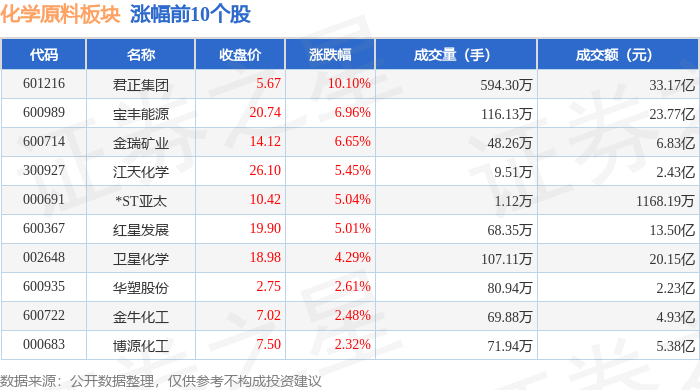
化学原料板块1月14日涨2.58%,君正集团领涨,主力资金净流入7.5亿元
Zheng Xing Xing Ye Ri Bao· 2026-01-14 08:44
Group 1 - The chemical raw materials sector increased by 2.58% on January 14, with Junzheng Group leading the gains [1] - The Shanghai Composite Index closed at 4126.09, down 0.31%, while the Shenzhen Component Index closed at 14248.6, up 0.56% [1] - Junzheng Group's stock price rose by 10.10% to 5.67, with a trading volume of 5.943 million shares [1] Group 2 - The main funds in the chemical raw materials sector saw a net inflow of 750 million yuan, while retail investors experienced a net outflow of 576 million yuan [2] - The trading data indicates that Junzheng Group had a net inflow of 825 million yuan from main funds, representing 24.89% of its trading volume [3] - Red Star Development also attracted significant main fund inflow of 93.98 million yuan, accounting for 6.96% of its trading volume [3]