古茗

Search documents
9.9元咖啡卷不动了?头部品牌“调价”,一杯到手涨2~5元
3 6 Ke· 2026-01-26 00:57
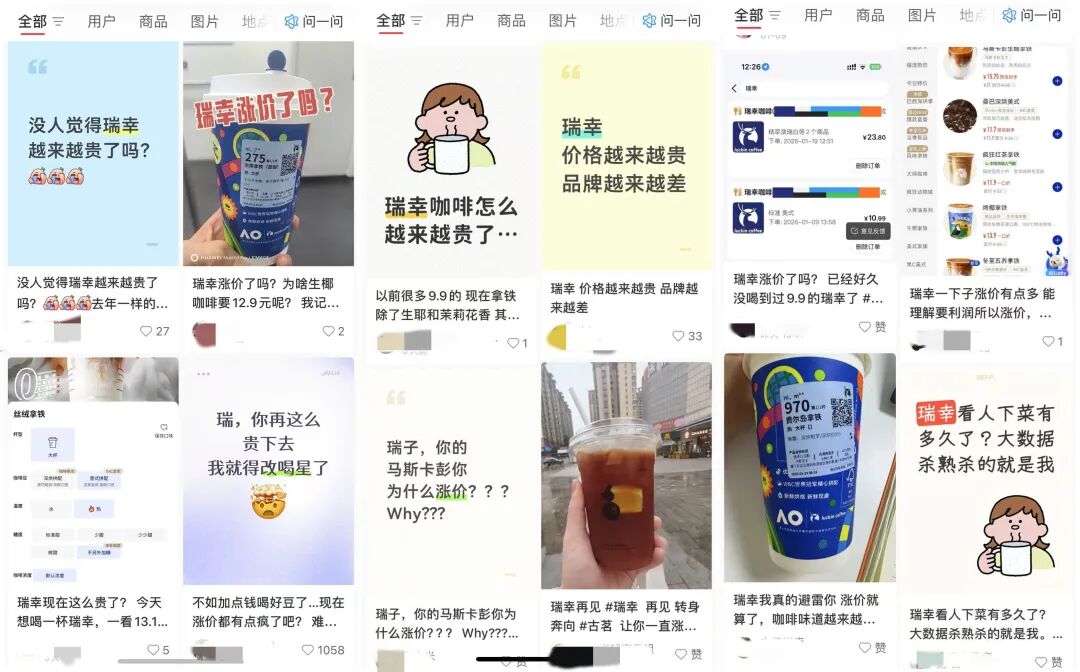
Core Insights - The era of 9.9 yuan coffee is fading, with prices for popular items rising to 12.9 yuan, 13.9 yuan, or even 15 yuan, leading to increased monthly coffee expenses for consumers [1][3] - The coffee market in China experienced significant adjustments in 2025, with a decline in low-price competition and an influx of new tea brands entering the market, reshaping the competitive landscape [1][9] Group 1: Price Changes and Market Dynamics - Major brands are reducing subsidies, leading to the gradual disappearance of the 9.9 yuan coffee, with discussions on social media reflecting consumer dissatisfaction with rising prices [1][3] - Luckin Coffee has raised prices for several milk coffee products by 1 yuan, while Kudi continues to offer all items at 9.9 yuan until the end of 2026 [5][6] - Starbucks has maintained stable prices but has slightly adjusted prices for some non-coffee beverages, while other mid-to-high-end brands like Manner and Tims have kept their prices steady in the 15-30 yuan range [6][8] Group 2: New Entrants and Consumer Perception - New tea brands are entering the coffee market with competitive pricing, significantly impacting consumer perceptions of coffee pricing, with some brands offering coffee as low as 4.9 yuan [9][19] - The entry of these new brands is reshaping consumer expectations, leading to a mindset where prices above 10 yuan are scrutinized, thus compressing the overall pricing space for coffee [19][21] - The competition is shifting from a price war to a more structured and differentiated approach, with brands needing to focus on quality, experience, and sustainable growth to succeed [21]


行业周报:锅圈开启“四店齐发”布局,茶饮龙头强者恒强-20260125
KAIYUAN SECURITIES· 2026-01-25 14:13
Investment Rating - The industry investment rating is maintained as "Positive" [5] Core Insights - The report highlights the strong performance of the tea beverage sector, with leading brands like Luckin Coffee and others expanding rapidly, while the supply in the tea segment is contracting [3][19] - The report notes the expansion of duty-free stores in second and third-tier cities, which is expected to boost high-end consumer spending [18] - The restaurant sector is experiencing a divergence in growth, with strong performance from tea and coffee brands, while traditional Chinese dining brands are also expanding [19][30] Summary by Sections Toy Industry - As of December 2025, the number of offline toy stores in China reached 9,689, with a net increase of 184 stores [12] - The average store efficiency for toy brands increased by 13% year-on-year in December 2025, with leading brands like Pop Mart showing a 47% increase [12][14] Duty-Free Industry - The new policy established 41 new duty-free stores in second and third-tier city airports and waterway ports, aimed at enhancing consumer spending [18] - The policy allows for participation from major operators, which is expected to benefit leading companies in the industry [18] Restaurant Industry - The tea beverage sector is seeing a contraction in supply, while coffee brands are accelerating their growth, with Luckin Coffee adding 7,922 stores in 2025 [19][26] - The average monthly store efficiency for the tea industry was 209,000 yuan, a 2.0% increase year-on-year, while coffee brands achieved an average of 286,000 yuan, up 2.4% [19][20] - The report emphasizes the success of the "community central kitchen" strategy by Guoquan, which has led to popular menu items selling out [3][19] Market Performance - The Hong Kong retail and consumer services sector outperformed the Hang Seng Index, with notable gains in the toy and gold categories [4] - The report recommends several stocks across various sectors, including tourism, education, and consumer services, indicating a positive outlook for these industries [4]
餐饮、潮玩及家电行业周报-20260125
Haitong Securities International· 2026-01-25 13:33
Investment Rating - The report assigns an "Outperform" rating to several companies, including Pop Mart, Anta Sports, Huazhu Group, Li Ning, Miniso, and others, with target prices ranging from 6.99 to 354.00 [1]. Core Insights - The report highlights the enhanced subsidized interest policy for personal consumption loans, which has been extended until the end of 2026, including support for credit card installment payments and the removal of certain limits on subsidy amounts [2]. - Pop Mart's new PUCKY series has gained significant popularity, being referred to as the "electronic wooden fish" due to its unique design and emotional stress-relief features [3]. - Weekly performance shows TCL Electronics (+24.8%), Pop Mart (+23.0%), and others leading the market, while companies like Ecovacs (-1.2%) and Haier Smart Home (-2.2%) lag behind [5][9]. Company Summaries - **Pop Mart**: Recently launched the PUCKY series, which quickly sold out and is now being resold at a premium on secondary markets [3]. The company also repurchased 1.9 million shares [7]. - **TCL Electronics**: Established a joint venture with Sony to take over Sony's home entertainment business, reflecting strategic growth initiatives [8]. - **Huazhu Group**: Engaged in strategic partnerships and is expected to benefit from the ongoing trends in the hospitality sector [4]. - **Li Ning**: Continues to perform well in the market, maintaining a positive outlook with an "Outperform" rating [1]. Industry Dynamics - The report notes significant strategic partnerships, such as Saint Bella's collaboration with Yunji Technology to explore AI and robotics in home care [15]. - The IPO of Busy Ming was oversubscribed by over 1,500 times, indicating strong market interest [10]. - Regulatory developments include the State Council's solicitation of opinions on national standards for pre-made dishes, which could impact the food and beverage sector [10].


【港股一周见】避险资产走强,市场关注FOMC与科技财报
Sou Hu Cai Jing· 2026-01-25 12:35
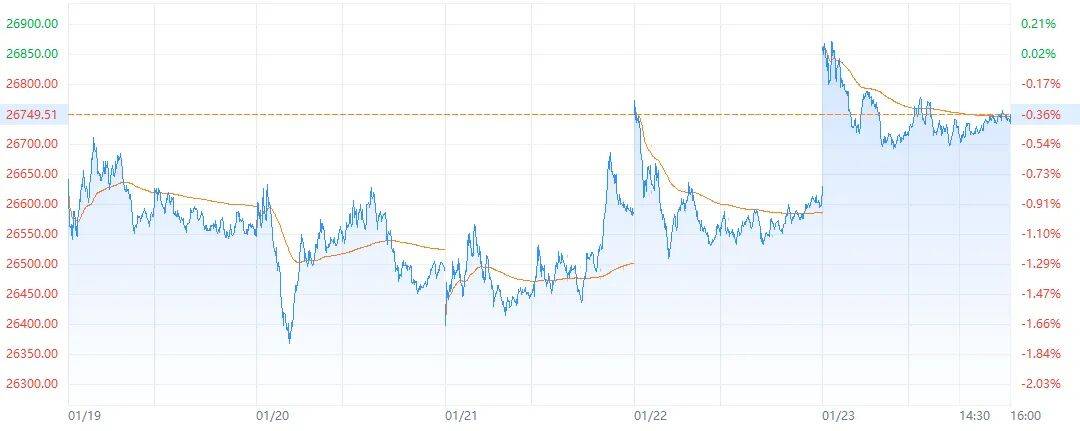
Market Overview - The Hong Kong stock market indices experienced a decline last week, with the Hang Seng Index closing at 26,749.51 points, down 0.36% for the week; the Hang Seng China Enterprises Index at 9,160.81 points, down 0.65%; and the Hang Seng Tech Index at 5,798.01 points, down 0.42% [1]. Capital Flow - In the past 5 days, the northbound trading of Hong Kong stocks saw an inflow of +164.91 billion, while in the past 20 days, the inflow was +359.08 billion. Over the last 60 days, the inflow reached +950.43 billion [3]. Sector Performance - The gold and precious metals sector saw a significant weekly increase of 9.14%, with Zijin Mining International rising by 23.98%, Chifeng Jilong Gold Mining by 23.68%, China Gold International by 15.18%, and Shandong Gold by 9.28% [4]. - The new consumption sector showed signs of recovery, with Pop Mart initiating a buyback and its stock rising by 22.96%. Other notable increases included Laopu Gold at 20.49%, Blukoo at 14.04%, and Guming at 10.32% [4]. External Influences - Recent U.S. economic data has shown resilience, with November PCE inflation data aligning with market expectations, indicating no significant rebound in inflation. Market focus has shifted towards the upcoming Federal Reserve meeting and the earnings reports of major tech companies, with particular attention on earnings guidance and sustainability of profits amid high valuations [4]. - In the precious metals market, initial concerns over tariffs from the U.S. on Europe led to a rise in safe-haven demand, pushing gold and silver prices to new highs. However, subsequent easing of tariff threats by the U.S. and discussions on restarting U.S.-EU trade agreements helped restore global market sentiment [5]. Technology Sector Insights - The Davos Forum has emphasized the long-term impacts of AI on the industry, with discussions on potential job structure changes and productivity enhancements. Countries like Japan and South Korea are planning significant investments in AI infrastructure, indicating a continued expansion phase in AI-related investments [6]. - Investors are shifting focus from growth narratives to cash flow and profit quality in the AI sector, with notable market divergence. The immediate trading focus remains on the Federal Reserve meeting and the performance of tech giants [6].
连锁茶饮行业研究:市场扩容持续,供应链铸就头部壁垒
SINOLINK SECURITIES· 2026-01-25 07:45
Investment Rating - The report assigns a "Buy" rating for the chain tea beverage industry, marking it as the first rating for this sector [1]. Core Insights - The market for ready-to-drink beverages is expected to grow significantly due to increased consumption frequency, with a projected market size of approximately 380 billion yuan by 2026, reflecting a year-on-year growth of 22.6% [2][18]. - The competitive landscape is being reshaped by supply chain advantages and product quality, leading to a consolidation of market share among leading brands [3][4]. Summary by Sections 1. Industry Growth in the Later Stage, Driven by Increased Consumption Frequency - The consumption frequency of ready-to-drink beverages is rising, driven by an expansion of consumption scenarios, including shopping, work, and leisure activities [11][14]. - The market size is projected to grow as the average annual consumption frequency is expected to maintain a compound annual growth rate (CAGR) of 22.4% from 2024 to 2026, with the market size reaching 380 billion yuan by 2026 [2][18][22]. - The total number of tea beverage stores is increasing, but the growth rate is slowing down, indicating a transition into the later stage of industry growth [24][27]. 2. Supply Chain and Product Power Reshape Competitive Landscape, Strengthening Leading Brands - Leading brands are experiencing steady growth in store numbers and operational efficiency due to their supply chain and product advantages, while smaller brands are being squeezed out due to insufficient supply chain capabilities [3][29]. - The market is becoming increasingly concentrated, with the share of stores held by brands with over 10,000 locations rising from 3% in early 2021 to 10.4% by late 2025 [29][30]. - The competitive dynamics vary by price segment, with high-end brands like Bawang Chaji consolidating their market position, while mid-range segments face intense competition [41][47]. 3. Scale Procurement and Efficient Distribution Create Cost and Quality Barriers - Leading brands leverage scale procurement to establish cost advantages and mitigate risks, while also ensuring product differentiation through deep integration with suppliers [3][38]. - Efficient distribution networks, including cold chain logistics, help maintain product freshness and further enhance cost advantages for leading brands [3][38]. 4. Key Company Analysis: Scale Effects and Store Optimization Drive Leading Brands - Miexue Ice City is expanding aggressively, with over 40,000 stores by 2025, maintaining a growth rate of over 20% [47][50]. - Guming is also showing robust growth, with a projected 13,000 stores by 2025, reflecting a 33% increase [31][36]. - Other brands like Chabaidao and Hushang Ayi are optimizing their store networks to improve efficiency and profitability [41][46].
食品饮料行业周度市场观察-20260125
Ai Rui Zi Xun· 2026-01-25 03:03
Investment Rating - The report does not explicitly provide an investment rating for the food and beverage industry Core Insights - The food and beverage industry is witnessing diverse trends such as the emergence of fresh food restaurants, smart products, and health management, indicating a shift towards quality consumption and lifestyle changes [2] - The 2025 consumption landscape in China is being reshaped by trends like the rise of night economy, health-oriented products, and the popularity of new Chinese-style beverages [4] - Local brands are gaining traction in the ready-to-drink coffee market, with significant sales growth driven by competitive pricing and innovative product offerings [4] Industry Environment - The pet economy is evolving, with a projected market size exceeding 300 billion yuan by 2024, driven by younger consumers seeking quality and diverse pet-related services [2] - The baking market in China has expanded to 365,000 stores, with a notable increase in health-conscious and visually appealing products, alongside a rise in pet baking [2] - The ready-to-drink coffee market is experiencing a transformation, with local brands like Nongfu Spring and Dongpeng gaining market share through affordable pricing and innovative flavors [4] - The new dietary guidelines in the U.S. emphasize protein and healthy fats while reducing sugar intake, reflecting a global trend towards healthier food options [5] - The rise of community bakeries is characterized by personalized service and community engagement, proving that small stores can compete effectively [7] - New Chinese-style health drinks are gaining popularity, with a market potential reaching billions, driven by the demand for convenient health solutions [8] - The condiment industry is seeing a split between leading brands and those struggling to keep up, with a focus on health-oriented product innovation [8] - The takeaway market is evolving into a competitive landscape, with platforms like Meituan and Alibaba expanding into instant retail [9] - The no-sugar beverage market in China is expected to double in size within five years, driven by increasing health awareness [14] - The rise of new health-oriented food products is appealing to younger consumers, with a focus on traditional ingredients and health benefits [15] Top Brand News - The acquisition of yogurt brand Suan Nai Kuan Kuan by Mo Yogurt reflects the ongoing consolidation in the ready-to-drink beverage sector [16] - Yili Group is actively engaging in capital operations, including debt repayment and establishing investment subsidiaries to seek growth opportunities [16] - Huablin Group is revitalizing its War Horse brand to compete with Dongpeng, launching new sugar-free products to cater to health-conscious consumers [17] - New retail formats combining supermarkets, markets, and restaurants are emerging in Shanghai, showcasing a shift in consumer preferences and supply chain integration [17] - The collaboration between Lynk & Co and Starbucks highlights innovative marketing strategies aimed at enhancing customer engagement [19] - Gu Ming has exceeded its expansion goals, planning to open 4,000 new stores in 2026, focusing on supply chain efficiency and product diversification [19]
新消费行业周报(2026.1.19-2026.1.23):泡泡玛特2.5亿港元回购;美丽田园25年业绩预告表现亮眼-20260124
Hua Yuan Zheng Quan· 2026-01-24 14:11
证券分析师 证券研究报告 商贸零售 行业定期报告 hyzqdatemark 2026 年 01 月 24 日 丁一 SAC:S1350524040003 dingyi@huayuanstock.com 板块表现: 泡泡玛特 2.5 亿港元回购;美丽田园 25 年业绩预告表现亮眼 投资评级: 看好(维持) ——新消费行业周报(2026.1.19-2026.1.23) 投资要点: 请务必仔细阅读正文之后的评级说明和重要声明 联系人 泡泡玛特 2.5 亿港元回购,彰显公司信心。公司近期公告回购 140w 股,合计耗资 2.5 亿+港元。公司低 位回购彰显公司经营信心。近期发布马年新品—马力全开搪胶毛绒,发布当日一分钟内多个平台均显示 "已售罄"。1 月官宣星星人新品系列怦然星动。泡泡玛特新品表现及品牌势能持续强劲。老 IP 持续运 营,新 IP 逐步发力,产品形态从盲盒、毛绒拓展至可动玩偶、饰品等,带动品牌影响力持续破圈。公司 作为中国潮玩行业的头部企业,具备 IP 玩具全产业链运营能力,公司通过出众的 IP 创造、运营能力及渠 道端多样的消费者触达能力持续高质量发展,且伴随公司海外业务逐步扩大、产品海外影响力不断 ...
蜜雪、瑞幸、茶颜都在推,“老人味”水果意外走红!
东京烘焙职业人· 2026-01-24 08:33
Core Viewpoint - The beverage industry is witnessing a surge in interest towards banana-based drinks, with major brands launching new products that highlight the fruit's versatility and appeal to a wide consumer base [6][10][24]. Group 1: Product Launches and Market Trends - Major brands like Mixue Ice City and Cha Yan Yue Se have recently introduced banana-flavored products, with Mixue launching three new banana drinks that quickly became top sellers in test stores [6][11][17]. - Other brands such as Luckin Coffee and 1点点 have also embraced banana in their offerings, indicating a broader trend across both tea and coffee sectors [19][22][24]. - The banana drink category is gaining traction, with products like banana lattes and banana milk gaining popularity due to their unique flavor profiles and nostalgic appeal [20][30]. Group 2: Consumer Appeal and Health Trends - Bananas are recognized for their high consumer acceptance and versatility, making them suitable for various beverage combinations, appealing to all age groups [28][30]. - The natural sweetness of bananas aligns with current health trends, allowing for reduced sugar content in drinks while still providing a satisfying flavor [35][41]. - The nutritional benefits of bananas, such as quick energy and satiety, enhance their appeal in meal replacement scenarios [35][37]. Group 3: Challenges and Industry Responses - Despite the growing popularity, banana beverages face challenges such as oxidation, flavor intensity, and quality control, which can affect consumer perception [42][43][46]. - The industry is exploring solutions like adding lemon juice to delay oxidation and using complementary flavors to balance sweetness [49][50]. - The stable supply chain and high recognition of bananas position them favorably in the beverage market, provided that brands can effectively address these challenges [51][52].

餐饮业持续回暖:2025年收入近5.8万亿,茶饮上市与“餐饮+”成亮点
第一财经· 2026-01-24 06:54
Core Viewpoint - The restaurant industry in China showed signs of recovery in 2025, with a total revenue of 57,982 billion yuan, reflecting a year-on-year growth of 3.2% and accounting for 11.6% of total retail sales of consumer goods, an increase of 0.2 percentage points from the previous year [3]. Group 1: Industry Performance - In 2022, the restaurant revenue was 43,941 billion yuan, experiencing a decline of 6.3%. The revenue rebounded to 52,890 billion yuan in 2023, marking a significant year-on-year growth of 20.4%. In 2024, the revenue reached 55,718 billion yuan, with a growth rate of 5.3% [3]. - The overall growth of the restaurant market in 2025 exhibited a pattern of "stable growth, structural optimization, and emerging highlights," with a noticeable trend of stabilization in the latter half of the year [3][4]. Group 2: Market Trends and Innovations - The year 2025 saw active performance in new business formats and categories, with a clear trend towards health and seasonality. Beverage sectors like tea and coffee accelerated innovation and capital investment, expanding towards health and integration [4]. - Restaurant companies launched seasonal products themed around "summer coolness" and "autumn and winter warmth," with hot pot and barbecue categories continuing to gain popularity amid consumer upgrades [4]. Group 3: Capital Market Activity - 2025 marked a concentrated period for restaurant industry listings, primarily on the Hong Kong stock market. Notable new tea brands such as Gu Ming and Mi Xue Group went public, followed by several other brands like Ba Wang Cha Ji and Green Tea Group [5]. - The China Cuisine Association noted that companies actively sought innovation and diversification through "restaurant+" models, enhancing product development, holiday marketing, and cultural integration [5]. Group 4: Future Outlook - The World Federation of Chinese Catering recently predicted trends in the restaurant industry, emphasizing the survival of small, specialized, and aesthetically pleasing establishments. Key characteristics of new consumption include fresh, traceable ingredients with fewer processing steps [5]. - There is an increasing demand for standardization, professionalism, technical skills, and innovation in the restaurant industry, alongside a diversification of consumption structures and greater use of automated kitchen equipment [5].
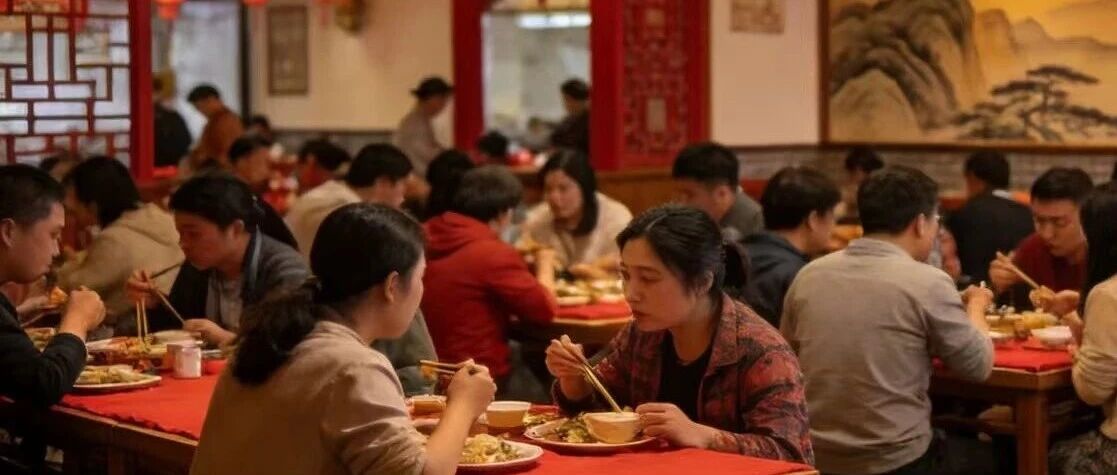
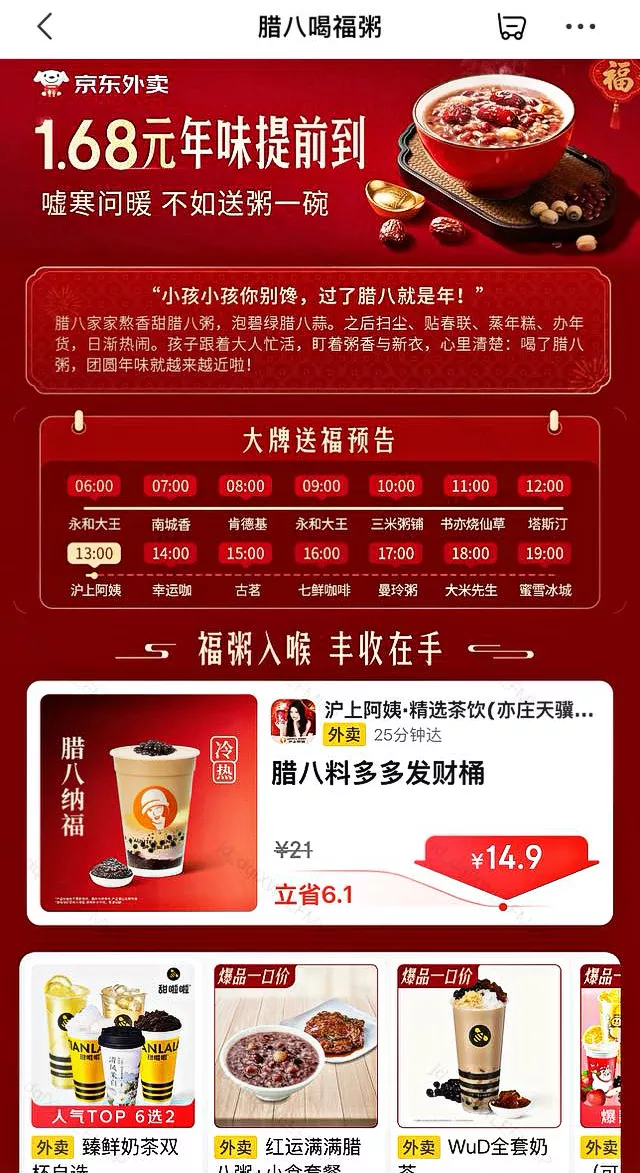
腊八喝好粥,上京东外卖:百款好粥1件免运,加热餐箱覆盖11城
Cai Jing Wang· 2026-01-24 05:56
Group 1 - The core idea of the news is the promotion of traditional Laba congee by JD.com, which aims to enhance consumer engagement during the Laba Festival by offering a variety of congee options at low prices and free delivery [1][4] - On Laba Festival, JD.com will collaborate with several well-known food brands to offer over a hundred types of congee, with prices starting as low as 1.68 yuan, and will provide free shipping for orders [1][2] - The promotion will cover various meal times throughout the day, including breakfast, lunch, afternoon tea, and dinner, ensuring that consumers can enjoy warm congee at any time [1][4] Group 2 - JD.com has introduced a heated meal box delivery service that will be available in multiple cities, ensuring that the congee remains warm upon delivery, with a temperature increase of 20°C compared to standard delivery boxes [4] - The service will initially cover cities such as Beijing, Shanghai, Urumqi, Harbin, and Nanchang, with plans to expand to 11 cities by the end of the month [4] - Consumers can place orders through the JD.com app's "秒送" channel, and there will be opportunities to win discount coupons for various services, enhancing the overall consumer experience [1][2][7]