霸王茶姬

Search documents
2025年中国餐饮品牌力白皮书
Sou Hu Cai Jing· 2026-01-19 15:43
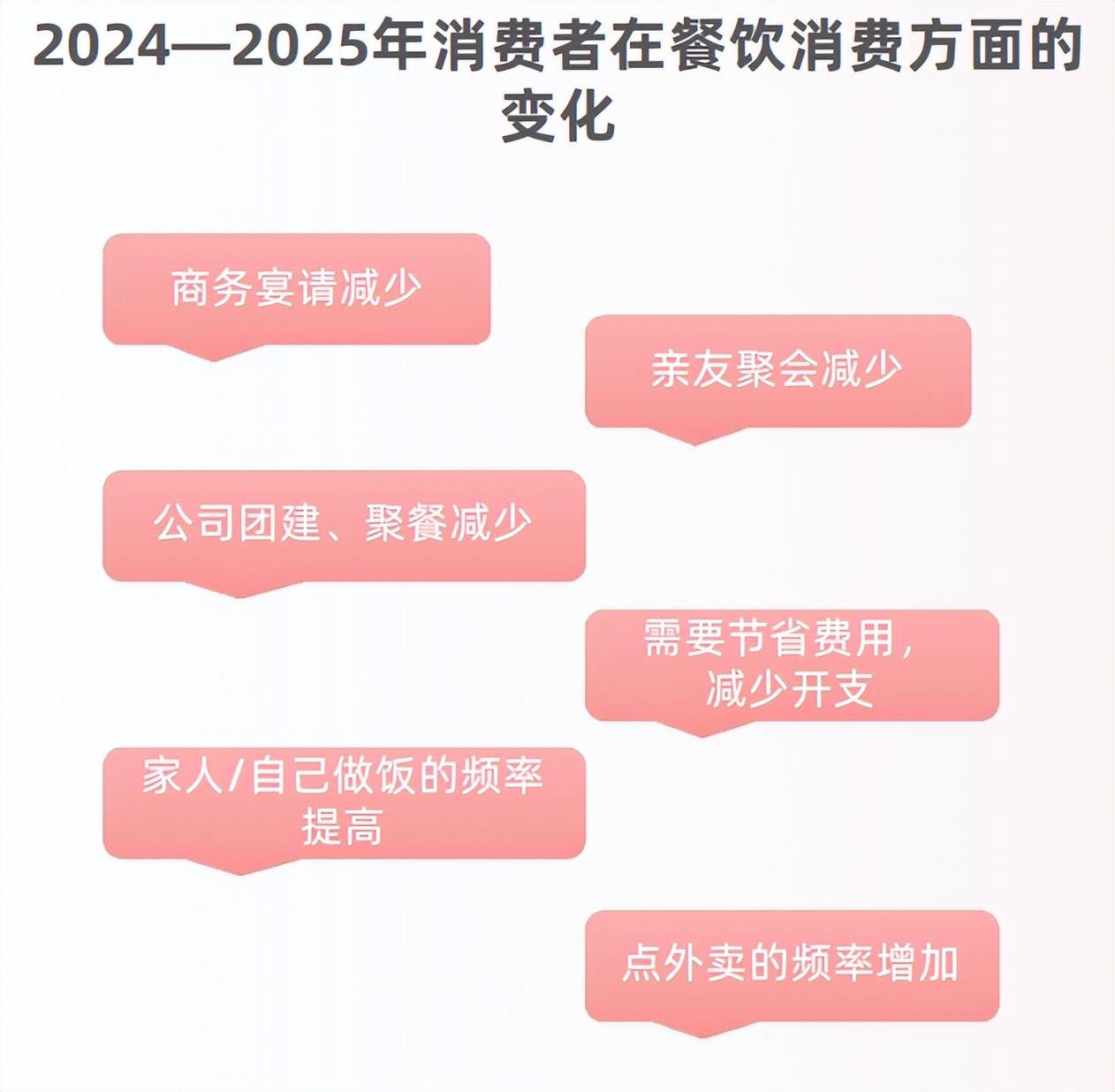
Core Insights - The Chinese catering industry is experiencing a significant slowdown, with a 3.6% year-on-year growth in revenue from January to August 2025, down from 6.6% in the same period of 2024, indicating a shift to a "micro-profit era" [1] - The total number of catering outlets in China has seen a rare negative growth, decreasing by 1.9% year-on-year to over 7.6 million by August 2025, marking a transition from "incremental competition" to "stock competition" [1] Industry Trends - Different segments within the catering industry show a clear divergence in outlet growth, with ready-to-drink beverages and Chinese cuisine being among the few segments experiencing growth, while fast food, bakery, barbecue, hot pot, Western cuisine, and Asian cuisine have all seen declines [2] - The overall operating efficiency of the industry is under pressure from rising costs and changing consumer demand, leading to the elimination of underperforming outlets and the survival of those with brand advantages and high operational efficiency [2] - The chain rate in the catering industry has steadily increased from 15% in 2020 to an expected 25% in 2025, highlighting the growing importance of brand and scale in the industry [2][3] Consumer Behavior - Consumer spending on dining is becoming more cautious, with a significant drop in the proportion of consumers planning to increase their dining expenditures in 2025 compared to 2024 [5] - A notable shift in dining habits is observed, with 24.2% of consumers reducing business meals and gatherings, while over 40% are cooking more at home, indicating a move towards more economical and healthier dining options [6] Market Dynamics - The takeaway market is undergoing a historic transformation, with the market size expected to exceed 1.4 trillion yuan in 2025, driven by a new competitive landscape following the entry of JD.com and Alibaba's "Taobao Flash Purchase" [4][5] - The competitive landscape in the takeaway market has shifted to a three-way competition among Meituan, Alibaba, and JD.com, moving beyond mere subsidy wars to focus on service quality and technological innovation [5] Operational Strategies - Brands are increasingly optimizing their store models to reduce costs and improve efficiency, with various new store formats emerging, such as satellite stores and delivery-focused outlets [10][11] - The average lifespan of catering outlets is decreasing, with projections indicating a further reduction to around 15 months in 2025, emphasizing the need for strong operational capabilities and brand differentiation [8] Product Innovation - The number of new products launched by brands has surged, with over 5,263 new items introduced from January to July 2025, reflecting a focus on regional ingredients and flavors to meet consumer demand for diversity [9] - Brands are leveraging regional specialties to create unique product offerings, enhancing brand value and consumer engagement through localized flavors [9]

银河证券:卫星互联网应用落地加速 三条主线勾勒产业新图景
智通财经网· 2026-01-19 00:18
Core Viewpoint - The report from Galaxy Securities highlights the long-term growth potential of satellite internet across various industries, recommending attention to three main lines in the satellite internet industry chain: potential operators of space computing power, satellite communication equipment providers, and satellite application service providers [1] Group 1: Strategic Cooperation - PuTian Technology and Changsha Nonferrous Institute have signed a strategic cooperation framework agreement to combine PuTian's technological advantages in 5G, satellite internet, data elements, and artificial intelligence with Changsha's expertise in mining and metallurgy [2] - This collaboration aims to provide advanced and comprehensive digital solutions for industry clients, serving as a practical model for upgrading traditional industries by integrating new communication technologies with specific industry know-how [2] Group 2: Accelerated Application Deployment - The new generation of communication technology, represented by satellite internet, is rapidly penetrating various industries, with a focus on three main lines of application [3] - The first line involves the acceleration of direct satellite connections for consumer and automotive sectors, with approximately 40 direct satellite phones expected to be launched by China Telecom and partners by the end of 2025, and an estimated cumulative shipment of over 25 million units [3] - The second line is the nationwide commercial trial of satellite IoT, initiated by the Ministry of Industry and Information Technology, which aims to establish a foundation for large-scale applications through phased, multi-scenario trials [3] - The third line emphasizes the evolution of space computing power, transitioning satellites from mere connectivity to also providing computational capabilities, which can alleviate bandwidth bottlenecks and create value for time-sensitive industries [4] Group 3: Key Developments in Space Computing - The "Three-Body Computing Constellation," in which PuTian Technology is deeply involved, has entered the networking phase, with plans for a launch of "one rocket, twelve satellites" by May 2025, featuring a single satellite computing power of up to 744 TOPS and inter-satellite laser communication rates of 100 Gbps [4] - This constellation aims to serve as an application accelerator by providing on-orbit computing and instant response capabilities, exploring business models such as inter-satellite link leasing and computing power leasing for various industries [4]

餐饮、潮玩及家电行业周报-20260118
Haitong Securities International· 2026-01-18 14:34
Investment Rating - The report assigns an "Outperform" rating to several companies including Pop Mart, Anta Sports, Huazhu Group, Li Ning, Miniso, Atour Group, and Xtep International, with target prices ranging from 6.99 to 354.00 [1]. Core Insights - The integration of AI and advertising models is gradually taking effect, with Generative Engine Optimization (GEO) expected to dominate the traffic competition in the AI-driven search era. The GEO market is projected to grow significantly, with a forecasted global market size of USD 11.2 billion in 2025, reaching USD 100.7 billion by 2030 [3][13]. - Key companies in the sector, such as Qingmu Technology, are actively developing their e-commerce ecosystems and leveraging proprietary systems to enhance their market position [4]. Company Performance - Top performers this week include Guoquan (+11.9%), Haidilao (+10.7%), Nayuki (+6.5%), SuperHi (+5.4%), and Hisense (+3.8%). Conversely, underperformers include JS Global Life (-4.6%), Roborock (-5.2%), TCL Electronics (-6.3%), Chagee (-8.2%), and Pop Mart (-9.3%) [6][14]. - Haidilao has appointed Zhang Yong as CEO, aiming to bring new perspectives and enhance board efficiency [8][15]. Industry Dynamics - Qdama and YUEN KEE FOOD have submitted listing applications to the Hong Kong Stock Exchange, with projected revenues showing growth [11][12]. - Big Catering has also submitted a listing application, with significant revenue growth reported for 2024 and Q3 2025 [12].

月薪2万-7万,茶颜悦色在北上深密集招人,公司回应“外拓”传闻:常规人员储备
Xin Lang Cai Jing· 2026-01-18 14:14
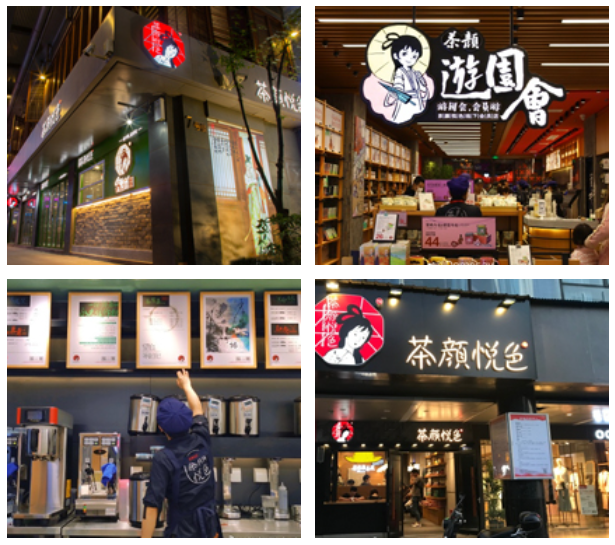
Core Viewpoint - The recent recruitment activities by the parent company of Cha Yan Yue Se in Beijing, Shenzhen, and Shanghai have sparked speculation about potential market expansion into North China, South China, and East China, although the company claims this is part of routine personnel reserves [1][14][16]. Group 1: Recruitment and Market Expansion - Cha Yan Yue Se is hiring for various positions in Beijing, Shenzhen, and Shanghai, with salaries ranging from 15,000 to 75,000 yuan, indicating a focus on brand, content, market, and technical roles [3][6][18]. - The company has stated that any new store opening plans will be communicated through its official channels, emphasizing that current hiring is for routine personnel reserves [1][14][20]. - There is speculation about a new creative studio being established in Shanghai, aimed at attracting professional talent and gathering creative inspiration, rather than immediate store openings [20][22]. Group 2: Company Growth and Competition - Established in 2013, Cha Yan Yue Se has only expanded to four provinces with approximately 758 stores, while competitors like Bawang Tea and Mixue Ice City have rapidly expanded to over 7,000 and 10,000 stores respectively [8][21][24]. - The company has been cautious in its expansion strategy, with a history of slow growth due to its direct sales model and concerns over product quality and supply chain management [9][21][22]. - Recent reports indicate that several investment firms have exited their stakes in Cha Yan Yue Se, returning control to the founding team, which may impact future growth and expansion plans [10][22][24]. Group 3: Industry Landscape - The new tea beverage market has undergone significant changes, with many competitors adopting franchise models for rapid expansion, while Cha Yan Yue Se has maintained a direct sales approach [12][24]. - Major competitors have successfully gone public and leveraged capital for global expansion, contrasting with Cha Yan Yue Se's more cautious approach to growth and potential IPO plans [12][22][24]. - The company is exploring new growth avenues, including retail and product diversification, but these efforts are currently limited to the Changsha area [11][23].
国资委公开80多家央企负责人薪酬
Sou Hu Cai Jing· 2026-01-17 13:14
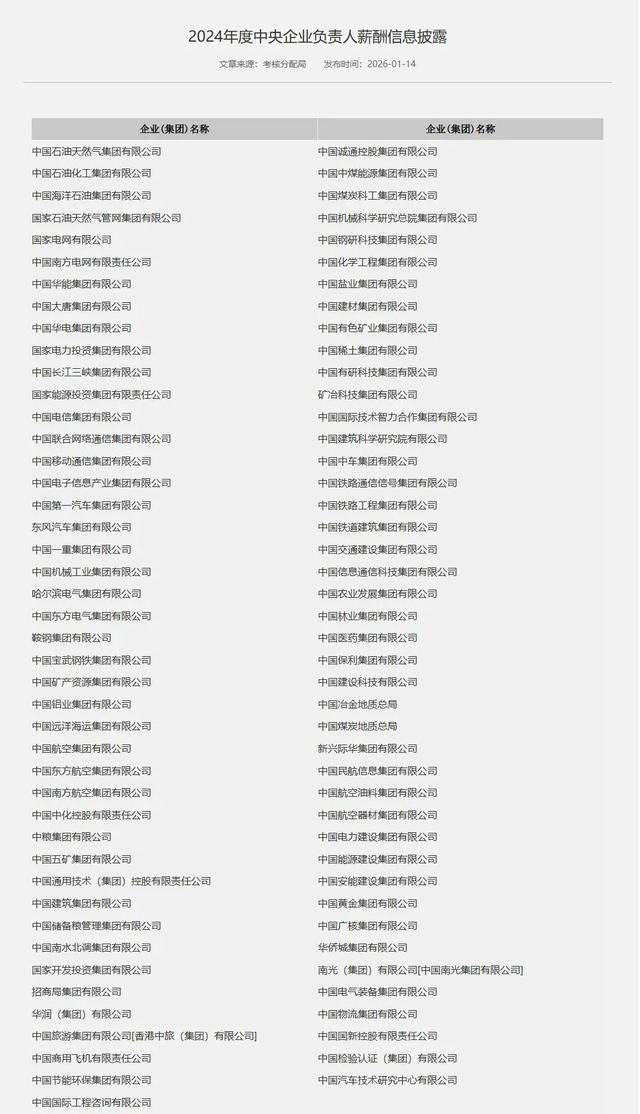
Core Viewpoint - The State-owned Assets Supervision and Administration Commission (SASAC) disclosed the salary information of over 80 central enterprise leaders for the year 2024, indicating a stable salary range without extreme high salaries, showcasing significant industry differentiation [1][5]. Group 1: Salary Disclosure - The disclosure of salary information is part of SASAC's ongoing efforts to enhance transparency in key areas and respond to public concerns [2]. - The overall salary of central enterprise leaders in 2024 remains within a stable range, characterized by "top leaders leading, median concentration, and low compliance," with no extreme high salary phenomena observed [5]. Group 2: Salary Rankings - The top tier of salaries is dominated by leaders from telecommunications and energy central enterprises, with China Mobile's former chairman Yang Jie leading with a pre-tax salary of 1.2582 million yuan, followed by China Telecom and China Unicom chairmen with salaries of 1.2160 million yuan and 1.2101 million yuan respectively [6]. - In the energy sector, PetroChina's chairman Dai Houliang and general manager Hou Qijun both have an annual salary of 978,500 yuan, ranking first among energy central enterprises [7]. - Other notable salaries include China Huaneng Group's chairman Wen Shugang at 961,700 yuan and State Power Investment Corporation's chairman Yu Bing at 953,700 yuan, both of whom are also in the top tier [8]. Group 3: Salary Distribution - The second tier includes core central enterprises in electricity, construction, and automotive industries, with notable figures such as State Grid's chairman Zhang Zhigang earning 735,000 yuan and China National Nuclear Corporation's chairman Yang Changli earning 930,000 yuan [15]. - The third tier consists of central enterprises with strong public welfare attributes, such as China Forestry Group's chairman Shan Zhongli and Overseas Chinese Town Group's chairman Zhang Zhenggao, both earning 438,500 yuan, which is below the average level for central enterprises [16]. Group 4: Salary Variability - Within the same industry, the salary differences among central enterprise executives are manageable, with the highest annual salary for energy central enterprise chairmen (PetroChina at 978,500 yuan) and the lowest (National Pipeline Network at 872,900 yuan) showing a difference of about 100,000 yuan [20].




5家消费品公司拿到新钱;贾国龙与罗永浩微博账号均被禁言;“死了么”APP估值已达1000万元|创投大视野
36氪未来消费· 2026-01-17 04:07
Investment Opportunities - The lemon tea brand "Linlee" has completed a Series A financing round of tens of millions, with a valuation close to 1 billion, aimed at brand building, supply chain upgrades, and organizational improvements [3] - Jiangsu Zhonggou has secured 12 million yuan in angel round financing, which will be used to strengthen its supply chain, expand offline direct sales networks, and upgrade its online digital platform [4] - OMOWAY has completed a Pre-A financing round of tens of millions of dollars, led by Sequoia China and Starry Sky Capital, with funds directed towards product mass production and global market development [5] - Futuring has announced a 200 million yuan angel round financing, primarily for product iteration and deployment in real family scenarios [6] - Fen Chuanqi has completed a 100 million yuan Series A financing round, focusing on supply chain upgrades and nationwide store expansion [7] Company Intelligence - The dispute between Xibei's Jia Guolong and Luo Yonghao has escalated, with both parties' Weibo accounts being silenced [8] - Xibei plans to close 102 stores, accounting for 30% of its total, while ensuring that all employees receive their wages and customer prepaid cards can be used at other locations [9] - Daya has confirmed that former CEO of Weidong, Sun Yinan, has joined as CEO [10] - The "Dead or Alive" app has been renamed Demumu, with a valuation of 10 million yuan, focusing on safety solutions for solitary individuals [11][12] - The founder of Zhong Xue Gao has won a defamation case regarding a misrepresented interview, with the court ruling in favor of the founder [14] Market Trends - Yuanji Food has submitted an application for listing on the Hong Kong Stock Exchange, aiming to become the largest Chinese fast-food company by store count [17][18] - Qian Dama has filed for an IPO, with a focus on community fresh food retail, reporting a GMV of 14.8 billion yuan in 2024 [20][22] - Dongpeng Beverage has passed the Hong Kong Stock Exchange hearing, targeting a fundraising goal of 1 billion USD [23] - The "Crying Horse" toy has gained popularity in Yiwu, leading to a surge in production to meet demand [24][25] Financial Performance - Yuanji Food expects revenues of 2.026 billion yuan and 2.561 billion yuan for 2023 and 2024, respectively, with a growth rate of 26% [19] - Qian Dama's revenue growth has stagnated, with a slight increase from 11.744 billion yuan in 2023 to 11.788 billion yuan in 2024 [21] - Dongpeng Beverage anticipates a revenue increase of 31.07% to 33.34% for 2025, projecting revenues between 20.76 billion yuan and 21.12 billion yuan [23]


险资系私募基金加速布局 11只产品已入市
Zheng Quan Ri Bao· 2026-01-16 16:41
Core Insights - The trial for long-term stock investment by insurance funds is accelerating, with the recent operation of the Honghu Fund Phase 3, increasing the total number of Honghu series funds to five and the total number of insurance-related private equity funds to eleven [1][2] Group 1: Fund Expansion - The long-term investment trial for insurance funds has three batches with a total amount of 222 billion yuan [2] - Seven insurance-related private equity fund management companies have been established, with Zhongyou Insurance Asset Management Company potentially becoming the eighth [2] - Guofeng Xinghua, the first insurance-related private equity fund management company, manages five Honghu series funds, with a total scale of 925 billion yuan across three funds [2] Group 2: Investment Strategy - The Honghu series private equity funds focus on high-dividend stocks, with ten out of eleven stocks having a dividend yield of over 3.4% in the past twelve months [4] - The investment strategy emphasizes stable, low-risk assets, targeting sectors like high-end manufacturing, artificial intelligence, and biomedicine to support the real economy [4][5] - Insurance funds are utilizing private equity to address low-interest environments and asset shortages, with high-dividend stocks providing stable cash dividends [5] Group 3: Future Outlook - The future expansion of insurance-related private equity funds is expected, supported by ongoing policy optimization to enhance the investment environment [6] - The foundation laid by the first three trial phases is anticipated to facilitate further expansion, with more small and medium-sized insurance companies applying for long-term stock investment trials [6]
「港股IPO观察」净利率从3%飙至27%!金星啤酒IPO亮出“暴利底牌”:中式精酿高定价能否抵御巨头围剿
Hua Xia Shi Bao· 2026-01-16 11:49
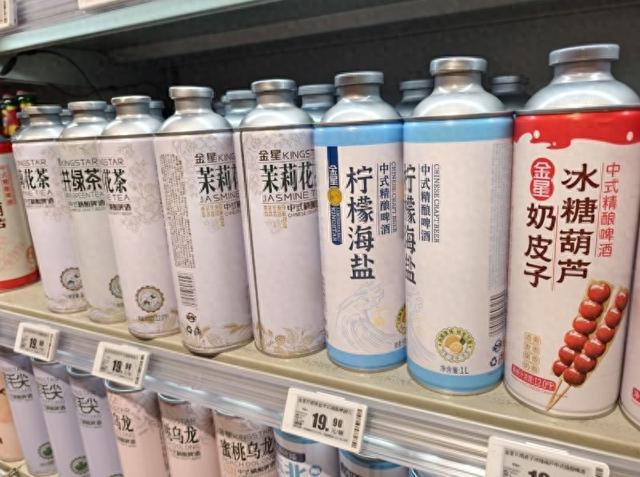
Core Viewpoint - Henan Jinxing Beer Co., Ltd. is embarking on an IPO journey in Hong Kong, aiming to enhance corporate governance, transparency, and secure capital for long-term product development and channel expansion [2][5]. Company Overview - Founded in 1982, Jinxing Beer has evolved from traditional beer to a focus on "Chinese craft beer," launching its first craft beer, Jinxing Maojian, in August 2024, which significantly boosted its performance [3][4]. - In 2023, the company reported revenues of 356 million yuan and a net profit of 12.2 million yuan, but by 2024, revenues surged to 730 million yuan, a 104.9% increase, with net profit reaching 125 million yuan, a 928% increase [3][4]. Financial Performance - For the first three quarters of 2025, Jinxing Beer achieved revenues of 1.11 billion yuan, a 191.2% increase year-on-year, and a net profit of 305 million yuan, a 1095.8% increase [3][4]. - The company has become the eighth largest in China's beer industry and the fifth largest domestic beer company, with a retail sales compound annual growth rate (CAGR) of 23.7% from 2022 to 2024 [4]. Product Pricing and Profitability - Jinxing Beer’s craft beer is priced significantly higher than traditional beers, with craft beer retail prices around 20 yuan per can (1L), compared to traditional beers priced between 2.5 yuan per can (330ml) and 6 yuan per bottle (500ml) [4]. - The gross margin has improved, with figures of 27.3%, 37.8%, and 47% for 2023, 2024, and the first three quarters of 2025, respectively, while net margins reached 3.4%, 17.2%, and 27.5% [4]. Market Position and Competition - Jinxing Beer faces increasing competition from major players like China Resources Beer and Yanjing Beer, which are expanding their craft beer offerings [6][9]. - The company relies heavily on distributors for sales, with 94.8% of its revenue coming from this channel, and has a network covering 29 provinces in China [7]. Strategic Outlook - The IPO is seen as a strategic move to strengthen Jinxing Beer’s market position amid intensifying competition, allowing for enhanced funding for innovation and brand development [5][9]. - The company aims to maintain its focus on Chinese craft beer while navigating the challenges posed by larger competitors and evolving market dynamics [8][9].
砸90万挤进一线商圈,贴身肉搏奶茶店,糖水铺再现新茶饮神话?
东京烘焙职业人· 2026-01-16 08:33
Core Viewpoint - The article discusses the rapid expansion and challenges faced by the dessert shop industry, particularly focusing on sugar water shops, which are becoming a hot topic among franchisees. Despite their growth, these shops face significant operational challenges and competition from established brands in the beverage sector [5][6][18]. Expansion and Market Dynamics - Sugar water shops are experiencing a surge in new brands, with companies like 麦记牛奶 planning to open over 800 stores by 2025, and 赵记传承 reaching 601 stores after investment from 喜茶's founder [5][12]. - The traditional dessert brands are also accelerating their expansion, with 满记甜品 aiming for 500 direct stores and over 2000 franchise stores in the next 3-5 years [5]. - New tea brands are entering the sugar water market, with products like "红豆沙牛乳" and "桃胶炖奶" being introduced to attract customers [5]. Operational Challenges - Sugar water shops are characterized by non-essential, low-frequency consumption, making it difficult to replicate the success of new tea drinks [6][7]. - The average monthly sales for some franchisees are around 200,000 yuan, with significant costs such as rent and labor making profitability challenging [7][11]. - The initial investment for opening a sugar water shop starts at 700,000 yuan, with additional costs for renovation and equipment [9][10]. Consumer Behavior and Market Saturation - The consumer base for sugar water shops overlaps less with that of tea shops, leading to strategic placement near high-end tea brands to attract young customers [7][12]. - The market is becoming saturated, especially in lower-tier cities, where many local shops compete with established brands, leading to price wars and reduced profit margins [17][22]. - The average gross margin for sugar water shops can reach 70%, but competition and external costs often lead to a recalibration of expected profits [11][22]. Product Diversification and Brand Strategy - New brands are diversifying their product offerings to increase customer spending per visit, with some combining sugar water with other food items like fried chicken and ice cream [15][16]. - The complexity of managing a diverse SKU (Stock Keeping Unit) range is higher for sugar water shops compared to tea shops, leading many brands to adopt a partnership model where franchisees focus on investment while the brand manages operations [15][17]. - The article notes that the sugar water market is facing challenges from new tea brands that can easily adapt their supply chains to include sugar water products, further intensifying competition [22].
茶颜悦色有个霸王茶姬梦
阿尔法工场研究院· 2026-01-16 05:37
Core Viewpoint - Chayan Yuese is preparing to accelerate its expansion in the competitive new tea beverage market, indicating ambitions to grow beyond its current regional presence and potentially emulate the success of rival brand Bawang Chaji [4][6][8]. Recruitment and Expansion Plans - Chayan Yuese is actively recruiting in Shanghai and Shenzhen, with salaries ranging from 20,000 to 75,000 yuan for various positions, signaling a push for talent acquisition and market expansion [7]. - The company plans to establish a creative studio in Shanghai to attract professionals and gather creative inspiration, although there are no immediate plans to open new stores in the city [7]. Market Position and Strategy - Founded in 2013 in Changsha, Chayan Yuese has become a representative brand of the city, focusing on a new Chinese-style fresh milk concept, which differentiates it from competitors like Nayuki and Heytea [10]. - As of December 25, 2025, Chayan Yuese operates 764 stores across five provinces, but its total store count is lower than that of other national brands, indicating a need for further expansion to achieve nationwide presence [10]. Competitive Landscape - Bawang Chaji, a newer competitor, has rapidly expanded through a franchise model and has outperformed Chayan Yuese in brand visibility and market presence, including a successful IPO on NASDAQ in April 2025 [16][18]. - The new tea beverage industry is experiencing a shift from rapid expansion to optimizing store efficiency and profitability, with major brands like Nayuki and Heytea facing challenges and scaling back their growth plans [24]. Future Outlook - Chayan Yuese is exploring potential market entry into first-tier cities and aims to tell a new brand story to attract consumers, while also needing to maintain steady growth without rushing [25]. - The company has room for growth in new markets and has a solid brand foundation, but it faces significant competition from both established and emerging brands in the industry [24][25].