
小米汽车

Search documents
中国11月销量榜单出炉:前10中新能源车型占据9席 Model Y、小米YU7入榜
Feng Huang Wang· 2025-12-08 12:44
Core Insights - In November 2025, China's wholesale sales of new energy passenger vehicles reached 1.706 million units, representing a year-on-year increase of 18.7% and a month-on-month increase of 5.8% [1] - Retail sales of new energy passenger vehicles in November totaled 1.321 million units, showing a year-on-year growth of 4.2% and a month-on-month growth of 3.0% [1] Sales Performance - Among the top ten best-selling models in November, nine were new energy vehicles, with BYD's Song leading at 56,000 units sold, followed closely by Tesla's Model Y at 55,000 units [1] - Xiaomi's Yu7 entered the top ten with over 33,000 units sold, marking Xiaomi's first SUV model to achieve this milestone [1] Market Penetration - The retail penetration rate of new energy vehicles in the overall passenger car market reached 59.3% in November, an increase of 7 percentage points compared to the same period last year [1] - The penetration rate for new energy vehicles among domestic brands was 79.6%, while luxury brands had a penetration rate of 38.8%, and mainstream joint venture brands only reached 8% [1] Retail Market Share - In November, the retail market share of new energy vehicles for domestic brands was 67.5%, a year-on-year decrease of 5.9 percentage points [1] - The market share for new energy vehicles from mainstream joint venture brands was 3.2%, down by 0.14 percentage points year-on-year [1] - The share of new forces, including brands like Xpeng, Leap Motor, and Xiaomi, grew by 5.9 percentage points year-on-year to 22.1%, while Tesla's share decreased by 0.3 percentage points to 5.5% [1]

汽车行业波澜壮阔,他们却为何选择逃离
Di Yi Cai Jing· 2025-12-08 10:15
Core Viewpoint - The automotive industry is undergoing significant changes due to the dual forces of opportunity and chaos, driven by the waves of new energy and intelligent technology, leading to increased competition, employee burnout, and a trend of professionals leaving the sector for other industries [1][2]. Group 1: Industry Challenges - The automotive sector has seen a rise in "involution," where employees face excessive competition and pressure, leading to a decline in job satisfaction and an increase in turnover [2][4]. - Many employees report a shift from a balanced work-life schedule to extended hours, with some experiencing a significant increase in workload without corresponding salary increases [3][5]. - The industry's competitive landscape has resulted in layoffs and a challenging job market, making it difficult for professionals to find suitable positions within the sector [4][5]. Group 2: Employee Transitions - A notable trend is the migration of automotive professionals to other industries, such as healthcare and robotics, where they seek better work-life balance and less stressful environments [3][11]. - Employees like Li Ai and Wang Fang have successfully transitioned to less demanding roles in other sectors, highlighting a growing preference for jobs with clearer boundaries and reduced pressure [3][5]. - The robotics industry is becoming increasingly attractive to automotive engineers, with significant growth potential and a more stable work environment compared to the automotive sector [11][12]. Group 3: Market Dynamics - The automotive industry's profit margins have been declining, with sales profit rates dropping to 3.9% in October 2025, significantly below historical averages, which has further pressured employee compensation and job security [12][13]. - The competition in the automotive market has intensified, leading to a focus on cost-cutting and efficiency rather than innovation, which may hinder long-term growth and development [12][13]. - The shift towards robotics and automation is seen as a potential growth area, with predictions indicating a substantial market opportunity in the coming years, contrasting with the saturated automotive market [11][12].
理想“背水一战”:MEGA召回、L系列滞销,百亿研发能否换来“具身智能”未来?
Xin Lang Cai Jing· 2025-12-08 02:14
Core Viewpoint - Li Auto is facing its most severe test since its establishment, with significant declines in revenue and net loss reported in the third quarter, marking the end of 11 consecutive quarters of profitability [2][24][26]. Financial Performance - In Q3, Li Auto reported revenue of 27.365 billion RMB, a year-on-year decline of 36.2%, and a net loss of 624 million RMB, compared to a profit of 2.821 billion RMB in the same period last year [3][26]. - Vehicle sales revenue for Q3 was 25.9 billion RMB, down 37.4% year-on-year and 10.4% quarter-on-quarter, attributed to a decrease in vehicle deliveries [6][28]. - The total vehicle deliveries in Q3 were 93,211 units, a 39.0% decrease year-on-year, while competitors like NIO and Xpeng saw significant growth in their deliveries [6][28]. Future Outlook - The company expects Q4 deliveries to decline further, projecting a drop of 37% to 30.7%, with total revenue anticipated to be between 26.5 billion and 29.2 billion RMB, reflecting a year-on-year decrease of 34.2% to 40.1% [13][35]. - Li Auto has revised its annual sales target for 2025 from 700,000 to 640,000 units, with cumulative deliveries reaching only 328,916 units by October, indicating less than 60% of the target achieved [8][31]. Challenges and Strategic Shifts - Li Auto's CEO, Li Xiang, indicated that the company is returning to a startup model, moving away from a professional management structure, and aims to innovate through self-developed AI and hardware technologies [18][39]. - The company is facing challenges in its range-extended electric vehicle (REEV) segment, which has seen a decline in market share due to increased competition and the maturation of the market [14][36]. - Li Auto's flagship pure electric model, MEGA, has faced criticism and has not replicated the success of its REEV models, contributing to the overall decline in sales [15][37]. Financial Health - As of Q3 2025, Li Auto's cash reserves stood at 98.9 billion RMB, but the company is experiencing cash flow issues, with a net cash outflow of 7.4 billion RMB compared to a net inflow of 11 billion RMB in the same period last year [11][35]. - The company reported a free cash flow deficit of 8.9 billion RMB, indicating a significant deterioration in financial health [11][33]. Market Position - Li Auto is the only new energy vehicle manufacturer among its peers to report a revenue decline in Q3, contrasting sharply with the growth reported by NIO and Xpeng [6][28]. - The company's stock price has also suffered, dropping over 33% from its peak in September, reflecting investor concerns about its future performance [15][37].


日产N6、别克至境世家、新款蓝电E5上市!小鹏联手华为推出下一代增程发电机!多款新车登录工信部!11月车企销量公布!丨一周大事件
电动车公社· 2025-12-07 16:05
New Car Launches - Dongfeng Nissan N6 launched with a limited-time price of 91,900 to 121,900 yuan, featuring a hybrid system with a 75kW engine and a 155kW motor, offering a pure electric range of 170-180 km [1][3][9] - New Blue Energy E5 Plus launched at a limited-time price of 119,800 yuan, equipped with a 70kW engine and a 160kW motor, providing a pure electric range of 230 km [1][12][17] - Buick Zhijing Shijia launched with a price range of 439,900 to 469,900 yuan, featuring a 132kW engine and a dual-motor system, offering a pure electric range of 224 km [1][20][25] Company Dynamics - Xiaomi Auto has surpassed 500,000 cumulative deliveries, achieving its annual target ahead of schedule [1][28][29] - XPeng Motors collaborates with Huawei to launch a next-generation range extender generator with over 92% efficiency [1][32][35] - Changan Automobile is set to roll out its 30 millionth vehicle, becoming the first Chinese brand to reach this milestone [1][36][40] Sales Performance - BYD sold 474,921 passenger vehicles in November, maintaining a leading position in the new energy sector [1][71][73] - Changan Automobile's November sales reached 283,000 units, with over 125,000 in new energy vehicles [1][76][79] - SAIC-GM-Wuling achieved 118,726 new energy vehicle sales in November, marking three consecutive months of over 100,000 units sold [1][81] - Chery's new energy vehicle sales reached 116,794 units in November, continuing its growth trend [1][82][86] - Hongmeng Zhixing delivered 81,864 units in November, benefiting from increased production capacity [1][87][90] - Leap Motor delivered 70,327 units in November, showing strong market performance [1][91][92] - Great Wall Motors sold 40,113 new energy vehicles in November, reflecting a significant growth in its transition to new energy [1][95][96] - XPeng Motors delivered 36,728 units in November, with a year-to-date growth of 156% [1][98][99] - NIO delivered 36,275 units in November, with a notable increase in sales [1][100][106] - Li Auto delivered 33,181 units in November, maintaining a positive outlook despite market pressures [1][107][109] - Deep Blue Automotive delivered 33,060 units in November, with strong performance from its S05 model [1][111][113] - BAIC New Energy sold 32,328 units in November, with a significant year-on-year increase [1][114][115] - Lantu Automotive delivered 20,005 units in November, marking a strong sales milestone [1][116][118] - FAW Bestune sold 15,793 new energy vehicles in November, with a focus on young consumers [1][119][123] - Avita delivered 14,057 units in November, achieving a historical high [1][124][125] - Zhiji delivered 13,577 units in November, with a focus on expanding its product line [1][126][128] - Jishi Automotive delivered 1,452 units in November, showing steady growth in international markets [1][129][132] Industry News - A new national standard for steer-by-wire technology has been released, removing mandatory mechanical connections [2][133][135] - Global penetration of new energy vehicles is on the rise, projected to reach 25.2% by Q4 2025 [2][138][140] - South Korea's automotive exports have declined for the first time in recent years, with a forecasted drop in total exports [2][143][145]





死磕技术的自动驾驶黄埔军校,又更新了这些技术进展......
自动驾驶之心· 2025-12-07 02:05
Core Insights - The article emphasizes the importance of a comprehensive community for autonomous driving, aiming to provide a platform for knowledge sharing and networking among industry professionals and academic experts [8][25][29]. Community Development - The "Autonomous Driving Heart Knowledge Planet" has been established to facilitate discussions on technology, trends, and changes in the autonomous driving sector, with over 4,000 members and a goal to reach nearly 10,000 in the next two years [8][11]. - The community offers a variety of resources, including videos, articles, learning paths, and job exchange opportunities, making it a valuable hub for both beginners and advanced learners [8][11][12]. Technical Resources - The community has compiled over 40 technical routes covering various aspects of autonomous driving, such as end-to-end learning, multi-modal models, and sensor fusion, which significantly reduces the time needed for research [11][25]. - Members can access detailed information on the latest advancements in autonomous driving technologies, including world models, VLA (Vision Language Models), and 3D target detection [25][49][51]. Job Opportunities - The community provides job referral mechanisms with various autonomous driving companies, ensuring members can connect with potential employers quickly [17][25]. - Regular updates on job openings and industry trends are shared, helping members stay informed about career opportunities in the autonomous driving field [30][100]. Educational Content - The community offers a structured learning path for newcomers, including foundational courses in mathematics, computer vision, and deep learning, tailored for those with no prior experience [19][25]. - Members can participate in live discussions and Q&A sessions with industry leaders, enhancing their understanding of current challenges and innovations in autonomous driving [12][92].
美国知名机器人公司爆雷,欠中国代工厂超25亿;奈飞5000亿元收购华纳兄弟;塔斯汀回应门店大开大关;美的官宣超人形机器人丨邦早报
创业邦· 2025-12-06 01:08
Group 1 - Pang Donglai is recruiting top talents under the age of 50 with a minimum annual salary of 1 million yuan and at least 60 days of paid leave [4][8] - Tasting responded to media reports about store closures, stating that the data was inaccurate and confirmed they have 11,124 operating stores as of November 2025 [8][9] - iRobot is facing a liquidity crisis and owes over 3.5 billion yuan to its Chinese supplier, Shenzhen Shanchuan Robotics, with a total cash and cash equivalents of only 24.8 million dollars [10][11] Group 2 - Meta has formed a new design team led by former Apple VP Alan Dye to focus on next-generation AI glasses and wearable devices [12] - Midea Group announced its humanoid robot strategy, which includes humanoid, super-humanoid robots aimed at achieving high efficiency and low costs [14] - Logitech's CEO reported a turnaround in the Chinese market with over 20% business growth for three consecutive quarters, emphasizing the integration of AI into existing products [16] Group 3 - Netflix has agreed to acquire Warner Bros. Discovery's film and streaming business for 72 billion dollars, significantly impacting Hollywood's power dynamics [11] - AMD has received permission to export certain MI 308 chips to China, preparing to pay a 15% tax to the U.S. government [11] - The global smart vacuum cleaner market saw a shipment increase of 18.7% year-on-year in the first three quarters of 2025, with Chinese manufacturers dominating the top five positions [28]






小米、小鹏、零跑提前完成KPI
财联社· 2025-12-05 13:38
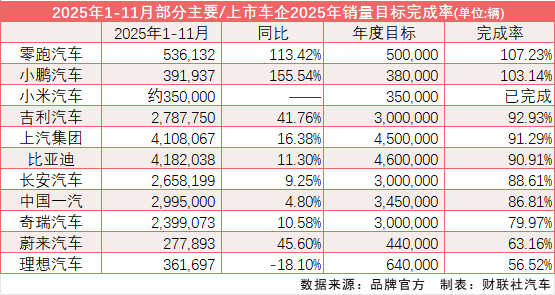
Core Viewpoint - The Chinese automotive market is experiencing a competitive end-of-year push, driven by policy changes, sales targets, and consumer demand [2]. Group 1: Sales Performance of Key Automakers - Leap Motor, XPeng, and Xiaomi have achieved their annual sales targets ahead of schedule, while NIO and Li Auto are struggling to meet their goals, with completion rates below 70% [2]. - Leap Motor delivered 536,132 vehicles from January to November, achieving a year-on-year growth of 113.42% and exceeding its annual target of 500,000 vehicles by 7.23% [3][4]. - XPeng's deliveries reached 391,937 units, a year-on-year increase of 155.54%, successfully meeting its annual target of 380,000 vehicles [3][5]. - Xiaomi's total sales for the year are approximately 350,000 units, also meeting its annual target [3][6]. - Geely, SAIC, and BYD have shown solid growth, with Geely's sales at 2.787 million units (up 41.76%) and BYD at 4.182 million units (up 11.3%) [3][6][7]. Group 2: Market Dynamics and Challenges - The overall passenger car market in China saw a wholesale volume of 26.766 million units from January to November, reflecting an 11% year-on-year increase [10]. - The market is facing challenges due to tightened policies on trade-in and scrappage subsidies, leading to a cautious consumer sentiment [10]. - NIO and Li Auto are experiencing a divergence in market performance, with NIO's deliveries at 277,893 units (63.16% of its target) and Li Auto's at 361,697 units (56.52% of its target), both struggling to maintain growth [9].

9家主流车企年度销量目标完成率超八成 零跑、小鹏、小米提前达成KPI
Xin Lang Cai Jing· 2025-12-05 08:40
Core Viewpoint - The Chinese automotive market is experiencing a year-end "sprint" driven by the approaching policy window, pressure to meet annual sales targets, and a surge in consumer demand [1] Group 1: Sales Performance - As of November, major domestic car manufacturers have varying completion rates for their 2025 sales targets, with Leap Motor, Xpeng, and Xiaomi having already met their goals, while NIO and Li Auto are below 70% completion [1] - Leap Motor achieved 536,132 vehicle deliveries from January to November, a year-on-year increase of 113.42%, exceeding its annual target of 500,000 vehicles by 7.23% [2] - Xpeng delivered 391,937 vehicles in the same period, marking a 155.54% year-on-year growth and successfully meeting its annual target of 380,000 vehicles [3] - Xiaomi's total sales reached approximately 350,000 vehicles, also achieving its annual target [3] - Geely, SAIC Group, and BYD have completion rates of 92.93%, 91.29%, and 90.91% respectively, with Geely's sales reaching 2.787 million vehicles, a 41.76% increase year-on-year [2][4] - NIO and Li Auto reported significantly lower completion rates, with NIO at 63.16% and Li Auto at 56.52% [2][6] Group 2: Market Trends and Strategies - Leap Motor aims to reach a sales target of 1 million vehicles in 2026, supported by the launch of new models like the A10 and Lafa5 [3] - Xpeng's overseas market performance has been a highlight, with 39,773 vehicles delivered internationally, a 95% increase year-on-year [3] - Geely's growth is driven by its strong performance in the new energy sector, with 153.4 million new energy vehicles sold, a 97% increase [4] - SAIC Group's sales have shown resilience, with a total of 4.108 million vehicles sold, a 16.4% increase year-on-year [5] - BYD's sales reached 4.182 million vehicles, but it has faced a decline in monthly performance since September, attributed to increased competition and market saturation [5] Group 3: Challenges and Outlook - NIO's performance has been inconsistent, with a total of 277,893 vehicles delivered, and it faces a challenging target of 43,000 deliveries in December to meet its quarterly guidance [6] - Li Auto has experienced a decline in deliveries for six consecutive months, with a focus on resolving supply issues for its i6 model [6] - The overall passenger car market in China saw a wholesale increase of 11% year-on-year, but consumer sentiment is cautious due to tightening policies on trade-in and scrappage subsidies [6]


汽车行业双周报(2025、11、21-2025、12、4):今年全年我国汽车销量预计将超3400万辆-20251205
Dongguan Securities· 2025-12-05 08:37
Investment Rating - The report maintains an "Overweight" rating for the automotive industry, expecting the industry index to outperform the market index by over 10% in the next six months [38]. Core Insights - The total automotive sales in China for the year are projected to exceed 34 million units, with new energy vehicle (NEV) sales expected to reach 16 million units and exports anticipated to surpass 6.8 million units [26][33]. - The tightening of purchase tax incentives for NEVs starting in 2026 is expected to create a rush in vehicle purchases by the end of 2025, leading to a potential "micro-growth" phase in the domestic market in 2026 [33]. - Export markets are seen as a new growth driver for major automotive companies, transitioning from merely exporting products to establishing local production capabilities abroad [33]. Industry Performance and Valuation - As of December 4, 2025, the Shenyin Wanguo automotive sector index has increased by 1.43% over the past two weeks, outperforming the CSI 300 index by 1.83 percentage points, ranking 7th among 31 industries [10][12]. - Year-to-date, the automotive sector has risen by 17.68%, also outperforming the CSI 300 index by 2.14 percentage points [10][12]. - The current price-to-earnings (P/E) ratio for the automotive sector is 25.38 times, with sub-sectors showing varying valuations: automotive services at 30.71 times, automotive parts at 27.11 times, and passenger vehicles at 23.69 times [16]. Industry Data Tracking - Raw material prices have shown mixed trends: steel prices increased by 0.20%, aluminum by 1.38%, and copper by 2.21%, while lithium carbonate prices decreased by 0.37% and glass prices fell by 0.26% [18][19]. Industry News - In November 2025, retail sales of passenger vehicles in China decreased by 7% year-on-year, while NEV retail sales grew by 20% [21][22]. - The Shanghai government announced that all new or updated public charging facilities must comply with mandatory certification standards starting August 1, 2026 [22]. - The China Automobile Dealers Association reported a rise in the inventory alert index to 55.6%, indicating a decline in the automotive circulation industry's prosperity [23]. Company News - Li Auto launched its first AI smart glasses, priced from 1,699 yuan after subsidies [27]. - Changan Automobile reported November sales of 283,000 units, a 2.3% year-on-year increase, with NEV sales up 23% [28]. - Xiaomi's automotive division has delivered over 500,000 vehicles since its launch [29]. Investment Recommendations - The report suggests focusing on companies that are actively expanding into overseas markets, such as BYD and Seres, as well as those in the intelligent driving supply chain like Fuyao Glass and Joyson Electronics [33][34].



贾可:中国汽车淘汰赛至少还有十年
汽车商业评论· 2025-12-05 07:31
Core Viewpoint - The Chinese automotive industry has not yet reached a stable state, and it may take another 10 years for the market to stabilize, with approximately 10 major automotive giants expected to remain in the future [3][35]. Group 1: Industry Overview - The WNATCES 2025 event focused on the theme of "long-term vs. short-term," featuring various forums and exhibitions aimed at addressing current industry pain points and promoting sustainable development in the new automotive ecosystem [5][7]. - Historical context shows that the automotive industry has undergone significant changes over the past century, with periods of fragmentation followed by consolidation, particularly in Europe and the U.S. [12][15][17]. Group 2: Market Dynamics - Predictions from industry leaders suggest a competitive landscape where only a few manufacturers will survive in the coming years, with estimates ranging from 3 to 10 major players by 2030 [10][19]. - The transition from traditional fuel vehicles to electric and intelligent vehicles has created new opportunities and challenges, with core components like the "three electrics" (battery, motor, and electronic control) becoming critical for competitiveness [20][22]. Group 3: Competitive Landscape - The current automotive market is categorized into six major camps, including traditional private enterprises, state-owned groups, new car-making forces, and joint ventures, each with distinct strategies and market positions [26][29]. - The rise of new entrants in the automotive sector, particularly those leveraging technology and innovative business models, indicates a dynamic and evolving competitive environment [31][38]. Group 4: Future Outlook - The industry is expected to continue evolving, with a focus on both cost leadership and superior user experience as key competitive strategies [24][30]. - The integration of AI and other advanced technologies into the automotive sector presents significant potential for transformation and growth, suggesting that the industry is still in a phase of exploration and development [33][43].
