
龙湖集团

Search documents
商业不动产REITs系列二:国际镜鉴:中国商业不动产REITs前景
HTSC· 2026-01-12 08:03
Investment Rating - The report maintains a rating of "Buy" for several commercial real estate companies, including Longfor Group, China Overseas Development, Link REIT, and others [10][5]. Core Insights - The C-REIT market is entering a comprehensive development era, with significant potential for commercial real estate REITs, driven by abundant stock, high adaptability for securitization, and strong market recognition [1][12]. - The report emphasizes that commercial real estate REITs can enhance asset liquidity and facilitate value reassessment for related enterprises, particularly benefiting those deeply engaged in commercial real estate and management services [1][12]. - The potential market size for domestic commercial real estate REITs could reach trillions, with a current market value of only 40.8 billion, indicating substantial growth opportunities [3][12]. Summary by Sections International Comparison - In the U.S. and Japan, commercial real estate constitutes a significant portion of REITs, with respective shares of 43% and 55% as of November 2025 [2][16]. - The report highlights that income volatility affects risk premiums and valuation differences, with hotel REITs showing the highest dividend yields and office REITs the lowest due to their sensitivity to economic fluctuations [2][16]. Domestic Outlook - The report forecasts a substantial expansion potential for C-REITs, particularly in the retail sector, as domestic demand mirrors that of the U.S. market [3][56]. - Factors driving the growth of commercial real estate REITs include the emergence of projects with management premiums and location advantages, as well as a significant stock of quality assets [3][12]. Market Style - The report suggests that the C-REIT market may adopt a fixed-income plus investment mindset, similar to Japan's market style, with stable assets likely to present valuation premiums [14][56]. - It notes that the domestic REITs market is expected to benefit from the recent regulatory changes that broaden the asset base to include office buildings and hotels [3][56]. Investment Recommendations - The report recommends investing in established commercial real estate operators and property management companies with management premiums and strategic advantages, including Longfor Group, China Resources Land, and others [5][15].



规模收缩,价值聚焦
Haitong Securities International· 2026-01-12 06:18
Investment Rating - The report indicates a positive outlook for the real estate sector, suggesting that the industry is entering a phase of stable structure and profitability, with a focus on quality over quantity in land acquisition [61]. Core Insights - The 2025 land market is characterized by a "quality over quantity" approach, with a significant decrease in land supply and transaction volumes, while average transaction prices have increased [25][61]. - Central state-owned enterprises (SOEs) and leading real estate companies are becoming more active in land acquisition, with a notable increase in land acquisition intensity among major firms [48][61]. - The average premium rate for land transactions in national sample cities has risen, indicating strong competition for prime land in first and second-tier cities [31][61]. Summary by Sections Land Market Overview - In 2025, the total land supply in national sample cities decreased by 16.9% year-on-year to 1,172.42 million square meters, with first, second, and third-fourth tier cities experiencing declines of 27.6%, 6.4%, and 19.2% respectively [25][28]. - Land transaction volumes also fell by 12.5% to 986.63 million square meters, with transaction values dropping by 11.4% to RMB 28,488 billion, while the average transaction floor price increased by 3.4% to RMB 2,887 per square meter [25][28]. Premium Rates and City Focus - The average premium rate for land transactions in 2025 was 5.3%, up 1.1 percentage points year-on-year, with first-tier cities averaging 10.7% and second-tier cities at 6.2% [31][61]. - Major cities like Shanghai, Shenzhen, Hangzhou, and Chengdu saw premium rates exceeding 10%, indicating a strong demand for quality land [31][61]. Investment Strategies of Key Players - In 2025, 12 real estate companies exceeded RMB 10 billion in land acquisition, with 11 being central SOEs, highlighting the dominance of state-owned enterprises in the market [48][61]. - The land acquisition intensity for the top 100 real estate companies was 0.29, reflecting a 70.6% increase year-on-year, with Hangzhou Binjiang Real Estate Group leading at 81.9% [48][61]. Investment Recommendations - The report suggests focusing on key players in the real estate sector, including Poly Developments, China Merchants Shekou, and China Resources Land, among others, as they are well-positioned to benefit from the current market dynamics [61][65].




资金覆盖率逐步提升,专项债成关键驱动力
Haitong Securities International· 2026-01-12 05:07
Investment Rating - Investment advice emphasizes high-quality development in the real estate sector, with low-valuation real estate showing potential for gains. The sector is expected to experience valuation recovery in 2026 due to improved regulations and policies [20]. Core Insights - The Fifteenth Five-Year Plan focuses on high-quality development in real estate, with market enthusiasm on the rise. The current total market cap of the AH real estate sector is misaligned with its economic position, indicating potential investment opportunities [20]. - The report highlights a decrease in planned land reserve acquisitions, with a total planned reserve exceeding RMB 700 billion. By 4Q25, 5,364 idle land plots are planned for acquisition, covering 290 million square meters, totaling RMB 706 billion [20][3]. - Special bond issuance remains high, with over RMB 300 billion in land reserve special bonds issued by 4Q25, covering 43% of planned reserves, an increase of 11 percentage points from the previous quarter [20][3]. Summary by Sections Land Reserve Planning - In 4Q25, the new planned land reserve amount is RMB 79.8 billion, down 44.4% quarter-on-quarter. The top three regions by reserve scale are Zhejiang (RMB 90.7 billion), Guangdong (RMB 88.4 billion), and Chongqing (RMB 67 billion) [20][3]. - The average discount rate for land acquisition is 0.8, with 77.6% of the new plots acquired being from the 2020-2024 period [20][3]. Special Bonds - By 4Q25, the issuance of special bonds for land reserve has reached over RMB 3,000 billion, with a coverage rate of 43% for planned reserves. The new issuance in 4Q25 is RMB 109.5 billion, maintaining a high pace [20][3]. - Local governments plan to issue RMB 4.58 trillion in new special bonds in 2025, with 6.6% allocated for acquiring idle land [20][3]. Key Companies to Watch - Key targets for investment include development companies such as Poly Developments, China Merchants Shekou, and Gemdale, as well as property management firms like China Resources Mixc and Poly Property Services [20][3].

浙江这37个项目开业,杭州占领“半壁江山”
3 6 Ke· 2026-01-12 02:29
Core Insights - Zhejiang province opened 37 new commercial projects in 2023, with a total commercial area of approximately 2.4743 million square meters, marking a year-on-year decrease of about 31% in the number of projects, but an opening rate exceeding 80%, maintaining a leading position in the national market [1] Group 1: Market Overview - Hangzhou dominates the market with 17 new projects and a total area of 1.1504 million square meters, accounting for nearly half of the province's total, solidifying its leading position [3] - Ningbo followed with 7 new projects totaling 408,900 square meters, with notable projects like Ningbo Jiangshan Wanda Plaza recognized for urban renewal [3] - Jinhua continues its growth trend with 5 projects planned for 2025, totaling 382,000 square meters, reflecting the trend of operators penetrating into third and fourth-tier cities [4] Group 2: Project Types and Trends - Shopping centers remain the dominant project type, comprising 54% of new openings, while non-standard commercial projects account for 27%, indicating a growing demand for unique and themed commercial spaces [5] - Traditional shopping centers are innovating by incorporating park-like or street-like designs to enhance openness and social attributes, transforming commercial spaces into "lifestyle destinations" [5] - Mid-sized projects (5-10 million square meters) are the most numerous, with 12 projects, indicating a shift towards a more layered market structure [6] Group 3: Key Players and Innovations - Major operators like Longfor, Intime, and Wanda continue to deepen their presence in Zhejiang, with Wanda managing the most openings in 2023 [7] - Local emerging players are also entering the market, with innovative projects like Hangzhou Jindi T-ONE MO and Alibaba's non-standard commercial project Qincheng Park [7] - Notable projects include Hangzhou Aoyao Wanxiang Tiandi, which integrates local culture and aims to redefine urban commercial spaces [10] Group 4: Noteworthy Projects - Hangzhou North招商花园城, with a commercial area of over 240,000 square meters, has achieved a leasing and opening rate exceeding 95% [11] - Longfor Hangzhou Shangcheng Tiandi, positioned as a "park-style commercial" center, features over 270 brands and aims to enhance local quality of life [17][18] - Jindi T-ONE MO, located in the core of Hangzhou's Olympic Sports Circle, opened with over 130 brands and achieved significant foot traffic and sales in its initial days [19][21] - The Qinwang Water Street project aims to redefine urban waterfront living with a focus on aesthetics and cultural integration [23][25]


环球房产周报:房地产融资协调机制调整,万科郁亮退休,多家房企发布2025年销售业绩……
Huan Qiu Wang· 2026-01-12 02:10
Policy News - The State Council held a meeting on January 9 to implement a package policy for fiscal and financial coordination to boost domestic demand, emphasizing the need to guide social capital in promoting consumption and expanding investment, particularly in supporting resident consumption upgrades and private investment development [1] - The People's Bank of China emphasized the continuation of moderately loose monetary policy during its 2026 work meeting, aiming to support stable growth in the real economy and financial market, while also addressing financial risks in key areas [1] - Recent adjustments to the real estate financing coordination mechanism allow projects on the "white list" to extend loans for up to five years, compared to the previous maximum of two and a half years [1] Market News - In 2025, the total land transfer fees for residential land in 300 cities decreased by 10.6% year-on-year, with a total of 2.3 trillion yuan, and the planned building area for residential land transactions fell by 13.5% to 620 million square meters [4] - The top 20 cities accounted for 52% of the national residential land transfer fees, indicating a concentration of land acquisition by major enterprises in core cities [4] Real Estate Company News - Vanke announced that Yu Liang has retired due to age, resigning from his positions as director and executive vice president, with no impact on the board's operation [8] - Country Garden's four bonds resumed trading on January 9 after early cash repayment was completed on December 26, 2025 [12] - Sunac China reported three new overdue debts totaling approximately 640 million yuan, with the main reasons being unpaid principal [13] - R&F Properties disclosed that as of November 30, 2025, the total overdue debt reached 38.7 billion yuan, primarily due to various financial obligations not being repaid [14] - Several real estate companies reported their 2025 sales performance, with Poly Developments achieving a signed sales amount of 253.03 billion yuan and China Overseas Development reaching 251.23 billion yuan [15]



高盛闭门会-脉动中国-中国2026房地产展望
Goldman Sachs· 2026-01-12 01:41
Investment Rating - The report indicates a pessimistic outlook for the real estate market, with expectations of a 10%-15% decline in second-hand housing prices over the next two years [1][3][12] Core Insights - The overall real estate sales are projected to decline moderately, with new housing sales decreasing but a slight rebound in the absorption rate anticipated [1][5] - Land sales are expected to slow down after a brief recovery in the first half of 2025, with new construction area potentially dropping below 500 million square meters by the end of 2027 [1][6] - Developers are facing significant financing challenges, with interest burdens rising, particularly for private developers, leading to increased repayment pressures [1][8] - The liquidity situation for 28 developers under pressure has worsened, with a significant reduction in sales contribution and a high proportion of short-term debt [1][9] Summary by Sections Real Estate Market Outlook - The forecast for the real estate market in 2026 and 2027 has been updated, with a delay in the stabilization of housing prices due to unclear policy support [2][12] - Second-hand housing prices are expected to decline by 10%-15%, with transaction volumes stabilizing around 600 million square meters [3][12] New Housing Market - New housing sales are anticipated to decline, but a slight rebound in the absorption rate is expected due to a decrease in available inventory [5][6] Land Sales and New Construction - Land sales are projected to concentrate in first and second-tier cities, with new construction area potentially decreasing significantly by 2027 [6][7] Developer Challenges - Developers are facing increased interest expenses, with the interest coverage ratio for many private companies dropping significantly, raising concerns about their ability to manage debt [8][9] - The report categorizes developers into three groups based on their financial health, highlighting the challenges faced by private developers [13][15] Property Management Sector - The property management sector is viewed as relatively defensive, with expectations of stable fundamentals and potential marginal recovery [14][16]
房地产:中国房企发展与转型——迈向资产管理
2026-01-12 01:40
Summary of Conference Call on Real Estate Industry and Company Transformation Industry Overview - The report focuses on the transformation of the real estate industry in China towards asset management, driven by ongoing policy changes emphasizing high-quality housing development and operational real estate business [2][4] - The industry is at a dual turning point of urbanization and financial market development, with a consensus on the need for real estate companies to explore asset management as a necessary direction [4][5] Key Insights - **Historical Context**: The transformation of real estate companies into asset management firms has been primarily driven by financial deepening over the past 40 years, particularly in Western economies, while Asian markets are still in the early stages of this transition [3][10] - **China's Position**: China is expected to see a significant shift in real estate focus from traditional development to asset management, especially during the 14th Five-Year Plan period, which is anticipated to be crucial for institutional development [4][49] - **Challenges**: The pace of transformation in China's real estate sector is slower than expected, with companies facing challenges in their ability to adapt [5][49] Financial Dynamics - The report highlights that the real estate sector's contribution to GDP has been declining, with a shift towards financial mechanisms and asset management becoming more prominent [10][11] - The debt accumulation in the real estate sector has been manageable, but fluctuations in debt levels and asset prices have historically led to economic volatility [11][12] Structural Changes - The report discusses the need for a comprehensive process of transformation, including organizational restructuring and capability enhancement, as companies move from traditional development to asset management [4][19] - The emergence of new asset types in the REITs market, such as logistics and data centers, reflects the evolving landscape of real estate investment [14][28] Comparative Analysis - **International Examples**: The report draws comparisons between the evolution of real estate companies in the U.S., Japan, and Singapore, noting that U.S. firms have successfully transitioned to asset management platforms, while Japanese firms remain more conservative and focused on domestic markets [25][39] - **East vs. West**: There are significant differences in the development stages of real estate companies between East Asian and Western markets, with East Asian firms often maintaining a mixed business model while Western firms tend to specialize [20][23] Future Outlook - The report anticipates that the future of the real estate market in China will focus on managing existing assets and enhancing the quality of new developments, with urban renewal becoming a key area of opportunity [50][51] - The balance between rental and purchase markets is expected to shift, leading to a more stable housing market and potentially higher asset prices [51][52] Risks and Considerations - The report warns of potential risks associated with the slow pace of transformation and the challenges posed by existing market structures and regulatory environments [5][49] - It emphasizes the importance of developing a robust asset management framework to navigate the complexities of the evolving real estate landscape in China [49][50]
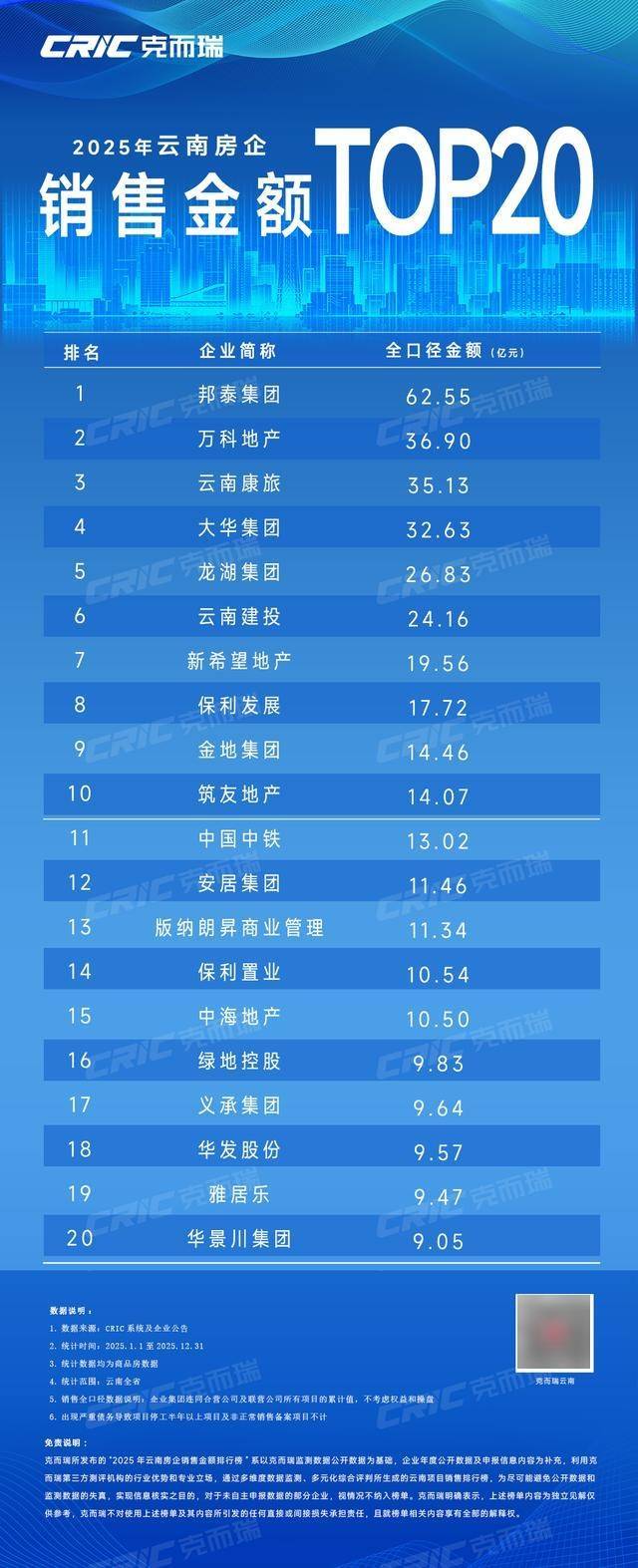
2025年云南房企销售TOP20榜单公布
Sou Hu Cai Jing· 2026-01-11 16:05
Core Insights - The 2025 Yunnan real estate market is under pressure, but leading companies have achieved performance breakthroughs through efficient new project launches and marketing innovations [1][4] - The strategic focus of real estate companies is shifting, with contributions from cities gradually decreasing and market differentiation becoming more pronounced [1][7] Group 1: Sales Rankings and Performance - The top 20 real estate companies in Yunnan for 2025 have a sales threshold of 9.05 billion yuan, a 17% decrease year-on-year, indicating increased competitive pressure in the industry [4] - Bangtai Group leads the rankings with a sales amount of 62.55 billion yuan, showing a 25% year-on-year increase and a remarkable 164% growth compared to 2024 [4][5] - Vanke Real Estate and Yunnan Kanglv follow in second and third place with sales of 36.90 billion yuan and 35.13 billion yuan, respectively, with Vanke showing a two-position improvement in the rankings [4][5] Group 2: Market Trends and Dynamics - The overall market for commodity housing in Yunnan faces challenges, with new construction area down 3% and real estate investment down 5% year-on-year [4] - The land market shows a significant decline in supply area by 19%, while transaction area increased by 8%, and floor prices rose by 37.85% year-on-year [4] - The contribution of city-level performance has decreased to 18%, down 6 percentage points from the first half of the year, as national brands adjust their regional strategies [7] Group 3: City-Level Insights - Kunming remains the main support for land transactions, accounting for 22% of the total transaction area in the province, with both transaction volume and prices rebounding despite overall supply declines [8] - Other cities like Dali, Lijiang, and Zhaotong are experiencing localized structural recoveries, benefiting from the sales of quality residential projects [8] - The tourism and cultural sectors in cities like Xishuangbanna are facing price declines due to promotional discounts, while Dali and Lijiang show healthy market conditions with rising volumes and prices [8] Group 4: Future Outlook - Future policies are expected to focus on more precise and actionable measures to stimulate demand, as the effectiveness of housing purchase subsidies diminishes [9] - The market is anticipated to become more refined and differentiated, with leading companies leveraging their strengths to seize opportunities amid structural adjustments and regional differentiation [9]
信用利差周度跟踪20260109:信用利差全线收窄二永债表现强势-20260111
Huafu Securities· 2026-01-11 05:25
Fixed Income - The report indicates that credit spreads have narrowed across the board, demonstrating resilience in credit despite rising interest rates. During the week from January 4 to January 9, government bond yields generally increased, with 1Y, 3Y, and 10Y government bonds rising by 3 basis points (BP), while the 5Y bond rose by 4 BP and the 7Y bond by 2 BP. In contrast, credit bonds outperformed government bonds, with 1Y AA+ and above credit bond yields decreasing by 2 BP, while other grades increased by 1 BP. For 3Y AAA and AA grades, yields remained stable, while other grades decreased by 1-2 BP. The 5Y AA+ and above grades saw yields rise by 1 BP, while other grades increased by 3 BP. The 7Y AAA grade yields remained stable, while other grades decreased by 2 BP. The 10Y AAA credit bonds decreased by 1 BP, with other grades remaining stable. Overall, credit spreads narrowed, with 1Y AA+ and above credit spreads decreasing by 5 BP, and other grades down by 2 BP. For 3Y, spreads decreased by 3-5 BP across grades, while for 5Y, AA+ and above spreads decreased by 3 BP, and other grades down by 1 BP. The 7Y AAA grade spreads decreased by 2 BP, with other grades down by 4 BP, and for 10Y, spreads decreased by 3-4 BP across grades [3][9][20]. City Investment Bonds - The report notes that city investment bond spreads mostly decreased by 3-4 BP. The overall credit spread for AAA-rated platforms decreased by 3 BP, while AA and AA+ platforms saw a 4 BP decrease. By administrative level, provincial platform credit spreads generally decreased by 3 BP, while city and county-level platform spreads decreased by 4 BP. Specifically, AAA-rated spreads mostly decreased by 3-4 BP, with Inner Mongolia down by 2 BP, and Yunnan, Hainan, and Gansu down by 5-6 BP. AA+ rated platforms mostly saw decreases of 3-5 BP, with Xinjiang and Guizhou down by 1-2 BP, and Ningxia and Gansu down by 6-7 BP. AA-rated platforms mostly decreased by 4-5 BP, with Shaanxi down by 3 BP and Tianjin down by 6 BP [4][13][16]. Industry Bonds - The report highlights that while most industry bond spreads decreased, real estate bond spreads continued to widen. Specifically, the spreads for central state-owned enterprise real estate bonds widened slightly by 1-3 BP, while mixed-ownership real estate bonds saw a significant increase of 702 BP. In contrast, private enterprise real estate bond spreads decreased by 30 BP. Notable changes include Longfor's spread decreasing by 6 BP, CIFI's increasing by 55 BP, Vanke's decreasing by 974 BP, Midea's decreasing by 4 BP, Huafa's increasing by 17 BP, and Poly's increasing by 5 BP. Additionally, spreads for coal bonds decreased by 2-3 BP across grades, while steel and chemical bonds saw a decrease of 3 BP [20][21]. Perpetual Bonds - The report indicates that the spreads for secondary capital bonds and perpetual bonds have significantly narrowed, with yields for 1Y secondary capital bonds decreasing by 2-3 BP and perpetual bonds down by 3-4 BP, compressing spreads by 5-6 BP. For 3Y, AA+ and above secondary bonds saw yields decrease by 1 BP, while AA secondary bonds and all grades of perpetual bonds saw yields decrease by 1-2 BP, compressing spreads by 4-5 BP. In the 5Y category, AAA- secondary capital bond yields increased by 1 BP, AA+ remained stable, and AA decreased by 1 BP, with perpetual bond yields remaining stable and spreads compressing by 3-5 BP [5][25]. Excess Spreads - The report notes that the excess spread for industry AAA-rated 3Y perpetual bonds remained stable at 14.84 BP, positioned at the 40.79% percentile since 2015. The 5Y perpetual bond excess spread slightly decreased by 0.01 BP to 13.20 BP, at the 32.21% percentile. Conversely, the excess spread for city investment AAA-rated 3Y perpetual bonds increased by 1.93 BP to 4.64 BP, at the 3.74% percentile, while the 5Y excess spread increased by 1.52 BP to 10.92 BP, at the 18.64% percentile [27][28].
中国房地产指数系统百城价格指数报告(2025年12月)
中指研究院· 2026-01-11 01:36
Investment Rating - The report does not explicitly provide an investment rating for the real estate industry. Core Insights - The average price of new residential properties in 100 cities in December was 17,084 RMB/square meter, with a month-on-month increase of 0.28% and a year-on-year increase of 2.58% [3][8] - The average price of second-hand residential properties in the same cities was 13,016 RMB/square meter, showing a month-on-month decrease of 0.97% and a year-on-year decrease of 8.36% [3][12] - The average rental price in 50 cities was 34.16 RMB/square meter/month, reflecting a month-on-month decrease of 0.60% and a year-on-year decrease of 3.62% [3][17] Market Performance - In December, new residential prices saw structural increases in cities like Shenzhen, Beijing, and Shanghai, while the overall market remains in a bottoming phase [5][6] - The second-hand housing market continues to experience high listing volumes, with significant month-on-month price declines [5] - The rental market is in a traditional off-season, with low demand and continued price declines in rental properties [5] Policy Developments - The Central Economic Work Conference emphasized stabilizing the real estate market and implementing city-specific policies to control inventory and improve supply [4] - Recent policy changes include reducing the value-added tax on personal housing sales and easing purchase restrictions for non-local residents and families with multiple children in cities like Beijing and Shanghai [4] - The government aims to accelerate the construction of affordable housing and improve the housing provident fund system [4][6] Price Index Analysis - In December, 26 cities experienced an increase in new residential prices, while 68 cities saw declines [9] - The average price of new residential properties in first-tier cities increased by 0.81% month-on-month, while second-tier cities saw a 0.16% increase [8] - For second-hand properties, 100 cities reported a uniform price decline, with 27 cities experiencing declines exceeding 1% [13] Future Outlook - The year 2026 is expected to be crucial for stabilizing the real estate market, with policies likely to be implemented to optimize restrictions in core cities and promote the acquisition of existing properties [6] - The report forecasts a 6.2% year-on-year decrease in new residential sales area in 2026, with price performance expected to remain differentiated [6]