格林美

Search documents
年重要化工品景气跟踪-pvc-烧碱
2026-01-13 01:10
年重要化工品景气跟踪——pvc、烧碱 20260112 摘要 液氯因剧毒受严格管控,多为即产即销,价格波动大,曾出现负补贴。 近期价格在 150 至 250 元/吨之间,市场表现受宏观因素影响显著。 烧碱主要需求来自氧化铝行业,占比最高,其余为印染、化纤等分散需 求。2026 年预计新增产能释放,叠加氧化镁替代烧碱趋势,供需格局 偏向过剩,出口受阻。 PVC 需求与房地产关联紧密,占比超 40%。2025 年 PVC 市场总体偏 弱,价格持续下跌。光伏商品出口退税取消对 PVC 出口影响重大,可能 加速行业产能出清。 PVC 市场受宏观因素影响大,即使基本面疲软,仍有上涨空间。低估值 状态下,宏观利好易引发盘面反弹,但需警惕不合理高价后的下跌风险。 2025 年上半年氧化铝市场受大规模投产、厂家降负荷及出口担忧等因 素影响,需求前置,推动行情上涨,但需求兑现后市场下跌。 烧碱价格受液氯价格、投机需求、出口及反内卷政策等多重因素影响, 波动剧烈。2025 年新增产能释放,供应充足,需求端表现疲软。 头部化工企业如新疆企业在电价方面具有显著成本优势,出口退税取消 后,小厂面临更大压力,行业或加速产能出清,头部企业 ...
长江有色:12日镍价上涨 现货挺价明显电池企业观望
Xin Lang Cai Jing· 2026-01-12 09:46
Core Viewpoint - Nickel prices have strengthened due to a combination of macroeconomic factors, industry trends, and geopolitical disturbances, reflecting a complex interplay of liquidity expectations, supply constraints, and geopolitical uncertainties [2] Supply Side - Indonesia's policy changes are the biggest variable affecting the supply landscape, with rumors suggesting a potential 34% reduction in nickel ore production quotas by 2026, which could significantly alter the global nickel supply-demand balance [2] - Indonesia's proposed revision of mining taxes to classify by-product cobalt as a separate taxable item may increase nickel smelting production costs, providing price support from the cost side [2] - Although LME nickel inventories are high, the availability of specific brands and grades for delivery is relatively tight, leading to higher spot premiums and indicating that immediate supply is not as loose as the absolute inventory figures suggest [2] Demand Side - Nickel demand is driven by two core areas: stainless steel, which accounts for over 60% of global nickel consumption, and the rapidly growing demand from the new energy battery sector, particularly high-nickel ternary batteries [3] - The aerospace and military sectors also contribute to demand through the use of nickel-based superalloys, adding a high-value growth segment to the market [3] - The nickel industry chain is characterized by high upstream concentration, technology-driven midstream, and diversified downstream demand, with Indonesia controlling about 70% of global supply [3] Market Outlook - Short-term nickel price trends will be primarily influenced by expectations surrounding Indonesia's production reduction policies, alongside geopolitical factors and resilient demand, suggesting prices may remain strong but volatile [4] - High global visible inventories will impose substantial constraints on the upward price potential, with future market focus on the implementation and effectiveness of Indonesia's policies and the path for inventory digestion [4]


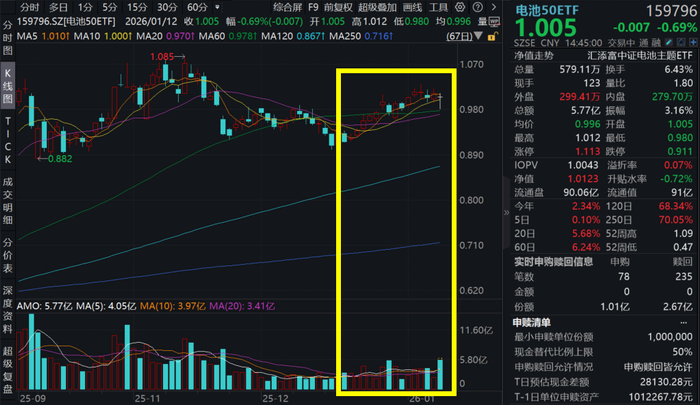
A股现天量,两市成交超3.6万亿元创新高!电池50ETF(159796)逆市爆量收跌,电池出口退税政策调整,影响几何?
Xin Lang Cai Jing· 2026-01-12 08:55
Core Viewpoint - The A-share market experienced a significant surge on January 12, with over 4,100 stocks closing in the green and a record trading volume of 3.64 trillion yuan, surpassing the previous high on October 8, 2024. The adjustment of export tax rebate policies for batteries has influenced market dynamics, leading to a notable increase in trading activity for the Battery 50 ETF (159796), which closed down 0.69% despite a trading volume nearing 600 million yuan [1][3]. Group 1: Market Performance - The Battery 50 ETF (159796) saw most of its constituent stocks decline, with notable drops including Sunshine Power and Xian Dao Intelligent, both down over 3%, while Ningde Times and Guoxuan High-Tech fell over 2% [3]. - The trading volume of the Battery 50 ETF (159796) surged to nearly 600 million yuan, indicating heightened investor interest despite the ETF's decline [1][3]. Group 2: Policy Impact - On January 9, two departments announced adjustments to export tax rebate policies, effective from April 1, 2026, which will reduce the VAT export rebate rate for battery products from 9% to 6%, and eliminate it entirely by January 1, 2027 [4][5]. - The previous reduction in export tax rebates for certain photovoltaic and battery products from 13% to 9% in November 2024 had already triggered a rush in exports, and the latest adjustments may lead to a similar surge, benefiting the lithium carbonate sector [5]. Group 3: Industry Outlook - Global demand for energy storage is expected to grow steadily, with projections indicating that global energy storage installations will reach 404 GWh by 2026, representing a 38% year-on-year increase [5]. - The battery sector is experiencing a sustained upward trend, driven by the growth of the global electric vehicle market, with domestic battery installations expected to maintain high growth rates through 2026 [5][6]. - Solid-state battery technology is advancing, with potential for significant industry upgrades, as companies that can provide stable supply and mature processes are likely to benefit [6]. Group 4: Investment Strategy - The Battery 50 ETF (159796) is positioned to benefit from its high content in energy storage (18.7%) and solid-state batteries (45%), making it a strong candidate for investors looking to capitalize on these growing segments [7][9]. - The ETF's focus on battery chemicals, which account for 31% of its weight, positions it well to benefit from the recovery of upstream material prices, enhancing the overall industry outlook [9][12].





锂电回收行业迎来转机 能源金属涨价推升“城市矿山”价值
Zheng Quan Shi Bao· 2026-01-12 03:03
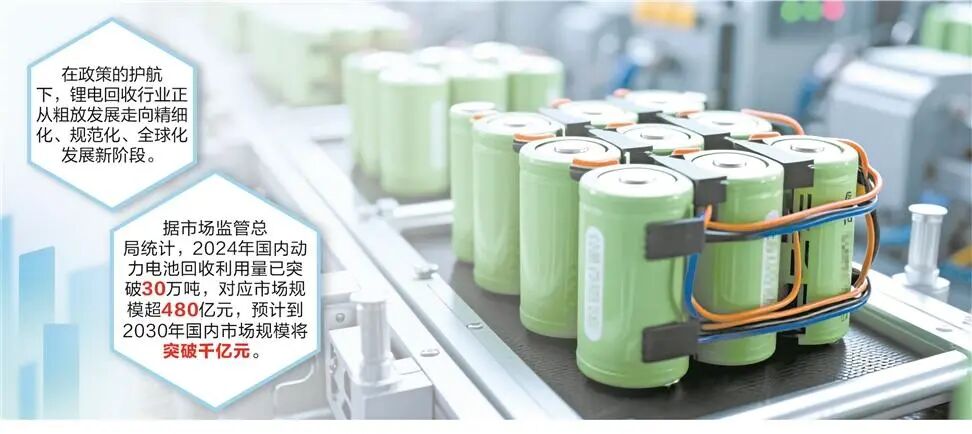
Core Viewpoint - The lithium battery recycling industry is transitioning from a rough development phase to a more refined, standardized, and globalized stage, driven by rising prices of lithium and cobalt, supportive policies, and increasing demand for energy metals [1][2][6]. Industry Overview - Lithium battery recycling is likened to the development of "urban mines," converting waste batteries into valuable, recyclable resources [1]. - The industry is witnessing a transformation, with a market size exceeding 100 billion yuan, reshaping the resource supply landscape in the new energy sector [1][7]. Profitability and Market Dynamics - The profitability of lithium battery recycling businesses has improved significantly, with a reported 59% year-on-year increase in battery dismantling volume, reaching 36,000 tons in the first three quarters of 2025 [2]. - The rise in prices of lithium, cobalt, and nickel has enhanced cash flow for recycling companies, shifting the profit model from reliance on subsidies to the intrinsic value of recycled materials [2][3]. Policy and Regulatory Environment - The Chinese government has relaxed import policies for recycled materials, allowing certain types of black powder to be imported, which addresses previous challenges in the industry [3]. - This regulatory change is expected to secure domestic strategic resource supply and integrate China's battery recycling industry into global resource allocation [2][3]. Capacity Expansion and Capital Operations - Leading companies are adopting a dual strategy of capacity expansion and capital operations to capture market opportunities, with significant investments in new facilities and technology partnerships [4][5]. - Companies like Grinmei and Tianqi are actively pursuing acquisitions and financing to enhance their operational capabilities and market presence [4][5]. Technological Advancements and Lifecycle Integration - The industry is evolving from merely end-of-life disposal to playing a crucial role in the entire battery lifecycle, with companies developing comprehensive value chains from recycling to remanufacturing [6]. - Grinmei has achieved a lithium recovery rate exceeding 96.5% through innovative technologies, establishing partnerships with over 1,000 automotive and battery manufacturers [6]. Future Outlook - The lithium battery recycling market is projected to grow at an annual rate exceeding 50% over the next 3 to 5 years, with the domestic market expected to surpass 100 billion yuan by 2030 [7]. - The industry is moving towards a more regulated and competitive environment, with non-compliant players gradually exiting the market, signaling a positive trend for sustainable practices [7].

绿金周报0112|小米雷军:特斯拉确实强 但并非不可战胜 AI驱动全球核电需求增长
Xin Lang Cai Jing· 2026-01-12 02:30
Group 1: Solid-State Battery Innovation - Donut Lab introduced the world's first mass-producible solid-state battery, achieving an energy density of 400Wh/kg and a fast charging time of 10 minutes [1] - The Verge electric motorcycle, equipped with this battery, is set for user delivery this year, although the technology faces scrutiny over data verification and aggressive production expansion [1] Group 2: Industry Regulation and Collaboration - The Ministry of Industry and Information Technology (MIIT) held a meeting with multiple agencies to address issues in the power and energy storage battery industry, focusing on capacity control, price stabilization, and patent protection [1][2] - The meeting included 16 companies, primarily leaders in the power and energy storage battery sectors, indicating a collaborative effort to regulate industry competition [2] Group 3: Market Developments in Energy Storage - Shenzhen-based Yuanxin Energy submitted a listing application to the Hong Kong Stock Exchange and completed a 200 million RMB equity financing round, with a post-financing valuation of approximately 2 billion RMB [3] Group 4: Nuclear Power and AI Influence - AI is driving a significant increase in global nuclear power demand, with over 63% of surveyed investors considering AI-related consumption a structural change in electricity demand [4] Group 5: Advancements in Solar Technology - Research teams from Xiamen University and Xi'an Jiaotong University developed a new method to enhance the stability of perovskite solar cells, addressing critical defects that affect performance [5][6] Group 6: Future Energy Initiatives - Beijing Economic-Technological Development Area plans to establish a "Future Energy Town" focusing on new energy storage, clean energy, low-carbon transition, and fusion energy [7] Group 7: Electric Vehicle Market Adjustments - General Motors announced a $6 billion impairment charge to terminate certain electric vehicle investments, influenced by market demand fluctuations and policy changes [8] - Geely Holding Group projected a total sales volume of 4.116 million vehicles in 2025, with a 26% year-on-year increase, driven by a 58% growth in new energy vehicle sales [8] Group 8: Carbon Capture and Utilization Standards - China Huaneng Group released three national standards in the CCUS field, covering the entire process from carbon capture to geological storage, marking a significant advancement in carbon asset development [10] Group 9: Circular Economy Initiatives - Greeenme's project for recycling end-of-life vehicles received a carbon reduction certification, marking a significant achievement in carbon asset development [12] - The "Love Recycling" initiative reported a recycling volume of 945,000 tons in 2025, reflecting a 40% increase from the previous year [13]
2025年中国废铜回收行业发展历程、市场政策、产业链图谱、回收量、回收价值、竞争格局及发展趋势分析:行业呈现量价齐升的局面[图]
Chan Ye Xin Xi Wang· 2026-01-12 01:26
Core Viewpoint - The copper recycling industry in China is experiencing rapid growth driven by strong demand in strategic sectors and government policies aimed at promoting circular economy and carbon neutrality goals. The recycling of waste copper is becoming a key channel to bridge the supply-demand gap, with significant increases in recycling volume, average price, and total value projected for 2024 [1][5]. Overview - Waste copper recycling refers to the process of collecting, sorting, processing, and purifying discarded copper and copper alloy products to convert them back into usable industrial copper materials (recycled copper). This process reduces resource consumption and environmental damage from copper mining and lowers energy consumption and pollutant emissions from copper smelting [2]. Development History - The waste copper recycling industry in China has evolved from state monopoly during the planned economy to market-oriented growth post-reform, and is now entering a high-quality development phase driven by dual carbon goals and environmental policies. The industry is shaped by policy drivers, technological innovations, and changing market demands [3]. Market Policies - The Chinese government has issued numerous policies to support the development of the recycling industry, including guidelines for establishing recycling systems for various waste materials and promoting green development in manufacturing. These policies create a favorable environment for the growth of the waste copper recycling sector [4]. Industry Chain - The waste copper recycling industry in China has formed a complete closed loop consisting of upstream recycling, midstream processing, and downstream application. The midstream segment, which focuses on the smelting and processing of recycled copper, is the core of value transformation within the industry [6]. Current Development - The demand for copper in key sectors such as new energy vehicles, photovoltaics, and electronic information is strong. The recycling market is projected to reach 2.6 million tons in 2024, with an average price of 68,564.9 yuan per ton and a total value of 178.27 billion yuan, reflecting year-on-year growth of 8.3%, 10.4%, and 19.6% respectively [1][8]. Competitive Landscape - The waste copper recycling market in China is becoming increasingly competitive, with many companies entering the sector. Major players include Anhui Chuangjiang Technology New Materials Co., Ltd., Ningbo Jintian Investment Holdings Co., Ltd., and Zhejiang Fu Holdings Co., Ltd., which are implementing integrated strategies to stabilize raw material supply and enhance product value [10]. Development Trends - The waste copper recycling industry is expected to see more standardized and compliant development driven by ongoing policy support. The focus will be on enhancing environmental qualifications and technological advantages among enterprises, while also promoting the use of intelligent and green technologies to improve efficiency and reduce emissions [12][13]. - The industry is likely to shift towards a more integrated and collaborative structure, with leading companies consolidating resources and establishing long-term partnerships across the supply chain to create a closed-loop system for recycling, processing, and reuse [14].

就业数据疲软提升降息预期,贵金属震荡上行
GOLDEN SUN SECURITIES· 2026-01-11 15:02
Investment Rating - The report maintains a "Buy" rating for the industry, indicating a positive outlook for investment opportunities in the sector [7]. Core Insights - The report highlights that weak employment data in the U.S. has raised expectations for interest rate cuts, benefiting precious metals which have shown a rebound after initial pressure [1]. - The copper market is facing supply disruptions and tight inventory in non-U.S. regions, which may lead to price volatility [2]. - The aluminum market is expected to experience strong fluctuations due to geopolitical tensions and improving macroeconomic sentiment [3]. - Nickel prices are anticipated to remain volatile due to policy uncertainties in Indonesia affecting supply [4]. - Tin prices are projected to experience strong fluctuations driven by macroeconomic factors and funding sentiment [5]. - Lithium prices are expected to remain high due to seasonal demand despite a slight decrease in production [6]. - Cobalt prices are likely to continue rising due to tight supply conditions and delayed export quotas from the Democratic Republic of Congo [10]. Summary by Sections Precious Metals - Precious metals are benefiting from liquidity easing, with a focus on companies such as Xinyi Silver, Shengda Resources, and Zijin Mining [1]. Copper - The copper market is experiencing an increase in global inventory, with concerns about supply tightness in non-U.S. regions due to disruptions in mining operations [2]. Aluminum - The aluminum sector is seeing a slight increase in production capacity, with geopolitical tensions contributing to a positive market sentiment [3]. Nickel - Nickel prices have shown significant fluctuations due to supply disruptions and policy changes in Indonesia, with a focus on companies like Huayou Cobalt and Lygend Resources [4]. Tin - Tin prices are influenced by macroeconomic expectations and demand from emerging sectors, with companies like Hunan Tin and Yunnan Tin being highlighted [5]. Lithium - Lithium prices are supported by strong demand despite seasonal production declines, with companies such as Ganfeng Lithium and Tianqi Lithium being recommended [6]. Cobalt - Cobalt prices are expected to rise due to supply constraints and regulatory changes in the Democratic Republic of Congo, with companies like Huayou Cobalt and Tianqi Lithium being of interest [10].
“妖”镍重现?印尼政策扰动,镍价坐上“过山车”
2 1 Shi Ji Jing Ji Bao Dao· 2026-01-11 11:23
Group 1 - The core point of the article highlights the significant volatility in the global nickel market, driven by policy changes in Indonesia, which has led to sharp price fluctuations and concerns over supply shortages [1][2]. - Indonesia's nickel production reduction plan, cutting quotas from 379 million tons to 250 million tons, has raised fears of supply constraints, potentially shifting the global nickel market from surplus to a tight balance or even structural shortage [2][5]. - Nickel prices have seen a dramatic increase, with the Shanghai nickel futures rising nearly 25% over 17 trading days, but the market fundamentals remain weak, as LME nickel inventories are above 250,000 tons and domestic refined nickel stocks have increased by 35% year-on-year [2][5]. Group 2 - Nickel-related resource companies in the A-share market have benefited from the price surge, with significant stock price increases observed since the New Year, including China First Heavy Industries and Huayou Cobalt, which saw gains of 36.96% and 11.27% respectively [4]. - Despite the recent price rebound, the overall nickel market is still characterized by oversupply, and analysts suggest that the recent price increases are more reflective of macro trading logic rather than actual supply-demand improvements [5]. - The uncertainty surrounding Indonesia's nickel mining policies continues to pose risks, with expectations of further price corrections in the medium to long term due to persistent oversupply pressures in the nickel industry [5].
头部企业大动作!锂电回收行业迎来转机 能源金属涨价推升“城市矿山”价值
Xin Lang Cai Jing· 2026-01-11 05:54
Core Viewpoint - The lithium battery recycling industry is transitioning from extensive development to a new phase characterized by refinement, standardization, and globalization, driven by rising prices of lithium and cobalt, along with supportive policies [1][9]. Industry Overview - Lithium battery recycling is likened to the development of "urban mines," converting waste batteries into valuable, recyclable resources [1]. - The industry is witnessing a transformation that is reshaping the resource supply landscape of the new energy sector, with a green circular market exceeding 100 billion yuan already formed [1][9]. Profitability and Market Dynamics - Since 2025, the prices of key metals like lithium, cobalt, and nickel have remained high, positively impacting the cash flow and profitability of recycling companies [3]. - For instance, a company reported a 59% year-on-year increase in battery recycling volume, reaching 36,000 tons in the first three quarters of 2025, leading to improved profit margins due to increased retired battery volumes and rising metal prices [3][9]. Policy and Regulatory Changes - In June 2025, a joint announcement by the Ministry of Ecology and Environment, the Ministry of Industry and Information Technology, and the State Administration for Market Regulation stated that recycled black powder meeting national standards is not classified as solid waste, facilitating imports [3][4]. - This policy change addresses previous challenges in importing materials and allows the domestic battery recycling industry to participate in global resource allocation [3][4]. Capital and Capacity Expansion - Leading companies are adopting a dual strategy of "capacity + capital" to seize market opportunities, including new base construction, technological cooperation, and capital financing [4][5]. - For example, a company announced a 400 million yuan acquisition to enhance its circular economy strategy, while another company has established a processing capacity of 100,000 tons for waste lithium batteries [5][7]. Technological Advancements and Industry Collaboration - The industry is evolving from merely end-of-life disposal to becoming a crucial player in the entire battery lifecycle, with companies developing comprehensive value chains from battery recycling to remanufacturing [8]. - One company has achieved a lithium recovery rate exceeding 96.5% and has established partnerships with over 1,000 automotive and battery manufacturers, creating a closed-loop supply chain [8]. Market Outlook - The lithium battery recycling market is expected to grow significantly, with an annual growth rate exceeding 50% projected over the next 3 to 5 years, potentially reaching a market size of over 100 billion yuan by 2030 [9].
能源金属涨价引爆千亿市场,头部企业加码锂电回收布局
Huan Qiu Wang· 2026-01-11 02:40
Core Viewpoint - The lithium battery recycling industry is undergoing a value reassessment driven by high energy metal prices, increased demand for energy storage, and supportive policies, leading to the formation of a green circular market exceeding 100 billion yuan by 2025 [1][6]. Industry Overview - The prices of key metals such as lithium, cobalt, and nickel are expected to remain high due to global mineral development cycles and a second surge in downstream energy storage demand [1]. - The industry is transitioning from extensive development to a more refined, standardized, and globalized phase, with a market size projected to exceed 100 billion yuan [1]. Company Performance - Companies like Greeenme and Tianqi have reported significant improvements in profitability due to increased retirement volumes and rising metal prices, with Greeenme's battery recycling volume reaching 36,000 tons, a 59% year-on-year increase [2]. - Tianqi's lithium battery recycling segment has turned profitable, aided by the lifting of black powder import restrictions and rising metal prices [2]. Strategic Initiatives - Leading companies are adopting a "capacity + capital" dual-drive strategy to capture market opportunities, with Greeenme planning to invest 400 million yuan to acquire shares in Henan Recycling Group and pursue a Hong Kong listing [4]. - Tianqi has established a processing capacity of 100,000 tons of used lithium batteries, with another 100,000 tons under construction, indicating a strong commitment to expanding its recycling capabilities [4]. Technological Advancements - Greeenme has achieved a lithium recovery rate exceeding 96.5% through its nine global recycling bases and has established partnerships with over 1,000 automotive and battery manufacturers [5]. - The industry is focusing on technological iteration and collaboration across the supply chain, with non-compliant small operations exiting the market, leading to a concentration of market share among companies with technological and environmental advantages [5]. Market Outlook - The lithium battery recycling industry is expected to experience accelerated growth over the next 3 to 5 years, with an annual growth rate projected to exceed 50%, potentially surpassing 100 billion yuan by 2030 [5][6]. - The industry's growth is not only driven by short-term fluctuations in energy metal prices but also by the necessity of closing the loop in the new energy industry chain, ensuring resource security and alleviating mining pressures [6].