
格力电器

Search documents
自由现金流ETF(159201)连续11天净流入,合计“吸金”22.59亿元
Sou Hu Cai Jing· 2026-02-02 02:38
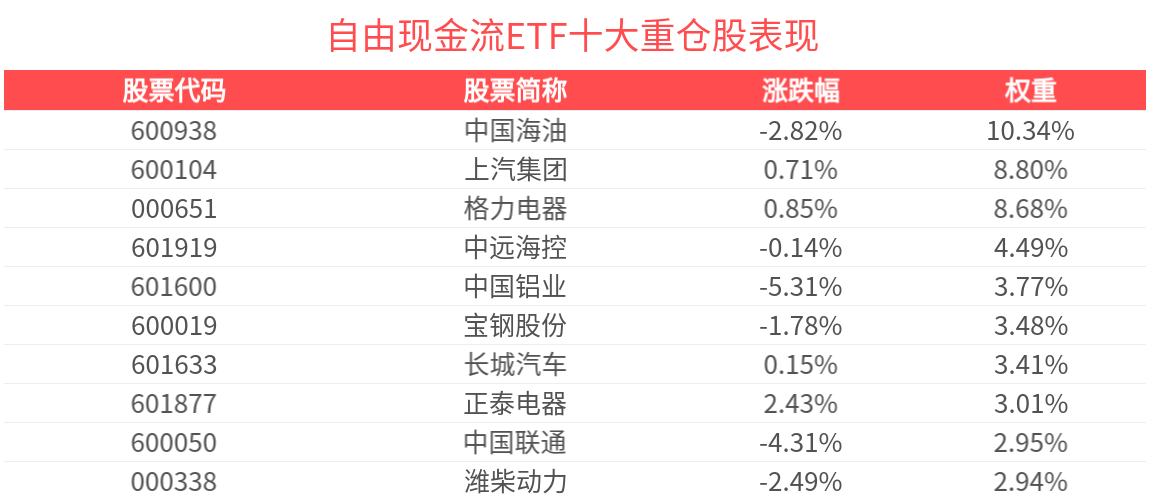
Core Viewpoint - The National Index of Free Cash Flow has experienced a decline of 2.01% as of February 2, 2026, with mixed performance among constituent stocks, indicating a volatile market environment [1]. Group 1: ETF Performance - The Free Cash Flow ETF (159201) has decreased by 2.03%, with the latest price at 1.3 yuan [1]. - The ETF has seen a turnover of 2.06% during the trading session, with a total transaction volume of 250 million yuan [1]. - Over the past week, the average daily transaction volume of the ETF has been 685 million yuan [1]. - The ETF has recorded a net inflow of 2.259 billion yuan over the last 11 days, reaching a total share count of 9.357 billion and a total scale of 12.409 billion yuan, marking a new high since its inception [1]. - The leverage funds have been actively investing, with a net financing purchase of 4.1325 million yuan on the previous trading day and a current financing balance of 141 million yuan [1]. - The net value of the ETF has increased by 24.49% over the past six months [1]. - The highest monthly return since inception was 9.25%, with the longest consecutive monthly gain being 6 months and a maximum increase of 22.69% [1]. - The ETF has a monthly profit percentage of 81.82% and a historical holding period profit probability of 100% [1]. Group 2: Top Holdings - As of January 30, 2026, the top ten weighted stocks in the National Index of Free Cash Flow include China National Offshore Oil Corporation, Gree Electric Appliances, SAIC Motor, China Aluminum, COSCO Shipping Holdings, Weichai Power, Silver Holdings, Baosteel, Chint Electric, and Great Wall Motors, collectively accounting for 50.3% of the index [2]. - The individual weightings of these stocks vary, with China National Offshore Oil Corporation holding the highest at 10.34% and Weichai Power at 2.94% [4].

西部证券晨会纪要-20260202
Western Securities· 2026-02-02 01:37
Banking Sector - The banking sector is expected to see three major catalysts in 2026: 1) Interest margins are likely to stabilize as new loan rates reach a low point, and deposit repricing effects will continue to improve banks' funding costs [6][7] 2) Risks related to real estate exposure are expected to have peaked, with significant progress in mitigating financial risks in the real estate sector [6] 3) Retail business may show marginal improvement as credit risks ease and wealth management activities are expected to activate [6][7] - Investment strategies for 2026 suggest focusing on four main lines: 1) Increase allocation to high-quality city commercial banks with strong earnings elasticity, recommending Hangzhou Bank and paying attention to Ningbo Bank, Nanjing Bank, Chongqing Bank, Qingdao Bank, and Xiamen Bank [5][7] 2) Allocate to high-dividend large banks, with a focus on Bank of China Hong Kong (H), CITIC Bank (H), China Construction Bank (H), and China Merchants Bank [5][7] 3) Pay attention to Shanghai Bank and Industrial Bank due to expected strong redemption of convertible bonds [5][7] 4) Consider banks with significant valuation discounts and potential for performance recovery, such as Minsheng Bank and Ping An Bank [5][7] Mechanical Equipment - The CDU liquid cooling pump is expected to benefit from the accelerated construction of AI data centers, as it plays a crucial role in regulating coolant flow and pressure, constituting 30%-40% of the liquid cooling system's value [9][10] - The market size for CDU liquid pumps is projected to reach between $1.139 billion and $1.544 billion in 2026, driven by the increasing demand for liquid cooling solutions as chip power exceeds the limits of air cooling [9][11] - The cooling source side of the liquid cooling system is also expected to benefit from the rapid development of AI data centers, with the global market for cooling water units projected to grow from approximately 105.21 billion yuan in 2024 to nearly 167.33 billion yuan by 2031 [10] Commercial Aerospace - SpaceX's application for an orbital data center system aims to reduce energy consumption from ground data centers, which may create significant incremental opportunities for rocket launch service providers and satellite manufacturers [22][24] - The acceleration of low Earth orbit satellite constellations is expected to drive domestic leading rocket launch service providers to actively expand their satellite constellation-related businesses, creating new growth opportunities in upstream supply chain segments [22][24] - The construction of orbital data centers is anticipated to significantly reduce energy consumption, benefiting both rocket launch service providers and satellite manufacturers [24] Fixed Income - The manufacturing PMI for January showed a significant seasonal decline, with the index at 49.3%, indicating a contraction in the manufacturing sector [14][15] - The service sector PMI slightly decreased, while the construction sector's activity index fell below 40%, indicating a need for further economic stabilization measures [19] - The credit market is expected to face structural opportunities despite a less favorable recovery outlook in February, with a focus on medium to high-rated city investment bonds [42][47] Airline Industry - Air China is projected to report a net loss of approximately 1.3 billion to 1.9 billion yuan for 2025, with Q4 losses expected to be between 3.17 billion and 3.77 billion yuan, indicating an increase in losses compared to the previous year [27][28] - Despite the projected losses, operational data for 2025 shows steady improvement, with available seat kilometers (ASK) and revenue passenger kilometers (RPK) increasing by 3.24% and 5.85% respectively [27][28] - The long-term demand for civil aviation in China is viewed positively, supported by the company's strong route network [28] Steel Industry - Fangda Special Steel is expected to see a significant increase in net profit for 2025, projected between 835 million and 998 million yuan, representing a year-on-year growth of 236.90% to 302.67% [31][32] - The growth is attributed to increased production and sales volumes, along with a decline in raw material costs, which have helped restore steel margins [31][32] - The company is focusing on refined management and cost reduction strategies, alongside potential asset injections from its parent group [32] Home Appliances - The home appliance industry is experiencing a decline in production and sales, particularly in the air conditioning and refrigerator segments, with significant year-on-year decreases reported [34] - The introduction of innovative products like Clawbot is expected to reshape the AI assistant market, enhancing consumer engagement and operational efficiency [35] - Companies like Ecovacs and Ninebot are projected to see substantial profit growth in 2025, driven by new product launches and increased market penetration [36]
“超级联络人”香港助力 广货稳步走向全球
Xin Lang Cai Jing· 2026-02-02 00:28
Core Viewpoint - The trend of "Guangdong products going south" is gaining momentum in Hong Kong, indicating a shift in consumer preferences from international brands to local Guangdong brands, driven by changes in consumer attitudes towards quality and experience [1][2]. Group 1: Consumer Perception and Market Dynamics - Hong Kong consumers' trust and recognition of Guangdong products have significantly increased, moving from a brand-centric view to one focused on product quality and experience [1][2]. - The integration of the Guangdong-Hong Kong-Macao Greater Bay Area has strengthened market connections and emotional ties, enhancing the recognition of Guangdong products [2]. - The rapid development of Guangdong technology enterprises has improved overall brand strength, creating a positive feedback loop that boosts product quality and consumer acceptance [2]. Group 2: Sales Performance and Competitive Landscape - Guangdong products have penetrated various categories in the Hong Kong market, including food, daily necessities, and home appliances, with notable brands like Gree and Heytea achieving significant market presence [2]. - Gree air conditioners have reached a market penetration rate of nearly 30% in Hong Kong, showcasing the competitive edge of Guangdong brands over international counterparts [2]. Group 3: Initiatives for International Expansion - Hong Kong serves as a crucial bridge for mainland brands to enter international markets, with the local government actively promoting Guangdong products and providing systematic support for brand expansion [3]. - The establishment of the International Brand Academy in Hong Kong and the creation of a government task force for overseas expansion reflect the commitment to facilitating Guangdong brands' international outreach [3]. Group 4: Future Development Strategies - Guangdong is transitioning from "Chinese speed" to "Chinese quality" and from "Chinese products" to "Chinese brands," with Hong Kong positioned to enhance this process through its international experience [4]. - Future strategies should focus on strengthening brand authority, establishing internationally recognized testing systems, and leveraging high technology, big data, and efficient logistics to support the global expansion of Guangdong products [4].
可选消费W05周度趋势解析:受美联储鹰派影响全球资产价格大跌,可选消费板块回撤较多-20260202
Haitong Securities International· 2026-02-01 23:30
Investment Rating - The report assigns an "Outperform" rating to multiple companies in the discretionary consumption sector, including Nike, Li Ning, Midea Group, JD Group, Haier Smart Home, Gree Electric Appliances, Anta Sports, and many others [1]. Core Insights - The discretionary consumption sector has experienced a significant pullback due to the hawkish stance of the Federal Reserve, leading to a decline in global asset prices [4][13]. - The report highlights that the domestic sportswear sector outperformed other segments, while luxury goods and cosmetics faced notable declines [4][13]. - The report provides a detailed analysis of the performance of various sub-sectors, indicating that gold and jewelry, overseas cosmetics, and snacks have shown resilience compared to the MSCI China index [4][11]. Summary by Relevant Sections Weekly Performance Review - The domestic sportswear sector increased by 0.6%, while other sectors such as credit cards, U.S. hotels, and retail saw declines ranging from -0.4% to -5.8% [4][13]. - The report notes that the gold and jewelry sector has outperformed the MSCI China index, with a monthly increase of 14.8% [4][13]. Sector Analysis - The domestic sportswear sector's growth is attributed to increased demand for warm clothing due to colder weather and positive media coverage of brands like Bosideng [15]. - The credit card sector saw mixed results, with Mastercard rising by 2.7% while Visa and American Express declined [15]. - The retail sector's performance was driven by specific companies like China Resources Mixc Lifestyle, which saw a 10.8% increase due to favorable policies [15]. Valuation Analysis - The report indicates that the expected PE ratios for various sectors in 2025 are below their historical averages, suggesting potential investment opportunities [11][18]. - For instance, the expected PE for the domestic sportswear sector is 13.4 times, which is 70% of its past five-year average [18]. Conclusion - Overall, the report emphasizes the impact of macroeconomic factors on the discretionary consumption sector and identifies specific companies and sub-sectors that may present investment opportunities amidst the current market volatility [4][11][18].
董明珠的言语经常惹争议,但是她做的事为何都做对了?
Sou Hu Cai Jing· 2026-02-01 23:07
近日,格力及其董事长董明珠再度成为社会舆论关注的焦点。 据天眼查公开信息披露,近日,珠海格力电子元器件有限公司近期进行了工商信息变更,董明珠不再担任该公司法定代表人及执行董事职务,改由方祥建 接任法定代表人,并出任执行公司事务的董事。 在中国企业家群体中,格力电器董事长董明珠无疑是最具话题性的人物之一。 她以直言不讳、言辞犀利著称,常常因一句"口无遮拦"的言论登上热搜,引发舆论风暴。从"90后员工不努力就滚蛋"到"我从来不在乎股价",再到"格力 手机要取代苹果"、"海归留学生都是间谍"。她的每一句表态似乎都在挑战公众的认知边界。然而,令人深思的是:尽管董明珠的言论屡屡引发争议,但 她主导的战略决策和企业行动却一次次被时间证明是正确的。 最近两起事件尤为典型,其一是关于空调行业"铝代铜"风波的反转;其二是格力进军芯片领域,尤其是碳化硅(SiC)功率半导体的成功落地。这两件事 不仅印证了董明珠在技术路线和产业判断上的前瞻性,还揭示了一个更深层的问题:为什么一个常被贴上"固执""偏执"标签的企业家,总能在关键时刻做 出正确选择? "固执"的董明珠最终赢了! 2025年,中国空调行业掀起一场关于"铝代铜"的技术讨论。 ...


“广货”何以行天下?——解码从“中国制造”向“中国创造”转型的广东样本
Xin Hua Wang· 2026-02-01 13:58
潮起珠江千帆竞,满载岭南好风物。 在全球新一轮科技革命和产业变革下,依托几十年不断积累的工业家底和对市场、技术敏锐的捕获力,广货实现了从"制造"到"创造"、 从"跟随潮流"到"引领潮流"的迭代。新能源汽车、工业机器人、无人机、文化产品等一批新"广货",顺着AI算力高速公路、电商平台,走向千 家万户。 当前,全球产业链加速重构。推动"广货"行天下,是服务国家战略、顺应时代之变、驱动广东高质量发展的主动出击。"广货"能行、先 行、畅行背后,蕴藏着中国经济发展韧性、潜力与活力的关键密码。 能行之基:产业厚积薄发 铸就"广货"硬实力 走进"中国灯饰之都"广东省中山市古镇镇,沿街商铺琳琅满目。一家灯饰企业的负责人向记者展示:"从设计图纸到成品出厂,所有配件 在5公里范围内都能配齐。"在深圳华强北,创客们很快就能"攒"出一台智能硬件原型机。 这种"一小时产业圈"的效率传奇,是广东数十年锻造的产业生态系统的极致体现。目前,广东拥有全部31个制造业大类,新一代电子信 息、轻工纺织、材料、石化、农业与食品、家电、软件与信息服务、汽车、新能源等9个万亿级产业集群蔚然成势,华为、格力等"参天大 树"和无数"专精特新"中小企业各美其 ...

产业亮点:如何看原材料涨价背景下空调品牌提价效果?
Changjiang Securities· 2026-02-01 13:50
Investment Rating - The report maintains a "Positive" investment rating for the home appliance industry [10] Core Insights - Starting from April 2025, the main raw material for air conditioners, copper, has entered a new price increase cycle, with prices accelerating since mid-November. As of January 14, 2026, the LME copper spot settlement price reached $13,335 per ton, reflecting a 53.5% increase compared to the beginning of 2025. In response to cost pressures, several air conditioning companies, including Aux, Midea, and others, have announced price increases ranging from 3% to 8% [2][4][16] - The report analyzes the impact of rising copper prices on air conditioner gross margins and evaluates the effectiveness of manufacturers' price increase strategies based on a review of the previous raw material price increase cycle [4][16] Summary by Sections Introduction - The report discusses the resumption of the copper price increase cycle starting in April 2025 and its implications for air conditioning manufacturers, highlighting the need for price adjustments in response to rising costs [4][16] Theoretical Impact of Rising Copper Prices on Air Conditioner Profitability - Raw material costs account for approximately 54% of air conditioner production costs, with copper, steel, and plastic comprising 22%, 12%, and 10% respectively. The high proportion of copper makes air conditioners particularly sensitive to copper price fluctuations. The report estimates that if copper prices rise by 15%, 30%, and 50%, air conditioner gross margins would theoretically decline by 2.1, 4.2, and 7.1 percentage points respectively [5][20][25] Effectiveness of Price Increases to Mitigate Cost Pressures - The report suggests that manufacturers would need to raise product factory prices by 3.0%, 5.9%, and 9.8% to effectively counteract the pressure on profitability from copper price increases of 15%, 30%, and 50% respectively. A review of the previous raw material price increase cycle (2020Q2-2022Q1) indicates that while price increases can mitigate cost pressures in the short term, sustained rapid increases in raw material prices may still pose challenges to profitability [6][36][47] Investment Recommendations - In light of the current cost uncertainties, the report recommends focusing on leading white goods companies with significant cost advantages and well-integrated supply chains, specifically highlighting Midea Group, Haier Smart Home, and Gree Electric as key investment opportunities [7][56]


从广东制造到全球智造,硬核广货畅销全球
Nan Fang Du Shi Bao· 2026-01-31 14:50
Core Insights - Guangdong products are transitioning from "Made in China" to "Intelligent Manufacturing Globally," showcasing innovation and quality as key advantages [1] - The "Guangdong Products Go Global" initiative aims to promote smart appliances and new energy vehicles internationally, reflecting Guangdong's commitment to innovation-driven consumption upgrades [1][2] Group 1: Global Market Performance - Guangdong's cross-border e-commerce import and export scale has expanded 66 times over nine years, accounting for over one-third of the national total, maintaining its position as the leading province [2] - By early 2026, Guangdong has established over 5,000 overseas branches, covering major economies across six continents, creating a comprehensive international layout [2][6] - The export value of Guangdong's home appliances reached 480 billion yuan in 2025, with a year-on-year growth of 12.3%, representing 35% of the national total [4][6] Group 2: Automotive Industry Growth - By 2025, Guangdong's new energy vehicle exports are projected to grow by approximately 120%, increasing its share of the national total to about 35% [3] - In 2025, Guangdong's automotive production is expected to exceed 5.7 million units, with new energy vehicles making up over 60% of this total [7] - BYD's ATTO 3 model is anticipated to rank among the top ten best-selling electric vehicles in Germany and France by 2025, highlighting its competitive edge in the European market [3] Group 3: Home Appliance Sector - Guangdong's home appliance industry, represented by brands like Gree, Midea, and TCL, has become a global leader through technological innovation and international expansion [4][6] - Midea has become the first domestic home appliance company to obtain the EU Product Environmental Declaration, marking a significant step towards becoming a global standard setter [9] - Gree's customized dehumidifiers have gained popularity in Southeast Asia, demonstrating the effectiveness of technology output over mere product exports [9] Group 4: Low-altitude Economy - Guangdong's low-altitude economy has surpassed 100 billion yuan, with over 15,000 related enterprises, capturing 70% of the global consumer drone market [5][8] - DJI leads the consumer drone market, while new entrants like Yihang are providing diverse low-altitude experiences [5][8] - The province has established 64 general airports and over 1,400 takeoff and landing points, enhancing its low-altitude infrastructure [8] Group 5: Cultural and Technological Impact - The internationalization of Guangdong products signifies a shift from simple product exports to technology and cultural exchange, enhancing China's global image [9] - Guangdong's products are not only recognized for their quality but also for their cultural significance, as seen in BYD's ATTO 3, which incorporates Chinese cultural elements [9][10] - The province's commitment to innovation and quality is expected to drive high-quality development and strengthen the global presence of "Chinese manufacturing" [10]

家电周报:三大白电 2 月排产数据发布,民爆光电公告收购预案-20260131
Shenwan Hongyuan Securities· 2026-01-31 12:12
Investment Rating - The report indicates a cautious outlook for the home appliance sector, with a recommendation to focus on leading companies that exhibit low valuations, high dividends, and stable growth potential [5][10]. Core Insights - The home appliance sector underperformed compared to the Shanghai and Shenzhen 300 Index, with a decline of 2.4% in the appliance index while the broader index rose by 1.1% [5][6]. - Major companies like Opple Lighting, Boss Electric, and Midea Group showed positive performance, while companies like Ecovacs, Lek Electric, and Huaxiang suffered significant declines [5][8]. - Production data for major appliances in February 2026 revealed substantial year-on-year declines, with air conditioner production down 31.6%, refrigerators down 17%, and washing machines down 3.2% [10][11]. - The report highlights three main investment themes: 1. **Dividend Play**: Leading white and black appliance companies are characterized by low valuations and high dividend yields, providing a safety margin and growth potential [5]. 2. **Technology Transition**: Key component manufacturers are diversifying into emerging tech sectors such as robotics and semiconductor cooling, indicating a shift in business strategy [5]. 3. **Export Opportunities**: Major appliance firms are well-positioned in global markets, with production bases in various regions to mitigate trade risks and capitalize on demand in emerging markets [5]. Industry Dynamics - The report notes a significant drop in production for major appliances in February 2026, with air conditioners at 11.49 million units, refrigerators at 6 million units, and washing machines at 6.3 million units, all showing declines compared to the previous year [10]. - The report also mentions a planned acquisition by Minexplosion Optoelectronics, which aims to purchase a 49% stake in Xiamen Maida and a 51% stake in cash, with a total consideration not exceeding 250 million yuan [11]. Data Observations - Sales data for cleaning appliances in December 2025 showed an increase in volume but a decrease in revenue and average price, with robotic vacuum sales up 29.11% but revenue down 2.14% [34]. - Personal care products like hair dryers saw a decline in sales volume and revenue, while electric shaver sales revenue increased despite a drop in volume [40][41]. Macro Economic Environment - As of January 30, 2026, the USD to RMB exchange rate showed a decrease of 0.87% since the beginning of the year, indicating potential impacts on import costs for raw materials [47]. Company Announcements - Ecovacs announced a bond buyback option, with no investors opting for the buyback during the specified period, indicating confidence in the company's stock performance [63]. - Other companies like Aojiahua and Foshan Lighting provided profit forecasts indicating significant declines in net profits for 2025, reflecting broader industry challenges [60][64].


三大白电2月排产数据发布,民爆光电公告收购预案
Shenwan Hongyuan Securities· 2026-01-31 09:49
Investment Rating - The report maintains a positive outlook on the home appliance sector, particularly recommending leading companies in the white and black goods categories due to their low valuations, high dividends, and stable growth potential [5][11]. Core Insights - The home appliance sector underperformed compared to the Shanghai and Shenzhen 300 Index, with a decline of 2.4% in the home appliance index while the broader index rose by 1.1% [5][6]. - Production data for major home appliances in February 2026 shows significant year-on-year declines: air conditioners down 31.6%, refrigerators down 17%, and washing machines down 3.2% [11][12]. - The report highlights the resilience of leading companies in the face of international trade fluctuations and emphasizes the growth potential in emerging markets [5][11]. Summary by Sections Industry Performance - The home appliance sector index decreased by 2.4%, while the Shanghai and Shenzhen 300 Index increased by 1.1% [5][6]. - Key companies such as Opple Lighting, Boss Electric, and Midea Group showed gains, while companies like Ecovacs and Lek Electric faced significant declines [5][8]. Production Data - February 2026 production figures indicate a total of 11.49 million air conditioners produced, a 31.6% decrease from the previous year; 6 million refrigerators, down 17%; and 6.3 million washing machines, down 3.2% [11][12]. Company Developments - Minexplosion Optoelectronics announced plans to acquire a 49% stake in Xiamen Maida and a cash purchase of 51% stake in Xiamen Precision, with a total cash consideration not exceeding 250 million yuan [12]. Market Trends - The report notes a year-on-year increase in sales of cleaning appliances, with robotic vacuum sales up 29.11% in December 2025, although sales revenue decreased by 2.14% [35][40]. - Personal care products showed mixed results, with hairdryer sales down 26.36% but electric shaver sales revenue up by 1.78% [42][45]. Investment Opportunities - The report identifies three main investment themes: 1. Leading white and black goods companies with low valuations and high dividends [5]. 2. Core component manufacturers expanding into new technology sectors [5]. 3. Companies like Ecovacs and Roborock benefiting from strong demand for cleaning appliances [5][11]. Economic Environment - As of January 30, 2026, the USD to RMB exchange rate has decreased by 0.87% since the beginning of the year [50][51]. - Retail sales in December 2025 showed a slight increase of 0.86% year-on-year, while disposable income for urban residents rose by 4.27% [52][53]. Regulatory Developments - Shenzhen's three-year action plan aims to enhance the consumption environment, promoting smart home products and digital consumption [73][75]. - The plan encourages the integration of artificial intelligence in home appliances and aims to boost home renovation and smart home adoption [75][76].