万辰集团

Search documents
行业周报:茅台韧性凸显,建议长期配置布局-20251130
KAIYUAN SECURITIES· 2025-11-30 09:43
Investment Rating - The investment rating for the food and beverage industry is "Positive" (maintained) [1] Core Viewpoints - During the industry downturn, Moutai is actively seeking change, demonstrating anti-cyclical capabilities suitable for long-term investment. The food and beverage index increased by 0.1% from November 24 to November 28, ranking 25th among 28 sectors, underperforming the CSI 300 by approximately 1.6 percentage points. The sub-sectors of processed foods (+5.6%), snacks (+2.9%), and baked goods (+2.7%) performed relatively well. The current liquor industry is in a deep adjustment period, with companies facing high channel inventories, product price inversions, and slowing growth rates. However, Moutai still shows growth potential. The high-quality liquor market in China has vast space for growth, particularly for sauce-flavored liquor and Moutai's market share. Moutai's historical significance and cultural strength are core competitive advantages, and it has successfully navigated multiple cycles in the past. After the third quarter of this adjustment period, Moutai's sales have shown a positive trend, with Moutai 1935 performing exceptionally well, confirming its risk resilience. Moutai's production capacity is subject to clear time constraints, with annual capacity investments not expected to be significant. Capacity release depends on ecological carrying capacity and the cultivation of skilled craftsmen, both of which are fundamental principles for capacity investment. During the industry adjustment period, Moutai will increase production and stockpile base liquor to improve the sales-to-inventory ratio, smoothing out industry cycle fluctuations. The "14th Five-Year Plan" for Moutai is based on positive, scientific, and rational principles, with reasonable goals. The main business focuses on consolidating core product advantages and enhancing channel ecology and competitiveness through series liquor. Innovation efforts are directed towards digital and green transformations, emphasizing consumer demand through product innovation and scenario expansion to adapt to changing consumption trends. Although the liquor industry is still in an adjustment cycle, Moutai's investment value stands out as a high-quality asset. Its strong brand and quality barriers, along with the scarcity of production capacity supported by ecological and craftsmanship guarantees, enhance its long-term momentum. Despite short-term price fluctuations, the company actively maintains market prices with a long-term development focus. Short-term attention should be paid to price changes and sales during the Spring Festival, while long-term views highlight its significant anti-cyclical capabilities and sustainable value creation potential, making it suitable for long-term investment [4][12][13]. Summary by Sections Market Performance - The food and beverage index increased by 0.1% from November 24 to November 28, ranking 25th among 28 sectors, underperforming the CSI 300 by approximately 1.6 percentage points. The sub-sectors of processed foods (+5.6%), snacks (+2.9%), and baked goods (+2.7%) performed relatively well. Leading stocks included Hai Xin Food, Jia Long Shares, and Yan Tang Dairy, while Nan Qiao Food, Hua Tong Shares, and Bai Run Shares saw declines [12][13][14]. Upstream Data - As of November 18, the GDT auction price for whole milk powder was $3,452 per ton, down 1.5% month-on-month and down 9.8% year-on-year. On November 20, the domestic fresh milk price was 3.03 yuan per kilogram, stable month-on-month but down 3.2% year-on-year. The domestic milk price is expected to continue its downward trend in the short to medium term [16][19]. Recommendations - Recommended stocks include Guizhou Moutai, Shanxi Fenjiu, Ximai Food, Weilong Delicious, and Bai Run Shares. Guizhou Moutai is expected to deepen its reform process and emphasize sustainable development despite short-term demand pressures. Shanxi Fenjiu has high mid-term growth certainty, while Ximai Food is experiencing stable growth in its oat business. Weilong Delicious is expected to alleviate declines in noodle products with new product launches, and Bai Run Shares is showing improvement trends in pre-mixed liquor [5][51].

盐津铺子的“增长神话”,是零食行业的“幸存者偏差”吗?
Sou Hu Cai Jing· 2025-11-29 04:41
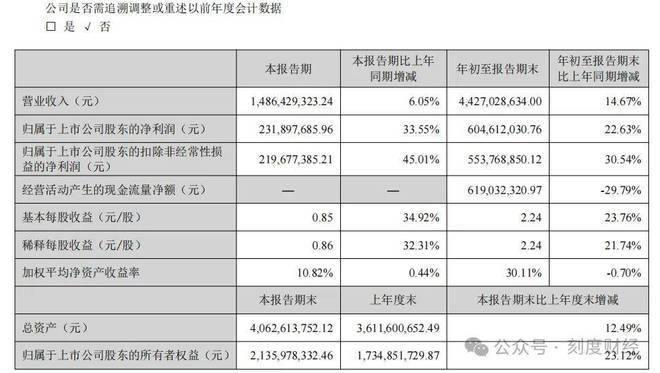
Core Insights - The snack industry is experiencing intense competition, with companies like Salted Fish and others facing challenges in profitability despite revenue growth [1][3] - Salted Fish has shown resilience, reporting a revenue of 44.27 billion yuan and a net profit of 6.05 billion yuan for the first three quarters of 2025, marking year-on-year growth of 14.67% and 22.63% respectively [1][3] - The company is expanding its market presence by targeting high-end channels and investing in a production base in Thailand [3][19] Financial Performance - For Q3 2025, Salted Fish achieved a revenue of 14.9 billion yuan, a 6.1% increase year-on-year, with a net profit of 2.3 billion yuan, reflecting a significant 33.6% growth [1][3] - The company's gross margin improved by 1.0 percentage points to 31.6%, driven by higher sales of high-margin konjac products and optimization of product structure [3][5] - The first three quarters of 2025 saw a net profit margin of 13.66%, with a cash flow from operating activities of 619 million yuan, indicating a decline of 29.79% [2][8] Market Position and Strategy - Salted Fish has successfully captured market share in the high-end snack segment while also expanding its distribution channels, covering over 40,000 retail outlets [5][15] - The company relies heavily on its konjac products, which accounted for 26.9% of total revenue in the first half of 2025, with a staggering year-on-year growth of 155.10% [10][12] - Despite its successes, Salted Fish faces challenges due to over-reliance on a single product category and the potential for market saturation [12][13] Industry Challenges - The snack industry is shifting from a focus on channel expansion to a need for innovation and efficiency, with many companies struggling to adapt [9][16] - Salted Fish's growth strategy has not addressed fundamental industry issues such as product homogeneity and weak innovation capabilities [9][17] - The competitive landscape is intensifying, with companies needing to enhance supply chain efficiency and product differentiation to maintain market relevance [16][20] Future Outlook - The snack market is projected to exceed 3.8 trillion yuan in 2025, but the underlying challenges of low entry barriers and intense competition remain [20][21] - Salted Fish's current growth model, which capitalizes on health trends and channel advantages, may not be sustainable in the long term without significant innovation and market adaptation [20][21] - The company must transition from being a beneficiary of market trends to a creator of lasting value to avoid potential declines in growth [21]

零食折扣店正在威胁便利店
Xin Lang Cai Jing· 2025-11-29 01:48
Core Insights - Discount supermarkets and bulk stores are rapidly emerging as a significant force disrupting traditional beverage channels, with a notable increase in consumer penetration in snack stores from 20% in 2023 to 40% [2][3] - Beverage brands are beginning to adapt to this channel restructuring, acknowledging the rapid growth of discount supermarkets despite initial resistance due to concerns over price disruption [3][4] Group 1: Market Dynamics - Discount stores like Haote Mai and bulk stores are selling beverages at significantly lower prices, with discounts ranging from 30% to 50% compared to convenience stores [4][10] - The sales growth in snack stores has reached 20% when comparing rolling annual sales data from June 2024 to June 2025 [2] Group 2: Brand Strategies - Major beverage companies are increasingly collaborating with discount stores to maintain market presence, with some brands adjusting their pricing strategies to align with these channels [11][12] - Companies like China Wangwang and Huanle Jia have reported significant revenue contributions from snack store channels, with Wangwang's contribution rising from 10% in 2024 to 15% in 2025 [12][14] Group 3: Consumer Behavior - Consumers are becoming more price-sensitive, often comparing prices between discount stores and traditional retailers, which is influencing purchasing decisions [10][11] - The trend of purchasing beverages with shorter shelf lives is growing, as consumers prioritize immediate consumption over long-term storage [5][7] Group 4: Product Customization - Beverage brands are developing customized products specifically for discount channels, allowing them to maintain competitive pricing while protecting traditional distribution channels [16] - Notable examples include Coca-Cola's introduction of smaller packaging sizes for discount stores, aimed at price-sensitive consumers [14][16]

食品饮料2026年投资策略:拐点显现、板块次第筑底、积极布局
China Post Securities· 2025-11-28 13:40
Group 1: Economic Indicators and Consumer Trends - The CPI in October showed a slight improvement, with a year-on-year increase of 0.2% and a month-on-month increase of 0.2%, indicating a potential recovery trend that may continue into the first half of next year [6][10] - The retail sales of consumer goods in October reached 46,291 billion yuan, growing by 2.93% year-on-year, with significant improvements in essential consumption categories such as food and beverages [10] - The restaurant sector saw a monthly revenue of 5,199 billion yuan in October, reflecting a year-on-year growth of 3.8%, driven by the National Day and Mid-Autumn Festival holidays [10] Group 2: Frozen and Food Supply Industry - The frozen food and catering industry is witnessing a shift from price wars to product innovation and channel development, with companies focusing on quality and service rather than just price competition [11] - Major players like Anjiyuan and Qianwei Central Kitchen are transitioning their strategies to emphasize product quality and operational efficiency, leading to improved profitability [11][15] - The industry is entering a "hard strength reshuffle period," where companies are expected to enhance their product offerings and service capabilities to maintain competitiveness [11] Group 3: Snack Food Sector - The snack food sector is experiencing a weak recovery, with a clear differentiation in growth among brands and channels, driven by strategic adjustments and product innovations [33][34] - The emergence of the konjac category as a significant growth driver, with market potential expected to reach 300 billion yuan by 2025, indicates a strong consumer demand for healthy snacks [34][40] - Companies like Yummy Foods and Salted Fish are leveraging their core products and channel strategies to achieve substantial growth, with a focus on high-margin products and efficient cost management [34][42] Group 4: Specific Company Strategies - Anjiyuan is focusing on high-margin products and channel expansion, with significant growth in its core offerings like volcanic stone grilled sausages and high-end dumplings [12][13] - Qianwei Central Kitchen is seeing improvements in its direct sales and distribution channels, with a focus on enhancing profitability through strategic adjustments in customer structure and resource allocation [15][18] - Salted Fish is capitalizing on the konjac trend and optimizing its product mix to improve profitability, with a strong emphasis on high-margin products and efficient channel management [40][41]



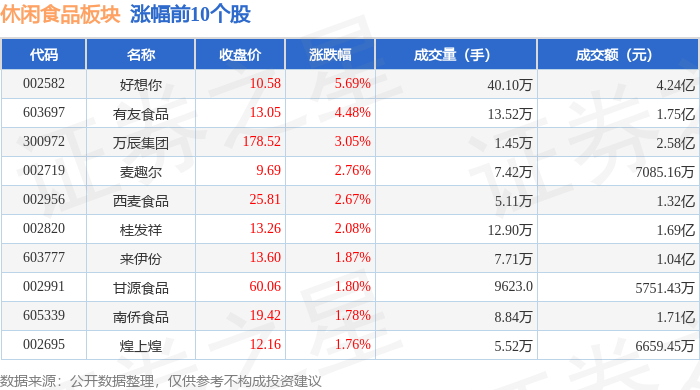
休闲食品板块11月28日涨1.54%,好想你领涨,主力资金净流入2134.56万元
Zheng Xing Xing Ye Ri Bao· 2025-11-28 09:08
Core Insights - The leisure food sector experienced a rise of 1.54% on November 28, with "Hao Xiang Ni" leading the gains [1] - The Shanghai Composite Index closed at 3888.6, up 0.34%, while the Shenzhen Component Index closed at 12984.08, up 0.85% [1] Sector Performance - "Hao Xiang Ni" (002582) closed at 10.58, with a gain of 5.69% and a trading volume of 401,000 shares, amounting to a transaction value of 424 million yuan [1] - "Youyou Food" (603697) closed at 13.05, up 4.48%, with a trading volume of 135,200 shares and a transaction value of 175 million yuan [1] - "Wancheng Group" (300972) saw a closing price of 178.52, increasing by 3.05%, with a trading volume of 14,500 shares and a transaction value of 258 million yuan [1] - Other notable performers include "Maiqu Er" (002719) with a 2.76% increase, "Ximai Food" (002956) with a 2.67% increase, and "Guifaxiang" (002820) with a 2.08% increase [1] Capital Flow - The leisure food sector saw a net inflow of 21.35 million yuan from institutional investors, while retail investors experienced a net outflow of 47.42 million yuan [3] - The overall capital flow indicates a mixed sentiment among different investor categories within the leisure food sector [3]


中国银河证券:提振消费是系统工程 增强消费品供需适配性
智通财经网· 2025-11-27 03:57
Core Viewpoint - The consumption industry in China needs to focus on the medium- and long-term goals outlined in the "14th Five-Year Plan," with short-term attention on policies related to consumption by 2026. The outlook for overseas business development in the consumption sector by 2026 is optimistic [1][2]. Group 1: Background and Policy Initiatives - On November 26, six departments issued a notice regarding the "Implementation Plan for Enhancing the Adaptability of Supply and Demand for Consumer Goods," aiming for a significant optimization of the supply structure by 2027, creating three trillion-level consumption fields and ten hundred-billion-level consumption hotspots [2]. - By 2030, a high-quality development pattern characterized by positive interaction between supply and consumption is expected to be established, with a steady increase in the contribution of consumption to economic growth [2]. Group 2: Consumption Stimulus Measures - National subsidies are the fastest way to stimulate short-term demand, with significant policy support since July 2024, including a special bond fund of 150 billion yuan allocated for supporting the replacement of consumer goods. An additional 300 billion yuan is planned for 2025 [3]. - The Central Economic Work Conference in December 2024 prioritized boosting consumption as the main task for 2025, leading to various policies aimed at enhancing consumption [4]. Group 3: Implementation Plan Measures - The "Implementation Plan" outlines five major areas with nineteen initiatives, including accelerating the application of new technologies and models, expanding the supply of unique and new products, and accurately matching the needs of different consumer groups [5]. - It also emphasizes cultivating new consumption scenarios and business formats, as well as creating a favorable development environment through financial support and market order maintenance [5]. Group 4: Investment Recommendations - Investment focus includes high-dividend quality companies during market style shifts, with specific recommendations in various sectors such as new consumption in the social service sector (e.g., Gu Ming, Da Mai Entertainment, Mi Xue Group) and food and beverage (e.g., Dongpeng Beverage, Lihigh Food) [6]. - Other sectors of interest include agriculture (e.g., Zhongchong Co.), sportswear (e.g., Anta Sports, Xtep International), and technology consumption (e.g., TCL Electronics, Hisense Home Appliances) [6].
研报掘金丨中国银河证券:内地提振消费政策发力 潮玩谷子赛道推荐泡泡玛特

Ge Long Hui· 2025-11-27 03:51
Core Viewpoint - The report from China Galaxy Securities highlights the recent issuance of a notice by six national ministries regarding the implementation plan to enhance the adaptability of supply and demand in consumer goods, aiming to further promote consumption [1] Industry Summary - The consumption industry is advised to pay attention to the medium- and long-term goals outlined in the 14th Five-Year Plan, with a short-term focus on consumption-related policies for 2026 [1] - The firm holds an optimistic view on the development of overseas business in the consumption sector by 2026 [1] Company Recommendations - In the new consumption sector of the social service industry, the following companies are recommended: Gu Ming, Da Mai Entertainment, and Mi Xue Group [1] - In the food and beverage sector, the recommendations include Dongpeng Beverage and Lihigh Food, with attention to Wancheng Group, Guoquan, and Nongfu Spring [1] - In the agriculture sector, Zhongchong Co., Ltd. is recommended [1] - In the textile and apparel sector, the focus is on Anta, Xtep International, and Hailan Home [1] - In the technology consumption sector, recommended companies include TCL Electronics, Hisense Home Appliances, Ugreen Technology, and Stone Technology [1] - For high-dividend home appliance companies, Midea Group and Haier Smart Home are highlighted [1] - In the light industry sector, Yongyi Co., Ltd. and Aorijin are recommended, while in the trendy toys sector, Pop Mart is suggested [1]
万辰集团:接受中邮证券等投资者调研
Mei Ri Jing Ji Xin Wen· 2025-11-26 12:31
Group 1 - The core viewpoint of the article is that Wancheng Group (SZ 300972) is engaging with investors through a scheduled meeting, highlighting its business focus and financial performance [1] - For the first half of 2025, Wancheng Group's revenue composition shows that 98.95% comes from snack retail, while agricultural planting contributes only 1.05% [1] - As of the report, Wancheng Group has a market capitalization of 32.4 billion yuan [1]
万辰集团(300972) - 福建万辰生物科技集团股份有限公司投资者关系活动记录表
2025-11-26 12:24
Group 1: Business Performance and Strategy - The company maintains a balance between store quality and quantity, focusing on steady development and improving single-store performance gradually [2] - The consumer demand-driven model effectively addresses profit loss from traditional distribution channels, enhancing product quality and store experience [2] - The company aims for sustainable growth by continuously improving its operational system and integrating supply chains [3] Group 2: Store Improvement and Customer Engagement - The company emphasizes food safety and product innovation, enhancing core competitive advantages through product iteration and the introduction of popular self-owned products [3] - Efforts to refine the membership system have successfully increased customer loyalty and repurchase rates [3] - The company is committed to building a strong trust relationship with consumers to convert it into stable foot traffic [4] Group 3: Product Development and Market Adaptation - The company focuses on consumer needs in its self-owned brand strategy, introducing products like natural water and sugar-free beverages that meet market demands [5] - Future product development will be guided by a flexible mechanism rather than rigid quantitative targets, ensuring responsiveness to consumer insights [5] Group 4: Inventory Management and Profitability - The core business model relies on efficient turnover, with a focus on precise product selection and rapid response to consumer needs [6][7] - The company prioritizes dynamic balance in product categories, avoiding the introduction of high-margin but slow-turnover items that could jeopardize sustainable growth [7] Group 5: Organizational Structure - The core management team for the snack business remains stable, with ongoing enhancements to the overall structure and active recruitment of talent across all levels [7]
国投证券:食品饮料行业迎来基本面与估值双重复苏机遇
智通财经网· 2025-11-26 09:13
Core Viewpoint - The report from Guotou Securities emphasizes the importance of consumption in economic growth, predicting a stabilization in the consumption fundamentals in 2026, which presents a significant opportunity for investment in the food and beverage industry [1] Group 1: Alcohol Industry - The liquor sector is at a cyclical bottom, with low expectations, low holdings, and low valuations, suggesting potential for left-side layout opportunities [2] - The rapid clearing of financial reports in the past two quarters indicates a resolution of supply-demand conflicts, with a gradual recovery in household consumption expected [2] - The white liquor business model remains strong, and with a potential economic recovery, valuations are likely to rebound quickly [2] Group 2: Beer Industry - The beer sector is expected to maintain a structural market in 2026, with investment opportunities in companies with strong single-product growth logic and those benefiting from competitor adjustments [3] - Overall profitability in the beer sector is on an upward trend, driven by the expansion of products priced between 8-10 yuan and improved efficiency from lean management [3] Group 3: Dairy Industry - The dairy sector is positioned for a turnaround in the raw milk cycle in 2026, with a focus on the profitability elasticity of the dairy supply chain [4] - Demand for dairy products has shown differentiation, with low-temperature fresh milk and cheese experiencing healthy growth, while room temperature liquid milk has been a drag [4] - The average milk price in major production areas is expected to recover above the average cost of production in 2026, making it an opportune time to invest in the dairy supply chain [4] Group 4: Soft Drink Industry - The soft drink sector has seen significant performance differentiation, with companies in strong growth categories leading the industry [5] - In 2026, there is a focus on functional beverages and the competitive landscape of packaged water, with an emphasis on companies introducing new products [5] - The demand for low-sugar functional beverages is anticipated to grow, particularly among white-collar workers seeking fatigue-relief options [5] Group 5: Snack Industry - The snack sector is benefiting from strong new channel drivers, with expectations of improved gross and net profit margins due to scale effects [6] - The konjac product category is maintaining high market interest, with significant growth potential in China [6] - Investment recommendations include focusing on companies with strong performance during the adjustment period and those with leading products in the snack sector [6]