
新凤鸣

Search documents
石化ETF(159731)近7天获得连续资金净流入,合计“吸金”2132.16万元
Sou Hu Cai Jing· 2025-12-02 02:25
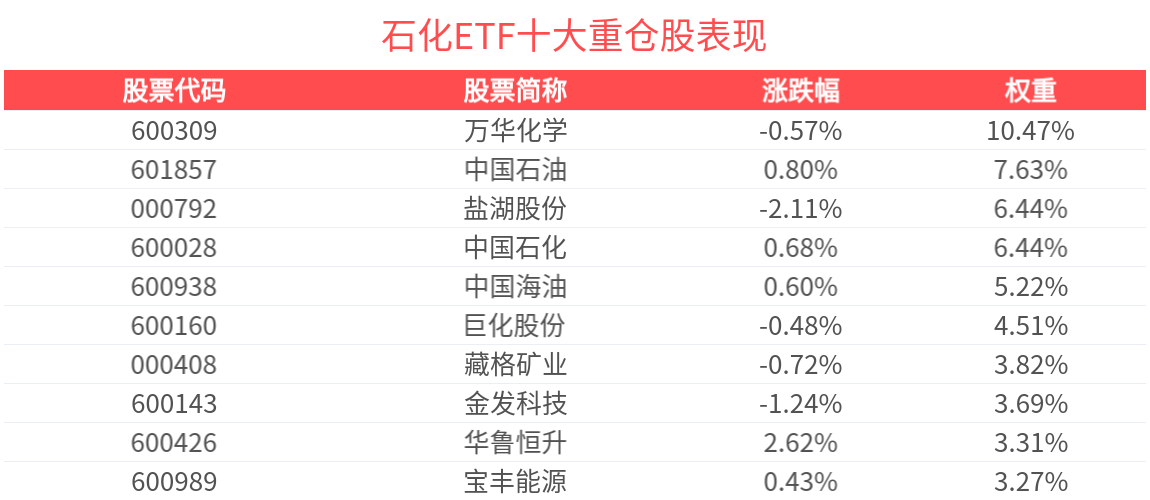
Core Insights - The China Petroleum Industry Index rose by 0.16% as of December 2, 2025, with significant gains from stocks like Hengyi Petrochemical and Tongcheng New Materials [1] - The Petrochemical ETF (159731) experienced a slight decline of 0.12%, priced at 0.83 yuan [1] - Over the past week, the Petrochemical ETF attracted a net inflow of 21.32 million yuan, reaching a new one-year high in both share count and scale [1] Fund Performance - The Petrochemical ETF's net value increased by 28.05% over the past two years, with a maximum monthly return of 15.86% since inception [1] - The longest consecutive monthly gain for the ETF was 7 months, with a total increase of 27.01%, and an average monthly return of 4.96% during rising months [1] - As of December 1, 2025, the ETF outperformed its benchmark with an annualized excess return of 4.62% over the last six months [1] Index Composition - The top ten weighted stocks in the China Petroleum Industry Index account for 56.67% of the index, including Wanhua Chemical, China Petroleum, and Yilong Lake [1] - The individual weightings of these stocks vary, with Wanhua Chemical at 10.47% and China Petroleum at 7.63% [3]







基础化工行业专题:东升西落,全球化工竞争格局的重塑
Guotou Securities· 2025-12-01 05:33
Investment Rating - The report maintains an investment rating of "Outperform the Market - A" for the chemical industry [4]. Core Insights - The global chemical competition landscape is being reshaped, with European and Japanese companies facing capacity exits due to high energy costs and environmental pressures, while Chinese companies are rapidly gaining market share due to significant cost advantages [1][15]. - The EU chemical capacity utilization rate has decreased from 75.6% in Q2 2025 to 74.6% in Q3 2025, significantly below the long-term average of 81.3% [2][31]. - China's chemical industry is characterized by high capital investment and R&D, leading to a strong cost advantage and enhanced global competitiveness [3][36]. Summary by Sections 1. Europe: Dual Dilemma of High Energy Costs and Environmental Pressure - European chemical companies are heavily reliant on natural gas, with over 40% of raw materials sourced from it, leading to increased production costs [20]. - The average wholesale electricity price in the EU rose by 30% year-on-year to $90 per megawatt-hour in H1 2025, expected to be twice that of the US and 1.5 times that of China [2][20]. - The EU's carbon emissions trading system (ETS) and the Carbon Border Adjustment Mechanism (CBAM) are tightening regulations, further squeezing the competitiveness of European chemical products [23][29]. 2. China: Scale Effects and Cost Advantages of Super Factories - China leads globally in chemical capital expenditure and R&D, accounting for 47% and 32% of the global total, respectively [36][38]. - The production capacity of ethylene in China has doubled from 26.69 million tons in 2019 to 54.49 million tons in 2024, with import dependency decreasing from 8.8% to 5.0% [10]. - Major Chinese companies like Wanhua Chemical are expected to further reduce costs through technological upgrades and capacity expansions, enhancing their competitive edge [9][12]. 3. Domestic Chemical Core Assets Exhibit Strong Competitive Strength - The report highlights the increasing global influence of Chinese chemical companies, which are leveraging cost, scale, and technological advantages to expand their market presence [12]. - Key players in the industry include Wanhua Chemical, Hualu Hengsheng, and others, which are positioned to benefit from the ongoing industry consolidation and optimization [12].


如何看大化工的投资机会?
2025-12-01 00:49
Summary of Conference Call on Chemical Industry Investment Opportunities Industry Overview - The chemical industry is currently experiencing historically low gross margins per ton due to rapid domestic capacity expansion leading to oversupply, while demand has not significantly decreased, indicating potential improvement in supply-demand dynamics in the future [1][2][3] - Companies are proactively reducing capital expenditures, with expectations of continued negative growth in capital expenditures for chemical listed companies from 2024 to 2026 [1][2] Supply and Demand Dynamics - Both domestic and international supply sides are showing signs of contraction. Domestically, companies are reducing capital expenditures due to poor profitability, while internationally, the Russia-Ukraine conflict has increased energy costs in Europe and led to operational difficulties for global chemical leaders, accelerating the shutdown of production lines [1][3] - The demand side is expected to recover, with the U.S. entering a rate-cutting cycle, followed by China and the UK, which may lead to a resonance in demand between China and the U.S. [1][3] Emerging Opportunities - New industries such as renewable energy, energy storage, photovoltaics, and AI are expected to drive incremental demand for chemical products, with the industry projected to enter an upward cycle from 2026 to 2027 [1][3] - Recommended sectors include: - **Bottom Elastic Products**: Organic silicon and industrial silicon benefiting from high energy consumption characteristics and energy-saving trends (e.g., Hengsheng Silicon, Xin'an Chemical, Xingfa Group) [1][4] - **Soda Ash**: Benefiting from anti-dumping policies despite expansion (e.g., Boyuan Chemical) [1][4] - **PTA and Polyester Filament**: Stable growth in end-user demand (e.g., Tongkun, Xinfengming) [1][4] Investment Recommendations - Focus on quality stocks with bottom valuations and potential volume growth, such as Wanhua Chemical, Hualu Hengsheng, Longbai Group, and Huahong New Materials [2][4][7] - Growth companies in tires and new materials are also worth attention, such as Sailun Tire, Xin Nuobang, and Shengquan Group, which benefit from AI, new energy development, and domestic substitution [5] Strategic Outlook for 2026 - The strategy for the petrochemical industry in 2026 will adopt a top-down framework due to prolonged low margins (10%-20%) and the completion of capital expenditures in 2023 and 2024 [6][7] - Anticipation of three rate cuts by the Federal Reserve in 2026, reducing rates to around 3%, is expected to support a soft landing for the global economy [6] Key Focus Areas in Petrochemical Sector - The PTA sector is highlighted as a key area of focus, with optimism regarding market corrections and support from national policies [7][8] - Attention should also be given to cyclical sectors, including private refining companies like Satellite Chemical, Baofeng Energy, and Hengli Petrochemical, which are expected to experience reversals [8] Additional Investment Opportunities - Other notable investment opportunities include the POE market and Xinjiang coal chemical stocks, which are expected to perform well due to stable operations and significant profit margin potential [11] - Companies like Aerospace Engineering and 3D Chemical are highlighted for their safety margins and potential valuation recovery due to supportive policies [11]
郑州商品交易所:发挥聚酯期货板块功能 提升重要大宗商品价格影响力
Ren Min Ri Bao· 2025-11-30 22:21
Core Viewpoint - The polyester industry in China plays a crucial role in providing 70% of textile raw materials and is closely linked to daily life, with the Zhengzhou Commodity Exchange (ZCE) developing a comprehensive risk management system for the polyester supply chain since the launch of PTA futures in 2006 [1][2]. Group 1: Risk Management Development - The ZCE has focused on addressing industry pain points by establishing a robust risk management framework for the polyester supply chain, starting with the launch of PTA futures in December 2006 [2]. - The introduction of PTA options in 2019 and short fiber futures in 2020 expanded the risk management tools available to the polyester industry, with further developments in 2023 including PX futures and options [2][3]. Group 2: Functional Impact on the Polyester Industry - The ZCE's polyester futures have significantly transformed trade practices, enhancing supply chain resilience and supporting high-quality development in the polyester sector [4]. - Since 2010, PTA futures have become a key reference for spot pricing, with nearly 100% of PTA spot trades now priced based on "futures price + premium/discount" [4][5]. Group 3: Internationalization and Price Influence - The ZCE is actively working to enhance the international pricing influence of polyester futures, allowing foreign investors to participate in trading since 2018 and hosting international forums to promote these products [6][7]. - The integration of PTA futures into international trade has improved negotiation efficiency and solidified supply chain relationships, exemplified by companies like Hengyi Petrochemical using PTA futures as a pricing benchmark in contracts [7][8]. Group 4: Future Directions - The ZCE aims to refine existing products, expand international outreach, and strengthen regulatory measures to continue supporting the manufacturing sector and contribute to new industrialization efforts [8].
基础化工行业周报:万华上调东南亚及南亚地区MDI价格,韩国提高对华PET薄膜反倾销税-20251130
Huafu Securities· 2025-11-30 12:13
Investment Rating - The report does not explicitly state an investment rating for the industry Core Views - The chemical sector has shown positive performance with the Shanghai Composite Index rising by 1.4%, the ChiNext Index by 4.54%, and the CSI 300 by 1.64% during the week. The CITIC Basic Chemical Index increased by 3.49%, and the Shenwan Chemical Index rose by 2.98% [2][14] - Key sub-industries within the chemical sector have experienced varied performance, with membrane materials leading at 7.48% growth, followed by titanium dioxide at 5.85% and chlor-alkali at 4.57% [2][17] Summary by Sections Industry Dynamics - Wanhua Chemical announced a price increase of $200/ton for MDI products in Southeast Asia and South Asia starting December 1, 2025, due to market conditions and supply stability [3] - South Korea raised anti-dumping duties on PET film imports from China, significantly increasing the tax rate on Tianjin Wanhua's products from 3.84% to 36.98% [3] Investment Themes - **Tire Sector**: Domestic tire companies are becoming increasingly competitive, with a focus on scarce growth targets. Recommended companies include Sailun Tire, Senqcia, General Motors, and Linglong Tire [4] - **Consumer Electronics**: A gradual recovery in consumer electronics is anticipated, benefiting upstream material companies. Key players in the panel supply chain include Dongcai Technology, Stik, Light Optoelectronics, and Ruile New Materials [4] - **Phosphate Chemicals**: Supply constraints due to environmental policies and increasing demand from the new energy sector are tightening the supply-demand balance. Recommended companies include Yuntianhua, Chuanheng Co., Xingfa Group, and Batian Co. [5] - **Fluorochemicals**: The reduction of production quotas for second-generation refrigerants is stabilizing profitability, with a focus on companies like Jinshi Resources and Juhua Co. [5] - **Economic Recovery**: As the economy improves, leading chemical companies are expected to benefit significantly from price and demand recovery. Recommended companies include Wanhua Chemical, Hualu Hengsheng, and Baofeng Energy [9] - **Vitamin Supply Disruptions**: BASF's supply issues with vitamins A and E are expected to create market imbalances, with companies like Zhejiang Medicine and New Hecheng recommended for attention [9] Sub-Industry Reviews - **Polyurethane**: Pure MDI prices in East China rose to 19,700 RMB/ton, a 1.55% increase week-on-week, with operating rates stable at 68% [30] - **Tire Industry**: Full steel tire operating rates increased to 63.91%, while semi-steel tire rates decreased to 72.37% [54] - **Fertilizers**: Urea prices rose to 1,679.1 RMB/ton, with operating rates for urea at 86.4% [67][68] - **Vitamins**: Vitamin A prices remained stable at 63 RMB/kg, while Vitamin E prices fell by 2.88% to 50.5 RMB/kg [86][87] - **Fluorochemicals**: Fluorspar prices decreased to 3,350 RMB/ton, with a decline in operating rates to 34.12% [91]
石油化工行业周报第430期(20251124—20251130):地缘缓和预期下油价低位震荡,关注OPEC+产量政策-20251130
EBSCN· 2025-11-30 08:36
2025 年 11 月 30 日 行业研究 地缘缓和预期下油价低位震荡,关注 OPEC+产量政策 ——石油化工行业周报第 430 期(20251124—20251130) 要点 地缘冲突缓和预期走强,本周油价低位震荡。本周俄乌和平谈判重启,地缘 冲突缓和预期驱动油价振荡加剧,但俄乌双方在核心问题的谈判尚未取得进 展,且 OPEC+增产幅度有望放缓,使得本周油价整体呈低位震荡态势。截至 11 月 28 日,布伦特、WTI 原油分别报收 62.32、58.48 美元/桶,较上周收盘 分别-0.3%、+0.9%。 俄乌谈判核心问题仍存分歧,地缘风险有望持续支撑油价。本周美国与乌克 兰代表在日内瓦举行谈判,美国宣布在达成和平协议方面取得巨大进展,使得 市场对俄乌实现和平预期走强,原油的地缘政治溢价下跌。但是,美乌谈判代 表未透露涉及俄乌重大分歧的具体解决方案,包括领土、乌克兰军队规模、乌 克兰加入北约等众多核心问题。截至本周五,谈判尚未取得任何成果。今年以 来美国数次试图调停俄乌冲突,但我们认为目前美、俄、乌、欧四方就俄乌冲 突的核心问题达成一致的可能性较低,俄乌冲突仍存长期化趋势。此外,委内 瑞拉局势紧张程度不断升 ...
基础化工行业周报:辛醇、锦纶切片价格上涨,关注反内卷和铬盐-20251130
Guohai Securities· 2025-11-30 07:01
Investment Rating - The report maintains a "Recommended" rating for the chemical industry [1] Core Insights - The chemical industry is expected to benefit from a shift in supply chain dynamics due to geopolitical tensions, particularly in semiconductor materials, leading to accelerated domestic replacements [5][6] - The chromium salt industry is experiencing a value reassessment driven by increased demand from AI data centers and commercial aircraft engines, with significant price increases noted [8][9] - The report highlights a potential upturn in the chemical industry as supply-side constraints and rising demand could enhance profitability and dividend yields for leading companies [6][10] Summary by Sections Industry Performance - The basic chemical sector has shown a 24.0% increase over the past 12 months, outperforming the CSI 300 index, which increased by 16.9% [3] Key Opportunities - Focus on low-cost expansion opportunities in companies such as Wanhua Chemical and Hualu Hengsheng, as well as sectors like tire manufacturing and pesticide formulations [6][9] - Emphasis on sectors with improving market conditions, including chromium salts, phosphate rock, and polyester filament [9][10] Price Trends - Recent price increases for key products include chromium oxide green at 35,500 CNY/ton and metallic chromium at 84,000 CNY/ton, both up by 1,000 CNY/ton from the previous week [8][16] - The report notes a tightening supply for isooctanol, with prices rising due to increased demand and production disruptions [13] Company Focus - The report identifies several key companies for investment, including Dongfang Shenghong, Hubei Yihua, and Wanhua Chemical, with positive earnings forecasts and attractive price-to-earnings ratios [28]


化工2025年三季报总结:化工产能周期拐点的再确认
Guotou Securities· 2025-11-30 04:03
Investment Rating - The report does not explicitly provide an investment rating for the chemical industry Core Insights - The chemical industry is experiencing a slight recovery in profitability, with a year-on-year increase in net profit of 7.54% for the first three quarters of 2025, reversing the declining trend since 2022 [20][23] - The overall revenue for the chemical industry increased by 2.96% year-on-year, reaching 18,663.84 billion yuan [20][23] - The CCPI index averaged 4021.69 points in Q3 2025, reflecting a year-on-year decrease of 11.37% and a quarter-on-quarter decrease of 1.90%, indicating that product prices remain at a low level [20][23] Summary by Sections 1. Revenue and Profit - The chemical industry achieved a revenue of 18,663.84 billion yuan in Q1-Q3 2025, up 2.96% year-on-year, and a net profit of 1,126.98 billion yuan, up 7.54% year-on-year, marking a significant recovery from the previous decline [20][23] - In Q3 2025, the industry recorded a revenue of 6,398.78 billion yuan, which is a slight decrease of 0.08% quarter-on-quarter but an increase of 2.27% year-on-year [23] 2. Profitability - The overall gross margin for the chemical industry in Q1-Q3 2025 was 17.10%, an increase of 0.23 percentage points year-on-year, while the net profit margin was 6.04%, up 0.26 percentage points year-on-year [2] - Specific sub-industries showed significant improvements in profitability, including pesticides (+31,346.91%), fluorochemicals (+124.56%), and adhesives and tapes (+91.69%) [28][30] 3. Cash Flow - The operating cash flow for the chemical industry increased by 20.33% year-on-year in Q1-Q3 2025, indicating strong cash flow management [3] - The net cash ratio has remained above 1 since 2018, reflecting good profitability quality within the industry [3] 4. Investment and R&D - The growth rate of construction projects in the chemical industry has slowed, with a total of 368.08 billion yuan in construction projects as of Q1-Q3 2025, down 16.66% year-on-year [10] - The capital expenditure for the industry in Q3 2025 was 57.919 billion yuan, up 10.81% year-on-year, but the overall trend in capital expenditure as a percentage of revenue is declining [10] 5. Debt Servicing Ability - The asset-liability ratio for the chemical industry was 45.21% as of Q3 2025, showing a slight improvement and indicating manageable debt levels [3][9] 6. Investment Recommendations - The report suggests focusing on four main investment lines: upstream resource assets with strong profitability certainty, supply-side optimization products, low-position leading stocks, and new productivity investment directions during the 14th Five-Year Plan [11][12][14][15]
大炼化周报:己内酰胺减产挺价,锦纶纤维价差收窄-20251129
Xinda Securities· 2025-11-29 14:38
Investment Rating - The report does not explicitly state an investment rating for the petrochemical industry. Core Insights - The report highlights the impact of production cuts in caprolactam on pricing stability, while the price spread for nylon fibers has narrowed [2]. - Domestic key refining project price spread increased to 2425.48 CNY/ton, a week-on-week rise of 29.04 CNY/ton (+1.21%), while international key refining project price spread decreased to 1277.36 CNY/ton, a decline of 151.77 CNY/ton (-10.62%) [3]. - Brent crude oil weekly average price was reported at 63.18 USD/barrel, reflecting a decrease of 1.05% [2]. Refining Sector Summary - The report discusses the geopolitical situation regarding the Russia-Ukraine peace plan, which has led to fluctuations in international oil prices. Brent and WTI crude prices were reported at 63.20 and 58.55 USD/barrel respectively, with slight increases from the previous week [14]. - Domestic refined oil prices showed minor fluctuations, with diesel, gasoline, and aviation kerosene averaging 6787.00, 7603.14, and 5905.76 CNY/ton respectively [14]. Chemical Sector Summary - The chemical products market experienced a general decline in prices due to weak demand, with notable decreases in polyethylene price spreads [2]. - The report indicates that the nylon fiber price spread has narrowed significantly due to rising costs in the caprolactam market, despite being in a traditional demand off-season [2]. Polyester & Nylon Sector Summary - Polyester cost remained stable, while nylon costs increased significantly, leading to a notable narrowing of the price spread for nylon fibers [2]. - The report mentions that the polyester upstream prices for PX and MEG have slightly decreased, while PTA prices have shown a slight increase [2]. Key Refining Companies Performance - The report provides stock performance data for six major refining companies, with notable weekly changes including Rongsheng Petrochemical (-0.92%) and Xin Fengming (+7.08%) [2].
降息周期下的石化行情展望 | 投研报告
Zhong Guo Neng Yuan Wang· 2025-11-28 02:05
Group 1: Oil Market Insights - OPEC+ will pause production increases in the first quarter of next year [1] - U.S. shale oil production may face cost pressures that could limit further output [1] - The supply-demand balance may see easing pressure in the second half of next year [1] Group 2: Petrochemical Industry - The PX-PTA-polyester industry chain is expected to see a recovery in profitability [2] Group 3: Investment Recommendations - In a defensive market phase or when oil prices stabilize, it is advisable to focus on major Chinese oil companies: China National Petroleum, China Petroleum & Chemical, and China National Offshore Oil [3] - After oil prices hit bottom, large refining companies may experience a turnaround, with a recommendation to pay attention to Rongsheng Petrochemical [3] Group 4: Specific Companies - For PTA and polyester sectors, the decline in long fiber inventory combined with reduced competition suggests monitoring Xin Fengming [4]