华润啤酒

Search documents
2025年第43周:酒行业周度市场观察
艾瑞咨询· 2025-10-29 00:07
Group 1 - The white liquor industry is embracing "instant retail" due to high inventory, price inversion, and changing consumer preferences, with major brands collaborating with platforms for rapid delivery services [3] - The golden era of the white liquor industry is ending, marked by significant price drops and a shift towards mid-to-low-end products as younger consumers prefer lower alcohol content and casual consumption [4] - The instant retail model is gaining traction, with Douyin's liquor GMV increasing by 71% month-on-month, indicating a strong growth potential in the market [5] Group 2 - Emotional value is becoming a key driver in liquor consumption, with younger consumers prioritizing brands that resonate with their emotional needs, leading to a shift in marketing strategies [6] - The white liquor industry is undergoing deep adjustments, with a focus on innovation and adapting to new consumer demands, moving from financial attributes back to the essence of consumption [8] - The whiskey market is experiencing a historic turning point, surpassing brandy in imports, driven by changing consumer preferences and market dynamics [9] Group 3 - The white liquor market is entering a peak season, with sales accelerating, particularly in the sub-300 yuan price range, as consumers shift towards more rational purchasing behaviors [10] - The beer industry is witnessing a transformation, with leading companies like China Resources Beer gaining market share and craft beer breaking traditional channel monopolies [11] - Instant retail is rapidly penetrating the liquor industry, with major brands adapting to new consumption patterns, although challenges remain in maintaining brand value and profitability [12] Group 4 - Companies like Zou Wang are leveraging traditional and health-oriented products to navigate the current market adjustments, focusing on consumer needs and innovative strategies [13][14] - Qingdao Beer is enhancing its brand through strategic partnerships, such as with the Australian Open, to connect sports and beer culture [15] - Fenjiu is integrating cultural elements into its branding strategy, collaborating with heritage artisans to elevate its market presence [16] Group 5 - Jinpai is focusing on health and youth-oriented products, promoting a healthy drinking culture while expanding its market reach [17] - Hengshui Laobaigan is maintaining strategic focus while innovating to meet changing consumer demands, showcasing a model of resilience in the industry [18] - The SIP Cocktail Festival in Shanghai is promoting cocktail culture, reflecting the growing market for cocktails among younger consumers [19] Group 6 - The internationalization of Chinese liquor culture is highlighted through exhibitions showcasing traditional craftsmanship, enhancing global recognition [20] - Siute's strategic focus on brand elevation and market expansion is indicative of a broader trend towards collaborative and sustainable growth in the liquor industry [21][22] - Guyue Longshan's partnership with China Resources Beer aims to innovate and attract younger consumers through new product offerings [23] Group 7 - Jiugui Liquor is implementing innovative marketing strategies to strengthen its brand connection with consumers during festive seasons [24]


中国必选消费品10月成本报告:包材价格上行,啤酒现货成本指数同比上涨
Haitong Securities International· 2025-10-28 15:13
Investment Rating - The report provides various investment ratings for companies in the consumer staples sector, with "Outperform" ratings for companies like China Feihe, Haidilao, and China Resources Beer, while Budweiser APAC is rated as "Neutral" [1]. Core Insights - The report highlights a rise in packaging material prices and an increase in the beer spot cost index by 2.96% year-on-year, indicating upward pressure on costs in the consumer staples sector [1][35]. - The cost indices for six categories of consumer goods monitored by HTI mostly increased, with notable changes in spot and futures indices across beer, frozen food, soft drinks, instant noodles, dairy products, and condiments [35]. Summary by Category Beer - The beer spot cost index is at 116.32, down 0.06% from last week, while the futures index is at 115.68, up 1.2% [13]. - Year-to-date, the spot index has decreased by 0.86%, and the futures index has decreased by 7.13% [14]. Condiments - The condiments spot cost index is at 100.51, down 0.1%, and the futures index is at 101.3, up 1.55% [17]. - Year-to-date, the spot index has decreased by 2.66%, and the futures index has decreased by 7.47% [17]. Dairy Products - The dairy products spot cost index is at 101.25, down 0.13%, and the futures index is at 91.04, up 0.69% [20]. - Year-to-date, the spot index has decreased by 2.89%, and the futures index has decreased by 3.28% [20]. Instant Noodles - The instant noodles spot cost index is at 103.62, down 0.23%, and the futures index is at 102.53, up 0.88% [23]. - Year-to-date, the spot index has decreased by 2.29%, and the futures index has decreased by 5.47% [24]. Frozen Food - The frozen food spot cost index is at 120.39, up 1.02%, and the futures index is at 119.44, up 1.72% [28]. - Year-to-date, the spot index has decreased by 0.17%, and the futures index has decreased by 1.35% [28]. Soft Drinks - The soft drinks spot cost index is at 109.39, up 0.22%, and the futures index is at 109.26, up 0.72% [31]. - Year-to-date, the spot index has decreased by 3.04%, and the futures index has decreased by 9.54% [31].




华润啤酒亮相2025ESG中国·创新年会 以“国麦振兴”与绿色实践引领行业未来
Zheng Quan Ri Bao Wang· 2025-10-28 12:00
Core Insights - The ESG China Innovation Conference (2025) and the first ESG International Expo were successfully held in Beijing, focusing on "full-chain innovation leading green transformation" [1] - The "National Barley Revitalization" initiative by China Resources Beer aims to reduce reliance on imported barley, enhancing the resilience of the domestic beer supply chain [2][3] Group 1: ESG Conference and Reports - The "2025 Annual ESG Excellence Practice Report" was released, providing significant reference for industry practices, supported by various governmental and academic institutions [2] - China Resources Beer’s case on "ESG governance leap enabling high-quality development" was selected as an exemplary practice, showcasing its commitment to sustainable practices [2] Group 2: National Barley Revitalization Initiative - The initiative has established 20,000 acres of standardized barley planting bases across key regions, achieving a record yield of 767.5 kg per acre for the "Yangnong Beer 14" variety [3] - The project has improved the income of local farmers through a "quality for price" order agriculture mechanism, contributing to rural revitalization and economic benefits [3] Group 3: ESG Achievements and Recognition - China Resources Beer ranked higher in the "China ESG Listed Company Pioneer 100 (2025)" list, reflecting its strong commitment to ESG principles [4] - The company showcased its achievements in green manufacturing and rural revitalization at the ESG International Expo, emphasizing its role in sustainable practices [5] Group 4: Green and Responsible Practices - The company has implemented various green initiatives, such as lightweight glass bottles and new materials, significantly reducing carbon emissions [5] - The "National Barley Revitalization" project highlights the integration of advanced breeding techniques and sustainable practices in the beer production process [6][7]
白酒借“酒+”模式探索出海新方向
Bei Jing Shang Bao· 2025-10-28 10:09
Group 1 - The report highlights that fine wine serves as a universal language of civilization, fostering an open and inclusive global wine culture through diverse exchanges, demand adaptation, and digital innovation [1][2] - Cross-industry integration and experiential innovation are identified as core pathways for wine culture dissemination, with international wine companies hosting over 200 tasting events in France, receiving positive feedback from 70% of participants [1] - Chinese wine companies are accelerating their international expansion, with Moutai opening an experience center in Germany and Wuliangye collaborating with overseas visa centers to create cultural spaces [1] Group 2 - The domestic wine market is adapting to diverse consumer needs, with overseas markets tailoring products to local dining habits and introducing lower-alcohol options to expand customer bases [2] - Digital transformation is emphasized as a key driver for industry upgrades, with companies like Moutai and Yanghe building intelligent brewing systems and applying AI technology in production control and flavor development [2] - The report stresses that the global wine industry is entering a phase of deep development characterized by cultural mutual learning and technological empowerment, advocating for the preservation of traditional craftsmanship while promoting cultural integration and innovation [2]


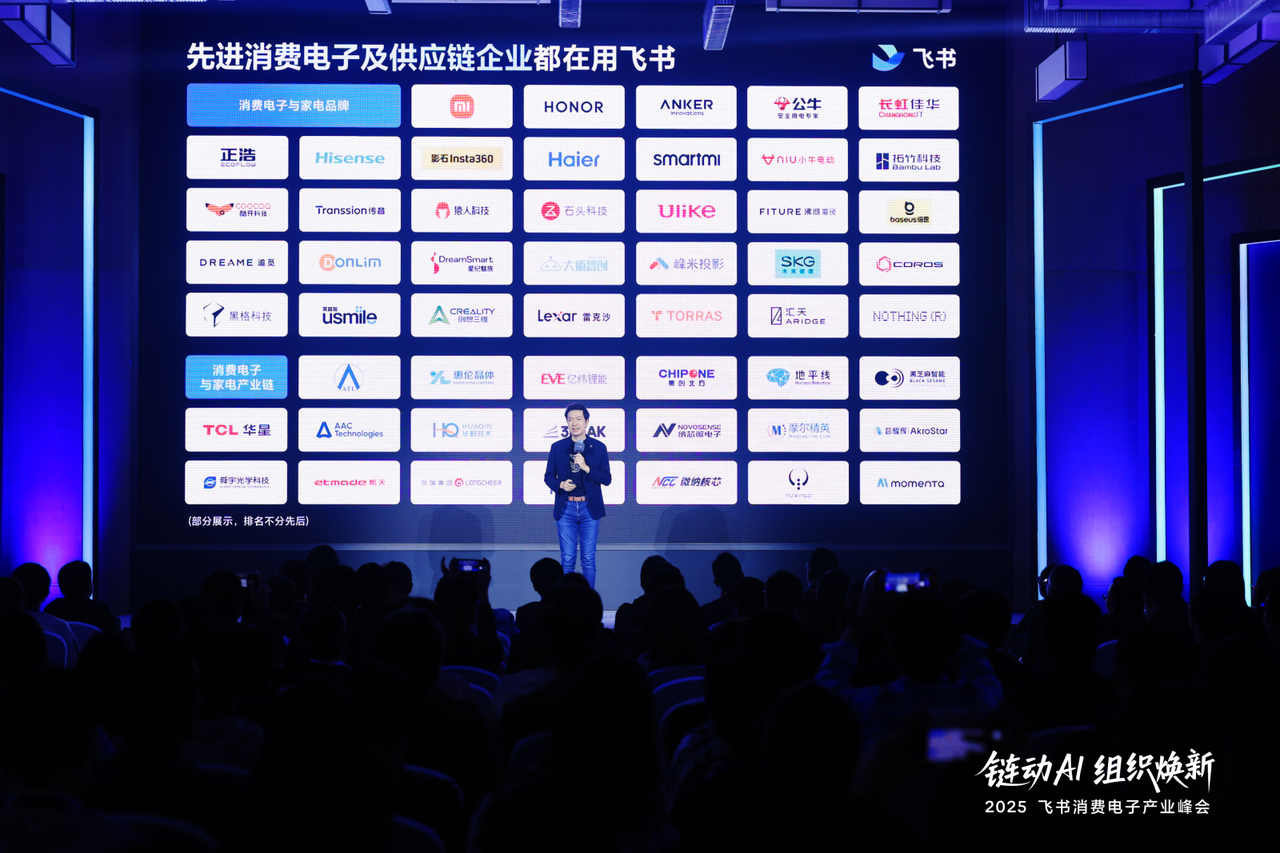
AI赋能“中国速度”,消费电子产业链集体上飞书
Cai Fu Zai Xian· 2025-10-28 09:25
Core Insights - The summit themed "Linking AI, Renewing Organizations" gathered leading companies in the consumer electronics industry to discuss how to leverage digital tools for higher collaboration in the AI era [1][2] - Shenzhen is recognized as a hub for innovation in the consumer electronics sector, showcasing a robust and resilient supply chain [1][2] Industry Trends - China's consumer electronics industry has rapidly risen on the global stage, creating renowned brands and a highly responsive supply chain [2] - The label "Made in China" is increasingly associated with cutting-edge technologies in smartphones, drones, and smart home devices [2] Digital Transformation - Feishu is becoming a common choice among leading Chinese consumer electronics companies, facilitating collaboration across various key segments from brands to supply chains [2] - The platform supports a collective upgrade in the consumer electronics industry, helping brands and supply chain partners adapt to rapid global market changes [2] Operational Efficiency - The consumer electronics sector faces rapid updates and global challenges, emphasizing the need for quick delivery and responsiveness [4] - Feishu's core value lies in creating a closed loop of information, tasks, and knowledge, transitioning companies from passive to proactive operational modes [4] Case Studies - Honor has adopted Feishu for a new work model that enhances online collaboration, achieving 15 million collaborative documents and 2.8 million daily messages [5] - Anker Innovation emphasizes the importance of converting knowledge into data assets, with over 2.9 million documents created and 17,000 meetings held since 2025 [7] - CATL has developed a unified collaboration platform, Alink, which has significantly reduced approval times by 83% and improved knowledge search efficiency by 50% [9] - Huizhou Crystal has improved production management efficiency, reducing sample delivery time from 20 days to just a few days and cutting material waste by approximately 30% [11] Industry Leadership - The president of the China Electronics Chamber of Commerce praised the consumer electronics industry's proactive exploration of organizational collaboration in the AI era [13]
青岛啤酒(600600):需求偏弱之下建议重视股息回报价值
HTSC· 2025-10-28 05:13
Investment Rating - The report maintains a "Buy" rating for the company with target prices of RMB 80.96 for A-shares and HKD 68.49 for H-shares [6][4]. Core Insights - The company reported a revenue of RMB 293.7 billion and a net profit of RMB 52.7 billion for the first three quarters of 2025, reflecting a year-on-year increase of 1.4% and 5.7% respectively. However, the growth rate has slowed in Q3 compared to H1, with Q3 revenue and net profit showing a slight decline [1][2]. - The beer sales volume for the first three quarters of 2025 reached 689.4 million tons, up 1.6% year-on-year, but the average selling price (ASP) decreased by 0.2% due to increased competition and promotional activities [2][3]. - The company is focusing on channel health adjustments and preparing for growth in 2026, with expectations of a consumption recovery improving the company's fundamentals in the medium to long term [1][4]. Financial Performance Summary - For Q3 2025, the company achieved a revenue of RMB 88.8 billion and a net profit of RMB 13.7 billion, with net profit margin increasing by 0.3 percentage points year-on-year due to cost savings and efficient advertising spending [1][3]. - The gross margin for the first three quarters of 2025 was 43.7%, up 1.9 percentage points year-on-year, benefiting from lower raw material costs [3]. - The company has adjusted its earnings per share (EPS) forecasts for 2025-2027, now expecting EPS of RMB 3.45, RMB 3.68, and RMB 3.91, reflecting a downward revision of 2%, 3%, and 5% respectively [4][10]. Market Outlook - The report highlights that the beer market is entering a low season, but anticipates a gradual recovery in mid-to-high-end beer sales as demand from the catering sector improves [2][4]. - The company is strategically positioning itself in the southern market and enhancing its product and channel layout, which is expected to support future growth [1][4].

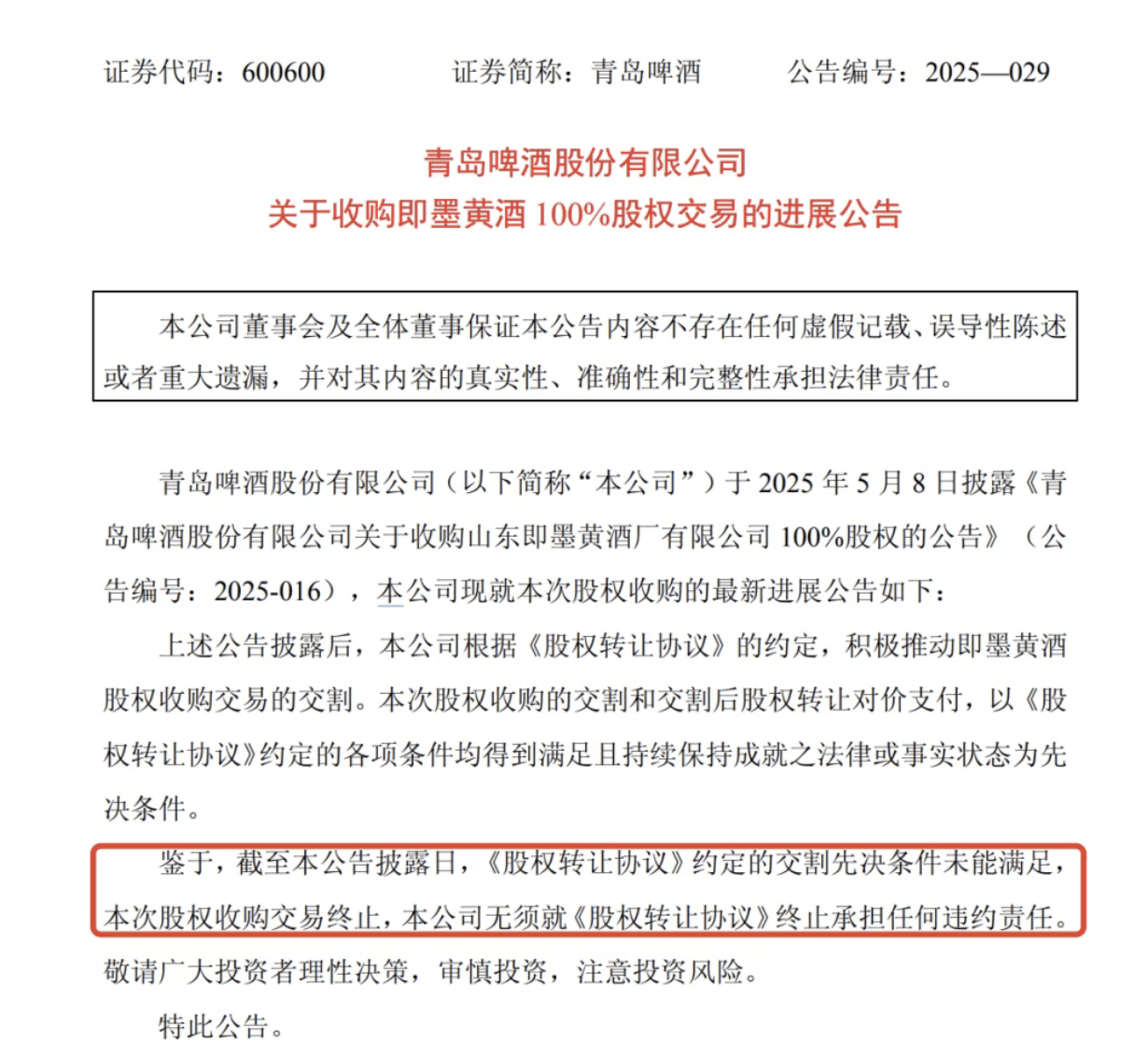
青岛啤酒弃购即墨黄酒,酒业跨界算盘为何总落空?
Sou Hu Cai Jing· 2025-10-27 13:48
Core Viewpoint - Qingdao Beer has decided to terminate its acquisition of 100% equity in Shandong Jimo Yellow Wine Factory for 665 million yuan due to unmet conditions in the share transfer agreement, ending over five months of anticipation [1][3][5]. Group 1: Acquisition Details - The acquisition was initially seen as a strategic move to complement Qingdao Beer's seasonal sales through the integration of beer and yellow wine, leveraging its 11,600 distributors for nationwide expansion [3][5]. - The 120-day delivery period set in the share transfer agreement was not met due to issues such as asset freezing and financial disputes involving the controlling shareholder, leading to the transaction's failure [5][6]. - Jimo Yellow Wine faced significant financial challenges, including a 77% debt ratio and 705 million yuan in total liabilities, which exceeded industry standards [6][8]. Group 2: Financial Implications - Qingdao Beer reported a revenue of 20.491 billion yuan and a net profit of 3.904 billion yuan in the first half of 2025, indicating a 7.21% year-on-year growth, suggesting that the termination of the acquisition will have a limited impact on its overall financial performance [6][8]. - The company’s high-end product sales increased by 5.1%, reflecting the effectiveness of its high-end strategy despite the acquisition setback [6][12]. Group 3: Industry Context - The yellow wine market is significantly smaller than the beer market, with a market size of only 21 billion yuan in 2024, representing less than 12% of the beer market [10]. - The yellow wine industry has experienced a compound annual growth rate of only 3.2% over the past decade, which is considerably lower than the growth rates of beer and white spirits [10][12]. - The challenges of cross-industry acquisitions in the beverage sector are highlighted by previous unsuccessful attempts by other companies, indicating that such strategies may not be effective in overcoming growth bottlenecks [12].
东兴证券晨报-20251027
Dongxing Securities· 2025-10-27 12:11
Economic News - The 28th ASEAN Plus China, Japan, and South Korea Leaders' Meeting emphasized the importance of open cooperation and strategic alignment to enhance economic potential through environmental improvement, deepening industrial chain collaboration, and fostering new growth drivers [1] - Canadian Prime Minister Carney announced plans for significant domestic investment and trade diversification, aiming to double exports to non-U.S. markets over the next decade, exceeding CAD 300 billion [1] - From January to September, profits of large-scale industrial enterprises in China increased by 3.2% year-on-year, marking the highest growth rate since August of the previous year [1] - The China Logistics and Purchasing Federation reported that the total demand for food cold chain logistics in the third quarter reached 117 million tons, a year-on-year increase of 4.72% [1] - The International Monetary Fund (IMF) predicts that the U.S. government's debt burden may exceed that of Italy and Greece for the first time this century, with total debt projected to rise over 20% to 143.4% of GDP by the end of the decade [1] Company Insights - Rio Tinto Group and State Power Investment Corporation launched a pilot project for pure electric battery swap mining trucks at the Oyu Tolgoi copper mine in Mongolia, marking the first use of this technology in an open-pit mine [4] - Yongmaotai reported third-quarter revenue of CNY 1.655 billion, a year-on-year increase of 59.65%, with net profit soaring by 6319.92% to CNY 30.41 million [4] - Delin Hai's third-quarter revenue reached CNY 185 million, up 94.96% year-on-year, while net profit surged by 1322.74% to CNY 48.73 million [4] - Knight Dairy's third-quarter revenue was CNY 246 million, down 6.78%, but net profit increased by 189.26% to CNY 22.73 million [4] - Porsche, a subsidiary of Volkswagen Group, reported a third-quarter loss of EUR 966 million (approximately CNY 8 billion), leading to a 99% year-on-year decline in sales profit for the first three quarters [4] Industry Analysis - The 20th Central Committee of the Communist Party of China emphasized the importance of high-quality development and technological self-reliance as core foundations for future growth, aiming to transition from a follower to a leader in the global industrial chain [6][7] - The meeting highlighted the need to build a modern industrial system and strengthen the real economy, with a focus on becoming a manufacturing, quality, aerospace, transportation, and internet power [6] - The report suggests that the technology sector, particularly those related to self-reliance, will be a key area for investment, with a positive outlook for companies in this space [7] - The food and beverage sector is experiencing a shift towards lower-alcohol products to attract younger consumers, as evidenced by the introduction of new low-alcohol products at recent trade fairs [10][11] - The logistics industry is seeing a recovery in single-ticket revenue, with major players like Shentong and Yunda reporting significant increases in revenue per ticket [22][23] Investment Recommendations - The report recommends focusing on technology sectors, particularly those with strong performance indicators, as the market shifts back to fundamentals with the release of quarterly reports [7] - In the food and beverage sector, attention is drawn to leading companies like Guizhou Moutai, which are showing signs of recovery despite short-term price fluctuations [11] - For the chemical industry, investment opportunities are identified in sectors benefiting from improved supply-demand dynamics and those driven by capital expenditure and R&D [27]





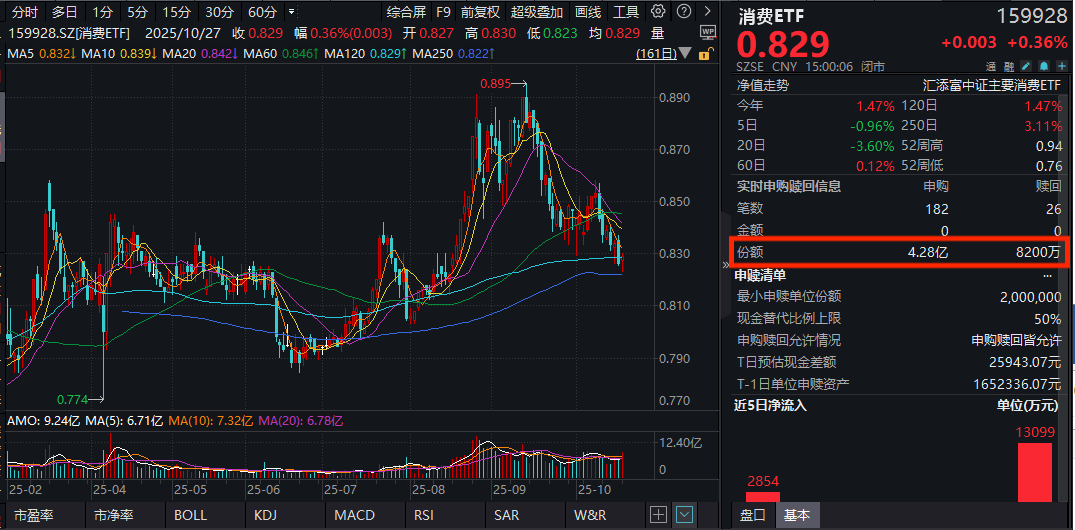
茅台集团换帅!东鹏三季报超预期!消费ETF(159928)收涨0.36%,全天获巨额净申购3.46亿份!机构:关注三季报业绩+提振内需政策
Xin Lang Cai Jing· 2025-10-27 09:57
Group 1: Market Performance - The Shanghai Composite Index increased by 1.18%, approaching the 4000-point mark, with significant trading volume exceeding 9.2 billion yuan, a rise of over 32% compared to the previous period [1] - The Consumption ETF (159928) saw a net subscription of 34.6 million units, accumulating over 1.23 billion yuan in the last 10 days, with its latest scale surpassing 20.4 billion yuan, leading its peers [1][3] Group 2: Economic and Policy Developments - Recent Sino-U.S. trade talks in Kuala Lumpur resulted in a basic consensus on addressing mutual economic concerns, highlighting the importance of consumption and effective investment in the national market [3] - A significant policy announcement on October 23 emphasized the need to boost consumption and eliminate barriers to the construction of a unified national market [3][7] Group 3: Company Updates - Moutai Group appointed a new chairman, Chen Hua, which is expected to enhance collaboration with higher management, while the previous chairman Zhang Deqin stepped down [4][5] - Dongpeng Beverage reported a strong Q3 performance with revenue and net profit increasing by 30.4% and 41.9% year-on-year, respectively, driven by network expansion and consumer promotions [4] Group 4: Investment Opportunities - The consumption sector is expected to play a more prominent role in the economic landscape, with a focus on high-quality consumption supply and mechanisms to stimulate consumption [7][10] - The current valuation of the consumption sector is at historical lows, indicating significant potential for recovery, particularly in sectors like beer, feed processing, and home appliances [11][14][16] Group 5: ETF Insights - The Consumption ETF (159928) is characterized by its resilience across economic cycles, with top holdings including leading liquor brands and major agricultural firms, collectively accounting for over 68% of the index [18][19] - The Hong Kong Consumption 50 ETF (159268) offers a convenient investment option in the consumer sector, supporting T+0 trading and not occupying QDII quotas, appealing to the younger generation's consumption trends [18][19]
在西部见证了一场极致真诚、极具影响力的科技领袖盛会|GTLC成都站圆满落幕
AI前线· 2025-10-27 07:29
Core Viewpoint - The GTLC Global Technology Leadership Conference in Chengdu focused on the theme "AI New 'Shu' Light," featuring over ten prominent speakers discussing AI application ecosystems and corporate transformation, attracting more than 300 participants from various cities [2][3]. Group 1: Event Overview - The conference included high-quality keynote speeches, 11 closed-door sessions, and unique activities such as a football friendly match and self-driving tours, emphasizing both learning and networking [3][57]. - TGO Kunpeng Club, the organizer, has grown its membership significantly over the past decade, aiming to cultivate technology leaders and support their personal and business growth [3][9]. Group 2: Keynote Highlights - The morning session centered on "Industry Exploration in the AI Era," with various speakers sharing insights on practical methodologies for AI integration in businesses [4][13]. - The first speaker, the CIO of Anker Innovation, discussed a three-phase approach for AI implementation, focusing on capability penetration, business integration, and AI-native transformation [13][14]. - The second speaker from China Resources Beer outlined a strategy for intelligent transformation, emphasizing scenario selection and phased implementation to enhance efficiency and reduce costs [17][18]. Group 3: Industry Insights - The discussion on intelligent driving highlighted the challenges and advancements in L4 technology, with companies like Waymo and Cruise leading the way but facing limitations in scalability [20][21]. - A presentation on AI's role in community operations emphasized the importance of leveraging AI as a "fourth super lever" to enhance individual and organizational effectiveness [23][24]. - The roundtable discussion on AI model applications reflected on the current state of AI in both consumer and business sectors, identifying gaps and future directions for practical applications [27][28]. Group 4: Afternoon Sessions - The afternoon sessions continued to explore AI's impact across various sectors, including finance, hardware, and education, with speakers sharing their experiences and methodologies for successful AI integration [30][34]. - A former executive from Suning discussed the importance of product-centric approaches in building intelligent enterprises, advocating for a shift from human-driven processes to product-driven operations [34][35]. - The chief model scientist from BaiRong AI presented a comprehensive methodology for applying large models in finance, showcasing successful implementations in marketing and customer service [37][39]. Group 5: Closing Thoughts - The conference concluded with reflections on the challenges and opportunities in AI education, emphasizing the need for a deep understanding of educational principles alongside technological advancements [48][50]. - The event also featured various networking opportunities, including closed-door meetings and social activities, fostering connections among technology leaders and participants [51][57].