
一汽集团

Search documents
中国汽车第一城易主
Di Yi Cai Jing Zi Xun· 2026-01-06 01:20
Core Insights - The competition for the title of "Automobile Capital" in China by 2025 is intensifying, with Chongqing currently leading in overall vehicle production and Hefei excelling in the new energy vehicle segment [1][2]. Group 1: Chongqing's Position - Chongqing's vehicle production reached 2.4981 million units from January to November 2025, marking a 12.1% year-on-year increase, solidifying its status as a leading automobile city [2]. - The city is home to traditional brands like Changan and emerging players like Seres, contributing to its competitive edge [2]. Group 2: Hefei's Growth - Hefei produced 1.246 million new energy vehicles in the same period, ranking first among cities in this category [4]. - The city aims to achieve a scale of 700 billion yuan in its new energy vehicle industry by 2025, with a target of producing over 3 million vehicles [4]. Group 3: Other Competitors - Anhui province, with a total vehicle production of 3.335 million units and 1.635 million new energy vehicles, has surpassed Guangdong to become the leading province [3]. - Cities like Wuhu and Liuzhou are also making significant strides, with Wuhu's production expected to rise and Liuzhou achieving a vehicle production of 1.331 million units, a 37.8% increase [5][4]. Group 4: Emerging Cities - Cities such as Xi'an, Zhengzhou, and Qingdao are approaching the "million vehicle" production threshold, with Xi'an producing 1.576 million vehicles and Zhengzhou showing a significant year-on-year growth of 89.72% [9]. - Qingdao's production reached 911,700 units, supported by major manufacturers like SAIC-GM Wuling and Chery [10]. Group 5: Challenges for Major Cities - Shenzhen's automotive production has declined, with the city no longer maintaining a competitive edge in vehicle production due to statistical adjustments [7]. - Guangzhou's traditional vehicle production fell by 20%, indicating a significant transition challenge [8].

2025车市收官:零跑领跑新势力,比亚迪反超特斯拉
Xin Lang Cai Jing· 2026-01-05 11:45
Industry Overview - In October 2025, China's new energy vehicle (NEV) sales reached approximately 1.715 million units, accounting for 51.6% of total new car sales, marking a significant shift in the market dynamics [1][11] - By November 2025, the penetration rate of NEVs further increased to 53.2%, indicating a transition from niche to mainstream consumer choice [1][11] - The automotive market is expected to face challenges as multiple consumer stimulus policies are set to exit, leading to a return to a demand-supply driven seasonal operation [1][12] New Entrants and Performance - Leap Motor emerged as the top new force with 596,600 units delivered, surpassing competitors like NIO, Xiaopeng, and Hongmeng Zhixing [3][14] - Xiaopeng Motors delivered 429,400 units, while Li Auto and NIO delivered 406,300 and 326,000 units respectively, with NIO experiencing a significant sales boost in Q4 due to the new ES8 model [3][14] - Xiaomi Auto achieved over 410,000 units, exceeding its target of 350,000 units, and plans to challenge a target of 550,000 units in 2026 [6][16] Established Brands Performance - BYD sold 4.6024 million vehicles globally, achieving its target and becoming the world's top seller of pure electric vehicles with 2.26 million units sold, a 28% year-on-year increase [7][17] - Geely and Changan both met their sales targets, with Geely selling 3.0246 million vehicles and Changan reaching 2.913 million, with significant growth in their NEV segments [8][18] - Great Wall Motors and Chery reported sales of 1.3237 million and 2.6314 million units respectively, with Chery's sales boosted by its collaboration with Huawei [8][18] Market Dynamics and Future Outlook - The competition among new entrants and established brands is intensifying, with the market expected to undergo significant changes as policy support diminishes [1][12] - The automotive industry is preparing for a challenging 2026, with various companies adjusting their strategies to maintain competitiveness [1][12]



中国电泳漆市场现状研究分析与发展前景预测报告
QYResearch· 2025-12-31 09:24
Core Viewpoint - The electrophoretic paint market in China is characterized by moderate scale, technical intensity, and stable growth, driven by both domestic demand and global industry trends. The market is expected to grow from $1,504.1 million in 2024 to $1,855.5 million by 2031, with a CAGR of 2.80% from 2025 to 2031 [3][9]. Market Size and Growth Trends - The Chinese electrophoretic paint market is projected to reach $1,504.1 million in sales revenue by 2024 and $1,855.5 million by 2031, indicating a stable growth trend with a CAGR of 2.80% from 2025 to 2031 [3]. Demand Analysis - The automotive and home appliance sectors are the primary consumers of electrophoretic paint, with automotive applications requiring high corrosion resistance and compatibility with subsequent coatings. The demand from the home appliance sector is characterized by large-scale, standardized needs [9]. Competitive Landscape - The market features a mix of international giants and local specialized manufacturers. Multinational companies dominate the high-end market due to their advanced formulation technologies and relationships with major automotive manufacturers, while local firms excel in the mid-to-low-end market segments [10][13]. Key Players - Major players in the Chinese market include PPG Industries, BASF, Haolisen, Xiangjiang Kansai, Axalta, Nippon Paint, and Jinlitai, with the top three companies holding approximately 38.63% of the market share in 2024 [13]. Industry Chain Analysis - Upstream - Key raw materials for electrophoretic paint include resins, solvents, additives, and pigments, with the chemical industry being the primary upstream sector. The market is competitive, and product costs are closely linked to fluctuations in crude oil prices [16]. Industry Chain Analysis - Midstream - Foreign brands hold a strong position in the automotive OEM paint sector, with six major companies controlling about 90% of the market share in automotive coatings. Domestic companies are gradually gaining market share in non-passenger vehicle segments [17]. Industry Chain Analysis - Downstream - The downstream industries include automotive manufacturing and other sectors such as engineering machinery, motorcycles, hardware, and home appliances, which are closely tied to macroeconomic conditions and exhibit cyclical characteristics [18]. Development Drivers - Key drivers for the industry include government support for environmentally friendly coatings, advancements in technology leading to diverse and functional products, and stable growth in downstream industries such as automotive and home appliances [21]. Development Constraints - The industry faces challenges such as risks from macroeconomic fluctuations, volatility in raw material prices, and intense competition, particularly from foreign brands in the high-end market [21].
错过最佳时机 一汽投资零跑多花了15倍
Zhong Guo Jing Ji Wang· 2025-12-31 09:17
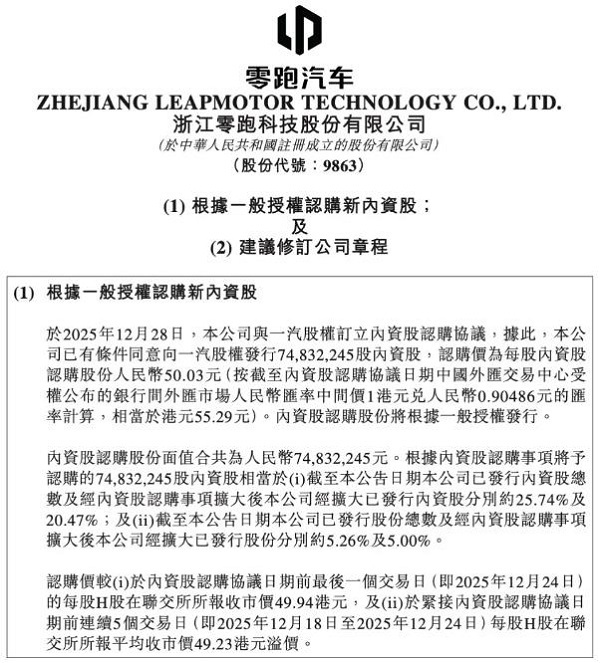
Core Viewpoint - Leap Motor has entered into a domestic share subscription agreement with FAW Group, raising approximately 3.744 billion RMB by issuing 74.8322 million shares at 50.03 RMB per share, making FAW a significant strategic shareholder with a 5% stake in the expanded total shares of 1.497 billion [1][8]. Group 1 - Leap Motor's founder, Zhu Jiangming, emphasized the importance of maintaining control over the company during a media communication session, despite the new investment from FAW and Stellantis [5][10]. - The company has experienced a tumultuous journey over the past decade, including a significant drop in share price upon its Hong Kong debut, but has since achieved a monthly sales record of 70,000 vehicles [7][15]. - The recent investment from FAW is seen as a recognition from a state-owned enterprise, which could enhance Leap Motor's brand credibility and market presence in China [14]. Group 2 - Following the subscription, Stellantis's stake will decrease to 18.99%, while the founding team will still hold the largest single shareholder group at 22.56% [8][9]. - Leap Motor's strategy focuses on stability, with significant investments from established automotive giants, which is expected to strengthen its market position and operational efficiency [14][17]. - The company plans to allocate 50% of the funds raised from the FAW investment towards research and development, ensuring ongoing innovation and sustainability [17].
重卡行业月度跟踪系列:十一月总量延续高涨,年末抢装下新能源激增-20251231
Changjiang Securities· 2025-12-31 00:13
Investment Rating - The report maintains a "Positive" investment rating for the heavy truck industry [3] Core Insights - The heavy truck industry continues to show high prosperity, driven by policies encouraging vehicle replacement and increasing demand for new energy vehicles [10][51] - The report highlights three main drivers of growth: low oil and gas price differentials, a surge in new energy vehicle sales due to year-end purchasing incentives, and strong export demand, particularly from Africa [30][48][71] Summary by Sections Overall Performance - In November 2025, wholesale heavy truck sales reached 113,000 units, a year-on-year increase of 65.3% and a month-on-month increase of 6.6% [10] - Heavy truck registration sales were 77,000 units, up 34.4% year-on-year and 9.4% month-on-month [10] - Heavy truck exports totaled 34,000 units, reflecting a year-on-year increase of 38.2% but a month-on-month decrease of 8.3% [10] Key Drivers - **Oil and Gas Price Differential**: The oil and gas price differential remains low, with liquefied natural gas priced at 4,213.7 RMB/ton and diesel at 6,883.8 RMB/ton, resulting in a differential of 2,670 RMB/ton [33] - **New Energy Vehicle Surge**: The new energy heavy truck registration reached 28,000 units in November 2025, marking a 192.6% increase year-on-year and a 40.8% increase month-on-month [51] - **Export Demand**: Heavy truck exports to Africa reached 14,111 units, a significant year-on-year increase of 99.7% [76] Market Segmentation - **By Purpose**: In November 2025, logistics vehicle registration was 60,000 units, up 39.7% year-on-year, while engineering vehicle registration was 17,000 units, up 18.6% year-on-year [13][23] - **By Energy Type**: Natural gas heavy truck registrations were 19,000 units, up 70.7% year-on-year, while new energy heavy trucks accounted for 28,000 units, with a penetration rate of 36.4% [51][38] Company Performance - The top three heavy truck manufacturers in November 2025 were China National Heavy Duty Truck Group, FAW Group, and Dongfeng Motor, with sales of 29,000, 24,000, and 17,000 units respectively [13][27] - The market shares for these companies were 25.5%, 21.0%, and 15.2%, showing varying changes compared to the previous year [27] Inventory Trends - Both enterprises and channels are increasing inventory levels, with a slight rise in inventory by 0.1 thousand units for enterprises and 0.3 thousand units for channels in November 2025 [14]


早报 | 贵金属大跳水;乌91架无人机袭击普京官邸?特朗普很生气;解放军无人机俯瞰台北101大厦;王忠磊、王忠军被限高
虎嗅APP· 2025-12-29 23:59
Group 1 - Precious metals, led by silver, experienced significant price corrections after a recent surge, with silver dropping over 8% and gold falling nearly $200 in a single day [2] - The Chicago Mercantile Exchange raised margin requirements for several popular futures contracts, including silver and gold, to mitigate market volatility [2] - The price of platinum and palladium also saw substantial declines, with platinum down nearly 13% and palladium over 15% [2] Group 2 - Labubu blind box prices have drastically decreased from previous highs, with the second-hand market seeing prices drop from over 4,600 yuan to around 260 yuan [5][7] - Morgan Stanley reported that Pop Mart is transitioning from explosive growth to sustainable growth, predicting a slowdown in revenue growth for Labubu by 2026 [7] Group 3 - Huayi Brothers and its founders are facing legal and financial issues, with a court restricting high consumption due to a 74.73 million yuan enforcement case [8] - The company has been involved in multiple legal disputes, indicating potential financial instability [8] Group 4 - SoftBank is in talks to acquire DigitalBridge Group, which manages over $100 billion in data center assets, as part of its strategy to enhance its data infrastructure [9] - DigitalBridge's stock surged by 45% in pre-market trading following news of the potential acquisition [9] Group 5 - The People's Bank of China announced a new action plan for digital yuan management, set to be implemented on January 1, 2026, with significant transaction volumes already recorded [10][11] - By November 2025, digital yuan transactions reached 34.8 billion, totaling 16.7 trillion yuan, indicating strong adoption [11][12] Group 6 - Zero Run Auto announced a 3.744 billion yuan investment from FAW Group, which will help enhance the company's stability and risk management capabilities [32] - The investment agreement ensures that the founding team retains control, reflecting a strategic partnership for future growth [32]

今日新闻丨一汽正式入股零跑!吉利千里智驾完成整合!
电动车公社· 2025-12-29 16:55
Group 1 - The core viewpoint of the article highlights the unprecedented collaboration between traditional automaker FAW Group and the new energy vehicle brand Leap Motor, with FAW investing 3.744 billion yuan for a 5% stake in Leap Motor [1][3] - This partnership is expected to leverage FAW's advanced supply chain capabilities, internal combustion engine R&D, and extensive distribution network alongside Leap Motor's self-developed intelligent and electrification technologies, creating a win-win situation for both parties [3] Group 2 - Geely has completed the integration of its intelligent driving division, aiming to enhance innovation and delivery efficiency in the field of advanced driver assistance systems [4] - Despite significant R&D investments in the driver assistance sector, user feedback indicates that Geely has not achieved a dominant lead over competitors, prompting the consolidation of its previously dispersed teams to focus efforts and potentially gain an advantage in a competitive market [6]

汽车行业 2026 年度投资策略报告:不必悲观,结构存机会-20251227
Guohai Securities· 2025-12-27 13:27
Core Insights - The report maintains a "Recommended" rating for the automotive industry, emphasizing that there are opportunities despite potential challenges in 2026 [1][2] - The automotive sector showed a 20% increase over the past 12 months, outperforming the Shanghai and Shenzhen 300 index, which increased by 16.8% [3] Group 1: Industry Overview - The automotive industry is expected to experience a strong performance in commercial vehicles while passenger vehicles may face challenges in 2026 [4] - The report highlights that the passenger vehicle market in 2025 was supported by trade-in policies, leading to stable performance, but anticipates pressure on total volume in 2026 [4] - The heavy truck segment is projected to see positive growth in 2026, driven by domestic demand recovery and increased exports [4] Group 2: Opportunities in Passenger Vehicles - The report identifies a significant opportunity in the high-end passenger vehicle market, particularly for models priced above 300,000 yuan, which is expected to continue to grow [4][5] - Domestic brands are anticipated to make substantial advancements in the high-end market with new models launching in 2026 [5] Group 3: Heavy Truck Market Insights - The heavy truck market is expected to benefit from a recovery in domestic demand and a favorable export environment, with wholesale volumes projected to grow positively in 2026 [4][5] - The report notes that the penetration rate of electric heavy trucks may stabilize in 2026 after significant increases in 2025, which could positively impact profitability [5] Group 4: Smart Driving and Technology - The report discusses the acceleration of high-level autonomous driving technology penetrating lower-priced models, which is expected to drive volume growth in 2026 [5] - The introduction of new AI-driven cockpit technologies is anticipated to enhance the value of smart cabins, creating additional investment opportunities in related components [5] Group 5: Robotics Sector - The report indicates that the humanoid robotics sector is entering a new phase, with significant growth potential for leading manufacturers and their supply chains [5] - The collaboration between domestic and international manufacturers is expected to enhance production capabilities and technological advancements in humanoid robots [5] Group 6: Investment Recommendations - The report recommends several companies for investment, including Jianghuai Automobile, Top Group, and BYD, highlighting their potential in the evolving automotive landscape [6][9] - Specific recommendations for heavy truck manufacturers include China National Heavy Duty Truck Group and Weichai Power, which are expected to benefit from industry growth [6][9]



航天智造(300446) - 投资者关系活动记录表
2025-12-26 12:15
Group 1: Automotive Parts Business Performance - The company's automotive parts business achieved a revenue growth of 25% year-on-year, surpassing the passenger car sales growth rate of 13.7% [3] - Key advantages driving this growth include strong customer resources and brand partnerships with major manufacturers like Geely, Changan, and BYD [3] - The company has established a comprehensive industrial layout with over 20 production bases, ensuring rapid response to customer demands [3] Group 2: Research and Development Collaboration - The company collaborates closely with vehicle manufacturers, where the manufacturers lead the vehicle definition and design, while the company focuses on high-quality component production [4] - The company possesses a national recognized laboratory and four provincial technology centers, with a total of 587 patents, including 67 invention patents [3][4] Group 3: Weather-Resistant Materials - The company’s weather-resistant materials, including light stabilizers and antioxidants, are primarily exported to Europe, America, and the Middle East, with a sales revenue of 39.52 million yuan in the first half of 2025 [6] - These materials are used in various applications, including agricultural films and modified products, targeting mid-to-high-end markets [6] Group 4: Market and Value Management - The company aims to enhance its core competitiveness and long-term investment value through focused market development and technological innovation [6] - Plans for capital management include increasing cash dividends and improving investor relations to enhance market recognition [6] Group 5: Future Development Strategy - The company has proposed a "1334" development strategy aimed at becoming a world-class aerospace intelligent equipment manufacturer [7] - It will leverage capital operations and industrial development to achieve growth and optimization [8]

航天智造:持续关注商业航天产业发展动态,努力寻求市场机会
Zheng Quan Shi Bao Wang· 2025-12-25 13:33
Core Viewpoint - Aerospace Intelligent Manufacturing (航天智造) is experiencing growth in its automotive parts business, driven by the overall increase in the automotive industry, particularly in the electric vehicle sector, while also exploring opportunities in the commercial aerospace sector [1][2][3] Group 1: Financial Performance - For the first three quarters of 2025, the company achieved operating revenue of 6.707 billion yuan, a year-on-year increase of 22.01%, and a net profit attributable to shareholders of 651 million yuan, up 21.43% year-on-year [1] - The automotive parts business saw a sales revenue increase of 25% year-on-year, supported by a 13.7% increase in passenger car sales and a 34.9% increase in new energy vehicle sales [1] Group 2: Business Segments - In the automotive parts sector, the company has established strong partnerships with major domestic automakers such as Geely, Changan, and BYD, as well as emerging players like Huawei's HarmonyOS [1][2] - The oil and gas equipment segment maintained stable sales revenue compared to the previous year, focusing on advanced technologies in shale gas and high-temperature, high-pressure perforation systems [1] - The high-performance functional materials segment experienced a decline in performance due to the full electronicization of train tickets, but the company is accelerating market transformation to promote pressure testing membranes as a leading product [1] Group 3: Strategic Focus - The company is closely monitoring developments in the domestic commercial aerospace sector and has not yet participated in related projects, but aims to leverage its core advantages to seek market opportunities in this emerging industry [2] - The company is also paying attention to the development plans of major clients in flying cars and robotics, indicating potential future involvement in these sectors based on industry developments [3]