
合盛硅业

Search documents
工业硅数据日报-20251028
Guo Mao Qi Huo· 2025-10-28 07:05
Report Industry Investment Rating - Not mentioned in the report Core View - Overall, the pattern of increasing supply and decreasing demand for industrial silicon remains unchanged, and silicon prices may run weakly. On the supply side, the resumption of production in Northwest China has slowed down, and the weekly production increase of industrial silicon has decreased. On the demand side, the weekly production of polysilicon and organic silicon has declined. On the inventory side, the reduction of warehouse receipts has led to an overall reduction [1]. Summary by Related Catalogs Futures Market - SI2511 closed at 45793 with a -0.29% change and a position of 8000. SI2512 closed at 8980 with a -0.39% change and a position of 122104. SI2601 closed at 8965 with a -0.17% change and a position of 201518. SI2602 closed at 8970 with a -0.06% change and a position of 26702. SI2603 closed at 8980 with a 0.22% change and a position of 11082 [1]. Spot Market - In the East China region, the price of 553 (non-oxygenated) was 9300 with no change, 553 (hydrogenated) was 9350 with no change, 421 was 9650 with no change, 441 was 9600 with a 200 increase, and 3303 was 10500. In Huangpu Port, 421 was 9950 with no change, and 553 (oxygenated) was 9250. In Tianjin Port, 421 was 9800 with no change, and 553 (hydrogenated) was 9600. In Sichuan, 421 was 9750 with no change [1]. Price Difference - The difference between SI2511 and SI2512 was -375 with a 5 increase. The difference between SI2512 and SI2601 was 15 with a -15 decrease. The difference between 421 spot and 553 oxygenated spot was 300 with no change. The basis (East China 553 spot - main contract) was 385 with a -45 decrease [1]. Warehouse Receipts - The total warehouse receipt capacity was 280,000 tons, with a decrease from 39677 to 39297. Many warehouses had no change in warehouse receipts, while some had decreases, such as -100 in Zhongchu Lutong (No. 1 Sijingzhilu), -6 in Waiyun Tianjin Binhai, -7 in Jianfa Tianjin Binhai, -56 in Qingdao Port Logistics, -3 in Jianfa Gaoke (Waiyun Longquanyi), -7 in Xiangyu Sichuan Shanghai, -5 in Zhongchu Wuxi, -14 in Jianfa Dongguan [1]. Industry Dynamics - The contract dispute between Xinjiang Transformer Factory of TBEA Co., Ltd. and Xinjiang Qibu Hesheng Silicon Industry Co., Ltd. and Xinjiang Zhongbu Hesheng Brick Industry Co., Ltd. will be heard in Changji People's Court on November 4, 2025, with the case number "(2025) Xin 2301 Min Chu 9566" [1].
“十五五”强调科技自立自强,关注新材料自主产业链 | 投研报告
Zhong Guo Neng Yuan Wang· 2025-10-28 01:33
Group 1: Industry Trends - The "14th Five-Year Plan" emphasizes technological self-reliance and the focus on new materials and autonomous industrial chains, highlighting high-quality development as a priority [2] - The National Development and Reform Commission aims to accelerate the development of strategic emerging industries such as new energy, new materials, and aerospace, potentially creating several trillion-level markets [2] - The report indicates that the chemical new materials industry is entering a period of accelerated domestic substitution, with opportunities in semiconductor materials and high-end engineering plastics [2] Group 2: Market Performance - During the week of October 20-24, 2025, the Shanghai and Shenzhen 300 Index rose by 3.24%, while the Shenwan Oil and Petrochemical Index increased by 4.33%, outperforming the market by 1.09 percentage points [3] - The Shenwan Basic Chemical Index rose by 2.14%, underperforming the market by 1.10 percentage points, with the oilfield services and other petrochemical sectors showing the highest gains [3] Group 3: Price Movements - Key price increases for the week included hydrochloric acid (19.05%), NYMEX natural gas (7.42%), and sulfur (6.57%), while significant price drops were seen in R22 (-21.69%) and propylene (-6.62%) [4][5] Group 4: Investment Recommendations - The supply side is expected to undergo structural optimization, with a focus on sectors with elastic and advantageous products, such as organic silicon and membrane materials [5] - The report suggests that domestic chemical enterprises are rapidly filling gaps in the international supply chain, driven by cost advantages and technological advancements [5] Group 5: Consumer Trends and Technological Development - New consumer trends are driving demand for health additives and sugar substitutes, with the food additive industry expected to expand due to supportive regulations [6] - The overall self-sufficiency rate of China's chemical new materials is about 56%, indicating a significant opportunity for domestic substitution in sectors like semiconductor materials and high-end additives [6]
新能源周报:核心驱动不变,价格方向延续-20251027
Guo Mao Qi Huo· 2025-10-27 06:33
1. Report Industry Investment Rating No relevant content provided. 2. Core Viewpoints of the Report The core driving factors remain unchanged, and the price direction continues. Industrial silicon may experience weak price trends due to increased supply and decreased demand, while polysilicon is likely to maintain a pattern of "weak reality, strong expectation" and may fluctuate widely in the short - term. The price of lithium carbonate is expected to rise in the short - term due to supply - demand mismatch and cost increases, but the long - term supply surplus situation remains [1][8][9][91]. 3. Summary According to the Directory 3.1 Part One: Non - ferrous and New Energy Price Monitoring - **Price Data**: The current value, daily, weekly, and annual price changes of various varieties such as the US dollar index, CNH exchange rate, industrial silicon, and lithium carbonate are presented. For example, the current price of industrial silicon is 8,920 yuan/ton, with a daily increase of 2.47%, a weekly increase of 2.71%, and an annual decrease of 18.80%. The current price of lithium carbonate is 79,520 yuan/ton, with a daily decrease of 0.53%, a weekly increase of 9.32%, and an annual increase of 3.14% [6]. 3.2 Part Two: Industrial Silicon (SI) and Polysilicon (PS) 3.2.1 Industrial Silicon - **Supply Side**: The national weekly production is 98,500 tons, a 1.05% increase from the previous week. The production in major regions shows different trends, with Xinjiang increasing by 2.28% week - on - week, Inner Mongolia decreasing by 1.91%, and Yunnan remaining unchanged. The production in September was 420,800 tons, a 9.10% increase from August, and the planned production in October is 456,600 tons, an 8.52% increase from September [8]. - **Demand Side**: The demand from polysilicon and organic silicon is weak. The weekly production of polysilicon decreased by 1.46% week - on - week, and the weekly production of DMC in organic silicon decreased by 2.81% [8]. - **Inventory Side**: The visible inventory decreased by 1.34% week - on - week, the industry inventory decreased slightly, and the warehouse receipt inventory decreased by 3.57% [8]. - **Cost and Profit**: The national average cost per ton is 9,093 yuan, a 0.07% increase from the previous week, and the profit per ton is 127 yuan, a 5 - yuan decrease [8]. - **Investment Viewpoint**: The supply - demand pattern of increased supply and decreased demand remains unchanged, and the silicon price may run weakly [8]. 3.2.2 Polysilicon - **Supply Side**: The national weekly production is 31,100 tons, a 1.46% decrease from the previous week. The production in major regions shows different trends, with Inner Mongolia decreasing by 1.83% and Xinjiang increasing by 1.21% [9]. - **Demand Side**: The demand is neutral. The weekly production of silicon wafers remains unchanged, and the factory inventory increased by 3.16% week - on - week [9]. - **Inventory Side**: The factory inventory increased by 3.62% week - on - week, and the registered warehouse receipts increased by 9.41% [9]. - **Cost and Profit**: The national average cost per ton is 41,443 yuan, a 0.12% decrease from the previous week, and the profit per ton is 9,157 yuan, a 50 - yuan increase [9]. - **Macro Factor**: On October 9th, the National Development and Reform Commission and the State Administration for Market Regulation issued a document emphasizing not to bid below cost [9]. - **Investment Viewpoint**: The fundamentals change little, maintaining the pattern of "weak reality, strong expectation". It may fluctuate widely in the short - term and improve in the long - term [9]. 3.3 Part Three: Lithium Carbonate (LC) - **Supply Side**: The national weekly production is 21,300 tons, with an overall increase of 1.15% week - on - week. The production from different sources shows different growth rates, with lithium mica extraction increasing by 3.58% and salt lake extraction increasing by 3.63%. The production in September was 87,300 tons, a 2.37% increase from August, and the planned production in October is about 90,000 tons, a 3.09% increase [91]. - **Import Side**: In August, the import volume of lithium carbonate was 19,600 tons, a 10.30% decrease from July. In September, Chile's exports of lithium carbonate to China decreased by 14.49% month - on - month. In September, the import volume of lithium concentrate was 520,500 tons, a 10.61% increase from August [91]. - **Material Demand**: The demand from iron - lithium and ternary materials is strong. The weekly production of iron - lithium materials increased by 6.83% week - on - week, and the factory inventory increased by 1.49% [91]. - **Terminal Demand**: The demand from new energy vehicles and energy storage is strong. In September, the production of new energy vehicles was 1.617 million, a 16.29% increase from August, and the sales volume was 1.604 million, a 14.96% increase. The domestic energy storage winning bid power/volume in September was 6.45GW/16.34GWh [91]. - **Inventory Side**: The social inventory (including warehouse receipts) decreased by 1.73% week - on - week, the lithium salt factory inventory decreased by 1.76%, and the downstream inventory decreased overall. The warehouse receipt inventory decreased by 5.77% [91]. - **Cost and Profit**: The cost of external ore - based lithium extraction increased, and the profit decreased. The cost of integrated lithium extraction also increased [91]. - **Investment Viewpoint**: The price is expected to rise in the short - term due to supply - demand mismatch and cost increases, but the long - term supply surplus situation remains [91].
行业聚焦:全球混炼硅胶市场头部企业份额调研(附Top 10 厂商名单)
QYResearch· 2025-10-23 09:43
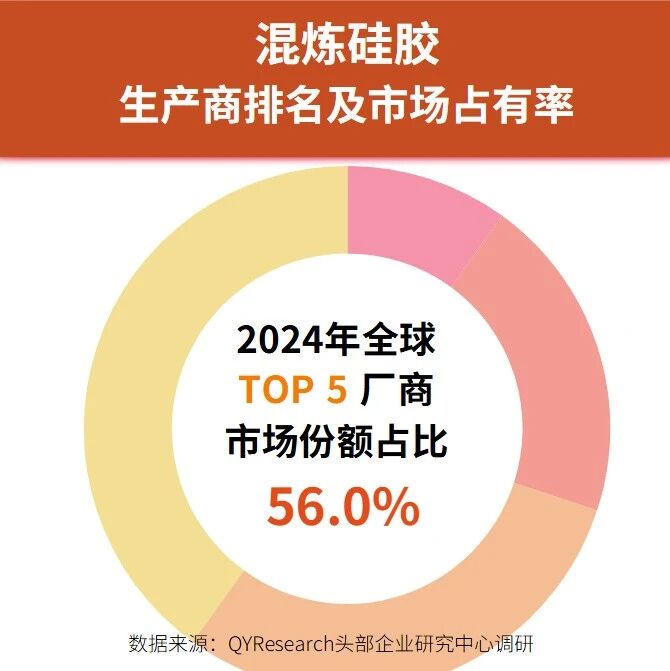
Core Viewpoint - The global mixing silicone rubber market is expected to grow steadily, driven by its superior properties and increasing demand in various industries such as automotive, electronics, and healthcare. The market is projected to reach USD 8.04 billion by 2031, with a compound annual growth rate (CAGR) of 6.8% from 2025 to 2031 [3][8]. Market Overview - Mixing silicone rubber is a high-performance elastomer material made from organic silicone polymers combined with fillers, crosslinking agents, and additives. It exhibits excellent resistance to extreme temperatures, weathering, electrical insulation, and biocompatibility, making it suitable for applications in automotive parts, consumer electronics, medical devices, electrical insulation, and household appliances [2]. - The supply chain is clearly defined, with upstream suppliers providing organic silicone monomers, fillers, catalysts, and additives, while downstream users include automotive manufacturers, electronics producers, medical device companies, and consumer goods manufacturers [2]. Market Growth Drivers - The demand for high-performance mixing silicone rubber is driven by the automotive industry (high-temperature components and seals for electric vehicles), consumer electronics (smart wearables and mobile accessories), and healthcare (catheters, seals, and implant materials) [8]. - The increasing reliance on durable materials in electric vehicles and electronic industries further boosts the demand for mixing silicone rubber [8]. Competitive Landscape - The market is characterized by a fragmented competitive landscape, with major multinational chemical companies and regional producers focusing on innovation in specialty grades and customized compounds to meet diverse end-user needs. The top five manufacturers hold approximately 56.0% of the market share as of 2024 [7][8]. Challenges and Barriers - Fluctuations in raw material prices, such as silicone rubber base materials and fillers, significantly impact production costs and profit margins [9]. - High technical barriers exist in producing high-performance mixing silicone rubber, making it difficult for small and medium-sized enterprises to enter the high-end market [10]. - Intense competition leads to price pressures, with product homogeneity potentially weakening profit margins [10]. Industry Opportunities - The demand for functional materials in industrial automation and high-performance equipment presents new application scenarios for mixing silicone rubber [11]. - Innovations in environmentally friendly and green formulations, driven by regulatory pressures and sustainability trends, offer manufacturers opportunities for differentiation [11]. Regional Insights - Rapid expansion in manufacturing, automotive, and electronics industries in regions like China, India, and Southeast Asia presents significant growth potential for mixing silicone rubber demand [13].

硅业分会:本周工业硅市场陷入了“供需双弱”的困境
智通财经网· 2025-10-23 09:23
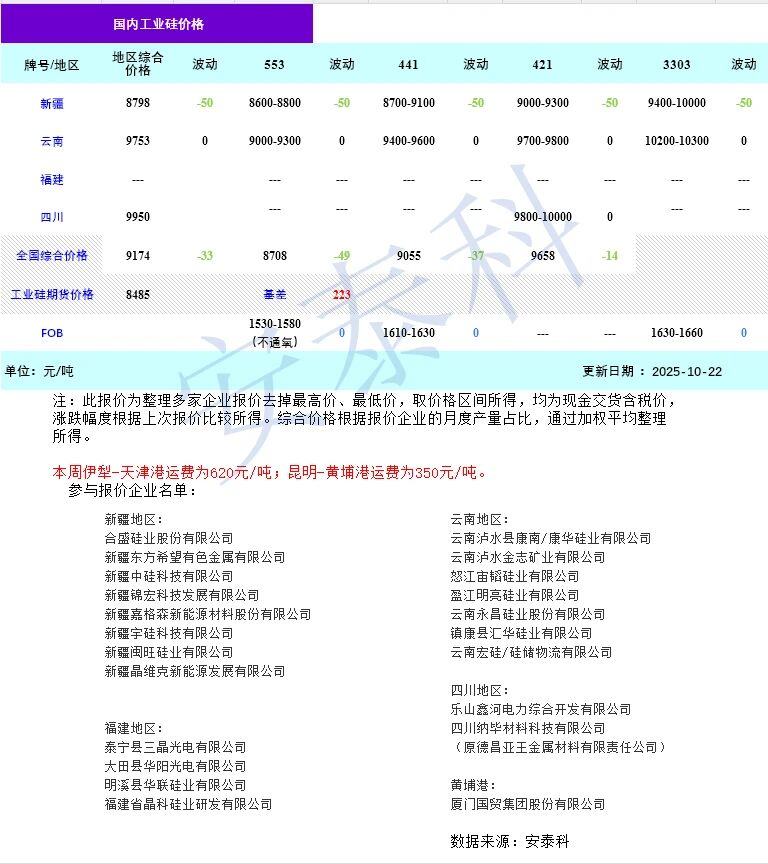
Core Insights - The industrial silicon market is currently facing a "double weakness" in supply and demand, primarily due to rising costs in the southwest region during the dry season and weak downstream demand [1][2] - The market is experiencing a downward trend with futures fluctuating and spot prices slightly declining, indicating limited upward potential due to unchanged supply-demand fundamentals [1][2] Supply Summary - Increased production in the northwest region and falling prices are offsetting the impact of reduced production and stable prices in the southwest, leading to growing inventory pressure [2] - The northwest's new production and futures warehouse delivery are putting pressure on market prices, while the north's rising transportation costs due to lower temperatures are forcing spot prices down [2] - In the southwest, production costs have significantly increased due to the approaching dry season, causing companies to halt quotes or cautiously raise prices, but the ample supply limits price rebounds [2] Demand Summary - All three major downstream industries are showing weak performance, resulting in insufficient momentum for improving industrial silicon demand [2] - The aluminum alloy market remains stable in price but lacks demand, preventing any increase in procurement [2] - The organic silicon market is struggling with low prices and companies operating at a loss, leading to significantly lower operating rates compared to historical levels and reduced stocking willingness [2] - The polysilicon market's prices remain stable, but some companies are expected to cut production in November, which will be a key factor affecting industrial silicon demand in the short term [2] Price Summary - As of October 22, the national average price for industrial silicon is reported at 9174 yuan/ton, down 33 yuan/ton from the previous week [1][3] - Specific prices for different grades include 553 at 8708 yuan/ton (down 49 yuan), 441 at 9055 yuan/ton (down 37 yuan), and 421 at 9658 yuan/ton (down 14 yuan) [3] - Regional prices show Xinjiang at 8798 yuan/ton, Yunnan at 9753 yuan/ton, and Sichuan at 9950 yuan/ton [3] Freight Summary - The freight cost from Yili to Tianjin Port is 620 yuan/ton, while from Kunming to Huangpu Port it is 350 yuan/ton [5]
【安泰科】工业硅周评—供需双弱,期现同步承压(2025年10月22日)
中国有色金属工业协会硅业分会· 2025-10-23 09:07
Core Viewpoint - The industrial silicon market is experiencing a "futures fluctuation and slight decline in spot prices" trend, with overall supply and demand showing weakness, leading to a challenging market environment [1][2]. Supply Analysis - Increased production in the northwest region and declining prices are offsetting the impact of reduced production and stable prices in the southwest region, resulting in growing inventory pressure [2]. - The northwest region's new production and futures warehouse delivery are putting pressure on market prices, while the north region faces increased transportation costs due to lower temperatures, forcing spot prices down [2]. - In the southwest region, rising production costs due to the approaching dry season have led companies to halt quotes or cautiously raise prices, but ample supply limits price rebounds [2]. Demand Analysis - All three major downstream industries are showing weak performance, lacking momentum for improvement in industrial silicon demand [2]. - The aluminum alloy market remains stable in price but experiences weak demand, hindering incremental purchases [2]. - The organic silicon market is struggling with low prices and companies operating at a loss, resulting in significantly lower operating rates compared to historical levels and reduced willingness to stock [2]. - The polysilicon market's prices remain stable, but some companies are expected to cut production in November, leading to low purchasing intentions, with production cuts being a key short-term factor affecting industrial silicon demand [2]. Market Overview - The industrial silicon market is currently in a "dual weakness" situation regarding supply and demand, with the core market dynamics being the conflict between rising costs in the southwest region and collectively weak downstream demand [2]. - The market's downward space is supported by cost factors, while the upward potential is limited due to the lack of substantial improvement in the supply-demand fundamentals [2].
欧盟批准对俄罗斯新一轮制裁,巴西新年度大豆产量继续增加
Dong Zheng Qi Huo· 2025-10-23 00:45
1. Report Industry Investment Ratings No relevant content provided. 2. Core Views of the Report - Geopolitical risks and macro - economic factors are causing significant fluctuations in various financial and commodity markets. - Different sectors are affected by specific events, such as sanctions, production changes, and policy adjustments, leading to diverse market trends and investment opportunities [1][2][3]. 3. Summary by Relevant Catalogs 3.1 Financial News and Reviews 3.1.1 Macro Strategy (Gold) - EU approved the 19th round of sanctions on Russia, including banning imports of Russian LNG and adding travel restrictions on Russian diplomats. - Gold price decline slowed, testing the 20 - day moving average support. The new sanctions pushed gold to rebound slightly, but the rebound space is limited, and the price has not stabilized yet. - Investment advice: Short - term gold price has increased long - short game and larger amplitude, not yet stabilized [12]. 3.1.2 Macro Strategy (Foreign Exchange Futures - US Dollar Index) - Trump cancelled the meeting with Putin, indicating the continuation of the Russia - Ukraine conflict. - The short - term market risk appetite declined, and the US dollar index fluctuated. - Investment advice: The US dollar index will fluctuate in the short term [16]. 3.1.3 Macro Strategy (US Stock Index Futures) - Tesla's Q3 revenue rebounded, but profit decreased by 31% more than expected. - The Fed considered reducing the bank capital requirement from 19% to a minimum of 3%. - PrimaLend applied for bankruptcy. - The market risk appetite decreased, and the three major stock indexes declined. - Investment advice: The US stock market shows a weak and volatile performance recently. Look for opportunities to buy on dips and maintain a bullish view overall [20]. 3.1.4 Macro Strategy (Treasury Bond Futures) - The central bank conducted 138.2 billion yuan of 7 - day reverse repurchase operations, with a net investment of 9.47 billion yuan. - The bond market fluctuated narrowly. The probability of double - cut (interest rate and reserve requirement ratio) is relatively low. - Investment advice: Observe the market sentiment and look for opportunities to buy mid - line long positions on dips [22]. 3.2 Commodity News and Reviews 3.2.1 Agricultural Products (Soybean Meal) - Argentina's September soybean crushing volume was 4.133 million tons. - Abiove predicted that Brazil's 25/26 annual soybean production will reach a record high of 178.5 million tons. - Investment advice: With the US government shutdown, focus on Brazil's weather and Sino - US relations. The domestic and foreign futures prices are expected to remain volatile [25]. 3.2.2 Black Metals (Rebar/Hot - Rolled Coil) - Infrastructure central enterprises' new "new infrastructure" project contracts increased significantly in the first three quarters. - Steel prices rebounded slightly in a volatile manner. The market has limited contradictions and driving forces. - Investment advice: Adopt a volatile trading strategy for steel prices in the near term [27]. 3.2.3 Agricultural Products (Soybean Oil/Rapeseed Oil/Palm Oil) - MPOA data showed that Malaysia's palm oil production from October 1 - 20 increased by 10.77% month - on - month. - The oil market corrected significantly. The increase in production reduced the possibility of tight supply in the fourth quarter. - Investment advice: After the over - expected production data in October, the confidence in the fourth - quarter palm oil price increase declined. Consider buying on dips around 9,000 yuan/ton and adopt a range - trading strategy [30]. 3.2.4 Black Metals (Steam Coal) - Newcastle Port's coal transportation volume in September was 14.0804 million tons, with a month - on - month increase of 15.8% and a year - on - year increase of 19.57%. - The coal price was supported by the increase in power consumption and the contraction of supply. - Investment advice: Although the power consumption in 8 provinces decreased after the end of high - temperature weather, the coming of the cold wave in the north and the long - lasting winter are expected to strongly support the steam coal price [31]. 3.2.5 Agricultural Products (Corn Starch) - The corn starch startup rate in North China decreased slightly, while that in Northeast China increased. - The futures rice - flour price difference rebounded significantly and is expected to continue to repair. - Investment advice: The futures rice - flour price difference is expected to continue to repair [34]. 3.2.6 Black Metals (Iron Ore) - The first heavy - haul train of Simandou was successfully dispatched. - The iron ore price fluctuated weakly. The performance of finished products was mediocre, and the inventory and profit pressure of steel mills restricted the price. - Investment advice: The iron ore price is expected to be structurally weak, and there is no clear trend for now [35]. 3.2.7 Agricultural Products (Red Dates) - The price of red dates in Guangzhou Ruyifang Market was weakly stable. - The futures price of the main contract CJ601 declined. - Investment advice: The next week is the key period for the formation of the purchase price. It is recommended to wait and see before the acquisition price is formed [37]. 3.2.8 Agricultural Products (Corn) - The inventory in the northern ports increased seasonally. - The futures and spot prices continued to fluctuate narrowly. - Investment advice: It is recommended to wait and see in the short term. The risk - return ratio of short - selling is not good, and it may be necessary to wait for the right time to go long [38]. 3.2.9 Non - ferrous Metals (Polysilicon) - China's photovoltaic module exports in September were 25.63GW, a 6.0% month - on - month decrease and a 46.8% year - on - year increase. - The spot price of polysilicon remained stable. The production in October is expected to be about 138,000 tons, and it is expected to decline significantly from November to December. - Investment advice: Maintain the view that the spot price will not fall in October. Consider buying on dips when the futures price is at a discount to the spot price [42]. 3.2.10 Non - ferrous Metals (Industrial Silicon) - Hesheng Group and its concerted actors pledged 49.91% of their shares in total. - The production in the north increased, while that in the south decreased. The inventory increased. - Investment advice: The fundamental situation is weakening, and the price has a clear lower limit. It is more cost - effective to buy on dips [44]. 3.2.11 Non - ferrous Metals (Lead) - Hebei restricted the entry of vehicles below the National V emission standard. - The LME lead price was in a narrow - range fluctuation, and the inventory decreased. - Investment advice: From a unilateral perspective, observe the price in a volatile manner. From an arbitrage perspective, pay attention to the mid - line positive arbitrage opportunities between domestic and foreign markets [47]. 3.2.12 Non - ferrous Metals (Zinc) - MMG's zinc ore production in Q3 increased by 26%. - The LME zinc price fluctuated upward, and the inventory decreased. - Investment advice: From a unilateral perspective, it is recommended to wait and see. From an arbitrage perspective, pay attention to the mid - line positive arbitrage opportunities and maintain a positive arbitrage strategy for domestic and foreign markets [50]. 3.2.13 Non - ferrous Metals (Copper) - Southern Copper's Tía María copper mine project was approved. - The customs clearance of scrap copper imports became stricter, and the import volume in October may decline. - Investment advice: Unilaterally, the copper price is expected to continue to fluctuate widely at a high level. Consider buying on dips. From an arbitrage perspective, wait and see [54]. 3.2.14 Non - ferrous Metals (Lithium Carbonate) - Rongbai Technology achieved 10 - ton - level shipments of all - solid - state cathode materials. - The price was supported by the improvement of inventory data during the peak demand season. - Investment advice: Adopt a range - trading strategy in the short term. Pay attention to short - selling opportunities after the peak demand in the year. Consider reverse arbitrage for LC2511 - LC2601 and positive arbitrage for LC2601 against more distant contracts [55]. 3.2.15 Non - ferrous Metals (Nickel) - Vale's nickel production in Q3 was 46,800 tons, basically the same as the previous year. - The global nickel inventory increased, and the price fluctuated narrowly. - Investment advice: The nickel ore price is expected to rise in Q4. It is recommended to buy on dips. Speculative traders can consider selling near - the - money put options and buying deep - out - of - the - money call options [59]. 3.2.16 Energy and Chemicals (Liquefied Petroleum Gas) - The FOB price of Middle East frozen cargo decreased. - The US C3 inventory increased. - Investment advice: The price is expected to fluctuate in the short term [62]. 3.2.17 Energy and Chemicals (Crude Oil) - The US EIA commercial crude oil inventory decreased. - The US sanctioned two Russian oil companies, causing the oil price to rise significantly. - Investment advice: The short - term geopolitical conflict will cause disturbances [66]. 3.2.18 Energy and Chemicals (PX) - An East China refinery has a plan to shut down for maintenance. - The PX spot market is tight, and the price rebounded. - Investment advice: The price will rebound from a low valuation in the short term, but the space may be limited by the oil price [68]. 3.2.19 Energy and Chemicals (PTA) - The sales of polyester yarn in Jiangsu and Zhejiang were differentiated. - The demand side is stable, and the supply side is expected to increase. - Investment advice: The price will rebound from a low valuation in the short term, but the upward space is limited [70]. 3.2.20 Energy and Chemicals (Methanol) - The production enterprise inventory was stable, and the port inventory increased slightly. - The futures and spot prices decreased, and the spot price decreased more. - Investment advice: It is recommended to wait and see [73]. 3.2.21 Energy and Chemicals (Urea) - The total inventory of urea enterprises increased, but the inventory accumulation slope slowed down. - Investment advice: The urea futures price is expected to stabilize in a volatile manner in the short term [75]. 3.2.22 Energy and Chemicals (Pulp) - The price of imported wood pulp in the spot market was basically stable. - The pulp futures price was relatively strong, but the upward space is limited due to the poor supply - demand situation. - Investment advice: The upward space of the pulp futures price is limited [76].
合盛硅业跌2.02%,成交额1.45亿元,主力资金净流出1969.45万元
Xin Lang Zheng Quan· 2025-10-22 06:23
Core Viewpoint - The stock price of Hesheng Silicon Industry has experienced a decline of 13.74% year-to-date, with significant drops in recent trading days, indicating potential challenges in the company's performance and market sentiment [1]. Company Overview - Hesheng Silicon Industry Co., Ltd. is located in Cixi City, Ningbo, Zhejiang Province, and was established on August 23, 2005, with its listing date on October 30, 2017 [1]. - The company specializes in the research, production, and sales of silicon-based new materials, including industrial silicon and organic silicon [1]. - The revenue composition of the company is as follows: organic silicon 47.69%, industrial silicon 41.01%, photovoltaic 5.93%, and others 3.21% [1]. Financial Performance - As of June 30, 2025, Hesheng Silicon Industry reported a revenue of 9.775 billion yuan, a year-on-year decrease of 26.34%, and a net profit attributable to shareholders of -397 million yuan, a year-on-year decrease of 140.60% [2]. - The company has distributed a total of 5.321 billion yuan in dividends since its A-share listing, with 2.366 billion yuan distributed in the last three years [3]. Shareholder Information - As of June 30, 2025, the number of shareholders increased by 18.20% to 44,500, while the average circulating shares per person decreased by 15.40% to 26,586 shares [2]. - Major shareholders include Hong Kong Central Clearing Limited, Huatai-PB CSI 300 ETF, and Shenwan Hongyuan Securities, with increases in their holdings compared to the previous period [3].

化工行业运行指标跟踪:2025年8-9月数据
Tianfeng Securities· 2025-10-21 10:45
Investment Rating - The report maintains a neutral rating for the chemical industry [2]. Core Insights - The current cycle may be nearing its end, with expectations for demand recovery. Infrastructure and export demand are expected to remain strong in 2024, while the real estate cycle continues to decline. The chemical industry is anticipated to experience a phase of price and profit level rebound in Q2 2024, although overall performance for the year will remain under pressure [4][5]. - The report emphasizes the importance of identifying industries with marginal supply-demand changes, focusing on both domestic and global market dynamics [6][7]. Summary by Sections Industry Valuation and Economic Indicators - The report tracks various indicators such as the comprehensive prosperity index of the chemical industry and industrial added value [3]. Price Indicators - It includes analysis of PPI, PPIRM, and CCPI, along with price differentials for chemical products [3]. Supply-side Indicators - Key metrics include capacity utilization rates, energy consumption, fixed asset investment, inventory levels, and ongoing construction projects [3]. Import and Export Indicators - The report breaks down the contribution of import and export values [3]. Downstream Industry Performance - It examines the performance of downstream sectors such as PMI, real estate, home appliances, automotive, and textiles [3]. Economic Efficiency Indicators - The report discusses three major economic efficiency indicators for the industry [3]. Global Macro and End Market Indicators - It analyzes global macroeconomic indicators including purchasing manager indices, GDP year-on-year growth, civil construction starts, consumer confidence indices, and automotive sales [3]. Global Chemical Product Prices and Differentials - The report provides insights into the prices and differentials of chemical raw materials, intermediate products, and sub-industries like resins and fibers [3]. Global Industry Economic Efficiency Indicators - It covers changes in sales revenue, profitability, growth capacity, solvency, operational capacity, and per-share indicators [3]. Chemical Product Prices and Production Indicators in Europe and the US - The report includes prosperity indicators, confidence indices, capacity utilization rates, production indices, PPI, and production indices for the chemical industry in Europe and the US [3].
期货眼日迹:每日早盘观察-20251021
Yin He Qi Huo· 2025-10-21 01:47
1. Report Industry Investment Ratings No industry investment ratings are provided in the report. 2. Core Views of the Report - The report analyzes various commodities including agricultural products, black metals, non - ferrous metals, and energy chemicals. Each commodity has its own supply - demand situation, price trends, and corresponding trading strategies based on factors such as macro - environment, seasonal changes, and policy impacts [5][7][9]. 3. Summary by Commodity Categories Agricultural Products - **Bean Meal**: The macro - environment affects the market. International soybean pressure is high, and domestic bean meal may face supply pressure and price decline. Suggestions include shorting the 05 contract, conducting M11 - 1 positive arbitrage, and selling call options at high points [17]. - **Sugar**: International raw sugar prices are weak, and domestic sugar is expected to follow. It is recommended to short at high prices [20][21]. - **Oils and Fats**: The market is expected to remain volatile in the short term. It is advisable to wait and consider going long on dips [24][25]. - **Corn/Corn Starch**: New grain prices are rebounding, and the market is expected to be strong and volatile. It is recommended to go long on the 12, 01, 05, and 07 contracts [28][29]. - **Hogs**: Supply pressure persists, and prices may face some downward pressure. It is recommended to wait and use a short - straddle strategy for options [30][32]. - **Peanuts**: There is a reduction in production, and the market is expected to be strong and volatile in the short term. It is recommended to go long on dips for the 01 and 05 contracts and sell the pk601 - P - 7600 option [34]. - **Eggs**: Demand is fair, but the egg price is still under pressure. It is recommended to close out short positions and wait [38]. - **Apples**: The high - quality fruit rate is average, and prices are expected to be stable with a slight increase. It is recommended to go long on the 11 - month contract and short the 1 - month contract [41][42]. - **Cotton - Cotton Yarn**: New cotton acquisition is accelerating, and the market is expected to be volatile. It is recommended to wait [45]. Black Metals - **Steel**: Demand is weak, and valuations are low. Steel prices are expected to fluctuate within a range. It is recommended to conduct long - short spread arbitrage on the volume - screw difference [48][49]. - **Coking Coal and Coke**: Market sentiment is cooling, and prices are expected to fluctuate within a range. It is recommended to go long on dips for coking coal [51]. - **Iron Ore**: It is recommended to take a bearish view in the medium term and conduct cash - futures reverse arbitrage [52][54]. - **Ferroalloys**: Demand is expected to be weak, but valuations and costs provide support. It is recommended to sell out - of - the - money straddle option combinations [55][56]. Non - Ferrous Metals - **Precious Metals**: Due to the U.S. government shutdown and high expectations of Fed rate cuts, precious metals are expected to rise. It is recommended to hold long positions and buy deep - out - of - the - money call options [59][60][63]. - **Copper**: The market is expected to consolidate in the short term, and the long - term trend remains unchanged. It is recommended to go long on dips and conduct cross - market positive arbitrage [64][65]. - **Alumina**: Supply is showing marginal changes, and prices are expected to bottom - out at low levels. It is recommended to wait and observe [69][71]. - **Electrolytic Aluminum**: The medium - term upward trend remains unchanged. It is recommended to go long on dips [74][76]. - **Cast Aluminum Alloy**: The price is expected to be strong and volatile. It is recommended to go long on dips [78]. - **Zinc**: It is recommended to wait and observe. Consider short - selling LME zinc and buying SHFE zinc if the ratio deteriorates [84]. - **Lead**: Supply is gradually recovering, and prices may decline. It is recommended to hold short positions [86][89]. - **Nickel**: Accumulating inventories indicate an oversupply, and prices are under pressure. It is recommended to short at the upper limit of the shock range and sell a wide - straddle option combination [89][91]. - **Stainless Steel**: Demand is weak, and prices may be in a weak and volatile pattern. It is recommended to wait and observe [94][95]. Other Commodities - **Industrial Silicon**: The price is expected to fluctuate narrowly in the short term. It is recommended to wait for a full correction [96][97]. - **Polysilicon**: It is recommended to avoid long positions in the short term and conduct reverse arbitrage for the 2511 and 2512 contracts [99]. - **Lithium Carbonate**: Demand provides support, and supply has risks. Lithium prices are expected to rise [100].