吉利

Search documents
Counterpoint:全球乘用车音响系统市场由Harman和Bose主导 两家厂商合计贡献近60%的总销售额
Zhi Tong Cai Jing· 2025-08-14 01:29
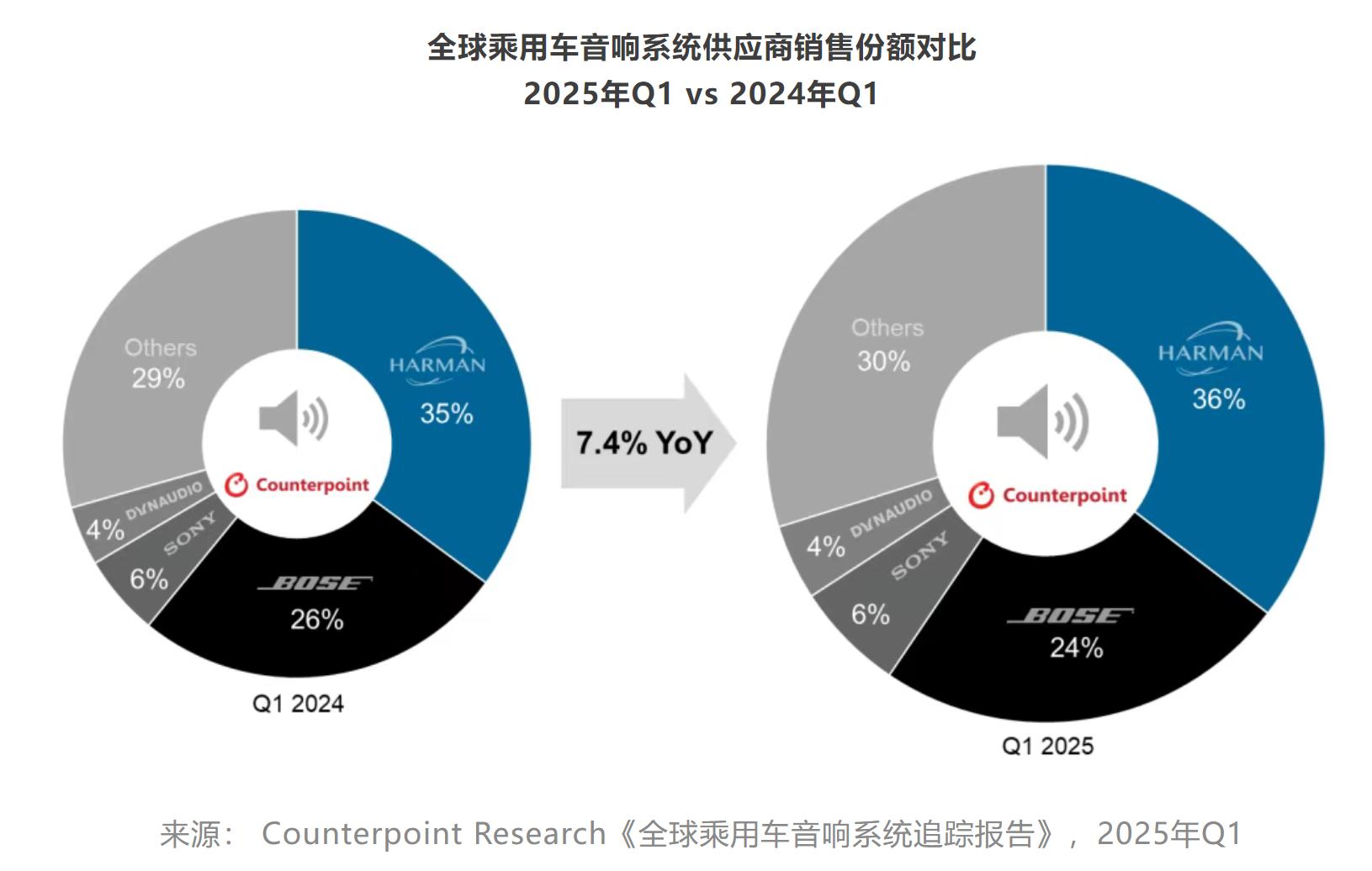
Group 1 - The global passenger car audio system market is dominated by Harman and Bose, which together account for nearly 60% of total sales [1] - AAC Technologies is the only Chinese company among the top ten suppliers in the market [1] - Chinese automotive brands such as Sonavox, WANOS, Nobo Automotive, and ADS Audio are rapidly emerging as they expand their influence globally [1] Group 2 - Chinese automakers are actively increasing the number of speakers in high-end models, with brands like NIO, Zeekr, and BYD launching vehicles equipped with over 20 speakers [4] - Despite the high speaker count in premium models, Chinese manufacturers are also focusing on producing more cost-effective electric vehicles with fewer speakers, reducing the average maximum speaker count in the market [4] - The competition in the car audio system market is being reshaped by the increasing integration of software-defined audio features, allowing for personalized audio experiences through OTA updates [4] - Advanced audio systems are becoming a core differentiating factor in consumer purchasing decisions, particularly in China, where consumers are willing to pay a premium for top-tier sound experiences [4]


成都先进制造业实力凸显,集群发展与创新突破齐头并进
Mei Ri Jing Ji Xin Wen· 2025-08-14 00:35
Core Insights - Chengdu is designated as a "national advanced manufacturing base" as part of its development goals, with a projected industrial output growth of 4.8% in 2024, an increase of 0.7 percentage points year-on-year [1] - The city has successfully cultivated multiple national-level industrial clusters, ranking seventh among cities nationwide for "specialized and innovative" small enterprises [1] Group 1: Advanced Manufacturing and Industrial Growth - In 2024, Chengdu's industrial investment is expected to grow by 48.7%, surpassing both national and provincial averages [1] - Chengdu has achieved significant milestones in advanced manufacturing, including the launch of China's first Micro-LED production line and the completion of the New Aviation Engine Industrial Park [2] - The city has established five national-level advanced manufacturing clusters and two strategic emerging industry clusters [1][2] Group 2: Emerging Industries and Technological Advancements - Chengdu is actively developing new industries, with a focus on artificial intelligence, having registered five AI industry models with national authorities [2][6] - The city has launched various innovative projects, including the world's first hydrogen-powered regional train and the establishment of a humanoid robot innovation center [2][3] - Chengdu's AI core industry is projected to exceed 70 billion yuan by mid-2025, with several local companies recognized among the top in the nation [6] Group 3: Infrastructure and Industrial Ecosystem - Chengdu has built a robust industrial ecosystem with four national-level public service platforms and 17 provincial-level platforms for industrial technology [3] - The city has developed nine large-scale computing power centers, enhancing its digital economy capabilities [3] - Chengdu's industrial parks are gaining recognition, with the Tianfu Traditional Chinese Medicine City being named one of the most vibrant in the country [4] Group 4: Strategic Initiatives and Government Support - The Sichuan provincial government is committed to supporting Chengdu's development in AI, low-altitude economy, and biomedicine, aligning with the city's strategic focus [5][6] - Chengdu is enhancing its participation in global industrial chains and fostering high-quality development through specialized industrial parks [5] - The city has been recognized as a pilot for several national-level initiatives, including smart manufacturing and 5G applications [4]
山东兖州:服务业持续发力彰显市场活力
Zhong Guo Fa Zhan Wang· 2025-08-13 08:37
Group 1 - The core viewpoint is that Yanzhou District in Jining City, Shandong Province, has made significant progress in enhancing consumption capacity and improving consumption conditions through innovative consumption scenarios and the development of productive services [1][2][3][4] - In the first half of the year, the scale of productive services in Yanzhou District exceeded 10 billion yuan, with a growth rate of over 17% [1] - The total retail sales of social consumer goods in the district reached 15.01 billion yuan, with an increase of 7.4% [1] Group 2 - Various innovative consumption scenarios have been created, such as summer beer festivals and seasonal events, which have activated the night economy and enriched cultural life for residents [2] - Over 50 themed activities have been organized, attracting nearly 2 million visitors, showcasing the district's efforts to enhance night-time consumption capabilities [2] - The district has implemented a "policy toolbox" to stimulate market consumption potential, including a trade-in program for household appliances, resulting in a subsidy of approximately 55.02 million yuan and an order amount of 410 million yuan [3] Group 3 - The district has launched a three-year action plan to double the productive services sector, establishing a command mechanism to enhance market vitality [4] - A total of 99 enterprises in the service sector have been established in the district, indicating a robust growth in the service industry [4] - Key projects in logistics and cold chain food processing have been initiated to improve regional circulation systems and enhance supply capabilities [4]
印媒:普及电动汽车,印度需要中国
Huan Qiu Wang Zi Xun· 2025-08-12 22:58
Group 1 - The Indian government aims to increase the share of electric vehicles (EVs) in total passenger car sales to 30% by 2030, while the current penetration rate is only 2.5% in 2024 [1] - To boost domestic EV manufacturing, the government offers import duty exemptions for manufacturers investing at least $500 million in local production facilities and meeting domestic value addition standards [1] - Despite efforts to develop the domestic EV industry, the Indian government is resisting Chinese investments, notably blocking BYD's proposal to invest $1 billion in a manufacturing plant [1][2] Group 2 - The slow adoption of EVs in India is attributed to factors such as range anxiety, high costs, safety concerns regarding battery technology, and limited vehicle options [2] - The Indian government has initiated the "Promote Indian Electric Passenger Car Manufacturing Scheme" to address issues related to imported components, but stringent requirements hinder manufacturers from applying for duty exemptions [2] - Some Indian states have implemented more comprehensive policies to promote the EV industry, offering land subsidies, tax incentives, and expedited approvals [2] Group 3 - Indian automakers heavily rely on imports from China, with 75% of all batteries imported in 2023-2024 coming from China [3] - Collaborations between Indian companies and Chinese technology-intensive component manufacturers could help reduce imports and facilitate technology transfer [3] - The reluctance to accept Chinese investments is pushing Chinese companies to explore other markets, while domestic innovation in China is rapidly expanding EV charging infrastructure [3] Group 4 - Cooperation in manufacturing could enhance India's domestic component supply chain, create new opportunities for small and medium enterprises, and significantly improve India's technological capabilities in clean mobility [4]
都市车界|“轮轴比”之争为哪般?汽车营销内卷几时休
Qi Lu Wan Bao· 2025-08-12 07:53
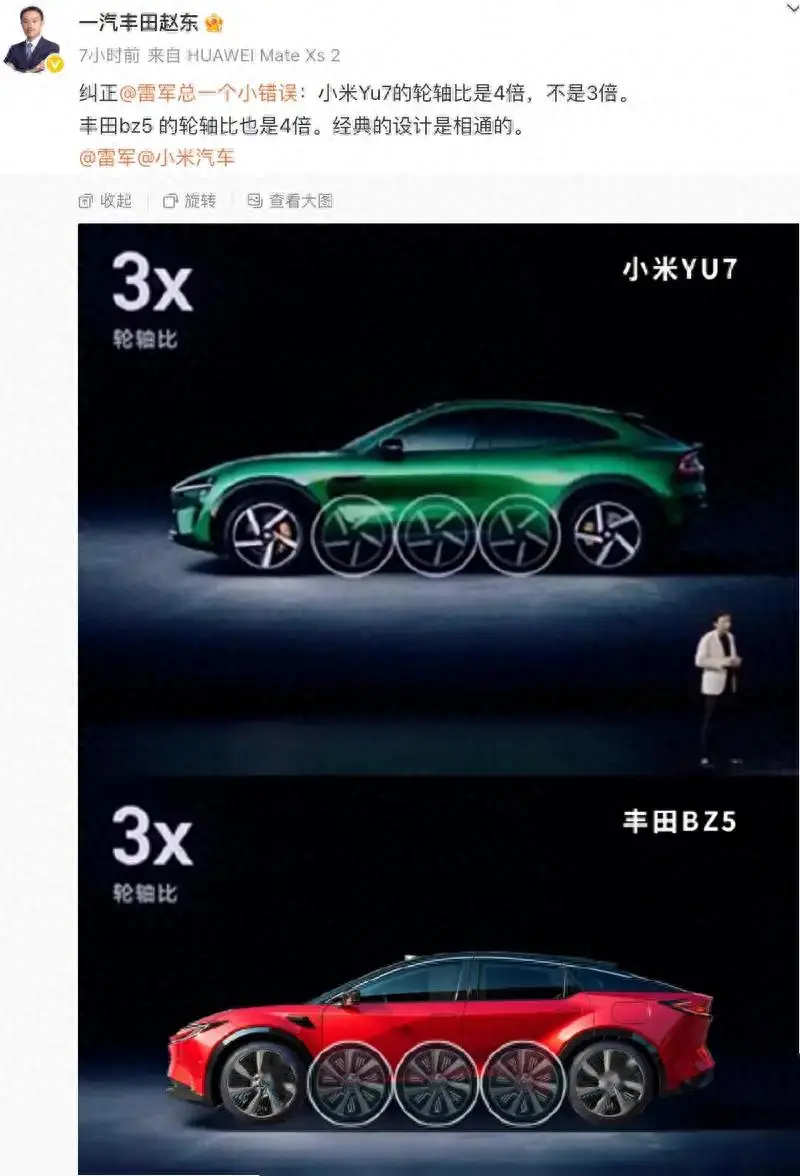
Core Viewpoint - The article highlights the intensifying competition in the Chinese electric vehicle (EV) market, focusing on the marketing tactics and technical claims made by various companies, particularly Xiaomi and traditional automakers like Toyota. It emphasizes the need for standardized definitions and testing methods for automotive parameters to prevent misleading information. Group 1: Market Dynamics - The Chinese EV market is entering a phase of fierce competition, with sales data from July indicating a rapid increase in brand concentration among leading manufacturers [4] - Xiaomi has successfully entered the top tier of the market with its SU7 and YU7 models, while Leap Motor has also seen significant growth, with July deliveries surpassing 50,000 units [5] - In contrast, Li Auto's July sales fell by 39.74% year-on-year, and NIO has accumulated losses exceeding 100 billion yuan, struggling to produce a popular model [6] Group 2: Marketing and Technical Claims - The dispute over the definition of "wheel axle ratio" between Xiaomi and Toyota reveals deeper issues in the marketing strategies of Chinese EVs, where parameters like acceleration time and range can be manipulated for better presentation [3][8] - The price war in the industry has led to significant price reductions, with new energy vehicle prices in Shenzhen dropping by 5-10% this year [10] - Companies like BYD are shifting focus from hardware development to algorithm optimization, enhancing their autonomous driving capabilities without the lengthy development cycles associated with chip production [14] Group 3: Policy and Industry Standards - The Ministry of Industry and Information Technology (MIIT) is taking steps to address "involution" in the industry, emphasizing the need for fair competition and the establishment of a mechanism for the exit of "zombie enterprises" [17] - The MIIT has identified five key technological areas for development, including battery materials and autonomous driving systems, indicating a strategic shift towards innovation [19] - Experts suggest that standardizing automotive parameters and definitions is crucial to prevent consumer confusion and misinformation in the rapidly evolving market [20]





多家新能源车企1月销量大涨 赛力斯首次跻身新势力月销冠军
Xin Hua Wang· 2025-08-12 05:47
Group 1 - Multiple new energy vehicle companies reported significant year-on-year growth in January 2024 deliveries, including Lantu, Li Auto, Zeekr, Xpeng, and Neta [1][2] - Lantu delivered 7,041 vehicles in January, marking a 355% increase year-on-year, and aims for an annual sales target of 100,000 units [2] - Li Auto delivered 31,165 vehicles in January, a 105.8% increase year-on-year, with a cumulative delivery of 664,529 vehicles since inception, targeting 800,000 annual deliveries in 2024 [2] Group 2 - Zeekr, Leap Motor, NIO, Neta, and Xpeng also reported substantial year-on-year delivery increases, with deliveries of 12,537, 12,277, 10,055, 10,032, and 8,250 vehicles respectively [2] - Neta announced overseas sales of 2,821 vehicles in January, with a global sales target of 300,000 units for the year [3] - Xpeng revealed that its XNGP smart driving feature has a monthly active user penetration rate exceeding 85%, with plans for suppliers to prepare for monthly sales of 20,000 to 30,000 units [3] Group 3 - AITO Wenjie emerged as a market leader with 32,973 vehicles delivered in January, a 34.76% month-on-month increase, and the new M7 model achieved a record delivery of 31,253 units [3][4] - Various new energy vehicle companies initiated promotional activities ahead of the Spring Festival, offering discounts and incentives to attract consumers [5] - Companies like Aion, Geely, and Tesla launched promotional campaigns, while Zeekr and Li Auto are enhancing their service infrastructure, including charging stations [5][6]


飞行汽车逐渐“飞入”现实 多家上市公司抢先布局
Xin Hua Wang· 2025-08-12 05:47
Group 1 - The core viewpoint of the articles is that flying cars, particularly electric vertical takeoff and landing (eVTOL) vehicles, are emerging as a revolutionary mode of urban transportation with significant social and commercial value, attracting substantial investment and competition among companies [1][2]. - Wan Feng Ao Wei has seen a surge in stock prices, achieving a limit-up on February 7, with a closing order of 110,000 shares, marking two consecutive limit-up days and positioning itself as a leader in the flying car concept stocks [1]. - The global market for flying cars is projected to reach $9 trillion by 2050, with China's potential market size estimated at $2.1 trillion, indicating a strong growth trajectory for the industry [2]. Group 2 - The flying car industry is at a critical point of industrialization, with a comprehensive supply chain that includes components such as servos, flight control systems, sensors, navigation solutions, batteries, and power systems, and applications in emergency rescue, logistics, sightseeing, and urban transportation [3]. - Over 20 companies in the A-share market are directly or indirectly involved in the flying car sector, with notable developments including the first test flights of eVTOL prototypes and collaborations with major automotive manufacturers [3][4]. - Eight flying car concept stocks are expected to see net profit growth rates exceeding 20% in the next two years, with significant trading activity observed in these stocks, indicating strong investor interest [6][7].
前荣耀CEO赵明辟谣加入智界汽车
Guan Cha Zhe Wang· 2025-08-12 05:44
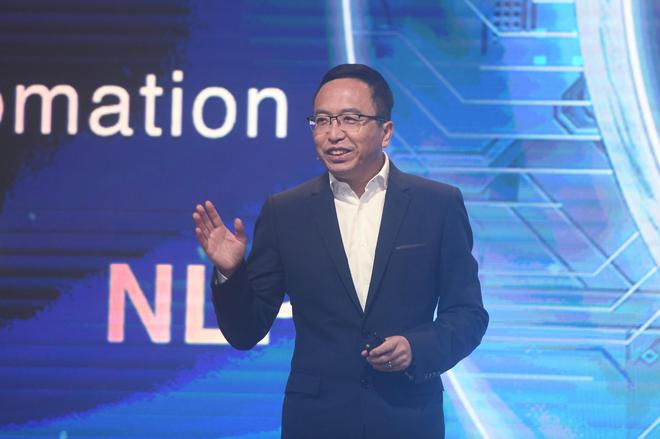
赵明 视觉中国 此前于8月7日,华为与奇瑞在深圳签署智界品牌战略2.0合作协议,并举行智界汽车上海-深圳双设计中 心开业仪式。智界品牌将投资超过100亿元,研发团队规模将增至5000人。双方还将成立智界新能源公 司,推动研发、生产、销售、服务一体化独立运作。 华为常务董事、终端BG董事长余承东表示,智界会让大家"眼前一亮又一亮",未来智界品牌计划发布 多款新品,进一步拓展新能源汽车市场。 【文/观察者网 潘昱辰 编辑/高莘】日前,网传荣耀前首席执行官(CEO)赵明将加入智界汽车。对此 消息,赵明本人向网易科技回应称"不会的",奇瑞内部人士也对此进行了否认。 作为华为鸿蒙智行的第二"界",智界品牌于2023年9月正式发布,先后上市轿车S7和SUV R7两款车型, 涵盖纯电动和增程式两种动力,但先前市场表现未能达到预期。 今年7月,智界品牌正式发布新LOGO。接着便是华为与奇瑞签署2.0合作协议,标志着智界的发展步入 新阶段。而智界新款车型也已开启预售。 而被传加入智界的赵明早在1998年便加入华为,曾任华为CDMA/WiMAX/TD产品线总裁、全球无线解 决方案销售部部长、意大利代表处代表、西欧地区部副总裁等职 ...
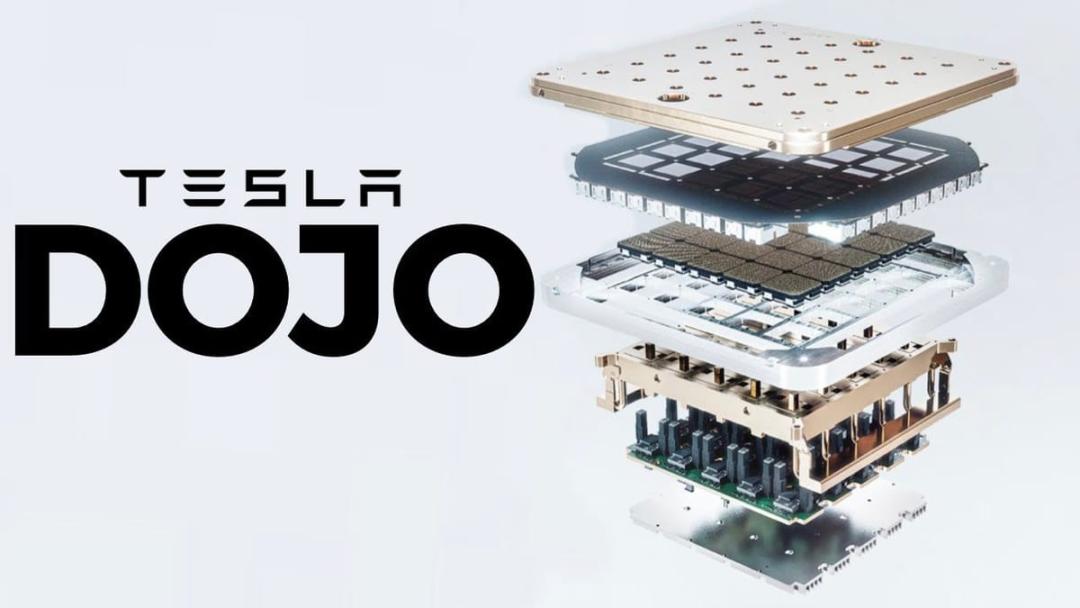
马斯克终结Dojo选择英伟达,中国车企的AI答卷应如何作答?
3 6 Ke· 2025-08-11 11:41
Core Insights - The dissolution of Tesla's Dojo supercomputer project marks a significant shift in the company's AI strategy, which was once valued at $500 billion by Wall Street analysts but has now been deemed a failure [1][4][14] - The end of Dojo raises uncertainties and challenges for the next phase of AI development in the automotive industry, prompting companies to reconsider their strategic paths [3][12] Group 1: Dojo Project Overview - Dojo was initiated with the ambition to create a supercomputer specifically optimized for video data, aimed at enhancing Tesla's Full Self-Driving (FSD) capabilities [6][8] - The project faced numerous challenges, including internal team turmoil and technological complexities, leading to delays and ultimately its termination [8][12] - Key personnel, including Peter Bannon and Ganesh Venkataramanan, have left the project, indicating a significant shift in Tesla's AI development team [4][8] Group 2: Industry Implications - The automotive industry is increasingly recognizing AI as a core component of its future, with companies like Xpeng and Li Auto positioning themselves as AI-centric firms [9][11] - The definition of automotive products is evolving from mere transportation tools to intelligent mobile spaces, emphasizing the importance of computational power and AI models over traditional mechanical performance [12][15] - The shift towards AI-driven business models is evident, with a move from one-time hardware sales to sustainable revenue streams such as FSD subscriptions and software services [12][14] Group 3: Future Directions - Tesla plans to rely more on technology partners like NVIDIA and AMD for computational capabilities, indicating a strategic pivot from in-house development to collaboration [14] - The integration of AI in vehicles is expected to deepen, with advancements towards true Level 4/5 autonomous driving and the emergence of generative AI for enhanced in-car interactions [15]


销量占比超七成,自主汽车品牌加速“超车”
Bei Jing Shang Bao· 2025-08-11 11:08
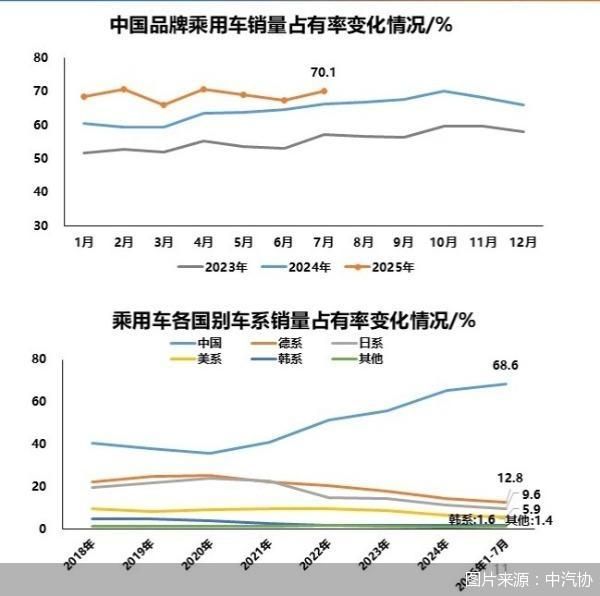
Group 1 - In July 2023, China's automotive production and sales reached 2.591 million and 2.593 million units respectively, showing a month-on-month decline of 7.3% and 10.7%, but a year-on-year increase of 13.3% and 14.7% [2] - The decline in July is attributed to the traditional off-season for the automotive market and some manufacturers conducting annual equipment maintenance, leading to a seasonal slowdown in production and sales [2] - The "trade-in" policy continues to show positive effects, and the comprehensive rectification of the industry is making progress, with new models being continuously launched by companies, contributing to stable market operations [2] Group 2 - In July 2023, the production and sales of passenger vehicles were 2.293 million and 2.287 million units, respectively, with year-on-year growth of 13% and 14.7% [3] - Chinese brands are becoming a significant support for passenger vehicle sales, with sales of Chinese brand passenger vehicles reaching 1.604 million units in July, a year-on-year increase of 21.3%, and a market share of 70.1%, up 3.8 percentage points year-on-year [3] - The market share of Chinese brand sedans, SUVs, and MPVs in July was 64.9%, 73.7%, and 68% respectively, indicating growth in all categories [3] Group 3 - In the first seven months of 2023, the domestic sales of new energy vehicles reached 6.913 million units, a year-on-year increase of 32.3%, with new energy passenger vehicles accounting for 6.499 million units, up 30.9% [4] - The top fifteen groups in new energy vehicle sales accounted for 95.1% of total sales, with BYD and Geely being the top two, together holding over 42% of the market share [4] - The competition among Chinese brands is intensifying, with Leap Motor surpassing Li Auto to become the sales champion in the first half of the year, and new entrants like AITO and Xpeng also showing strong sales performance [5] Group 4 - In July 2023, exports of Chinese vehicles reached 575,000 units, a year-on-year increase of 22.6%, with Chery and BYD leading the export growth [5] - Chery exported 119,000 units, a year-on-year increase of 31.9%, while BYD's exports reached 81,000 units, a significant increase of 160% [5] - Chinese brands are actively expanding into overseas markets, with several companies establishing overseas R&D and production bases [5]