红旗连锁

Search documents
从茶饮到潮玩 中国文创产品走红海外市场
Xin Hua Wang· 2025-11-16 05:53
Group 1: Chinese New Tea Beverage Industry - Chinese new tea beverage brands like Bawang Chaji, Mixue Ice City, Nayuki, and Heytea are expanding internationally, particularly in Malaysia, by combining cultural elements with their products to enhance their appeal [2][3] - The Malaysian market is witnessing a significant increase in the market share of Chinese tea brands, which are transitioning from passive followers to active participants in the global market, showcasing strong cultural attraction [2] - The incorporation of Chinese visual elements such as characters and traditional patterns into brand identity enhances brand recognition and consumer loyalty, reflecting cultural confidence and creativity of Chinese enterprises in overseas markets [3] Group 2: Chinese Television Dramas - Chinese historical dramas like "Journey to the West," "Empresses in the Palace," and "Nirvana in Fire" have gained immense popularity in Vietnam, with viewers discussing plots and characters passionately [4][5] - The cultural values portrayed in these dramas resonate deeply with Vietnamese audiences, fostering a better understanding of Chinese history and traditions [5] - The ongoing cultural exchanges between China and Vietnam are strengthening the ties between the two nations, enhancing mutual understanding and friendship [5] Group 3: Chinese Trendy Toy Industry - Chinese trendy toy brands such as Pop Mart are rapidly expanding in the UK, with plans to open additional stores, reflecting a growing market presence [6] - The sales of blind boxes from Chinese brand Miniso are increasing significantly, with a reported 63% growth in the past year in the UK [6] - Trendy toys are increasingly incorporating Chinese cultural elements, with brands like 52TOYS achieving success in Thailand by creating culturally inspired products that resonate with local consumers [6][7] - The success of these brands highlights the potential of Chinese creative products in the global market, showcasing the ability to connect emotionally with consumers [7]



在勇哥直播间看人创业,成了打工人的新乐子
虎嗅APP· 2025-11-16 03:09
Core Viewpoint - The article discusses the phenomenon of young entrepreneurs in China who, despite facing significant financial risks, are determined to start their own businesses, often leading to failure and debt. It highlights the common pitfalls and the influence of fast-track recruitment companies that exploit these aspiring entrepreneurs [5][101]. Group 1: Entrepreneurial Trends - A new wave of entrepreneurs is emerging, willing to incur substantial debt to open businesses, particularly in the food and beverage sector, such as tea and burger shops [5][11]. - Many entrepreneurs are drawn to the idea of starting their own businesses without conducting proper market research, leading to poor decision-making and financial losses [16][17]. - The article illustrates various entrepreneurial archetypes, including those who rely on loans and leverage to start their businesses, often resulting in significant debt [16][34]. Group 2: Common Pitfalls - Entrepreneurs frequently fall victim to fast-track recruitment companies that promise easy success but often lead to financial ruin [101][105]. - Many aspiring business owners lack basic business acumen, such as understanding market demand and competition, which contributes to their failures [17][94]. - The article provides examples of individuals who invested heavily in franchises without proper due diligence, leading to rapid financial losses [20][24][88]. Group 3: Case Studies - A case study highlights a woman who lost 900,000 yuan in just six days after opening a poorly chosen franchise, illustrating the risks of blind entrepreneurship [20][24]. - Another example features a man who invested 100,000 yuan in a lavishly designed tea shop but faced daily losses due to poor location and competition from established brands [34][36]. - The article also discusses a woman who opened a juice shop next to a popular brand, believing her product would attract customers despite the overwhelming competition [70][79]. Group 4: Market Dynamics - The article emphasizes the saturation of the food and beverage market, particularly in the tea and coffee segments, where established brands dominate and new entrants struggle to survive [111][105]. - It notes that many entrepreneurs are misled by the allure of trendy brands and fail to recognize the realities of market competition [89][120]. - The influence of social media and fast-track recruitment companies exacerbates the issue, as they promote unrealistic success stories that entice individuals to invest without proper understanding [120][121].


从茶饮热销到潮玩圈粉——中国文创产品走红海外市场
Xin Hua Wang· 2025-11-16 02:53
Group 1: Chinese Tea Beverage Industry - The rise of Chinese tea beverage brands like Bawang Chaji, Mixue Ice City, and Nayuki Tea in overseas markets, particularly in Malaysia, showcases a successful blend of culture and product innovation [2][3] - Malaysian consumers appreciate the unique flavors and cultural elements of these tea beverages, which differ from local brands, enhancing the cultural appeal of Chinese products [2][3] - The incorporation of traditional Chinese visual elements into branding has been identified as a strategy to increase brand recognition and consumer loyalty in foreign markets [3] Group 2: Chinese Cultural Products in Film and Television - Chinese historical dramas have gained significant popularity in Vietnam, with shows like "Nirvana in Fire" and "The Story of Yanxi Palace" resonating deeply with local audiences [4][5] - The themes of loyalty, family values, and respect for tradition in these dramas have struck a chord with viewers, leading to increased interest in Chinese culture and language [4][5] - Cultural exchanges through media are strengthening the ties between China and Vietnam, fostering mutual understanding and friendship [5] Group 3: Chinese Trendy Toys Industry - Chinese trendy toy brands like Pop Mart are expanding rapidly in the UK, with plans to open additional stores, reflecting a growing demand for these products [6][7] - The success of blind box toys in the UK market, with sales increasing by 63% for Miniso, indicates a strong consumer interest in Chinese cultural elements [6][7] - The integration of traditional Chinese stories and aesthetics into trendy toys is seen as a way to tap into a broader market potential, appealing to emotional needs of consumers [7]
外卖大战后,茶饮商家“大逃杀”
虎嗅APP· 2025-11-15 09:17
Core Viewpoint - The tea and coffee industry is facing significant challenges as consumer preferences shift towards lower-priced options, leading to a "new normal" where prices are capped at around 10 yuan, impacting profitability for many businesses [7][22][28]. Group 1: Industry Challenges - Many tea and coffee shop owners are experiencing a decline in business, with daily revenues often falling below the critical threshold of 1,000 yuan [5][19]. - The rapid increase in the number of tea and coffee shops has led to intense competition, with many businesses struggling to survive as consumer spending habits change [12][19]. - The industry is witnessing a "great escape" as independent entrepreneurs are disappearing, while chain stores are thriving due to their ability to leverage economies of scale and marketing resources [19][20][27]. Group 2: Market Dynamics - The tea and coffee market is evolving from a high-growth phase to a more mature stage, with a focus on consumer dependency and market penetration [12][16]. - Data shows that the revenue growth rate for the coffee and tea sector remains strong compared to other food and beverage categories, indicating potential for continued expansion despite current challenges [16]. - The shift in consumer behavior towards lower-priced drinks has created a new competitive landscape, where businesses must adapt to survive [22][28]. Group 3: Business Strategies - Successful operators are finding ways to innovate and reduce costs, such as developing simpler product lines that cater to the new consumer preferences while maintaining quality [35][36]. - Franchise opportunities are becoming more attractive as new brands offer lower entry costs and support during challenging market conditions [37][38]. - Identifying the right location and brand is crucial for success, as demonstrated by operators who have thrived by aligning with popular local brands and understanding community demographics [30][39].

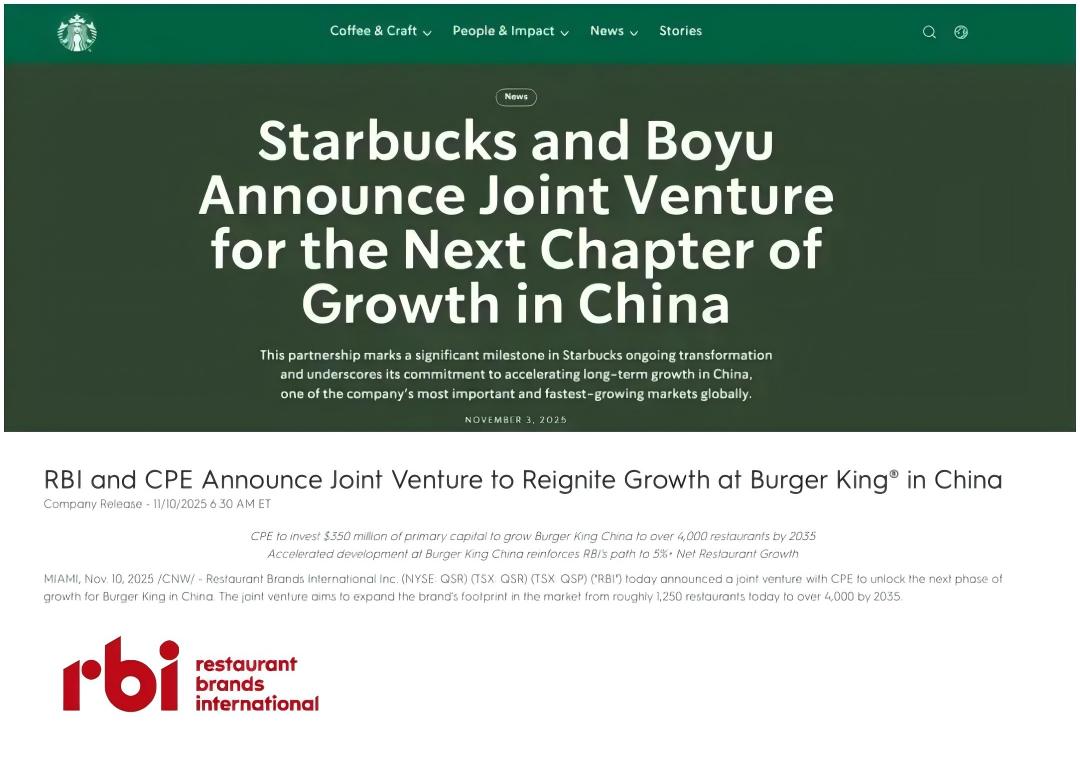
星巴克之后汉堡王中国也卖了,中国市场玩法变了|财经早察
2 1 Shi Ji Jing Ji Bao Dao· 2025-11-14 23:09
Core Insights - International brands like Starbucks and Burger King are seeking local partnerships in China to adapt to the unique market dynamics and consumer preferences [1][2] - The shift towards localization is not merely about menu adjustments but involves a comprehensive restructuring of supply chains, store strategies, and marketing approaches [2][3] - Successful examples from the past decade, such as McDonald's and Yum China, highlight the necessity of localization for international brands to thrive in the Chinese market [2][3] Group 1 - Burger King announced a joint venture with CPE Yuanfeng, investing $350 million to expand its Chinese stores from 1,250 to 4,000 by 2035 [1] - Starbucks has partnered with Boyu Capital, relinquishing 60% of its stake in its Chinese operations [1] - The changing consumer landscape in China demands innovative products that cater to local tastes rather than standardized offerings [1][2] Group 2 - Localization requires a more agile supply chain to quickly respond to trends and consumer preferences [2] - Store opening strategies must adapt to lower-tier cities, considering appropriate store types and pricing [2] - Marketing strategies need to resonate with local culture and trends, such as engaging with social media platforms [2][3] Group 3 - The trend of localization is evident beyond the food industry, with automotive companies also prioritizing comprehensive localization strategies [3] - The rapid evolution of the Chinese electric vehicle market necessitates a fundamental restructuring of international brands' approaches [3] - The competitive landscape in China favors brands that deeply understand local consumer needs and preferences [3]
中国消费品企业大举进入巴西市场
36氪· 2025-11-14 13:36
Core Viewpoint - Chinese consumer brands are increasingly entering the Brazilian market, capitalizing on the growing middle class and consumer demand, while also facing some local resistance due to competitive pressures [4][11][15]. Group 1: Market Entry and Expansion - Chinese brands like Meituan, Didi, and Mixue Ice City are expanding their presence in Brazil, with Mixue planning to open numerous stores and invest 3.2 billion reais (approximately 4.235 billion yuan) by 2030 [5][8]. - Meituan's overseas brand "Keeta" is set to invest 5.6 billion reais in the next five years, starting its services in the suburbs of São Paulo [7]. - Didi is doubling its investment in Brazil to 2 billion reais by 2026 to expand its food delivery service [8]. Group 2: Consumer Perception and Brand Image - Brazilian consumers are increasingly favoring Chinese products, with over 60% expressing a preference for Chinese goods in the tech sector, surpassing the 30% favoring American products [10]. - The perception of Chinese brands as offering "low prices and high performance" is becoming entrenched in Brazil, driven by the success of companies like BYD [11]. Group 3: Economic and Political Context - The strengthening political ties between China and Brazil are enhancing the investment environment, encouraging Chinese companies to target Brazilian consumers directly [8][12]. - Brazil's economic landscape, characterized by a population exceeding 200 million and a growing middle class, presents significant opportunities for Chinese brands [8]. Group 4: Local Resistance and Competitive Pressure - There are emerging concerns in Brazil regarding the competitive pressure from Chinese companies, particularly in light of the entry of cross-border e-commerce platforms like Temu and SHEIN [15]. - Local businesses are advocating for measures to counter the impact of Chinese brands, including adjustments to import tax policies [15].

圆桌论坛一:向新而行 拥抱市场 驭金融活水润泽产业能级跃迁
Zheng Quan Ri Bao Zhi Sheng· 2025-11-14 11:08
圆 桌论坛一:向新而行拥抱市场驭金融活水润泽产业能级跃迁 主持人:各位来宾、各位朋友、女士们、先生们下午好!欢迎大家继续回到会议现场,我们将在这里举 行下午的流程。今天下午将在这里有两场圆桌对话要奉献给大家,我们将会进入今天下午第一场圆桌对 话的时间,本场圆桌议题是"向新而行拥抱市场驭金融活水润泽产业能级跃迁",我们要请出参与圆桌的 嘉宾,他们是: 主持人:刘功润中欧陆家嘴国际金融研究院副院长 参会嘉宾: 席春迎香港中小上市公司协会主席 崔雷中德证券执行董事、产业研究部总经理 余红征君泽君(上海)律所合伙人 徐洁海尔创投执行董事兼总经理 蔡文彬大同证券总经理 陈祥义高粱资本董事长 崔胜朝山证国际投行业务负责人 刘功润:尊敬的各位来宾、各位企业家朋友大家下午好!非常荣幸又来到了太原,我直观的感受一下就 是由衷为我们山西产业圈包括资本圈的朋友们点赞,这个平台除了是每年一度的朋友聚会,关键是我们 大家思想交流,尤其思想交流之后我们希望能够达到的共同行动这种倡议,我们投资人,我们的产业圈 包括我们做研究的人,能够把大家的行动,整合在一起,找到好的突破路径。当然我看到我们的峰会每 年一度有一个关键词就是产业升级,围绕产 ...

星巴克的“退”与“变”:当中国市场不再是光环,而是考场
美股研究社· 2025-11-14 10:39
Core Insights - Starbucks is undergoing a significant transformation in the Chinese market, marking a shift from being a foreign brand to a local partner through a strategic collaboration with Boyu Capital [1][19] - The narrative of foreign brands in China is changing, as the allure of foreign brands diminishes and local brands gain prominence [2][25] Group 1: Market Dynamics - Over the past decade, Starbucks has defined the Chinese coffee market, selling not just coffee but a lifestyle and social experience [4] - The rise of competitors like Luckin Coffee and Kudi has shifted the perception of coffee from a luxury experience to a more affordable beverage, leading to a price war [6][9] - Consumers are increasingly valuing product experience, convenience, and price over brand prestige, indicating a shift in consumption habits [13][28] Group 2: Strategic Adjustments - Starbucks has attempted to adapt by introducing services like "Fei Kuai" and collaborating with platforms like Tmall, but these efforts have not addressed the fundamental issues of pricing and consumer perception [14] - The partnership with Boyu Capital allows Starbucks to retain 40% ownership while integrating local capital into its decision-making process, signifying a shift towards a co-governance model [17][19] - This trend of foreign brands localizing their operations is becoming more common, as seen with other brands like Burger King and McDonald's [20][22] Group 3: Cultural Shift - The myth that imported brands equate to high quality is being dismantled, as local brands like Mixue and Manner gain traction and redefine consumer expectations [24][27] - The cultural awakening among Chinese consumers is leading to a preference for local brands that resonate more with their values and experiences [28][29] - The competitive landscape is evolving, with local brands not only dominating the domestic market but also expanding internationally, challenging the traditional dominance of foreign brands [26][31]

三大主线驱动中国资产价值重估向纵深演进
Zheng Quan Ri Bao· 2025-11-13 17:19
Group 1 - The core viewpoint is that China's asset prices are undergoing a significant revaluation driven by multiple factors, marking the beginning of a new era for the Chinese capital market [1] - The institutional opening of China's capital market is deepening, reshaping global capital allocation logic, as evidenced by the Shanghai Stock Exchange's focus on expanding cross-border investment channels and enhancing international competitiveness [3][4] - China's economic resilience is providing a solid foundation for asset value revaluation, with GDP growth expected to remain around 5% in 2026, and the attractiveness of RMB assets in global capital allocation is increasing [4][5] Group 2 - New growth drivers are emerging, with innovation, mergers and acquisitions, and globalization creating diverse investment paths that expand valuation space for Chinese assets [6][7] - The innovation sector, particularly in AI and new consumption, is becoming a hotspot for global capital, while mergers and acquisitions are enhancing asset quality through industry consolidation [7][8] - The globalization of Chinese enterprises is accelerating, broadening revenue sources and reconstructing the valuation system on a global scale, indicating that the revaluation of Chinese assets is not just a forecast but a current reality [8]
汉堡王8个月转手赚2亿刀,外资到底在玩什么?
3 6 Ke· 2025-11-13 08:44
01 看了一堆汉堡王和星巴克"卖身"的标题党新闻后,我都快笑死了。 图|来源网络 一周之内,两条重磅:11月4号星巴克宣布把中国业务60%股权卖给博裕资本;11月10号汉堡王把83%股权卖给CPE源峰。 然后一堆媒体开始喊"外资餐饮大败退""洋品牌水土不服"。 我看完这些标题,又看了看交易细节,我感觉我又行了。 这哪是败退,这明明是换了个更舒服的姿势继续赚钱。 图|来源网络 星巴克一次性套现40亿美元,手里还握着40%股权,未来十年以上每年躺着收品牌授权费,加起来总价值超过130亿美元。 汉堡王拿走3.5亿美元,保留17%股权,还签了20年的品牌授权协议。 你们说这是败退? 这是完美退出好吧。 02 先别急着喊口号,咱们算笔账。 以星巴克为例,很多人觉得它把控股权卖了,是不是混不下去了? 朋友,你想多了。 星巴克在中国目前8000家店,2025财年全年营收31亿美元。 听起来不错对吧? 但你得知道,这31亿美元是怎么赚来的——门店租金、人力成本、供应链投入、营销费用,全是钱。 图|来源网络 更要命的是,星巴克还得跟瑞幸死磕。瑞幸现在27000家店了,年底冲刺30000家,而且价格比星巴克便宜一半还拐弯。 这意 ...