拓普集团

Search documents
一周一刻钟,大事快评(W133):策略会重点公司更新,车展重点公司更新
Shenwan Hongyuan Securities· 2025-11-25 13:43
Key Insights - The report highlights the strong growth potential of companies in the automotive sector, particularly those with established brands and innovative technologies [3][4][5] - The focus on electric vehicles and smart technologies is driving significant changes in the industry, with companies like BYD, Geely, and XPeng being recommended for investment [3][4][5] Company Updates - **Uxin**: The profitability of new stores is increasing faster than expected due to brand establishment, which enhances profit elasticity in a favorable market [3][4] - **SAIC Motor**: Future prospects hinge on Huawei's involvement, with adjustments in new car launches expected to create opportunities [3][4] - **Tuhu**: Anticipated stable earnings in Q4 2025, with potential for growth in the aftermarket sector [4] - **Hengbo Co., Ltd.**: Strong positioning in the robotics sector with high technical added value and a comprehensive supply chain [5] - **Double Ring Transmission**: Direct collaboration with Tesla on reducers, with significant growth expected in traditional and new energy sectors [5] - **Great Wall Motors**: Plans to launch multiple new models and power versions in 2026, with expected sales growth [8] - **XPeng Motors**: Anticipated improvement in sales structure and gross margins, with new technologies aiding in profitability [8][9] - **Leap Motor**: Expected to exceed 1 million units in sales by 2026, with stable gross margins despite industry challenges [9] Industry Trends - The automotive industry is witnessing a shift towards electric and smart vehicles, with companies focusing on innovation and brand strength to capture market share [3][4][5] - The integration of advanced technologies and partnerships with tech firms like Huawei is becoming crucial for automotive companies to enhance their product offerings and market positioning [3][4][5]






宇树科技IPO加速,金刚石下游应用不断拓宽 | 投研报告
Zhong Guo Neng Yuan Wang· 2025-11-25 09:08
Market Overview - A-shares experienced significant adjustments this week, with major indices showing weekly changes of -3.77% for CSI 300, -5.99% for ChiNext 300, -5.54% for STAR 50, -5.78% for CSI 500, and -5.80% for CSI 1000, with ChiNext 300 showing the most pronounced decline [1] Company Performance - In the humanoid robot sector, stock performance was mixed, with the top five gainers being Weichuang Electric, Shida Group, Longxi Co., Henggong Precision, and Anpeilong, while the top five losers included Siling Co., Fangyuan Co., Baichuan Energy, Fulim Precision, and Xingyun Co. [1] Recent Events - Yushu Technology has completed its IPO guidance report, with CITIC Securities noting that the company has established the necessary governance structure, accounting practices, and internal controls to qualify for listing, and that its management and major shareholders are well-versed in the legal responsibilities and obligations of public companies [1] Industry Insights - Humanoid robots are considered a significant downstream application of AI technology, with China's industrial manufacturing capabilities leading globally, creating substantial scale effects. As companies like Tesla and Zhiyuan continue to innovate, the industry chain is expected to accelerate [2] - The Intel Technology Innovation and Industry Ecosystem Conference held on November 19 introduced a dual-path cold plate liquid cooling server, developed in collaboration with several companies, which utilizes domestic memory to enhance reliability while reducing energy consumption and operational costs [2] - The application of diamond heat dissipation is gaining recognition among downstream clients, as the semiconductor industry progresses towards smaller nodes, necessitating effective heat management to maintain chip performance and reliability [2]
汽车行业年度策略:破局内卷提质转型,智能网联领航升级
Zhongyuan Securities· 2025-11-25 07:53
Market Overview - The automotive industry index increased by 14.79% as of November 21, 2025, outperforming the Shanghai Composite Index and CSI 300 Index by 0.38 percentage points and 1.61 percentage points respectively [11][12] - The automotive sector's performance was strong in the first half of 2025 but became more aligned with the broader market in the second half [11][12] - The majority of sub-sectors showed positive growth, with motorcycles and other segments leading the gains [17][18] Financial Performance - The automotive industry achieved a revenue of CNY 36,976.27 billion in 2024, a year-on-year increase of 3.35%, and a net profit of CNY 1,363.61 billion, up 9.98% [30] - In the first three quarters of 2025, the industry reported revenues of CNY 28,712.84 billion, reflecting a 10.73% year-on-year growth, and a net profit of CNY 1,165.36 billion, up 10.72% [30][31] - The industry’s gross margin was 15.83% in the first three quarters of 2025, a slight decline from the previous year, while the net margin improved to 4.29% [33] Passenger Vehicle Segment - The passenger vehicle market is expected to reach record sales in 2025, driven by policy support and increased penetration of new energy vehicles (NEVs) [43] - NEV retail sales reached 10.15 million units from January to October 2025, a year-on-year increase of 21.9%, with a market share of 52.73% [45][50] - The market structure is shifting towards domestic brands, which captured nearly 70% of the market share by September 2025, while foreign brands are losing ground [50][51] Commercial Vehicle Segment - The commercial vehicle market showed signs of recovery in 2025, with production and sales increasing by nearly 10% year-on-year in the first three quarters [5] - The growth in the commercial vehicle sector is driven by policies promoting vehicle replacements and the rising sales of new energy commercial vehicles [5][6] Automotive Parts Sector - The national strategy emphasizes "intelligent and connected" technologies as the main axis for upgrading the automotive industry [5] - The penetration of advanced driver-assistance systems (ADAS) is expected to drive market expansion and domestic substitution in core hardware [5][6] Investment Recommendations - The report maintains a "stronger than market" rating for the automotive sector, recommending key companies in the passenger vehicle segment such as BYD, Changan Automobile, and Great Wall Motors [6] - In the commercial vehicle segment, Yutong Bus is recommended, along with a focus on China National Heavy Duty Truck [6] - For the automotive parts sector, companies like Feilong Co., Top Group, and Desay SV are highlighted as potential investment opportunities [6]




人形机器人行业最新观点汇报:机器人赛道蓝海可期,2026年有望成为量产元年-20251125
CAITONG SECURITIES· 2025-11-25 07:26
Investment Rating - The report indicates a positive outlook for the humanoid robot industry, suggesting it is a promising investment opportunity with significant growth potential in the coming years [1]. Core Insights - The humanoid robot sector is expected to see mass production starting in 2026, with projected output levels of 50,000 to 100,000 units [2][9]. - The report highlights that the first wave of market momentum was driven by Elon Musk's announcement regarding production targets, while the second wave was influenced by a performance at the Spring Festival Gala [2][10]. - The overall market size for humanoid robots could reach 140 billion yuan if large-scale production of 1 million units is achieved, with an estimated cost of 140,000 yuan per unit [3][19]. - The industrialization of humanoid robots is accelerating, with major companies like Unitree Technology and UBTECH Robotics securing significant orders and preparing for IPOs [4][34]. Summary by Sections Humanoid Robot Market Review and Outlook - The report reviews the 2025 market performance, noting two key phases of growth driven by high-profile announcements and events [2][9]. - Future catalysts include the release of Tesla's Optimus Generation 3 and the anticipated IPOs of domestic companies [10][22]. Humanoid Robot Price and Volume Analysis - The report estimates that the cost structure of humanoid robots will see a breakdown with significant portions attributed to linear and rotational actuators [19][20]. - The market is expected to grow substantially with mass production, indicating a clear path for industrialization [22]. Acceleration of Humanoid Robot Industrialization - Major players in the industry are ramping up production capabilities and securing large orders, indicating a robust growth trajectory [4][29][31]. - The report identifies three categories of domestic players: established robot manufacturers, automotive companies, and internet giants, each leveraging their strengths in the humanoid robot space [23]. Investment Recommendations - The report suggests focusing on companies with strong order visibility and significant value in the supply chain, such as Top Group and Sanhua Intelligent Control [5][38]. - It also highlights the importance of monitoring core component suppliers that have secured orders or are undervalued [5][38].


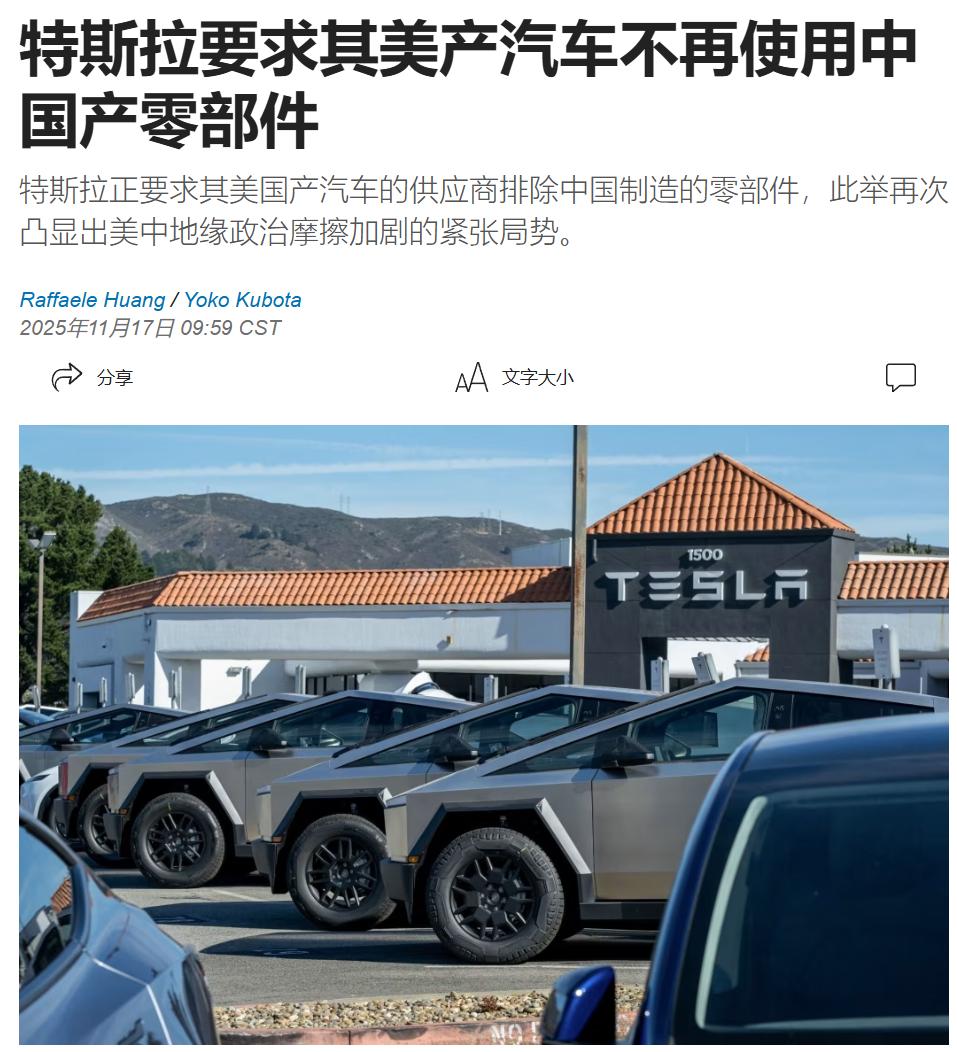
两年内放弃中国零件,特斯拉做得到吗?
3 6 Ke· 2025-11-25 02:18
Core Viewpoint - The ongoing U.S.-China trade tensions are leading American automakers to increasingly detach from Chinese supply chains, driven by U.S. policies aimed at boosting domestic manufacturing and reducing reliance on foreign components [1][4][20]. Group 1: U.S. Automakers' Strategies - Tesla is likely to stop using Chinese-made components in its U.S. vehicles within the next one to two years, indicating a shift in strategy that may impact Chinese suppliers [1][4]. - General Motors (GM) is reportedly planning to require its suppliers to move away from Chinese supply chains starting in 2024, reflecting a broader trend among U.S. automakers [7][8]. - The Inflation Reduction Act of 2023 includes provisions that prohibit U.S. automakers from using battery components and critical minerals sourced from China, Russia, North Korea, and Iran, further incentivizing the shift away from Chinese suppliers [8][9]. Group 2: Policy Implications - The Trump administration has implemented tariffs of 25% on imported vehicles and parts, significantly increasing production costs for American-made models [11][13]. - There is a potential for tariffs to rise to 50% if automakers do not further relocate production to the U.S., which could lead to increased vehicle prices for consumers [13][16]. - U.S. automakers are exploring ways to maintain compliance with trade regulations, including producing components in North America to qualify for tariff exemptions [15][16]. Group 3: Challenges and Market Dynamics - Despite the push for "decoupling," many U.S. and European automakers remain dependent on Chinese suppliers for critical components, making a complete separation challenging [20][22]. - For instance, Tesla's vehicles, while produced in North America, still rely on approximately 50% of their parts from China, highlighting the difficulty of fully eliminating Chinese components [22]. - The recent geopolitical tensions and supply chain disruptions have heightened concerns among automakers about the reliability of their supply chains, prompting a reevaluation of sourcing strategies [18][20].


机构调研揭示行业矛盾:机器人爆单之后将迎交付大考
Bei Jing Shang Bao· 2025-11-25 01:32
Core Insights - Goldman Sachs' supply chain report highlights a significant gap between optimistic production capacity plans and actual confirmed orders in the humanoid robot industry, indicating a typical characteristic of the current market [1] - The report titled "Capacity Optimism Ahead of Actual Orders" suggests that while key supply chain companies have planned annual production capacities ranging from 100,000 to 1,000,000 units, none have secured large, confirmed orders [1] Group 1: Industry Challenges - The release of a production video by UBTECH, showcasing their humanoid robot Walker S2, has sparked controversy due to prior skepticism from Goldman Sachs and public doubts about delivery authenticity [3] - Criticism from industry peers, such as Brett Adcock from Figure AI, claims that parts of the video were digitally altered, raising questions about the credibility of the demonstration [3] - Despite these challenges, UBTECH claims to have established partnerships with major companies like BYD and Foxconn to promote the commercial application of humanoid robots in various sectors [3] Group 2: Positive Signals - The humanoid robot sector is witnessing a surge in orders and investment, with over 18 significant contracts exceeding 10 million yuan since 2025, indicating a shift from concept validation to industrialization [5] - Investment activity has intensified, with over 100 financing events in the first half of 2025, totaling more than 15 billion yuan, and major firms like JD and Alibaba making substantial investments in the sector [6] - UBTECH has publicly disclosed multiple large orders, including a 1.59 billion yuan project for a humanoid robot data collection center, although details on operational specifics remain vague [7] Group 3: Delivery Strategies - UBTECH aims for large-scale delivery by focusing on key sectors such as automotive manufacturing and logistics, with a production capacity plan targeting 5,000 units by 2026 and 10,000 units by 2027 [8] - In contrast, Accelerated Evolution adopts a "small steps" approach, prioritizing single-unit deliveries to refine production and service capabilities before scaling up [9] - The competition in the humanoid robot sector is expected to intensify by 2025, with a focus on achieving large-scale commercial deployment and improving cost efficiency [9]


机器人板块观点更新&德昌电机控股深度汇报
2025-11-25 01:19
Summary of Key Points from the Conference Call Industry and Company Overview - The focus is on the robotics sector and specifically on 德昌电机控股 (Deka Motor Holdings), a leading global micro-motor company [1][13] - The robotics sector is expected to see a new market trend from Q4 2025 to Q1 2026, driven by small batch orders and the release of Tesla's third-generation humanoid robot [1][3] Core Insights and Arguments - **Technological Advancements**: Tesla's third-generation humanoid robot will feature significant technological upgrades, including: - Gearbox changes from harmonic to cycloidal gearboxes [4] - Motor upgrades from frameless torque motors to axial flux motors and harmonic field motors [6] - Increased degrees of freedom in hand design from 11 to 22 [6] - **Investment Recommendations**: Key companies to watch include: - **拓普集团 (Top Group)**: Estimated market value of approximately 100 billion, with significant rebound potential [7] - **浙江荣泰 (Zhejiang Rongtai)**: A stable supplier in the T-chain with high positioning [7] - **双环传动 (Shuanghuan Transmission)**: Collaborating with Tesla on gearbox development, benefiting from the rise in electrification [7][8] - **Market Dynamics**: The automotive and robotics sectors are experiencing volatility due to policy uncertainties and capital rotation pressures, but the long-term outlook for embodied intelligence remains positive [3] Financial Performance and Projections - **德昌电机控股 Financials**: - Revenue for FY 2025 is projected at $3.65 billion, a 4.5% decrease year-on-year, while net profit is expected to rise by 14.2% to $260 million [14] - The company has a balanced revenue distribution across regions: Asia (40%), Americas (32%), and Europe/Middle East/Africa (30.7%) [14] - FY 2026 profit forecast is $270 million, with a PE ratio of 14.4, indicating a potential 50% upside [2][14] Emerging Business Opportunities - **Robotics and Liquid Cooling**: The company is expanding into humanoid robots and liquid cooling systems, which are expected to provide new growth avenues [13][24] - **Market Potential**: The global humanoid robot joint assembly market is projected to reach approximately $20 billion by 2028 [21] Competitive Positioning - **Micro-Motor Market Share**: 德昌电机控股 holds an 18% market share in the global passenger vehicle micro-motor market, being the only Chinese company among the top five manufacturers [20] - **Technological Edge**: The company leverages vertical integration and a global production layout to maintain competitive advantages in cost and technology [20][22] Future Outlook - **Automotive Sector**: The automotive business, which constitutes 85% of revenue, is expected to face challenges in 2026 but is projected to recover by 2027 [25][16] - **Commercial Sector**: The commercial business is anticipated to stabilize, with slight revenue growth expected in FY 2026 [26] - **Emerging Business Contributions**: Robotics and liquid cooling are expected to start contributing to revenue from FY 2027 [27] Valuation and Investment Rating - The company is rated as a strong buy with a target price of HKD 43.6, reflecting a nearly 50% upside based on a 20x PE ratio for FY 2026 [28]

晨会纪要:2025年第200期-20251125
Guohai Securities· 2025-11-25 00:50
Group 1: Company Performance - The company, 万物新生 (RERE), reported Q3 2025 revenue of 5.149 billion RMB, a year-on-year increase of 27.1%, reaching the high end of previous guidance [3][4] - The breakdown of revenue shows that 1P product revenue was 4.726 billion RMB, up 28.7% year-on-year, driven by increased sales of second-hand consumer electronics [4] - The company expects Q4 2025 total revenue to be between 6.08 billion and 6.18 billion RMB, representing a year-on-year growth of 25.4% to 27.4% [3] Group 2: Profitability and Margins - The gross margin for Q3 2025 was 20.5%, an increase of 0.5 percentage points year-on-year, with 1P business gross margin at 13.4%, up 1.7 percentage points [5] - Non-GAAP operating profit was 140 million RMB, a year-on-year increase of 34.9%, with a Non-GAAP operating profit margin of 2.7% [5] - GAAP net profit reached 91 million RMB, up 407.3% year-on-year, while Non-GAAP net profit was 110 million RMB, a 22.3% increase [5] Group 3: Business Expansion and Strategy - The company is actively expanding its offline store presence, with a total of 2,195 stores by the end of Q3 2025, an increase of 558 stores year-on-year [4] - The 3P service revenue was 423 million RMB, up 11.6% year-on-year, driven by growth in multi-category recycling services [4] - The company is expected to benefit from the expansion of second-hand product acquisition channels and multi-category business growth, maintaining a "buy" rating [6] Group 4: Industry Insights - The bond market sentiment is currently divided, with seller sentiment rising and buyer sentiment declining, indicating a cautious market environment [7][9] - The macro liquidity remains loose, with significant improvements in equity fund issuance, while leverage funds have seen a slowdown [10] - The automotive sector underperformed the Shanghai Composite Index, with significant declines in stock prices for major players during the recent week [12][13]

【周观点】小鹏增程首款车型X9发布,继续看好汽车板块
东吴汽车黄细里团队· 2025-11-24 14:05
Investment Highlights - The automotive sector experienced a mixed performance this week, with the SW commercial cargo vehicle segment showing the best performance at -2.1%, while the SW passenger vehicle segment declined by -5.9% [4][13]. - The top five stocks covered this week include Chunfeng Power, JAC Motors, Suzhou Axle, Mingyang Technology, and Yinlun Technology, which showed positive growth [4][13]. Industry Core Changes - Xiaopeng Motors launched the X9 Super Range Extender, with the Max version starting at 309,800 yuan and the Ultra version at 329,800 yuan [6][14]. - Geely Automobile reported Q3 2025 revenue of 89.19 billion yuan, with year-on-year growth of 26.5% and a net profit of 3.82 billion yuan, reflecting a year-on-year increase of 59.3% [6][8][14]. - Leap Motor's Q3 2025 revenue reached 19.45 billion yuan, marking a year-on-year increase of 97.3% [6][8][14]. - Horizon Robotics continues to expand its mass production lineup, showcasing new models at the Guangzhou Auto Show [6][14]. - Pony.ai's fourth-generation autonomous truck family is set for mass production next year [6][14]. - WeRide's Robotaxi received a pure unmanned license in Switzerland [6][14]. Current Automotive Sector Configuration - The automotive industry is perceived to be at a crossroads, with the electric vehicle boom nearing its end and the smart vehicle era beginning [9][15]. - Investment opportunities are categorized into three main lines: AI smart vehicles, AI robots, and traditional vehicle segments [9][15]. - Key targets for AI smart vehicles include: - Robotaxi perspective: Tesla, Xiaopeng Motors, and Qianli Technology [9][15]. - Technology providers and operational sharing models: Horizon Robotics, Baidu, Pony.ai, and WeRide [9][15]. - Transformation of ride-hailing and taxi services: Cao Cao Mobility, Didi, and others [9][15]. - For the AI robot line, preferred components include Top Group, Junsheng Electronics, and others [9][15]. - The traditional vehicle segment includes buses (Yutong Bus), heavy trucks (China National Heavy Duty Truck Group, Weichai Power), and motorcycles (Chunfeng Power, Longxin General) [10][15].

太平人寿,一次落袋65亿
36氪· 2025-11-24 10:14
Core Viewpoint - China Taiping's subsidiary, Taiping Life, has sold equity stakes in four companies for 6.5 billion yuan, reflecting a strategic asset rotation amid a growing equity market for insurance capital [3][6][9]. Group 1: Asset Sale and Financial Impact - Taiping Life's sale of equity stakes will result in an influx of 6.5 billion yuan in cash, enhancing its liquidity for future investments [6][9]. - The investment in the four companies, made in December 2019, yielded a total return of approximately 2.35 billion yuan over nearly six years, indicating a successful exit strategy [9][10]. - The proceeds from the sale are intended for general operational funding, allowing for greater flexibility in future investments [11][12]. Group 2: Investment Performance and Strategy - In the first three quarters of 2025, Taiping Life reported a significant increase in investment income, totaling 16.71 billion yuan, up from 6.89 billion yuan in the same period the previous year, marking a 142.5% increase [13][14]. - The company has diversified its investments, appearing as a major shareholder in multiple stocks, with a focus on both traditional sectors and emerging technologies [14][15]. - The investment strategy has shifted from infrastructure-heavy allocations to a more balanced approach that includes equities, reflecting a response to changing market conditions and regulatory frameworks [28][29]. Group 3: Market Trends and Regulatory Environment - The insurance industry is experiencing a systemic trend towards increased equity market participation, driven by low interest rates and regulatory adjustments that allow for higher equity allocations [29][30]. - As of mid-2025, Taiping Life's equity investment weight was 13.6%, which is below the regulatory cap, indicating potential for further investment growth in equities [30][31]. - The shift in investment focus is seen as a rational response to market dynamics, aiming to enhance returns while managing risks effectively [28][29].