万华化学

Search documents
中东资本青睐中国的三大动因
Zheng Quan Ri Bao· 2026-01-11 17:04
■毛艺融 中东资本投资中国的热情愈发高涨。1月5日,阿布扎比投资局旗下全资子公司正式以领投方身份,完成 了对鼎晖投资管理有限公司第五期美元基金(CDHFundV)的接续基金注资。另外,精锋医疗科技股份 有限公司、MiniMax正式登陆港股,两家公司基石投资阵容里均出现了阿布扎比投资局的身影。 近年来,中东资本青睐中国科技企业,在笔者看来,这基于中东国家经济转型的战略需求、全球资本再 平衡背景下中国资产的独特吸引力,以及中国企业与中东资本的"双向奔赴"。 其一,中东国家转型诉求强烈,将科技等产业视为"新的石油"。 从传统能源到新能源,从一级市场到二级市场,从大型基建项目到初创科技企业,中东资本的投资触角 正加速延伸,折射出其对中国优质资产愈发浓厚的兴趣。 这一转变的底层逻辑,是中东国家的转型焦虑。沙特"2030愿景"、阿联酋的全球投资战略,为中东资 本"出海"投资提供了明确的政策支撑,也勾勒出了其欲摆脱石油经济依赖的发展路径。 通过投资,中东资本有力推动了本土石油产业升级。例如,2025年9月份,科威特石化工业公司斥资 6.38亿美元拿下万华化学集团股份有限公司旗下烟台万华石化有限公司25%的股权。同月,中国石 ...
基础化工周报:万华新疆、韩国韩华TDI临时停车,国内TDI价格上行-20260111
Soochow Securities· 2026-01-11 15:39
Investment Rating - The industry investment rating is "Overweight," indicating an expected outperformance of the industry index relative to the benchmark by more than 5% over the next six months [70]. Core Insights - The average prices for pure MDI, polymer MDI, and TDI are reported at 18,043, 14,171, and 14,478 CNY/ton respectively, with TDI showing a week-on-week increase of 59 CNY/ton [2]. - The average prices for ethane, propane, and coal are 1,165, 4,172, and 520 CNY/ton respectively, with ethane decreasing by 85 CNY/ton and propane increasing by 45 CNY/ton [2]. - The average prices for synthetic ammonia, urea, DMF, and acetic acid are 2,213, 1,724, 3,787, and 2,546 CNY/ton respectively, with synthetic ammonia decreasing by 34 CNY/ton and urea increasing by 12 CNY/ton [2]. - The average prices for animal nutrition products such as VA and VE are 62.5 and 54.9 CNY/kg respectively, with no significant changes [2]. Summary by Sections Polyurethane Sector - The average prices for pure MDI, polymer MDI, and TDI are 18,043, 14,171, and 14,478 CNY/ton respectively, with TDI showing a week-on-week increase of 59 CNY/ton [2][16][20]. Oil, Coal, and Olefins Sector - Ethane and propane average prices are 1,165 and 4,172 CNY/ton respectively, with ethane decreasing by 85 CNY/ton and propane increasing by 45 CNY/ton [2][24][31]. - The average price for polyethylene is 6,800 CNY/ton, reflecting a week-on-week increase of 30 CNY/ton [2]. Coal Chemical Sector - The average prices for synthetic ammonia, urea, DMF, and acetic acid are 2,213, 1,724, 3,787, and 2,546 CNY/ton respectively, with synthetic ammonia decreasing by 34 CNY/ton and urea increasing by 12 CNY/ton [2][40][48][49]. Animal Nutrition Sector - The average prices for VA, VE, solid egg amino acid, and liquid egg amino acid are 62.5, 54.9, 17.6, and 14.2 CNY/kg respectively, with no significant changes [2][56][62].



多项产品出口退税政策调整,不改中国产业竞争优势
Orient Securities· 2026-01-11 15:38
Investment Rating - The industry investment rating is maintained as "Positive" [5] Core Viewpoints - The adjustment of export tax rebate policies does not alter the competitive advantage of China's chemical industry. The cancellation of export tax rebates for various chemical products is expected to increase export costs, reflecting China's energy and waste treatment capabilities. Despite theoretical concerns about competitiveness, high energy-consuming products like PVC lack global expansion capacity, and the price increase due to VAT will not significantly change competitive dynamics [2][7] - Market rumors do not change the profit recovery opportunities in the industry. Reports of regulatory discussions regarding monopolistic risks have led to stock price corrections for leading chemical companies. However, the industry is still in a self-rescue phase, with production cuts not aimed at achieving monopolistic profits but rather at facilitating recovery from previous losses [2][7] Investment Recommendations and Targets - Recommended leading companies in the refining industry include Sinopec (600028, Buy), Rongsheng Petrochemical (002493, Buy), and Hengli Petrochemical (600346, Buy). The report also highlights recovery opportunities in various chemical sub-industries, such as MDI leader Wanhua Chemical (600309, Buy) and PVC-related companies like Zhongtai Chemical (002092, Not Rated), Xinjiang Tianye (600075, Not Rated), Chlor-alkali Chemical (600618, Not Rated), and Tianyuan Co., Ltd. (002386, Not Rated). In the phosphoric chemical sector, companies like Chuanheng Co., Ltd. (002895, Not Rated) and Yuntianhua (600096, Not Rated) are noted for their growth potential driven by rapid energy storage growth. In the oxalic acid sector, attention is drawn to Hualu Hengsheng (600426, Buy), Huayi Group (600623, Buy), and Wankai New Materials (301216, Buy) [3]



新材料产业周报:英伟达AI超级计算平台Vera Rubin全面投产,AS700取得国产载人飞艇生产许可证-20260111
Guohai Securities· 2026-01-11 14:57
Investment Rating - The industry investment rating is "Recommended" (maintained) [1] Core Insights - The new materials sector is a crucial direction for the chemical industry, currently experiencing rapid growth in downstream demand. With policy support and technological breakthroughs, domestic new materials are expected to accelerate their long-term growth. The report emphasizes that "one generation of materials leads to one generation of industries," highlighting the foundational nature of the new materials industry as the material basis for other industries [5][15]. Summary by Relevant Sections 1. Electronic Information Sector - Focus on semiconductor materials, display materials, and 5G materials [6] - Recent developments include NVIDIA's announcement of its new AI supercomputing platform, Vera Rubin, which has entered full production. The platform features six independent chips, with the Rubin GPU achieving a peak computing power of 50 Petaflops and a training performance 3.5 times that of its predecessor [7][37]. 2. Aerospace Sector - Focus on PI films, precision ceramics, and carbon fiber [8] - The successful acquisition of a production license for the AS700 manned airship marks a significant milestone for China's aerospace industry, indicating a shift towards standardized and commercialized production [9][10]. 3. New Energy Sector - Focus on photovoltaics, lithium-ion batteries, proton exchange membranes, and hydrogen storage materials [10] - A notable development is the introduction of the world's first all-solid-state battery by a Finnish startup, set to enter OEM mass production [11]. 4. Biotechnology Sector - Focus on synthetic biology and scientific services [12] - Beijing's economic development zone has announced measures to support the innovation and development of the synthetic biology manufacturing industry, aiming to establish a globally influential industry cluster by 2028 [13]. 5. Energy Conservation and Environmental Protection Sector - Focus on adsorbent resins, membrane materials, and biodegradable plastics [14] - The Guangxi government has issued a plan for green mine construction, aiming for over 90% of large and medium-sized mines to meet green standards by the end of 2028 [15]. 6. Industry Rating and Investment Strategy - The new materials sector is expected to benefit from the catalytic effects of downstream application sectors, gradually entering a prosperous cycle, thus maintaining a "Recommended" rating for the new materials industry [15].




能源化工合成橡胶周度报告-20260111
Guo Tai Jun An Qi Huo· 2026-01-11 13:28
Report Overview - Report Title: Synthetic Rubber Weekly Report - Report Date: January 11, 2026 - Report Author: Yang Honghan 1. Report Industry Investment Rating - Not provided in the content 2. Report Core Viewpoints - The synthetic rubber market is expected to experience high-level oscillations in the short term [2][4] - The upward trend of butadiene is expected to slow down [6] 3. Summary by Relevant Catalogs 3.1 Synthetic Rubber 3.1.1 Supply - During the cycle, Maoming Petrochemical and Dushanzi Petrochemical's high-cis butadiene rubber plants continued to be shut down, while the load of individual butadiene rubber plants increased, with the capacity utilization rate reaching an absolute high level. The output of high-cis butadiene rubber in this cycle was 31,800 tons, an increase of 800 tons compared to the previous cycle, a month-on-month increase of 2.55%, and the capacity utilization rate was 79.15%, a month-on-month increase of 1.97 percentage points. It is expected that there will be limited changes in domestic butadiene plants in the next cycle [5] 3.1.2 Demand - In terms of rigid demand, some enterprises were still in the shutdown and maintenance state during the "New Year's Day" holiday this week, gradually resuming work around the 4th. The production scheduling did not operate normally for most of the week, dragging down the overall capacity utilization rate to continue to decline. The shipment was slow during the cycle, and the inventory reduction rhythm was lower than expected. It is expected that the capacity utilization rate of tire sample enterprises will increase in a restorative manner in the next cycle, and the overall output will increase with the resumption of work and production of maintenance enterprises. Some enterprises continued to control production flexibly to control finished product inventory, which will limit the recent increase range [5] - In terms of alternative demand, the price difference between the main contracts of NR-BR is gradually narrowing, and the alternative demand remains at a high level. Therefore, the overall demand side of butadiene rubber maintains a high year-on-year growth rate [5] 3.1.3 Inventory - As of January 7, 2026, the domestic butadiene rubber inventory was 33,100 tons, a decrease of 400 tons compared to the previous cycle, a month-on-month decrease of 1.08%. The output of domestic butadiene rubber continued to be at a high level this cycle. The butadiene market was boosted by a sharp increase in the raw material market, and the shipment of production enterprises improved somewhat. However, there was some inventory waiting to be picked up after being sold. The overall inventory level changed little. Against the background of obvious differences in the negotiation focus, the inventory of individual sample traders decreased slightly during the downstream rigid demand price-pressing procurement follow-up [5] 3.1.4 Valuation - Currently, the static valuation range of the butadiene rubber futures fundamentals is 11,100 - 12,100 yuan/ton. Due to the strong expectation of butadiene in futures trading, the futures are at a premium to the spot, and the upper limit of the static valuation is temporarily invalid. The valuation logic has changed from the cost side providing support for the lower valuation to the NR-BR price difference providing support for the lower valuation [5] 3.1.5 Strategy - Unilateral: The unilateral trend has changed from being relatively strong in the previous period to high-level oscillations; the upper pressure is 12,000 - 12,100 yuan/ton (moving dynamically following the spot trend of butadiene rubber), and the lower support is 11,100 - 11,200 yuan/ton (supported by the NR-BR price difference and butadiene cost) [5] - Cross-variety: The price difference between NR-BR is gradually narrowing [5] 3.2 Butadiene 3.2.1 Supply - In this cycle (January 2 - 8, 2026), the estimated weekly output of Chinese butadiene industry sample enterprises was 113,600 tons, an increase of 200 tons compared to the previous cycle, a month-on-month increase of 0.18%. During the week, plants such as Nanjing Chengzhi, Sierbang, Yanshan Petrochemical, a unit of Shanghai Petrochemical, Maoming Petrochemical 2, and Sinochem Quanzhou Petrochemical remained shut down, and there were no obvious changes in other plants, with a slight increase in weekly output. Next week, it is expected that the weekly output of Chinese butadiene sample enterprises will be around 112,300 tons, a slight reduction compared to this cycle. There are no plans to restart plants next week, and the maintenance situation of Hainan Refining & Chemical needs further attention [6] 3.2.2 Demand - In terms of synthetic rubber, the operating rates of butadiene rubber and styrene-butadiene rubber will remain at a high level in the medium term, maintaining a year-on-year high demand for butadiene. In the short term, with the reduction of butadiene rubber plant maintenance, it is expected that the rigid demand procurement volume of synthetic rubber for butadiene will remain at a high level [6] - In terms of ABS, the inventory pressure is relatively high, and it is expected that the demand for butadiene will only maintain a constant level, with relatively limited incremental demand [6] - In terms of SBS, the operating rate has increased slightly, maintaining rigid demand procurement for butadiene with little change [6] 3.2.3 Inventory - In this cycle (January 1 - 7, 2026), the domestic butadiene inventory decreased slightly, and the total sample inventory continued to decline by 4.28% compared to last week. Among them, the inventory of sample enterprises fluctuated slightly, with a slight increase of 0.48% compared to last week. Although high-price transactions were slightly slow, affecting the slow inventory reduction, there was no obvious inventory pressure overall. The sample port inventory decreased significantly by 7.61% compared to last week. The arrival of imported ships was limited during the week, and the raw material inventory of downstream industries was normally consumed. Although there was some trading inventory, the market expectation was relatively strong in the later period, and it was in an inventory reduction cycle overall [6] 3.2.4 Viewpoint - In the short term, the relatively low absolute price has driven downstream periodic replenishment, and the transactions have improved. In addition, the prices of butadiene in Asia and Europe are relatively strong. Overall, butadiene is still relatively strong in the short term. However, due to the weakening of short-term spot market transactions, it is expected that the upward trend of butadiene will slow down [6]
——基础化工行业周报:多晶硅、丁二烯价格上涨,关注反内卷和铬盐-20260111
Guohai Securities· 2026-01-11 13:03
Investment Rating - The report maintains a "Recommended" rating for the chemical industry [1] Core Insights - The chemical industry is expected to experience an upward cycle due to the implementation of "anti-involution" policies in China and the accelerated exit of some European facilities [29] - The report highlights the potential for domestic substitution of semiconductor materials from Japan due to rising geopolitical tensions, which could benefit various companies in the sector [5] - The chromium salt industry is undergoing a value reassessment driven by increased demand from AI data centers and commercial aircraft engines, with a projected supply-demand gap of 340,900 tons by 2028 [8] Summary by Sections Industry Performance - The chemical industry has shown strong relative performance with a 1-month increase of 10.7%, 3-month increase of 9.6%, and a 12-month increase of 45.1%, outperforming the CSI 300 index [3] Price Trends - Key products such as lithium carbonate and polysilicon have seen significant price increases, supported by policy guidance and industry self-discipline [12] - The price of chromium salts has remained stable, with metal chromium priced at 82,000 CNY/ton as of January 9, 2026 [15] Investment Opportunities - Focus on companies with low-cost expansion capabilities, such as Wanhu Chemical and Hualu Hengsheng, as well as those in sectors with improving market conditions like chromium salts and phosphates [6][9] - High dividend yield opportunities are identified in state-owned enterprises like China Petroleum and China National Chemical [10] Key Company Tracking - Companies such as Dongfang Shenghong and Huabei Yihua are highlighted for their earnings potential, with projected EPS growth for 2026 [30] - The report tracks specific price movements for various chemicals, including a notable increase in the price of ammonium phosphate and a stable price for urea [17][19]


基础化工行业周报:中国石化与中国航油实施重组,尿素市场迎开门红-20260111
Huafu Securities· 2026-01-11 08:51
Investment Rating - The report maintains a positive outlook on the basic chemical industry, highlighting strong performance in various sub-sectors and suggesting potential investment opportunities in specific companies [3][4][5]. Core Insights - The restructuring of China Petroleum & Chemical Corporation (Sinopec) and China Aviation Oil (China National Aviation Fuel) is a significant development, marking the first major state-owned enterprise restructuring in 2026, which is expected to enhance the production and application of sustainable aviation fuel (SAF) [3]. - The domestic urea market has shown signs of recovery, with prices rising to over 1700 RMB per ton, a 9% increase from the lowest point in October 2025, driven by steady demand and reduced supply [3][4]. - The report identifies several investment themes, including the competitiveness of domestic tire manufacturers, the potential recovery in consumer electronics, and the resilience of certain cyclical industries [4][5][7]. Summary by Sections Market Performance - The Shanghai Composite Index rose by 3.82%, the ChiNext Index by 3.89%, and the CSI 300 Index by 2.79%. The CITIC Basic Chemical Index increased by 5.39%, and the Shenwan Chemical Index by 5.03% [13][16]. - The top-performing sub-sectors included rubber additives (17.27%), electronic chemicals (15.08%), and modified plastics (9.87%) [16]. Key Industry Dynamics - Sinopec and China Aviation Oil's restructuring aims to streamline operations and enhance the production of SAF, positioning the companies for future growth in a low-carbon economy [3]. - The urea market is expected to continue its upward trend, with a forecast for moderate price increases in the near future due to favorable supply-demand dynamics [3][4]. Investment Themes - **Tire Industry**: Domestic tire manufacturers are becoming increasingly competitive, with recommended stocks including Sailun Tire, Senqcia, General Tire, and Linglong Tire [4]. - **Consumer Electronics**: A gradual recovery in consumer electronics is anticipated, with upstream material companies expected to benefit. Recommended stocks include Dongcai Technology, Stik, Lite-On Optoelectronics, and Ruian New Materials [4]. - **Cyclical Industries**: Focus on industries with strong resilience and inventory destocking, particularly in phosphate and fluorine chemicals, as well as polyester filament [5][7]. - **Vitamin Supply**: Attention is drawn to vitamin products due to supply disruptions from BASF, which may lead to market imbalances [7].


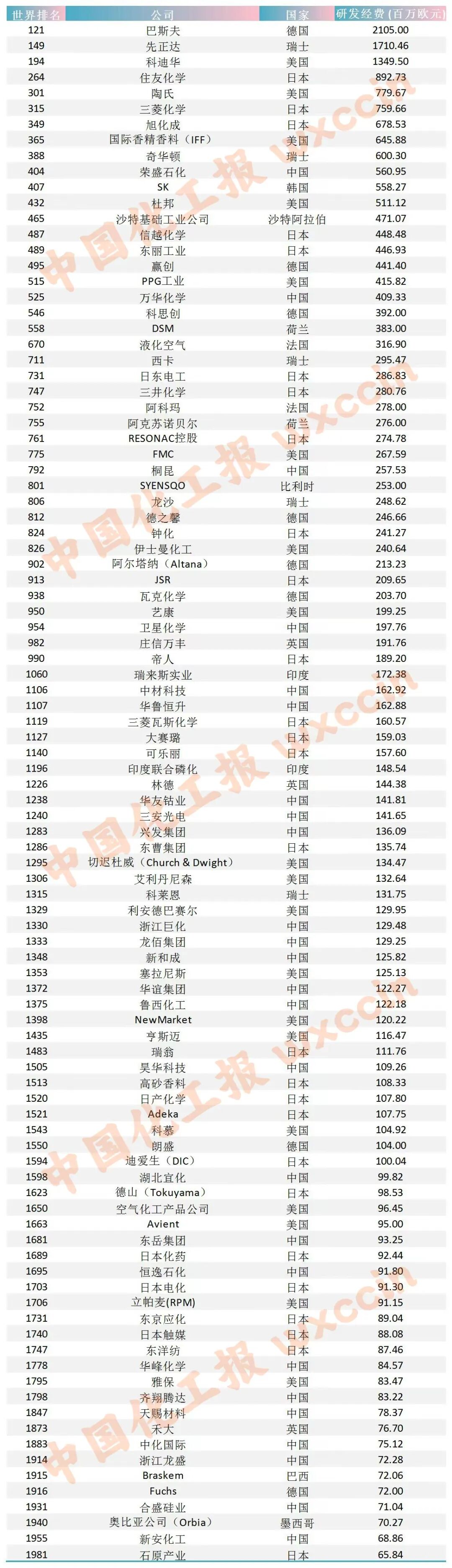
25家中国化企上榜全球研发投入2000强(附名单)
Zhong Guo Hua Gong Bao· 2026-01-11 04:33
Group 1 - The European Commission's report on the "2025 EU Industrial R&D Investment Scoreboard" reveals that 25 Chinese chemical companies are among the top 2000 global industrial R&D investors for 2025 [1] - Among the top 2000 companies, there are 98 chemical firms, with a total R&D investment of €26 billion in 2024, averaging €1.32 million per chemical company [2] - BASF leads the chemical industry with an R&D investment of €2.1 billion in 2024, ranking 121st overall; Syngenta ranks 149th with €1.71 billion, and Corteva ranks 194th with €1.34 billion [2] Group 2 - By country, Japan has the highest number of companies on the list with 27, followed by China with 25, the USA with 19, Germany with 8, and Switzerland with 5 [3] - The total R&D investment of the top 2000 companies in 2024 is €144.6 billion, accounting for over 90% of global corporate R&D investment [3] - The top ten companies globally include Amazon, Alphabet (Google's parent company), Meta (Facebook's parent company), Microsoft, Apple, Huawei, Samsung Electronics, Volkswagen, Johnson & Johnson, and Intel [4] Group 3 - The detailed list of the top chemical companies includes BASF (Germany), Syngenta (Switzerland), Corteva (USA), and others, with their respective R&D expenditures listed in millions of euros [5][6] - Notable Chinese companies in the list include Rongsheng Petrochemical (ranked 404th with €560.95 million), Wanhua Chemical (525th with €409.33 million), and others [5][6] - The report highlights the competitive landscape of the chemical industry, showcasing significant investments in R&D by various global players [2][3]


涨价,涨价!新能源替代潮来袭,下一个“苹果级”回报就在眼前?
券商中国· 2026-01-10 23:31
Core Viewpoint - The article discusses the ongoing supercycle in resource prices driven by the explosive demand in the new energy sector, highlighting the transition from traditional industries to new energy companies and the potential for high returns on investment in this sector [2][6]. Group 1: Resource Price Increases - Since 2025, prices for copper, lithium, nickel, cobalt, aluminum, and even sulfur have risen, indicating a significant shift not solely attributed to economic recovery or monetary phenomena, as other resource sectors like cement and steel remain stagnant [1]. - The prediction made by BYD's chairman in 2016 about the tightening of lithium resources and the potential shortage of copper is now becoming a reality, driven by the growth in electric vehicle demand [2][6]. Group 2: Investment Opportunities in New Energy - The penetration rate of new energy vehicles in the domestic passenger car market has approached 60% this year, marking a significant shift towards high profitability and shareholder returns for leading new energy companies [2]. - Investment in leading new energy companies is compared to historical investments in Apple, suggesting that the current market conditions present a similar opportunity for substantial returns [3][5]. Group 3: Valuation and Profitability - A leading new energy battery company's stock price was at 140 yuan per share with a market cap of 580 billion yuan, and projected profits for 2025 could reach 100 billion yuan, indicating a low valuation of around 6 times earnings [3]. - The core principle of value investing remains unchanged: buying a company worth 1 yuan for 0.4 yuan, emphasizing the importance of purchasing undervalued assets [3]. Group 4: Market Trends and Future Projections - The current market for new energy vehicles is expected to grow from a 10% penetration rate to 100%, similar to the rapid adoption of smartphones, which will likely lead to significant returns for investors in this sector [5][7]. - The domestic new energy vehicle retail penetration rate reached 62.2% in early December 2025, indicating a strong consumer preference shift towards electric vehicles [6].




装备新科技挖掘:TPU材料性能优势明显,有望广泛应用于人形机器人
Orient Securities· 2026-01-10 13:16
Investment Rating - The industry investment rating is maintained as "Positive" [6] Core Insights - The trend towards lightweight humanoid robots is irreversible, with the future widespread application of electronic skin expected to drive growth in orders for dexterous hands and related manufacturers, benefiting lightweight material and component suppliers [3] - TPU (Thermoplastic Polyurethane) materials exhibit significant advantages such as good stretchability, abrasion resistance, thermal stability, and corrosion resistance, with sufficient domestic production capacity [9][17] - The global electronic skin market is projected to reach USD 6.44 billion by 2025 and USD 111.53 billion by 2035, with a compound annual growth rate (CAGR) of 33% over the next decade, driven primarily by medical needs, wearable devices, and robotics applications [13][17] Summary by Sections TPU Material Advantages - TPU materials combine the processing capabilities of plastics with the elasticity of rubber, offering excellent biocompatibility, high-temperature resistance, and corrosion resistance. The domestic production capacity is primarily focused on mid-to-low-end products, with leading domestic companies achieving quality comparable to international leaders [9][18] Electronic Skin Market - The electronic skin market is expected to grow rapidly, with robotics applications accounting for approximately 42% of the market. About 68% of robotics laboratories are actively testing electronic skin to enhance tactile perception [13][17] Application in Robotics - TPU materials are well-suited for the performance requirements of electronic skin and lightweight structural components in robots. They have been explored in applications such as the passive support system of the Xiaopeng IRON robot and in collaborations between Fourier Intelligence and BASF [17][18]