
温和再通胀

Search documents
每周投资策略-20260209
citic securities· 2026-02-09 10:57
Group 1: Global Market Overview - The MSCI ACWI Global Index closed at 1,042.82, with a weekly change of -0.1% and a yearly change of +19.1% [6] - The MSCI Emerging Markets Index decreased by 1.4% over the week but showed a significant yearly increase of 36.7% [6] - The U.S. market saw the Dow Jones increase by 2.5% weekly, while the S&P 500 and Nasdaq experienced slight declines of -0.1% and -1.8% respectively [6] Group 2: China Market Focus - The Chinese market is expected to experience mild re-inflation, with December 2025 PPI rising by 0.2% month-on-month, the highest since 2024 [12][13] - CPI for December 2025 rose to +0.8% year-on-year, driven by increased food prices and a recovery in core CPI [14] - Key stocks to watch include Alibaba and Ping An, with the盈富基金 ETF being highlighted for investment [10][19][27] Group 3: South Korea Market Focus - South Korea's inflation rate decreased to 2.0% year-on-year in January 2026, aligning with the central bank's target [36] - The KOSPI index is expected to align with the average price-to-book ratio of emerging markets, with a projected index level of 6,775 points [42] - Notable stocks include SK Hynix and Samsung Electronics, which are expected to benefit from strong demand in the semiconductor sector [46][47] Group 4: Indonesia Market Focus - Indonesia's GDP growth for Q4 2025 exceeded expectations at 5.39%, contributing to an annual growth rate of 5.10% [55] - The market faces uncertainty due to potential downgrades by MSCI, which could lead to capital outflows and increased bond yields [59] - The iShares MSCI Indonesia ETF is noted for tracking the performance of large and mid-cap stocks in Indonesia [60][62]
天风固收谭逸鸣:5%GDP下的转型叙事
Sou Hu Cai Jing· 2026-01-20 23:48
Group 1 - The core viewpoint of the articles indicates that China's economy is expected to maintain a GDP growth rate of around 5% in 2026, with a focus on balancing multiple goals such as stable growth, expanding domestic demand, improving people's livelihoods, and preventing risks [1][3] - In 2025, China's GDP grew by 5.0%, achieving the expected growth target amidst complex internal and external environments, characterized by stronger production than demand, resilient exports, and a need to boost domestic demand [2][3] - The economic growth engine is shifting from traditional "real estate-infrastructure" to a new model driven by "consumption, new productive forces, and coordinated domestic and external demand," with consumption becoming the main driver of domestic demand [2][3] Group 2 - Industrial production showed a recovery in December, with a year-on-year increase of 5.2% in industrial added value, highlighting the strong momentum of manufacturing upgrades, particularly in new energy vehicles and industrial robots [4] - Consumer spending growth continued to slow, with December retail sales growth dropping to 0.9%, indicating insufficient recovery momentum in consumption, although online retail channels remained resilient with a growth of 8.6% for the year [5] - Investment growth saw a significant decline, with a year-on-year decrease of 3.8% for the year, although manufacturing investment was a key driver, supported by policies promoting new equipment purchases [6][7]
宏观周报:高频数据显示经济呈现开门红-20260118
Yin He Zheng Quan· 2026-01-18 07:44
Economic Overview - The economic outlook for Q1 2026 is optimistic, with high-frequency data indicating a strong start to the year[1] - Moderate re-inflation is expected to be a key macro theme influencing asset allocation in the first quarter[1] Policy Measures - Domestic macro policies are showing a clear trend of proactive measures, with a focus on the coordination of monetary and fiscal policies[1] - Fiscal policy is set to issue 8,000 billion yuan, while monetary policy is expected to adjust interest rates by 50 basis points[1] Demand Side Analysis - Consumer activity remains stable, with a 4.9% increase in travel, although movie box office revenues have seen a decline of 13.4%[2] - External demand shows resilience, with port cargo and container throughput exceeding last year's levels, despite a 26.6% drop in the Baltic Dry Index (BDI)[2] Production Insights - Production remains robust during the off-peak season, with a 1.44 percentage point increase in operational rates across various sectors[2] - The production index for PTA has increased by 1.12%, indicating a healthy production environment[2] Price Trends - Consumer Price Index (CPI) shows a marginal recovery in pork prices, while vegetable prices continue to decline, with a CPI increase of 0.27%[3] - Producer Price Index (PPI) reflects fluctuations in crude oil prices, with a 4.50% increase noted[3] Fiscal and Monetary Dynamics - Fiscal issuance is strategically positioned, with multiple measures being implemented to support economic growth[3] - The yield curve for government bonds has shifted downward, indicating a potential easing of monetary conditions[3] Global Economic Context - Global growth expectations have been slightly revised upward, with a projected GDP growth of 2.6% for 2026, reflecting a 0.2% increase[4] - The U.S. inflation rate remains stable at 2.7%, with strong employment data supporting consumer spending[4]
东莞证券财富通每周策略-20260116
Dongguan Securities· 2026-01-16 10:28
Market Overview - The market experienced a pullback after a strong rally, with mixed performance across the three major indices. The Shanghai Composite Index fell by 0.45%, while the Shenzhen Component rose by 1.14%, and the ChiNext Index increased by 1.00% [1][2][8] - In the first half of the week, trading volume exceeded 3 trillion yuan, and margin trading balances rose significantly, with the Shanghai index reaching a ten-year high. However, market sentiment cooled in the latter half due to regulatory adjustments [1][2][8] Economic Indicators - Exports showed resilience at the end of 2025, with December exports in USD terms growing by 6.6% year-on-year, surpassing 350 billion USD, marking a historical high. Integrated circuits and automobiles contributed over 60% of this growth [9][10] - The Consumer Price Index (CPI) rose by 0.8% year-on-year in December 2025, the highest since March 2023, indicating an improving price environment. The Producer Price Index (PPI) saw a narrowing decline of 1.9% year-on-year [9][10] Federal Reserve Outlook - The U.S. labor market data was mixed, with non-farm payrolls adding 50,000 jobs in December, below expectations. However, the unemployment rate fell to 4.4%, leading to increased expectations that the Federal Reserve will pause interest rate cuts in January [10][11] - Inflation remained stable, with the December CPI at 2.7% year-on-year, supporting the Fed's accommodative policy stance. Market participants expect cumulative rate cuts of about 50 basis points in 2026 [10][11] Regulatory Adjustments - The adjustment of margin trading requirements by the Shanghai and Shenzhen stock exchanges aims to cool overheated market sentiment rather than suppress it. The minimum margin requirement for new financing contracts has been raised from 80% to 100% [11][12] - The People's Bank of China has implemented structural interest rate cuts to support economic transformation, with a 0.25 percentage point reduction in various monetary policy tools [12][13] Sector Recommendations - Investment focus is recommended on sectors such as non-ferrous metals, TMT (Technology, Media, and Telecommunications), machinery, power equipment, and basic chemicals [14]
每日投行/机构观点梳理(2026-01-12)
Xin Lang Cai Jing· 2026-01-12 12:34
Group 1: Federal Reserve and Employment Data - Goldman Sachs expects the Federal Reserve to maintain its current policy in January, with two rate cuts anticipated in the remainder of 2026 due to initial signs of labor market stability [1] - JPMorgan has removed its forecast for a rate cut in 2026, now predicting a 25 basis point increase in Q3 2027 [1] - Societe Generale believes the decline in unemployment and rising wages provide a stronger rationale for the Fed to hold rates steady in January [1] Group 2: Oil Prices and Geopolitical Risks - Goldman Sachs indicates that despite ongoing geopolitical risks, oil prices may continue to decline due to ample supply, predicting Brent and WTI crude oil prices to average $56 and $52 per barrel respectively in 2026 [2] Group 3: Chinese Economic Outlook - CITIC Securities forecasts a "mild re-inflation" in China in 2026, driven by a slight increase in PPI and CPI, with core CPI expected to rise due to various factors including food prices and service costs [3] - CITIC Securities also notes that the balance between external and internal demand will be crucial for the A-share market, with a higher probability of upward movement in early 2026 [4] Group 4: Commodity Prices and Market Trends - CITIC Jinpu predicts that copper prices will continue to rise, with the market not yet at an end, and expects significant support for copper prices despite short-term corrections [5] - CITIC Securities anticipates that investment in the power grid during the 14th Five-Year Plan period may reach 3.8 trillion yuan, focusing on high-quality development and stability in the energy sector [6] Group 5: Currency and Market Dynamics - Huatai Securities expects the Federal Reserve to pause rate cuts from January to May, with potential cuts occurring after the new Fed chair takes office [7] - Huachuang Securities highlights the commercialization of brain-computer interfaces, indicating a growing market with significant potential for expansion beyond the medical field [8] - Shenwan Hongyuan predicts that the RMB will appreciate by 2-3% annually over the next few years, with a total appreciation of over 30% in the next decade, benefiting the stock market [10]





光伏、电池产品出口退税政策调整,影响几何?
Sou Hu Cai Jing· 2026-01-12 01:27
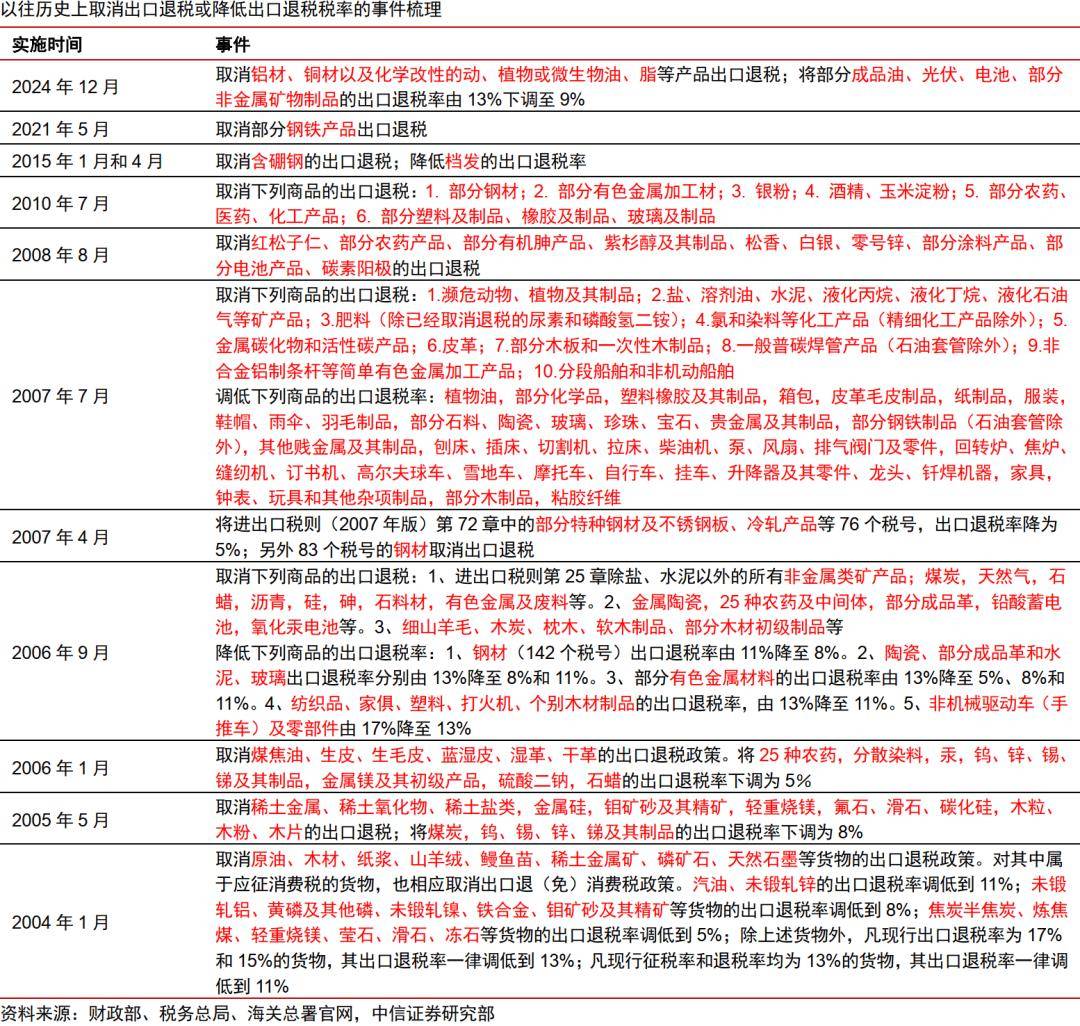
Macro - The Ministry of Finance and the State Taxation Administration announced adjustments to export tax rebate policies for photovoltaic and battery products on January 9, aimed at reducing trade friction and supporting industrial upgrades, which may bolster export growth for related products in Q1 2026 [1][6] - The PPI in December 2025 slightly exceeded market expectations, while the CPI has shown a continuous recovery for four months, reaching +0.8% year-on-year, with core CPI remaining at a high of +1.2%, aligning with market expectations [1][9] Battery Industry - The adjustment of export tax rebate policies for battery products is seen as a measure to prevent "involution" and enhance the profitability of export products, with a structured decline in tax rates and a transition period [2][11] - The tax rebate for battery products will decrease from 9% to 6% starting April 1, 2026, and will be eliminated entirely from January 1, 2027, affecting lithium-ion batteries and nickel-hydrogen batteries [11][12] - The estimated impact on export tax rebates is approximately $22 million for 2026 and $66 million for 2027, with the potential for a "rush to export" scenario due to the structured decline in tax rates [12][13] - The policy is expected to favor Chinese battery companies with overseas production capacity, enhancing their global competitiveness and market share [2][12][13] Trade Policy - Mexico's recent tariff adjustments are primarily aimed at countries like China and South Korea, affecting about 45% of China's exports to Mexico, which could impact overall Chinese exports by approximately 1% [3][4] - The tariff adjustments are interpreted as a gesture towards the U.S., indicating potential follow-up actions from other developed economies, particularly Canada, in response to U.S. trade policy [4][5]

中信证券:2026年中国有望迎来“温和再通胀”
Zheng Quan Shi Bao Wang· 2026-01-10 02:26
Group 1 - The core viewpoint of the article indicates that the PPI in December 2025 slightly exceeded market expectations, with a month-on-month increase of 0.2%, marking the highest value since the beginning of 2024, driven primarily by surging prices in non-ferrous metals such as copper, aluminum, and silver [1] - The downstream industries are generally showing a trend of "continuing month-on-month decline with narrowing year-on-year declines," with the PPI for lithium-ion battery manufacturing and photovoltaic equipment and components manufacturing narrowing for four and nine consecutive months, respectively [1] - There is a noted phenomenon of poor price transmission from upstream to downstream industries due to weak demand, which may pressure profit margins in certain downstream sectors as some upstream raw material prices surge [1] Group 2 - The CPI has shown a year-on-year increase for four consecutive months, reaching 0.8%, while the core CPI remains high at 1.2%, aligning with market expectations, with the expansion of food prices being the main driver for the recent CPI increase [1] - Since June 2025, the core CPI has entered a rapid upward trend, significantly influenced by a quick drop in the base figure, along with unexpected increases in gold jewelry prices, notable rises in certain service prices (especially medical and educational services), and improvements in durable consumer goods prices benefiting from national subsidies [1] - The overall price performance in 2025 shows that both PPI and CPI year-on-year figures were slightly weaker than in 2024, but the year exhibited a significant "front low, back high" characteristic, with a notable improvement in the price environment since the second half of 2025, suggesting a potential "mild re-inflation" in China in 2026 [1]
中央经济工作会议为明年定下哪些基调?
Di Yi Cai Jing· 2025-12-18 10:26
Group 1 - The central economic work conference emphasized a shift in macroeconomic policy, upgrading fiscal policy to "more proactive" and monetary policy to "moderately loose," marking the first simultaneous easing since 2011 [1] - The conference highlighted the need for a flexible and efficient monetary policy to support economic stability and reasonable price recovery, utilizing various tools such as reserve requirement ratio cuts and interest rate reductions [1] - The necessity for policy intervention is underscored by three hard indicators: persistent demand gaps, evident deflationary pressures, and fiscal revenue challenges, indicating a need for stronger policy measures [2][3] Group 2 - The conference aims to break the negative cycle through a combination of fiscal expansion to boost nominal GDP and monetary easing to lower real interest rates, targeting sustained economic recovery [3] - The fiscal deficit and debt levels will be managed flexibly, with potential adjustments to the fiscal deficit rate expected to rise to 3.5%-3.8% by 2026, depending on economic conditions [4] - The transition from broad subsidies to targeted support in fiscal policy is anticipated, focusing on key sectors such as equipment upgrades and urban renewal projects, with an estimated 300 billion yuan allocated for interest subsidies to stimulate investment [5] Group 3 - The conference reiterated the importance of maintaining the stability of the RMB exchange rate within a reasonable range, especially in the context of potential U.S. Federal Reserve interest rate cuts [6] - The macroeconomic outlook for 2026 is characterized by a combination of central government leverage, bank interest rate reductions, and stable expectations, aligning with the conference's goals of proactive fiscal and moderately loose monetary policies [7] - Investors are advised to focus on opportunities arising from fiscal expansion while being cautious of exchange rate fluctuations and the Federal Reserve's policy trajectory [7]
变局中寻路:中国银河把脉2026,勾勒“十五五”投资新蓝图
2 1 Shi Ji Jing Ji Bao Dao· 2025-11-27 11:58
Core Insights - The current stability mechanism of China's capital market has shifted from "crisis response" to "proactive governance," significantly enhancing the market's inherent stability [1] - The 2026 economic outlook is framed around the theme of "ReNew," highlighting the coexistence of global "new patterns and cycles" with domestic "new blueprints and new productive forces" [1][2] Group 1: Economic Challenges and Trends - The economic landscape is characterized by three layers of challenges: long-term "3D challenges" (aging population, debt crisis, de-globalization), mid-term "spiral downward" mechanisms, and recent "three inflection points" (U.S. political shift, China's economic transformation, global technological leap) [2] - Global economic growth is expected to continue a slight decline, but the growth gap between developed economies and emerging markets is predicted to narrow [2] - By 2026, Asia's economic scale is projected to surpass that of North America and Europe for the first time, indicating a profound shift in the global economic landscape [2] Group 2: Investment Opportunities and Strategies - China must seize opportunities presented by "creative destruction," with the government playing dual roles as "investor" and "insurer" to stimulate innovation and buffer transformation shocks [3] - The future of China's economy is summarized by "three news" (new blueprint, new starting point, new productive forces) and "three rebalances" (external vs. internal demand, supply vs. demand, nominal vs. real variables) [3] - The capital market is undergoing a paradigm shift from "cyclical fluctuations" to "structural changes," necessitating a comprehensive update of traditional analytical frameworks [4] Group 3: Asset Pricing and Market Dynamics - The traditional correlation between asset prices and economic fundamentals is being restructured, with economic drivers shifting from traditional inputs to innovation-driven growth [4] - The capital market in 2026 is expected to exhibit "economic rebalancing and moderate re-inflation," with fiscal policy maintaining necessary spending intensity and monetary policy remaining prudent [4] - Investors are advised to focus on the changes in "three prices": RMB exchange rate, Sino-U.S. interest rate differentials, and stock-bond relative prices, as these will influence asset performance [4] Group 4: Sector-Specific Insights - In the AI sector, a shift from "model-driven" to "application-driven" development is anticipated, with 2026 being a critical year for AI applications [5] - The communication industry is expected to upgrade due to AI computing power demands, with significant growth in AI capital expenditures by cloud vendors [5] - The pharmaceutical sector is undergoing a "hard technology" transformation, with a focus on innovative drug companies and medical device firms that possess genuine innovation capabilities [6] - The consumer market is evolving into a "dual-driven" new pattern, with continuous innovation in technology consumption and emerging new consumption scenarios [6]

深化新供给侧改革布局“十五五”新机遇
Zhong Guo Zheng Quan Bao· 2025-11-26 20:20
Core Insights - The conference themed "Change and Leap" highlighted the resilience of the Chinese economy amidst global restructuring and transformation, with a focus on structural opportunities in the capital market [1][2] - China Galaxy Securities aims to inject financial momentum into the new development pattern, emphasizing the importance of capital markets in the upcoming five years [2][3] Economic Outlook - The chief economist of China Galaxy Securities, Zhang Jun, introduced the "ReNew" framework, predicting a convergence of growth rates between emerging and developed markets, and a rebalancing of the US and Chinese economies [3][4] - Zhang emphasized the importance of new supply-side reforms in 2026, focusing on stabilizing the real estate market, eliminating outdated production capacity, and promoting AI and digital economy development [3][4] Policy and Market Predictions - The macro chief analyst, Zhang Di, forecasted a stable policy environment in 2026, with a fiscal deficit rate of around 4% and special government bonds between 1.3 trillion and 1.5 trillion yuan to support consumption [4] - Zhang also predicted a mild re-inflation with CPI growth around 0.4% and a recovery in PPI, which would positively impact corporate profits and household income expectations [4] Investment Strategy - The strategy chief analyst, Yang Chao, suggested that the A-share market is likely to shift from valuation-driven to profit-driven, with a focus on new quality productivity and manufacturing sector optimization [5][6] - Yang recommended two main investment lines: focusing on key areas such as AI, quantum technology, and new energy, and capitalizing on domestic consumption policies [5][6] Technology Trends - Analysts from China Galaxy Securities discussed the future of the computer industry, predicting a shift towards AI applications and increased domestic computing power penetration [6] - The communication sector is expected to benefit from AI computing power, with a focus on operational efficiency and advancements in quantum technology [6]