稳增长政策

Search documents
2026年2月PMI数据点评:春节长假影响制造业PMI指数季节性下行,服务业景气度回升
Dong Fang Jin Cheng· 2026-03-04 07:10
东方金诚宏观研究 春节长假影响制造业 PMI 指数季节性下行,服务业景气度回升 ———— 2026 年 2 月 PMI 数据点评 王青 李晓峰 冯琳 事件:根据国家统计局公布的数据,2026 年 2 月,中国制造业采购经理指数(PMI)为 49.0%,比 1 月下降 0.3 个百分点;2 月非制造业商务活动指数为 49.5%,比 1 月回升 0.1 个百分点,其中,建筑 业商务活动指数为 48.2%,比 1 月下降 0.6 个百分点,服务业 PMI 指数为 49.7%,比 1 月回升 0.2 个百 分点;2 月综合 PMI 产出指数为 49.5%,比 1 月下降 0.3 个百分点。 2 月 PMI 数据要点解读如下: 2月制造业PMI指数比上月回落0.3个百分点至49.0%,基本符合预期。可以看到,剔除极端数据, 过去十年"春节月"该指数平均环比下降约 0.4 个百分点。今年春节落在 2 月,假期增加 1 天,企业员 工放假、农民工大规模返乡过节,带动制造业 PMI 指数中的生产指数大幅度下降 1 个百分点至 49.6%, 是 2 月整体指数下行的主要原因。其次,在假期企业生产放缓的过程中,制造业产业链需求也 ...
未知机构:浙商宏观李超林成炜2月经济前瞻工业生产蓄势一季度开门红-20260304
未知机构· 2026-03-04 02:45
3投资端整体仍偏低位,固定资 【浙商宏观||李超|林成炜】2月经济前瞻:工业生产蓄势一季度开门红 我们预计2026年开年前两个月经济运行延续供给稳、需求修复、价格温和、信用偏弱的结构性特征: 1供给端在工业大学生产修复与服务业景气回升带动下,规上工业增加值同比或达5.0%左右; 2需求端受春节错位与"拼假"效应提振,社零同比预计回升至5.1%,但地产偏弱仍对居民部门消费与投资形成约 束; 总体看,稳增长政策继续发力有望支撑一季度"开门红",但修复斜率仍取决于地产拖累缓解与内生需求持续性。 基于以上判断,大类资产方面,权益市场,预计流动性驱动下A股将在2026年继续走强,低波红利与科技成长 交织的结构化行情,出口出海链条受益外需改善同样具备机会。 债券市场,预计10年期国债收益率在1.5-2%区间宽幅震荡。 风险提示:1)国际大宗商品价格超预期波动;2)大国博弈强度超预期。 【浙商宏观||李超|林成炜】2月经济前瞻:工业生产蓄势一季度开门红 我们预计2026年开年前两个月经济运行延续供给稳、需求修复、价格温和、信用偏弱的结构性特征: 1供给端在工业大学生产修复与服务业景气回升带动下,规上工业增加值同比或达5.0 ...
涨疯了vs跌傻了:港股这场极致分化,透露了2026年最大的赚钱密码
Sou Hu Cai Jing· 2026-02-27 10:58
如果你是一位港股投资者,今年的账户表现可能会让你怀疑人生。 第二个驱动力:大宗商品价格持续上行,能源原材料板块业绩直接兑现。 打开账户一看,有的人赚得盆满钵满,有的人亏得怀疑人生。这不是运气问题,而是你有没有站对队的 问题。 来看一组数据:截至2026年2月底,恒生综合行业指数呈现出罕见的极致分化。原材料业暴涨23.62%, 地产建筑业大涨20.02%,能源业涨18.8%,工业涨15.87%。而另一边,信息科技业大跌9.74%,电讯业 跌2.39%,非必需性消费微跌0.65%。 首尾相差超过33个百分点。这意味着,如果你年初买的是原材料,现在已经赚了将近四分之一;如果你 买的是科技股,可能已经亏了十个点。冰火两重天,不过如此。 那么,究竟是什么原因导致了如此剧烈的分化? 说白了,市场的定价逻辑正在发生根本性转变——从"讲故事"转向"看业绩",从"成长叙事"转向"政策 确定性"。 第一个驱动力:稳增长政策超预期发力,地产链风险基本解除。 这是本轮分化最核心的政策逻辑。2025年底中央经济工作会议定调"着力稳定房地产市场"后,2026年开 年政策密集落地:商业用房首付比例从50%直接降到30%,二手房增值税减免, ...
人民币汇率突破6.87创近三年新高 或可提振股市
2 1 Shi Ji Jing Ji Bao Dao· 2026-02-25 13:18
21世纪经济报道记者 叶麦穗 春节长假之后,人民币汇率迎来"开门红",2月25日盘中,离岸人民币兑美元一度升至6.8619,在岸人民币兑美元 触及6.8654,两大核心汇率指标双双刷新2023年4月以来的新高,并且上涨都超过130个基点。 市场认为,今年一季度我国出口有望延续较快增长态势,叠加当前外汇市场情绪持续向好,短期内美元指数大幅反弹的可能性较低。预计春节 后一段时间内,人民币汇率仍将保持偏强运行格局。 多因素共促人民币走强 汇市迎来"开门红",连续两个交易日出现大涨。2月24日,在岸人民币兑美元汇率盘中最高升值至6.8804,离岸人民币兑美元汇率盘中最高升 值至6.8760,刷新2023年4月28日以来高点。 2月25日,这一趋势延续。当日人民币兑美元中间价上调93个基点,报6.9321。在岸价和离岸价也都继续上攻,离岸人民币兑美元一度升至 6.8619,在岸人民币兑美元触及6.8654,两大核心汇率指标双双刷新2023年4月以来的新高。 自2025年12月底升破7.0这一整数关口后,2026年开年人民币汇率延续升值趋势,人民币兑美元一直处于7之下,离岸价最高为6.9957。 2月以来,人民币兑美元汇 ...

金融市场流动性与监管动态周报:历史上两会前后A股风格如何演绎?-20260224
CMS· 2026-02-24 14:31
Market Performance - Historically, A-shares tend to perform well in the two weeks leading up to the National People's Congress (NPC), with a probability of over 50% for indices like the CSI 1000 and CSI 500 to rise, averaging over 3% returns in the two weeks prior [9][18] - After the NPC, the probability of market increases rises significantly, with indices like the CSI 1000 and CSI 500 showing a 64% probability of rising in the weeks following the congress [9][18] Style Performance - There is a calendar effect observed in A-shares around the NPC, where small-cap stocks generally outperform both before and after the congress, driven by expectations of stable growth policies and active financing [12][18] - The small-cap growth and value styles are expected to dominate during the NPC period, while large-cap styles may gain traction in the month following the congress [12][18] Industry Performance - Industries such as basic chemicals, non-ferrous metals, and construction materials show strong performance before and after the NPC, with over 50% probability of rising in the weeks leading up to the congress [14][18] - Post-NPC, industries like real estate, construction materials, and consumer goods are expected to see higher probabilities of increases as stable growth policies are implemented [16][18] Liquidity and Funding - The liquidity indicators show a net outflow of financing funds amounting to 830.2 billion yuan, with a significant drop in ETF inflows [30][36] - The issuance of public funds increased by 340.3 million units, indicating a rise in demand for equity investments despite the overall net outflow [30][36] Market Sentiment - Market sentiment has shown a decrease in trading activity, with the proportion of financing transactions in A-share trading falling to 8.6% [44] - The VIX index has decreased, indicating improved risk appetite in the market, with the Nasdaq and S&P 500 indices also showing positive performance [46][48]
华商基金张雨迪:权益市场指数或延续波动向上
Zhong Guo Jing Ji Wang· 2026-02-12 08:45
开年以来,政策预期、流动性与基本面共振上修,投资者对证券市场也有了更多的期待。 数据说明:截至2025.12.31,张雨迪具有7.4年证券从业经历,其中6.6年证券研究经历,0.8年证券投资 经历,张雨迪历任基金——华商稳健泓利一年持有混合20250226至今。文中观点来自基金定期报告,仅 为基金经理投资理念,基金的投资策略详见基金法律文件。华商稳健泓利一年持有混合A类申购费率根 据申购金额划分不同标准:金额<100万元时费率为0.8%;100万元≤金额<300万元时费率为0.5%;300 万元≤金额<500万元时费率为0.3%;金额≥500万元时按每笔1000元收取。C类基金份额不收取申购费。 投资人持有本基金 A 类或 C 类基金份额需至少满一年,在一年持有期内不能提出赎回申请,持有满一 年后赎回,不收取赎回费用。红利再投资的基金份额在对应认购/申购份额锁定持有期到期后即可进行 赎回或转换转出,不收取赎回费用。销售服务费A类不收取,C类0.4%/年。通过本公司直销中心申购本 基金的养老金客户适用特定的申购费率,详见本基金《招募说明书》及相关公告。 华商稳健泓利一年持有混合基金经理张雨迪表示,展望未来,预计 ...
光大期货:2月12日金融日报
Sou Hu Cai Jing· 2026-02-12 01:25
来源:市场资讯 股指: (王东灜,从业资格号:F03087149;交易咨询资格号:Z0019537) 春节期间,地缘风险是影响A股的重要因素之一。其一,美伊局势值得关注,目前美国再次向本国公民 发布撤离提示,局部冲突的风险正在逐步升高;其二,日本右翼政党选举中取胜,对于地区发展的影响 值得长期关注。作为战略储备资源的贵金属和其他有色金属主要计价现有国际秩序的不确定性,春节前 后波动可能增加。对股指而言,当前指数波动率逐渐回落,如果节日期间爆发地缘冲突,指数波动率可 能短期上升。 (朱金涛,从业资格号:F3060829;交易咨询资格号:Z0015271) 昨日国债期货收盘,30年期主力合约涨0.05%,10年期主力合约涨0.06%,5年期主力合约涨0.04%,2年 期主力合约基本持稳。中国央行2月11日开展4000亿元14天期和785亿元7天期逆回购。据qeubee统计, 公开市场有750亿元7天逆回购到期,实现净投放4035亿元。资金面来看,DR001上行0.5BP至1.37%, DR007下行2BP至1.54%。短期来看,继央行结构性降息之后财政政策接续发力,稳增长政策持续出台 背景下债市持续走强动力不足, ...
稳增长政策成效显现 技术红利进一步释放 亚太发展中经济体提升内生增长动能 中国高科技和创新产品带动地区经济高质量发展(国际视点)
Ren Min Ri Bao· 2026-02-11 22:38
Group 1 - The Asian Development Bank (ADB) forecasts a 4.6% economic growth for developing economies in the Asia-Pacific region by 2026, an increase of 0.1 percentage points from previous estimates, supported by stable economic fundamentals and a favorable investment environment [1] - In East Asia, economic growth forecasts for 2025 and 2026 have been raised to 4.6% and 4.1% respectively, with overall inflation remaining moderate [1] - The report highlights strong export performance in high-tech and innovative products from China, particularly in electric vehicles, photovoltaic products, and lithium batteries, contributing to high-quality economic development in the Asia-Pacific region [1] Group 2 - Southeast Asia is projected to see economic growth of 4.5% in 2025 and 4.4% in 2026, with countries like Indonesia, Malaysia, Singapore, and Vietnam showing strong growth, particularly in the third quarter of 2025 [1] - The tourism sector is rebounding quickly, with the Asia-Pacific region expected to receive 331 million international visitors in 2025, a 6% increase year-on-year, providing significant support for regional economic growth [2] - The digital economy is becoming a new growth driver for Southeast Asian countries, with Malaysia aiming to increase the digital economy's share of GDP to 25.5% by 2030, and Indonesia focusing on digital finance with over 56 million users accessing QR payment systems [4] Group 3 - The Regional Comprehensive Economic Partnership (RCEP) has attracted over 30% of global foreign direct investment, enhancing regional cooperation in areas like digital economy and green development [3] - The World Trade Organization has lowered the global goods trade growth forecast for 2026 to 0.5%, indicating challenges posed by unilateralism and protectionism affecting export-oriented economies in the Asia-Pacific region [3] - ADB emphasizes that developing economies in the Asia-Pacific are implementing policy measures to stabilize economic performance, with a focus on digital transformation and technological innovation to enhance growth resilience [4]

铝产业链周度报告-20260206
Zhong Hang Qi Huo· 2026-02-06 10:04
1. Report Industry Investment Rating - No information provided in the report. 2. Core Viewpoints - Aluminum prices are expected to continue to fluctuate in the short - term and have a clear upward trend in the medium and long - term [5]. - The price of aluminum alloy may continue to fluctuate and adjust following the price of electrolytic aluminum [64]. 3. Summary by Directory 3.1 Report Summary - US economic data: The US January ISM manufacturing PMI index rose to 52.6, hitting a new high since August 2022. The January ISM services PMI index slightly fell to 53.8 but was better than expected. The January ADP employment number was 22,000, lower than the market forecast. The release of the US non - farm payroll report was postponed [5][12]. - Chinese economic data: China's January official manufacturing PMI was 49.3%, a 0.8 - percentage - point month - on - month decline. The Rating Dog manufacturing PMI rose to a three - month high of 50.3 in January, with sales prices rising for the first time in 14 months [5][16]. - Market sentiment: Global large - scale silver ETF selling put pressure on the precious metal market. Market risk appetite was poor, and domestic PMI data weakened. Steady - growth policies need continuous efforts [5]. - Aluminum market fundamentals: Overseas new production capacity is slowly put into operation. In China, the operating capacity of electrolytic aluminum has changed little in the near term. With the approaching of the Spring Festival, some enterprises choose to take holidays in advance, and the demand shows a weakening trend. Aluminum ingot social inventory has continued to accumulate [5]. 3.2 Multi - empty Focus - Bullish factors: The operating capacity of domestic electrolytic aluminum has changed little [8]. - Bearish factors: Social inventory continues to accumulate. Consumption weakens as the Spring Festival approaches. Precious metals continue to decline, and market risk appetite is poor [8][9]. 3.3 Data Analysis - Bauxite supply: From January to November this year, China's cumulative bauxite production was 55.2135 million tons, a year - on - year increase of 4.21%. In November, the single - month output was 4.698 million tons, a year - on - year decrease of 5.26%. The domestic bauxite supply is tight. The total amount of imported bauxite in December was 14.67 million tons. The supply of overseas bauxite is expected to be relatively loose, and the export volume of Guinean bauxite in 2026 is expected to reach 180 million tons [18][21]. - Alumina market: In 2025, the new domestic alumina production capacity was 9.8 million tons, and it is expected to be 8.6 million tons in 2026. If all new production capacity is put into operation on time, the alumina supply surplus will exceed 10 million tons in 2026. Overseas, the planned new production capacity from 2025 - 2026 is 8.5 million tons, and 5.5 million tons are expected to be added in 2026. Alumina is expected to oscillate at a low level [25]. - Electrolytic aluminum production: In December 2025, China's electrolytic aluminum production increased by 1.9% year - on - year and 4.0% month - on - month. The aluminum water ratio decreased by 0.8 percentage points month - on - month to 76.5%. At the end of December, the national electrolytic aluminum operating capacity increased by 383,000 tons month - on - month. It is expected that the operating capacity will increase slightly in January, and the aluminum water ratio may continue to decline [29]. - Aluminum processing: The comprehensive aluminum processing start - up rate last week was 59.4%, a 1.5 - percentage - point decline from the previous week [30]. - Inventory: LME aluminum inventory decreased to 492,975 tons. As of January 30, SHFE aluminum inventory increased by 10% week - on - week to 216,771 tons. As of February 5, the electrolytic aluminum inventory in major Chinese markets was 853,000 tons, a 24,000 - ton increase from Monday [40][43]. - Price difference: On February 5, the average price of Shanghai Wumao aluminum had a reduced discount. The LME aluminum 0 - 3 discount increased [47]. - Recycled aluminum: In December, the domestic recycled aluminum alloy ingot production was 640,400 tons, a 41,800 - ton month - on - month decrease. Small and medium - sized aluminum plants faced difficulties in raw material procurement. As of January 15, the recycled aluminum alloy industry start - up rate was 58%, unchanged from the previous week [50][54]. - Aluminum trade: In 2025, China's cumulative exports of unwrought aluminum and aluminum products decreased by 8.0% year - on - year. In December, exports were 540,000 tons, a 5.3% year - on - year decrease. Imports in December were 320,000 tons, a 33.3% year - on - year increase [58]. - Aluminum alloy inventory: As of January 30, the weekly social inventory of Chinese aluminum alloy was 67,300 tons, a 300 - ton increase from the previous week, and the in - plant inventory was 71,100 tons, a 6,000 - ton increase from the previous week [61]. 3.4 Market Outlook - Aluminum alloy prices are expected to follow the electrolytic aluminum prices and continue to fluctuate and adjust [64]. - Aluminum prices are expected to continue to fluctuate in the short - term and have a clear upward trend in the medium and long - term [67].
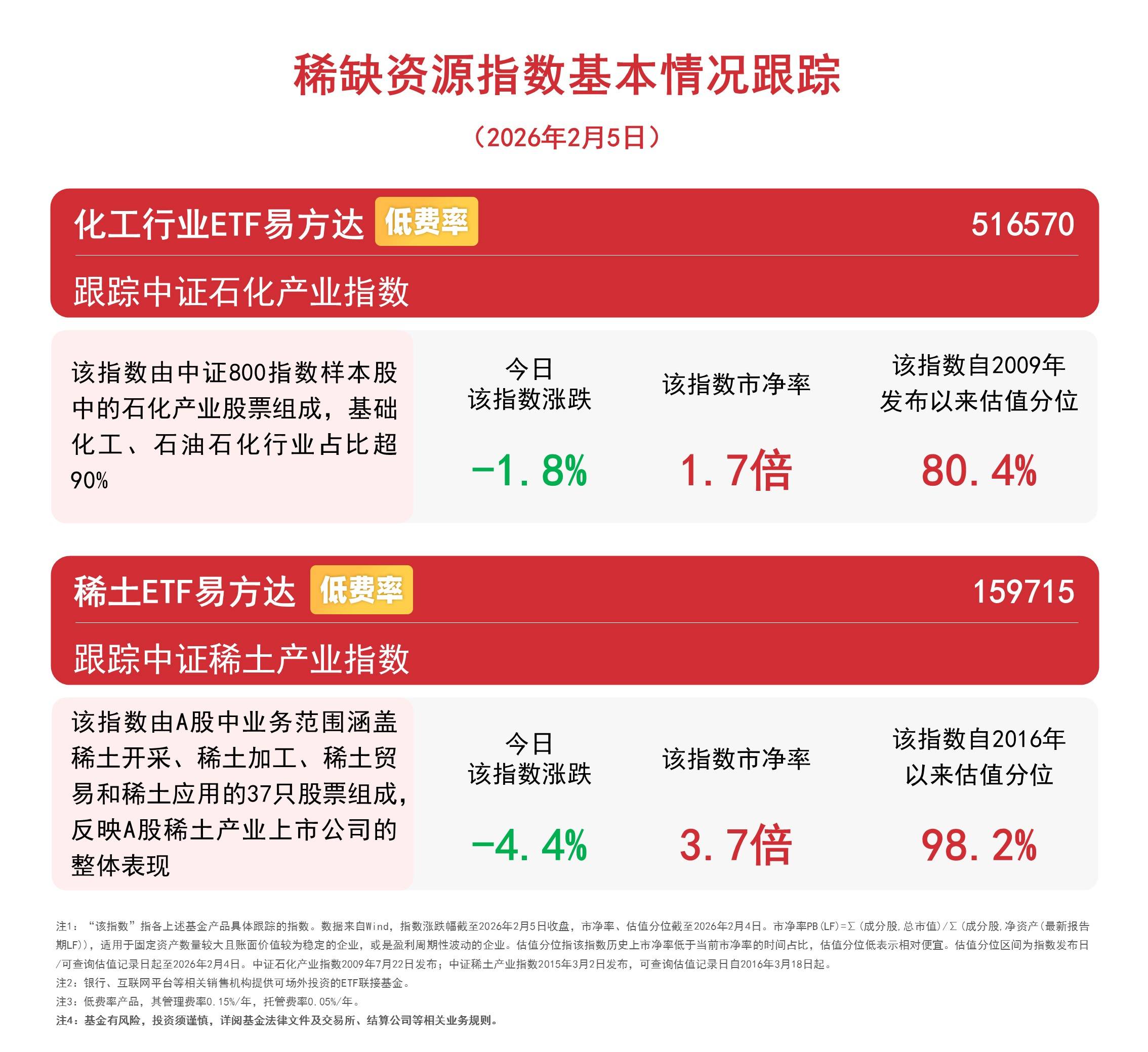
石油化工板块回调,化工行业ETF易方达(516570)近5日"吸金"超10亿元
Sou Hu Cai Jing· 2026-02-05 12:57
截至收盘,中证石化产业指数下跌1.8%,中证稀土产业指数下跌4.4%。据Wind数据统计,化工行业ETF易方达(516570)近5个交易日合计资金净流入超10 亿元。 兴业证券指出,化工品底部区间运行已达三年,行业在建工程增速持续下滑,新产能投放接近尾声。展望2026年,"十五五"开局之年国内稳增长政策有望发 力,美联储进入降息周期,化工品传统需求有望温和复苏;"反内卷"浪潮的助推下,周期拐点有望加速来临,具备全球竞争优势的化工核心资产有望迎来盈 利与估值修复。 每日经济新闻 ...