美国滞胀

Search documents
宏观周报:避险逻辑退潮,金价何去何从?-20260322
Western Securities· 2026-03-22 08:15
Group 1: Gold Price Dynamics - After the US-Iran conflict on February 28, gold prices rose from $5222.30 per ounce on February 27 to $5313.9 per ounce on March 2, but failed to maintain the upward trend[1] - The shift in gold pricing logic is attributed to rising real interest rates and a stronger US dollar, moving away from geopolitical risk-driven pricing[9] - From March 2 to March 19, the yield on 10-year US Treasury bonds increased by 20 basis points, with real interest rates contributing 12 basis points and inflation expectations contributing 8 basis points[9] Group 2: Market Sentiment and Economic Indicators - The current gold-oil ratio is declining, while the gold-copper ratio remains high, indicating cautious market sentiment regarding future economic prospects[10] - Core PCE inflation data exceeded expectations, raising concerns about future monetary policy space and contributing to market pricing of "stagflation" in the US[11] - Consumer spending is showing signs of slowdown, with real personal consumption expenditures only increasing by 0.1% after adjusting for inflation, despite a nominal increase of 0.4%[15] Group 3: Future Outlook for Gold - The upward logic for gold prices remains intact but requires clearer catalytic factors for a rebound[16] - Long-term support factors for gold include ongoing central bank purchases, normalized geopolitical risks, and rising global debt and credit pressures[16] - A potential reconfiguration of gold pricing may occur once energy prices stabilize and monetary policy disturbances subside, allowing for a return to a pricing model based on both safe-haven demand and inflation protection[16]
资产配置日报:投石问路-20260309
HUAXI Securities· 2026-03-09 15:19
Market Performance - The A-share market saw a decline of 0.84%, with a trading volume of 2.67 trillion yuan, an increase of 451.3 billion yuan compared to last Friday[1] - The Hang Seng Index dropped by 1.35%, while the Hang Seng Tech Index fell by 0.12%[1] - Southbound capital recorded a net inflow of 37.213 billion HKD, the largest single-day inflow since 2014[3] Sector Analysis - The SW Oil and Petrochemical Index opened up 7.52% but closed with a gain of only 0.57%, indicating market volatility and profit-taking behavior[2] - The energy sector is experiencing significant interest, with oil prices rising sharply due to geopolitical tensions, impacting inflation expectations[4] Inflation and Bond Market - Brent crude oil prices surged from 73.2 USD/barrel to 93.3 USD/barrel, a rise of over 27%, raising concerns about imported inflation[4] - If Brent prices reach 90, 100, or 120 USD/barrel by the end of March, the PPI could increase by 0.5, 0.7, or 1.2 percentage points respectively[4] - The yields on 5-year, 7-year, 10-year, and 30-year government bonds rose by 2.8bp, 2.7bp, 2.3bp, and 4.0bp respectively, reflecting increased inflation concerns[4] Investment Strategies - Investors are focusing on two main sectors: renewable energy and cloud computing, with expectations of increased capital inflow into these areas[3] - The current market sentiment suggests a potential rebound in the internet and innovative pharmaceutical sectors as liquidity conditions improve[3] Risk Factors - The report highlights potential risks including unexpected changes in monetary policy, liquidity conditions, and fiscal policy adjustments that could impact market stability[11]
海外周报20260308:2月美国CPI前瞻:油价飙升前的平静-20260308
Soochow Securities· 2026-03-08 14:31
Economic Outlook - The surge in oil prices has rapidly increased U.S. inflation expectations, alongside disappointing February non-farm employment data, raising concerns about stagflation and recession in the U.S. market[1] - The overall economic data in the U.S. has been better than expected year-to-date, with a forecast of steady growth in Q1 due to fiscal and monetary stimulus[1] Inflation Projections - The upcoming February CPI is expected to show a month-on-month increase of 0.25-0.3%, with core CPI around 0.2%, indicating continued improvement in inflation pressure[1] - If oil prices remain at $150 per barrel in March and April, the year-on-year CPI growth could increase by 1.80 and 2.04 percentage points, respectively, leading to a CPI of 4.19% and 4.43%[1] Market Reactions - The geopolitical tensions in the Middle East have led to a significant rise in oil prices, with WTI crude increasing by 35.63% during the week, while global stock markets generally declined[2] - The Korean stock market, heavily reliant on imported oil, fell by 10.56% due to these tensions and rising oil prices[2] Risk Factors - Potential risks include unexpected developments in the Iranian situation, excessive rate cuts by the Federal Reserve leading to inflation rebound, and prolonged high interest rates causing liquidity crises in the financial system[1][22]
资金爆买黄金主题ETF,规模突破2000亿,上金所紧急提醒
2 1 Shi Ji Jing Ji Bao Dao· 2025-10-16 11:49
Core Viewpoint - Gold has become a focal point as international gold prices surged past $4,200, reaching a historical high, prompting significant interest in gold-themed ETFs in China [2][5]. Group 1: Gold Price Surge - On October 15, the London spot gold price reached $4,218 per ounce, while COMEX gold futures hit $4,235 per ounce, both setting new records [5]. - The scale of gold-themed ETFs in China has surpassed 200 billion yuan, with a total of 2,180.19 billion yuan as of October 15, marking a significant increase from 730.53 billion yuan at the beginning of the year, representing a growth of approximately 198% [5][6]. Group 2: ETF Performance - Among the 20 gold-themed ETFs, 14 are gold ETFs and 6 are gold stock ETFs, with an average annual return of 55% for the gold ETFs and 96% for the gold stock ETFs [3][6]. - Five gold-themed ETFs have entered the "100 billion club," with the Huaan Gold ETF leading with a net inflow of 278.22 billion yuan this year, reaching a total size of 788.47 billion yuan, a 1.75 times increase from the beginning of the year [5][6]. Group 3: Investment Trends - The current surge in gold prices is attributed to a shift in perception, where gold is transitioning from a "safe-haven asset" to a "credit substitute" amid a global trend of "de-dollarization" [3][8]. - Institutional investors suggest that gold should be viewed as a long-term strategic asset to address uncertainties in the global monetary system, rather than just a short-term hedge [9][11]. Group 4: Future Outlook - Many institutions maintain a bullish long-term outlook for gold, citing ongoing issues with the dollar's credit as a core factor supporting gold prices [11][12]. - The anticipated Federal Reserve interest rate cuts and increasing geopolitical uncertainties are expected to provide further support for gold prices [11][12]. Group 5: Investment Strategies - Institutions recommend a cautious approach to investing in gold, advocating for strategies such as "long-term dollar-cost averaging" and "buying on dips" [15][16]. - Suggested allocation strategies vary, with aggressive investors advised to allocate 30%-40% to gold, while conservative investors may consider a central allocation of around 10% [16][17]. Cautious investors are advised to limit their allocation to below 2% [18][19].

海外宏观周报:全球避险情绪升温-20251013
Ping An Securities· 2025-10-13 03:20
Market Overview - Global financial markets experienced increased volatility, with US and European stocks declining while gold, US Treasuries, and the US dollar index rose[2] - On October 10, the S&P 500 index fell nearly 3% due to Trump's tariff threats, resulting in a weekly decline of 2.4%[2] - The Stoxx 600 index in Europe dropped 1.25% on the same day, with a weekly decline of 1.1%[2] Economic Policies - In the US, President Trump indicated plans to cut federal projects favored by Democrats amid a government shutdown stalemate, with permanent layoffs of federal employees confirmed[3] - The Federal Reserve's September meeting minutes showed a willingness for further rate cuts, with a 98.3% probability of a 25 basis point cut in October[3][7] - The Michigan consumer confidence index for October slightly decreased to 55, a five-month low, but still above market expectations[3][5] Asset Performance - US Treasury yields fell across all maturities, with the 10-year yield down 8 basis points to 4.05%[14] - Brent and WTI crude oil prices fell by 2.8% and 3.3%, respectively, closing at $62.7 and $58.9 per barrel[17] - Gold prices rose by 2.3% to $3974.5 per ounce, while silver increased by 6.6% to $50.8 per ounce[17] Currency Movements - The US dollar index rose by 1.13% to 98.82, while the euro and yen fell by 1.01% and 2.42%, respectively[19] - The Chinese yuan depreciated slightly against the dollar, closing at 7.1232[19]
原油周报:美国基本面数据坚韧,关注俄乌和平进程进展-20250822
Dong Wu Qi Huo· 2025-08-22 11:05
Report Title Crude Oil Weekly Report Report Date August 22, 2025 1. Report Industry Investment Rating Not provided in the content. 2. Core Viewpoints of the Report - Crude oil remains under pressure from the large supply narrative in the medium to long term, but strong short - term data may alleviate market pessimism and potentially drive a limited - height rebound, especially considering potential changes in Russia - Ukraine talks. Additionally, pay attention to rumors about OPEC+'s future production policies [8]. - The core inflation being more stubborn and PPI rising significantly strengthen the view that the Fed's most - concerned core PCE data is unlikely to fall to 2% this year. The market's bet on a September rate cut has decreased, and the speech of Fed Chairman Powell at the Jackson Hole Symposium is highly anticipated [25]. 3. Summaries by Directory 3.1 Weekly Viewpoints - Last week, the large supply narrative in institutional reports strengthened the medium - to - long - term bearish view, and the US inflation data supported the expectation of stagflation. Short - term market focus was on the Trump - Putin meeting and potential cyclones in the Gulf of Mexico, which could provide better short - selling opportunities. - This week, oil prices weakened slightly at the beginning, then rebounded due to the positive EIA weekly report and re - evaluation of the peace talks. Fundamentally, diesel cracking stabilized and rebounded, but the large supply background pressured the crude oil monthly spread. The Russia - Ukraine peace talks had progress but still had core differences. The Fed's Jackson Hole Symposium was awaited, with the prediction that Powell would not give a clear guidance [8]. 3.2 Weekly Highlights - **Global Near - Month Spreads**: Western market spreads of WTI and Brent were weak, indicating a slowdown in immediate supply - demand. Eastern market spreads were also weak after the contract rollover, and domestic SC crude oil entered the contango structure [10][12]. - **US Cracking**: Global cracking was generally stable, but US cracking strengthened, consistent with the EIA weekly report. Despite decent downstream demand, the larger supply release led to a weaker near - term spread [13][15]. - **Crude Oil Fundamental Indicators**: The current comprehensive indicator of crude oil fundamentals was neutral, and the forward - looking indicator was also neutral. Both had briefly and slightly touched the negative range recently [17]. - **Global Spot Cracking**: Global diesel cracking strengthened after an adjustment period. As the gasoline consumption peak ended and the diesel demand seasonal peak approached, diesel cracking would support the crude oil downstream [18][19]. - **EIA Weekly Report**: As of August 15, US commercial crude oil inventories decreased by 6.014 million barrels. The EIA report implied strong demand, which could slightly correct the market's pessimistic expectations in the short term [21][23]. - **Russia - Ukraine Peace Talks**: There were core differences between Russia, Ukraine, and the US on territorial and security issues. If the talks fluctuated, the risk premium might return [24]. - **US Macroeconomic Data**: Core inflation and PPI trends strengthened the view that the core PCE would not fall to 2%. Market bets on a September rate cut decreased. The market was concerned about Powell's speech at the Jackson Hole Symposium [25]. - **North American Hurricane Forecast**: According to NOAA, this year's hurricane activity had a 60% chance of exceeding the normal level, but it was calmer than last year. Currently, there were no hurricanes in the Gulf of Mexico, and no potential cyclones were forecasted in the next 7 days [27][28]. 3.3 Price, Spread, and Cracking - **Crude Oil Futures and Spot Prices**: Provided historical trends of various crude oil futures and spot prices, including Brent, WTI, Oman, and SC [32]. - **Brent and WTI Positions**: Showed the net long positions of different participants in Brent and WTI futures and options [34][36]. - **Crude Oil Futures Structure and Monthly Spread**: Presented the futures structure and monthly spreads of WTI, Brent, Oman, and SC [38][41]. - **Cross - Market Futures and Spot Spreads**: Displayed cross - market futures and spot spreads, such as Brent - WTI, Brent - Oman, etc. [44][47]. - **Saudi OSP**: The Saudi OSP for different grades of crude oil to various regions had different price adjustments in September compared to August [55]. - **Refined Product Prices and Cracking**: Showed the prices and cracking spreads of refined products in the futures and spot markets, including gasoline, diesel, etc. [59][67] 3.4 Supply - Demand Inventory Balance Sheet - **Global Crude Oil Supply**: Included the supply of non - OPEC+, OPEC, and OPEC+ and the total global supply, with historical data and forecasts [80][81]. - **Non - OPEC and OPEC Supply**: Analyzed the supply of non - OPEC countries (such as the US, the former Soviet Union, China, and Brazil) and OPEC countries, including production, capacity, and supply from major countries and exempt countries [83][93]. - **Global Rig Count**: Showed the number of oil rigs in the US, Canada, and globally [95][96]. - **US Oil Rig and Refinery Shutdown**: Included data on US oil rigs, well completion, and shutdowns of CDU and FCC units globally and in different regions [97][102]. - **Global Crude Oil Demand**: Included the demand of OECD, non - OECD, and the total global demand, with historical data and forecasts [103][104]. - **Crude Oil Inventory**: Showed the inventories of the US, OECD, and other regions, as well as the EIA balance sheet and its changes [112][135]. - **OECD Inventory, Consumption Days, and Floating Storage**: Provided data on OECD inventory, consumption days, and floating storage [144]. 3.5 EIA Weekly Report and Others - **EIA Weekly Report Main Data**: Not detailed in the provided content, only the section title was given [147].
期货日报:黄金重启涨势的决定性因素有哪些?
Qi Huo Ri Bao· 2025-08-14 01:00
Group 1: Gold Market Overview - International gold prices have maintained a high level of fluctuation after reaching a historical high, supported at $3200 per ounce, but require more positive factors for a new upward trend [1] - The marginal effects of previous positive factors such as central bank gold purchases and increased investment demand are diminishing, while the ongoing de-dollarization process and geopolitical crises provide some support against significant declines [1] - Future gold price increases largely depend on potential interest rate cuts by the Federal Reserve, with caution advised regarding the impact of U.S. Treasury issuance on dollar liquidity [1][6] Group 2: U.S. Economic Conditions - The risk of stagflation in the U.S. is increasing, with second-quarter economic growth seen as a correction of the first quarter's distortions rather than a strengthening of growth momentum [2] - Private domestic sales growth slowed to 1.2% in the second quarter, the slowest since Q4 2022, indicating weak domestic demand [2] - Employment data shows a significant drop in non-farm payrolls, with July's figures at 73,000, the lowest in nine months, raising concerns about the labor market [2] Group 3: Inflation and Consumer Prices - Tariff policies have contributed to inflation concerns, with July's Consumer Price Index (CPI) showing a 0.2% month-on-month increase and a year-on-year increase of 2.7%, slightly below expectations [3] - The core CPI, excluding food and energy, rose by 0.3% month-on-month and 3.1% year-on-year, indicating persistent inflationary pressures [3] - Historical evidence suggests that stagflation environments are favorable for gold, as seen in the 1970s when gold prices surged from $43 per ounce in 1970 to $666 per ounce in 1980 [3] Group 4: Federal Reserve Interest Rate Expectations - Following the release of July employment data, some Federal Reserve policymakers are leaning towards a dovish stance, with predictions of potential interest rate cuts [4] - Market expectations indicate a 94.1% probability of a 25 basis point cut in September, with significant probabilities for further cuts in October [4] - Increased demand for gold investments has been observed, with holdings in the SPDR Gold ETF rising to 964.2 tons, surpassing previous records [4] Group 5: Global Gold Demand - Global gold demand increased by 3% year-on-year in Q2, reaching 1248.8 tons, with investment demand remaining stable despite a decline in physical demand due to high prices [5] - Investment demand for gold in Q2 reached 477.2 tons, a 78% year-on-year increase, with significant growth in gold bars and coins [5] - The inflow of funds into gold ETFs increased by $3.2 billion in July, indicating strong investment interest [5] Group 6: Dollar Liquidity Risks - The U.S. Treasury has issued approximately $328 billion in short-term debt since raising the debt ceiling, which could strain liquidity in the financial system [6] - Predictions suggest that the cash balance in the Treasury General Account (TGA) will rise significantly, potentially impacting bank reserves and increasing the risk of liquidity issues [6] - The decline in the usage of the Federal Reserve's overnight reverse repurchase agreements (RRP) may lead to pressures in the financing market as Treasury cash balances grow [6]
预期“美国滞胀”且美联储降息空间有限,德银建议:做空十年期美债
Hua Er Jie Jian Wen· 2025-08-12 00:36
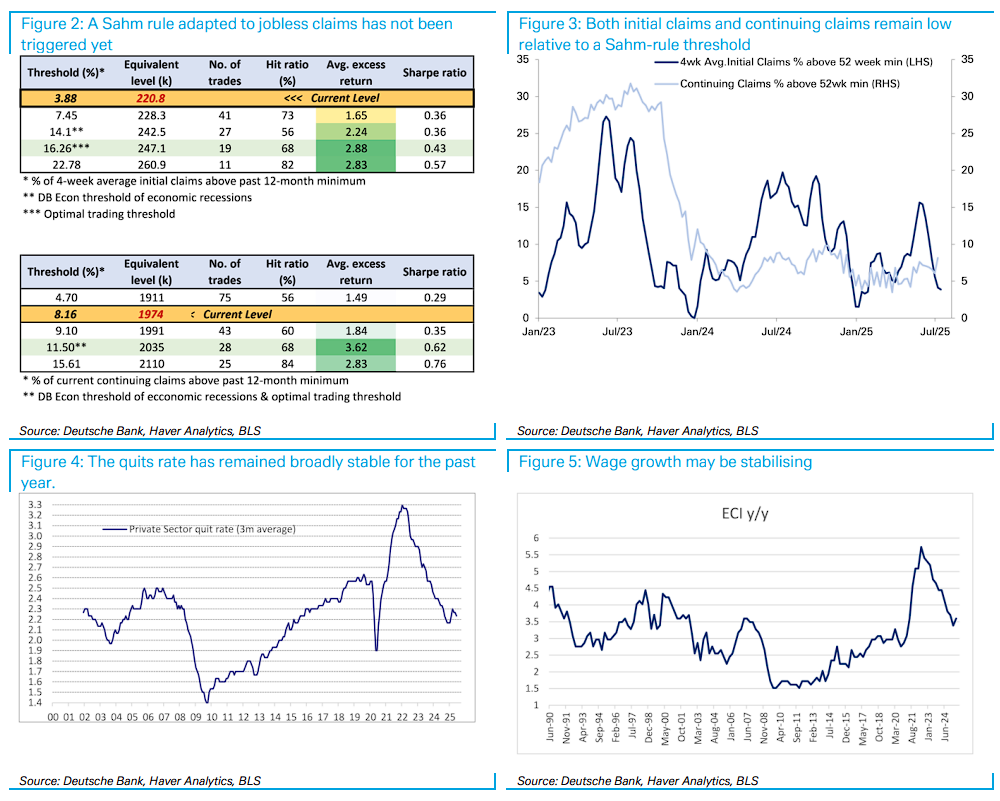
Core Viewpoint - Deutsche Bank strategists believe the U.S. economy is facing stagflation risks due to supply-side shocks, recommending short positions on 10-year U.S. Treasuries [1][7]. Economic Impact of Tariffs and Immigration Policies - The report indicates that tariff increases and tightened immigration policies will negatively impact the U.S. economy, raising inflation while weakening economic growth, but not leading to a recession [1][4]. - Tariffs are expected to raise core CPI inflation by approximately 0.5 percentage points in the coming months, significantly above market consensus [1][8]. - The tightening of immigration policies is projected to lower the non-farm employment growth equilibrium to a range of 50,000 to 100,000 jobs, although wage growth remains resilient [4][5]. Labor Market Analysis - Despite recent weak employment data, Deutsche Bank maintains that initial expectations have not materially changed, attributing fluctuations to seasonal factors [5]. - The unemployment claims data has not triggered the Sam Rule, and the turnover rate has remained stable over the past year, aligning with the interpretation of negative supply shocks [5]. Inflation Outlook - The structural changes in supply and demand are expected to push inflation higher while weakening economic growth, without leading to a recession [7]. - The current market pricing of the terminal rate is around 3%, with actual rates significantly below neutral levels, indicating potential upward pressure on inflation [9]. Investment Strategy - Deutsche Bank suggests a short position on 10-year U.S. Treasuries, with a target yield of 4.60% and a stop-loss at 4.05%, supported by technical and seasonal factors [10]. - For investors looking to hedge against spread risks, the recommendation includes going long on 10-year SOFR with a target of 4.10% and a stop-loss at 3.55% [10].

美国白宫国家经济委员会主任哈塞特:我不认同摩根大通CEO戴蒙关于美国滞胀的观点。
news flash· 2025-05-22 20:55
Core Viewpoint - The Director of the National Economic Council, Hassett, disagrees with JPMorgan CEO Dimon's perspective on the issue of stagflation in the United States [1] Group 1 - Hassett emphasizes that he does not share the same concerns regarding stagflation as expressed by Dimon [1]
黄金还要跌多久?
虎嗅APP· 2025-05-19 00:06
Core Viewpoint - Gold prices have recently declined despite a general market uptrend, primarily due to improved risk appetite stemming from a temporary resolution in the US-China tariff conflict, which has reduced demand for gold as a safe-haven asset [1][3] Group 1: Short-term Factors - Gold prices are currently influenced more by market sentiment than by fundamental factors, with a significant increase in speculative trading following a 30% rise in gold prices earlier in 2025 [3][5] - The recent technical adjustment in gold prices is attributed to an overbought condition, with non-commercial net long positions reaching a historical peak of 382,000 contracts, 47% above the five-year average [1][3] - Geopolitical tensions and the Federal Reserve's monetary policy decisions are critical in determining gold price fluctuations, as they directly impact market risk sentiment [3][4] Group 2: Mid-term Outlook - The potential for the US economy to enter a stagflation phase is a key factor for gold prices, as high inflation coupled with stagnant growth would make gold an attractive investment [4][5] - Historical precedents, such as the stagflation of the 1970s, illustrate how gold prices can surge dramatically during periods of economic instability, with prices rising from $35 to $850 per ounce between 1971 and 1980 [4][9] Group 3: Long-term Dynamics - The long-term value of gold is increasingly tied to the erosion of dollar credit, as the dollar's share in global foreign exchange reserves has decreased from 72.7% to 57.3% [9][11] - The demand for gold is expected to rise as central banks continue to diversify their reserves, with projections indicating a need for an additional 750 tons of gold annually over the next decade to offset the declining dollar share [11][12] - The ongoing questioning of US Treasury securities as a "safe asset" has led to a divergence between gold prices and bond yields, with gold's monetary attributes becoming more dominant [7][8] Group 4: Challenges to Dollar Credibility - The US faces significant challenges in restoring dollar credibility, including a rising national debt exceeding $36 trillion and a potential increase in interest payments that could strain fiscal resources [14] - The shift in global technological leadership from the US to China poses a threat to the dollar's dominance, particularly in key sectors like 5G and artificial intelligence [14] - The inherent contradictions in the dollar's supply and demand dynamics create a cycle that undermines its stability, complicating efforts to restore its status as a reliable currency [14]