美联储货币政策转向

Search documents
南华期货有色金属锌2026年度二季度展望:潜龙在渊,虎视眈眈
Nan Hua Qi Huo· 2026-03-31 11:17
1. Report Industry Investment Rating No information provided in the report. 2. Core Viewpoints of the Report - In the second quarter, zinc prices are expected to fluctuate. At the beginning of the quarter, prices will be relatively weak due to macro - negative factors and high inventory levels. Towards the end of the quarter, prices are expected to strengthen with the reduction of imported ore volume and cost support from energy disturbances [1]. - The core narrative of the overseas macro - market in the first quarter of 2026 has shifted to a stagflation trading theme, which will directly affect the price of zinc and other industrial products [8]. - The supply side is facing challenges such as reduced overseas zinc ore increments and potential disruptions in transportation, while the demand side shows a delayed recovery, with different downstream industries having different impacts on zinc consumption [1][28][59]. 3. Summary by Directory 3.1 Chapter 1: Viewpoint Summary - Price trend: Zinc prices will fluctuate in the second quarter. At the beginning, they will be weak due to macro - negative factors and high inventory, and strengthen at the end with reduced imports and cost support [1]. - Macro: At the beginning of the quarter, the war - induced systemic risk is the main trading theme. If the war ends quickly, energy disturbances may lead to a higher price center, and commodities may strengthen under stagflation trading [1]. - Supply side: TC remained stable in the first quarter. There may be a shortage of imported ore for domestic enterprises, and import TC has room to decline. The blockade of the Strait of Hormuz has disrupted the transportation of some zinc concentrates [1]. - Demand side: Downstream demand is significantly delayed, but terminal consumption shows strong resilience after the Two Sessions. Demand is expected to recover slowly in the second quarter, and attention should be paid to the turning point of social inventory [1]. - Forecast range: The core fluctuation range of the SHFE Shanghai zinc main contract in the second quarter of 2026 is expected to be 22,000 - 25,000 yuan/ton, and that of LME zinc is 3000 - 3450 US dollars/ton [1]. 3.2 Chapter 2: Market Review - In the first quarter, zinc prices in the non - ferrous metals sector were relatively weak but still followed the overall volatility increase. The prices of SHFE zinc and LME zinc showed an inverted V - shaped trend of rising at the beginning, oscillating during the holiday, and falling after the holiday. Macro - sentiment disturbances and continuous shortages of ore supply were the two core factors [4]. 3.3 Chapter 3: Macro - economic Factors - **Crude oil price increase**: Since March 2026, international crude oil prices have skyrocketed. By March 27, the closing price of the Brent crude oil main contract reached 106.29 US dollars/barrel, with a cumulative increase of over 36% from early March. Geopolitical conflicts and long - term production cuts are the main reasons for the price increase [9][12]. - **Stagflation trading**: The sharp increase in oil prices has led to inflation and suppressed economic growth, triggering stagflation trading. The inflation data is expected to rise, and economic growth is under pressure [13][16]. - **Monetary policy**: The Fed's monetary policy has shifted from an expected continuous interest rate cut to a more hawkish stance, with the possibility of restarting interest rate hikes [23]. - **Key variables**: The core contradiction in the overseas macro - environment is the persistence of the crude oil supply shock caused by the Middle East geopolitical conflict. Key variables to watch include the development of geopolitical conflicts, US inflation data from March to April, and the economic growth and employment market [25]. 3.4 Chapter 4: Supply Side - **Zinc concentrate**: In 2025, global zinc mine production was 12.57 million tons, a year - on - year increase of 9.40%. In 2026, the growth rate of global zinc concentrate production is expected to narrow. Overseas zinc ore production has been affected by many factors, and the expected increment has been continuously revised downwards. Domestic zinc concentrate production is expected to increase by 180,000 tons in 2026 [26][28][33]. - **Smelting end**: In 2025, global zinc ingot production was 13.8225 million tons, a year - on - year increase of 1.63%. In 2026, domestic smelting is supported by profits, and new production capacity is being put into operation. Overseas smelting is affected by raw materials and energy, and the annual output is expected to increase by 50,000 tons [38][42][52]. 3.5 Chapter 5: Demand Side - **Real estate**: In 2026, the real estate market will still drag down the zinc market, but the drag is limited. The completion data may show a soft - landing feature of a halved decline [61]. - **Infrastructure**: In 2026, infrastructure investment is expected to maintain a medium - to - high - speed growth. The "14th Five - Year Plan" for the power grid will drive zinc consumption, with an expected 2026 investment of 120 billion yuan in UHV projects, which will consume 43,700 - 69,300 tons of zinc [65]. - **Automobile**: In 2026, the growth rate of automobile sales is expected to slow down, and the penetration rate of new energy vehicles will exceed 50%. The lightweight trend of new energy vehicles will drag down the growth rate of zinc consumption by about - 0.31% [68]. - **Household appliances**: In 2026, the household appliance industry will maintain a moderate positive growth, but the marginal contribution to zinc consumption is limited [73]. - **Emerging fields**: The growth rate of the photovoltaic industry will decline in 2026, which will drag down zinc consumption. The wind power industry is expected to become a core growth point, with an expected global wind power zinc consumption of about 430,000 tons in 2026, a year - on - year increase of 10.8% [83][87]. - **Downstream demand**: Downstream demand recovery was slow in the first quarter, but it is expected to return in the second quarter [89]. 3.6 Chapter 6: Import - Export and Inventory - **Import - export**: In 2025, China's zinc concentrate imports increased by 30.1% year - on - year. The import structure is affected by geopolitical factors, and the import TC may decline again. The internal - external price ratio may further invert in the second quarter [96][101]. - **Inventory**: In the first quarter, domestic and overseas inventories were polarized. Domestic inventories increased rapidly, while LME inventories remained at a low level. In the future, LME inventories are likely to remain low, and domestic inventories may remain at a high level [103]. 3.7 Chapter 7: Supply - Demand Balance Sheet - **Global zinc concentrate balance**: In 2026, the global zinc concentrate supply is expected to be 12.88 million tons, and the consumption is 12.78 million tons, with a surplus of 100,000 tons [108]. - **Global refined zinc balance**: In 2026, the global refined zinc supply is expected to be 14.03 million tons, and the consumption is 13.9 million tons, with a surplus of 130,000 tons [109]. - **China's zinc concentrate balance**: In 2026, China's zinc concentrate supply is expected to be 7.185 million tons, and the consumption is 7.02 million tons, with a surplus of 325,000 tons [110]. - **China's refined zinc balance**: In 2026, China's refined zinc supply is expected to be 7.2 million tons, and the consumption is 7.12 million tons, with a surplus of 80,000 tons [110].
格林期货早盘提示:全球经济-20260309
Ge Lin Qi Huo· 2026-03-09 01:08
Report Industry Investment Rating - Not provided Core Viewpoints - The wave of production cuts by Middle Eastern oil - producing countries has pushed the Brent crude oil price to a two - year high, breaking $93 per barrel. Oil prices are likely to break through $100 next week and may exceed historical peaks if the strait remains blocked in March [1][2] - The current high asset prices and blind profit - seeking are reminiscent of the pre - 2008 financial crisis, and a credit cycle reversal may trigger an unexpected default wave [2] - The world is on the verge of a "capital war" due to geopolitical tensions and high capital market volatility [2] - The Fed's uncertainty is expected to peak from July to November 2026, and there may be a trend of "fleeing from US assets" [2] - The US's return to the Monroe Doctrine and the Fed's policy shift will have a profound impact on major asset classes [3] - The closure of the Strait of Hormuz due to the conflict between the US, Israel and Iran may cause a sharp rise in oil prices, which will impact the global economy [4] - The US stock market decline may have a significant negative impact on US consumption, and the global economy has started to decline since the end of 2025 [4] Summary by Related Catalogs Global Economic Logic - Middle Eastern oil - producing countries' production cuts have pushed Brent crude oil prices to a two - year high, and the supply shock is 17 times that of Russia's peak production decline in April 2022. Oil prices may break $100 next week and exceed historical peaks in March [1][2] - High asset prices and blind profit - seeking are similar to the pre - 2008 financial crisis, and a credit cycle reversal may lead to an unexpected default wave [2] - The world is on the verge of a "capital war" due to geopolitical tensions and capital market volatility [2] - The Fed's uncertainty may peak from July to November 2026, and there may be a trend of "fleeing from US assets" [2] - Consumers are experiencing a K - shaped differentiation, with high - income consumers maintaining spending resilience and low - and middle - income families tightening their belts [2] - Funds are flowing from technology stocks to defensive sectors, and investors should be wary of subsequent sharp fluctuations [2] US Policy Impact - The US's return to the Monroe Doctrine will have a profound impact on major asset classes such as the global economy, US bonds, US stocks, the US dollar, precious metals, and industrial metals [3] - The Fed's policy shift (interest rate cut + balance sheet reduction) will have a strong liquidity contraction expectation for equity assets [3] Geopolitical Impact - The conflict between the US, Israel and Iran, and the closure of the Strait of Hormuz may cause a sharp rise in oil prices and impact the global economy [4] - The decline of the US stock market may have a significant negative impact on US consumption, and the global economy has started to decline since the end of 2025 [4]
格林大华期货早盘提示:全球经济-20260306
Ge Lin Qi Huo· 2026-03-06 01:50
Report Industry Investment Rating - Not provided Core Viewpoints - The global economy has passed its peak in late 2025 and is now on a downward trajectory due to a series of wrong policies in the US [3] - The US returning to the Monroe Doctrine will have a profound and subversive impact on major asset classes such as the global economy, US bonds, US stocks, the US dollar, precious metals, and industrial metals [3] - Wash's combination of interest - rate cuts and balance - sheet reduction indicates a major shift in the Fed's monetary policy, creating a strong expectation of liquidity contraction for equity assets [3] - The Nasdaq has broken through the six - month moving average again, and factors like AI's disruptive substitution and the Middle East situation may trigger a new round of large - scale selling in US stocks, which could have a significant negative impact on US consumption [3] - Amid geopolitical tensions and high capital - market volatility, the world is on the verge of a "capital war" [2] - The Fed's uncertainty is expected to peak from July to November 2026, which may lead to a trend of "fleeing US assets" [2] Summary by Related Catalogs Global Economic Logic - Trump's offer of war insurance and naval escort for oil tankers has eased market liquidity risks [2] - Iran's attacks on Israel and US military bases in the Middle East, along with the blockade of the Strait of Hormuz, and its declaration of being ready for a "long - term war" have heightened geopolitical tensions [2] - Hedge funds have been net - selling US stocks at the fastest pace since March last year, and the high asset prices and blind profit - chasing are reminiscent of the pre - 2008 financial crisis, with a potential credit - cycle reversal and an unexpected default wave [2] - The Fed's incoming chairman Wash's expected balance - sheet reduction policy has had a strong negative impact on global equity and commodity assets [2] - The US's actions such as arresting the Venezuelan president, seizing Venezuelan oil, and attempting to buy Greenland have disrupted the global political order [2] - The US has released a new National Security Strategy, giving up global hegemony and planning to adjust economic relations with China to revitalize its economic autonomy [2] - The Fed's Beige Book shows a K - shaped consumer divide, with high - income consumers maintaining spending while middle - and low - income families are tightening their belts [2] - As concerns grow, funds are flowing from technology stocks to defensive sectors, and investors should be wary of subsequent sharp fluctuations [2] Important Information - US Defense Secretary Hedges said the conflict between the US and Iran could last for weeks, up to 8 weeks or more, and the US will control the pace and intensity of the action [1] - The "Iranian Kurdish anti - government armed forces" in Iraq have launched a "ground offensive" into Iran, and the US is planning to provide weapons and intelligence support, but ground operations in Iran may get stuck in a long - term quagmire [1] - Due to the increased uncertainty of the duration of the Middle East conflict, Wall Street traders are revisiting the trading strategies after the 2022 Russia - Ukraine conflict. There are concerns that rising energy prices will push up inflation, strengthen the US dollar, and cause a double - kill of stocks and bonds. Brent crude and natural gas prices have risen significantly, and global stock markets are under pressure [1] - The US Treasury Secretary said that the US International Development Finance Corporation (DFC) will provide insurance for oil tankers and cargo ships operating in the Persian Gulf, and more measures will be introduced in the future [1] - Dalio believes that AI is disrupting all industries and may eventually disrupt itself. Most AI companies may not generate enough profits to survive, and the US profit - centered business model will face fundamental systemic challenges when China offers equivalent AI in an open - source and free model [1] - Timiraos believes that after Powell's departure, the Fed's independence will face a severe challenge, as Trump may try to control the majority of the council through personnel infiltration [1] - Bahrain Aluminium announced force majeure on March 4, still producing but unable to ship. Qatar Aluminium, in which Norsk Hydro has a stake, stopped production on March 3. Their production capacities are 162.3 million tons and 63.6 million tons respectively [1] - Iran's ammonia production capacity is completely offline, and the blockade of the Strait of Hormuz has cut off 35% of global urea and 45% of sulfur export channels. Middle East urea prices have skyrocketed by $130 per week, and European ammonia futures prices have also risen significantly. Analysts warn that the impact of this physical logistics blockade may exceed that of the 2022 Russia - Ukraine conflict, and bread prices may rise within 6 weeks [1]
格林大华期货早盘提示-20260303
Ge Lin Qi Huo· 2026-03-02 23:30
Report Summary 1. Report Industry Investment Rating - Not provided in the given content 2. Core Viewpoints - The geopolitical conflict between the US, Israel and Iran has severely disrupted the energy market, pushing the Brent oil price to contain a risk premium of $9 - $10, and the energy market is approaching the critical point of physical supply disruption. The conflict may also force the Fed to maintain high - interest rates in a declining growth environment, putting pressure on the US stock market [1]. - The global economic situation is facing high uncertainty due to US policies, geopolitical conflicts, and the Fed's expected policy changes. The global economy has started to decline since the end of 2025, and investors need to be vigilant about market fluctuations [2]. 3. Summary by Related Catalogs 【Important Information】 - Trump said a military operation against Iran might take about four weeks or less, and leaders of the UK, France, and Germany may take "necessary defensive actions" against Iran [1]. - The Iranian Revolutionary Guard hit 3 "violating" US - UK oil tankers in the Persian Gulf and the Strait of Hormuz, and an oil tanker "MKD VYOM" was hit [1]. - Morgan Stanley estimates that if the Strait is fully blocked, the storage capacity of the seven major Middle - Eastern oil - producing countries can only support 25 days, and then they will be forced to stop production. The daily oil export volume has dropped to a quarter of the normal level [1]. - War - risk insurers have canceled policies for ships in the Persian Gulf and the Strait of Hormuz, and some insurance premiums may rise by up to 50% in the next few days [1]. - Goldman Sachs warns that if the conflict turns into a "protracted war" like in 2022, high fiscal spending and energy inflation will force the Fed to maintain high - interest rates, flattening the US Treasury yield curve and pressuring the US stock market [1]. - The actual duration of the US - Iran conflict is limited by the "inventory of air - defense interceptor missiles", and the inventory of the US, Israel and other countries may be depleted in a few days [1]. - Bank of America strategist Hartnett warns that the private - credit market is sending a risk alert, and credit risks are starting to spread to the financial system [1]. - Japanese experts say that if the Strait of Hormuz is blocked for a long time, Japan's GDP is expected to decrease by 3% [1]. - The AI competition in Silicon Valley has created an extreme over - work culture, and AI is reducing entry - level jobs and increasing lay - off anxiety [2]. 【Global Economic Logic】 - The US and Israel's attacks on Iran, Iran's counter - attacks, and the interruption of transportation in the Strait of Hormuz have led to hedge funds selling US stocks at the fastest pace since March last year [2]. - JPMorgan Chase CEO warns that the current high asset prices and blind profit - seeking are similar to the situation before the 2008 financial crisis, and a credit - cycle reversal may cause an unexpected default wave [2]. - Bridgewater Associates founder Dalio warns that the world is on the verge of a "capital war" due to geopolitical tensions and capital - market volatility [2]. - The expected balance - sheet reduction policy of the Fed's incoming chairman Wash has a strong negative impact on global equity and commodity assets [2]. - The US's actions such as arresting the Venezuelan president and trying to control Venezuelan oil and Greenland have brought great uncertainty to the global economy [2]. - Nomura says that the Fed's uncertainty is expected to peak from July to November 2026, and there may be a trend of "fleeing from US assets" [2]. - Goldman Sachs analysts warn that the decline in Las Vegas gambling revenue is similar to the early warning signal before the 2008 financial crisis [2]. - The US is adjusting its economic relations with China and trying to revive its economic autonomy [2]. - The Fed's Beige Book shows that consumer K - type differentiation is intensifying, and funds are flowing from technology stocks to defensive sectors [2]. - The US's return to the Monroe Doctrine will have a profound impact on major asset classes [2]. - Wash's combination of interest - rate cuts and balance - sheet reduction indicates a major shift in the Fed's monetary policy, which will lead to a strong expectation of liquidity contraction for equity assets [2]. - The Nasdaq has broken through the six - month moving average again, and AI's disruptive substitution may trigger a new round of large - scale selling, and the decline in US stocks may have a negative impact on US consumption [2]. - Due to the US's wrong policies, the global economy has passed its peak at the end of 2025 and started to decline [2].

格林大华期货研究院专题报告:格林大华期货对国内期货市场一周行情回顾
Ge Lin Qi Huo· 2026-02-06 11:13
Report Overview - The report reviews the weekly market conditions of the domestic futures market from February 2 - 6, 2026, covering various sectors including agriculture, black commodities, energy and chemicals, and financial futures [1]. Industry Investment Rating - Not provided in the report. Core Viewpoints - The domestic futures market showed a mixed performance this week, with more declining varieties than rising ones in the commodity futures market. Different sectors were affected by various factors such as supply - demand relationships, geopolitical events, and policy regulations [1]. Summary by Sector Agricultural Futures - **Corn**: The spot price had a narrow - range fluctuation, with the futures price rising 0.13% and closing at 2274 yuan/ton. Near - term, the spot market will be quiet due to the approaching Spring Festival, and the futures market is expected to trade within a wide range. The 2603 contract has support at 2250 and short - term pressure at 2280 [4]. - **Pig**: The spot price was weak, with the average price on the 6th at 11.96 yuan/kg. The futures price of the 2603 contract dropped 3.21% to 10860 yuan/ton. As the Spring Festival approaches, the average price hovers around 12 yuan/kg. Near - month short positions were suggested to take profits, and far - month short positions were to test the lower support [5][6]. - **Egg**: The egg price dropped sharply and then stabilized, with the Hebei Guantao price at 2.96 yuan/jin on the 6th. The futures price of the 2603 contract fell 3.26% to 2904 yuan/500KG. In the short term, the supply - strong and demand - weak situation may continue to pressure the price. Mid - term, the supply pressure is postponed. Previously held short positions were advised to take profits below 3000, and now it's mainly in a wait - and - see mode [6]. - **Jujube**: The Xinjiang jujube trees are in dormancy, and the Hebei market price is stable. The futures price was weakly oscillating. The supply pressure is the main factor suppressing the price, and the CJ605 contract is expected to seek historical low support. A bearish view is recommended for the medium - to - long - term [6]. - **Sugar**: Zhengzhou sugar oscillated. The northern beet sugar production is nearly over, and the southern is in the peak season. After the Spring Festival stocking, there is no obvious positive support, but some overseas institutions' reduction of the 2026/27 global sugar surplus may boost the far - month price. It's expected to trade within a range next week [7]. - **Log**: The log futures market is complex. The downstream 3 - meter wood square price in Lanshan is rising, and radiation pine traders' quotes are firm. If the price transmission is smooth, the spot price may rise, and the futures market has some positive factors [7]. - **Apple**: The apple market is structurally differentiated. High - quality apples support the price in the long - term, while ordinary apples face sales pressure. Near the end of the Spring Festival, the market will continue to oscillate widely in the short - term [8]. - **Cotton**: Internationally, cotton supply is tightening, and demand is resilient. Brazilian exports are down, and Australian production is expected to decrease. US net signing and shipping volumes are stable. Domestically, the supply - demand pattern is stable, but demand is seasonally weakening. The Zhengzhou cotton main contract will oscillate between 14500 - 15000 yuan/ton before the Spring Festival [8]. Black Commodities - **Steel Products**: The supply of five major steel products decreased by 0.4% to 819.9 million tons, and the total inventory increased by 4.6% to 1337.75 million tons. Consumption decreased by 5.1%, with a significant drop in building materials and a slight increase in plates. The downstream winter - storage willingness is weak, and the price is expected to remain in the oscillation range before the Spring Festival, with 3050 as strong support for the rebar main contract [9][10]. - **Iron Ore**: Global iron ore shipments and arrivals increased. Domestic mine production decreased, and port inventories continued to accumulate. Iron water production remained stable, and steel mills' pre - holiday replenishment is almost over. The first support for the main contract is 750, the second is 730, and the first pressure is 800, the second is 830 [10]. - **Coking Coal**: The coking coal futures oscillated sharply. The supply is decreasing as coal mines close for the holiday, but Mongolian coal imports are high. Steel mills' pre - holiday replenishment is almost done, and the market is expected to oscillate within a range before the Spring Festival [11]. Energy and Chemicals - **Crude Oil**: Affected by the geopolitical risks in the Middle East, the price fluctuated greatly. The US - Iran negotiation and the US manufacturing PMI affected the market sentiment. Before a conclusion on the US - Iran situation, the price is expected to oscillate upwards [13]. - **Lithium Carbonate**: It was under pressure due to the decline of precious and non - ferrous metals and the strengthening of risk management by the exchange. With the approaching Spring Festival, long - position holders are more willing to close positions. It's expected to oscillate widely between 130,000 - 150,000 yuan/ton, and a short straddle option strategy can be considered [14]. - **Methanol**: The port inventory is decreasing, and Iranian plants are resuming production. The downstream olefin plant operating rate is low, and the inland market is mainly for inventory clearance. It will continue to oscillate within a range in the short - term [15]. - **Urea**: The seasonal demand is starting, and the upstream inventory pressure is reducing. However, the high - supply situation remains. The price is expected to oscillate strongly within a key range, and investors can wait for price corrections to enter the market [15][16]. - **Bottle Chips**: Affected by the geopolitical situation in the Middle East and the fluctuation of crude oil prices, the price followed the raw materials to oscillate widely. The supply is increasing, and the demand is weak in the short - term. It's recommended to operate lightly within the 6100 - 6450 yuan/ton range [16]. - **Rubber**: Natural rubber oscillated weakly, with cost support from raw materials but weakening demand due to the approaching holiday. Synthetic rubber's BR main contract fell from a high level due to the weakening of raw material cost support and increased market supply. Both are expected to have a weak performance before the Spring Festival [17]. Financial Futures - The new nominee for the Fed Chairman's monetary policy of "rate - cut + balance - sheet reduction" has led to global de - leveraging. The A - share market is in an adjustment period, and the US stock market is accelerating de - leveraging. Before the Spring Festival, it's necessary to prevent the impact of the US stock market on A - shares, and it's recommended to close long positions, reduce equity assets, or hedge risks [18].
PTA:多空消息博弈 短期PTA行情偏稳
Sou Hu Cai Jing· 2026-02-05 02:23
Group 1 - The PTA market experienced fluctuations this week, initially declining before rebounding due to the interplay between rising crude oil prices and accumulating PTA inventory [1] - Concerns over a potential shift in the Federal Reserve's monetary policy led to a broad decline in the commodity market, causing PTA prices to retreat from high levels at the beginning of the week [1] - Geopolitical uncertainties have contributed to the rise in crude oil prices, which in turn has supported the PTA market [1] Group 2 - Downstream polyester operating rates continue to decline, creating a stalemate between cost support and decreasing demand in the market [1] - The short-term outlook for the PTA market is expected to remain stable [1]
格林大华期货早盘提示:全球经济-20260205
Ge Lin Qi Huo· 2026-02-05 01:50
Report Industry Investment Rating - Not provided Core Viewpoints - The world is on the verge of a "capital war" due to intensified geopolitical tensions and high capital market volatility [1][2] - The Fed's policy under the leadership of the incoming chairman Wash may have a significant negative impact on global equity and commodity assets [2] - The global economy started to decline after reaching its peak at the end of 2025 because of the US's wrong policies [3] Summary by Related Catalogs Global Economy and Finance - Bridgewater Associates founder Ray Dalio warns of a "capital war" and the risk of capital controls, and the US political situation is like a powder keg [1][2] - Musk's team visited Chinese photovoltaic companies, focusing on those with heterojunction and perovskite technology [1] - "Wooden Sister" Cathie Wood believes China leads the US in technology integration [1] - Intel CEO says memory chip supply won't ease until at least 2028 due to AI infrastructure expansion [1] - Nvidia is close to investing $20 billion in OpenAI [1] - The software industry is in a "doomsday crisis" with the S&P North American Software Index dropping 15% in January [1] - Anthropic's new function intensifies competition in the legal field, leading to a sell - off of SaaS stocks [1] - Bond analyst Steven Major thinks the Fed under Wash may cut interest rates four or five times, more than the market expects [1] Global Economic Logic - The Fed's uncertainty is expected to peak from July to November 2026, possibly leading to a "flight from US assets" [2] - High - end consumer spending remains resilient, while middle - and low - income families are tightening their belts [2] - SpaceX acquires xAI, and the combined company is valued at $1.25 trillion, with plans to increase AI computing power [2] Impact on Assets - The US's return to the Monroe Doctrine will have a profound impact on major asset classes [3] - Wash's combination of interest - rate cuts and balance - sheet reduction will lead to a strong expectation of liquidity contraction for equity assets [3]
金银暴跌只是开始?单日暴跌10%!警惕5000美元下的暗涌:去美元化与AI争矿时代的财富重构危机
Sou Hu Cai Jing· 2026-02-01 12:06
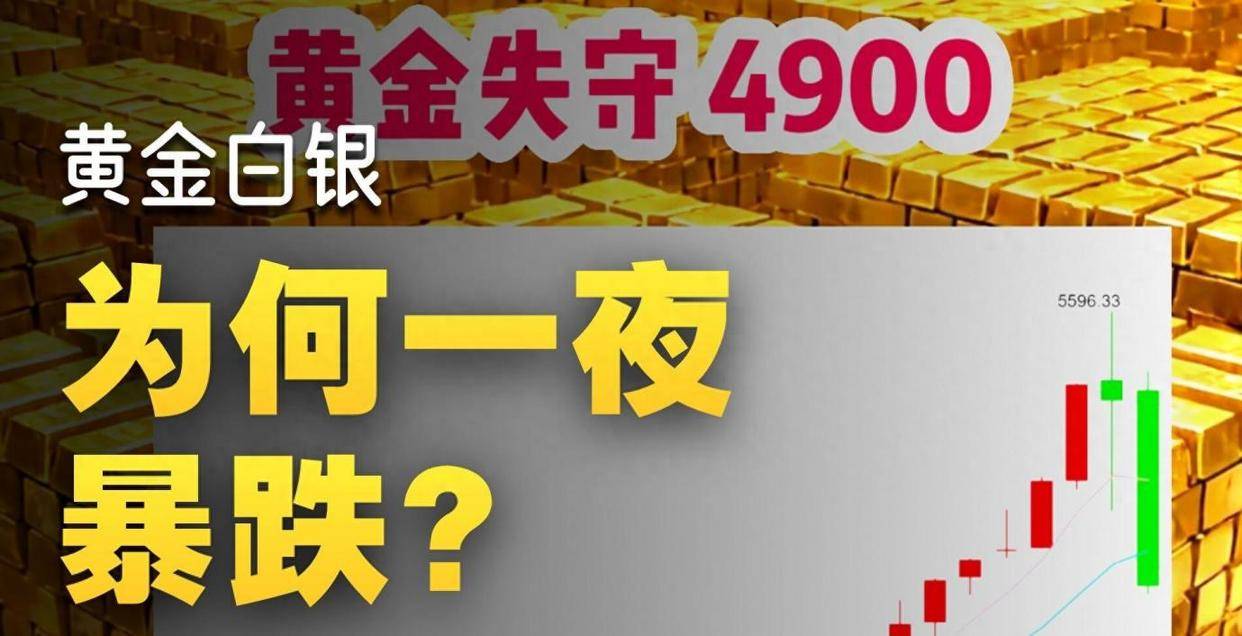
Core Viewpoint - The global precious metals market experienced a historic crash on January 30, 2026, with gold prices plummeting over 10% in a single day, marking the largest daily drop since 1983 [1][3]. Group 1: Market Reaction - Gold prices fell from a high of $5,450 to a low of $4,686 per ounce within half an hour, a drop of $380 [1][3]. - Silver prices saw an even more severe decline, with intraday losses reaching 35%, falling below $80 [1][3]. - The market's panic spread globally, affecting various financial instruments and leading to significant losses in related sectors [1][6]. Group 2: Causes of the Crash - The catalyst for the crash was the appointment of hawkish former Fed governor Kevin Walsh as the new Fed Chair, which was interpreted as a signal for a shift in monetary policy [3][8]. - Prior expectations of three interest rate cuts in the first half of 2026 were quickly abandoned, leading to a surge in the dollar index by 0.93% to 97.03 and a spike in 10-year Treasury yields by 18 basis points [3][8]. - The rapid sell-off was exacerbated by a buildup of speculative positions and a technical correction, as gold had previously surged over 23% in January 2026, reaching a peak of $5,626.80 [3][5]. Group 3: Impact on Trading and Investment - The Chicago Mercantile Exchange raised the margin requirement for gold futures from 5% to 6%, reducing leverage from 23 times to 16.7 times, which forced many high-leverage accounts to liquidate positions [5][6]. - Algorithmic trading triggered stop-loss orders, creating a feedback loop of selling that further drove down prices [5][6]. - The crash led to a significant decline in domestic gold contracts, with the Shanghai gold futures dropping 12% and A-share gold stocks collectively losing over 100 billion yuan in market value [6][8]. Group 4: Broader Economic Context - The crash reflects deeper issues within the U.S. dollar credit system and the competition for AI resources, as the U.S. national debt surpassed $38 trillion and the dollar's share of global reserves fell to a historic low of 56.3% [8]. - Central banks, particularly in emerging markets like China, India, and Russia, have been increasing their gold reserves, indicating a shift towards gold as a non-sovereign asset [8]. - Historical patterns show that shifts in Fed monetary policy are core variables affecting gold price volatility, with high leverage and market bubbles amplifying declines [8].

黄金一度突破5200美元!关注2信号
Wind万得· 2026-01-28 01:33
Core Viewpoint - The article discusses the recent surge in gold prices, driven by geopolitical risks and expectations of interest rate cuts by the Federal Reserve, leading to a historical high in gold prices and increased interest in gold-related ETFs [4][6]. Group 1: Gold Price Surge - Gold prices have recently surpassed $5,200 per ounce, marking an eight-day consecutive increase and setting a new historical record [2]. - The market is reacting to President Trump's comments about potential interest rate cuts by the Federal Reserve, which has contributed to the bullish sentiment surrounding gold [4]. Group 2: Gold ETFs and Institutional Investment - Gold-related ETFs have gained significant attention, with 20 products currently available in the market, including 14 gold ETFs and 6 gold stock ETFs, showcasing strong capital inflow [5]. - The World Gold Council reported that global gold ETF inflows reached $89 billion in 2025, with total assets under management (AUM) growing to $559 billion, both figures setting new records [6]. Group 3: Increased Risk Assessment in Gold Accumulation - Major Chinese banks, including Agricultural Bank of China and Industrial and Commercial Bank of China, have raised the entry requirements for gold accumulation services, reflecting a reassessment of risks associated with high-volatility assets [7]. - Starting January 30, 2026, individual clients will need to pass a risk assessment to participate in gold accumulation transactions, indicating a shift towards more cautious investment practices [7]. Group 4: Future of the Gold Bull Market - Historical patterns suggest that the end of the current gold bull market may not be solely due to rising interest rates but rather a reversal in the underlying drivers of gold prices [8][9]. - Two critical signals to watch for a potential shift in the gold market include a substantial tightening of the Federal Reserve's monetary policy and a significant improvement in the U.S. economic fundamentals [9][10].

彻底爆了,金价直逼5000美元大关!金饰一夜暴涨,冲向1600元!
Sou Hu Cai Jing· 2026-01-23 06:40
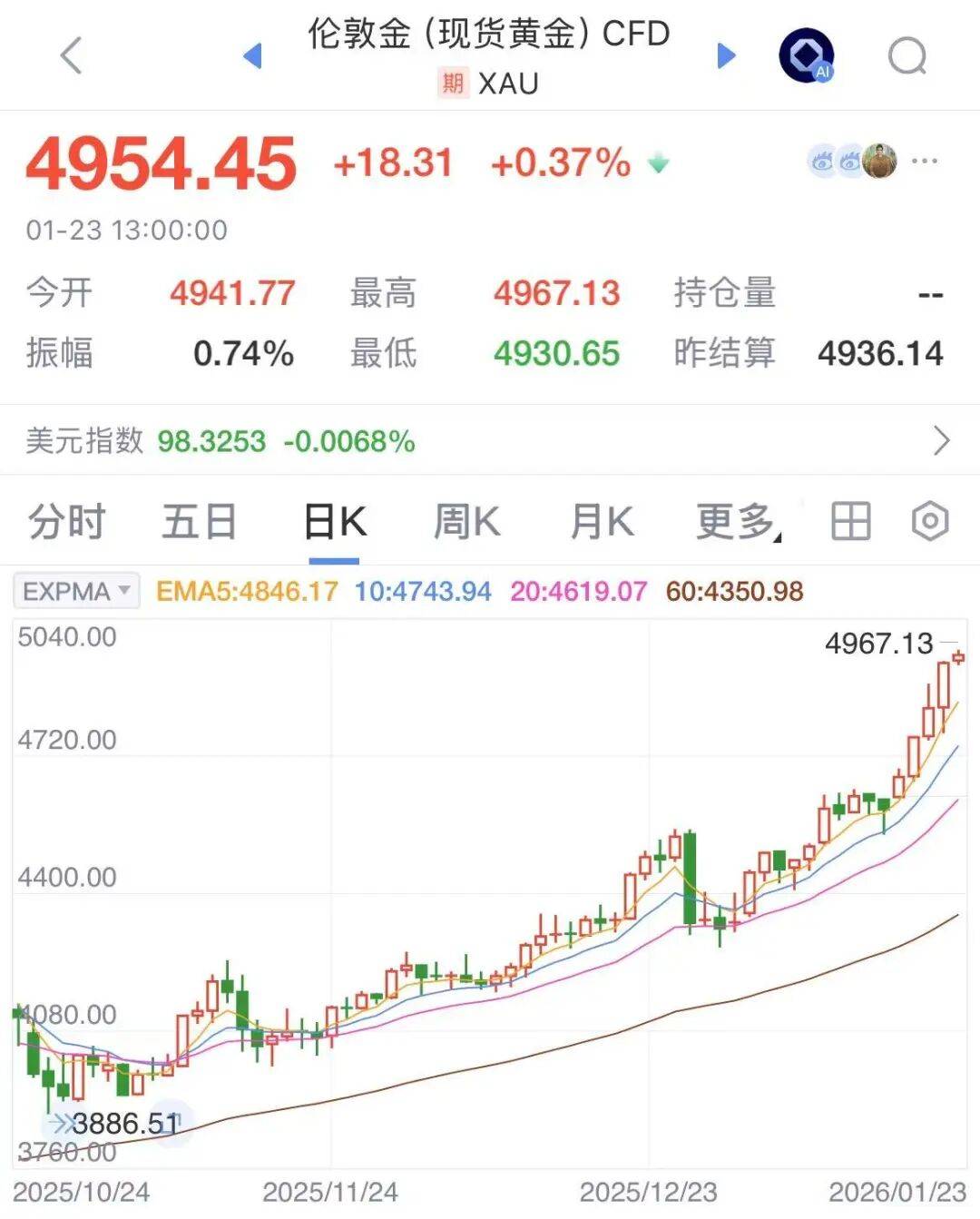
Core Viewpoint - The prices of spot gold and silver have reached historical highs, driven by expectations of changes in U.S. Federal Reserve monetary policy and ongoing geopolitical risks [1][6]. Group 1: Gold and Silver Prices - Spot gold prices surged past $4,967 per ounce, while spot silver prices exceeded $99 per ounce [1]. - As of the latest update, spot gold is priced at $4,954.45 per ounce, reflecting a 0.37% increase, and spot silver is at $98.64 per ounce, showing a 2.59% rise [1][3]. Group 2: Market Dynamics - Analysts attribute the rise in gold prices to strong market expectations that the Federal Reserve will shift its monetary policy, with predictions of 2-3 rate cuts in 2026, which is higher than the Fed's own projections [6]. - Geopolitical tensions are also contributing to the strategic support for gold prices, as global conflicts intensify [6]. Group 3: Investment Products - The surge in gold prices has led to a spike in the issuance of gold-linked structured deposit products by banks, with various offerings from state-owned and foreign banks [7]. - For instance, Bank of China has launched a product with a minimum investment of 10,000 yuan and an expected annual yield ranging from 0.2% to 5.2% [7]. - Some foreign banks are offering structured deposits with annual yields as high as 9.5%, linked to a basket of assets including U.S. and Hong Kong stocks [7]. Group 4: Institutional Participation - The popularity of gold-linked structured deposits is not limited to individual investors; institutional funds are also entering the market, with numerous A-share listed companies announcing investments in these products [10]. - Companies like Jin Hai Gao Ke and Su Jiao Ke have allocated significant amounts, ranging from millions to over a hundred million yuan, into structured deposits linked to gold [10].