
出口

Search documents
国贸期货期权日报-20250915
Guo Mao Qi Huo· 2025-09-15 08:35
1. Report Industry Investment Rating No relevant content provided. 2. Core View of the Report - This week, the commodity index fluctuated and declined slightly. Industrial and agricultural products both weakened. The weak fundamentals dragged down the overall commodity trend in the first half - week, while the market risk appetite improved in the second half - week, driving the commodities to rebound. The demand in the peak season was not strong, and the commodities were likely to fluctuate weakly. There were both bullish and bearish factors at the macro - level, and the demand had not improved significantly at the fundamental level [3]. 3. Summary by Related Catalogs PART ONE: Main Views - **Review**: The commodity index fluctuated and declined slightly this week. Industrial and agricultural products weakened. The weak fundamentals in the first half - week and the improved risk appetite in the second half - week due to Fed rate - cut expectations and A - share rebound affected the commodity trend [3]. - **Overseas**: - In August, US inflation met market expectations. The CPI increased year - on - year and month - on - month, mainly due to rising prices of food, energy, and housing. A 25BP rate cut in September was the benchmark scenario, and the inflation upside risk was controllable. The weak employment market might be the Fed's focus [3]. - In the first week of September, the seasonally - adjusted initial jobless claims in the US reached 263,000, an increase of 27,000 from the previous week, indicating a cooling labor market [3]. - The ECB maintained key interest rates unchanged on September 11, 2025. The policy signal was "hawkish". The market's expectation of another ECB rate cut this year dropped to about 15%. In the short - term, the ECB was likely to stay put, while in the long - term, its policy stance was uncertain [3]. - **Domestic**: - In August, the new social financing scale was 2.57 trillion yuan, less than the same period last year but slightly higher than expected. New loans were 590 billion yuan, less than last year and in line with expectations. The real - economy financing demand was weak, and government net financing might become a drag. The rebound of resident and enterprise credit demand was crucial [3]. - In August, China's imports and exports in US dollars were lower than expected. Export momentum might weaken marginally, but there were still supporting factors such as global economic recovery and strong exports to Africa [3]. - **Commodity View**: With the peak demand season not living up to expectations, commodities were likely to fluctuate weakly. There were both bullish and bearish factors at the macro - level, and the demand had not improved at the fundamental level [3]. PART TWO: Overseas Situation Analysis - **US Inflation and Employment**: In August, US CPI increased year - on - year to 2.9%. The seasonally - adjusted initial jobless claims in the first week of September increased significantly, and the labor market was cooling [3][7][10]. - **ECB Policy**: The ECB maintained key interest rates unchanged on September 11, 2025. The policy signal was "hawkish", and the market's expectation of another rate cut this year dropped to about 15%. The future policy stance was uncertain depending on inflation and economic recovery [3][13]. PART THREE: Domestic Situation Analysis - **Financial Data**: In August, new social financing and loans were lower than the same period last year. The real - economy financing demand was weak, and government net financing might affect future performance. The rebound of credit demand was key [3][17]. - **Foreign Trade Data**: In August, China's imports and exports in US dollars were lower than expected. Export momentum might weaken, but there were supporting factors [3][20]. PART FOUR: High - Frequency Data Tracking - **Industrial Data**: On September 5, the PTA operating rate was 78.28%, and the POY operating rate was 87.36%. In August and September, the operating rates of some industries showed certain changes [27][34]. - **Automobile Data**: In August and September, the sales of automobiles showed growth. For example, in August, the sales were 201.9 (units not specified), a 5.9% increase [34]. - **Agricultural Product Data**: On September 12, the price changes of some agricultural products were 0.75% and 0.14%, etc. [35].
8月经济总体平稳,国家统计局:下一步继续扩内需、稳楼市
2 1 Shi Ji Jing Ji Bao Dao· 2025-09-15 05:13
Economic Overview - In August, the industrial added value of large-scale enterprises increased by 5.2% year-on-year and 0.37% month-on-month [1] - The service production index rose by 5.6% year-on-year in August [1] - The total retail sales of consumer goods grew by 3.4% year-on-year and 0.17% month-on-month in August [1] - From January to August, fixed asset investment (excluding rural households) increased by 0.5% year-on-year, while excluding real estate development, it grew by 4.2% [1][2] - The total import and export volume in August increased by 3.5% year-on-year, with exports rising by 4.8% and imports by 1.7% [1][6] Real Estate Market - Real estate development investment decreased by 12.9% year-on-year from January to August, with the decline expanding by 0.9 percentage points compared to the previous period [2][3] - Despite fluctuations, the sales of commercial housing and residential prices have shown a narrowing decline, indicating progress in destocking [2] - The government is implementing policies to stabilize the real estate market and promote housing demand [3] Consumer Market - The retail sales of consumer goods showed a growth of 4.6% year-on-year from January to August, with service retail sales increasing by 5.1% [5] - In August, key consumer goods such as furniture and home appliances saw significant sales growth, with increases of 18.6% and 14.3% respectively [6] - The film industry also experienced a surge, with box office revenue and attendance increasing by 48.6% and 66.9% year-on-year in August [6] Export Dynamics - Exports to the U.S. fell by 32.9% in August, which was a significant drag on overall export performance [7] - However, exports to non-U.S. and non-ASEAN regions grew by 6.4% year-on-year, indicating successful market diversification efforts [7] Price Trends - The Producer Price Index (PPI) decreased by 2.9% year-on-year in August, but the decline was less severe than in previous months [8] - Factors contributing to the narrowing PPI decline include improved market competition, increased demand in emerging industries, and effective consumption-boosting policies [8]
CPI、PPI点评:反内卷带动煤钢价格环比转正
Huafu Securities· 2025-09-10 07:25
Inflation Trends - August CPI fell significantly by 0.4 percentage points to -0.4%, the lowest in nearly six months, primarily due to low food prices[3] - Core CPI improved slightly by 0.1 percentage points to 0.9%, driven by rising gold prices and stable service consumption[5] Food Prices - August food CPI decreased by 2.7 percentage points to -4.3%, significantly impacting overall CPI[4] - Fresh food supply was ample, with egg prices rising by 1.5% and fresh fruit prices dropping by 2.8% month-on-month[4] Industrial Prices - PPI's year-on-year decline narrowed by 0.7 percentage points to -2.9%, with month-on-month prices stabilizing after eight months of decline[6] - Coal and steel prices rebounded, with coal mining and washing industries increasing by 2.8% and black metal smelting rising by 1.9% month-on-month[6] Economic Outlook - The recovery of core CPI and PPI is expected to be gradual, influenced by fiscal policy and the real estate market's ongoing challenges[6] - Export demand is showing initial signs of cooling, necessitating close monitoring of economic conditions through 2026[6]
13.2万亿元、50.6%……多领域活力数据折射经济强大韧性与潜力
Yang Shi Wang· 2025-09-07 01:53
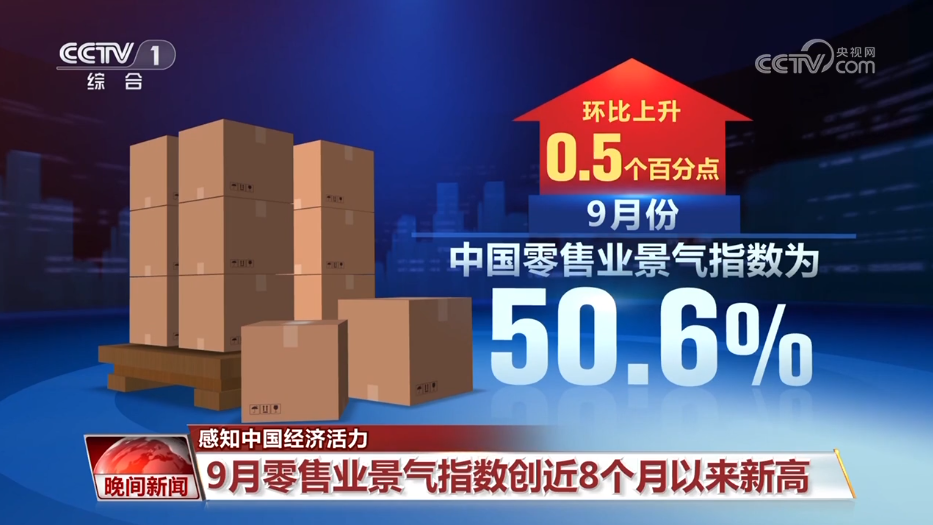
Economic Resilience and Retail Sector - In September, China's retail industry prosperity index reached 50.6%, an increase of 0.5 percentage points month-on-month, marking the highest level in eight months, indicating a positive trend in retail development [3] - The retail sector's performance is supported by policies aimed at expanding domestic demand and promoting consumption, with retail sales of 11 categories of light industrial goods reaching 4.9 trillion yuan, a year-on-year increase of 11.4% [8] Logistics and Transportation - In August, 15 new international air cargo routes were opened, with over 30 round-trip flights added weekly, totaling 152 new routes in the first eight months of the year [5] - The road logistics price index for August was reported at 105.1 points, reflecting a month-on-month increase of 0.01% and a year-on-year increase of 0.8%, indicating a vibrant road logistics market [7] Light Industry Performance - In the first seven months of the year, China's light industry maintained steady operation with a total revenue of 13.2 trillion yuan and a profit of 760.1 billion yuan, supported by strong production and market scale [8] - The investment growth in the light industry remains robust, with major sectors experiencing double-digit growth rates, surpassing the national fixed asset investment and manufacturing investment growth rates [10] Export Dynamics - Light industry exports reached 535.75 billion USD in the first seven months, accounting for 25.1% of the national total, with 11 out of 21 major categories showing growth [12] Foreign Investment in Guangdong - Guangdong province saw a 32.7% year-on-year increase in the number of newly established foreign-funded enterprises, totaling 17,000 in the first seven months [13][14] - The actual use of foreign capital in Guangdong reached 65.67 billion yuan, an increase of 8.2% year-on-year, with the manufacturing sector accounting for 29.1% of the total [16] Customs Special Supervision Areas - The comprehensive bonded zones and bonded logistics parks have contributed significantly to foreign trade, accounting for one-fifth of the national import and export value despite occupying less than 0.02% of the land area [16][18] - By 2024, the import and export value of customs special supervision areas is expected to grow by over 30% compared to 2020 [16]

X @外汇交易员
外汇交易员· 2025-09-03 01:47
中国8月RatingDog服务业PMI录得53,预期52.5,前值52.6。中国8月RatingDog综合PMI录得51.9,前值50.8。其中服务业新接业务量录得2024年5月后最快增速,新订单连续第二个月加速增长,增速同样创2024年5月后最高纪录,其中部分贡献来自新出口业务,录得2月份后最高增速。https://t.co/pHLQQuONhP https://t.co/9FAoPPgz5m外汇交易员 (@myfxtrader):中国8月RatingDog制造业PMI录得50.5,预期49.7,前值49.5。数据显示,制造业景气改善率5个月来最显著,同时新增出口业务量的收缩率较7月份放缓,制造商的采购量和库存量也随之增加,当月原材料和半成品库存录得2020年11月后最大增幅。 https://t.co/I5kciLs2zr ...
宏观经济数据前瞻:2025年8月宏观经济指标预期一览
Guoxin Securities· 2025-09-02 05:25
Economic Indicators - August 2025 domestic CPI is expected to be approximately 0.1% month-on-month, with a year-on-year decline to -0.3%[3] - July 2025 PPI is projected to increase by about 0.4% month-on-month, with a significant year-on-year recovery to -2.5%[3] - Industrial added value is anticipated to rebound slightly to 6.0% year-on-year in August 2025[3] - Retail sales of consumer goods are expected to rise to 4.5% year-on-year in August 2025[3] Investment and Trade - Fixed asset investment is forecasted to continue declining, reaching a cumulative year-on-year growth of 1.3%[3] - Exports in dollar terms are projected to decrease to around 6.0% year-on-year[3] - Trade surplus for August 2025 is estimated at 992 million USD, up from 982 million USD in the previous period[4] Financial Metrics - Monthly increase in credit is expected to be 10,500 million CNY, a significant improvement from a decrease of 500 million CNY previously[4] - Total social financing is projected to increase by 26,000 million CNY for the month, compared to 11,320 million CNY previously[4] - M2 year-on-year growth rate is expected to remain stable at 8.8%[4]
出口吞吐维持韧性,价格走势分化
HTSC· 2025-08-25 14:06
Report Information - Report Title: Export Throughput Maintains Resilience, Price Trends Diverge [1] - Report Date: August 25, 2025 - Analysts: Zhang Jiqiang, Wu Jing, Wu Yuhang - Contact: Li Zihao Core Viewpoints - In the third week of August, external demand showed high throughput year-on-year, but freight rates were weak with a widening decline. The real estate market had mixed performance in transactions, with new and second-hand housing sales continuing to decline year-on-year, and housing prices yet to stabilize. On the production side, the industrial freight volume was good, coal prices rose, and production maintained a differentiated resilience. In the construction industry, cement supply and demand improved marginally, while black metal supply and demand were weak. In the consumption sector, travel remained resilient, and automobile consumption increased slightly. Prices of crude oil were significantly affected by external factors, and the fundamentals restricted black metal prices, while Powell's dovish signals supported copper prices [2]. Summary by Category Consumption - Travel maintained a high level, with increases in subway ridership, congestion delay index, and flight operation rates similar to the previous year. Automobile consumption increased slightly, textile consumption recovered, and express delivery pick-up volume remained high [3]. Real Estate - Real estate transactions were differentiated. New housing transactions were basically flat, with second-tier cities leading. Second-hand housing transactions recovered, especially in Beijing, Shanghai, Shenzhen, and Chengdu. The listing price and quantity of second-hand housing both decreased, and the land premium rate increased while land transactions decreased [4][6]. Production - Freight volume remained high, and the data of operating rates were differentiated. In the power sector, coal consumption increased, hydropower decreased, and coal prices rose. In the construction industry, the funds in place increased year-on-year, cement supply and demand improved, black metal supply and demand declined, and asphalt operating rates decreased [5][13][14]. External Demand - Port throughput remained high, but freight rates declined. The cumulative cargo throughput and container throughput of ports were at a high level. The RJ/CRB index increased year-on-year, the Baltic Dry Index (BDI) decreased, and international route freight rates weakened. South Korea's exports in the first 20 days of August increased by 7.62% year-on-year, and Vietnam's exports in the first half of August increased by 15.56% year-on-year [5]. Prices - The prices of agricultural products, crude oil, and cement increased, while the prices of black metals were differentiated, and the prices of non-ferrous metals and glass decreased. The increase in crude oil prices was due to geopolitical risks and increased demand, while the differentiation of black metal prices was affected by supply and demand and policies [20][21].
金属周期品高频数据周报:钼精矿创近29个月新高,钨精矿价格续创2011年以来新高水平-20250825
EBSCN· 2025-08-25 06:44
Investment Rating - The report maintains an "Overweight" rating for the steel and non-ferrous metals sectors [5] Core Insights - Molybdenum concentrate prices have reached a nearly 29-month high, while tungsten concentrate prices have hit the highest level since 2011 [2] - The liquidity indicators show that the M1 and M2 growth rate difference narrowed to -3.2 percentage points, marking a nearly 49-month high [11] - The construction and real estate sectors are showing mixed signals, with a notable increase in crude steel production [22] Summary by Sections Liquidity - The M1 and M2 growth rate difference was -3.2 percentage points in July 2025, up by 0.5 percentage points from the previous month [11] - The BCI small and medium enterprise financing environment index for July 2025 was 46.09, down 6.16% month-on-month [19] Construction and Real Estate Chain - The average daily crude steel production for key enterprises in early August increased by 4.64% month-on-month [22] - The national average capacity utilization rate for blast furnaces was 90.25%, with a slight increase of 0.03 percentage points [40] Industrial Products Chain - The operating rate for semi-steel tires was at a five-year high, with a current rate of 73.13%, up by 1.06 percentage points [2] - The prices for major commodities showed varied performance, with copper prices down by 0.29% and aluminum prices up by 0.34% [2] Price Movements - The price of rebar was 3,270 yuan/ton, down by 0.91% week-on-week [10] - Molybdenum concentrate prices reached 4,465 yuan/ton, up by 2.29% [2] - Tungsten concentrate prices were at 227,000 yuan/ton, reflecting a week-on-week increase of 12.94% [10] Valuation Metrics - The Shanghai Composite Index increased by 4.18%, with the commercial vehicle sector showing the best performance at +5.13% [4] - The PB ratio for the steel sector relative to the broader market is currently at 0.56, with a historical high of 0.82 [4] Real Estate Completion Chain - The cumulative year-on-year change in national commercial housing completion area from January to July 2025 was -16.50% [75] - The profit margins for titanium dioxide and flat glass remain low, with flat glass operating rates at 75.34% [77]
债市跟随股市起舞
Ge Lin Qi Huo· 2025-08-23 11:17
1. Report Industry Investment Rating - No relevant content provided 2. Core View of the Report - This week, the bond market followed the stock market. The influence of the stock index on the bond market weakened. Short - term focus on stock market changes: a strong stock market will suppress the bond market, while a stock market correction will benefit bond bulls. The trading strategy is for trading - type investors to conduct band operations [2][35][36] 3. Summary by Relevant Catalogs 3.1 Treasury Bond Futures Weekly Market Review - This week, the main contracts of treasury bond futures opened lower with a gap on Monday and then fell sharply, fluctuated horizontally on Tuesday, fell sharply on Wednesday, rebounded after hitting the bottom on Thursday, and declined slightly on Friday. The 30 - year treasury bond fell 1.05%, the 10 - year treasury bond fell 0.52%, the 5 - year treasury bond fell 0.28%, and the 2 - year treasury bond fell 0.03% [5] - As of August 22, the maturity yield curve of treasury bond cash bonds shifted upward in parallel compared with August 15. The 2 - year, 5 - year, 10 - year, and 30 - year treasury bond yields rose by 3, 4, 3, and 3 basis points respectively [8] 3.2 Fiscal Revenue and Expenditure Data - In July, the national general public budget revenue was 2027.3 billion yuan, a year - on - year increase of 2.65%, and the expenditure was 1946.6 billion yuan, a year - on - year increase of 3.04%. From January to July, the cumulative general public budget revenue increased by 0.1% year - on - year, and the expenditure increased by 3.4% year - on - year [11] - In July, national tax revenue was 1801.8 billion yuan, a year - on - year increase of 5.0%, and non - tax revenue was 225.5 billion yuan, a year - on - year decrease of 12.9% [13] - From January to July, the national government - funded budget revenue was 2312.4 billion yuan, a year - on - year decrease of 0.7%, and the expenditure was 5428.7 billion yuan, a year - on - year increase of 31.7% [16] 3.3 Unemployment Rate - In July, the unemployment rate of the 16 - 24 age group (excluding students) in urban areas was 17.8%, higher than the same period last year by 0.7 percentage points; the 25 - 29 age group was 6.9%, higher than the same period last year by 0.4 percentage points; the 30 - 59 age group was 3.9%, the same as the same period last year [19] 3.4 South Korean Export Data - In the first 20 days of August, South Korea's exports increased by 7.6% year - on - year. Semiconductor exports were 8.71 billion US dollars, a year - on - year increase of 29.5%, accounting for 24.5% of the total exports in the first 20 days of August, up 4.2 percentage points from the same period last year [21] 3.5 New Home Sales Data - Since June, the decline rate of the national new home sales area has accelerated. From January to March, the average daily trading area of commercial housing in 30 large and medium - sized cities was 2.36 million square meters, a year - on - year increase of 2.5%. From August 1 to 20, it was 1.8 million square meters, a year - on - year decrease of 16% [23] 3.6 Price Data - As of August 22, the 200 - index of agricultural product wholesale prices was 115.53. Prices showed a slight upward trend in the first 22 days of August, but the upward slope was much lower than the same period last year. In July, energy prices increased by 1.6% month - on - month, affecting the CPI to rise by about 0.12 percentage points. The average domestic refined oil price in August was lower than that in July [25] - The Nanhua Industrial Products Index declined slightly in the first 22 days of August. After reaching a closing high on July 25, it continued to decline. Short - term inflation pressure is limited [28] 3.7 Capital Interest Rate Data - This week, capital interest rates increased. The weighted average of DR001 was 1.45%, and it fell to 1.41% on Friday. The weighted average of DR007 was 1.52%, and it fell to 1.47% on Friday. The average issuance interest rate of one - year AAA inter - bank certificates of deposit was 1.67%, higher than last week's average of 1.64% [31][32] 3.8 Treasury Bond Futures Market Logic and Trading Strategy - In July, China's fixed - asset investment growth rate was significantly lower than market expectations. Retail sales of consumer goods, industrial added value, and the service industry production index were all lower than expected. Real estate sales and prices continued to decline, while exports exceeded expectations. The central bank will implement a moderately loose monetary policy, and the State Council will take measures to stimulate consumption, expand investment, and stabilize the real estate market [35] - The trading strategy is for trading - type investors to conduct band operations [36]
宏观经济专题:建筑需求同比下行速度放缓
KAIYUAN SECURITIES· 2025-08-19 01:47
Supply and Demand - Construction starts remain at seasonal low levels, with asphalt plant operating rates at 32.9%, down 12.9% year-on-year, and cement dispatch rates at 40.1%, down 4.4% year-on-year[14] - Industrial production shows a mixed picture, with PX operating rates at 82.4%, down 7.7% year-on-year, while automotive steel tire operating rates have decreased[24] - Some construction demand has turned positive year-on-year, with rebar apparent demand showing a positive change, primarily due to a low base in 2024[29] Prices - International commodity prices are fluctuating, with crude oil prices declining and gold prices showing a slight increase[39] - Domestic industrial prices are generally weak, with the Nanhua Composite Index declining, while coal prices have continued to rise[40] - Agricultural product prices have shown an upward trend, while pork prices have been declining[56] Real Estate - New housing transactions remain at historical lows, with a 18% decrease in average transaction area in 30 major cities compared to the previous two weeks, and a year-on-year decline of 29% compared to 2023[58] - Second-hand housing transactions are also weak, with Beijing, Shanghai, and Shenzhen showing year-on-year changes of -8%, +4%, and +2% respectively[62] Exports - Exports from August 1 to 17 are estimated to have increased by approximately 7% to 9% year-on-year, with models indicating a 7% increase and container ship loading data suggesting a 9% increase[65] Liquidity - Recent weeks have seen fluctuations in funding rates, with the R007 at 1.45% and DR007 at 1.51% as of August 1[71] - The central bank has conducted a net withdrawal of 21,022 billion yuan through reverse repos in recent weeks[72] Risk Warning - There are risks associated with unexpected fluctuations in commodity prices and potential changes in policy strength[76]