
渠道变革

Search documents
复盘106家食品企业半年报:70家公司业绩下滑,蒙牛液奶缩水40亿,农夫逆袭净赚76亿
3 6 Ke· 2025-09-03 08:50
Overall Industry Performance - In the first half of 2025, 70 out of 106 companies reported varying degrees of performance decline, with 57 experiencing revenue drops and 48 facing net profit declines, indicating a trend of prioritizing profit preservation over revenue growth [1][2] - The consumer market remains weak, leading to supply-demand imbalances, intense competition, and price wars [1] Dairy Industry - The dairy sector is significantly impacted, with 25 out of 33 listed companies reporting performance declines, primarily due to falling liquid milk sales [1][3] - Major players like Yili and Mengniu saw substantial revenue drops in their liquid milk segments, with Yili's liquid milk revenue decreasing by 7.61 billion yuan and Mengniu's by 40.48 billion yuan [3][4] - Conversely, the milk powder segment shows signs of structural recovery, with some companies reporting revenue growth due to market consolidation and subsidy policies [3][5] Snack Industry - Snack companies are largely struggling, with brands like Liuyinpuzi and Laiyifen reporting losses, while others like Qiaqia and Three Squirrels experienced significant profit declines [1][2] - The challenges stem from channel transformations and rising costs, particularly in raw materials, leading to increased customer acquisition costs [1] Beverage Industry - The beverage sector shows mixed results, with companies like Nongfu Spring and Dongpeng achieving record net profits, while others like China Resources Beverage faced revenue declines [9][10] - Nongfu Spring's tea beverage segment surpassed 10 billion yuan in revenue for the first time, indicating strong market performance [9] Seasoned Food Industry - The seasoning industry is experiencing increasing differentiation, with leading companies like Haitian maintaining stable growth while others like Zhongju Gaoxin face significant declines [7][8] - Many companies are adjusting their channel strategies in response to market saturation, with a focus on international expansion [8] Convenience Food Industry - The convenience food sector shows slight recovery among leading companies, with Shuanghui Development reporting a revenue increase of 2.97% [13] - Notably, Guoquan Foods achieved remarkable growth, with revenue and net profit increasing significantly [14] Overall Conclusion - The food industry is facing a challenging environment with more companies reporting declines than gains, but there are still structural growth opportunities for those willing to adapt and innovate [14]
泸州老窖(000568):25Q2降速释放压力 强化渠道下沉精耕
Xin Lang Cai Jing· 2025-09-02 00:41
Core Viewpoint - The company reported a decline in revenue and net profit for the first half of 2025, indicating a challenging market environment with a focus on transformation and innovation to maintain competitive advantage [1][2]. Financial Performance - In H1 2025, the company achieved revenue of 16.45 billion yuan, a year-on-year decrease of 2.7%, and a net profit attributable to shareholders of 7.66 billion yuan, down 4.5% [1]. - For Q2 2025, revenue was 7.10 billion yuan, reflecting an 8.0% year-on-year decline, with net profit at 3.07 billion yuan, down 11.1% [1]. - The gross margin for Q2 2025 decreased by 1.0 percentage point to 87.9%, attributed to a higher proportion of lower-end products [1][2]. Product and Market Dynamics - The demand for mid-to-high-end liquor was weak in H1 2025, with the company focusing on transforming its product offerings and channel strategies to adapt to market changes [1]. - Revenue from mid-to-high-end liquor was 15.05 billion yuan, a slight decrease of 1.1%, while other liquor categories saw a more significant decline of 17.0% in revenue [1]. - The company is actively pursuing market expansion through initiatives like the "Hundred Cities Plan" and enhancing channel management [2]. Cost and Efficiency - The overall expense ratio decreased by 2.5 percentage points to 12.7% in Q2 2025, with reductions in sales, management, and financial expense ratios [2]. - Cash flow for Q2 2025 was 8.08 billion yuan, down 15.1% year-on-year, while contract liabilities increased by 50.7% to 3.53 billion yuan, indicating a robust channel liquidity [2]. Future Outlook - The company forecasts net profits of 12.97 billion yuan, 14.27 billion yuan, and 15.71 billion yuan for 2025-2027, with corresponding EPS of 8.81 yuan, 9.69 yuan, and 10.67 yuan, suggesting a positive long-term growth trajectory [3].

酒企“寒冬”:总量承压,分化加剧,龙头集中度提升
中国基金报· 2025-09-01 02:51
Core Viewpoint - The white liquor industry is experiencing a significant slowdown in growth, with major companies showing resilience and increasing market concentration despite overall declines in revenue and profit [2][6][8]. Industry Performance - In the first half of 2025, 20 A-share listed liquor companies reported a noticeable decline, with 6 companies showing single-digit growth, 11 experiencing declines, and 3 reporting losses [2]. - Overall revenue and net profit for listed liquor companies decreased by approximately 1%, with a more pronounced drop in the second quarter, where revenue fell by 5% and net profit by 7.5% [7]. - The top two companies, Guizhou Moutai and Wuliangye, managed to achieve revenue growth of 9.1% and 4.19% respectively, indicating a divergence in performance within the industry [8][9]. Market Dynamics - The concentration of the top companies in the industry is increasing, with the revenue share of the top two companies (CR2) reaching 62.6%, up 6 percentage points year-on-year [9]. - The industry is characterized by "volume shrinkage, price decline, and high inventory pressure," with regional companies facing significant challenges [9]. Product and Channel Innovations - Companies are focusing on product innovation and channel transformation to explore new growth opportunities, shifting from high-end products to more affordable options [10][15]. - There is a growing demand for mid-to-low priced liquor products, particularly high-quality light bottle liquor, which has become a new trend in the industry [12][14]. - The introduction of low-alcohol products is also gaining traction, catering to younger consumers seeking lighter drinking experiences [14]. Future Outlook - Despite the current challenges, there are positive signs emerging, such as a shift towards rational and healthy development, with a focus on quality and brand value [15]. - The industry is expected to continue its deep adjustment until the second half of 2026, with potential signs of recovery by the end of 2025 [16].




泸州老窖(000568):业绩主动出清 挖掘渠道空间
Xin Lang Cai Jing· 2025-09-01 00:36
Core Viewpoint - The company reported a decline in revenue and net profit for the first half of 2025, indicating short-term pressure on performance due to industry policy impacts and a shift in consumer behavior [1][2]. Financial Performance - Total revenue for H1 2025 was 16.454 billion yuan, down 3% year-on-year, with a net profit attributable to shareholders of 7.663 billion yuan, down 5% [1]. - In Q2 2025, total revenue was 7.102 billion yuan, a decrease of 8%, and net profit was 3.070 billion yuan, down 11% [1]. Profitability Metrics - The company's gross margin decreased by 1 percentage point to 87.86%, while the net profit margin fell by 2 percentage points to 43.26% [2]. - Sales expense ratio decreased by 1 percentage point to 10.58%, primarily due to a significant reduction in advertising expenses [2]. Product Sales and Strategy - Revenue from mid-to-high-end liquor and other liquor categories decreased by 1% and 17% respectively, with sales volume increasing by 13% and decreasing by 7% [3]. - The company plans to focus on mainstream mid-to-high-end products and is set to launch new products to capture growth in the market [3]. Channel Development - Online sales grew by 28%, while offline sales declined by 4%, with total revenue from online channels reaching 0.932 billion yuan [4]. - The company is accelerating channel transformation through self-built e-commerce platforms and partnerships with major e-commerce and instant retail platforms [4]. Future Outlook - The company is adopting a "dual brand, three product lines, and major single product" strategy to adapt to changing consumer demands and channel transformations [5]. - EPS forecasts for 2025-2027 have been adjusted to 8.42, 9.15, and 10.04 yuan respectively, with corresponding PE ratios of 16, 15, and 14 times [5].
宽窄研究院酒业半年报探析:头部分化明显行业共同承压,产品创新渠道变革细分赛道成为破局点
Sou Hu Cai Jing· 2025-08-30 14:48
Core Viewpoint - The Chinese liquor industry is undergoing a deep adjustment period, facing challenges such as production contraction, consumption differentiation, and weak terminal sales, leading to a shift from rapid growth to declining production and sales profits [1] Industry Overview - The release of half-year reports from listed liquor companies indicates a significant change in the industry, with increased sales expenses and fierce competition among well-known brands for first-tier markets [1][12] - The overall profitability of the industry is declining, with many companies experiencing double-digit declines in revenue and profit, alongside rising inventory pressures and deteriorating product liquidity [11] Company Performance - Guizhou Moutai reported a total revenue of 91.094 billion, a year-on-year increase of 9.16%, and a net profit of 45.403 billion, up 8.89% [3] - Wuliangye achieved a revenue of 52.771 billion, growing 4.19%, and a net profit of 19.492 billion, up 2.28% [3] - Shanxi Fenjiu's revenue reached 23.964 billion, a 5.35% increase, with a net profit of 8.505 billion, up 1.13% [3] - Luzhou Laojiao reported a revenue of 16.454 billion, down 2.67%, and a net profit of 7.663 billion, down 4.54% [5] - Yanghe's revenue was 14.796 billion, down 35.32%, with a net profit of 4.344 billion, down 45.34% [5] - Other companies like Water Well and Shede also reported significant declines in revenue and profit, indicating the widespread impact of the industry's challenges [5][6][7] Market Trends - The industry is seeing a shift towards product innovation and channel transformation, with companies launching lower-alcohol and light bottle products to attract younger consumers [12][13] - The market is characterized by a need for companies to adapt to changing consumer preferences and enhance brand influence and channel efficiency [7][12] - Analysts suggest that the current environment is not isolated, and the liquor industry will eventually recover as consumption and the economy improve [13]



海天狂揽152亿,千禾大跌,加加扭亏……22家上市企业财报揭露五大残酷“真相”!
Sou Hu Cai Jing· 2025-08-30 04:38
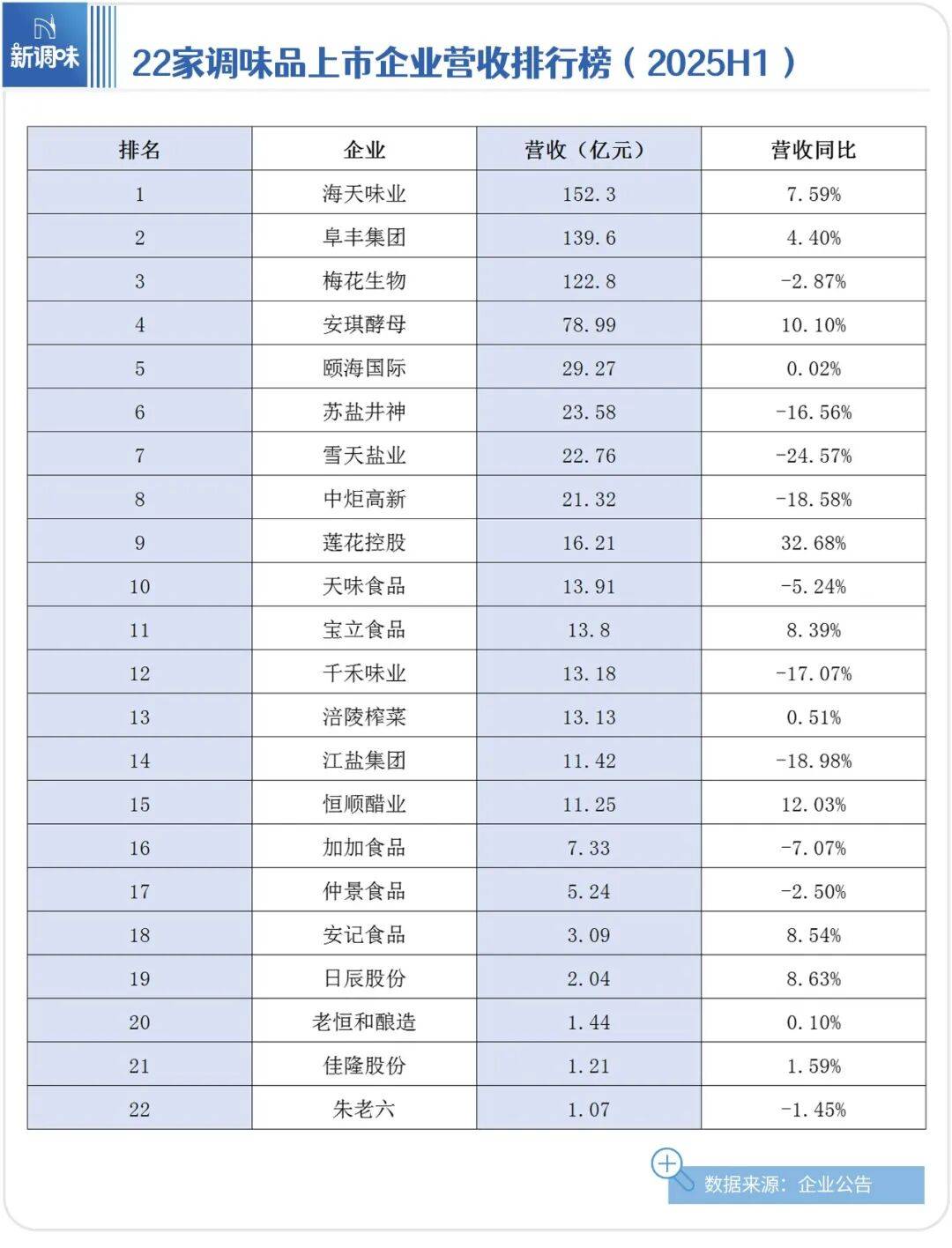
Core Insights - The condiment industry is experiencing a significant divergence in performance, with some companies thriving while others struggle to survive [1] Revenue Performance - In the first half of 2025, 22 listed condiment companies reported a total revenue of 704.94 billion yuan, a slight increase of 0.46% year-on-year [5] - 12 companies achieved revenue growth, while 10 experienced declines [3] - Leading companies include: - Haitian Flavor Industry: 15.23 billion yuan, up 7.59% [2] - Fufeng Group: 13.96 billion yuan, up 4.40% [2] - Meihua Biological: 12.28 billion yuan, down 2.87% [2] - Lianhua Holdings led in revenue growth rate at 32.68%, followed by Hengshun Vinegar (12.03%) and Angel Yeast (10.10%) [3] Profit Performance - The total net profit for the 22 companies reached 10.52 billion yuan, a year-on-year increase of 10.43% [5] - 13 companies reported profit growth, while 9 saw declines [5] - Top performers in net profit include: - Haitian Flavor Industry: 3.91 billion yuan, up 13.35% [4] - Fufeng Group: 1.79 billion yuan, up 72.10% [4] - Meihua Biological: 1.77 billion yuan, up 19.96% [4] - Fufeng Group had the highest net profit growth rate at 72.1%, followed by Lianhua Holdings (60.01%) and Anji Food (58.61%) [5] Industry Trends - The industry is witnessing a shift towards health-oriented products, with companies focusing on "reduced salt" and organic offerings [7] - Companies like Hengshun Vinegar and Jiajia Foods are successfully implementing health strategies to improve performance [9] Channel Transformation - The industry is undergoing a channel transformation, with a focus on optimizing distribution strategies [10] - Online channels are growing rapidly, with Haitian Flavor Industry reporting online revenue of 842 million yuan, up 38.97% [12] - Customization for the restaurant sector is emerging as a new growth area, with companies like Rich Chen achieving revenue growth through tailored solutions [12] Cost Management - Fluctuations in raw material costs are challenging companies, but some are managing to reduce costs effectively [13] - Companies like Meihua Biological have benefited from lower raw material prices, leading to profit growth [15] Global Expansion - Internationalization is becoming essential for condiment companies, with many accelerating their global strategies [16] - Haitian Flavor Industry has made significant strides in international markets, including a successful listing in Hong Kong [16] - Companies like Meihua Biological and Jiangyan Group are also expanding their global footprint through acquisitions and exports [18]
透视半年报|格力电器营收下滑净利微增,空调等主业承压
Xin Jing Bao· 2025-08-29 13:36
Core Viewpoint - Gree Electric Appliances faces intensified market competition, resulting in a decline in revenue despite an increase in net profit for the first half of 2025, highlighting the challenges in the home appliance sector, particularly in air conditioning [1][2]. Financial Performance - For the first half of 2025, Gree reported total revenue of 973.25 billion yuan, a decrease of 2.46% year-on-year, while net profit attributable to shareholders was 144.12 billion yuan, an increase of 1.95% [2]. - In Q2 2025, Gree's total revenue was 599.80 billion yuan, down 12.11% year-on-year, and net profit was 85.08 billion yuan, down 10.07% [2]. - The consumer electronics segment, primarily air conditioning, generated revenue of 762.79 billion yuan, a decline of 5.09% year-on-year, with a gross margin of 33.20%, down 0.29% [3]. Market Competition - The home air conditioning market is experiencing fierce competition, with low-end models priced below 2100 yuan accounting for over 50% of online sales, putting pressure on mid-to-high-end demand [2][3]. - Gree's market share in the air conditioning sector is 23.62%, a slight decrease of 0.17% year-on-year, while Xiaomi's market share increased to 15.32%, up 4.78% [3]. Strategic Initiatives - Gree launched the "Dong Mingzhu Healthy Home" brand strategy, aiming to establish 1,000 stores by 2025, with a focus on enhancing retail value through data visualization and smart interaction [6]. - The company is expanding its product offerings beyond air conditioning to include innovative products in health-related categories, although the contribution to revenue remains limited [6]. Leadership and Governance - Dong Mingzhu was re-elected as the chairperson of Gree's board, with Zhang Wei appointed as the new president, indicating a continuation of leadership amidst ongoing market challenges [6][7]. - The company is preparing for succession, with several candidates being groomed for future leadership roles [7]. Dividend Policy - Gree announced plans not to distribute cash dividends or issue bonus shares for the current year, contrasting with the previous year's generous dividend policy, which may impact investor sentiment [7].

格力电器营收下滑净利微增,空调等主业承压
Xin Jing Bao· 2025-08-29 13:33
Core Viewpoint - Gree Electric Appliances faces intense market competition, resulting in a decline in revenue despite a slight increase in net profit for the first half of 2025 [1][2]. Group 1: Financial Performance - In the first half of 2025, Gree's total revenue was 973.25 billion yuan, a decrease of 2.46% year-on-year, while net profit attributable to shareholders was 144.12 billion yuan, an increase of 1.95% [2]. - The second quarter saw a significant decline, with total revenue at 599.80 billion yuan, down 12.11% year-on-year, and net profit at 85.08 billion yuan, down 10.07% [2]. - The consumer electronics segment, primarily air conditioning, generated revenue of 762.79 billion yuan, a decline of 5.09% year-on-year, with a gross margin of 33.20%, down 0.29% [3]. Group 2: Market Competition - The home air conditioning market is experiencing intensified competition, with low-end air conditioning units priced below 2100 yuan accounting for over 50% of online sales, putting pressure on mid-to-high-end demand [2]. - Gree's market share in the air conditioning sector is 23.62%, a decrease of 0.17% year-on-year, while Xiaomi's market share has increased to 15.32%, up 4.78% [3]. Group 3: Strategic Developments - Gree has launched a new brand, "Dong Mingzhu Healthy Home," aiming to enhance retail value through experiential and interactive services, with plans to open 1,000 stores by 2025 [6]. - The company is expanding its product range beyond air conditioning to include health-related appliances, although the contribution from these new categories remains limited [6]. - Gree's board of directors has undergone a reshuffle, with Dong Mingzhu re-elected as chairperson and Zhang Wei appointed as president [6][7]. Group 4: Future Outlook - Gree plans not to distribute cash dividends or issue bonus shares for the current year, contrasting with the previous year's generous dividend policy [7]. - The company is focusing on long-term strategic positioning rather than short-term market rankings, as emphasized by Xiaomi's leadership [4].
上半年净利缩水20%,平江零食龙头也顶不住了,A股零食企业一片哀嚎
3 6 Ke· 2025-08-29 03:05
Core Viewpoint - Jinzai Food, known as the "first stock of fish snacks," reported a decline in revenue and profit for the first half of 2025, reflecting broader industry challenges faced by snack companies in the A-share market [1][7]. Company Performance - Jinzai Food's revenue for the first half of 2025 was 1.124 billion yuan, a year-on-year decrease of 0.5%, while net profit attributable to shareholders was 112 million yuan, down 21.86% [1]. - Despite growth in sales of fish and bean products, the company faced declines in quail egg and konjac products, with online sales also contributing to the performance drop [1][7]. - The company maintained a robust "basic plate," with fish product revenue at 757 million yuan (up 7.61%) and bean product revenue at 115 million yuan (up 3.61%) [5]. Product Category Insights - The poultry product category, which had been a growth driver, saw a revenue decline of 24% in the first half of 2025, totaling 196 million yuan [2]. - The vegetable product category also experienced a decline of 10.69%, with revenue at 34.05 million yuan [4]. - Jinzai's poultry products, including shredded meat and quail eggs, had previously shown significant growth, but increased competition and price pressures have led to a slowdown [3][4]. Industry Context - The A-share snack industry is facing collective challenges, with major companies like Good Products and Laiyifen reporting significant losses in the first half of 2025 [7][8]. - The competitive landscape has intensified, with rising customer acquisition costs and a shift in consumer behavior impacting both online and offline sales channels [9]. Strategic Adjustments - In response to current challenges, Jinzai Food has made personnel adjustments, appointing Tong Jingming as the new deputy general manager to bring fresh operational insights [6]. - The company plans to focus on channel construction as a key strategy moving forward, addressing the decline in online sales due to community group buying distributors exiting the market [7].
五粮液(000858):2025年中报点评:迎难而进,务实求变
Soochow Securities· 2025-08-28 06:24
Investment Rating - The investment rating for the company is "Buy" (maintained) [1] Core Views - The company is navigating challenges and seeking practical changes, focusing on enhancing marketing execution and channel transformation [8] - In H1 2025, the company achieved revenue and net profit of 52.77 billion and 19.49 billion RMB, respectively, with year-on-year growth of 4.2% and 2.3% [8] - The company is adjusting its profit forecasts for 2025-2027 due to a slower recovery in high-end demand, with net profit estimates revised to 31.6 billion, 32.0 billion, and 34.9 billion RMB [8] Financial Performance Summary - Total revenue for 2023A is projected at 83.27 billion RMB, with a year-on-year growth of 12.58% [1] - The net profit attributable to shareholders for 2023A is estimated at 30.21 billion RMB, reflecting a year-on-year increase of 13.19% [1] - The latest diluted EPS for 2023A is 7.78 RMB, with a P/E ratio of 16.27 [1] Revenue Breakdown - In H1 2025, the company achieved 49.12 billion RMB in liquor revenue, a year-on-year increase of 4.3% [8] - The revenue from the flagship product, Wuliangye, grew by 4.6% in H1 2025, with volume and price changes of +12.7% and -7.2%, respectively [8] - Other liquor categories saw a revenue increase of 2.7% in H1 2025, with significant volume growth of 58.8% but a price decline of 35.3% [8] Profitability Metrics - The company's net profit margin decreased by 1.0 percentage points year-on-year in H1 2025, primarily due to pressure on gross margins and taxes [8] - The overall gross margin for H1 2025 was 82.2%, down 0.4 percentage points from the previous year [8] - Sales expenses remained stable, with a slight decrease in advertising costs and an increase in promotional expenses [8] Strategic Initiatives - The company is focused on channel restructuring and enhancing marketing management through specialized sales companies [8] - In H1 2025, the company added 242 new stores, filling gaps in 18 counties, and developed 60 corporate clients [8] - The company aims to explore new marketing models and resource development to meet emerging demands and scenarios [8]