
通胀数据

Search documents
2025年12月通胀数据点评:PPI超预期回升
CMS· 2026-01-09 14:01
CPI Analysis - December CPI increased by 0.8% year-on-year, the highest growth since March 2023[2] - Food prices contributed significantly to CPI, with fresh vegetables and fruits rising by 18.2% and 4.4% respectively[2] - Core CPI, excluding food and energy, remained stable at 1.2% year-on-year[2] PPI Analysis - December PPI decreased by 1.9% year-on-year, but the decline narrowed by 0.3 percentage points from the previous month[2] - PPI recorded a month-on-month increase of 0.2%, marking three consecutive months of growth[2] - Key industries such as coal mining and cement manufacturing saw price increases of 1.3%, 0.8%, and 0.5% respectively[2] Market Outlook - January CPI is expected to drop to around 0.4% year-on-year due to a high base effect from the previous year[2] - January PPI is projected to rise to approximately 0.3% month-on-month, with a year-on-year estimate of -1.2%[2] - The impact of low oil prices continues to weigh on PPI improvements, while rising prices in non-ferrous metals support certain sectors[2] Risks - Domestic policy effectiveness may fall short of expectations, posing risks to economic recovery[2]
通胀数据向好修复,国债期货震荡整理
Bao Cheng Qi Huo· 2026-01-09 11:10
1. Report Industry Investment Rating - Not provided in the given content 2. Core View of the Report - Today, Treasury bond futures oscillated with a slight decline. The inflation data in December showed that CPI rose moderately and PPI's decline narrowed, indicating positive repair of price indices under the continuous promotion of consumption - boosting and anti - involution policies. Considering the strong resilience of the December manufacturing PMI data, the short - term possibility of interest rate cuts continued to decline, putting pressure on Treasury bond futures prices. However, as the prices of Treasury bond cash bonds fell, the implied interest rate cut expectations in the Treasury bond yields faded, and the anchoring effect of policy interest rates emerged, limiting the downside space of Treasury bond futures. In the medium - to - long term, the problem of insufficient effective domestic demand still requires a relatively loose monetary and credit environment on the policy side, so there is still support for Treasury bond futures. Overall, it is expected to be mainly in an oscillatory consolidation in the short term [3] 3. Summary According to Relevant Catalogs Industry News - On January 9, the People's Bank of China conducted 34 billion yuan of 7 - day reverse repurchase operations at a fixed - rate and quantity - tendered manner, with an operating rate of 1.4%. Since there were no 7 - day reverse repurchase maturities on this day, a net investment of 34 billion yuan was achieved. - On January 9, the National Bureau of Statistics released data showing that in December 2025, the national consumer price index (CPI) rose 0.8% year - on - year, with the increase expanding to a new high since March 2023; month - on - month, it turned from a decline to an increase, rising 0.2%. The national industrial producer price decreased 1.9% year - on - year, with the decline narrowing by 0.3 percentage points compared with the previous month; month - on - month, it rose 0.2%, with the increase expanding by 0.1 percentage points compared with the previous month [5] Related Charts - The report includes charts such as the trends of TL2603, T2603, TF2603, TS2603, the Treasury bond yield - to - maturity curve, and the central bank's open - market operations, with data sources from iFinD and the Baocheng Futures Research Institute [6][8][10]
2025年12月通胀数据点评:物价稳步回升、政策仍有空间
Bank of China Securities· 2026-01-09 08:59
Report Title - "2025 December Inflation Data Review: Steady Price Recovery and Policy Room" [1] Report Date - January 9, 2026 [1] Report Industry Investment Rating - Not provided in the report Core Viewpoints - Nominal GDP growth rate may be an important indicator for interest rate cuts [1][3] - Demand - side policies still have room to play in 2026, and monetary policy may be the focus of incremental policies [3] - It is expected that there may be two 10BP policy interest rate cuts in monetary policy this year [3] Summary by Content Inflation Data in December 2025 - CPI year - on - year increase widened to 0.8%, food prices rose 1.1%, non - food prices rose 0.8%, consumer goods prices rose 1.0%, and service prices rose 0.6% [3] - Among the eight categories of prices, the year - on - year increases of food, tobacco and alcohol, household goods and services, education, culture and entertainment, healthcare, and other goods and services expanded compared with November; the year - on - year increases of clothing, housing, and transportation and communication shrank (or the year - on - year declines expanded) [3] - PPI monthly increase widened and year - on - year decline narrowed, indicating that the recovery of upstream prices was transmitted to downstream as policies to expand domestic demand and promote consumption continued to show effects [3] - Core CPI continued to stabilize and recover, with a year - on - year increase of 1.2%, and the increase was basically the same as the previous month [3] - Food price year - on - year increase expanded to 1.1%, higher than the increase of edible agricultural product prices, and there may be room for further expansion [3] - Rent CPI monthly decline narrowed, and year - on - year decline slightly expanded, reflecting that the supply and demand of urban housing may still be in a balanced state [3] Monetary Policy Outlook - The Central Economic Work Conference in 2025 required that promoting stable economic growth and reasonable price recovery be important considerations for monetary policy, and flexibly and efficiently use various policy tools such as reserve requirement ratio cuts and interest rate cuts to maintain sufficient liquidity [3] - Considering the requirements of stable economic growth and reasonable price recovery, nominal GDP growth rate may become an important reference for monetary policy [3] - In 2025, China's GDP had ideal real growth in the first half of the year and good price recovery in the second half, but the two did not show a trend of strengthening simultaneously. So, demand - side policies still have room to play in 2026, and monetary policy may be the focus of incremental policies [3] - It is expected that there may be two 10BP policy interest rate cuts in monetary policy this year. If the Q4 2025 economic data shows that the nominal GDP year - on - year growth rate is stronger than 3.7% in Q3, the interest rate cut may be later; if it is lower than 3.7%, an interest rate cut in the near future cannot be ruled out [3]
经济学家:澳洲联储仓促加息或扰乱脆弱复苏
Sou Hu Cai Jing· 2026-01-08 01:24
Core Viewpoint - The Australian currency market is discussing the possibility of an interest rate hike in February, but some economists warn that a reflexive response to inflation data could undermine the fragile economic recovery [1] Group 1: Economic Indicators - AMP's Deputy Chief Economist, Diana Mousina, stated that a rate hike would harm the private sector, which has just begun to show signs of improvement [1] - Recent signals from the Reserve Bank of Australia indicate that rate cuts are no longer an option, which has led to an increase in bond yields over the past month, tightening the monetary environment [1]
欧股开盘走势分化 防务股上涨与能源股下跌博弈
Xin Lang Cai Jing· 2026-01-07 09:00
MACD金叉信号形成,这些股涨势不错! 格隆汇1月7日|欧洲股市开盘表现不一,地缘政治紧张局势升温带动的防务股涨幅被能源股的跌势所抵 消。英国富时100指数开盘较周二的历史高位下跌0.25%,其中石油巨头英国石油下跌2.75%,国民威斯 敏斯特银行微跌2.7%。在其他市场,受防务公司提振,米兰富时MIB指数上涨0.15%,莱昂纳多上涨 2.1%,造船厂芬坎蒂尼大涨1.7%。德国DAX指数在西门子和拜耳等个股上涨的带动下攀升0.5%。西班 牙IBEX35指数因银行和能源股走低而下跌0.2%,而法国CAC40指数微跌0.05%,防务股的涨幅被能源 和奢侈品股的损失抵消。投资者目前正密切关注欧元区12月通胀数据以及关键的美国就业数据。 ...
澳元走强通胀成博弈点
Jin Tou Wang· 2026-01-07 02:46
2026年开年以来,澳元兑美元延续2025年的强势格局,呈现震荡偏强态势。截至1月7日10时35分,该货 币对报0.6749,较前一交易日上涨0.0012,涨幅达0.1930%,日内最高触及0.6752,最低下探0.6714,展 现出较强韧性。回顾2025年,澳元兑美元上演惊艳V型反转,从4月的五年低点0.5922美元一路反弹,年 末突破0.67关键关口创下14个月新高,全年累计涨幅超7%,跻身全球主要货币表现前列。 本轮澳元走强的核心驱动力源于澳美两国货币政策的显著分化。澳大利亚联储(澳联储)全年释放明确鹰 派信号,连续维持基准利率于3.6%不变,12月会议纪要强调通胀风险偏向上行,宣告降息周期彻底终 结,行长Bullock更明确表态"完全没有考虑过降息",甚至讨论2026年加息可能性。当前市场对澳联储 政策定价持续调整,2月加息概率升至32%,3月逼近50%,澳新银行等机构预测基准利率或上调至 3.85%。与之形成鲜明对比的是,美联储在2025年累计降息75个基点,当前政策利率维持在3.5%-3.75% 区间,尽管部分官员释放偏鹰信号,但市场仍预期2026年可能继续降息两次,这种政策分歧直接推动澳 美利差 ...
欧元微跌待政策通胀指引
Jin Tou Wang· 2026-01-07 02:46
Core Viewpoint - The euro to dollar exchange rate is experiencing narrow fluctuations, with a slight decline, as market attention shifts to inflation data and central bank policy signals from both Europe and the U.S. [1] Group 1: Market Performance - The euro to dollar exchange rate opened and fluctuated within a narrow range, with a high followed by a retreat, indicating limited overall volatility [1] - The U.S. dollar index showed a slight rebound, exerting pressure on the euro exchange rate [1] Group 2: Influencing Factors - Multiple factors are contributing to the pressure on the exchange rate, including rising U.S. 10-year Treasury yields and increased expectations for investment-grade bond issuance, which strengthen the dollar index [1] - The economic fundamentals in the eurozone are weak, with a downward revision of the December manufacturing PMI and ongoing contraction in core manufacturing activities, raising concerns about growth momentum in the eurozone [1] - Divergence in policy expectations between the European Central Bank (ECB) and the Federal Reserve is affecting the exchange rate, with the market awaiting clearer signals on the Fed's interest rate cut path and closely monitoring the eurozone inflation report [1] Group 3: Short-term Outlook - In the short term, the euro to dollar exchange rate is likely to continue its range-bound oscillation, with technical indicators showing a cooling trend in momentum [1] - A breakthrough in the exchange rate direction will depend on key data guidance, with potential support for the euro if eurozone inflation data exceeds expectations, while strong U.S. non-farm payrolls could further boost the dollar [1] Group 4: Long-term Perspective - From a medium to long-term perspective, the growth rate differential between the U.S. and eurozone economies will be a core factor influencing exchange rate movements [2] - Additionally, the adjustment pace of interest rate policies by the ECB and the Fed, the recovery process of eurozone manufacturing, and changes in geopolitical situations will be important variables driving exchange rate fluctuations [2]
IC外汇平台:降息预期下,英镑兑美元小幅震荡整理
Sou Hu Cai Jing· 2026-01-06 02:31
周二亚洲交易时段,英镑/美元货币对呈现小幅走低态势,部分回吐前一交易日的上涨成果。 此前该货币对曾强势上行至1.3545-1.3550区间,创下2025年9月以来的阶段性高点。 最新公布的经济数据显示,英国零售协会周二发布报告指出,12月整体商店价格同比上涨0.7%,其中食品通胀表现尤为值得关注, 从11月的3.0%攀升至3.3%。这一通胀数据的变化,可能会促使市场重新评估英国央行的政策宽松预期,进而对英镑形成支撑,短期 内英镑/美元的空头力量或需保持谨慎态度。 对于后续市场走势而言,即将公布的经济数据将成为关键驱动力。 目前市场参与者正等待英国和美国最终服务业PMI数据的出炉,期望从中获取新的交易指引。不过需要注意的是,当前市场焦点仍 高度集中于周五即将公布的美国非农就业报告(NFP),在此之前,短期市场大概率将维持相对平淡的运行格局,波动空间或较为 有限。 除非农就业报告外,本月初即将公布的其他多项美国核心宏观经济数据,也将为市场判断美联储降息路径提供重要参考。这些数据 的表现将直接影响市场对美元的需求变化,进而推动英镑/美元汇率的短期走势。 数据显示,标普全球美国制造业PMI维持在51.8的水平,这一数 ...


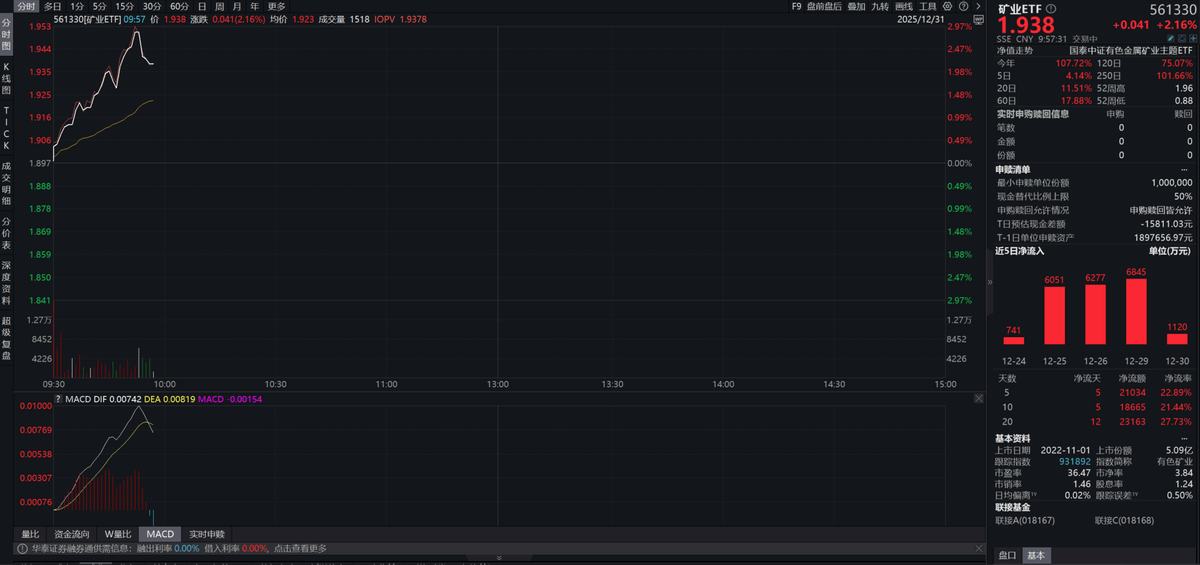
“家里有矿,年内涨超有色”,矿业ETF(561330)涨超2%,年内涨超108%
Sou Hu Cai Jing· 2025-12-31 02:30
Core Viewpoint - The mining ETF (561330) has shown significant growth, with a year-to-date increase of over 108% and continuous net inflows exceeding 210 million yuan over the past five days, indicating strong investor interest and confidence in the sector [1][4]. Group 1: Market Dynamics - Inflation data has stimulated expectations for interest rate cuts by the Federal Reserve, leading to a decline in U.S. Treasury yields, which has provided upward momentum for gold and silver prices [3]. - Geopolitical conflicts, a weakening dollar, and expectations of Fed rate cuts have collectively driven gold and silver prices to new historical highs, enhancing their appeal as safe-haven assets [3]. - Copper prices have also surged, with London copper breaking through 12,000 USD/ton and Shanghai copper exceeding 100,000 yuan/ton, driven by supply constraints and potential labor strikes in Chile [3]. Group 2: Supply Constraints and Future Outlook - The supply side is facing significant constraints, with insufficient capital expenditure in copper mining and frequent disruptions, which may shift the supply-demand balance from tight equilibrium to shortage [3][12]. - The National Development and Reform Commission is encouraging mergers and restructuring among major copper smelting enterprises, which may stabilize the copper smelting sector [3]. - Analysts expect that the combination of liquidity easing from the Fed and rising physical demand from the A-share market will boost demand for base metals, particularly copper and aluminum, leading to a steady increase in their price levels [3][12]. Group 3: ETF Performance and Composition - The mining ETF (561330) has outperformed the CSI Nonferrous Metals Index by over 10% year-to-date, attributed to a more concentrated selection of leading stocks [4][7]. - The mining ETF tracks the CSI Nonferrous Metals Mining Theme Index, which has a higher concentration of leading stocks, with the top ten constituents accounting for 55.56% of the index [4][6]. - The composition of the CSI Nonferrous Metals Mining Theme Index shows a higher proportion of gold, copper, and rare earths at 53.4%, compared to 49.5% in the CSI Nonferrous Index, indicating a strategic focus on high-demand sectors [7].






贵金属期货:高位震荡
Ning Zheng Qi Huo· 2025-12-29 07:30
Report Summary 1. Report's Industry Investment Rating - Not provided in the report 2. Core View of the Report - The US November core CPI rose 2.6% year - on - year, the slowest pace since early 2021, lower than the market expected 3%. The overall CPI rose 2.7% year - on - year, lower than the expected 3.1%. Weaker inflation data has led to higher market expectations for the Fed's rate - cut space next year [2]. - The US initial jobless claims for the week ending December 20 fell to 214,000, indicating that the labor market shows no obvious pressure. The end of Powell's term in December and the potential change of the Fed chairperson are market concerns. The Fed's rate - cut cycle increases the risk appetite for stocks and other commodities, suppressing the safe - haven asset gold. The volatility of precious metals may increase, and it is not advisable to chase long positions. Long positions should pay attention to profit protection [3]. - The factors to be concerned about include US economic data, changes in the Fed's top management, and the monetary policies of the Japanese and European central banks [4]. 3. Summary by Relevant Catalog 3.1 Futures Market Review - The report presents figures on the internal and external prices of gold and silver futures, as well as the trading volume and open interest of Shanghai gold and silver futures [5][9] 3.2 Interest Rates and Exchange Rates - Figures show the relationship between the US dollar index and gold price, and the relationship between US interest rates and gold price [7] 3.3 Macro Data - The report includes figures on US CPI and PCE inflation data, initial jobless claims, unemployment rate, new non - farm employment, PMI, retail and personal disposable income, new private housing starts, and new home sales [12][17][18] 3.4 Fund Holdings and Ratios - Figures show the total holdings of silver and gold ETFs, the holding ratios of gold and silver asset management institutions, and the gold - to - silver ratio and gold - to - copper ratio [23][25][28]