
供需矛盾

Search documents
广发期货《有色》日报-20250821
Guang Fa Qi Huo· 2025-08-21 05:59
Report Summary 1. Report Industry Investment Ratings No investment ratings were provided in the reports. 2. Core Views - **Copper**: In the short term, copper prices are expected to trade in a range of 77,500 - 79,000 yuan/ton. The "stagflation - like" environment in the US restricts the upside of copper prices, but the supply - demand contradiction in the medium - long term provides support. The short - term trading focus is on the US inflation and employment data in August, which will affect the Fed's decision in September [1]. - **Aluminum**: The alumina market is expected to remain in a slight surplus, with the main contract price oscillating between 3,000 - 3,300 yuan/ton. It is advisable to short at high prices. For electrolytic aluminum, the short - term price is under pressure at high levels, with the main contract price between 20,000 - 21,000 yuan/ton, and the 21,000 yuan/ton level is a key resistance [3]. - **Aluminum Alloy**: The supply - demand of the aluminum alloy market remains weak, with the main contract price expected to oscillate between 19,600 - 20,400 yuan/ton. Attention should be paid to the supply and import of scrap aluminum [4]. - **Zinc**: Zinc prices are likely to oscillate in the short term, with the main contract price between 21,500 - 23,000 yuan/ton. The supply - demand fundamentals do not strongly support a continuous rise in zinc prices, but low inventories provide support [6]. - **Tin**: Tin prices will have a wide - range oscillation in the short term. If the supply from Myanmar recovers smoothly, a short - selling strategy is recommended; otherwise, tin prices are expected to remain high and oscillate [9]. - **Nickel**: The nickel market is expected to have an interval adjustment in the short term, with the main contract price between 118,000 - 126,000 yuan/ton. The macro situation is weakening, and the supply of nickel ore is expected to be loose [10]. - **Stainless Steel**: The stainless - steel market will oscillate in the short term, with the main contract price between 12,800 - 13,500 yuan/ton. The cost support is strengthening, but the spot demand is weak [11]. - **Lithium Carbonate**: Lithium carbonate prices are expected to have a wide - range oscillation, with the main contract price having strong support between 75,000 - 80,000 yuan/ton. Although the market sentiment is weak, the fundamentals are in a tight balance [12]. 3. Summary by Directory Copper - **Price and Basis**: SMM 1 electrolytic copper price dropped to 78,770 yuan/ton, a decrease of 0.42%. The SMM 1 electrolytic copper premium dropped to 190 yuan/ton. The refined - scrap copper price difference decreased by 10.08% to 944 yuan/ton [1]. - **Fundamentals**: In July, the electrolytic copper production was 117.43 million tons, a month - on - month increase of 3.47%. The domestic mainstream port copper concentrate inventory decreased by 10.01% week - on - week to 55.76 million tons [1]. Aluminum - **Price and Spreads**: SMM A00 aluminum price dropped to 20,520 yuan/ton, a decrease of 0.34%. The import profit and loss improved to - 1,154 yuan/ton [3]. - **Fundamentals**: In July, the alumina production was 765.02 million tons, a month - on - month increase of 5.40%. The electrolytic aluminum production was 372.14 million tons, a month - on - month increase of 3.11% [3]. Aluminum Alloy - **Price and Spreads**: The price of SMM aluminum alloy ADC12 remained unchanged at 20,350 yuan/ton. The month - to - month spread between 2511 - 2512 decreased to - 5 yuan/ton [4]. - **Fundamentals**: In July, the production of recycled aluminum alloy ingots was 62.50 million tons, a month - on - month increase of 1.63%. The production of primary aluminum alloy ingots was 26.60 million tons, a month - on - month increase of 4.31% [4]. Zinc - **Price and Spreads**: SMM 0 zinc ingot price dropped to 22,170 yuan/ton, a decrease of 0.14%. The import profit and loss improved to - 1,644 yuan/ton [6]. - **Fundamentals**: In July, the refined zinc production was 60.28 million tons, a month - on - month increase of 3.03%. The Chinese zinc ingot seven - region social inventory increased by 13.59% week - on - week to 13.54 million tons [6]. Tin - **Price and Spreads**: SMM 1 tin price rose to 267,500 yuan/ton, an increase of 0.49%. The import profit and loss decreased to - 19,038.82 yuan/ton [9]. - **Fundamentals**: In July, the domestic tin ore import decreased by 13.71% month - on - month. The SMM refined tin production was 15,940 tons, a month - on - month increase of 15.42% [9]. Nickel - **Price and Spreads**: SMM 1 electrolytic nickel price dropped to 120,900 yuan/ton, a decrease of 0.62%. The futures import profit and loss decreased to - 1,857 yuan/ton [10]. - **Fundamentals**: In July, the Chinese refined nickel production was 31,800 tons, a month - on - month decrease of 10.04%. The refined nickel import increased by 116.90% month - on - month to 19,157 tons [10]. Stainless Steel - **Price and Spreads**: The price of 304/2B (Wuxi Hongwang 2.0 coil) dropped to 13,050 yuan/ton, a decrease of 0.38%. The futures - spot price difference increased to 400 yuan/ton [11]. - **Fundamentals**: In July, the Chinese 300 - series stainless - steel crude steel production was 171.33 million tons, a month - on - month decrease of 3.83%. The 300 - series social inventory (Wuxi + Foshan) decreased by 1.00% week - on - week to 49.65 million tons [11]. Lithium Carbonate - **Price and Spreads**: The SMM battery - grade lithium carbonate average price remained unchanged at 85,700 yuan/ton. The month - to - month spread between 2509 - 2511 decreased to 40 yuan/ton [12]. - **Fundamentals**: In July, the lithium carbonate production was 93,958 tons, a month - on - month increase of 4.41%. The lithium carbonate total inventory decreased by 2.01% month - on - month to 97,846 tons [12].
《有色》日报-20250819
Guang Fa Qi Huo· 2025-08-19 04:03
1. Report Industry Investment Rating No relevant information provided. 2. Report Core Views Copper - Short - term trading focuses on interest - rate cut expectations. US inflation data shows potential upward pressure, but it may not prevent a restart of rate cuts. Trump has extended the China - US tariff truce for 90 days. - Fundamentally, it's approaching the traditional peak season. Spot premiums are strong, and domestic social inventories are decreasing. "Tight mine supply + resilient demand" supports copper prices. - In the future, copper pricing will return to macro trading. Weak economic expectations will cap copper prices, but the market is not in a recession narrative, so the downside is limited. It will likely fluctuate in the range of 78,000 - 79,500, depending on US economic data [1]. Aluminum - The aluminum market is under pressure with prices falling. The supply of alumina is expected to increase in the medium - term, and the market will be slightly oversupplied. - For electrolytic aluminum, the domestic production capacity is stable, but demand is weak. Under the pressure of inventory accumulation, demand weakness, and macro - level disturbances, the price is expected to be under pressure in the short - term, with the main contract price ranging from 20,000 - 21,000 [3]. Aluminum Alloy - The aluminum alloy market followed the decline of aluminum prices. The supply of scrap aluminum is tight, and demand is affected by the off - season. The market will remain in a situation of weak supply and demand, with the main contract price ranging from 19,600 - 20,400 [6]. Zinc - Overseas zinc mines are in an up - cycle of production and restart, but the growth rate of mine production is lower than expected. The supply of zinc concentrate is gradually being transmitted to the smelting end, and production has increased significantly. - Demand is in the seasonal off - season, and the primary processing industries' operating rates are at seasonal lows. Low inventory provides price support. In the future, the current fundamentals are not sufficient to boost a continuous rise in zinc prices, and it will likely fluctuate in the range of 22,000 - 23,000 [9]. Tin - Tin ore supply remains tight, and the actual output from Myanmar may be postponed to the fourth quarter. Demand is weak after the end of the photovoltaic installation rush and due to the off - season in the electronics industry. - Affected by the US PPI data, the market expects a delay in interest - rate cuts, and the dollar is strengthening, suppressing tin prices. If supply recovers smoothly, a short - selling strategy is recommended; otherwise, the price will likely remain high and fluctuate [11]. Nickel - The macro - level shows easing inflation pressure and a weak employment market, increasing expectations of more aggressive monetary easing. - The supply of nickel ore is expected to be loose, and the price of nickel iron has increased but still faces over - supply pressure. Stainless steel demand is weak, and the acceptance of high - priced nickel sulfate in the new energy sector is low. - Overseas inventory is high, and domestic inventory has increased. The price is expected to adjust in the range of 118,000 - 126,000 in the short - term [12]. Stainless Steel - The stainless - steel market is in the transition from the off - season to the peak season, with cautious downstream procurement. The export pressure has eased, and the macro - level expectation has strengthened. - The price of nickel iron is rising steadily, and steel mills' profits have improved, increasing production motivation. However, terminal demand is weak, and inventory reduction is slow. The price will likely fluctuate strongly in the range of 12,800 - 13,500 [14]. Lithium Carbonate - The lithium carbonate futures market is strong. There are supply - side uncertainties, and the fundamentals are in a tight balance. - Demand is expected to increase as it approaches the peak season, but the actual demand has not been significantly boosted due to inventory pressure in the material industry chain. - The price is expected to remain strong in the short - term, ranging from 86,000 - 92,000. A cautious and wait - and - see approach is recommended, and light - position long - entry on dips can be considered [17]. 3. Summary by Related Catalogs Copper Price and Basis - SMM 1 electrolytic copper price rose to 79,280 yuan/ton, up 0.13%. The premium increased by 45 yuan/ton. - The refined - scrap price difference decreased by 7.74% to 1,014 yuan/ton. The import profit increased by 184.22 yuan/ton to 329 yuan/ton [1]. Fundamental Data - In July, electrolytic copper production was 117.43 million tons, up 3.47%. Imports were 30.05 million tons, up 18.74%. - The copper concentrate inventory at domestic ports decreased by 10.01% to 55.76 million tons. The operating rate of electrolytic - copper rod production increased by 1.75 percentage points to 70.61% [1]. Aluminum Price and Spread - SMM A00 aluminum price fell by 0.77% to 20,550 yuan/ton. Alumina prices in different regions showed mixed trends. - The import profit increased to 57.1 yuan/ton, and the monthly spread of some contracts decreased [3]. Fundamental Data - In July, alumina production was 765.02 million tons, up 5.40%. Electrolytic aluminum production was 372.14 million tons, up 3.11%. - The operating rates of various aluminum - processing industries increased slightly, and the social inventory of electrolytic aluminum increased by 3.41% to 60.70 million tons [3]. Aluminum Alloy Price and Spread - The price of SMM aluminum alloy ADC12 remained stable at 20,350 yuan/ton in most regions, with a 0.49% decrease in the southwest region. - The monthly spread of some contracts changed, with the 2511 - 2512 spread increasing by 20 yuan/ton [6]. Fundamental Data - In June, the production of recycled and primary aluminum alloy ingots increased by 1.63% and 4.31% respectively. The import of unforged aluminum alloy ingots decreased by 20.21%, and exports increased by 6.61%. - The operating rate of recycled aluminum alloy increased by 3.02%, and the weekly social inventory increased by 2.03% [6]. Zinc Price and Spread - SMM 0 zinc ingot price fell by 0.67% to 22,300 yuan/ton. The import profit increased by 234.81 yuan/ton to - 1,791 yuan/ton. - The monthly spread of some contracts decreased [9]. Fundamental Data - In July, domestic refined zinc production was 60.28 million tons, up 3.03%. In June, imports were 3.61 million tons, up 34.97%, and exports were 0.19 million tons, up 33.24%. - The operating rates of the three primary processing industries were at seasonal lows, and the global inventory level was low [9]. Tin Price and Spread - SMM 1 tin price rose by 0.30% to 266,800 yuan/ton. The LME 0 - 3 premium increased by 280.00% to 63.00 US dollars/ton. - The import loss increased by 7.60% to - 17,389.53 yuan/ton [11]. Fundamental Data - In June, tin ore imports decreased by 11.44%, and SMM refined tin production decreased by 6.94%. - The operating rates of refined tin and solder production decreased. The SHEF inventory decreased by 0.17% to 7,792 tons [11]. Nickel Price and Basis - SMM 1 electrolytic nickel price rose by 0.12% to 121,650 yuan/ton. The import loss increased by 4.25% to - 1,766 yuan/ton. - The price of 8 - 12% high - nickel pig iron increased slightly to 926 yuan/ni point [12]. Fundamental Data - In July, the production of Chinese refined nickel products decreased by 10.04%. Imports increased by 116.90% in June. - The LME inventory decreased by 0.59% to 210,414 tons, and the SHFE warehouse receipts increased by 4.11% to 23,051 tons [12]. Stainless Steel Price and Spread - The price of 304/2B stainless - steel coil in Wuxi rose by 0.38% to 13,150 yuan/ton. The monthly spread of some contracts decreased. - The prices of raw materials such as nickel ore and high - nickel pig iron remained stable [14]. Fundamental Data - The production of 300 - series stainless - steel crude steel in China decreased by 3.83% in July. Imports decreased by 12.48%, and exports decreased by 10.63%. - The 300 - series social inventory in Wuxi and Foshan decreased by 1.00% to 49.65 million tons [14]. Lithium Carbonate Price and Spread - SMM battery - grade lithium carbonate price rose by 2.30% to 84,600 yuan/ton. The monthly spread of some contracts changed. - The price of lithium - spodumene concentrate increased by 4.04% to 978 US dollars/ton [17]. Fundamental Data - In July, lithium carbonate production was 81,530 tons, up 4.41%. Demand was 96,275 tons, up 2.62%. - In June, imports decreased by 16.31%, and exports increased by 49.84%. The total inventory decreased by 2.01% to 97,846 tons [17].
2×2框架下的供需矛盾变化——7月经济数据点评
一瑜中的· 2025-08-17 15:09
Core Viewpoint - The article focuses on the supply-demand contradictions in the economy, particularly in the manufacturing sector, analyzing changes in both supply and demand sides and their implications for future economic trends [1][2]. Group 1: Supply-Demand Contradiction Changes - A 2x2 analytical framework is constructed to examine the supply side (upstream and midstream manufacturing) and the corresponding demand (infrastructure and real estate for upstream; equipment purchase, electromechanical exports, and durable goods consumption for midstream) [4][12]. - In 2024, the investment growth rate in equipment manufacturing decreased from 9% to 4.8% in the first seven months, while the combined demand growth rate increased from 9% to 10.7% during the same period [5][6]. - Upstream investment growth has rapidly declined, with a notable drop in real estate and infrastructure investments, which saw a faster decline in July [6][17]. Group 2: Midstream Manufacturing - The midstream sector shows two positive changes: demand growth remains high, with electromechanical exports growing at 8.1%, equipment purchase at 15.2%, and durable goods consumption at 9.0%, leading to a combined growth rate of 10.7% [5][14]. - Supply-side investment growth in the midstream sector has started to decline, with equipment manufacturing investment growth dropping to 4.8% from 6.3% [5][14]. Group 3: Upstream Manufacturing - The upstream sector presents a mixed picture: while investment growth has rapidly declined, with raw material investment growth at -0.1%, demand from real estate and infrastructure remains weak, with infrastructure investment growth at 3.2% and real estate investment at -12% [6][17]. - Historical observations from 2013-2017 indicate that upstream supply typically declines before demand recovers, suggesting that current upstream price recovery may depend on future demand increases [2][18]. Group 4: July Economic Data Overview - In July, industrial production growth was 5.7%, while service sector production index growth was 5.8%, indicating a strong supply side [20][22]. - Consumer demand and investment growth have declined, with retail sales growth at 3.7% and fixed asset investment growth at -5.3% [20][41]. - Real estate sales area decreased by 7.8% in July, and fixed asset investment growth has shown a significant decline across various sectors [27][41]. Group 5: Employment and Consumer Trends - The urban survey unemployment rate in July was 5.2%, reflecting a seasonal increase [23]. - Retail sales growth has shown resilience in lower-tier categories, with limited impact from fixed asset investment declines on middle and low-income groups [24][25].


四川盛世钢联 | 2025年8月16日成都钢板周评今日报价
Sou Hu Cai Jing· 2025-08-16 07:43
Core Viewpoint - The Chengdu steel plate market experienced a pattern of "initial rise followed by stability, with a tendency to weaken" during the week of August 12-16, influenced by fluctuations in the futures market and changes in terminal demand [1] Price Trend Analysis by Product Type - **Rebar**: Prices slightly decreased due to weak futures market impact, with HRB400E Ф20mm rebar priced at 3370 CNY/ton, down 20 CNY/ton from the beginning of the week. Demand remained weak, focusing mainly on essential orders [4] - **Medium and Heavy Plates**: Prices remained stable but showed signs of weakness, with mainstream Q235B plates priced at 5240 CNY/ton. Inventory levels were around 83,800 tons, slightly down from the previous week, indicating slow inventory turnover [4] - **Low Alloy High Strength Plates**: Prices remained stable, with Q460C plates priced at 4190 CNY/ton. However, market demand was weak, leading to poor overall sales [5] - **Stainless Steel Plates**: Prices for 316L/NO.1 stainless steel plates remained at 28700 CNY/ton, with limited market improvement and a prevailing wait-and-see attitude among buyers [6] Market Dynamics Analysis - **Futures Market Impact**: The black futures market showed weak fluctuations, directly affecting the sentiment in the spot market, leading to reduced purchasing plans from end-users [7] - **Supply and Demand Imbalance**: Demand recovery in downstream infrastructure and real estate sectors was below expectations, with purchases mainly consisting of sporadic orders. Despite some production cuts from steel mills, overall inventory levels remained high, making it difficult to resolve supply-demand conflicts in the short term [7] - **Weakening Cost Support**: Prices for raw materials like iron ore and coke slightly declined, reducing cost support for steel prices, which increased downward pressure on steel prices amid bearish market sentiment [8] Behavior of Steel Mills and Traders - **Steel Mill Pricing Strategies**: Mainstream steel mills adjusted their ex-factory prices in line with market fluctuations, with some adopting flexible pricing models to encourage transactions, keeping adjustments within 20 CNY/ton [9] - **Trader Operations**: Most traders focused on reducing inventory, leading to noticeable price reductions. Some traders attempted to attract customers through discount promotions and increased financing services, but with limited success [9] Market Sentiment and Future Outlook - **Short-term Forecast**: The Chengdu steel plate market is expected to continue a weak and fluctuating trend in the coming week, with no significant positive stimuli for demand and uncertainty in futures trends, leading to potential further slight price reductions of 20-30 CNY/ton [10]
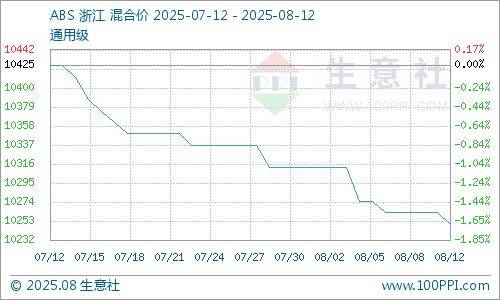
生意社:消费未见改观 8月上旬ABS低位走跌
Sou Hu Cai Jing· 2025-08-12 10:12
Core Viewpoint - The ABS market has continued to show weakness since early August, with some spot prices declining, reflecting a challenging supply-demand balance [1][10]. Supply Analysis - Domestic ABS industry load has increased since August, with overall load levels rising from 67% at the beginning of the month to over 71% [3]. - Weekly production is close to 140,000 tons, and inventory levels are stable at 220,000 tons, indicating a continued supply surplus [3]. - The supply side is expected to maintain a loose structure, providing limited support for ABS spot prices [3]. Cost Factors - The upstream materials for ABS have seen slight increases, but the overall impact on ABS costs remains limited [3]. - Some production facilities have reduced output, which may alleviate excess supply pressures in the short term [3]. - Downstream demand from major manufacturers remains stable, but overall cautious buying behavior persists due to ample supply [3]. Demand Analysis - The demand from downstream ABS factories has been moderate, with the market currently in a traditional off-peak season [9]. - The electrical appliance sector has reduced production, leading to further consumption declines [9]. - Geopolitical tensions in Eastern Europe have added to market caution, resulting in slow inventory turnover [9]. Market Outlook - The ABS market is expected to continue its weak consolidation trend, influenced by ongoing supply-demand imbalances [10]. - The market dynamics are unlikely to improve significantly in the short term, with prices expected to remain under pressure [10].
《能源化工》日报-20250812
Guang Fa Qi Huo· 2025-08-12 06:19
1. Urea Core View The domestic urea futures market has shown a weak and volatile trend recently, mainly driven by the contradiction between supply and demand. The supply is sufficient, while the demand is weak, leading to a poor trading atmosphere in the spot market and pushing down the futures price [7]. Summary by Category - **Futures Prices**: On August 11, the 01 contract closed at 1751, unchanged from August 8; the 05 contract closed at 1790, up 6 or 0.34%; the 09 contract closed at 1722, down 6 or -0.35% [2]. - **Futures Contract Spreads**: The spread between the 01 and 05 contracts was -39 on August 11, down 6 or -18.18% from August 8; the spread between the 05 and 09 contracts was 68, up 12 or 21.43%; the spread between the 09 and 01 contracts was -29, down 6 or -26.09%; the spread between the UR and MA main contracts was -667, down 12 or -1.83% [3]. - **Main Positions**: The long positions of the top 20 increased by 1403 to 63621 on August 11, a rise of 2.25%; the short positions of the top 20 decreased by 966 to 69896, a decline of -1.36%; the long - short ratio was 0.91, up 0.03 or 3.67%; the unilateral trading volume was 102540, up 22267 or 27.74%; the number of Zhengshang Institute warehouse receipts remained unchanged at 3623 [4]. - **Upstream Raw Materials**: The price of small - sized anthracite in Jincheng remained at 900 yuan/ton; the price of thermal coal at the pithead in Ejin Horo Banner increased by 10 to 525 yuan/ton, a rise of 1.94%; the price of thermal coal at the Qinhuangdao port remained at 680 yuan/ton; the price of synthetic ammonia in Shandong remained at 2300 yuan/ton; the estimated fixed - bed production cost remained at 1430 yuan/ton; the estimated water - coal slurry production cost increased by 14 to 1155 yuan/ton, a rise of 1.23% [5]. - **Spot Market Prices**: The prices of small - sized urea in Shandong, Shanxi, and Henan decreased by 30, 20, and 40 yuan/ton respectively, with declines of -1.70%, -1.21%, and -2.25%; the prices in Northeast China and Guangdong remained unchanged; the FOB price of small - sized urea in China and the FOB price of large - sized urea in the US Gulf remained unchanged [6]. - **Regional Spreads and Basis**: The spreads between Shandong and Henan, Guangdong and Henan, and Guangdong and Shanxi changed, and the basis in Shandong, Shanxi, and Henan decreased, while the basis in Guangdong increased [7]. - **Downstream Products**: The price of melamine in Shandong increased by 70 to 5177 yuan/ton, a rise of 1.37%; the prices of 45% S and 45% CL compound fertilizers in Henan remained unchanged; the compound fertilizer - urea ratio increased by 0.04 to 1.57, a rise of 2.30% [7]. - **Supply and Demand**: The daily domestic urea production increased by 0.20 to 19.21 million tons, a rise of 1.05%; the weekly domestic urea production decreased by 2.63 to 132.85 million tons, a decline of -1.94%; the weekly domestic urea plant - side inventory decreased by 2.97 to 88.76 million tons, a decline of -3.24%; the weekly domestic urea port inventory decreased by 1.00 to 48.30 million tons, a decline of -2.03% [7]. 2. Crude Oil Core View Recent oil prices have shown a weak and volatile trend. The main trading logic is the influence of geopolitical risks and marginal supply increments. The upcoming meeting between Trump and Putin is the focus. The market is in a cautious wait - and - see attitude. In the medium - to - long term, the direction of oil prices depends on the negotiation results and inventory changes. There is no strong unilateral trend currently [9]. Summary by Category - **Oil Prices and Spreads**: On August 12, Brent crude oil was at 66.84 dollars/barrel, up 0.21 or 0.32%; WTI was at 64.13 dollars/barrel, up 0.17 or 0.27%; SC was at 494.00 yuan/barrel, up 1.50 or 0.30%. Spreads such as Brent M1 - M3, WTI M1 - M3, and SC M1 - M3 also changed [9]. - **Refined Oil Prices and Spreads**: The prices and spreads of NYM RBOB, NYM ULSD, ICE Gasoil and their month - to - month spreads changed on August 12 compared with August 11 [9]. - **Refined Oil Crack Spreads**: The crack spreads of various refined oil products in the US, Europe, and Singapore changed on August 12 compared with August 11 [9]. 3. PVC and Caustic Soda Core View The caustic soda market is expected to be neutral to weak in the later stage, and the PVC market faces great supply - demand pressure, but attention should be paid to the boost of coking coal prices on PVC [19]. Summary by Category - **Spot and Futures Prices**: On August 11, the prices of Shandong 32% liquid caustic soda, Shandong 50% liquid caustic soda, and various PVC futures contracts changed compared with August 8 [14]. - **Overseas Quotes and Export Profits**: The FOB price of caustic soda in East China decreased by 10 to 390 dollars/ton, a decline of -2.5%; the export profit increased by 22.7 to 142.5 yuan/ton, a rise of 19.0%. The overseas quotes of PVC remained unchanged, and the export profit increased by 87.9 to 30.3 yuan/ton, a rise of 152.5% [15][16]. - **Supply**: The caustic soda industry's operating rate and the PVC total operating rate increased, while the profits of externally - purchased calcium carbide - based PVC and northwest integrated PVC decreased [17]. - **Demand**: The operating rates of caustic soda downstream industries such as alumina, viscose staple fiber, and printing and dyeing changed slightly; the operating rates of PVC downstream products such as pipes, profiles, and the pre - sales volume of PVC decreased [18][19]. - **Inventory**: The inventories of liquid caustic soda in East China and Shandong increased, the upstream plant - side inventory of PVC decreased, and the total social inventory of PVC increased [19]. 4. Polyolefins Core View The supply of PP and PE has different trends, and the demand is expected to improve in the peak season. The overall valuation is moderately high, and the inventories in the middle and upstream are being depleted. There is no major supply - demand contradiction [23]. Summary by Category - **Futures and Spot Prices**: On August 11, the closing prices of L2601, L2509, PP2601, PP2509 and their spreads, as well as the spot prices of East China PP drawstrings, North China LLDPE film materials, and their basis changed compared with August 8 [23]. - **PE and PP Standard Prices**: The prices of various PE and PP products in East China changed on August 11 compared with the previous period [23]. - **Upstream and Downstream Operating Rates and Inventories**: The operating rates of PE and PP plants and their downstream industries changed, and the inventories of PE and PP enterprises and traders increased [23]. 5. Pure Benzene - Styrene Core View In the short term, pure benzene prices are relatively well - supported, but the rebound space is limited. Styrene's fundamentals are weak, but the downward space is also restricted. Specific trading strategies are provided for both [26]. Summary by Category - **Upstream Prices and Spreads**: On August 11, the prices of Brent crude oil, WTI crude oil, CFR Japan naphtha, CFR Northeast Asia ethylene, CFR China pure benzene, and their spreads changed compared with August 8 [26]. - **Styrene - Related Prices and Spreads**: The prices of styrene in East China, EB futures contracts, and their spreads, as well as the cash flows and import profits changed [26]. - **Downstream Cash Flows**: The cash flows of phenol, caprolactam, aniline, EPS, PS, ABS and other downstream products changed [26]. - **Inventory and Operating Rates**: The inventories of pure benzene and styrene in Jiangsu ports decreased, and the operating rates of various industries in the pure benzene and styrene产业链 changed [26]. 6. Methanol Core View The methanol market is affected by factors such as production, inventory, and demand. The 09 contract has a strong expectation of inventory accumulation, while the 01 contract has seasonal and supply - reduction expectations. Specific trading strategies are provided [30]. Summary by Category - **Prices and Spreads**: On August 8, the closing prices of MA2601 and MA2509 decreased, and the MA91 spread, Taicang basis, and regional spreads changed compared with August 7 [30]. - **Inventory**: The methanol enterprise inventory decreased by 3 to 29.3688%, a decline of -9.50%; the methanol port inventory increased by 12 to 92.5 million tons, a rise of 14.48%; the methanol social inventory increased by 8.6 to 121.9%, a rise of 7.61% [30]. - **Upstream and Downstream Operating Rates**: The operating rates of upstream domestic enterprises and some downstream industries changed on August 8 compared with the previous period [30]. 7. Polyester Industry Chain Core View The supply - demand situations of PX, PTA, ethylene glycol, short - fiber, and bottle - chip are different, and corresponding trading strategies are provided for each [59]. Summary by Category - **Downstream Polyester Product Prices and Cash Flows**: On August 11, the prices of POY, FDY, DTY, polyester chips, polyester bottle - chips, and their cash flows changed compared with August 8 [59]. - **PX - Related Prices and Spreads**: The prices of CFR China PX, PX futures contracts, and their spreads, as well as the PX basis and processing spreads changed [59]. - **PTA - Related Prices and Spreads**: The prices of PTA, PTA futures contracts, and their basis, processing spreads, and operating rates changed [59]. - **MEG - Related Prices and Spreads**: The prices of MEG, MEG futures contracts, and their basis, spreads, and cash flows changed [59]. - **Industry Operating Rates**: The operating rates of various industries in the polyester industry chain such as PX, PTA, MEG, and polyester products changed [59].
邓正红能源软实力:石油供应担忧支撑国际油价上涨 美国原油库存激增限制涨幅
Sou Hu Cai Jing· 2025-07-31 08:14
Group 1: Oil Price Movements - International oil prices rose due to concerns over supply following Trump's tariff threats against India, which is a major buyer of Russian oil [1][3] - As of July 30, West Texas Intermediate crude oil settled at $70.00 per barrel, up $0.79 (1.14%), while Brent crude oil settled at $73.24 per barrel, up $0.73 (1.01%) [1] Group 2: Geopolitical Implications - Trump's threats to impose a 25% tariff on India are seen as a move to leverage geopolitical power, aiming to disrupt Russia's oil revenue streams [3][4] - The sanctions and geopolitical tensions have led to a decrease in refinery operations in India, raising concerns about tightening supply in the refined oil market [1][3] Group 3: U.S. Oil Inventory Impact - The U.S. Energy Information Administration reported a significant increase in crude oil inventories, with a rise of 7.7 million barrels, the largest increase since January [1][4] - The increase in inventory levels, particularly in Cushing, Oklahoma, has limited the upward momentum of oil prices despite geopolitical tensions [1][4] Group 4: Chevron's Operations in Venezuela - Chevron has received limited permission from the U.S. government to operate in Venezuela, provided that oil revenues do not benefit President Maduro's government [2] - This permission allows Chevron to make decisions within its joint ventures and engage in procurement and contract payments [2] Group 5: Long-term Energy Dynamics - The short-term oil price dynamics are influenced by U.S. policy deterrence and resource autonomy from Russia, Venezuela, and Iran, while long-term stability will depend on OPEC's rule innovations and Asian demand resilience [5] - The geopolitical landscape is shifting, with emerging energy cooperation networks potentially countering U.S. tariff strategies [5]

【期货热点追踪】玻璃期货夜盘涨超5%,逆转近两日的大跌走势,此前郑商所调整玻璃期货交易手续费,机构分析表示,在行业大规模产能清退、终端地产全面正增长之前,玻璃供需矛盾仍难有实质性缓解,短期盘面或回吐超涨部分。
news flash· 2025-07-29 14:10
Core Viewpoint - Glass futures experienced a significant rebound, rising over 5% in the night session, reversing the downward trend observed in the previous two days. This shift follows the adjustment of trading fees for glass futures by the Zhengzhou Commodity Exchange [1] Group 1: Market Dynamics - The recent increase in glass futures is attributed to the adjustment of trading fees by the Zhengzhou Commodity Exchange, which has influenced market sentiment positively [1] - Despite the short-term price increase, analysts indicate that the supply-demand imbalance in the glass industry is unlikely to see substantial relief before a large-scale capacity exit and comprehensive growth in the real estate sector [1] Group 2: Future Outlook - The short-term market may experience a correction as it could give back some of the excessive gains achieved recently, indicating potential volatility ahead [1]
供需矛盾累积,关注天气扰动
Hua Tai Qi Huo· 2025-07-29 05:40
1. Report Industry Investment Rating - The investment strategy for soybeans and peanuts is neutral [2][4] 2. Core View of the Report - The soybean market is affected by factors such as the supply outlook of international major producers, trade policy uncertainty, China's demand - structure adjustment, and high domestic inventory pressure. Future attention should be paid to the weather in major producing areas, trade - negotiation policies, and domestic inventory digestion [1] - The peanut market has limited and quality - differentiated sources of goods, with strong selling pressure from holders but weak downstream purchasing. The new - season planting area has increased, and future focus is on the impact of rainfall on new - season yields and demand changes [3] 3. Summary by Related Catalogs Soybean Market Analysis - Futures: The closing price of the bean - one 2509 contract was 4153.00 yuan/ton, a change of - 71.00 yuan/ton (- 1.68%) from the previous day [1] - Spot: The edible - bean spot basis was A09 + 147, a change of + 71 (+ 32.14%) from the previous day. Northeast soybean prices remained stable [1] Strategy - Neutral [2] Risk - None [2] Peanut Market Analysis - Futures: The closing price of the peanut 2510 contract was 8142.00 yuan/ton, a change of + 4.00 yuan/ton (+ 0.05%) from the previous day [2] - Spot: The average peanut spot price was 8620.00 yuan/ton, a change of - 60.00 yuan/ton (- 0.69%) from the previous day. The spot basis was PK10 + 58.00, a change of - 4.00 (- 6.45%) from the previous day. Domestic peanut spot prices were slightly weaker, and most产区 inventories were low [2] Strategy - Neutral [4] Risk - Weak demand [4]
铅:供需矛盾逐步显现,价格走强
Guo Tai Jun An Qi Huo· 2025-07-21 02:26
Report Summary 1. Industry Investment Rating No information provided. 2. Core Viewpoints - The supply - demand contradiction of lead is gradually emerging, and the price is strengthening [1]. - In May 2025, the global refined lead market had a supply shortage of 37,600 tons, with production of 1.1113 million tons and consumption of 1.1489 million tons [2]. 3. Summary by Relevant Catalogs Fundamental Tracking - **Price and Volume**: The closing price of SHFE lead main contract was 16,820 yuan/ton, down 0.15%; the LME lead 3M electronic disk closed at 2,011.5 dollars/ton, up 1.72%. The trading volume of SHFE lead main contract was 32,288 lots, an increase of 893 lots; the LME lead trading volume was 9,912 lots, an increase of 1,265 lots. The open interest of SHFE lead main contract was 50,581 lots, a decrease of 1,370 lots; the LME lead open interest was 136,098 lots, a decrease of 457 lots [1]. - **Premium and Discount**: The premium of Shanghai 1 lead was - 25 yuan/ton, an increase of 5 yuan/ton; the LME CASH - 3M premium was - 23.5 dollars/ton, an increase of 5.5 dollars/ton. The PB00 - PB01 spread was - 25 yuan/ton, an increase of 5 yuan/ton; the import premium was 105 dollars/ton, unchanged [1]. - **Inventory**: The SHFE lead futures inventory was 60,084 tons, a decrease of 200 tons; the LME lead inventory was 268,400 tons, a decrease of 2,550 tons. The LME lead cancelled warrants were 74,975 tons, an increase of 35,225 tons [1]. - **Cost and Profit**: The price of waste electric vehicle batteries was 10,250 yuan/ton, unchanged; the price of secondary refined lead was 16,700 yuan/ton, unchanged. The comprehensive profit and loss of secondary lead was - 533 yuan/ton, unchanged. The spot import profit and loss of lead ingots was - 592.93 yuan/ton, a decrease of 40.75 yuan/ton; the import profit and loss of SHFE lead continuous third contract was - 460.62 yuan/ton, a decrease of 15.24 yuan/ton [1]. News - Fed Governor Waller supports a rate cut in July, and the 2 - year US Treasury yield once fell about 4 basis points. Trump is reported to be pushing for higher tariffs on the EU, and tariffs on multiple industries will take effect before August 1st. US consumer inflation expectations have improved [2]. - The Ministry of Industry and Information Technology will introduce a steady - growth work plan for ten key industries such as steel, non - ferrous metals, petrochemicals, and building materials, aiming to adjust the structure, optimize the supply, and eliminate backward production capacity [2].