
经济增长

Search documents
渣打警告:若特朗普政策未能刺激经济增长,美元明年或面临“重大”下跌
Hua Er Jie Jian Wen· 2025-05-28 13:26
Core Viewpoint - The report from Standard Chartered Bank indicates that if Trump's policies increase U.S. debt without boosting economic growth, the risk of a significant decline in the dollar next year will rise [1][2]. Group 1: U.S. Debt and Economic Growth - The simultaneous rise in U.S. government debt and external liabilities poses a significant risk to the dollar and U.S. bonds, potentially leading to a loss of confidence from foreign investors in the U.S.'s long-term borrowing capacity [1]. - The expanding U.S. deficit is reducing national savings and increasing reliance on foreign savings, which translates into a higher current account deficit [1][2]. Group 2: Investor Sentiment and Market Reactions - Concerns are growing among foreign creditors regarding the sustainability of U.S. debt if tariffs and tax policies fail to stimulate growth, which could manifest as higher risk premiums, either through increased interest rates or a weaker dollar [2][3]. - Investors are beginning to question the stability of U.S. assets due to Trump's aggressive tariff policies and their chaotic implementation [2]. Group 3: Future Economic Outlook - Standard Chartered believes that foreign investors are currently hesitant to fully divest from traditional safe-haven assets, as they await the impact of Trump's policies on growth [3]. - If the tax reform is approved, it may provide some economic benefits this year, but the positive effects are expected to fade by mid-2026 or 2027, raising concerns about long-term growth and debt impacts [3]. Group 4: Federal Reserve's Limitations - The effectiveness of the Federal Reserve's policy tools may be limited in the face of potential crises, with any easing measures possibly not extending to longer-duration bonds [4]. - While the U.S. government can continue to issue dollar-denominated debt, the risk of effective default through inflation could become a substantial concern if the debt trajectory is not stabilized [4].
黄金期货沪金维持跌势 新西兰联储宣布降息25个基点
Jin Tou Wang· 2025-05-28 06:57
Group 1: Macro News - The Reserve Bank of New Zealand has cut interest rates by 25 basis points to 3.25%, marking the sixth rate cut since August of the previous year, totaling a reduction of 225 basis points [3] - The current inflation rate in New Zealand is 2.5%, which is within the target range of 1%-3%, allowing for further monetary policy adjustments [3] - The central bank highlighted the "sharp shift in U.S. trade policy" as a key reason for increasing monetary easing, indicating potential negative impacts on New Zealand's export-dependent economy due to U.S. tariffs on Chinese goods [3] Group 2: Gold Futures Analysis - Gold futures prices are currently down, with the latest price at 771.64 CNY per gram, reflecting a decline of 0.67% [4] - The highest price reached today was 773.80 CNY per gram, while the lowest was 767.20 CNY per gram [4] - Resistance levels for gold are identified between 796-806 CNY per gram, with support levels between 733-743 CNY per gram [4]
印度宣布:已超越日本,成为全球第四大经济体!2024财年GDP增长率9.6%,莫迪:2047年前要将印度转型为发达国家
Mei Ri Jing Ji Xin Wen· 2025-05-27 09:19
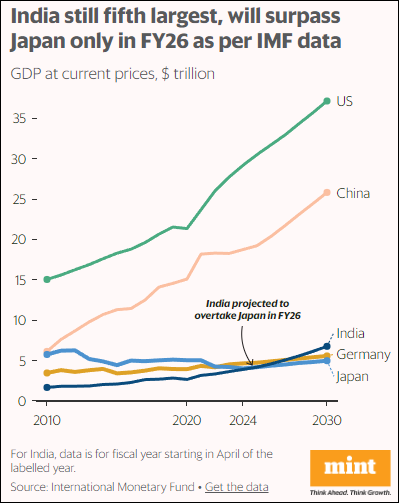
Core Viewpoint - India has surpassed Japan to become the world's fourth-largest economy, with a GDP of $4 trillion, and aims to become the third-largest economy within three years if current plans are followed [1][4]. Economic Growth - The Indian economy is projected to grow at a rate of 6.5% for the fiscal year 2024-2025, which is the highest among major economies [1][5]. - According to the IMF, India's nominal GDP is expected to reach $4.187 trillion by the end of 2025, slightly exceeding Japan's projected GDP of $4.186 trillion [4]. Future Projections - The IMF forecasts that India's GDP will reach $5.584 trillion by 2028, surpassing Germany to become the third-largest economy globally [4]. - India's Prime Minister Modi has set a vision for the country to become a developed nation by 2047, coinciding with the 100th anniversary of India's independence [5]. Demographics and Economic Indicators - As of 2023, India's population is approximately 1.44 billion, with a GDP of $3.55 trillion and a per capita GDP of $2,430 [5]. - India's average GDP growth rates from 2021 to 2024 are projected to be 9.7%, 7.6%, 9.2%, and 6.5%, significantly outpacing many developed and emerging markets [5].

印度官方称已超日本成第四大经济体,果真?
Guan Cha Zhe Wang· 2025-05-27 05:29
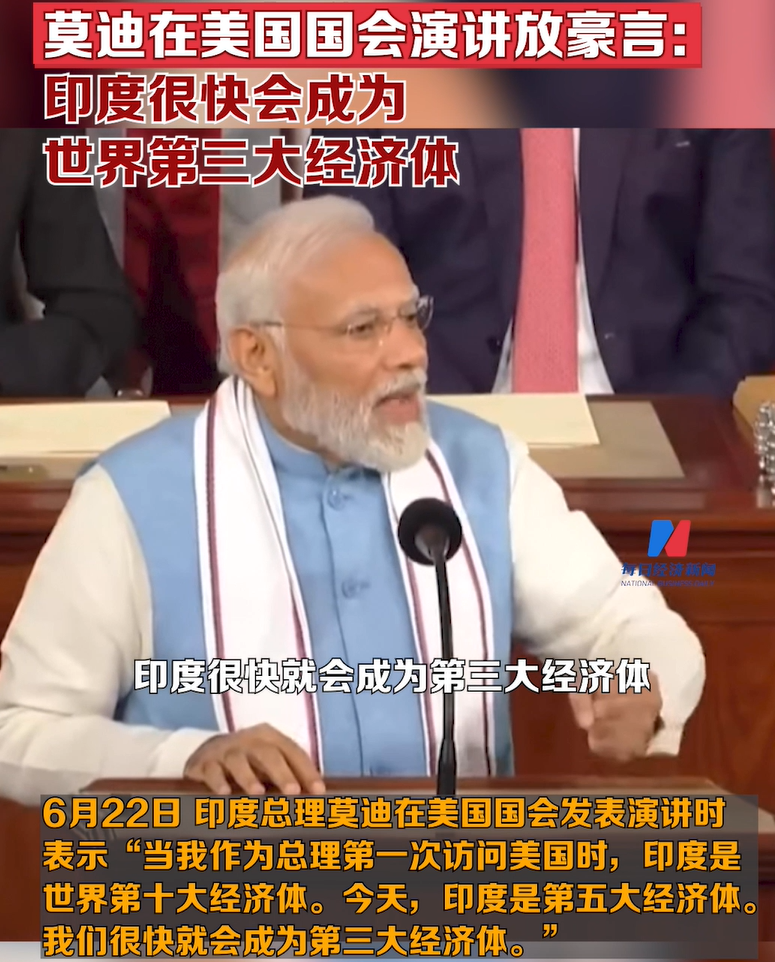
观察者网消息,"印度已正式超过日本,成为世界第四大经济体。"当地时间5月25日,诸如《印度时 报》、《印度快报》等印媒援引印度政府最高公共政策智库"印度转型国家研究所"(NITI Aayog)的这 一说法,纷纷关注报道。 印度知名财经媒体MINT则发文指出,尽管苏布拉马尼亚姆用IMF的数据加以佐证,但事实并非如此。 根据IMF今年4月发布的《世界经济展望》报告显示,印度2025财年的GDP预计将达到3.909万亿美元, 而日本2024日历年的GDP预计为4.026万亿美元。因此,印度目前仍是世界第五大经济体。 在当地时间5月24日举行的一场新闻发布会上,NITI Aayog首席执行官苏布拉马尼亚姆(B.V.R. Subrahmanyam)表示,印度经济体量已增长至4万亿美元,仅次于美国、中国和德国,并已超过日本而 成为世界第四大经济体。在现场,他还援引国际货币基金组织(IMF)的数据加以证明。 "就在我说话的时候,我们是第四大经济体。在我讲话的时候,我们是一个4万亿美元的经济体。"他认 为,当前整体地缘政治和经济环境对印度有利,并补充说:"只有美国、中国和德国(的经济体量)比 印度大,如果我们坚持目前正在计划 ...
法国兴业银行:经济展望(未来一周):关税问题再度来袭
2025-05-26 13:25
Summary of Key Points from the Conference Call Industry or Company Involved - The conference call discusses macroeconomic trends and monetary policies affecting various regions, particularly focusing on the Euro area, United States, and Asia Pacific. Core Insights and Arguments 1. **U.S. Economic Policy and Deficits** - The House passed a reconciliation bill proposing $3.8 trillion in new deficits over the next 10 years, which is the lower end of earlier estimates that reached up to $15 trillion [4][15][16] - The Senate's approval is pending, and the process may extend until after August, potentially requiring temporary debt-limit relief [18][19] 2. **Inflation and Monetary Policy in the Euro Area** - Flash inflation data for May is expected to show stable or lower total inflation across most Euro area countries, with a focus on the impact of new tariff threats [5][40] - The European Central Bank (ECB) is anticipated to implement a 25 basis point rate cut in June, with discussions ongoing about future cuts [39][44] 3. **Consumer Confidence and Spending Trends** - Consumer confidence in the U.S. remains weak, driven by fears of price increases and potential layoffs, despite healthy consumer spending trends [20][23][31] - April consumer spending is expected to show a nominal increase of 0.3%, with real expenditures rising by 0.2% due to low inflation [33][34] 4. **Asia Pacific Economic Outlook** - The Bank of Korea (BoK) is expected to cut its policy rate by 25 basis points amid weak economic growth [6][39] - India's GDP growth is projected to have picked up in Q1, driven by government spending and investment [6][39] 5. **Tariff Impacts and Trade Dynamics** - President Trump's threats of new tariffs against the EU and potential tariffs on iPhones have created uncertainty that could negatively impact global growth [3][5] - The Euro area is experiencing disinflation amidst these tariff threats, with consumer confidence showing signs of decline in France [38][41] Other Important but Possibly Overlooked Content 1. **Sector-Specific Insights** - The manufacturing sector in the Euro area is showing signs of improvement, while the services sector is lagging, indicating a divergence in economic recovery [38][45] - The U.S. durable goods orders are expected to show a significant drop in April, particularly in the aircraft sector, which had previously seen strong orders [29][30] 2. **Geopolitical Considerations** - The geopolitical landscape, particularly regarding U.S.-China trade relations, continues to influence economic sentiment and market expectations [19][39] - Brazil's economic activity suggests strong GDP expansion in Q1, but underlying components may indicate potential weaknesses ahead [8][13] 3. **Monetary Growth Trends** - M3 money supply growth in the Euro area has been improving, driven by higher loan demand in the private sector, although there are concerns about banks' external asset sales [53][54] This summary encapsulates the key points discussed in the conference call, highlighting the macroeconomic trends, monetary policies, and sector-specific insights that could influence investment decisions.

前4个月南京规上工业增加值同比增长6.2%
Shang Hai Zheng Quan Bao· 2025-05-26 11:53
Economic Overview - Nanjing's economy has shown stable growth in the first four months of 2025, building on a strong start in the first quarter [1] - Key economic indicators reflect the city's commitment to economic development and project promotion [1] Industrial Performance - The industrial added value in Nanjing increased by 6.2% year-on-year from January to April, improving by 0.9 percentage points compared to the same period last year and by 3.0 percentage points compared to the entire previous year [1] - Manufacturing added value grew by 6.8%, with the automotive manufacturing sector experiencing a significant increase of 29.3% year-on-year due to the export of new energy vehicles [1] - The electrical machinery and pharmaceutical industries also saw substantial growth, with increases of 19.8% and 15.9% respectively, driven by new lithium battery models and mass production of new drugs [1] Fixed Asset Investment - Fixed asset investment in Nanjing decreased by 5.9% year-on-year in the first four months, but the decline was narrowed by 1.3 percentage points compared to the first quarter [1] - Manufacturing investment rose by 10.1%, contributing 36.2% to the overall investment growth [1] - Investment in equipment and tools increased by 18.2% year-on-year, while high-tech industry investment grew by 13.2%, with high-tech manufacturing investment surging by 26.9% [1] Consumer Market - The total retail sales of social consumer goods in Nanjing reached 294.46 billion yuan, marking a year-on-year growth of 5.9%, which is an increase of 2.5 percentage points compared to the same period last year and 1.6 percentage points compared to the previous year [2] - The "old-for-new" policy has boosted retail sales in various categories, with home appliances and audio-visual equipment, cultural and office supplies, communication equipment, and automotive goods seeing year-on-year growth of 15.9%, 38.1%, 37.8%, and 10.3% respectively [2] Price Trends - Consumer prices in Nanjing decreased by 0.4% year-on-year in the first four months, with specific categories such as clothing, education, culture, entertainment, and healthcare seeing slight increases [2] - The industrial producer price index fell by 1.9% year-on-year, while the purchasing price index for industrial producers decreased by 2.5% [2]
泰国财长:经济将出现停滞,今年的增长可能刚刚超过1%。
news flash· 2025-05-26 06:51
Core Viewpoint - Thailand's Finance Minister has indicated that the economy is expected to stagnate, with growth projected to barely exceed 1% this year [1] Economic Outlook - The Thai economy is facing challenges that may lead to stagnation, with growth estimates being revised downwards [1] - The anticipated growth rate for this year is just above 1%, reflecting a significant slowdown compared to previous years [1]
中金:美国还能“扛多久”?
中金点睛· 2025-05-25 23:32
Group 1 - The article discusses the dramatic changes in Trump's tariff policy towards China, with tariffs fluctuating from 34% to 125% and then down to 10% after negotiations, indicating a volatile trade environment [1][3] - The market has shown resilience, recovering losses incurred after the initial tariff announcements, suggesting that the impact of tariffs may not be as severe as initially feared [1][3] - The article highlights the necessity for the U.S. to lower tariffs to avoid significant economic and inflationary pressures, as high tariffs are unsustainable for both the U.S. and China [3][5] Group 2 - Tariffs are expected to have a significant impact on U.S. inflation, potentially raising the Consumer Price Index (CPI) by 1 percentage point, although factors like low oil prices and inventory replenishment may delay this effect until late Q3 [25][32] - The article outlines that U.S. inventory levels have increased significantly, with a 20% rise in import amounts and a 2.4% increase in nominal inventory compared to the previous year, indicating a robust supply chain response [10][18] - Different industries will experience varying levels of pressure from tariffs, with textiles, apparel, computers, and electronics facing the most significant challenges due to their high reliance on imports from China [22][23] Group 3 - The article emphasizes that U.S. economic growth can be sustained until the end of the year, supported by consumer spending and investment, but warns that renewed tariffs could lead to stagnation [36][37] - It notes that the Federal Reserve's ability to lower interest rates is constrained by inflationary pressures, which could further suppress private sector credit expansion and investment [8][36] - The potential for tax cuts and further tariff reductions could alleviate some of the economic pressures, but the timing and implementation of these measures remain uncertain [9][57] Group 4 - The financial market's stability is under scrutiny, particularly following a downgrade in the U.S. credit rating by Moody's, which could affect investor confidence and market dynamics [58][59] - The article points out that the upcoming debt ceiling resolution and increased bond supply could lead to liquidity issues in the market, impacting the overall financial landscape [59][61] - Long-term concerns about the U.S. dollar's status as a reserve currency are raised, particularly if tariffs continue to affect trade balances and investor sentiment [65]
吉姆·奥尼尔:英国的增长使命出了什么问题
Di Yi Cai Jing· 2025-05-25 12:40
为什么不抓住时机放弃"三重锁定"呢?这样做将允许开展更多的长期项目,从而极大改善国家的增长前 景和财政健康状况。 在成为第一个与美国达成新贸易"协议"(或至少是协议框架)的国家之后,英国首相基尔·斯塔默领导 的工党政府即将迎来备受期待的支出审查和十年基础设施战略的发布。对于一个承诺将经济增长作为重 中之重的政府来说,这可能是说服国民相信其认真态度的最后机会。 政府不仅受制于外部环境,也受制于自身的胆怯。自去年竞选活动以来斯塔默在名义上围绕五项"使 命"制定了工党的战略,而其中第一项使命就是实现七国集团(G7)中最快的经济增长。但在去年7月 上台后不久,他的政府就决定将重点放在英国的各类财政挑战上,这意味着要实施紧缩政策并与首要目 标的精神背道而驰。 虽说政府在2024年秋季预算中引入了更大胆的财政框架,并增加了针对学校和国家医疗服务体系的资本 支出;但这些并不是促进增长、提高生产力的基础设施投资形式。而英国预算责任办公室则预测原有的 增长趋势线不会有任何改善。 如果英国增加对预防感染和其他疾病的投资,而不是增加对国家医疗服务体系的投入,情况会怎样呢? 我想大多数预测者都会认为,从长远来看这类支出更能促进经济增 ...
股指期货周报:成交缩量影响,股指震荡走弱-20250525
Zhe Shang Qi Huo· 2025-05-25 06:57
Report Summary 1. Report Industry Investment Rating No investment rating information is provided in the report. 2. Core Viewpoints - Due to the impact of shrinking trading volume, the stock index fluctuated weakly. It is recommended to have long positions in 182506 and IP2506, and also allocate more to IM2506 because of its relatively high annualized basis rate [5]. - The joint statement between China and the US, domestic economic data improvement, policy support, capital market reforms, and "national team" actions are important factors supporting the market [6]. 3. Summary by Directory Market Performance - Domestic indices continued to fluctuate weakly this week, while US stocks fell significantly. By May 23, 2025, the NASDAQ fell 2.47%, the S&P 500 fell 2.61%, the Hang Seng Tech Index fell 0.65%, the Shanghai Composite Index fell 0.57%, the CSI 1000 fell 1.23%, the SSE 50 fell 0.18%, the ChiNext Index fell 0.88%, and the STAR 50 fell 1.47%. The performance of Shenwan's primary 31 industry indices was divergent, with sectors such as medicine, biology, non - ferrous metals, and automobiles rising, and sectors such as computers, machinery, and electronics falling [13][14]. Liquidity - In April, the growth rate of social financing increased significantly, and the growth rate of M2 rebounded. The net MLF investment in April was 50 billion yuan. The yield of 10 - year treasury bonds was around 1.65%. The growth rate of social financing stock was 8.7% year - on - year, a 0.3% increase from the previous month. More than 80% of the 1.16 trillion yuan increase in social financing came from new government bond financing. The M2 growth rate rebounded significantly, the M1 growth rate declined month - on - month, and the M1 - M2 gap widened to - 6.5%, indicating insufficient economic vitality [24]. Trading Data and Sentiment - The trading volume of the two markets continued to decline to around one trillion yuan. The number of new stock account openings in January was 1.57 million, in February was 2.83 million, in March was 3.06 million, and in April it dropped to 1.92 million [27][37]. Index Valuation - As of May 23, 2025, the latest PE of the Shanghai Composite Index was 14.48, with a percentile of 62.56, and the latest PE of the All - A Index was 18.95, with a percentile of 59.90. Among the major stock indices, the valuation percentile ranking was CSI 500 < CSI 1000 < SSE 300 < SSE 50 [53]. Index Industry Weights (as of December 31, 2024) - In the SSE 50, the weights of banks, food and beverage, and non - bank finance were relatively high, at 19.4%, 16.57%, and 13.07% respectively, and the electronics sector became the fourth - largest weighted industry. - The weights of the SSE 300 were relatively dispersed, with the top three weighted industries being banks, non - bank finance, and electronics. - The top three weighted industries of the CSI 500 and CSI 1000 were exactly the same, namely electronics, medicine and biology, and power equipment, but the electronics industry in the CSI 1000 had a higher weight [54].