美联储降息

Search documents
光大期货金融期货日报-20260115
Guang Da Qi Huo· 2026-01-15 03:08
1. Report Industry Investment Rating - The investment rating for stock index futures is "volatile", and for treasury bond futures is "relatively strong" [1] 2. Core Viewpoints - The A-share market had a volatile performance on January 15, 2026, with the overall market surging and then falling back, and the three major indexes showing mixed results. The trading volume of the whole market was close to 4 trillion, hitting a new high. The index increase at the beginning of 2026 was mainly driven by global technological development, and geopolitical tensions also made rare metals popular. The stock index is expected to be volatile, and investors should be cautious about chasing high prices and mainly adopt a wait-and-see approach [1] - Treasury bond futures showed mixed results. The short - term reasonable and sufficient liquidity is the biggest support for the bond market, but factors such as economic stability, rising inflation, and cautious attitude towards interest rate cuts restrict the bond market. The bond market is expected to remain in a range - bound pattern in the short term [1][2] 3. Summary by Relevant Catalogs 3.1 Research Viewpoints Stock Index Futures - The market had a volatile performance, with the Shanghai Composite Index down 0.31%, the Shenzhen Component Index up 0.56%, and the ChiNext Index up 0.82%. The rise was driven by technological development and geopolitical factors. The short - term trend is volatile, and investors are advised to be cautious [1] Treasury Bond Futures - The 30 - year main contract was down 0.04%, the 10 - year main contract was up 0.08%, the 5 - year main contract was up 0.04%, and the 2 - year main contract was flat. The central bank carried out 240.8 billion yuan of 7 - day reverse repurchase, with a net injection of 212.2 billion yuan. The bond market is expected to be range - bound in the short term [1][2] 3.2 Daily Price Changes Stock Index Futures - IH decreased by 0.75% from 3,137.6 to 3,114.0; IF decreased by 0.39% from 4,758.6 to 4,740.0; IC increased by 0.82% from 8,131.2 to 8,197.8; IM decreased by 0.05% from 8,160.4 to 8,156.0 [3] - The Shanghai 50 Index decreased by 0.67% from 3,132.9 to 3,112.1; the CSI 300 Index decreased by 0.40% from 4,761.0 to 4,741.9; the CSI 500 Index increased by 1.04% from 8,143.3 to 8,227.7; the CSI 1000 Index increased by 0.66% from 8,203.1 to 8,257.2 [3] Treasury Bond Futures - TS remained flat at 102.33; TF increased by 0.03% from 105.63 to 105.66; T increased by 0.07% from 107.85 to 107.93; TL decreased by 0.07% from 111.35 to 111.27 [3] 3.3 Market News - The Ministry of Science and Technology will strengthen financial services for major national scientific and technological tasks and technology - based small and medium - sized enterprises in 2026, and play a role in the science - finance coordination mechanism [4] 3.4 Chart Analysis Stock Index Futures - The report presents the trends and basis trends of IH, IF, IM, and IC main contracts [5][6][7][8][9][10] Treasury Bond Futures - The report shows the trends of treasury bond futures main contracts, treasury bond spot yields, basis, inter - period spreads, cross - variety spreads, and capital interest rates [12][13][14][15][16][17][18][21] Exchange Rates - The report displays the trends of the US dollar against the Chinese yuan, the euro against the Chinese yuan, forward exchange rates, the US dollar index, euro - US dollar, pound - US dollar, and US dollar - Japanese yen exchange rates [22][23][24][25][27][29]
光大期货0115黄金点评:地缘局势持续紧张,金价延续偏强运行
Xin Lang Cai Jing· 2026-01-15 02:55
Core Viewpoint - The article discusses the recent performance of gold prices and the economic indicators from the United States, highlighting the resilience of consumer spending and the potential impact of geopolitical tensions on gold prices [2][5]. Economic Indicators - COMEX gold prices closed at $4633.9 per ounce, with a gain of 0.76%, while SHFE gold prices closed at 1039.72 yuan per gram, up 0.46% [2][5]. - The U.S. Department of Commerce reported a 0.6% month-over-month increase in retail sales for November, surpassing the expected 0.5% [2][5]. - The National Association of Realtors (NAR) indicated that December's existing home sales totaled an annualized 4.35 million units, the highest level since February 2023, exceeding expectations of 4.22 million and the previous value of 4.13 million [2][5]. - The Federal Reserve's Beige Book noted improvements in the overall economy across most regions, with stable employment levels and moderate price increases [2][5]. Federal Reserve and Interest Rates - There is significant internal disagreement within the Federal Reserve regarding the future path of interest rate cuts, but a majority supports not lowering rates in January [2][5]. - The slight recovery of the U.S. dollar index suggests that expectations for rate cuts may not provide substantial upward momentum for gold prices [2][5]. Geopolitical Factors - Multiple governments have advised their citizens to evacuate Iran, with former President Trump indicating a wait-and-see approach regarding the situation [2][5]. - The escalating tensions in Iran may keep gold prices strong in the short term, especially in the context of the Federal Reserve's potential pause on interest rate cuts [2][5].


现货白银单日暴涨7%突破93美元,市值超英伟达!有色矿业ETF招商(159690)刷新上市高位
Sou Hu Cai Jing· 2026-01-15 02:08
Group 1 - The core viewpoint of the articles highlights the significant rise in silver prices, with spot silver increasing by 7% to surpass $93 per ounce, marking a new historical high [1] - The surge in silver prices is driven by two main factors: lower-than-expected CPI data in the U.S. for December 2025, which has increased market bets on a potential interest rate cut by the Federal Reserve in March, and growing concerns about the independence and stability of the Fed's policies due to recent tensions between the U.S. government and the Fed [1] - As of January 14, 2025, silver's market capitalization exceeded $5 trillion, making it the second most valuable asset globally, only behind gold, surpassing Nvidia [1] Group 2 - The non-ferrous metals sector has shown strong performance, with an annual increase of 94.73%, ranking first among the Shenwan primary industries [2] - The non-ferrous mining ETF (159690) tracking the CSI Non-Ferrous Metals Mining Index has achieved an annual growth of 104.84%, indicating better relative elasticity [2] - Historically, the non-ferrous mining index has demonstrated higher elasticity compared to mainstream non-ferrous metal theme indices, with a cumulative increase of 172.62% over the past decade and an annualized growth rate of 10.87% [2]

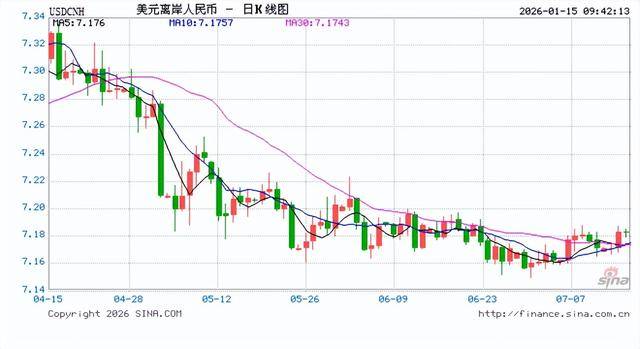
人民币兑美元中间价报7.0064上调56点,升值至2023年5月18日以来最高!投资者押注美联储今年将维持利率不变
Sou Hu Cai Jing· 2026-01-15 01:59
Group 1 - Increasing number of options traders are betting that the Federal Reserve will maintain interest rates unchanged throughout the year, moving away from expectations of rate cuts [2] - Recent U.S. employment data showed an unexpected drop in the unemployment rate, which has nearly eliminated the possibility of a rate cut in the upcoming policy meeting [2] - The stable labor market provides little justification for further rate cuts after three reductions of 25 basis points each last year, especially with inflation still above the Fed's target [2] Group 2 - The probability of the Federal Reserve maintaining interest rates unchanged in January is 95%, while the probability of a 25 basis point cut is only 5% [3] - By March, the cumulative probability of a 25 basis point cut is 26%, with a 72.8% chance of maintaining rates unchanged, and only a 1.2% chance of a 50 basis point cut [3] Group 3 - On January 15, the central parity rate of the RMB against the USD was reported at 7.0064, an increase of 56 points, marking the highest level since May 18, 2023 [4]
美联储褐皮书描绘“稳健软着陆”路线图:美国经济回暖 就业波澜不惊
智通财经网· 2026-01-14 23:57
Core Viewpoint - The Federal Reserve's Beige Book indicates a slight to moderate economic recovery across most regions in the U.S., supporting the narrative of a "soft landing" for the economy, with the labor market showing signs of gradual improvement [1][3]. Economic Growth - The Beige Book reports that economic activity is increasing at a "slight to moderate" pace, with no significant signs of recession, which is crucial for the "soft landing" narrative [3]. - Most regions reported stable non-farm employment levels, with moderate wage growth returning to normal levels [2][3]. Labor Market - Despite some regions noting a slowdown in hiring, overall employment levels remain stable, and wage growth is moderate, indicating a balanced labor market without significant overheating or mass layoffs [3][4]. - The labor market is described as showing signs of slight recovery, with some Federal Reserve officials cautious about further rate cuts due to inflation remaining above the 2% target [4][5]. Inflation and Pricing - Recent CPI data shows a steady decline in inflation, with price growth across most economic regions described as "moderate" rather than significantly rising [2][3]. - Some businesses are beginning to pass on tariff-related costs to consumers, but overall inflation trends remain downward [3][6]. Interest Rate Expectations - Market expectations for interest rate cuts have shifted, with traders now anticipating two rate cuts in 2026, with the first expected in June rather than March [2][5]. - Goldman Sachs and Morgan Stanley have adjusted their forecasts for rate cuts to June and September, emphasizing the need for inflation to return to the 2% target before any policy actions [5][6]. Regional Highlights - Boston reports an increase in temporary hiring, with expectations for many positions to become permanent [6]. - New York notes that increased tariffs have led to cost pass-through to customers, affecting pricing strategies [6]. - Philadelphia highlights ongoing consumer budget pressures across various sectors, including housing and healthcare [6]. - Cleveland sees a rebound in demand for manufactured goods, driven by AI data center construction [6]. - Atlanta mentions increased AI adoption to enhance productivity, although significant impacts on employment may take time [6].
美股全线下挫,科技七巨头、芯片股普跌,携程跌超17%,白银狂飙突破93美元
21世纪经济报道· 2026-01-14 23:27
记者丨金珊 张伟泽 吴斌 编辑丨黎雨桐 周三(1月14日),美国三大股指全线收跌,道指跌0.09%,标普500指数跌0.53%,纳指跌1%。 | 道琼斯 | 纳斯达克 | 标普500 | | --- | --- | --- | | 49149.63 | 23471.75 | 6926.60 | | -42.36 -0.09% | -238.12 -1.00% | -37.14 -0.53% | | 中国金龙指数 | 纳指100期货 | 标普500期货 | | 7856.78 | 25621.50 | 6960.25 | | -18.05 -0.23% | -284.50 -1.10% | -41.50 -0.59% | 大型科技股全线下跌,个股方面,脸书、亚马逊、微软跌超2%,特斯拉跌近2%,英伟达跌超1%。 | 名称 | 现价 涨跌幅 = | li | | --- | --- | --- | | 脸书(META PLATF | 615.520 -2.47% | | | META.O | | | | 亚马逊(AMAZON) | 236.710 -2.43% | | | AMZN.O | | | | 微软(MI ...

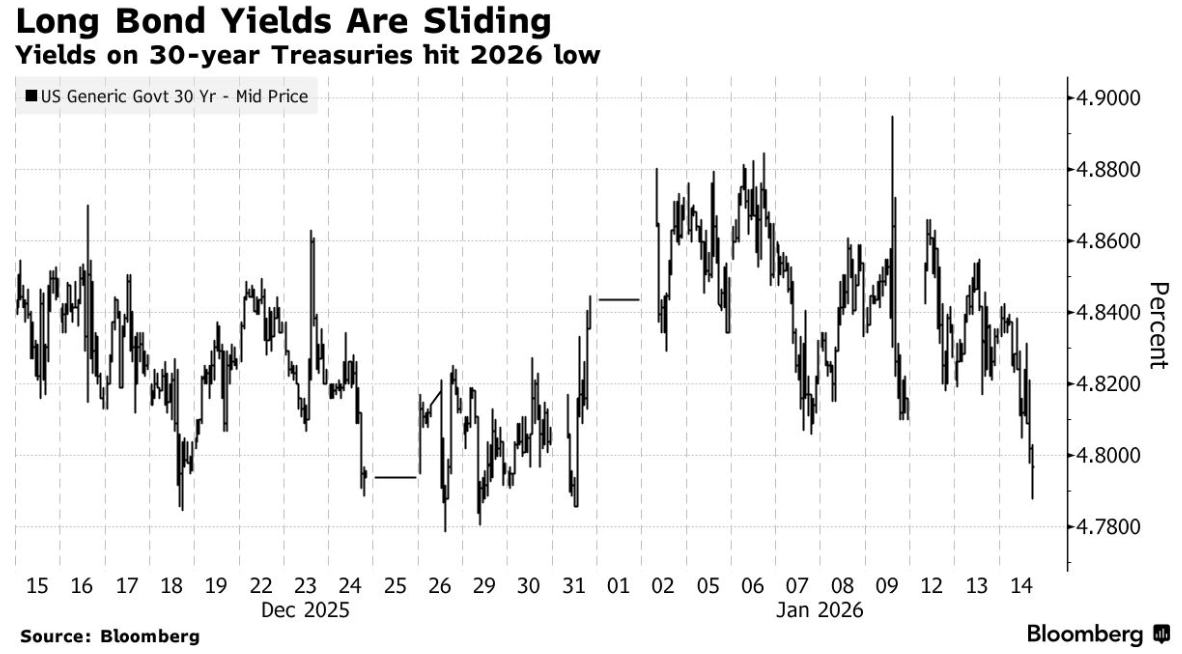
避险需求与供给因素共推美债上涨 30年期收益率跌破4.8%创年内新低
Zhi Tong Cai Jing· 2026-01-14 23:25
Group 1 - U.S. Treasury prices have risen due to safe-haven demand and bond supply considerations, leading to a drop in the 30-year Treasury yield to its lowest level of the year [1] - As of Wednesday's close, yields across various maturities of U.S. Treasuries fell by 2 to 5 basis points, with the 30-year yield dropping below 4.80% for the first time this year [1][3] - Factors contributing to this rebound include a decline in U.S. stock indices, additional safe-haven demand related to potential military action against Iran, and the Supreme Court's postponement of a ruling on tariff policies, which improved the fiscal situation in the U.S. [3] Group 2 - Strong demand in recent Treasury auctions and a routine bond buyback operation targeting 20 to 30-year maturities also played a role in the yield decline [3] - Earlier in the week, yields had risen as traders pushed back expectations for the next Federal Reserve rate cut to later in 2026, influenced by recent employment and inflation data [3] - However, the options market shows an increasing number of traders are dismissing the possibility of a Fed rate cut in 2026, betting instead that rates will remain unchanged throughout the year [4]
【宏观】通胀担忧缓和,但短期降息必要性不强——2025年12月美国CPI数据点评(赵格格/刘星辰)
光大证券研究· 2026-01-14 23:07
Core Viewpoints - The December US CPI year-on-year increased by 2.7%, matching market expectations, while the core CPI year-on-year rose by 2.6%, slightly below expectations of 2.7% [4][6] - The mild rebound in core CPI was influenced by a decline in used car and truck prices, indicating that tariffs have a limited impact on inflation [5][7] - Despite easing inflation concerns, the likelihood of interest rate cuts in the first quarter remains low, with expectations for the first cut still set for June [5][9] Group 1: December US Inflation Data - December core CPI reading was lower than market expectations, with a month-on-month increase of 0.2%, below the expected 0.3% [6][9] - The inflation rebound was less than anticipated due to price declines in used cars and trucks, which offset increases in food, clothing, housing, medical care services, and transportation services [7][8] - Food prices increased by 0.7%, clothing by 0.6%, housing by 0.4%, medical care services by 0.4%, and transportation services by 0.5% month-on-month, while used car and truck prices fell by 1.1% [7] Group 2: Future Inflation Expectations and Fed Policy - The focus will be on January's corporate product repricing, as limited impact from tariffs on US inflation suggests the end of this inflationary cycle [8] - The market anticipates a 48.1% probability of a Fed rate cut in June, up from 46.2% prior to the inflation data release [9] - The labor market shows resilience with a decline in the unemployment rate, and a large tax refund is expected in the first quarter, reducing the necessity for immediate rate cuts [9]

21评论丨美联储第一季度降息概率不大
Xin Lang Cai Jing· 2026-01-14 22:45
Core Insights - The U.S. CPI for December 2025 shows a month-on-month increase of 0.3%, the smallest since July of the previous year, with a year-on-year growth of 2.7%, the lowest since May 2025, indicating a slow decline in inflation [2] - Core CPI, excluding volatile food and energy prices, increased by 0.2% month-on-month and 2.6% year-on-year, matching November figures and reflecting the lowest levels since March 2021 [2][4] - The data for December 2025 is considered reliable and complete, suggesting a consistent downward trend in inflation since September 2025, despite previous data collection issues in November [2] Inflation Components - The decrease in inflation is primarily attributed to zero growth in core goods prices, particularly new vehicles, used cars, and trucks, indicating a milder-than-expected impact from tariffs [3] - Core services prices rose by 0.3%, with housing costs, which have a significant weight in the CPI, increasing by 0.4%, the largest rise in four months, and a year-on-year increase from 3.0% to 3.2% [3] - The rental market showed a significant decline, with a 0.31% drop in rents in October 2025, the largest in 15 years, driven by increased supply and reduced demand [3] Employment and Economic Impact - Non-farm employment in the U.S. increased by 584,000 in 2025, significantly lower than the 2 million increase in 2024, with the unemployment rate rising from 4.0% to 4.4% [6] - Real average weekly earnings for American workers decreased by 0.3% in December 2025, which, while beneficial for controlling inflation, negatively impacts consumer spending and economic growth [6] Federal Reserve Outlook - The Federal Reserve's recent interest rate cuts and government policies may improve employment and income growth, but the effects of these cuts typically take 3 to 6 months to materialize [7] - The likelihood of further rate cuts in the first quarter remains low unless there is significant deterioration in employment or a notable drop in inflation, with market expectations leaning towards maintaining current rates in January [7]

美联储第一季度降息概率不大
2 1 Shi Ji Jing Ji Bao Dao· 2026-01-14 22:34
Group 1 - The core viewpoint of the articles indicates that the U.S. inflation is showing signs of gradual decline, with the Consumer Price Index (CPI) for December 2025 reflecting the smallest month-on-month increase since July of the previous year, at 0.3%, and a year-on-year increase of 2.7%, the lowest since May 2025 [2][3] - The core CPI, excluding volatile food and energy prices, increased by 0.2% month-on-month and 2.6% year-on-year, marking the lowest levels since March 2021, indicating a consistent downward trend in inflation since September 2025 [2][3] - The main contributors to the CPI decrease in December were the prices of core goods, particularly new cars, used cars, and trucks, which showed zero growth or declines, suggesting that the impact of tariffs is milder than expected [3][5] Group 2 - The housing costs, which have a significant weight in the CPI basket, increased by 0.4% month-on-month, the largest increase in four months, and the year-on-year rate rose from 3.0% to 3.2%, indicating persistent housing inflation [3][4] - The super core inflation, excluding housing, showed a month-on-month increase of approximately 0.3% and a year-on-year increase of about 2.7%, remaining at the lowest levels since the pandemic [4] - The employment growth in the U.S. was significantly lower in 2025, with only 584,000 non-farm jobs added throughout the year, compared to 2 million in 2024, reflecting a slowdown in job creation and an increase in the unemployment rate from 4.0% to 4.4% [6][7] Group 3 - The Federal Reserve's decision-making is based on the Personal Consumption Expenditures (PCE) inflation data, which typically shows lower inflation rates than the CPI, suggesting that the PCE for December 2025 is expected to reflect a similar trend [4] - Despite the potential negative impacts of tariffs, the recent interest rate cuts by the Federal Reserve and government policies aimed at tax reduction and deregulation may improve employment and income growth [7] - The market anticipates that the Federal Reserve will maintain interest rates in January 2026, with a probability of over 97%, and is not expected to lower rates until at least June 2026 [7]