
利率下行

Search documents
利率周期轮回 险企再战分红险
Jing Ji Guan Cha Wang· 2025-07-12 02:51
Core Viewpoint - The insurance industry is experiencing a shift towards dividend insurance products due to declining interest rates and regulatory changes, with companies focusing on enhancing their offerings in this area to meet customer demand for stable returns [2][4][8]. Group 1: Market Trends - The decline in deposit rates has led customers to seek alternative investment options, such as dividend insurance products, which offer both protection and potential returns [2][4]. - Since the second half of last year, insurance companies have adjusted their product offerings, prioritizing dividend insurance over other types like endowment and annuity products [4][6]. - The market for dividend insurance is expected to grow, with several major insurance companies reporting increases in premium income from these products in 2024 [7][8]. Group 2: Sales Challenges - Sales representatives are facing difficulties in promoting dividend insurance due to customer skepticism and the complexity of explaining the product's benefits and mechanisms [5][6]. - The shift from traditional fixed-return products to dividend insurance requires agents to adapt their sales strategies, which has resulted in a decline in performance for some agents [4][5]. - The insurance industry is under pressure to improve sales techniques and customer education regarding dividend insurance to address concerns about future returns [6][8]. Group 3: Regulatory Environment - Regulatory bodies are increasing scrutiny on dividend insurance products, emphasizing the need for transparency in dividend distribution and sales practices [14][15]. - New regulations aim to ensure that insurance companies do not overpromise returns and that they align dividend levels with actual business performance [15][16]. - The industry is moving towards a more structured approach to product offerings, with a focus on balancing guaranteed returns and variable dividends to enhance customer trust [14][15]. Group 4: Future Outlook - The insurance sector is expected to continue its transition towards dividend insurance as a key product offering, with a consensus among industry experts on its importance for sustainable growth [8][16]. - Companies with strong asset-liability management capabilities are likely to perform better in the dividend insurance market, as they can effectively manage the associated risks [9][16]. - The overall success of this transition will depend on the industry's ability to standardize product offerings and improve communication with customers regarding the nature of dividend insurance [16].


一周流动性观察 | 季初效应仍存 税期扰动未至 资金价格有望维持低位运行
Xin Hua Cai Jing· 2025-07-07 08:41
Group 1 - The People's Bank of China (PBOC) conducted a 7-day reverse repurchase operation of 106.5 billion yuan at a stable interest rate of 1.40%, resulting in a net liquidity withdrawal of 225 billion yuan due to 331.5 billion yuan of reverse repos maturing on the same day [1] - The central bank's net liquidity withdrawal in the previous week was 1.3753 trillion yuan, with daily net withdrawals exceeding 250 billion yuan, indicating a tightening of the funding environment [1] - Despite the accelerated pace of net withdrawals by the central bank, the funding market is showing a seasonal trend of easing, with overnight and 7-day funding rates hitting new lows for the year [1] Group 2 - The upcoming week (July 7-11) will see a decrease in the scale of reverse repos maturing to 652.2 billion yuan, with government bond net payments expected to rise to 251.1 billion yuan, primarily concentrated on Monday [2] - The market is anticipated to experience a "stable period" in funding prices, with overnight rates expected to fluctuate around the OMO ±5 basis points range and 7-day funding rates likely to remain below 1.5% [2] - The central bank has not announced any buyout reverse repos or government bond trading operations for June, with 1.2 trillion yuan of buyout reverse repos maturing in July, creating a potential funding gap [3] Group 3 - The market may face a 1.3 trillion yuan medium- to long-term funding gap until the MLF renewal on July 25, making the central bank's decision on whether to conduct buyout reverse repo auctions a key variable for the funding market [3] - The expectation is that the supply of government bonds in July will not significantly increase compared to June, and the central bank's desire to prevent long-term yields from declining unilaterally remains [3] - The central bank's proactive stance on liquidity and the continued decline in money market rates are seen as the most certain factors, with short-term rates potentially having further room to decline [4]
【债市观察】跨季后资金宽松DR001回落至1.3% 短端利率或有进一步下行空间
Xin Hua Cai Jing· 2025-07-07 03:25
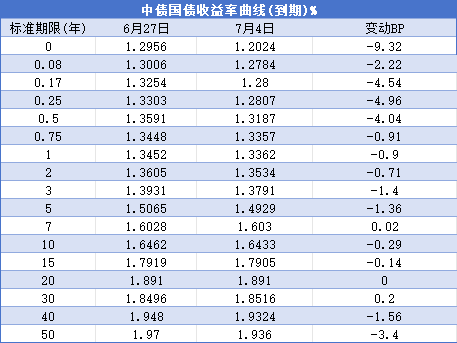
Group 1 - The funding environment turned loose after the quarter-end, with overnight and 7-day funding rates dropping to 1.3% and 1.4% respectively, indicating potential for further decline in short-term rates [1] - The manufacturing and non-manufacturing PMI for June showed a rebound, suggesting a stable economic foundation, while long-term rates may continue to fluctuate [1][10] - The bond market experienced a mixed performance, with the 10-year government bond yield showing slight fluctuations throughout the week, ultimately down by 0.5 basis points [2][5] Group 2 - A total of 47 bonds were issued last week, amounting to 513.2 billion yuan, with government bonds accounting for 28 billion yuan [6] - The upcoming week is expected to see the issuance of 51 bonds totaling 268.79 billion yuan, with no government bonds planned for issuance [6] - The U.S. Treasury yields rose overall, with the 10-year yield increasing by 7 basis points to 4.35%, reflecting a shift in market expectations [7] Group 3 - The bond market is currently in a favorable window for long positions, but the potential for profit is limited, suggesting a focus on yield spread trading [13] - The current market dynamics indicate a shift, with increased activity in long-duration bonds reflecting strong investor sentiment [14] - The central bank's supportive stance on liquidity and the continued decline in money market rates are seen as key certainties for the market [14]
产业债发行十一年复盘
CMS· 2025-07-03 03:33
2024 年,全市场非金融产业债发行规模 76266 万元,较 2023 年增长 22%,且 为历史新高。从历年发债规模走势来看,2014 年-2016 年产业债发行规模增长 较快。2017 年监管政策相对收紧,产业债发行规模大幅回落。2018 年以来维 持震荡增长。另一方面,2024 年产业债净融资规模 16600 亿元,为历史次高, 仅低于2015年的19305亿元。2014年以来,产业债仅在2017年和2021年-2023 年两个周期内净融资为负值,均为融资政策相对较严的政策区间。 二、2024 年以来产业债发行期限整体延长 2014 年至 2016 年,产业债加权平均发行期限分别为 2.11 年、1.98 年和 2.1 年, 但随着 2017 年融资环境收紧,产业债发行期限也随之缩短。2017 年至 2023 年,产业债加权平均发行期限均在 2 年以内,其中 2021 年达到最低值 1.54 年。 但随着 2023 年"一揽子化债"启动和债市持续走牛,2024 年和 2025 年 1-5 月,产业债加权平均发行期限分别达到 3.09 年和 3.29 年,增长幅度较大。 三、近年来产业债平均发行成本持续 ...
利率下行高息资产受捧!港股通红利ETF(513530)成港股红利类资产投资人气之选
Xin Lang Ji Jin· 2025-06-27 05:19
Group 1 - The core viewpoint of the article highlights the increasing investment in Hong Kong dividend assets, particularly the Hong Kong Stock Connect Dividend ETF (513530), which has seen continuous net inflows for 22 trading days as of June 26, 2025 [1] - The Hong Kong Stock Connect Dividend ETF has achieved a significant growth in scale, increasing over 35% in the month, with the latest share count reaching 1.655 billion and total assets at 2.703 billion yuan [1] - The Hong Kong Stock Connect High Dividend Index has outperformed other dividend indices, with a six-month increase of 10.30% and a two-year increase of 35.56%, indicating its strong historical performance across different market conditions [1] Group 2 - The latest dividend yield for the Hong Kong Stock Connect High Dividend Index is 7.76%, which is significantly higher than the yields of major A-share dividend indices, such as the CSI Dividend Index at 5.84% and the Shenzhen Dividend Index at 4.45% [1] - The Hong Kong Stock Connect Dividend ETF is the first ETF that allows investment in the CSI Hong Kong Stock Connect High Dividend Index through the QDII model, offering a more favorable tax structure compared to traditional channels [1] - The fund management company, Huatai-PB Fund, has over 18 years of experience in index investment and has developed a comprehensive range of dividend-themed ETFs, managing over 41.6 billion yuan in dividend-themed ETFs as of June 26, 2025 [2]
十年国债ETF(511260)上一交易日资金净流入1.2亿元,市场关注利率下行趋势
Mei Ri Jing Ji Xin Wen· 2025-06-27 02:11
Group 1 - The core viewpoint is that since 2021, the domestic 10-year government bond yield has been on a downward trend, entering a low-interest-rate era, with yields falling below the long-term range of 2.8% to 4.5% [1] - The ability of valuation to rise during a declining interest rate phase depends on the state of the fundamentals; if the economy stabilizes but does not significantly recover, valuations may increase, while in a deflationary environment, valuations may continue to decline despite a loose monetary environment [1] - Currently, the A-share market's 6% to 7% ROE level corresponds to a reasonable 2x PB, but there is significant industry differentiation; economic cycle assets have reasonable valuations but limited ROE recovery, while stable assets have room for improvement in a declining interest rate environment [1] Group 2 - The 10-year government bond ETF (511260) employs an optimized sampling replication strategy to closely track the Shanghai Stock Exchange 10-year government bond index, with an average duration of 7.6 years [1] - The ETF publishes a daily PCF list, ensuring transparency in holdings, making it suitable for medium to long-term investors seeking stable returns as a core allocation [1] - Growth assets are more transaction-oriented, with a focus on positive mid-term expectations in areas such as overseas AI computing power chains, exports to Europe, and price increase chains [1]
五穷六绝七翻身,A股牛市进行时
Jin Xin Qi Huo· 2025-06-25 14:14
Report Industry Investment Rating No information provided. Core View of the Report - A-share market is driven by "economic recovery + interest rate decline + deposit relocation", and the breakthrough of the Shanghai Composite Index above 3400 points marks the opening of a new upward space. The A-share "bull market" has shifted from expectation to reality, and investors can focus on the opportunity to go long on stock index futures on dips [2][24]. Summary by Relevant Catalogs Market Performance - As of June 25, 2025, the Shanghai Composite Index broke through and closed above the key level of 3450 points, with three consecutive days of stable gains. Other indices such as the Shenzhen Component Index and the ChiNext Index also rose in tandem. The trading volume of the two markets increased significantly, showing a healthy "volume-price increase" technical pattern, opening up upward space for the second-half market [3]. Economic Situation - In 2025, China's economy continued the recovery trend since the fourth quarter of last year. The GDP growth rate in the first quarter was 5.4%, significantly higher than 4.8% in the fourth quarter of last year [4]. - The new quality productivity-related industries improved notably, laying a solid foundation for further economic recovery. Policy-driven consumption played a key role, with durable goods like cars and home appliances directly benefiting from dual subsidies from the central and local governments. During the "618" promotion period, sales data in new consumption areas such as beauty, small home appliances, and pet economy exceeded expectations, indicating the accumulation of domestic demand resilience [6]. Policy Environment - Fiscal policy: In 2025, the deficit rate is expected to further increase, and ultra-long-term special treasury bonds will continue to be issued, with funds mainly invested in hard technology and people's livelihood areas. The focus of fiscal efforts is shifting from traditional infrastructure to promoting domestic demand [7]. - Monetary policy: The central bank has set the tone of "choosing the right time to cut reserve requirements and interest rates" and "maintaining ample liquidity". In 2025, policy interest rates and the deposit reserve ratio are expected to be further lowered [7]. - Real estate policy: Real estate policies have shifted from "protecting projects" to "protecting real estate enterprises", and a storage model is being explored to stabilize housing prices [7]. - Capital market policy: The "New Nine - Article Guidelines" for the capital market promotes investment - side reforms, aiming to improve shareholder returns and encourage mergers and acquisitions, providing institutional guarantees for the entry of medium - and long - term funds [7]. Corporate Earnings - After the profit adjustment in 2024, A - share corporate profits are expected to recover in 2025. In April 2025, the profits of industrial enterprises above the designated size in China turned positive year - on - year, reaching 1.5%. Most institutions predict that the profit growth rate of the entire A - share market will show an inflection point of improvement around mid - 2025, with an annual growth rate expected to reach 6.5%. Emerging industries may become the main force for profit growth [8][10]. Global Environment - The Fed is still in an interest rate cut cycle in 2025, which will have a positive impact on the Chinese stock market. Historically, Fed rate cuts tend to reduce the attractiveness of the US dollar, prompting international funds to flow from US dollar assets to emerging markets. The appreciation trend of the RMB exchange rate further enhances the attractiveness of A - shares to foreign capital [13]. Interest Rate Environment - China's monetary policy is in a loose cycle, and the decline in interest rates directly reduces corporate financing costs, which is particularly beneficial to high - leverage industries (such as real estate and infrastructure) and R & D - intensive technology companies. Historical data shows that in the middle and late stages of interest rate decline, the stock market rally often lasts for more than 4 months [14]. Market Liquidity - The current A - share liquidity shows a triple - support pattern: foreign capital is flowing back, with recent net inflows into the Chinese stock market hitting a new high; the investment ratio limit of insurance funds in equities has been increased by 5%, and it is expected that social security, insurance, and annuities will net buy more than 200 billion yuan of A - shares in 2025; leveraged funds are active, indicating a significant increase in on - site risk appetite [17]. Resident Savings - In March 2025, China's household deposits exceeded 160 trillion yuan, with per capita deposits reaching 107,000 yuan, significantly higher than the GDP of 135 trillion yuan. Households hold about 40 trillion yuan in excess savings. With the continuous decline in deposit interest rates, this part of the funds faces a strong need for re - allocation [18]. - The transfer of household savings to the capital market has become an irreversible trend. Recently, the one - year fixed - deposit rate has dropped to around 1.5%, while the dividend yield of the CSI 300 Index has risen to 3.2%, and the average dividend yield of the constituent stocks of the dividend index exceeds 5%. The relative attractiveness of equity assets is prominent [21].
30年国债ETF博时(511130)早盘飘红,机构:利率中枢倾向于下行,关注大行买债背后隐含的央行操作节奏
Sou Hu Cai Jing· 2025-06-23 03:48
Group 1 - The trading volume in the Shanghai, Shenzhen, and Beijing markets has exceeded 500 billion, with an estimated total trading amount of approximately 1.1 trillion for the day [1] - The bond futures market is mostly flat, with the 30-year main contract up by 0.13%, while the 10-year, 5-year, and 2-year main contracts remain flat [1] - The 30-year government bond ETF from Bosera (511130) opened high but fluctuated downwards during the day, increasing by 4 basis points with a turnover rate exceeding 12% and a trading volume close to 1 billion [1] Group 2 - There is an expectation of a second interest rate cut this year, with rates likely to fluctuate downwards before the cut, suggesting a strategy of increasing bond allocation during rate hikes [2] - The Bosera 30-year government bond ETF (511130) was established in March 2024 and is one of only two on-market ultra-long-term bond ETFs, tracking the "Shanghai Stock Exchange 30-Year Government Bond Index" [2] - The index reflects the overall performance of 30-year government bonds listed on the Shanghai Stock Exchange, with a duration of approximately 21 years, making it highly sensitive to interest rate changes [2]
周观:“低波动”现状难掩利率趋势下行力量(2025年第24期)
Soochow Securities· 2025-06-22 11:07
Report Industry Investment Rating The document does not mention the industry investment rating. Core Viewpoints of the Report - In the bond market, the yield of the 10 - year Treasury bond active bond decreased by 0.4bp from 1.642% last Friday to 1.638% this week. In the short - term, interest rates are still fluctuating within a narrow range, but due to loose liquidity, the logic of interest rate decline is relatively smooth in the coming month. The bond issuance peak will end, leading to "passive" liquidity easing, and the capital situation in July is worry - free. The central bank's two repurchase operations in June show an "active" liquidity easing, and the 10 - year Treasury bond yield is expected to drop to 1.5% [1][13][14]. - Regarding US bonds, the conflict between Israel and Iran continues to ferment. US bond yields have declined across the board. US bonds still have strong allocation attractiveness. The long - end may fluctuate between 4 - 4.5%, and the short - end is likely to decline but difficult to rise. It is recommended to appropriately shorten the portfolio duration. The US economic data shows that consumption, manufacturing, and employment are under pressure, and the Fed maintains the interest rate unchanged. The market's near - term expectation of interest rate cuts has cooled, while the second half of the year may be a critical time for the Fed's monetary policy adjustment [2][4]. Summary by Relevant Catalogs 1. One - Week Views Q1: Bond market situation and interest rate trend - This week (2025.6.16 - 2025.6.20), the yield of the 10 - year Treasury bond active bond decreased by 0.4bp to 1.638%. The daily fluctuations were affected by economic data announcements, central bank operations, market news, and policy expectations. In the short - term, interest rates fluctuate narrowly, but due to loose liquidity, the interest rate decline logic is smooth in the coming month. The bond issuance peak will end, and the central bank's operations ensure liquidity [1][12][13]. Q2: US economic data and US bond yield outlook - The conflict between Israel and Iran continues to ferment. US bond yields have declined across the board. US bonds still have strong allocation attractiveness. The long - end may fluctuate between 4 - 4.5%, and the short - end is likely to decline but difficult to rise. The US economic data shows that retail sales, manufacturing, and employment are under pressure. The Fed maintains the interest rate unchanged, and the market's near - term expectation of interest rate cuts has cooled, while the second half of the year may be a critical time for policy adjustment [2][4]. 2. Domestic and Foreign Data Aggregation 2.1 Liquidity Tracking - From 2025/06/13 to 2025/06/20, the total net injection of open - market operations was 1021 billion yuan. The money market interest rates and bond yields showed certain changes, and the central bank's interest rate corridor and the trading volume of Treasury bond futures also had corresponding performances [32]. 2.2 Domestic and Foreign Macroeconomic Data Tracking - Steel prices showed mixed trends, and LME non - ferrous metal futures official prices generally increased. Commodity prices such as coal, vegetables, and crude oil also had different changes. The exchange rates of major currencies and the performance of stock indexes and bond yields in the international market also varied [56][69][75]. 3. One - Week Review of Local Bonds 3.1 Primary Market Issuance Overview - This week, 60 local bonds were issued in the primary market, with an issuance amount of 261.753 billion yuan, a repayment amount of 137.418 billion yuan, and a net financing amount of 124.334 billion yuan. The top three provinces in terms of issuance amount were Yunnan, Beijing, and Shanghai. Yunnan issued 52.7 billion yuan of local special refinancing special bonds for replacing hidden debts [83][86][87]. 3.2 Secondary Market Overview - This week, the stock of local bonds was 51.21 trillion yuan, the trading volume was 511.578 billion yuan, and the turnover rate was 1.00%. The top three provinces with active local bond trading were Shandong, Sichuan, and Zhejiang, and the top three active trading terms were 10Y, 30Y, and 20Y [96]. 3.3 This Month's Local Bond Issuance Plan - The maturity yields of local bonds across all terms declined this week. The issuance plan shows the planned issuance amounts of different provinces in the coming days [100][101]. 4. One - Week Review of the Credit Bond Market 4.1 Primary Market Issuance Overview - This week, 426 credit bonds were issued in the primary market, with a total issuance amount of 411.377 billion yuan, a total repayment amount of 305.974 billion yuan, and a net financing amount of 105.403 billion yuan, an increase of 57.65 billion yuan compared with last week. The net financing of urban investment bonds was - 73.28 billion yuan, while that of industrial bonds was 112.73 billion yuan [102][103]. 4.2 Issuance Interest Rates - The actual issuance interest rates of various bond types this week showed different changes. For example, the issuance interest rate of short - term financing increased by 6.99bp, while that of medium - term notes decreased by 8.68bp [113]. 4.3 Secondary Market Transaction Overview - This week, the total trading volume of credit bonds was 711.571 billion yuan. The trading volumes of different bond types and credit ratings varied [115]. 4.4 Maturity Yields - The maturity yields of national development bonds, short - term financing, medium - term notes, enterprise bonds, and urban investment bonds all declined this week [115][116][118]. 4.5 Credit Spreads - The credit spreads of short - term financing and medium - term notes showed a differentiated trend, while those of enterprise bonds and urban investment bonds generally narrowed [120][122][126]. 4.6 Grade Spreads - The grade spreads of short - term financing and medium - term notes generally widened, those of enterprise bonds generally widened, and those of urban investment bonds generally narrowed [132][135][139]. 4.7 Trading Activity - This week, the top five most actively traded bonds of each bond type are listed, including short - term financing, medium - term notes, enterprise bonds, corporate bonds, and private placement notes. The industrial sector had the largest weekly trading volume of credit bonds [143]. 4.8 Issuer Credit Rating Changes - This week, there were no downgrades or upgrades of issuer credit ratings or outlooks [145].