工业企业利润

Search documents
7月工业企业利润降幅收窄,高技术制造业利润大幅回升
Ge Lin Qi Huo· 2025-08-28 08:58
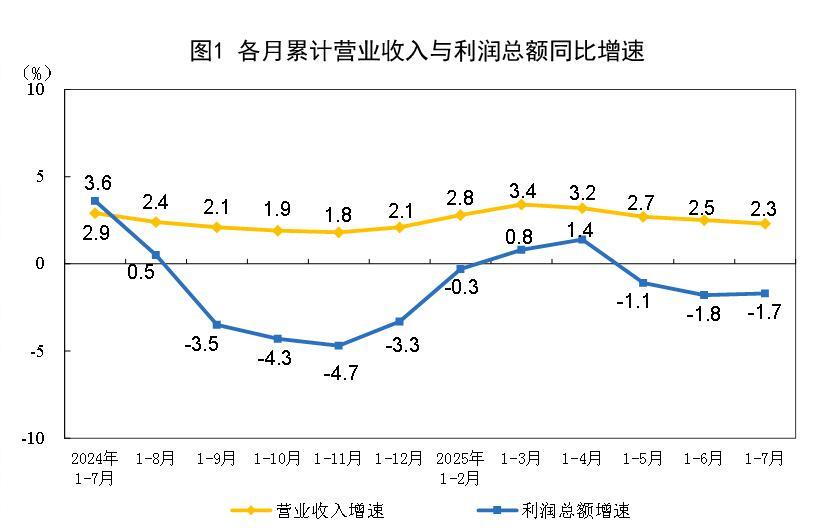
Group 1: Investment Rating - Not provided Group 2: Core Viewpoints - In July, the decline in profits of large-scale industrial enterprises narrowed, and the profits of the manufacturing industry, especially high-tech manufacturing, rebounded significantly year-on-year. Whether this trend can continue is worthy of attention. The implementation of anti-involution policies and the narrowing of the year-on-year decline in PPI are beneficial to the year-on-year recovery of industrial enterprise profits [3][14] Group 3: Summary by Relevant Content Operating Income and Profit - From January to July, large-scale industrial enterprises achieved operating income of 78.07 trillion yuan, a year-on-year increase of 2.3%. In July, the operating income of large-scale industrial enterprises increased by 0.9% year-on-year. The total profit was 402.035 billion yuan, a year-on-year decrease of 1.7%. In July, the profit of large-scale industrial enterprises decreased by 1.5% year-on-year [1][4] - From January to July, private industrial enterprises' total profit increased by 1.8% year-on-year, and in July, their profit increased by 2.6% year-on-year [4] - From January to July, large-scale manufacturing enterprises achieved a total profit of 3.02 trillion yuan, a year-on-year increase of 4.8%. In July, manufacturing profits increased by 6.8% year-on-year, 5.4 percentage points faster than in June [2][7] - In July, the profit of raw material manufacturing turned from a 5.0% decline in June to a 36.9% increase. The consumer goods manufacturing industry decreased by 4.7%, with the decline narrowing by 3.0 percentage points compared to June. The profit of high-tech manufacturing turned from a 0.9% decline in June to an 18.9% increase [2][7] - Industries with relatively fast year-on-year profit growth from January to July include the ferrous metal smelting and rolling processing industry (5175.9%), non-ferrous metal mining and dressing industry (39.1%), etc. Industries with relatively large year-on-year profit declines include the coal mining and washing industry (-55.2%), ferrous metal mining and dressing industry (-33.7%), etc. [8] Operating Income Profit Margin - From January to July, the operating income profit margin of large-scale industrial enterprises was 5.15%, a year-on-year decrease of 0.25 percentage points. The manufacturing industry was 4.46%, slightly higher than the same period last year but about one percentage point lower than the same period in 2019. The mining industry was 16.75%, still higher than the same period in 2019. The production and supply of electricity, heat, gas, and water was 6.92%, better than the same period last year and higher than the same period in 2019 [2][9] Asset - Liability Ratio - At the end of July, the asset - liability ratio of large-scale industrial enterprises was 57.9%, a year-on-year increase of 0.3 percentage points. The asset - liability ratio of large-scale manufacturing enterprises was 57.2%, a year-on-year increase of 0.1 percentage point. Both are at the highest levels for the same period in the past decade [3][10] Accounts Receivable and Inventory - At the end of July, the average collection period of accounts receivable of large-scale industrial enterprises was 69.8 days, a year-on-year increase of 3.4 days, and that of large-scale manufacturing enterprises was 70.8 days, a year-on-year increase of 2.9 days, both at the highest levels for the same period since 2015, putting pressure on corporate cash flow [3][13] - From January to July, the cumulative year-on-year growth of finished product inventory of large-scale industrial enterprises was 2.4%. Industrial enterprises controlled a small year-on-year increase in finished product inventory under the circumstances of falling ex-factory prices, negative year-on-year net profit growth, longer accounts receivable periods, and rising debt ratios [3][13]
1-7月工企利润数据点评:四季度增量政策或仍值得期待
Bank of China Securities· 2025-08-28 02:34
Profit and Revenue Analysis - From January to July 2025, the total profit of industrial enterprises reached CNY 40,203.5 billion, a year-on-year decrease of 1.7%, with the decline narrowing by 0.1 percentage points compared to the first half of the year[1] - In July 2025, industrial enterprises' profits fell by 1.5% year-on-year, with the decline narrowing by 2.8 percentage points from June[1] - The operating income of industrial enterprises grew by 2.3% year-on-year from January to July, with the growth rate slowing by 0.2 percentage points compared to the first half of the year[1] Cost and Profitability Metrics - The operating income profit margin for industrial enterprises was 5.2% from January to July, unchanged from the first half of the year[2] - Operating costs increased by 2.5% year-on-year during the same period, with the growth rate slowing by 0.3 percentage points compared to the first half[1] - The average revenue per CNY 100 of assets was CNY 74.0, an increase of CNY 0.1 from the first half of the year[1] Industry Performance Insights - The mining industry accounted for 12.3% of total industrial profits, continuing to decline, with profits in this sector dropping by 31.6% year-on-year[9] - High-tech manufacturing contributed positively to the profit growth of industrial enterprises, adding 1.9 percentage points to the cumulative year-on-year profit growth[11] - The overall industrial production value increased by 6.3% year-on-year, slightly slowing by 0.1 percentage points compared to the first half of the year[6] Future Policy Expectations - There are expectations for incremental policies in the fourth quarter to address the weak pricing environment affecting industrial profitability[18] - The negative contribution from the mining and raw materials processing industries to profit growth is anticipated to continue, while traditional and high-tech manufacturing sectors provide some support[18]
期指:仍有企稳回升可能
Guo Tai Jun An Qi Huo· 2025-08-28 02:27
Report Summary 1. Report Industry Investment Rating - Not provided in the content 2. Core View of the Report - The stock index futures still have the possibility of stabilizing and rebounding [3] 3. Summary by Relevant Catalogs 3.1. Index Futures Data Tracking - On August 27, all the current-month contracts of the four major index futures declined. IF dropped 1.71%, IH dropped 1.84%, IC dropped 1.51%, and IM dropped 2.08% [1] - On this trading day, the total trading volume of index futures rebounded, indicating that investors' trading enthusiasm has increased. Specifically, the total trading volume of IF increased by 43,644 lots, IH increased by 16,891 lots, IC increased by 57,059 lots, and IM increased by 92,377 lots. In terms of positions, the total positions of IF increased by 13,045 lots, IH increased by 3,677 lots, IC increased by 24,398 lots, and IM increased by 17,455 lots [2] 3.2. Index Futures Member Positions - The long and short positions of the top 20 member institutions in different contracts of IF, IH, IC, and IM have different changes. For example, in IF2509, the long positions increased by 4,337 lots, and the short positions increased by 3,404 lots [5] 3.3. Trend Strength and Important Drivers - The trend strength of IF and IH is 1, and the trend strength of IC and IM is 1. The range of trend strength values is an integer in the [-2, 2] interval [6] - The Ministry of Commerce will introduce several policy measures to expand service consumption next month, and the relevant policy document on promoting service exports will be publicly issued soon. In July, the profits of industrial enterprises above designated size decreased by 1.5% year-on-year, with the decline narrowing for two consecutive months. High-tech manufacturing profits turned from a 0.9% decline in June to an 18.9% increase [6] - The three major A-share indexes rose and then fell, with the Shanghai Composite Index recording its largest decline in nearly five months. The market's full-day trading volume was 3.2 trillion yuan, ranking second in history [6]
中国期货每日简报-20250828
Zhong Xin Qi Huo· 2025-08-28 02:06
1. Report Industry Investment Rating - No relevant content provided 2. Core Viewpoints - On August 27, equity indices fell while CGB futures rose, and commodity futures generally declined, with polysilicon, coking coal, crude oil, and coke leading the drop [10][12] - The Ministry of Commerce will introduce several policy measures to expand service consumption in September [34][35] - From January to July, the total profits of industrial enterprises above designated size nationwide decreased by 1.7% year-on-year [34][35] - In the first seven months of this year, Hong Kong's IPO fundraising surged by over 610% year-on-year to HK$128 billion [36] - From August 14 to 20, allocative foreign capital turned to a net inflow of 6.98 billion yuan, indicating an improvement in the attractiveness of RMB assets [36] 3. Summary by Directory 3.1 China Futures 3.1.1 Overview - On August 27, equity indices fell while CGB futures rose; commodity futures generally declined, with polysilicon, coking coal, crude oil, and coke leading the decline [10][12] - The top three gainers were apple (up 1.5% with a 23.5% month-on-month increase in open interest), nickel (up 1.2% with a 9.5% month-on-month decrease in open interest), and tin (up 0.8% with a 73.8% month-on-month increase in open interest) [10][12] - The top three decliners were polysilicon (down 4.9% with a 12.4% month-on-month increase in open interest), coking coal (down 3.9% with a 1.0% month-on-month increase in open interest), and crude oil (down 3.6% with a 6.5% month-on-month increase in open interest) [11][12] 3.1.2 Daily Raise - Tin - On August 27, tin increased by 0.8% to 271,790 yuan/ton. Under the current tightened mining supply, tin prices are expected to fluctuate, and their volatility may rise [16][20] - The domestic mining end remains tight, and the official resumption of production in Wa State does not change the tight situation. In Indonesia, refined tin exports declined in July, and African tin ore production and export are unstable [17][20] - Smelters face a shortage of raw materials, with low processing fees and a low smelting operating rate. Tin terminal demand has weakened, and inventory destocking is difficult [18][19][20] 3.1.3 Daily Drop 3.1.3.1 Crude Oil - On August 27, crude oil decreased by 3.6% to 479.7 yuan/barrel. Oil prices are expected to fluctuate weakly, and attention should be paid to short-term disturbances from the Russia-Ukraine issue [23][25] - API data shows a small inventory draw in the US. OPEC+ is accelerating supply release, US production is high, and non-US and non-OPEC+ output is growing steadily, leading to persistent supply pressure [24][25] - The high operating rates of Chinese and US refineries may decline due to the accumulation of refined oil inventories, and oil price rebounds remain weak [24][25] 3.1.3.2 Coking Coal - On August 27, coking coal decreased by 3.9% to 1,154 yuan/ton. Supply disruptions persist, and it is difficult to increase supply before the military parade. The market still has support due to the eighth round of coke price increases [28][31][32] - Futures market sentiment has declined, and the market has pulled back. Some coal mines have resumed production, but output is still restricted. The average daily customs clearance at the Ganqimaodu Port remains above 1,000 trucks [29][32] - The eighth round of coke price increases has started, with regional differentiation. Coking production is restricted in some areas, and short-term rigid demand for coking coal has declined slightly. Downstream enterprises are purchasing on demand, and some coal mines have seen inventory accumulation [30][32] 3.2 China News 3.2.1 Macro News - The Ministry of Commerce will introduce several policy measures to expand service consumption in September, aiming to optimize service supply and stimulate new growth in service consumption [34][35] - From January to July, the total profits of industrial enterprises above designated size nationwide were 4,020.35 billion yuan, a year-on-year decrease of 1.7%. In July, the profits of these enterprises decreased by 1.5% year-on-year [34][35] 3.2.2 Industry News - In the first seven months of this year, there were 51 IPOs in Hong Kong, and the fundraising amount surged by over 610% year-on-year to HK$128 billion. As of the end of July, over 220 IPO applications were under review [36] - From August 14 to 20, allocative foreign capital turned to a net inflow of 6.98 billion yuan, with passive allocative foreign capital having a net inflow of 6.84 billion yuan and active allocative foreign capital having a net inflow of 140 million yuan, indicating an improvement in the attractiveness of RMB assets [36]
经济数据好转 政策效果初现-20250828
申银万国期货研究· 2025-08-28 00:26
Group 1 - In July, the profits of industrial enterprises above designated size decreased by 1.5% year-on-year, with the decline narrowing by 2.8 percentage points compared to June, marking two consecutive months of narrowing [1][6] - High-tech manufacturing profits shifted from a 0.9% decline in June to an 18.9% increase in July, significantly boosting the overall profit growth rate of industrial enterprises [1][6] - From August 1 to 24, the retail sales of new energy vehicles in the passenger car market reached 727,000 units, a year-on-year increase of 6% and a month-on-month increase of 7%, with a cumulative retail of 7.182 million units in 2023, up 27% year-on-year [1] Group 2 - The 10-year government bond yield rose to 1.7625%, with a net withdrawal of 236.1 billion yuan in the central bank's open market operations [2][9] - The manufacturing PMI for August in both the US and Eurozone rebounded above the critical point, indicating a potential for interest rate cuts by the Federal Reserve in September [2][9] - The real estate market continues to adjust, with second-hand housing prices in first-tier cities declining month-on-month, prompting the government to enhance macro policy effectiveness [2][9] Group 3 - The palm oil production in Malaysia is expected to increase by 3.03% from the same period last month, while exports are projected to rise significantly [3][25] - The dual-fuel market is experiencing a mixed trend, with iron and coke prices showing fluctuations amid stable demand and increasing inventory levels [3][23] Group 4 - The upcoming Shanghai Cooperation Organization summit will take place from August 31 to September 1, 2025, in Tianjin, where member states will sign the "Tianjin Declaration" and approve the "10-Year Development Strategy of the SCO" [5]


【广发宏观王丹】工业企业利润增速降幅收窄,三季度末预计小幅转正
郭磊宏观茶座· 2025-08-27 13:26
Core Viewpoint - The industrial enterprises' revenue shows a "bottoming out" characteristic, with a slight year-on-year growth of 0.9% in July, remaining stable compared to previous months [6][7]. Revenue and Profit Performance - In the first seven months, the cumulative year-on-year revenue growth for industrial enterprises was 2.3%, slightly lower than the 2.5% in the first half of the year [6][7]. - The profit performance was slightly better than revenue, with July's profit total showing a year-on-year decline of 1.5%, an improvement from the previous month's decline of 4.3% [6][8]. - Cumulative profit for the first seven months was down 1.7%, consistent with the first half's decline of 1.8% [8]. Data Breakdown - The "volume" shows volatility, with industrial added value growth peaking at the end of quarters; the "price" has slowed down, with PPI at a low for the year in June and July; profit margins improved significantly in July, driven by a decrease in costs [10][11]. - From January to July, the cost per hundred yuan of revenue increased by 0.24 yuan, lower than the 0.26 yuan increase in the first half of the year [10]. Industry Profit Trends - In the first seven months, industries with positive profit growth were concentrated in four areas: certain mining and raw materials sectors, midstream equipment manufacturing, essential consumer goods, and some public utilities [14][15]. - The largest profit declines were seen in mining (coal and black mining), petrochemical, textile and apparel, and light manufacturing sectors [16]. Marginal Changes in July - "Anti-involution" led to profit improvements in some upstream industries, with raw material manufacturing profits rebounding from a decline of 5% in June to a growth of 36.9% in July [17][18]. - Consumer goods manufacturing also saw a recovery, with July's profit decline narrowing to 1.7% from 4.7% in June [17]. - Midstream manufacturing, benefiting from policy incentives and industrial upgrades, maintained rapid profit growth, with computer communication electronics and transportation equipment growing by 30% and 24.8% year-on-year, respectively [17]. Inventory and Debt Levels - By the end of July, nominal and actual inventories showed significant reduction, with finished goods inventory growth at 2.4%, down 0.7 percentage points from June [20]. - The asset-liability ratio for industrial enterprises remained stable at 57.9%, with a slight year-on-year increase of 0.2 percentage points [22]. Quarterly Outlook - The profit growth rate for industrial enterprises in the third quarter is expected to be better than in the second quarter, with potential for cumulative profit growth to turn slightly positive by the end of the third quarter [25].

1-7月工业企业利润点评:盈利改善既靠分配也靠增收
Changjiang Securities· 2025-08-27 12:51
Group 1: Profit Trends - In July, the year-on-year profit growth rate for industrial enterprises improved to -1.5%, showing a marginal recovery compared to June[9] - From January to July, the total profit of industrial enterprises decreased by 1.7% year-on-year[7] - The marginal recovery in profit margins was the main driver for the increase in profit growth rate in July[9] Group 2: Revenue and Demand - In July, industrial enterprises' operating revenue grew by 0.9% year-on-year, indicating a slight decline in growth rate[9] - The marginal decline in volume growth reflects weak downstream demand, contributing to the revenue slowdown[9] - The PMI data for July indicates an expanding gap between raw material procurement prices and factory prices, which may squeeze downstream profits[9] Group 3: Sector Performance - In July, the profit growth rate for the public utilities sector rose by 5.4 percentage points to 6.9%[9] - The mining sector's profit growth rate fell by 3.1 percentage points to -39.2%, primarily due to production cuts and inventory digestion[9] - The manufacturing sector's profit growth rate increased by 5.2 percentage points to 6.6%, with upstream profits recovering significantly[9] Group 4: Inventory and Supply Chain - As of the end of June, the nominal year-on-year growth of finished goods inventory for industrial enterprises was 2.4%, with actual growth at 6.2%[9] - The inventory turnover days for industrial enterprises in July were 20.5 days, indicating a slight increase in turnover[9] - The average collection period for accounts receivable remained stable at 69.8 days, suggesting ongoing pressure in the supply chain[9] Group 5: Future Outlook - The growth of export-oriented industries remains a crucial support for overall profits, with strong global non-U.S. demand observed[9] - The impact of upstream price increases on downstream profits is a key concern, especially as demand remains weak[9] - The resilience of domestic demand will be critical in maintaining stable corporate profits as economic data begins to reflect last year's high base[9]
地产脉冲已在今年一季度释放,地产投资后续或进一步下探|宏观晚6点
Sou Hu Cai Jing· 2025-08-27 10:13
Macro News - The Ministry of Commerce will soon introduce a series of policy measures to promote service exports, focusing on fiscal, financial, and facilitation aspects to optimize the policy environment [1] Industrial Sector - In July, the profits of large-scale industrial enterprises decreased by 1.5% year-on-year, with the decline narrowing by 2.8 percentage points compared to June, marking two consecutive months of narrowing [2] - From January to July, the profits of large-scale industrial enterprises fell by 1.7% year-on-year, with the decline narrowing by 0.1 percentage points compared to the first half of the year [2] Service Sector - The Ministry of Commerce aims to include more service consumption areas in the encouraged foreign investment industry catalog, addressing the issue of insufficient high-quality service supply [3][5] - The Ministry will promote the expansion of high-quality service supply through "internal opening and external opening," and will expand pilot programs in telecommunications, healthcare, and education [5] - The initiative aims to stimulate innovation and reform in the service consumption sector, enhancing the vitality of various business entities and better meeting consumer demand in areas such as health, elderly care, childcare, and housekeeping [5]

【数据发布】2025年1—7月份全国规模以上工业企业利润下降1.7%
中汽协会数据· 2025-08-27 09:23
Core Viewpoint - In the first seven months of the year, the total profit of industrial enterprises above designated size in China decreased by 1.7% year-on-year, indicating a challenging economic environment for the industrial sector [1]. Group 1: Profit Performance - From January to July, state-owned enterprises reported a profit of 12,823.4 billion yuan, down 7.5% year-on-year, while joint-stock enterprises saw a profit of 29,742.5 billion yuan, a decline of 2.8% [1]. - Foreign and Hong Kong, Macao, and Taiwan-invested enterprises achieved a profit of 10,216.7 billion yuan, an increase of 1.8%, and private enterprises reported a profit of 11,183.7 billion yuan, also up by 1.8% [1]. - The mining industry experienced a significant profit drop of 31.6%, while the manufacturing sector saw a profit increase of 4.8% [1][2]. Group 2: Revenue and Cost Analysis - In the first seven months, the total operating revenue of industrial enterprises reached 78.07 trillion yuan, a year-on-year increase of 2.3%, with operating costs rising by 2.5% to 66.80 trillion yuan [2]. - The operating profit margin was recorded at 5.15%, reflecting a decrease of 0.21 percentage points compared to the previous year [2]. - By the end of July, total assets of these enterprises amounted to 183.67 trillion yuan, up 4.9% year-on-year, while total liabilities increased by 5.1% to 106.26 trillion yuan [2]. Group 3: Efficiency Metrics - The cost per 100 yuan of operating revenue was 85.57 yuan, an increase of 0.24 yuan year-on-year, while expenses per 100 yuan of operating revenue decreased by 0.08 yuan to 8.38 yuan [3]. - The average revenue per 100 yuan of assets was 74.0 yuan, down by 1.9 yuan year-on-year, indicating a decline in asset efficiency [3]. - The average collection period for accounts receivable increased to 69.8 days, up by 3.7 days year-on-year, suggesting a slowdown in cash flow [3].
国家统计局:2025年1-7月份全国规模以上工业企业利润下降1.7%
Xin Hua Cai Jing· 2025-08-27 03:09
Core Insights - The total profit of industrial enterprises above designated size in China for the first seven months of 2025 was 40,203.5 billion yuan, a year-on-year decrease of 1.7% [2][10] - State-owned enterprises saw a profit of 12,823.4 billion yuan, down 7.5%, while private enterprises and foreign-invested enterprises both experienced a profit increase of 1.8% [2][10] - The mining industry faced a significant profit decline of 31.6%, while the manufacturing sector reported a profit growth of 4.8% [2][10] Profit and Revenue Analysis - From January to July, the total revenue of industrial enterprises was 780,703.3 billion yuan, reflecting a year-on-year growth of 2.3% [3][10] - The cost of operations increased by 2.5% to 668,042.1 billion yuan, leading to a profit margin of 5.15%, which is a decrease of 0.21 percentage points compared to the previous year [3][10] - The mining sector's revenue dropped by 13.6%, while the manufacturing sector's revenue grew by 3.3% [10][14] Sector Performance - Key sectors with notable profit growth include the agricultural and food processing industry (14.5%), electrical machinery manufacturing (11.7%), and non-ferrous metal smelting (6.9%) [3][10] - Conversely, sectors such as coal mining and washing saw a dramatic profit decline of 55.2%, and the chemical raw materials and products manufacturing sector experienced an 8.0% decrease [3][10] - The automotive manufacturing sector reported a modest profit growth of 0.9% [3][10] Financial Metrics - As of the end of July, total assets of industrial enterprises amounted to 183.67 trillion yuan, a year-on-year increase of 4.9%, while total liabilities reached 106.26 trillion yuan, up 5.1% [4][10] - The average accounts receivable period increased to 69.8 days, up 3.7 days from the previous year, indicating a potential liquidity concern [4][10] - The inventory turnover days for finished goods stood at 20.5 days, reflecting a slight increase of 0.2 days year-on-year [4][10]