美联储降息周期

Search documents
长安期货屈亚娟:基本面偏强持续发力,铜价高位波动加剧
Xin Lang Cai Jing· 2025-10-31 01:13
Core Viewpoint - Copper prices have surged rapidly post-October, driven by macroeconomic factors and tightening supply in mining and smelting, with the Shanghai copper index breaking 89,000 yuan/ton and London copper reaching a high of $11,200/ton [1] Macroeconomic Factors - The Federal Reserve lowered interest rates by 25 basis points in October, bringing the federal funds rate to 3.75%-4.00%, marking the second rate cut of the year, with a potential end to balance sheet reduction starting December 1 [2] - The dollar index and U.S. Treasury yields have risen, putting pressure on copper prices, while recent discussions between China and the U.S. leaders have positively impacted market sentiment [2] Supply Side Dynamics - The mining sector remains tight, with Freeport-McMoRan's Q3 copper production dropping to 912 million pounds and Glencore's copper output down 17% year-on-year to 583,500 tons [3] - Indonesia has issued a copper concentrate export quota of approximately 400,000 tons to Amman Mineral, which may alleviate some supply constraints [3] - Global copper mine production in August was 1.937 million tons, showing a slight decrease from July, with a year-on-year increase of only 2.2% [3] Refining and Production Trends - Global refined copper production in August was 2.451 million tons, remaining stable from July, with a cumulative increase of 4.1% year-on-year for the first eight months [5] - China's refined copper production in September was 1.266 million tons, a decrease from the previous month but a 10.1% increase year-on-year [6] - Domestic smelting plants are facing reduced production due to low processing fees, which may lead to a gradual decline in refined copper output [6] Inventory Levels - Domestic copper inventory is at a relatively balanced level, with SMM electrolytic copper social inventory at 182,600 tons as of October 30, showing no significant depletion [8] - LME copper inventory has slightly decreased to 135,000 tons, while COMEX copper inventory has risen to 347,000 tons [8] Demand Dynamics - Post-holiday, the rapid rise in copper prices has suppressed downstream demand, with SMM refined copper rod enterprises' operating rate dropping to 61.55% [10] - Overall consumption remains subdued, with significant sectors like cables and enameled wire primarily engaging in just-in-time purchasing [10] - Investment growth in the power grid has slowed to 9.9%, and real estate data continues to show weakness, impacting overall demand [10][11] Summary - Overall, while macroeconomic conditions do not present significant downside risks, the high copper prices have led to increased caution among investors, with potential profit-taking and adjustments in precious metals impacting copper prices [12] - The supply side remains fragile, with expectations for reduced supply in the coming years, while low processing fees are affecting domestic refined copper production [12] - The price increase is also suppressing demand, which is a key concern for the market [12]


张尧浠:风险预期利空即将出尽、金价筑底调整待再攀升
Sou Hu Cai Jing· 2025-10-30 01:00
Core Viewpoint - The international gold price is expected to stabilize and potentially rise after a period of adjustment, with market sentiment shifting towards bullish as negative factors are anticipated to be exhausted [1][3]. Price Movement Summary - On October 29, gold opened at $3950.69 per ounce, dipped to a low of $3916.97, and later rebounded to a high of $4030 before closing at $3930.21, marking a daily fluctuation of $113.03 and a decline of $20.48 or 0.52% [1][3]. - The price movement was influenced by market reactions to the Federal Reserve's interest rate cut and geopolitical tensions, including U.S.-Russia sanctions and trade discussions with China [3][5]. Market Sentiment and Future Outlook - The market is currently experiencing a bullish sentiment driven by buying pressure as negative expectations are likely to be fully priced in, with a focus on upcoming U.S.-China trade talks [3][5]. - The Federal Reserve's recent interest rate cut of 25 basis points has led to a stronger dollar, which has pressured gold prices, but expectations of further rate cuts may support gold in the long term [3][5]. Technical Analysis - Technical indicators suggest that gold prices are at a critical juncture, with potential support near the 10-week moving average and the middle band of the Bollinger Bands indicating limited downside [7][9]. - The daily chart shows a reversal pattern with signs of a bottoming process, suggesting that gold may either consolidate before rising or test lower support levels before rebounding [9].
有色60ETF大涨4.78%、矿业ETF大涨4.48%点评
Sou Hu Cai Jing· 2025-10-29 13:25
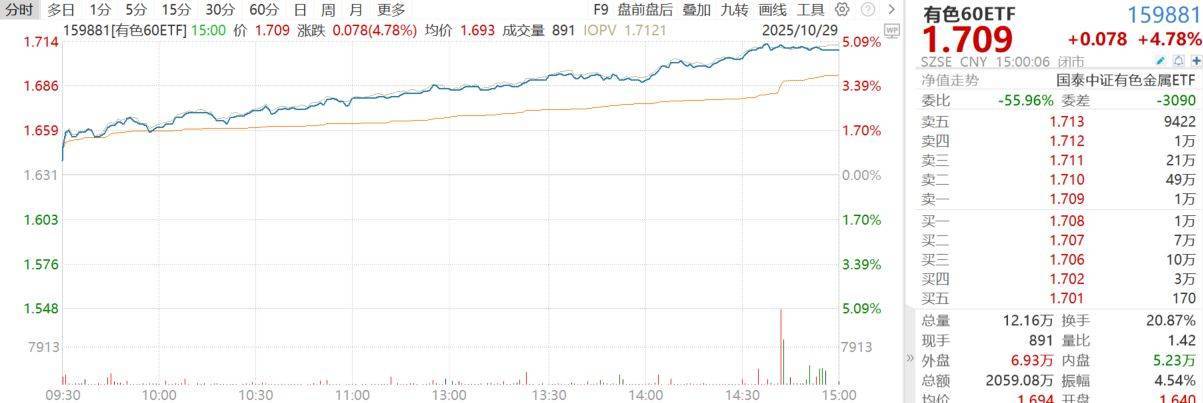
Core Viewpoint - The A-share market experienced a collective rise, with significant increases in major indices, driven by strong performance in the metals sector and positive market sentiment ahead of the upcoming FOMC meeting [1][6]. Market Performance - The Shanghai Composite Index rose by 0.7%, stabilizing above 4000 points; the Shenzhen Component increased by 1.95%, and the ChiNext Index surged by 2.93%. The North Star 50 Index saw a remarkable rise of 8.41%. The total market turnover reached 2.29 trillion yuan, showing an increase compared to the previous day [1]. Metals Sector - The Nonferrous Metals ETF (159881) closed up by 4.78%, while the Mining ETF (561330) rose by 4.48% [2][4]. - The nonferrous metals sector saw a collective surge, with copper and zinc leading the gains. The main copper futures contract in London broke through the $11,000/ton mark and reached an intraday high of $11,130/ton, surpassing the previous historical high of $11,104.5/ton set in May of last year, marking a year-to-date increase of nearly 25% [6]. - London aluminum prices also rose, breaking a nearly three-year record, reaching an intraday high of $2,909.9/ton, with a year-to-date increase of over 13% [6]. Economic Factors - The rebound in spot gold prices followed a drop to $3,886.2/ounce, with market participants awaiting the FOMC meeting and anticipating a 25 basis point rate cut, which could benefit precious metals [6]. - Recent trade discussions between China and the U.S. in Kuala Lumpur have eased trade concerns, boosting market risk appetite and benefiting industrial metals like copper and aluminum [6]. Future Outlook - The copper supply-demand situation remains tight, with expectations for price increases in a rate-cutting cycle. Recent disruptions in overseas copper mines, including a forecasted production shortfall from Antofagasta in Chile, have led to downward adjustments in production guidance for several major projects, cumulatively reducing output by nearly 500,000 tons [7]. - The ongoing low treatment charge (TC) prices for copper mines and the tightening of smelting capacity in China are expected to support copper prices in the medium term [7]. - For gold, the core factors supporting price increases include the onset of a Fed rate-cutting cycle, challenges to the dollar's credit system, and ongoing geopolitical uncertainties [8][9]. Investment Opportunities - Investors are encouraged to focus on resource stocks, particularly the Mining ETF (561330) and the Nonferrous Metals ETF (159881), which have significant exposure to gold, copper, and rare metals, collectively accounting for over 50% of their industry distribution [10].
睿远港股通核心价值混合:三季度降低了创新药板块获利仓位 互联网板块成为配置重点
Zheng Quan Shi Bao Wang· 2025-10-28 05:25
Core Viewpoint - The fund has moderately reduced its holdings in the innovative drug sector while increasing allocations to the non-bank financial and internet sectors in Q3 2025 [1] Non-Bank Financial Sector - The tightening liquidity environment benefits insurance companies' interest spreads, with valuations at historically low levels, providing good safety margins and recovery potential [1] - In the context of a weak macroeconomic recovery, the stable nature of insurance products is likely to attract more capital [1] Internet Sector - The internet sector has become a key focus for allocation in Q3, with valuation recovery driven by a combination of macroeconomic, fundamental, and liquidity factors rather than a surge in performance [1] - The initiation of the Federal Reserve's interest rate cut cycle has lowered risk-free rates, directly boosting the valuations of long-duration assets like internet companies [1] - Improved market sentiment regarding overall demand has enhanced growth prospects for core businesses such as e-commerce and advertising [1] - Internet companies have shifted from a growth-oriented to a profit-oriented approach after several years of strategic adjustments, resulting in significantly improved profitability and cash flow quality [1] - In a challenging environment for traditional industries and increased volatility in certain tech sectors, leading internet firms have become a consensus investment choice due to their high liquidity, clear business models, and stable shareholder returns, attracting funds from other sectors [1]
苍原资本:A股市场慢涨行情有望延续
Sou Hu Cai Jing· 2025-10-28 03:47
Market Performance - The A-share market showed strong performance on October 27, with the Shanghai Composite Index approaching the 4000-point mark, indicating a bullish trend [1][4] - The market sentiment is gradually stabilizing, with active funds' reduction behavior nearing its end, reflecting a steady correction in investor confidence [4] Sector Analysis - Key sectors performing well include communication equipment, electronic components, consumer electronics, and non-ferrous metals, while gaming, wind power equipment, engineering consulting services, and mining sectors lagged [1] - The storage chip sector showed strength, with local stocks in Fujian performing well, and the computing hardware sector remained active [4] Economic and Policy Influences - Multiple factors such as the Fourth Plenary Session setting the tone for the "14th Five-Year Plan," the opening of the Federal Reserve's interest rate cut cycle, and the easing of China-US trade relations are contributing to a gradual upward trend in the A-share market [1] - The market is expected to continue its slow upward trend in the short term, with close attention needed on policy, capital flow, and external market changes [1] Technical Analysis - From a technical perspective, the index has broken through key resistance levels, with significant volume expansion indicating active market sentiment [4] - The Shanghai Composite Index has surpassed its previous trading range, suggesting potential for further upward movement [4] Mid-term Outlook - Despite potential supply-demand pressures in the spring of next year, the gradual clearing of production capacity and the effects of policies are expected to stabilize the economic and market bottom, serving as a key driving force for a new market rally [4] - Supportive factors for the fourth quarter include anti-involution policies, increased household savings entering the market, Federal Reserve interest rate cuts, and a reversal in technical indicators, suggesting a bullish outlook for A-shares [4]

国际金价近期回调,别慌!
Sou Hu Cai Jing· 2025-10-27 11:17
Core Viewpoint - The recent decline in gold prices has led to a significant drop in the retail price of gold jewelry, prompting investors to consider buying opportunities as prices retreat from recent highs [2][3]. Group 1: Price Movements - On October 21, the spot gold price fell from a high of $4,374.79 per ounce, experiencing a daily drop of 6.70%, marking the largest single-day decline in 12 years with a closing drop of 5.33% [2]. - By October 26, the retail price of gold jewelry from major brands like Chow Tai Fook and Luk Fook dropped to 1,232 CNY per gram, down 60 CNY from the peak of 1,292 CNY per gram on October 21, resulting in a savings of 4,800 CNY for an 80-gram gold bracelet [2]. Group 2: Investor Behavior - Investors are beginning to re-enter the market, with some, like Ms. Lin, purchasing 40,000 CNY worth of gold on October 22, seizing the opportunity presented by the price drop after previously hesitating due to high prices [3]. - Ms. Liu, holding nearly 500,000 CNY in gold ETFs, experienced a loss of approximately 19,000 CNY in a single day but remains calm, viewing the price correction as a normal market behavior [3]. Group 3: Market Outlook - Short-term fluctuations in gold prices are influenced by geopolitical factors and profit-taking, but long-term support remains strong due to ongoing monetary policy changes, including potential interest rate cuts by the Federal Reserve and central bank gold purchases [4][5]. - Analysts suggest that the current price correction may present a buying opportunity, with expectations that the long-term price trend for gold remains upward due to factors such as a weakening dollar and global economic uncertainties [4][5].
宏观利好刺激,铜价接近新高
Hong Ye Qi Huo· 2025-10-27 11:13
Group 1: Report Industry Investment Rating - Not mentioned in the provided content Group 2: Core View of the Report - The copper price is close to a new high due to macro - positive stimuli. The overall sentiment in the market is optimistic. The copper price may continue to rise in the medium - to - long - term and could potentially break through historical highs following the trend of gold [3][4] Group 3: Summary Based on Related Information Market Performance - Today, the US dollar rose slightly while the RMB soared. Non - ferrous metals remained strong throughout the day. Shanghai copper, London copper, and domestic spot copper all increased. The closing price of Shanghai copper was 88,370, and the spot price was 88,340. The spot was at a discount of - 30 points to the futures. The spot basis turned to a discount of - 45 points, and spot trading was poor. The LME spot discount narrowed slightly to - 26 dollars this week, indicating general foreign spot demand. US copper inventories continued to rise significantly this week, London copper inventories decreased, and Shanghai copper inventories increased, with general spot demand. The RMB exchange rate rose significantly this week, and the Yangshan copper premium dropped to 34.5 dollars, showing weak domestic spot demand. The London - Shanghai ratio of copper prices rose to 8.09, and the premium of international copper over Shanghai copper increased to 595 points, with the foreign price - to - value ratio higher than the domestic one [3] Technical and Fundamental Analysis - Technically, London copper surged today, trading around 11,050 dollars. Shanghai copper also rose sharply, closing at 88,370, hitting a recent high with a strong technical pattern. Both trading volume and open interest of Shanghai copper increased, and market sentiment was optimistic. Macroscopically, the global trade pattern is gradually stabilizing, the Fed's interest - rate cut cycle continues, and global monetary policies are becoming more accommodative, which is a medium - term positive for copper prices. In terms of supply and demand, mine production in places like Indonesia has declined, but short - term spot demand remains weak, inventories are high, and there is growth potential for medium - to - long - term copper demand, presenting a generally neutral situation that requires attention [3][4] Future Events to Watch - In the short - term, important macro events to follow include the results of Sino - US talks, the Fed's interest - rate meeting early Thursday, the APEC meeting at the end of the month where Sino - US leaders may meet, and the end of the US government shutdown. In the medium - term, it is necessary to monitor whether Sino - US relations can continue to improve, whether the Fed's interest - rate cut cycle can persist, when the current weak domestic and foreign spot demand will improve, and whether AI - related demand can materialize [4] Copper Market Indicator Monitoring | Date | RMB Exchange Rate | Spot Premium/Discount (yuan/ton) | Yangshan Copper Premium (dollars/ton) | LME Copper - Futures and Spot Spread | Main Contract London - Shanghai Ratio | | ---- | ---- | ---- | ---- | ---- | ---- | | Oct 21 | 7.1269 | 450 | 35 | - 23 | 8.05 | | Oct 22 | 7.1256 | - 320 | 34 | - 30 | 8.03 | | Oct 23 | 7.1246 | - 520 | 40 | - 6 | 8.05 | | Oct 24 | 7.1259 | - 1170 | 39 | - 12 | 7.97 | | Oct 27 | 7.1136 | - 30 | 34.5 | - 26 | 8.09 | [5]
贵金属日报2025-10-27:贵金属-20251027
Wu Kuang Qi Huo· 2025-10-27 03:13
1. Report Industry Investment Rating No relevant content provided. 2. Core View of the Report - The recent correction in precious metal prices is mainly due to the expectation of a temporary easing of overseas risk events and an over - bought correction in trading, rather than a reversal of the trading logic. The price decline is more of a "correction in the upward trend" than a "trend reversal" based on geopolitical risks, weakening US dollar credit, and the start of the Fed's interest - rate cut cycle. It is recommended to maintain a long - position strategy, focusing on the upcoming Fed interest - rate meeting and considering buying on dips. [2][4] 3. Summary by Related Catalogs 3.1 Market Quotes - On October 27, 2025, Shanghai gold futures (SHFE) fell 0.48% to 941.34 yuan/gram, and Shanghai silver futures fell 0.25% to 11,419.00 yuan/kilogram. COMEX gold was reported at 4,126.90 US dollars/ounce, and COMEX silver was reported at 48.41 US dollars/ounce. The US 10 - year Treasury yield was 4.02%, and the US dollar index was 98.94. [2] - From August 22 to October 17, the price of the COMEX gold main contract rose by 26.21%, and the price of the COMEX silver main contract rose by 31.23%. On October 21, COMEX gold prices dropped by 5.07%, and COMEX silver prices dropped by 6.27%. [2] 3.2 Factors Affecting Prices - Overseas risk events: Media reports of a potential peace plan to end the Russia - Ukraine conflict led to a short - term drop in precious metal prices. However, the situation has not been completely reversed as Trump and the White House stated there are no plans for a meeting between the US and Russian presidents. [2] - US inflation data and Fed policy expectations: US September CPI data was lower than expected, boosting expectations of the Fed's loose monetary policy. Due to the government shutdown in October, inflation data may not be released in November. The market has almost fully priced in two 25 - basis - point interest rate cuts in the next two Fed meetings. [3] 3.3 Strategy Suggestions - Maintain a long - position strategy. Focus on the Fed's interest - rate meeting on Thursday (market expects a 25 - basis - point rate cut), and pay attention to Powell's statement on the balance - sheet. It is recommended to buy on dips. The reference trading range for the SHFE gold main contract is 923 - 982 yuan/gram, and for the SHFE silver main contract is 11,082 - 12,023 yuan/kilogram. [4] 3.4 Data Summary - **Gold**: On October 24, 2025, compared with the previous day, COMEX gold's closing price (active contract) decreased by 0.39% to 4,126.90 US dollars/ounce, trading volume increased by 10.19% to 29.20 million lots, and open interest increased by 2.43% to 52.88 million lots. SHFE gold's closing price (active contract) decreased by 0.44% to 938.10 yuan/gram, trading volume decreased by 33.87% to 49.95 million lots, and open interest decreased by 1.28% to 35.59 million lots. [7] - **Silver**: On October 24, 2025, compared with the previous day, COMEX silver's closing price (active contract) decreased by 0.49% to 48.41 US dollars/ounce, open interest increased by 1.75% to 16.58 million lots. SHFE silver's closing price (active contract) decreased by 1.18% to 11,332.00 yuan/kilogram, trading volume decreased by 5.55% to 147.59 million lots, and open interest decreased by 1.97% to 73.99 million lots. [7]
光大证券:流动性驱动行情下 TMT板块更容易成为中期主线
Xin Lang Cai Jing· 2025-10-26 10:46
Core Viewpoint - The report from Everbright Securities emphasizes a focus on the TMT (Technology, Media, and Telecommunications) and advanced manufacturing sectors in the mid-term, while suggesting a shift towards high-dividend and consumer sectors if market volatility occurs [1] Industry Focus - Mid-term attention is directed towards the TMT and advanced manufacturing sectors, with TMT likely to be a main focus during liquidity-driven market conditions [1] - The TMT sector currently has several catalysts, including the onset of a Federal Reserve interest rate cut cycle and the ongoing development of the AI industry, which provide upward momentum [1] Market Conditions - If the market shifts towards being driven by fundamentals, advanced manufacturing should be a key area of focus, as the current market may be in a mid-term phase [1] - In the event of market turbulence, sectors that are lagging, such as high-dividend stocks and consumer sectors, should be monitored, including industries like banking, utilities, food and beverage, and personal care [1]

美联储降息周期开启 医药化工行业正迎来分化和巨变
Sou Hu Cai Jing· 2025-10-26 10:28
Group 1: Federal Reserve Policy Shift - The Federal Reserve is transitioning from prioritizing inflation control to focusing on growth, with a consensus expectation of interest rate cuts in October and December, indicating a potential continuous rate-cutting cycle [1] - This policy adjustment is driven by reduced inflation pressures and signs of weakness in the job market, rather than economic panic [1] Group 2: Impact on Pharmaceutical and Chemical Industries - The interest rate cuts will lower financing costs and improve global liquidity, significantly benefiting the pharmaceutical sector, especially innovative drug and CXO companies reliant on financing for R&D [3] - The pharmaceutical sector is expected to see increased capital flow towards emerging market assets, supported by recent policy events and conferences [3] - In contrast, the chemical industry may experience a replenishment cycle, stimulating capital expenditures and production investments, but faces challenges from rising raw material costs and weak global demand [3] Group 3: Company Performance Highlights - Sanofi expects high single-digit sales growth and low double-digit earnings per share growth driven by innovation, despite challenges in its vaccine business [4] - Roche reported a 7% year-on-year sales increase to 45.9 billion Swiss francs, primarily driven by its pharmaceutical division, which saw a 9% increase due to high demand for key innovative drugs [5] - Dow Inc. experienced an 8% year-on-year decline in net sales, with all operational segments showing a downturn, although cash flow improved significantly due to working capital optimization [5] Group 4: Trends in the Pharmaceutical and Chemical Sectors - Chinese companies are gaining global competitiveness in the pharmaceutical sector, particularly in the CXO field, which is becoming a crucial base for global pharmaceutical innovation [5] - Traditional sectors like raw material and chemical pharmaceuticals must upgrade technology and collaborate across the supply chain to avoid market share and profit erosion [5] - The future competitiveness of the global market and China's pharmaceutical and chemical industries will increasingly depend on technological innovation and global operational capabilities [6]