智能化

Search documents
两位数“五连增”!海尔智家核心数据亮眼
Zhong Guo Zheng Quan Bao - Zhong Zheng Wang· 2025-11-25 11:57
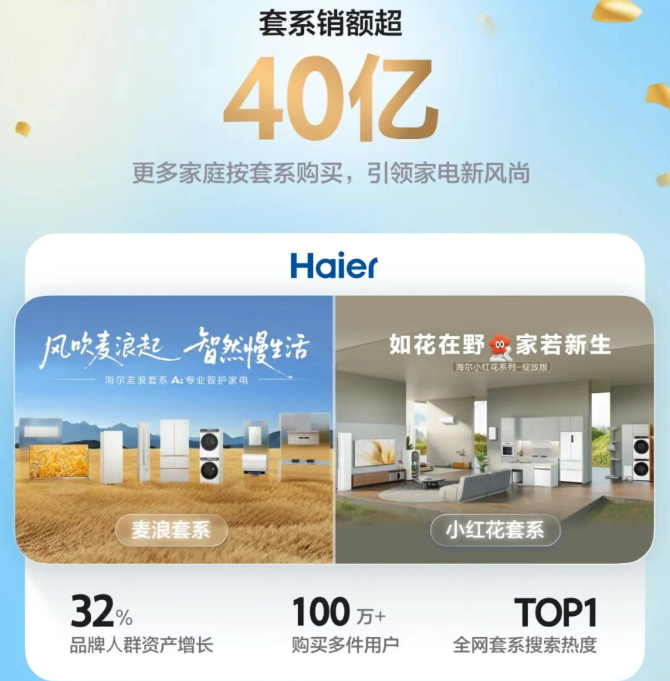
Core Insights - Haier Smart Home has achieved impressive growth, with a continuous double-digit year-on-year increase in net profit attributable to shareholders for five consecutive years [1][2] - The company has established itself as a "hardcore growth" leader in the appliance industry, successfully navigating challenges such as market saturation and rising raw material costs [2] Financial Performance - From 2021 to 2025, the year-on-year growth rates of net profit attributable to shareholders for the first three quarters were 57.68%, 17.26%, 12.71%, 15.27%, and 14.68% respectively [1][7] - The latest report indicates a 14.68% year-on-year increase in net profit for the first three quarters of 2025, surpassing revenue growth [7] Strategic Dimensions - Haier's growth is driven by five strategic dimensions: high-end, globalization, digitalization, intelligence, and ecological integration, which collectively enhance user recognition [3] - The Casarte brand, known for its differentiated technology, has become a key profit driver, with products like the zoned washing machine and oxygen-preserving refrigerator meeting high-end consumer needs [3] Globalization Efforts - Haier's globalization strategy focuses on localizing products and services, establishing R&D, production, and sales systems in key markets to serve local users effectively [3] Digital Transformation - Digital transformation plays a crucial role in enhancing operational efficiency and user experience, with initiatives like the comprehensive inventory management system and multi-channel digital operations [4] - The application of AI technology has led to innovative products that address everyday consumer pain points, contributing to significant sales during major shopping events [4][5] Market Position and Future Outlook - During the 2025 Double Eleven shopping festival, Haier's product sales exceeded 4 billion yuan, with significant contributions from specific product lines [5] - Analysts maintain a positive outlook on Haier's growth potential, citing the ongoing deepening of its high-end strategy, steady globalization, and increasing penetration of smart home solutions [7]


广汽总经理閤先庆:生态合作是应对竞争的必选项
Xin Jing Bao· 2025-11-25 11:51
Core Insights - GAC Group aims to transform into a technology-driven enterprise by implementing a dual-driven strategy of "market + technology" to create a "New GAC" [1][2] - The company acknowledges that its previous performance was subpar due to an engineering mindset that did not align with customer needs [1][2] Transformation Strategy - The first step in the transformation involves shifting the entire R&D system from an engineering mindset to a user-centric approach [2] - GAC has adopted Huawei's Integrated Product Development (IPD) to deeply integrate user needs into the entire product lifecycle, from market insights to delivery [2] - The organizational structure has shifted from a functional model to a matrix structure to enhance end-to-end collaboration [2] Four Engines of Development - GAC has identified "new technology, new products, new services, and new ecosystems" as the four engines to create value for users [3] - Technology is the foundation, focusing on two main directions: new energy technologies, including solid-state batteries, and AI and smart technologies [3] - Product development now emphasizes emotional value, aesthetics, and smart interactions, alongside traditional performance metrics [3] Ecosystem Cooperation - GAC emphasizes that ecological cooperation is essential for meeting customer and market demands and for competitive advantage [4] - The collaboration with Huawei is characterized by deep co-creation rather than a simple supplier relationship, with significant resources allocated to joint R&D efforts [5] Brand Differentiation - GAC's new brand, "Qijing," targets a younger, fashion-conscious market with high-performance demands, differentiating itself from existing brands like Trumpchi and Aion [6] - Trumpchi will continue to focus on both fuel and electric vehicles, while Aion targets young families with electric models [6] - The positioning of each brand is distinct, with Qijing aimed at high-end intelligent electric vehicles, while other brands cater to different customer segments [6]

深化“油电同智”、发力用户共创,上汽大众加速布局谋篇未来——专访上汽大众党委书记、总经理陶海龙
Xin Hua Cai Jing· 2025-11-25 08:27
Core Insights - The Guangzhou Auto Show serves as a significant platform for automakers to showcase their new products and future plans, with SAIC Volkswagen unveiling its new ID. ERA series and the first plug-in hybrid model, the Passat ePro, indicating a shift towards a diversified energy product matrix [1][5][6] - The company emphasizes "intelligentization" as a key theme in its product strategy, aiming to integrate traditional fuel vehicles with new energy technologies to enhance user experience [2][7] Product Strategy - SAIC Volkswagen is launching a series of new energy vehicles, including the ID. ERA series, which is positioned as a "German flagship SUV" and aims to set new benchmarks in the market [5][6] - The Pro series, which includes models like the Passat ePro and the newly launched Langyi Pro, focuses on providing intelligent features and advanced driving assistance systems, thereby expanding its market reach [3][4] Market Performance - The Pro series has achieved a nearly 9% market share in the fuel vehicle segment, with cumulative sales reaching 850,000 units from January to October 2024, indicating strong market acceptance [2][3] - The company plans to introduce six new energy models within the next year, with a target of over 20 new models by 2030, reflecting its commitment to expanding its product lineup [8][9] Strategic Partnerships - SAIC Volkswagen is actively collaborating with leading technology companies such as Baidu and Huawei to enhance its product offerings and integrate advanced technologies into its vehicles [2][7] - The company is shifting from a traditional supply chain model to a joint development approach, aiming to create top-tier product experiences in smart driving and cockpit systems [7][8] Organizational Transformation - The company is undergoing internal changes to improve efficiency and responsiveness to market demands, including the adoption of modern organizational structures and management practices [8][9] - SAIC Volkswagen is focusing on user engagement through initiatives like the ID. ERA "Pioneer Experience Program," which invites users to participate in product testing and feedback [7][8] Future Outlook - The company remains optimistic about navigating the challenges posed by the gradual reduction of government subsidies for electric vehicles, leveraging its strong fuel vehicle base as a buffer [9][10] - By the end of 2025, SAIC Volkswagen expects to surpass cumulative sales of 26 million units, maintaining its position as a leading brand in the domestic market [9][10]

10月乘用车市场销量分析:新能源板块表现强势 转型步伐持续加速
Zhong Guo Zhi Liang Xin Wen Wang· 2025-11-25 08:05
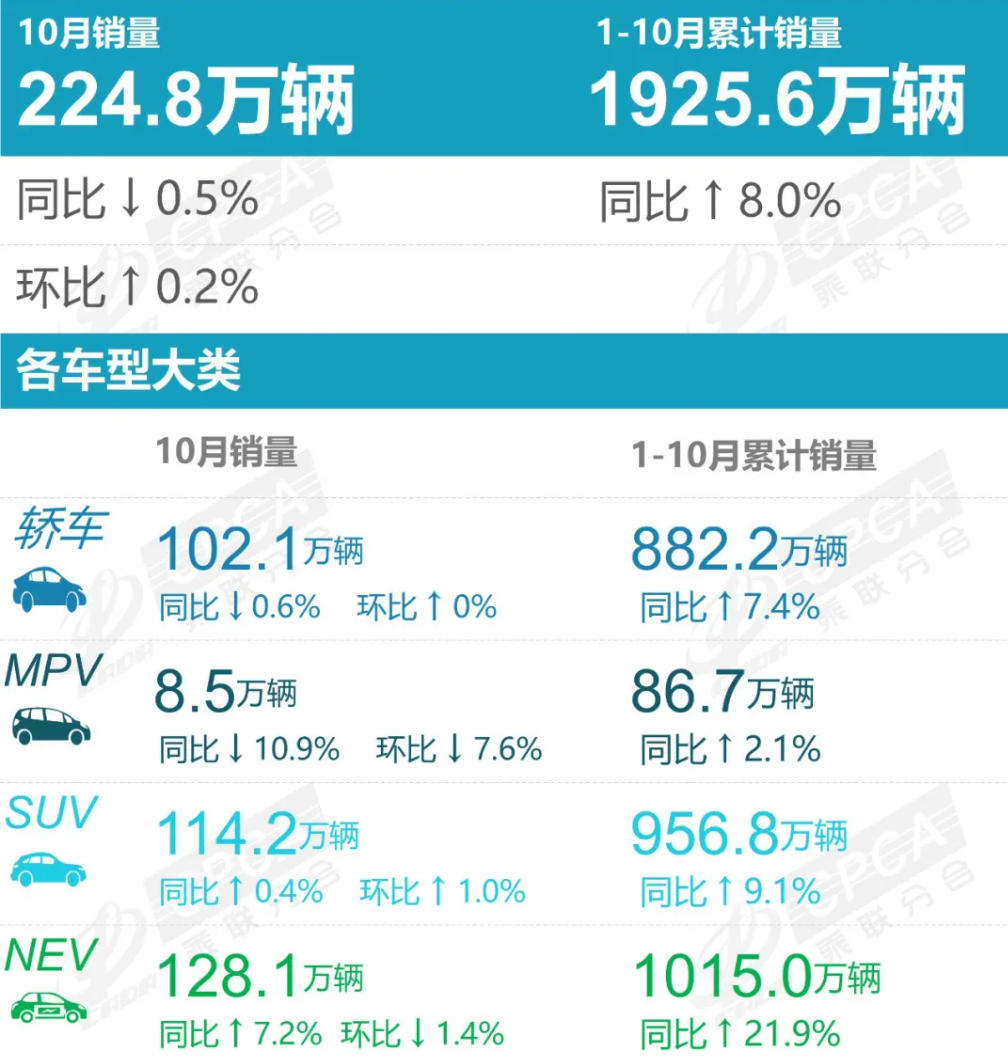
Core Insights - The domestic passenger car market experienced a retail sales volume of 2.248 million units in October 2025, reflecting a year-on-year decline of 0.5% but a month-on-month increase of 0.2% [1] - The market is undergoing a transformation, with strong performances from domestic brands and the new energy sector contrasting sharply with the pressures faced by joint venture brands [1][3] Market Performance - The SUV segment was the only category to achieve positive growth, with sales reaching 1.142 million units, up 0.4% year-on-year and 1.0% month-on-month [3] - New energy vehicle sales in October totaled 1.281 million units, showing a year-on-year increase of 7.2% despite a slight month-on-month decline of 1.4% [3] - The market share of domestic brands reached 68.7%, a year-on-year increase of 3 percentage points, with retail sales of 1.55 million units, up 4% year-on-year and 3% month-on-month [3][4] Brand Performance - Joint venture brands faced significant challenges, with retail sales of mainstream joint venture brands at 510,000 units, a year-on-year decline of 10% [4] - The luxury car market saw retail sales drop to 190,000 units, down 10% year-on-year and 23% month-on-month, with market share falling to 8.4% [4] - BYD led the sales ranking with 295,871 units sold, despite a year-on-year decline of 31.4%, marking the largest drop among the top ten manufacturers [5][4] Sales Rankings - Geely ranked second with 265,565 units sold, achieving a remarkable year-on-year increase of 36.8%, driven by the Geely Galaxy series [5][6] - Volkswagen ranked third with 136,002 units sold, but experienced a year-on-year decline of 3.9% [7] - Changan and Chery followed closely, with sales of 132,229 and 130,128 units respectively, both showing positive growth [7][6] New Energy Vehicle Market - BYD maintained its lead in the new energy vehicle market with a market share of 23.1%, despite a year-on-year decline of 31.4% [15] - Geely's new energy vehicle sales reached 164,256 units, with a year-on-year increase of 54.7%, narrowing the gap with BYD [15][17] - The new energy vehicle penetration rate surpassed 57%, indicating a deepening market acceptance [14][21] Future Outlook - The market is expected to see a release of consumer demand as tax incentives end, coupled with increased promotional efforts from manufacturers [21] - The ongoing trends of electrification and smart technology are anticipated to reshape the Chinese automotive market, with domestic and new energy brands likely to lead the next phase of industry transformation [21]


车展季·大咖说丨大通品牌全面焕新 宋海:未来将推四大车系22款新能源车型
Mei Ri Jing Ji Xin Wen· 2025-11-25 04:23
Core Viewpoint - SAIC Maxus is undergoing a significant brand renewal, focusing on a complete transition to new energy vehicles (NEVs) with plans to launch 22 new models across four vehicle series by 2025 [1][7] Group 1: Brand Renewal and Strategy - The brand renewal includes a new logo, vision, mission, values, and brand pillars, marking a milestone in SAIC Maxus's development [1] - The company aims to become the brand with the widest coverage of NEVs in the commercial vehicle sector [1] - SAIC Maxus has integrated its light commercial vehicle business under the OEM strategy, consolidating brands such as Maxus, Yuedong, and Iveco [3] Group 2: New Product Launches - At the 2025 Guangzhou Auto Show, SAIC Maxus unveiled the new "Zhonghui" logo and introduced the RoboVAN and RoboBUS, both part of its new energy light commercial vehicle series [4] - The RoboVAN is designed for 24/7 operation, capable of automatic order acceptance and optimal route planning, with plans for mass deployment next year [4] - Both models are built on the "Hongtu" super commercial electric architecture, which focuses on specialized technology solutions for commercial vehicles [4] Group 3: Strategic Partnerships - SAIC Maxus has entered a strategic partnership with CATL for autonomous battery swapping, integrating smart driving, fast charging, and battery swapping technologies [6] - CATL's battery swapping stations have been established at over 800 locations, supporting various commercial vehicle types [6] Group 4: Market Performance and Future Plans - The monthly order for the DANA product series has exceeded 3,000 units, with NEV sales accounting for 41% of SAIC Maxus's total sales [7] - The company plans to introduce a series of new energy vehicles, including light commercial vehicles, pickups, and MPVs, targeting global markets [7] - In October, SAIC Maxus reported sales of approximately 19,900 units, a year-on-year increase of 47.86%, with cumulative sales for the first ten months reaching 180,000 units, up 16.63% year-on-year [9]

瞭望 | 筑牢汽车运行安全底线
Xin Hua She· 2025-11-25 03:12
Core Viewpoint - The recent draft of the national standard for "Motor Vehicle Operation Safety Technical Conditions" emphasizes that safety is a non-negotiable baseline for innovation in the automotive industry, particularly for electric and autonomous vehicles [1][2] Group 1: Safety Standards and Regulations - The new standards include critical technical indicators such as acceleration performance, door handles, rotating seats, and in-car displays, highlighting the urgent need for safety in the rapidly evolving automotive landscape [1] - The automotive industry has a long history of prioritizing safety, with innovations like three-point seat belts and ABS systems being foundational to vehicle design [1] Group 2: Industry Challenges and Responsibilities - The rise of electric vehicles and smart driving technologies presents new challenges, including battery safety, electronic control system reliability, and the stability of new body materials, making adherence to safety standards more crucial than ever [1] - The automotive sector must cultivate a safety-first culture, ensuring that safety considerations take precedence over cost in every aspect of design, material selection, testing, and production [2] Group 3: Consumer and Regulatory Roles - Consumers are encouraged to make rational choices and not to blindly pursue flashy features, which can pressure companies to prioritize safety [2] - Regulatory bodies need to enhance the standard system and strengthen market supervision to create a robust framework for automotive safety, ensuring that industry standards are forward-looking and responsive to new technological challenges [2]
欧派家居再度获人民日报点赞!
Zhong Jin Zai Xian· 2025-11-25 03:05
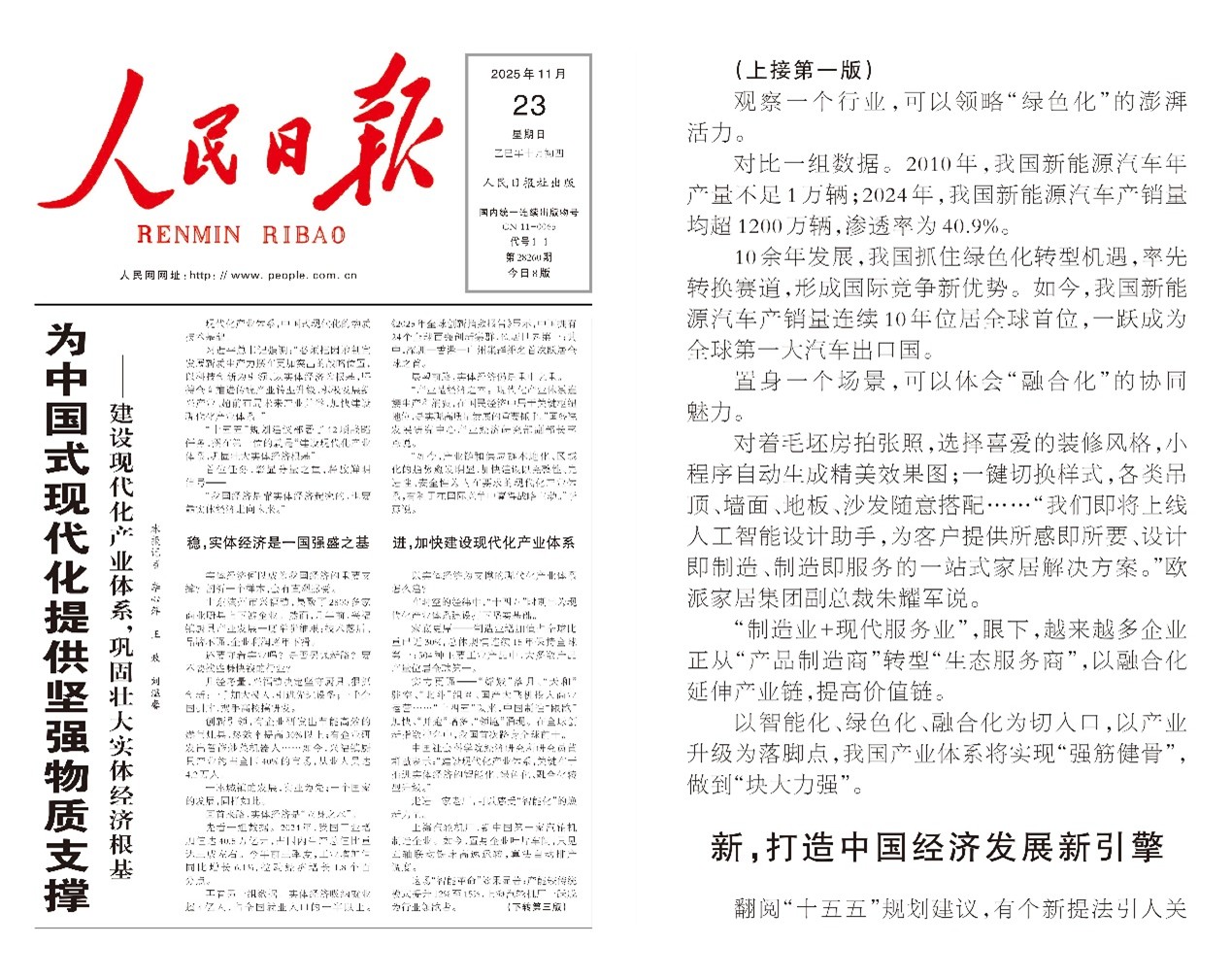
Core Viewpoint - The article emphasizes the importance of building a modern industrial system in China, focusing on "intelligent, green, and integrated" industrial upgrades, with a spotlight on Oppein Home's strategic transformation from a "product manufacturer" to an "ecological service provider" [1][3][4]. Group 1: Industry Transformation - The production of new energy vehicles in China has surged from less than 10,000 units in 2010 to over 12 million units in 2024, achieving a penetration rate of 40.9% [3]. - Oppein Home is set to launch an AI design assistant that will provide a one-stop home furnishing solution, showcasing the integration of manufacturing and modern services [3][8]. - The trend of companies transitioning from "product manufacturers" to "ecological service providers" is gaining momentum, enhancing value chains and extending industrial chains [3][10]. Group 2: Emerging Pillar Industries - The concept of "emerging pillar industries" is introduced, which combines characteristics of both emerging and pillar industries, playing a crucial role in economic growth and requiring high technological content and added value [4][5]. - By 2025, the added value of strategic emerging industries is expected to account for over 17% of GDP, an increase of approximately 5.3 percentage points compared to the "13th Five-Year Plan" [5][6]. - The low-altitude economy is highlighted as a significant example, with a projected market size of 1.5 trillion yuan in 2023, expected to reach 3.5 trillion yuan by 2035 [5][6]. Group 3: Oppein's Strategic Direction - Oppein's integration of AI technology into its design and manufacturing processes is seen as a transformative step, creating a closed-loop system of "design as manufacturing, manufacturing as service" [8][10]. - The company aims to strengthen its foundation in the real economy while promoting deep integration between manufacturing and modern services, contributing to the modernization of China's economy [10][12]. - The recognition by People's Daily of Oppein's transformation path underscores the importance of industry integration and innovation in achieving a robust industrial system [12].

专访 || 厦门金龙旅行车有限公司技术中心主任张纲:以智能化、网联化重新定义高端客车未来
Zhong Guo Qi Che Bao Wang· 2025-11-25 01:32
Core Insights - The article highlights the launch of the GC15 bus by Xiamen Golden Dragon Bus Co., marking a significant moment for Chinese bus manufacturers in the global market, particularly in the context of new energy and intelligent technology [3][4] - The GC15 is positioned as a high-end, intelligent, and reliable vehicle, showcasing the company's commitment to global expansion and advanced technology [4][5] Group 1: Product Definition and Positioning - The GC15 bus is designed for the next 5-10 years, focusing on premium quality and intelligence, representing a new brand image for Golden Dragon [4] - The core positioning of the GC15 encompasses three dimensions: a balance of intelligence and premium quality, reliability and energy efficiency, and the use of forward-looking technology to define the future [4][5] Group 2: Intelligent and Premium Features - The integration of intelligence and premium features aims to address user pain points, such as reducing dangerous driving actions and enhancing human-machine collaboration [5][6] - The bus includes a multifunctional armrest for the driver, consolidating common operations to reduce labor intensity and improve safety [5][6] Group 3: Reliability and Energy Efficiency - The GC15 adheres to a "super power, super energy-saving, super safety" standard, exceeding international regulations with internal standards for energy consumption and safety [6][7] - The vehicle's electric architecture focuses on optimizing energy efficiency and lifecycle reliability, having undergone extensive testing in various environments [6][7] Group 4: Electronic and Electrical Architecture Innovation - The GC15 introduces a domain controller architecture, replacing numerous independent ECUs, which reduces wiring costs by approximately 30% and improves assembly efficiency by about 25% [7][8] - This simplification in production not only optimizes manufacturing processes but also enhances lifecycle cost efficiency [7][8] Group 5: Data-Driven Intelligent Upgrades - The integration of artificial intelligence in the bus's development and operation signifies a new phase in intelligent competition within the bus sector [8][9] - The vehicle's energy management system utilizes proprietary algorithms to dynamically adjust energy consumption strategies based on real-time conditions [9][10] Group 6: Future Trends in Bus Industry - The global bus market is moving towards integrated and modular electronic architectures, with centralized domain controllers becoming mainstream [10] - The ability to perform OTA updates and software enhancements will be crucial for competitive differentiation in the future [10]


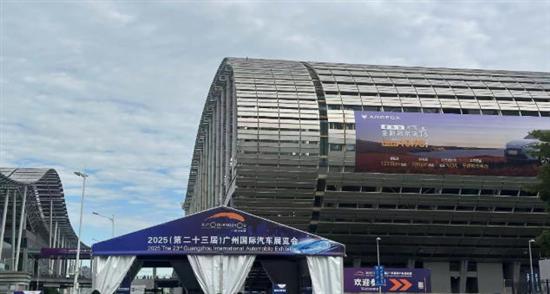
2025广州车展 新能源车占比占比高达57.9%
Cai Jing Wang· 2025-11-25 01:29
Group 1 - The 23rd Guangzhou International Auto Show, themed "New Technology? New Life," focuses on electrification, intelligence, and connectivity, showcasing a shift from single-function to systematic competition [1] - The exhibition covers an area of 220,000 square meters with a total of 1,085 vehicles on display, of which 629 are new energy vehicles, accounting for 57.9% [1] - The China Association of Automobile Manufacturers predicts that in 2024, China's automobile production and sales will exceed 31 million units, with new energy vehicles surpassing 10 million units for the first time [2] Group 2 - GAC Group and BYD are the two major exhibitors at the show, with GAC showcasing its "Panyu Action" achievements and new technology brands, including "Star Spirit Intelligent Driving" [3] - BYD presents various brands and technologies, including the first public appearance of the Yangwang U9 Xtreme and the CTC battery integration technology [5] - The show features a high concentration of domestic brands, with Huawei showcasing its automotive business and partnerships with various manufacturers [7] Group 3 - Several traditional luxury brands, including Jaguar Land Rover and Rolls-Royce, are absent from this year's exhibition, continuing a trend from the previous year [8] - The market share of traditional luxury brands has declined, with a reported 10.9% drop in cumulative sales for the first three quarters of 2025 [8] - Financial data for traditional luxury brands shows a significant decline, with many reporting over a 30% drop in net profit for the first half of 2025, attributed to fierce competition in the Chinese market [12]
周观点 | 小米25Q3汽车业务首次盈利 关注汽车政策延续情况【国联民生汽车 崔琰团队】
汽车琰究· 2025-11-24 14:50
Market Performance - The A-share automotive sector declined by 5.0% from November 17 to November 23, underperforming the CSI 300 index, which fell by 2.9% [1] - Within the automotive sub-sectors, commercial trucks, motorcycles, commercial passenger vehicles, auto parts, automotive services, and passenger cars experienced declines of -2.7%, -4.0%, -4.7%, -4.9%, -5.9%, and -5.9% respectively [1] Investment Recommendations - Recommended core stocks include Geely Automobile, Xpeng Motors, BYD, Xiaomi Group, Li Auto, Berteli, Top Group, Xinchuan Co., Hu Guang Co., and Chunfeng Power [2][10] Company Highlights - Xiaomi Group reported Q3 2025 revenue of 113.1 billion yuan, a 22.3% year-on-year increase, with its automotive and AI businesses achieving operational profitability for the first time, generating 700 million yuan [3][11] - Xpeng Motors announced that its new generation production robot will enter the "ET0" mass production phase next month, with a target of over 1 million units sold annually by 2030 [3][11] Technological Developments - Huawei announced its ADS Pro enhanced version, which will be commercially available in 2026, featuring advanced capabilities for urban navigation and risk scenario avoidance [4][12] - The HarmonySpace 5 cockpit has achieved significant upgrades, with user numbers reaching 1.34 million [4][12] Sector Insights Passenger Vehicles - The continuation of the vehicle replacement policy is expected to stimulate domestic demand positively [15] - Recommended stocks in the passenger vehicle segment include Geely, Xpeng, BYD, Xiaomi, Li Auto, and Seres [15] Auto Parts - The auto parts sector is expected to grow, with a focus on intelligent driving and new energy vehicle supply chains [16][18] - Recommended companies include Berteli, Horizon Robotics, and Kobot [18] Motorcycles - The market for large-displacement motorcycles is expanding, with a recommendation for leading companies such as Chunfeng Power and Longxin General [6][25][27] Commercial Vehicles - The heavy truck market is recovering, with sales in October reaching approximately 93,000 units, a year-on-year increase of about 40% [28] - Recommended companies include Weichai Power and China National Heavy Duty Truck [29] Tires - The tire industry is experiencing a shift towards globalization, with recommendations for leading companies like Sailun Tire and Senkiren [30][32]