
AI算力

Search documents
一块布,卡了英伟达的脖子?
首席商业评论· 2026-01-18 04:41
Core Viewpoint - The article emphasizes the critical role of high-end electronic fabric in the AI computing power revolution, highlighting that Japanese companies dominate this market, controlling nearly 70% of the global high-end electronic fabric market, which is essential for AI chip performance [4][6][9]. Group 1: Japanese Dominance in High-End Electronic Fabric - Japanese companies such as Nitto Denko, Asahi Kasei, and AGC dominate the high-end electronic fabric market, which is crucial for AI computing power [6][9]. - These companies have established a significant competitive advantage through decades of research and development, creating a robust patent network that covers the entire production process [9][10]. - The high cost of entry into this market, with investments in production facilities reaching up to 1.5 billion yuan, deters potential competitors, allowing Japanese firms to maintain their market position [9][10]. Group 2: Chinese Companies' Response and Innovations - Chinese companies have begun to challenge the Japanese monopoly, with firms like Honghe Technology and Linzhou Guangyuan making significant advancements in ultra-thin and low-dielectric electronic fabrics [10][11]. - Honghe Technology successfully produced 9-micron ultra-thin electronic fabric in 2021, breaking the long-standing foreign monopoly [10][11]. - Linzhou Guangyuan achieved mass production of low-dielectric fabric in 2021, marking a significant milestone in the industry [11][12]. Group 3: Material Revolution and Future Opportunities - The next generation of quartz electronic fabric is emerging as a critical material for AI applications, providing an opportunity for Chinese companies to leapfrog in technology [12][19]. - Companies like Feilihua are leading the charge in developing M9-level quartz fabric, which has been certified by NVIDIA, thus providing an alternative to Japanese suppliers [12][14]. - The ongoing material revolution is seen as essential for China's technological independence and advancement in various high-tech sectors, including aerospace, new energy, and semiconductors [19][20].


存储价格上涨原因
Xin Lang Cai Jing· 2026-01-18 04:04
Core Insights - The price of storage chips, including memory and flash, has surged dramatically since the second half of 2025, with prices doubling or more, driven primarily by the explosive demand for AI computing power [1] - The price increase of memory modules has outpaced that of gold, with reports indicating that DDR5 memory prices have risen over 300% and DDR4 prices have increased by more than 150% since September 2025 [1] - AI servers require 8-10 times more memory than standard servers, leading to AI servers consuming 53% of the global monthly memory production capacity, which has significantly impacted the allocation of consumer-grade memory production [1] - Major cloud service providers are placing substantial purchase orders, indicating a shift in the storage market towards a "super bull market," surpassing historical peaks seen in 2018 [1]
上市公司密集公告业绩利好!长芯博创净利最高预增超4倍
Zheng Quan Shi Bao· 2026-01-18 01:51
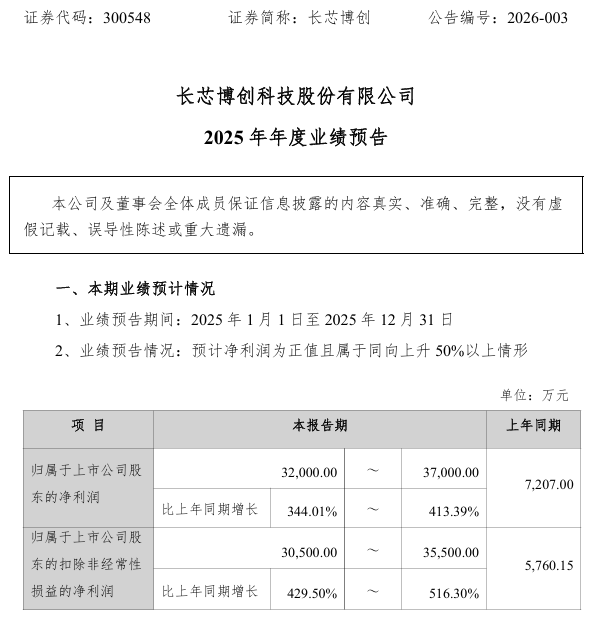
Core Viewpoint - The A-share listed companies are gradually disclosing their performance forecasts for the year 2025, with a significant number of companies expecting substantial profit growth, driven by advancements in technology and market demand [1]. Group 1: Performance Forecasts - As of January 17, 2025, 365 listed companies have released their performance forecasts, with 138 companies expecting positive results [1]. - Longxin Bochuang (300548) anticipates a net profit of 320 million to 370 million yuan, representing a year-on-year growth of 344.01% to 413.39% [1]. - Shenghong Technology (300476) expects a net profit of 4.16 billion to 4.56 billion yuan, with a growth rate of 260.35% to 295.00% [4]. - Haitai Technology (301022) forecasts a net profit of 51.5 million to 66.8 million yuan, indicating a growth of 226.86% to 323.97% [8]. - Haineng Technology (920476) projects a net profit of 41 million to 44 million yuan, with a growth of 213.65% to 236.61% [16]. - Hongyuan Pharmaceutical (301246) expects a net profit of 113 million to 137 million yuan, reflecting a growth of 119.57% to 166.2% [17]. - Northern Rare Earth (600111) anticipates a net profit of 2.176 billion to 2.356 billion yuan, with an increase of 116.67% to 134.60% [20]. - Lishang Guochao (600738) forecasts a net profit of 14 million to 17 million yuan, indicating a growth of 92.96% to 134.31% [22]. - Cambridge Technology (603083) expects a net profit of 252 million to 278 million yuan, with a growth of 51.19% to 66.79% [25]. Group 2: Industry Trends - The demand for new generation information technologies such as cloud computing, artificial intelligence, and big data is driving the rapid growth of the data communication market, positively impacting companies' revenues and profits [1]. - Shenghong Technology is consolidating its technological leadership in the global PCB manufacturing sector, with high-end products achieving large-scale production, contributing to significant revenue growth [4]. - Haitai Technology benefits from a high industry boom and increasing orders due to the gradual release of production capacity from its initial public offering projects [8]. - Haineng Technology is experiencing growth in new materials, new energy, and pharmaceuticals, supported by overall market demand recovery [16]. - Northern Rare Earth has successfully increased its sales of lanthanum and cerium products, achieving significant inventory reduction and production growth [20].



基金研究周报:权益风格分化,白银再度飙涨(1.12-1.16)
Sou Hu Cai Jing· 2026-01-17 22:42
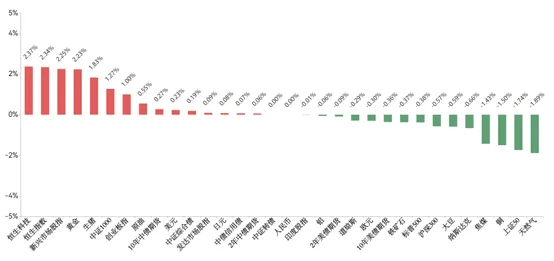
Market Overview - The A-share market exhibited structural differentiation and active trading last week, with the Shanghai Composite Index closing at 4101.91 points, down 0.45%, while the Shenzhen Component Index rose by 1.14% and the ChiNext Index increased by 1.00%, indicating resilience in growth sectors despite short-term volatility [1] - The overall market trend favored growth stocks while value stocks faced a pullback, with small-cap and technology sectors being the main focus of capital [1] Industry Performance - Most of the Wind first-level industry indices declined, averaging a drop of 0.44%. The information technology sector led with a 3.37% increase, driven by sustained AI computing demand, accelerated domestic substitution, and expectations of policy support. In contrast, the real estate sector fell by 3.66% due to weak sales data and limited policy effectiveness [1][9] Fund Issuance - A total of 23 funds were issued last week, including 10 equity funds, 7 mixed funds, 3 bond funds, 1 QDII fund, and 2 FOF funds, with a total issuance of 19.294 billion units [1][16] Fund Performance - The Wind All-Fund Index rose by 0.73% last week, with the equity mixed fund index increasing by 1.52%. However, there was significant differentiation, as the Wind Growth Fund Index rose by 1.88%, while the Wind Value Fund Index fell by 0.31%. The bond fund index saw a slight increase of 0.17% [1][5]
基金研究周报:权益风格分化,白银再度飙涨(1.12-1.16)
Wind万得· 2026-01-17 22:20
Market Overview - The A-share market exhibited structural differentiation and active trading last week, with the Shanghai Composite Index closing at 4101.91 points, down 0.45%, while the Shenzhen Component Index rose by 1.14% and the ChiNext Index increased by 1.00%, indicating resilience in the growth sector despite short-term volatility [1] - The overall market trend continues to favor growth over value, with small-cap and technology sectors being the main focus of capital [1] Industry Performance - Most of the Wind first-level industry indices declined last week, averaging a drop of 0.44%. The information technology sector led with a 3.37% increase, driven by sustained AI computing demand, accelerated domestic substitution, and policy support expectations. In contrast, the real estate sector fell by 3.66% due to weak sales data and limited policy effectiveness [9][10] Fund Issuance - A total of 23 funds were issued last week, including 10 equity funds, 7 mixed funds, 3 bond funds, 1 QDII fund, and 2 FOF funds, with a total issuance of 19.294 billion units [15] Fund Performance - The Wind All-Fund Index rose by 0.73% last week, with the equity mixed fund index increasing by 1.52%. However, there was significant differentiation, as the Wind Growth Fund Index rose by 1.88%, while the Wind Value Fund Index fell by 0.31% [5] Bond Market Overview - The bond market remained stable, with the China Convertible Bond Index rising by 1.08%. The 10-year and 30-year government bond futures increased by 0.27% and 0.26%, respectively, supported by liquidity injections through reverse repos and structural interest rate cuts [12]

【招商电子】汇聚科技(1729.HK)25 年业绩超预期,26年算力、汽车及医疗业务驱动持续高成长
招商电子· 2026-01-17 15:26
Core Viewpoint - The company expects a net profit growth of 60% to 70% in 2025, driven by strong performance in data center and server businesses, as well as the consolidation of Leoni [1] Group 1: Financial Performance - The company anticipates a net profit of approximately 720 to 770 million HKD for 2025, reflecting a significant increase due to rising sales orders in the data center and server segments [1] - The performance is expected to exceed forecasts, primarily due to increased demand from domestic server clients such as Alibaba and ByteDance [1] - The integration of Leoni is expected to enhance profitability in the second half of the year [1] Group 2: Market Outlook - The global AI computing power construction is projected to remain robust in 2026, benefiting the company's MPO and server assembly businesses [2] - The company is aligning its MPO products with trends in multi-core and high-density technology, anticipating a continued increase in product value [2] - The expansion of production capacity in both domestic and international markets is expected to drive high order volumes for MPO in 2026 [2] Group 3: Strategic Acquisitions - The successful acquisition of a 49% stake in Leoni's cable solutions business and the completion of the Dejin Chang acquisition are expected to strengthen the company's production capacity and supply chain security [3] - The integration of Leoni is anticipated to exceed expectations, with benefits from automation and new client introductions [3] - The company is also investing in the medical sector, targeting growth from aging populations and increased health awareness, alongside advancements in wearable medical technology [3] Group 4: Revenue Projections - The company has revised its revenue forecasts for 2025, 2026, and 2027, reflecting the positive outlook from data center and server market demands [4]

AI算力破局关键!先进封装板块暴涨,风口来了?
格隆汇APP· 2026-01-17 11:23
Core Insights - The article discusses the critical role of advanced packaging and SiC technology in addressing the surging demand for AI computing power, highlighting the industry's shift towards these innovations as a solution to existing limitations in traditional chip packaging [5][7][24]. Industry Overview - The demand for computing power is expected to grow exponentially, with China's intelligent computing scale projected to reach 1037.3 EFLOPS by 2025, increasing by 40% in 2026 [7]. - Traditional packaging methods are unable to cope with the power limits, as chip performance improvements lead to a threefold increase in power consumption for every doubling of performance [7][9]. Advanced Packaging Technology - Advanced packaging techniques, including 2.5D/3D stacking and the use of SiC as an intermediary layer, are essential for overcoming thermal management challenges and enhancing chip interconnect density by over 10 times [9][11]. - The global advanced packaging market is forecasted to exceed $79 billion by 2030, with 2.5D/3D packaging experiencing a growth rate of 37% [9]. SiC Technology - SiC is identified as the optimal solution for intermediary layers due to its superior thermal conductivity (490 W/m·K), hardness (Mohs hardness of 9.5), and ability to support high aspect ratio through-hole designs, improving wiring density and transmission speed by 20% [11][13]. - By 2027, SiC intermediary layer mass production is anticipated, with a projected need for over 2.3 million 12-inch SiC substrates by 2030, indicating a significant supply gap [14]. Market Dynamics - The advanced packaging boom is characterized by a collective resonance across the entire supply chain, including equipment, materials, and OSAT (Outsourced Semiconductor Assembly and Test) sectors [16]. - Key players in the OSAT space include Changdian Technology and Tongfu Microelectronics, both of which are positioned to benefit from the domestic substitution trend and the growing demand for advanced packaging solutions [16][21]. Investment Opportunities - Four key investment directions are highlighted: SiC materials and equipment, advanced packaging OSAT, critical materials, and mixed bonding/3D packaging technologies [19][20][21][22]. - Companies such as Tianyue Advanced and Sanan Optoelectronics are noted for their advancements in 12-inch SiC substrate production, while equipment manufacturers like Jing Sheng and Huahai Qingke are breaking through overseas monopolies [20][18]. Conclusion - The advanced packaging industry is evolving from a semiconductor backend process to a core component of computing power, essential for AI, data centers, and smart driving applications [24]. - The industry is on the brink of a significant growth phase, driven by the upcoming mass production of SiC intermediary layers and breakthroughs in domestic supply chains [24].

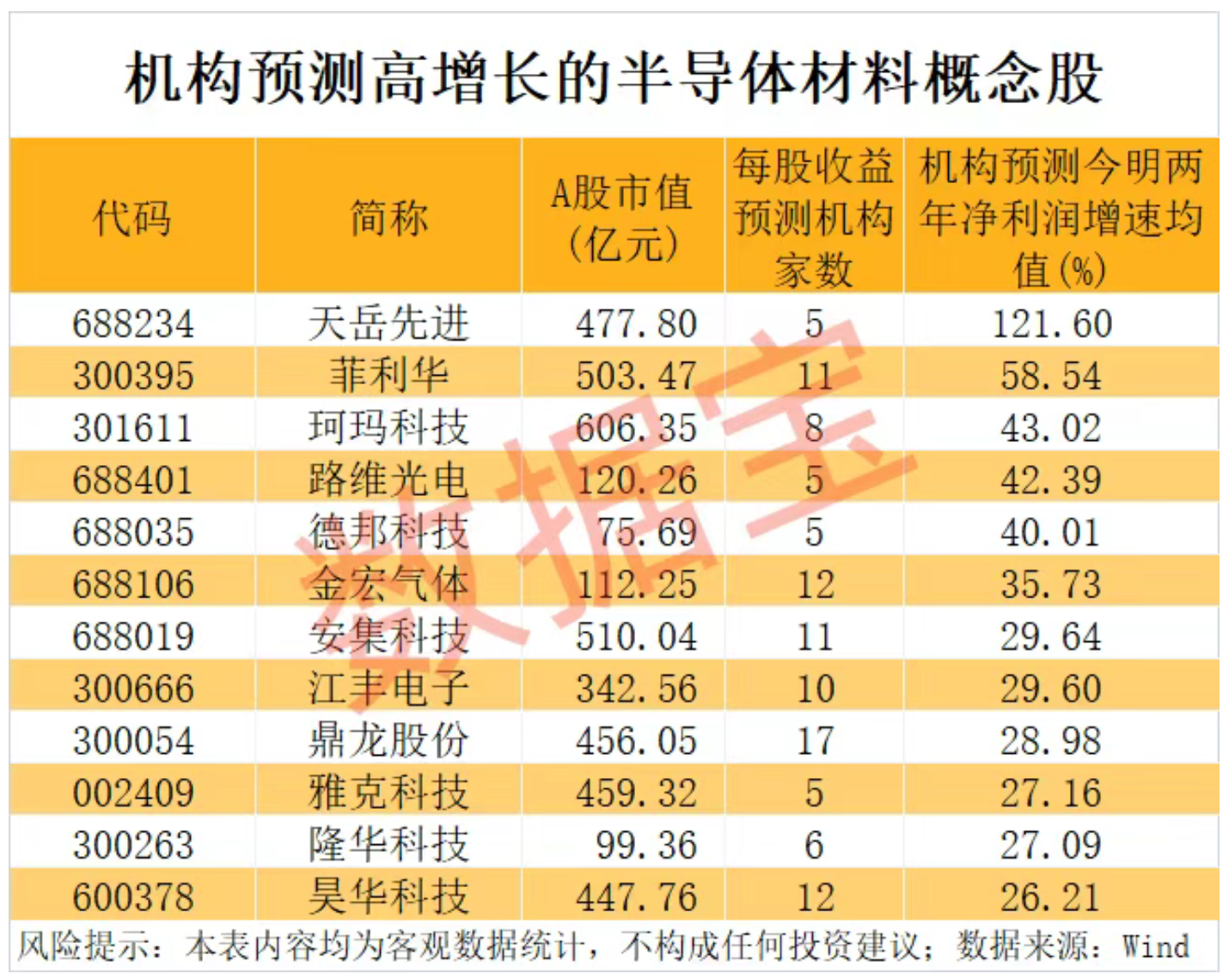
半导体材料概念取得开门红 机构预测高增长半导体材料概念股梳理
Zheng Quan Shi Bao Wang· 2026-01-17 10:29
Group 1 - The semiconductor materials sector has shown strong performance in the secondary market, with an average increase of 21.15% since the beginning of 2026, significantly outperforming major indices such as the Shanghai Composite Index, ChiNext Index, and STAR Market 50 Index [1] - The current earnings forecast period has shifted investor focus towards performance, particularly in the context of rapid expansion in AI computing power, data centers, and smart driving sectors [1] - According to data, there are 12 semiconductor material stocks expected to achieve a net profit growth rate exceeding 20% in both 2026 and 2027, based on consensus forecasts from five or more institutions [1] Group 2 - Among the 12 high-growth semiconductor material stocks, Debang Technology and Haohua Technology have significant upside potential, with respective increases of 39.21% and 10.86% compared to their target prices as of January 16 [1] - The table lists several semiconductor material stocks along with their market capitalization in billions and the number of institutions providing earnings forecasts, indicating a diverse range of companies in this sector [2] - Notable companies include Tianyue Advanced, Feili Hua, and Kema Technology, with market capitalizations of 477.80 billion, 503.47 billion, and 606.35 billion respectively, highlighting the scale of these firms within the industry [2]
中信证券:26年台积电Capex指引超预期 先进制程国产替代开启国产设备成长大周期
Zhi Tong Cai Jing· 2026-01-17 07:33
Core Viewpoint - TSMC is expected to significantly increase its capital expenditure to $52-56 billion in 2026, exceeding market expectations, which indicates an early start to the 2nm process mass production cycle [1][3]. Group 1: Financial Performance - In 2025, TSMC is projected to achieve record revenue of $122 billion, a year-on-year increase of 35.9%, driven by strong demand in AI and HPC, with a gross margin nearing 60% [2]. - The revenue contribution from advanced processes (7nm and below) is expected to reach 77%, with 3nm and 5nm processes contributing 63% of wafer sales [2]. - TSMC's net profit attributable to the parent company is forecasted to reach NT$1.72 trillion, representing over a 30% year-on-year growth, marking a historical high [2]. Group 2: Capital Expenditure - TSMC's capital expenditure for 2025 is set at $40.9 billion, with a more aggressive guidance for 2026 at $52-56 billion, significantly above the previous market expectation of $45-48 billion [1][3]. - Approximately 70%-80% of the 2026 capital expenditure will be allocated to advanced processes, while 10%-20% will be directed towards advanced packaging, testing, and mask manufacturing [3]. Group 3: Market Demand and Supply - The global semiconductor market is projected to grow from $680 billion in 2025 to $1.741 trillion by 2035, with a CAGR of 9.9%, driven by demand from servers, data centers, and storage [4]. - Advanced logic capacity (7nm and below) is expected to grow at a CAGR of approximately 15% from 2025 to 2035, fueled by AI demand [5]. - The domestic semiconductor demand in China accounts for about 35% of the global market, while its production capacity for advanced logic processes is currently less than 5% [6]. Group 4: Domestic Market Dynamics - The domestic semiconductor industry is experiencing a dual drive of "high growth in AI computing power" and "domestic substitution of advanced processes," with a significant capacity gap of over 1 million wafers per month [6]. - The domestic semiconductor equipment localization rate is currently around 30%, with expectations to increase to 60%-70% in the future, indicating substantial growth potential [7]. Group 5: Investment Recommendations - The ongoing large-scale investments in China to fill the advanced capacity gap are expected to create a long-term growth period for domestic equipment manufacturers, independent of global semiconductor cycles [8]. - Focus is recommended on leading companies that have achieved technological breakthroughs in core equipment areas such as etching, thin film deposition, cleaning, and CMP, and have validated their capabilities with major clients [8].


中信证券:26年台积电(TSM.US)Capex指引超预期 先进制程国产替代开启国产设备成长大周期
智通财经网· 2026-01-17 07:32
Core Viewpoint - TSMC is expected to significantly increase its capital expenditure to $52-56 billion in 2026, exceeding market expectations, which indicates an early start to the 2nm process mass production cycle [1][3]. Group 1: Financial Performance - In 2025, TSMC is projected to achieve record revenue of $122 billion, a year-on-year increase of 35.9%, driven by strong demand in AI and HPC, with a gross margin nearing 60% [2]. - The revenue contribution from advanced processes (7nm and below) is expected to reach 77%, with 3nm and 5nm processes contributing 63% of wafer sales [2]. - The net profit attributable to the parent company is forecasted to reach NT$1.72 trillion, marking a growth of over 30% year-on-year, setting a historical high [2]. Group 2: Capital Expenditure Insights - TSMC's capital expenditure for 2025 is set at $40.9 billion, with a more aggressive guidance for 2026 at $52-56 billion, with 70%-80% allocated to advanced processes and 10%-20% for advanced packaging, testing, and mask manufacturing [3]. - This increased investment reflects TSMC's strategic commitment to expanding production capacity in response to the growing demand for AI computing chips [3]. Group 3: Semiconductor Market Trends - The global semiconductor market is projected to grow from $680 billion in 2025 to $1.741 trillion by 2035, with a CAGR of 9.9%, driven by demand from servers, data centers, and storage [4]. - Advanced logic capacity (7nm and below) is expected to grow at a CAGR of approximately 15% from 2025 to 2035, fueled by AI demand [5]. Group 4: Domestic Market Dynamics - China's semiconductor demand accounts for about 35% of the global market, while its production capacity for 7nm and below is less than 5%, indicating a significant potential for capacity expansion [6]. - The domestic semiconductor industry is expected to fill the capacity gap, leading to a market for equipment investments worth hundreds of billions of dollars [6]. Group 5: Equipment Supply Chain and Localization - Domestic wafer fabs are actively building a "non-US" equipment supply chain, providing a growth window for local equipment manufacturers [7]. - The localization rate of semiconductor equipment is expected to increase from 30% to 60%-70% in the coming years, driven by the domestic production of DRAM and 3D NAND [7]. Group 6: Investment Recommendations - The dual drivers of AI demand and domestic substitution are expected to lead to sustained large-scale investments in advanced capacity in China [8]. - Focus is recommended on leading companies that have achieved technological breakthroughs in core equipment areas such as etching, deposition, cleaning, and CMP, which have validated their capabilities with major clients [8].