反内卷

Search documents
“科技叙事”重塑投资逻辑 “反内卷”再造产业生态
Zheng Quan Shi Bao· 2025-12-28 18:03
Group 1: AI and Technology - The launch of DeepSeek-R1 in January 2025 has energized the capital market, establishing AI as the core investment theme for the year, with significant attention on the related industry chain including chips, devices, and applications [3] - The AI industry is shifting from a focus on performance to competition based on cost, efficiency, and commercialization capabilities, allowing small and medium enterprises to build applications quickly using open-source weights [3] - The stock prices of leading AI companies have surged, with notable increases such as the "Yizhongtian" combination exceeding 450% in annual growth, and the stock price of Cambrian Technology surpassing that of Kweichow Moutai at one point [3] Group 2: Film and Entertainment - The film "Nezha 2" released in early 2025 achieved a box office of 15.4 billion yuan, breaking domestic records and entering the global top five, leading to a significant stock price increase for its producer, Light Media [4] - The success of "Nezha 2" reflects the potential of the Chinese animation film industry, with several other animated films also performing well at the box office [4] - The overall domestic film box office reached over 50 billion yuan in 2025, a 75 billion yuan increase from 2024, with total viewership reaching 1.2 billion, indicating a recovery in the film industry [4] Group 3: Robotics - The humanoid robot industry entered a commercialized phase in 2025, with significant orders indicating a shift towards scalable applications, including over 46 billion yuan in total orders and more than 20,000 units sold [5] - The applications of humanoid robots are expanding from industrial settings to service sectors, creating a collaborative development environment across the entire industry chain [5] - The commercialization of humanoid robots has attracted substantial investment and resources, laying a solid foundation for the industry's long-term growth [5] Group 4: Stock Market Dynamics - The competition for the title of "stock king" in the A-share market saw Cambrian Technology and Kweichow Moutai vying for dominance, reflecting a shift in investor preference from traditional consumer sectors to high-growth technology sectors [7] - Cambrian Technology's stock price initially surpassed Kweichow Moutai's, indicating a recognition of the growth potential in tech innovation, but later fluctuations in stock prices highlighted the volatility of market preferences [7] Group 5: Food Delivery Industry - The food delivery industry experienced intense competition in 2025, initiated by JD's entry with a no-commission model, prompting other platforms to enhance rider benefits and engage in large-scale subsidies [8] - This subsidy war led to significant challenges for merchants and platforms, with Meituan reporting a 2% revenue growth despite record user numbers, indicating the pressure on profitability [8] - Regulatory bodies intervened to address the chaotic competition, leading to commitments from major platforms to curb harmful practices and signaling a transition to a more rational development phase in the industry [8] Group 6: Semiconductor and AI Chip Industry - The domestic GPU industry marked a significant milestone with the listing of multiple companies, including Moer Technology and Muxi Technology, indicating a collective movement towards self-sufficiency in AI chips [10] - The semiconductor sector is experiencing a wave of mergers and acquisitions, reflecting a strategic shift from "domestic substitution" to becoming "globally competitive" [10] - The introduction of new listing standards for the Sci-Tech Innovation Board has further supported the growth of emerging industries, enhancing the capital market's backing for innovation [11] Group 7: Dividend Trends - A-share companies have shown a significant increase in dividend payouts, with total cash dividends reaching 2.61 trillion yuan in 2025, surpassing the previous year's total and setting a new record [12] - The growing trend of companies participating in dividend distributions reflects an improvement in overall profitability and a commitment to shareholder returns [12] Group 8: Lithium Battery Industry - The lithium battery industry has seen a rebound in prices due to a collective effort to combat "involution" competition, with significant price increases in lithium carbonate and hexafluorophosphate [13] - The industry is undergoing a transformation towards more sustainable practices, with regulatory measures aimed at stabilizing prices and promoting orderly competition [13] Group 9: Charging Battery Industry - The charging battery industry is entering a new phase of orderly development following a series of recalls by major brands due to safety concerns, highlighting the consequences of intense competition [14] - Regulatory changes and new certification rules are being implemented to enhance oversight and ensure product safety, marking a shift towards more responsible industry practices [14]




周期板块驱动逻辑生变 基金经理看好2026年机会
Zheng Quan Shi Bao· 2025-12-28 18:02
证券时报记者 李明珠 在全球经济格局重塑与产业变革浪潮的交织下,2025年以来,以有色金属为代表的周期板块强势崛起,成为资本 市场一道亮丽的风景线。临近年尾,全球贵金属市场再度迎来历史性行情。金银价格屡创新高,铜铝等工业金属 走势强劲,市场情绪持续高涨。与有色金属相关的基金产品,也纷纷迎来大涨。 Wind数据显示,截至12月28日,有色金属(申万)年内累计上涨93.94%,接近翻倍,在31个申万一级行业中位居 第一。展望2026年,多家基金经理观点均指向一个共识:周期板块,尤其是有色金属领域,正步入一个由"新质生 产力"的强势需求主导、供给长期受限、驱动因素多元化的牛市新格局。 有色主题基金走势抢眼 12月26日,国际金银价格同步创下历史新高,其中伦敦金现货最高触及4549.9美元/盎司,年内累计涨幅已超过 70%。白银表现更为亮眼,12月19日至26日连续五个交易日大涨,当日盘中最高触及79.4美元/盎司,年内涨幅超 170%。 基金方面,国内跟踪黄金的ETF产品以及跟踪白银期货的基金产品,也都表现亮眼。例如,华安黄金ETF今年以来 涨幅超过62%,国投瑞银白银LOF今年以来涨幅超187%。 从世界白银协会 ...
周末,全是利好!史诗级行情,刚刚宣布,暂停申购!
Zhong Guo Ji Jin Bao· 2025-12-28 15:35
Group 1: Fiscal Policy and Economic Support - The Ministry of Finance will continue to implement a more proactive fiscal policy in 2026, expanding fiscal expenditure and optimizing government bond tools to enhance their effectiveness [1][2] - The Ministry of Finance plans to support consumption by arranging funds for the replacement of old consumer goods and adjusting subsidy standards [2] Group 2: Financial Market and Investment Environment - The People's Bank of China aims to improve the institutional and policy environment for long-term investments, significantly increasing the scale and proportion of various long-term funds invested in A-shares [3] - The Shanghai Stock Exchange has introduced a series of fee reduction measures for 2026, expecting a total reduction of approximately 1.113 billion yuan [8] Group 3: Industry-Specific Developments - The National Internet Information Office has drafted interim measures for the management of AI humanoid interactive services to promote healthy development and regulation [7] - The Shanghai Stock Exchange has released detailed rules for commercial rocket enterprises to better support high-quality companies in the commercial space sector [5] - The State Administration for Market Regulation is guiding compliance in the photovoltaic industry to address issues of price competition and low-quality competition [6] Group 4: Market Trends and Investment Strategies - Major brokerages are observing a "small volatility" in the A-share market, with significant trading volume and a focus on sectors like non-ferrous metals and commercial aerospace [20] - Analysts suggest that the upcoming spring market may present opportunities, particularly in sectors with structural growth potential such as chemicals and engineering machinery [11][14] - The trend of rising prices across various industries is expected to continue, driven by liquidity and supply-side changes [15]
【十大券商一周策略】A股跨年行情已经启动,新的主线浮出水面
券商中国· 2025-12-28 14:59
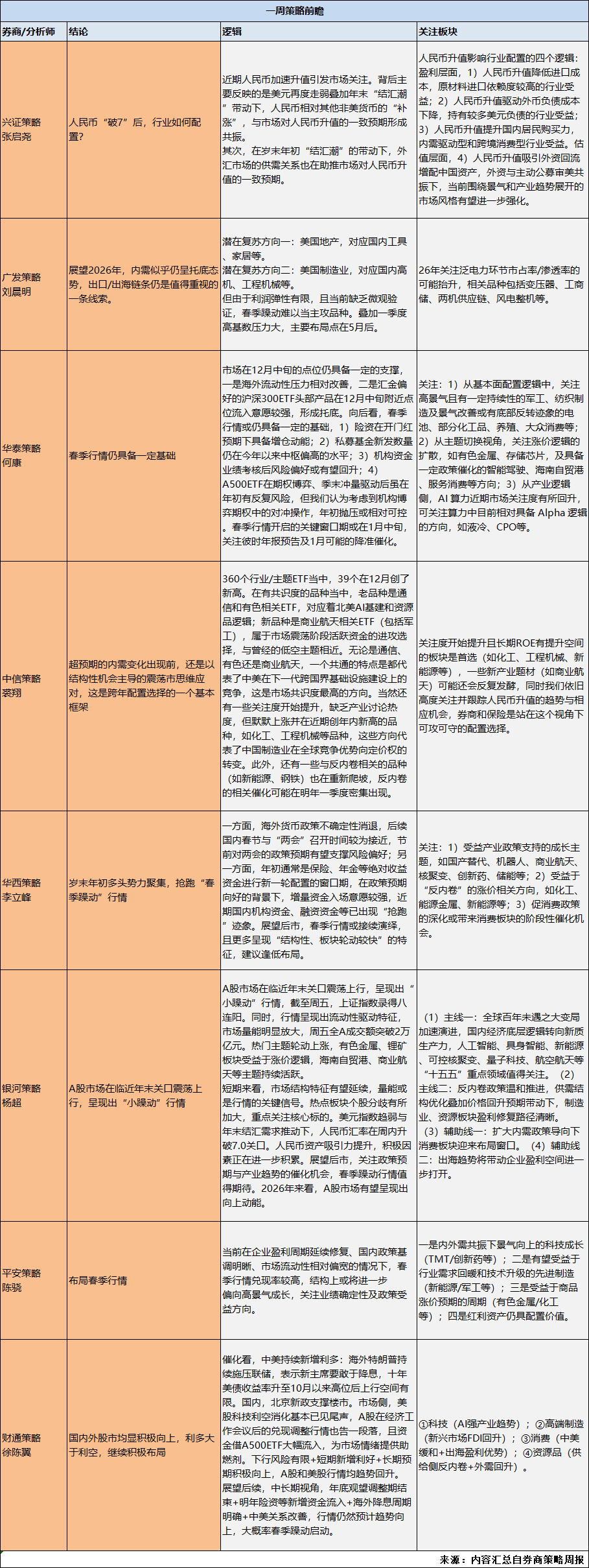
Group 1 - The article highlights that among 360 industry/theme ETFs, 39 reached new highs in December, with established sectors like telecommunications and non-ferrous metals reflecting North American AI infrastructure and resource logic, while new sectors like commercial aerospace are gaining attention during market fluctuations [2] - The focus is on structural opportunities in a volatile market, with sectors like chemicals, engineering machinery, and new energy being prioritized due to their long-term ROE potential, alongside emerging themes like commercial aerospace [3] - The article emphasizes the importance of the RMB appreciation trend and its implications for investment strategies, particularly in brokerage and insurance sectors [3] Group 2 - The article discusses favorable conditions for the spring market rally, driven by liquidity and investor expectations, with a focus on the A500 ETF and potential market fluctuations at year-end and early next year [4] - It notes that the RMB's recent strength, driven by corporate settlement demand and a favorable external environment, could lead to a capital market rally, benefiting sectors reliant on imported materials and those with significant foreign currency liabilities [6] - The article identifies new investment themes emerging in the commodity market and manufacturing sectors, particularly in AI and global manufacturing recovery, recommending investments in industrial resources and equipment exports [8] Group 3 - The article indicates that the A-share market has entered a cross-year rally phase, supported by optimistic institutional investor sentiment and favorable policy expectations [9] - It suggests that the spring market is likely to exhibit structural characteristics with rapid sector rotation, encouraging investors to adopt a low-buying strategy [13][14] - The article highlights the potential for a continued upward trend in the market leading up to the Spring Festival, with a focus on technology themes and non-bank financial sectors [15]

开源晨会-20251228
KAIYUAN SECURITIES· 2025-12-28 14:46
Core Insights - The report highlights a continued slowdown in corporate profits, with the cumulative profit of large-scale industrial enterprises in China showing a year-on-year increase of only 0.1% from January to November 2025, down from 1.9% in the previous period [3] - The report suggests that the current economic environment is characterized by a weak demand, necessitating further policy support to stimulate internal demand and address rising inventory levels [6][25] - The report emphasizes the importance of the upcoming spring market rally, suggesting a dual focus on technology and cyclical sectors for investment strategies [12] Macro Economic Analysis - The cumulative operating revenue of large-scale industrial enterprises from January to November 2025 increased by 1.6%, a slight decrease from the previous year's 1.8% [3] - November's profit margin saw a significant decline, with a year-on-year drop of 13.1%, indicating a challenging environment for industrial profitability [4] - The report notes that the inventory-to-sales ratio has risen significantly, indicating a need for policy intervention to stimulate demand [6] Industry Insights Chemical Industry - The report indicates an overall upward trend in the polyester industry chain, driven by rising prices of PX and PTA, with PX prices increasing by 6.97% and PTA by 8.95% as of December 26, 2025 [35] - The report highlights the importance of the "anti-involution" policy in supporting price stability and profitability within the chemical sector [36] Real Estate - The report notes a month-on-month increase in new and second-hand housing transaction areas, with Beijing further optimizing housing purchase restrictions [40] - The report indicates that various policies aimed at stabilizing the real estate market are beginning to take effect, contributing to a gradual recovery in housing prices [41] Electronics - The electronics sector is experiencing a high level of prosperity, with significant price increases expected in storage components, driven by strong demand and supply constraints [46][49] - The report highlights the positive performance of semiconductor stocks, with notable increases in stock prices for major players like SK Hynix and Micron [46] Biotechnology - The report discusses the upcoming IPO of Rebio Biotech, which focuses on innovative siRNA technology platforms for treating chronic diseases and cancers [52][54] - The company has established multiple clinical research pipelines and has secured significant partnerships with major pharmaceutical firms, indicating strong growth potential [55]


跨年行情如何布局?六大机构最新策略出炉
Xin Lang Cai Jing· 2025-12-28 14:15
Market Outlook - The A-share market is expected to continue a structural opportunity-driven volatile market approach as the year-end trading concludes, with key signals from trading volume [1][5] - The focus is on sectors with low holding concentration and potential for long-term ROE improvement, such as commercial aerospace and other trending themes [1][5] Fiscal Policy - The National Fiscal Work Conference has decided to continue implementing a more proactive fiscal policy in 2026, which includes expanding fiscal spending, optimizing government bond tools, and enhancing the effectiveness of transfer payments [2] Industrial Profit - From January to November, the total profit of large-scale industrial enterprises reached 66,268.6 billion yuan, showing a year-on-year growth of 0.1%, with cumulative growth maintained for four consecutive months since August [3] ETF Market - The total scale of domestic ETFs has reached a historical high of 6.03 trillion yuan, with stock ETFs exceeding 3.8 trillion yuan and cross-border ETFs over 930 billion yuan [4] Investment Strategies - Citic Securities suggests a focus on sectors with low holding concentration and rising market attention, such as chemicals, engineering machinery, and new energy, while also monitoring the trend of RMB appreciation [5] - Industrial sectors benefiting from RMB appreciation include AI hardware, advantageous manufacturing, and non-ferrous metals, as well as upstream resource products like steel and chemicals [6] - China Galaxy emphasizes that trading volume will be a key signal for market trends, recommending defensive sectors and focusing on new production capabilities in AI, renewable energy, and aerospace [7] Economic Expectations - The low-altitude economy is highlighted as a key investment theme, with expectations for a spring market rally in 2026 driven by stable macroeconomic conditions and abundant global liquidity [8] - Investment in infrastructure and real estate is anticipated to drive cyclical price increases, while service consumption is also recommended as a focus area [8]
去库信号仍待观察
CAITONG SECURITIES· 2025-12-28 13:21
Profit Trends - In November, the profit of industrial enterprises decreased by 13.1% year-on-year, a significant drop from the previous value of -5.5%[5] - The profit margin for industrial enterprises in November was approximately 5.7%, which is significantly lower than seasonal levels[12] - The total profit for industrial enterprises in November was 676.6 billion yuan, marking the lowest level for the same period since 2021[12] Price and Cost Dynamics - The Producer Price Index (PPI) in November fell by 2.2% year-on-year, widening from a decline of 2.1% in October[9] - The cost per 100 yuan of revenue for industrial enterprises increased to 85.5 yuan, up by 0.16 yuan year-on-year[29] - The unit revenue expense for the first eleven months was 8.39 yuan, a slight decrease of 0.01 yuan year-on-year[32] Inventory Insights - As of the end of November, the inventory of finished products for industrial enterprises increased by 4.6% year-on-year, with a 0.9 percentage point rise from October[33] - The actual inventory growth rate, excluding PPI effects, was 6.8%, slightly up from 5.8% in October[33] - The PMI data indicated a divergence, showing a decrease in inventory while actual inventory levels were still rising, suggesting unclear signals regarding destocking[33] Sector Performance - The upstream mining sector showed significant improvement with revenue growth of 5.3% and profit growth of 24.4% in November[23] - The midstream intermediate goods manufacturing sector faced challenges, with revenue and profit growth rates of -10.7% and -21.2%, respectively[26] - The downstream consumer goods manufacturing sector reported a profit margin of 11.7%, but revenue and profit growth were both negative at -12.2% and -22.6%[27]
A股分析师前瞻:多头势力聚集,“春季躁动”有望抢跑
Xuan Gu Bao· 2025-12-28 13:08
Core Viewpoint - Overall optimism remains among brokerage strategy analysts, with expectations for a "spring rally" as domestic policies and market conditions align favorably [1] Group 1: Market Trends - The A-share market is experiencing a "small rally" as it approaches year-end, with the Shanghai Composite Index recording eight consecutive days of gains [1] - Market liquidity is increasing, with total trading volume in the A-share market exceeding 2 trillion yuan on Friday [1][3] - Analysts suggest that the current market structure may continue, with trading volume being a key indicator of market trends [3] Group 2: Currency Impact - The recent appreciation of the RMB is drawing market attention, with four key implications for industry allocation: 1. Lower import costs benefiting industries reliant on imported raw materials [2] 2. Decreased foreign currency debt costs benefiting industries with significant USD liabilities [2] 3. Enhanced domestic purchasing power benefiting demand-driven and cross-border consumption industries [2] 4. Attraction of foreign capital back to Chinese assets due to RMB appreciation, potentially reinforcing market styles focused on economic trends [2][3] Group 3: Sector Focus - Analysts highlight several sectors for potential investment, including: - High-demand sectors such as military, textiles, and chemicals, which may show signs of recovery [3] - Industries benefiting from policy support, such as domestic substitution, robotics, and commercial aerospace [4] - Growth sectors like advanced manufacturing and technology, which are expected to benefit from economic recovery and policy clarity [5]
石油化工行业周报第434期(20251222—20251228):25年周期景气下行龙头优势明显,26年继续看好行业龙头穿越周期-20251228
EBSCN· 2025-12-28 13:02
Investment Rating - The report maintains an "Overweight" rating for the petrochemical sector [4] Core Viewpoints - The 2025 CITIC Petrochemical Index recorded an annual increase of 15.1%, underperforming compared to the CSI 300 and Wind All A indices, with an excess return rate of -6.8% [8][11] - The "Big Three" oil companies demonstrated resilience during periods of oil price fluctuations, with their stock prices recovering in the second half of 2025 [13][21] - The refining and chemical fiber sector showed strong stock performance, with key companies benefiting from a recovery in demand and policy support [18][22] - The coal chemical industry is expected to improve profitability due to a downward trend in coal prices and accelerated industrial upgrades [23] Summary by Sections Petrochemical Sector - The CITIC Petrochemical Index's performance was significantly impacted by oil price expectations, with a notable decline in the first half of 2025 due to OPEC+ production increases [8][11] - The "Big Three" oil companies (China National Petroleum, Sinopec, and CNOOC) achieved stable performance and cash flow despite challenges, with stock price changes of +16.3%, -9.8%, and +0.7% respectively [13][21] - The refining and chemical fiber sector saw strong stock price increases, with Hengli Petrochemical, Rongsheng Petrochemical, and Dongfang Shenghong rising by 43.6%, 22.9%, and 30.6% respectively [18][19] Coal Chemical Sector - The coal market has seen a gradual easing of supply and demand, with average prices for coking coal, thermal coal, and anthracite at 1700 RMB/ton, 677 RMB/ton, and 931 RMB/ton respectively, reflecting changes of +11.1%, -11.3%, and -10.5% year-to-date [23] - The modern coal chemical industry is expected to develop positively, driven by the need for green transformation and deep clean utilization of coal resources [23] Investment Recommendations - The report suggests focusing on the "Big Three" oil companies and their subsidiaries in the oil service sector, as well as leading companies in the refining-chemical fiber and coal chemical industries [3][21]



石油化工行业周报(2025/12/22—2025/12/28):PX供需偏紧景气回暖,PTA供给支撑毛利修复-20251228
Shenwan Hongyuan Securities· 2025-12-28 12:23
Investment Rating - The report provides a "C" investment rating for the petrochemical industry, indicating a cautious outlook for investment opportunities [2]. Core Insights - The PX supply-demand balance is expected to tighten in the first half of 2026, leading to a recovery in market conditions. The operating rate is projected to improve from 78% in 2023 to over 85% [3][11]. - The PTA industry has reached the end of its capital expenditure cycle, with no new capacity expected until mid-2027. The current industry is entering a phase of coordinated production cuts, which may reduce PX demand [11][12]. - The downstream polyester sector is gradually tightening, with expectations for improved market conditions. Recommended companies include Tongkun Co. and Wankai New Materials [16]. Summary by Sections PX Supply and Demand - PX supply-demand is expected to be tight in the first half of 2026, with a significant recovery in market conditions anticipated. The operating rate is projected to rise from 78% in 2023 to over 85% [3][11]. - There are no large-scale new capacity plans in the short term, and maintenance seasons for domestic refineries may create temporary supply gaps [3]. PTA Industry Overview - The PTA industry's capacity increased from 46.08 million tons in 2018 to 86.02 million tons in 2024, with an average annual growth rate of 11%. The current capacity accounts for about 75% of global PTA capacity [11]. - The PTA industry is expected to enter a phase of coordinated production cuts, which may weaken PX demand [11][12]. Investment Recommendations - The report recommends focusing on high-quality companies in the polyester sector, such as Tongkun Co. and Wankai New Materials, as well as large refining companies like Hengli Petrochemical and Rongsheng Petrochemical [16]. - The upstream exploration and development sector remains highly prosperous, with expectations for continued high capital expenditure in offshore services, recommending companies like CNOOC Services and Haiyou Engineering [16].