
反内卷政策

Search documents
宏观国债月报:通缩压力有所缓和,内需仍为主要矛盾-20250901
Zhe Shang Qi Huo· 2025-09-01 08:32
Report Investment Rating - Not provided in the given content Core Views - **10 - year Treasury Bonds**: Expected to trade in a range of [107, 108.5] for the T2512 contract. The reasons include the "stock - bond seesaw" effect leading to a rise in risk appetite, more redemptions of bond funds driving up interest rates, moderately loose monetary policy with the central bank maintaining neutral - to - loose liquidity, and the economic slowdown in June with weak domestic demand and external shocks. Key data to watch are the August economic data [7]. - **2 - year Treasury Bonds**: Forecasted to trade in a range of [102, 102.7] for the TS2512 contract. Logic involves improved liquidity with the central bank conducting outright reverse repurchase operations, the moderately loose monetary policy stance set by the Politburo meeting in July, and the "stock - bond seesaw" impact on risk appetite and bond fund redemptions. Data to focus on are central bank LPR rate changes, central bank monetary policy shifts, and August economic data [7]. - **5 - year Treasury Bonds**: Predicted to trade in a range of [104.6, 106.1] for the TF2512 contract. The factors are improved liquidity, the moderately loose monetary policy from the July Politburo meeting, and the "stock - bond seesaw" effect. Key data includes central bank monetary policy operations, central bank LPR rate changes, and August economic data [12]. - **30 - year Treasury Bonds**: Expected to trade in a range of [114, 118] for the TL2512 contract. Reasons are the "stock - bond seesaw" effect, moderately loose monetary policy, and the economic slowdown in June with weak domestic demand and external shocks. The key data to monitor is the August economic data [12]. Summary by Directory Economic Situation - **Consumption**: Short - term consumption declined slightly. In July, the total retail sales of consumer goods were 3.878 trillion yuan, a 3.7% year - on - year increase. Excluding automobiles, it was 3.4931 trillion yuan, a 4.3% increase. From January to July, the total retail sales of consumer goods were 28.4238 trillion yuan, a 4.8% increase, and excluding automobiles, it was 25.7014 trillion yuan, a 5.3% increase [23]. - **Investment**: Investment growth slowed. From January to July 2025, national fixed - asset investment (excluding rural households) was 28.8229 trillion yuan, a 1.6% year - on - year increase. Private fixed - asset investment decreased by 1.5%. Manufacturing investment grew by 6.2%, infrastructure investment (excluding electricity, heat, gas, and water production and supply) increased by 3.2%, and real estate development investment was 535.8 billion yuan, a 12.0% decrease. In July, manufacturing investment growth dropped to 6.2%, a 1.3% decline from the previous month, and high - tech service industries also declined [23][27]. - **Exports and Imports**: In July 2025, China's total import and export value increased by 6.7% year - on - year, accelerating for two consecutive months. Exports in US dollars increased by 7.2%, and imports increased by 4.1%. Mechanical and electrical products' exports in the first seven months increased by 9.3%, accounting for 60% of total exports. Integrated circuit exports increased by 29.2%, industrial robots by 62.2%, and automobile exports by 10.9%. The combined exports of new - energy vehicles, lithium batteries, and photovoltaic products increased by 14.9% [41]. - **Real Estate**: In June, the real - estate investment growth rate continued to decline. The cumulative year - on - year decline in new housing construction area was 19.5%, with a slightly narrowed decline, and the cumulative year - on - year decline in commercial housing sales area was 4%, with an expanded decline [43]. Inflation Indicators - **CPI**: In July 2025, the national consumer price index was flat year - on - year, a 0.1 - percentage - point decline from June. Core CPI increased by 0.8% year - on - year, rising for three consecutive months and reaching a new high since March 2024. Food prices were a major drag, with a 1.6% year - on - year decrease in July, and service prices increased by 0.5% year - on - year, indicating strong summer consumption [49]. - **PPI**: In July 2025, the national producer price index for industrial products and purchase prices decreased by 3.6% year - on - year, the same as the previous month [48]. Policy Expectations - **Monetary Policy**: The Politburo meeting continued the general tone of "seeking progress while maintaining stability," emphasizing policy continuity, stability, flexibility, and predictability. Monetary policy focused on structural tools to support scientific and technological innovation, small and micro - enterprises, and reduce social financing costs [47]. - **Fiscal Policy**: Fiscal policy focused on accelerating the issuance and use of government bonds, improving capital efficiency, and ensuring the "three guarantees" at the grass - roots level [47]. Overseas Data - **US Economy**: In the second quarter of 2025, the US GDP's annualized quarterly growth rate was 3%, a significant rebound from the first quarter. However, the year - on - year growth rate has been lower than the potential GDP growth rate for two consecutive quarters, indicating a still low growth rate [45]. - **US Inflation**: In July 2025, the US CPI increased by 2.7% year - on - year, the same as the previous value and slightly lower than the market expectation of 2.8%. It increased by 0.2% month - on - month, a decline from the previous 0.3%. Energy prices declined, with gasoline prices dropping by 2.2% month - on - month. Core commodity CPI reached a new high since June 2023, and core service inflation remained at 3.6% year - on - year [51]. - **US Employment**: In July 2025, the initial value of new non - farm payrolls was 73,000, significantly lower than the market expectation of 104,000 and a nearly 50% decline from the initial June value. Historical data was revised downward significantly, and the unemployment rate rose to 4.2%, the highest since November 2021 [55]. - **US PMI**: The US ISM manufacturing PMI in July slightly declined to 48%, below the boom - bust line, indicating a decline in manufacturing prosperity after the suspension of interest - rate cuts [57]. - **Fed Monetary Policy**: Market expectations suggest an 85% probability of a Fed interest - rate cut in September, and a high probability of 2 - 3 interest - rate cuts within the year. The Fed paused interest - rate cuts in July, maintaining the federal funds rate target range at 4.25% - 4.50% [62][69]. Other Data - **Interest Rates**: The central bank's outright reverse repurchase operations improved market liquidity. The DR007 rate remained between 1.40% and 1.50%, and inter - bank certificate of deposit rates also remained low and stable [80]. - **Exchange Rates**: In August, the US dollar - to - RMB exchange rate (onshore) fluctuated around 7.17, and the US dollar index remained weak, fluctuating around 97 [83][84]. - **Bond Yields**: In August, the stock market performed well, driving up market risk appetite. The 10 - year Treasury bond yield was around 1.85%, and the 30 - year Treasury bond yield was around 2.14% [88].
2025年8月PMI数据点评:PMI略升:PMI略升
Haitong Securities International· 2025-09-01 08:22
Manufacturing PMI Insights - In August 2025, the Manufacturing PMI slightly increased to 49.4%, up by 0.1 percentage points from the previous month[8] - The production index rose to 50.8%, marking a 0.3 percentage point increase, remaining above the critical point for four consecutive months[14] - New orders index slightly increased to 49.5%, up by 0.1 percentage points, but still in the contraction zone[14] Sector Performance - Large enterprises' PMI rose to 50.8%, up by 0.5 percentage points, while medium and small enterprises' PMIs were 48.9% and 46.6%, respectively[13] - High-tech manufacturing and equipment manufacturing PMIs were 51.9% and 50.5%, respectively, indicating relative strength in these sectors[13] Price and Inventory Trends - The main raw materials purchase price index rose to 53.3%, up by 1.8 percentage points, indicating expansion, while the factory price index was at 49.1%, up by 0.8 percentage points[20] - The procurement volume index increased to 50.4%, up by 0.9 percentage points, while the finished goods inventory index decreased by 0.6 percentage points, reflecting improved production-sales coordination[23] Service and Construction Sector Analysis - The service sector business activity index reached 50.5%, up by 0.5 percentage points, driven by summer travel and active capital markets[24] - The construction sector's business activity index fell to 49.1%, down by 1.5 percentage points, with new orders index at 40.6%, down by 2.1 percentage points, indicating a significant seasonal decline[27] Risk Considerations - Real estate demand remains weak, posing a risk to overall economic recovery[4][29]
明阳智能德国海风订单取消,组件企业海外毛利率下降
Ping An Securities· 2025-09-01 07:38
Investment Rating - The report maintains an "Outperform" rating for the industry [1] Core Insights - The report highlights the cancellation of Mingyang Smart's offshore wind order in Germany, indicating challenges for Chinese wind turbine manufacturers in entering the German market, while still suggesting potential opportunities in other European countries like the UK [5][10][35] - The profitability of leading solar module companies in overseas markets has significantly declined, with JinkoSolar's overseas gross margin dropping from 13.46% to -2.42%, Trina Solar from 17.65% to 3.32%, and LONGi Green Energy from 14.43% to 4.77% [5][38] - The report discusses the competitive landscape in the energy storage sector, noting a recent tender for a large-scale storage system in Inner Mongolia with a bid price range of 0.393 to 0.399 RMB/Wh, indicating a downward trend in pricing [6] Summary by Sections Wind Power - Mingyang Smart has canceled its participation in the Waterkant offshore wind project in Germany, which reflects the difficulties faced by Chinese companies in the German offshore wind market [5][10] - The wind power index increased by 2.06% during the week, underperforming the CSI 300 index by 0.65 percentage points, with a current overall PE ratio of 22.28 [12][18] - The report notes that domestic demand for wind power remains strong, which is expected to improve the overall supply-demand situation and restore profitability for companies in the sector [5][6] Solar Power - Leading solar module companies have reported a significant decline in overseas business profitability, primarily due to trade barriers imposed by the U.S. on Southeast Asian countries [5][38] - The report suggests that the profitability of these companies may have reached a bottom, with potential for recovery as excess capacity is gradually eliminated [5] Energy Storage & Hydrogen - A recent tender for a 5.2GWh energy storage system in Inner Mongolia saw competitive bidding, with prices further declining, indicating a shift towards market-driven pricing in the energy storage sector [6] - The report emphasizes the importance of integrated system solutions for energy storage projects, highlighting the need for a focus on lifecycle costs rather than just initial purchase prices [6] Investment Recommendations - For wind power, the report recommends focusing on domestic demand growth, profitability recovery, and opportunities in offshore wind exports, suggesting companies like Mingyang Smart and Goldwind [5][6] - In solar power, it advises monitoring structural opportunities within the industry, with recommended stocks including Dier Laser and LONGi Green Energy [5] - In energy storage, it highlights opportunities in non-U.S. markets and suggests companies like Sungrow Power and Deye Technology [6]
机构:9月钢市需求改善幅度或有不及预期 钢价料先抑后扬
Xin Hua Cai Jing· 2025-09-01 07:13
Core Viewpoint - The steel industry is experiencing a downward trend in September, with prices under pressure despite the traditional peak season for demand approaching [1][3]. Group 1: Market Conditions - On September 1, the main rebar futures contract fell below 3100 yuan/ton, with the near-month contract hitting a two-month low of 3029 yuan/ton [1]. - Steel inventory has accumulated for four consecutive weeks since the end of July, increasing by 1.04 million tons [1]. - The coal inventory has risen, leading to a temporary decrease in cost lines, while downstream restocking has slowed [1]. Group 2: Demand Analysis - Although there is a seasonal improvement in steel demand expected in September, the extent of this improvement is uncertain and may not meet expectations [1][3]. - The real estate sector continues to face significant downward pressure, with current policies focused on destocking, limiting the impact on construction material consumption [1][2]. Group 3: Supply Dynamics - Steel mills are likely to resume production after initial production cuts, which may lead to an increase in electric arc furnace output in September and October [2]. - The changes in demand and steel mill profits will be the main factors influencing steel supply in September and the fourth quarter [2]. Group 4: Price Forecast - The expected price range for rebar in September is between 3100-3350 yuan/ton, while hot-rolled coil prices are projected to range from 3250-3450 yuan/ton [3]. - Iron ore demand is expected to remain high, but with narrowing steel mill profits and ongoing policies, iron and steel production may decline in the fourth quarter [3].
建信期货宏观市场月报-20250901
Jian Xin Qi Huo· 2025-09-01 06:17
1. Report Industry Investment Rating - Overweight interest rate bonds and gold, moderately allocate credit bonds, blue - chip stocks, and crude oil, and under - allocate growth stocks and currency [4][54] 2. Core Viewpoints of the Report - Trump's leadership in the restructuring of the international trade and monetary system is mostly framed. The Sino - US trade deadlock may continue, the Fed may restart the interest - rate cut process, and China may shift its focus from stabilizing growth to adjusting the economic structure. The macro - environment is relatively favorable for risk assets such as stocks and industrial commodities, slightly favorable for precious metals, and unfavorable for government bonds. However, the A - share market has internal adjustment risks, and bonds may have periodic opportunities [4] 3. Summary According to the Table of Contents 3.1 2025 January - August Macro - market Review - From November 2024 to mid - January 2025, the "Trump trade" boom made the US dollar, US Treasury yields, and US stocks rise, while overseas assets were under pressure. From mid - January to March, the US dollar and US Treasury yields weakened as Trump's reforms caused risks in the US, and overseas assets became more attractive. In early April, Trump's high - tariff announcement triggered a global financial tsunami, followed by a 90 - day suspension. In May, China increased counter - cyclical adjustments, and the global risk appetite gradually recovered from late April to June. Since July, global risk assets have continued to rise, and safe - haven assets have been suppressed [4][6] 3.2 Macro - environment Review 3.2.1 China's External Demand Shows Resilience but Domestic Demand Weakens Across the Board - In July, China's domestic demand weakened due to the diminishing effect of fiscal and monetary stimulus and international trade frictions. However, external demand remained resilient. Investment growth slowed down in multiple sectors, consumption growth declined, industrial output growth weakened, the real - estate market showed mixed signals with high inventory, prices continued to fall, CPI was stable with some fluctuations, PPI continued to decline, new social financing increased, and exports grew due to multiple factors [7][10][19] 3.2.2 New Policies Impact the US Economy into Stagflation - Trump's radical reforms have disrupted the US economic and social order. In July, US employment data deteriorated significantly, the labor participation rate decreased, the unemployment rate increased, inflation showed a complex situation with core CPI rising and some commodity inflation pressures easing, and consumer confidence was affected by trade policies [21][23][26] 3.2.3 China Increases Counter - cyclical Support Policies - In August, China adjusted real - estate policies in core cities, introduced personal and service - sector consumption loan subsidy policies. From January to July, China's fiscal stimulus was strong, but it also led to a rapid increase in the debt - leverage ratio [27][29][34] 3.2.4 The Fed Hints at Restarting the Interest - rate Cut Process - Fed Chairman Powell's speech at the Jackson - Hole meeting hinted at a possible interest - rate cut in September. The market has high expectations for rate cuts this year. Trump is trying to increase his influence on the Fed. In 2026, the Fed's rate - cut pace may slow down based on economic fundamentals, but Trump's influence may accelerate it [35][36][37] 3.3 Asset Market Analysis - China's Treasury bond yields are expected to be weak in the second half of 2025, with a core range of 1.5 - 2% for the 10 - year bond. US Treasury bond yields are likely to remain high and fluctuate, with a core range of 4 - 5% for the 10 - year bond. The US dollar index is expected to decline first and then rise, with a core range of 95 - 105. The RMB exchange - rate index may be under pressure, and the RMB against the US dollar may depreciate. Global stock markets have risen this year, but the A - share market has internal adjustment risks. Commodities are likely to maintain a high - level and wide - range oscillation [42][46][51] 3.4 Medium - term Asset Allocation - From January to August 2025, Chinese stocks, currency, commodities, and bonds had different growth rates. The international trade and monetary system restructuring and domestic liquidity environment have affected asset prices. Based on the current situation, it is recommended to over - allocate interest - rate bonds and gold, moderately allocate credit bonds, blue - chip stocks, and crude oil, and under - allocate growth stocks and currency [52][53][54]
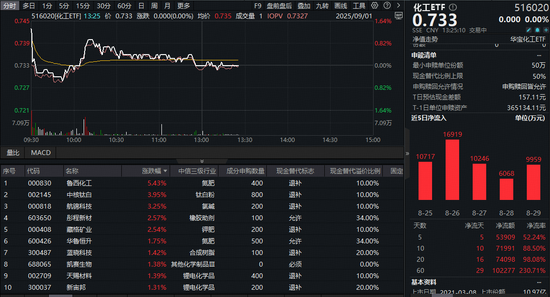
券商二季度加码化工板块!制冷剂价格飙升,低估值板块迎来布局时机?
Xin Lang Ji Jin· 2025-09-01 05:43
Group 1 - The chemical sector experienced fluctuations and a slight decline in the afternoon of September 1, with the chemical ETF (516020) showing similar trends [1] - Key stocks in the sector included Lu Xi Chemical, which rose over 5%, and Zhongke Titanium and Hangjin Technology, both increasing over 3% [1] - Conversely, some stocks in the chemical raw materials sector, such as Hangyang Co. and Lianhong Xinke, fell over 1%, negatively impacting the overall sector performance [1] Group 2 - Following the release of semi-annual reports, brokerages revealed their second-quarter heavy holdings, showing a preference for industries like basic chemicals, machinery, automotive, and biomedicine [3] - The price of refrigerant R32 has been rising, with expectations for stable demand growth in air conditioning due to improved living standards and climate change, leading to a tight supply-demand balance [3] - The chemical ETF (516020) has a price-to-book ratio of 2.26, indicating a low valuation at the 36.86 percentile over the past decade, suggesting attractive long-term investment opportunities [3] Group 3 - Dongfang Securities noted that the "anti-involution" policy is not merely about capacity reduction but aims to eliminate unfair competition through regulatory measures, which could positively impact the chemical industry [4] - The "anti-involution" policy is expected to lead to more targeted policies for the chemical sector, potentially helping the industry recover from its current downturn [4] Group 4 - Guohai Securities anticipates that the "anti-involution" measures will slow down global chemical industry capacity expansion, enhancing the potential dividend yield for Chinese chemical companies [5] - Changes in supply dynamics are expected to halt the decline in industry conditions, allowing chemical stocks to benefit from both high elasticity and high dividend advantages [5] Group 5 - The chemical ETF (516020) tracks the CSI segmented chemical industry theme index, covering various sub-sectors, with nearly 50% of its holdings in large-cap leading stocks like Wanhua Chemical and Salt Lake Co. [6] - The ETF provides an efficient way for investors to gain exposure to the chemical sector, with the remaining 50% of holdings diversified across leading stocks in phosphate, fluorine, and nitrogen sectors [6]



大越期货玻璃周报-20250901
Da Yue Qi Huo· 2025-09-01 05:39
1. Report Industry Investment Rating No relevant content provided. 2. Core Viewpoints of the Report - The glass market fundamentals remain weak, with short - term expectations of a mainly weak and oscillatory trend. The supply has declined to a relatively low level, and there has been a phased reduction in the glass factory's inventory due to downstream replenishment, but the sustainability of this inventory reduction is uncertain, and it is expected that the glass will mainly have a wide - range oscillatory movement [3][7]. 3. Summary by Related Catalogs 3.1 Weekly Glass Futures and Spot Market Conditions - The glass futures showed an oscillatory trend last week. The closing price of the main contract FG2601 increased by 0.77% to 1182 yuan/ton compared to the previous week. The spot price of 5mm white glass sheets in Hebei Shahe was 1060 yuan/ton, a 1.12% decrease from the previous week. The main contract basis was - 122 yuan/ton, a 20.79% increase [2][8][13]. 3.2 Factors Affecting the Glass Market 3.2.1 Positive Factors - Under the influence of the "anti - involution" policy, there are expectations of capacity clearance in the float glass industry [5]. 3.2.2 Negative Factors - The real - estate terminal demand remains weak, and the number of orders for glass deep - processing enterprises is at a historical low for the same period. The capital collection in the deep - processing industry is not optimistic, and traders and processors are cautious, mainly consuming their original inventory. The market sentiment of the "anti - involution" has faded [6]. 3.3 Fundamental Analysis 3.3.1 Supply - The number of operating float glass production lines in the country is 224, with an operating rate of 75.49% and a daily melting volume of 159,600 tons, remaining unchanged from the previous week. The supply has stabilized at a historical low [3]. 3.3.2 Demand - The orders of downstream processing plants remain at a weak level, with no obvious improvement. They mainly purchase based on rigid demand and have no intention to stock up due to the continuous decline in the price of raw glass. As of August 28, the inventory of national float glass enterprises was 62.566 million weight boxes, a 1.64% decrease from the previous week, and the inventory continued to accumulate [3]. 3.3.3 Inventory - The inventory of national float glass enterprises is 62.566 million weight boxes, a 1.64% decrease from the previous week, and the inventory is running above the five - year average [43]. 3.3.4 Supply - Demand Balance Sheet - The report provides a float glass annual supply - demand balance sheet from 2017 to 2024E, including data on production, consumption, production growth rate, consumption growth rate, and net import ratio [44].
合成橡胶:短期跟随宏观情绪区间运行
Guo Tai Jun An Qi Huo· 2025-09-01 02:34
Report Industry Investment Rating - Not provided Core View of the Report - In the short term, with a neutral fundamental outlook, synthetic rubber is expected to trade within a range, facing both upward pressure and downward support. The upward pressure comes from the high - supply situation of cis - butadiene rubber and increased inventory pressure, as well as the relatively high short - term arrival volume of butadiene. The downward support is due to the medium - to long - term "anti - involution" and supply - side optimization policies, which support the overall valuation of commodities and reduce investors' risk appetite for short - selling [4]. Summary by Relevant Catalogs 1. Fundamental Tracking - **Futures Market**: For the cis - butadiene rubber主力 (10 contract), the daily closing price was 11,900 yuan/ton, a decrease of 80 yuan compared to the previous day; the trading volume was 87,677 lots, a decrease of 44,620 lots; the open interest was 35,493 lots, a decrease of 5,585 lots; and the trading volume was 519.883 million yuan, a decrease of 266.886 million yuan. The basis (Shandong cis - butadiene - futures主力) was 50 yuan, an increase of 80 yuan; the monthly spread (BR09 - BR10) was 15 yuan, an increase of 30 yuan [1]. - **Spot Market**: The prices of private cis - butadiene in North China, East China, and South China decreased by 50 yuan, 50 yuan, and 50 yuan respectively. The market price of Shandong cis - butadiene (delivery product) remained unchanged at 11,950 yuan. The price of Qilu styrene - butadiene (model 1502) increased by 50 yuan, while the price of Qilu styrene - butadiene (model 1712) decreased by 100 yuan. The prices of butadiene in Jiangsu and Shandong were 9,400 yuan and 9,525 yuan respectively, with the Shandong price decreasing by 65 yuan [1]. - **Fundamentals**: The cis - butadiene operating rate was 76.0112%, remaining unchanged; the theoretical full cost of cis - butadiene was 12,285 yuan/ton, remaining unchanged; and the cis - butadiene profit was - 185 yuan/ton, remaining unchanged [1]. 2. Industry News - **Inventory Information**: As of August 27, 2025, the latest inventory of butadiene in East China ports was about 24,000 tons, a decrease of 3,300 tons from the previous period. The inventory of high - cis cis - butadiene rubber sample enterprises in China was 31,700 tons, an increase of 1,100 tons from the previous period, a month - on - month increase of 3.63%. The inventory of sample production enterprises increased, while the inventory of sample trading enterprises decreased slightly [3][4]. - **Market Outlook**: In the short term, synthetic rubber is expected to trade within a range, with the market influenced by factors such as the high - supply pattern of cis - butadiene rubber, butadiene arrival volume, and policy support [4].
甲醇:短期偏弱,中期震荡
Guo Tai Jun An Qi Huo· 2025-09-01 02:27
Report Summary 1) Report Industry Investment Rating - The report does not explicitly mention an industry investment rating. 2) Core Viewpoints of the Report - In the short - term, the fundamentals of methanol are under pressure, showing a weak operation. In the medium - term, it is expected to present a volatile pattern. The short - term fundamental contradictions of methanol are significant, with the near - end port inventory continuously and substantially increasing, and there is a risk of tank fullness in South and East China ports. Although the price difference between ports and inland areas is gradually weakening, which may drive the return of port goods to the inland, there is currently no obvious price difference support. In the medium - term, the downward space of methanol is narrowing. The "anti - involution" and supply - side optimization policies have a certain supporting effect on the overall valuation of commodities, and after the commodity valuation enters a reasonable range, investors' risk preference for shorting may significantly decrease. Overall, the short - term fundamentals of methanol have large contradictions and a downward drive, while in the medium - term, with the marginal improvement of the weak fundamentals, methanol may enter an interval - volatile pattern [4][5]. 3) Summary by Related Catalogs [Fundamental Tracking] - **Futures Market**: The closing price of methanol was 2,361 yuan/ton, down 12 yuan from the previous day; the settlement price was 2,370 yuan/ton, up 2 yuan; the trading volume was 419,697 lots, down 41,517 lots; the open interest was 821,019 lots, up 35,186 lots; the number of warehouse receipts was 9,746 tons, down 520 tons; the trading volume was 994.542 million yuan, down 97.621 million yuan. The basis was - 136, up 5; the monthly spread (MA09 - MA01) was - 157, down 9 [2]. - **Spot Market**: The ex - tank price in Jiangsu was 2,260 yuan/ton, down 20 yuan; the price in Inner Mongolia was 2,040 yuan/ton, down 10 yuan; the price in Northern Shaanxi was 2,030 yuan/ton, down 20 yuan; the price in Shandong was 2,260 yuan/ton, unchanged [2]. [Futures Research] - **Inventory Situation**: As of August 27, 2025, the sample inventory of Chinese methanol ports was 1299300 tons, an increase of 223300 tons from the previous period, a month - on - month increase of 20.75%. This week, the methanol port inventory accelerated and significantly increased. There were 393300 tons of visible foreign vessel discharges during the period. Although the提货 in the mainstream storage areas of Jiangsu was relatively stable supported by a small amount of reverse flow to the inland, due to the concentrated discharge of foreign vessels, the inventory still increased significantly. In Zhejiang, one olefin plant remained shut down, but other rigid demands were stable, and the inventory continued to increase with the discharge of foreign vessels. The inventory in South China ports continued to increase. In Guangdong, both imported and domestic vessels arrived at the port, and there were still some vessels being unloaded that were not yet included in the inventory. The local and surrounding downstream consumption remained stable, and the inventory also increased. In Fujian, the downstream demand was average, and the inventory continued to increase under the stable supply of imported cargoes [4]. - **Market Outlook**: In the short - term, the fundamentals are under pressure and the market is in a weak operation. In the medium - term, it is expected to be volatile. The short - term fundamental contradictions are large, and the near - end port inventory continues to increase significantly. There is a risk of tank fullness in South and East China ports. Although the price difference between ports and inland areas may drive the return of port goods to the inland, there is currently no obvious price difference support. In the medium - term, the downward space of methanol is narrowing. The "anti - involution" and supply - side optimization policies have a certain supporting effect on the overall valuation of commodities, and investors' risk preference for shorting may significantly decrease. Overall, the short - term fundamentals have large contradictions and a downward drive, while in the medium - term, with the marginal improvement of the weak fundamentals, methanol may enter an interval - volatile pattern [4][5]. [Trend Intensity] - The trend intensity of methanol is 0, indicating a neutral trend. The trend intensity ranges from - 2 to 2, with - 2 indicating the most bearish and 2 indicating the most bullish [5].
大越期货玻璃早报-20250901
Da Yue Qi Huo· 2025-09-01 02:17
交易咨询业务资格:证监许可【2012】1091号 大越期货投资咨询部 胡毓秀 从业资格证号:F03105325 投资咨询证号:Z0021337 联系方式:0575-85226759 重要提示:本报告非期货交易咨询业务项下服务,其中的观点和信息仅作参考之用,不构成对任何人的投资建议 。 我司不会因为关注、收到或阅读本报告内容而视相关人员为客户;市场有风险,投资需谨慎。 玻璃早报 2025-9-1 每日观点 玻璃: 1、基本面:玻璃生产利润回落,行业冷修速度放缓,开工率、产量下降至历史同期低位;深加工 订单不及往年同期,终端需求偏弱;偏空 2、基差:浮法玻璃河北沙河大板现货1060元/吨,FG2601收盘价为1182元/吨,基差为-122元,期 货升水现货;偏空 3、库存:全国浮法玻璃企业库存6256.60万重量箱,较前一周减少1.64%,库存在5年均值上方运 行;偏空 4、盘面:价格在20日线下方运行,20日线向下;偏空 5、主力持仓:主力持仓净空,空减;偏空 6、预期:玻璃基本面疲弱,短期预计震荡偏弱运行为主。 影响因素总结 利多: 1、"反内卷"政策影响下,浮法玻璃行业存产能出清预期。 利空: 1、地产终端 ...