估值修复

Search documents
瑞银:上调国泰航空目标价15.3港元 维持“买入”评级
Zhi Tong Cai Jing· 2026-01-06 03:13
瑞银发布研报称,基于更高的权益回报率假设,将国泰航空(00293)目标前瞻市账率从1.5倍上调至1.6 倍,相应上调目标价9%,由14港元升至15.3港元。维持"买入",并重申国泰航空是亚太航空业中最看好 之一。 考虑最新收入趋势及盈利指引,该行将其2025年盈利预测(含供应商和解协议带来的9亿港元一次性收 益)上调13%。同时轻微上调2026-2027年盈测2%-5%,主要因调高货运板块收入假设。基于11%的收入 增长和12.4%的营业利润率,瑞银现预计2025年盈利为102亿港元,同比增长6%。目前的前瞻市账率仍 低于2010年末1.6倍的峰值。该行认为,由于市场尚未充分反映其高权益回报率的可持续性,该股存在 估值修复空间。该行预计2025-2027年权益回报率将维持在19%-20%。从股东回报来看,基于50%的派 息比率,估算2025年每股股息为0.76港元,股息收益率达6.1%,即便在2025年股价上涨30%后仍具吸引 力。 国泰航空近期发布的2025年盈利指引大幅超预期。尽管面临高基数、2025年美国关税上调、6月地震恐 慌及11月中旬以来中日地缘紧张升级等因素导致日本航线需求受冲击等挑战,管理层仍 ...

瑞银:上调国泰航空(00293)目标价15.3港元 维持“买入”评级
智通财经网· 2026-01-06 03:13
智通财经APP获悉,瑞银发布研报称,基于更高的权益回报率假设,将国泰航空(00293)目标前瞻市账率 从1.5倍上调至1.6倍,相应上调目标价9%,由14港元升至15.3港元。维持"买入",并重申国泰航空是亚 太航空业中最看好之一。 考虑最新收入趋势及盈利指引,该行将其2025年盈利预测(含供应商和解协议带来的9亿港元一次性收 益)上调13%。同时轻微上调2026-2027年盈测2%-5%,主要因调高货运板块收入假设。基于11%的收入 增长和12.4%的营业利润率,瑞银现预计2025年盈利为102亿港元,同比增长6%。目前的前瞻市账率仍 低于2010年末1.6倍的峰值。该行认为,由于市场尚未充分反映其高权益回报率的可持续性,该股存在 估值修复空间。该行预计2025-2027年权益回报率将维持在19%-20%。从股东回报来看,基于50%的派 息比率,估算2025年每股股息为0.76港元,股息收益率达6.1%,即便在2025年股价上涨30%后仍具吸引 力。 国泰航空近期发布的2025年盈利指引大幅超预期。尽管面临高基数、2025年美国关税上调、6月地震恐 慌及11月中旬以来中日地缘紧张升级等因素导致日本航线需求受 ...
A股“开门红” 三大利好因素将持续发力
Zheng Quan Shi Bao Wang· 2026-01-05 23:23
Core Viewpoint - The A-share market experienced a strong start in 2026, with the Shanghai Composite Index rising by 1.38% and achieving a rare 12 consecutive days of gains, surpassing the 4000-point mark [1] Market Performance - The Shanghai Composite Index, Shanghai 50, and Shenzhen Component Index all saw significant increases, reaching new highs [1] - Total trading volume for the day was 2.57 trillion yuan, an increase of over 500 billion yuan compared to the previous trading day [1] Sector Performance - Sectors such as brain-computer interfaces, insurance, healthcare, and technology led the market gains [1] Market Outlook - The comprehensive market surge is attributed to the improvement in fundamentals, the release of policy dividends, and the restoration of liquidity, indicating a sustainable "slow bull" market [1] - The ongoing implementation of "two重" and "two新" policies, along with a shift from "valuation repair" to "earnings realization," is expected to support a positive market trend [1] - Three favorable factors are highlighted: the appreciation of the yuan, the anticipated "15th Five-Year Plan," and the maturation of China's technological development, which are expected to drive the continuation of the technology bull market and the dual impact on profitability and valuation in the consumer sector [1]
银行-保险-券商年度策略
2026-01-05 15:42
Summary of Conference Call Records Industry Overview - **Insurance Industry**: The insurance sector is expected to continue its recovery in 2026, with concerns over interest margin losses easing. Regulatory adjustments have lowered the preset interest rates, and the return on universal insurance products has decreased. Investment returns for insurance stocks are projected to exceed 5%, surpassing the intrinsic value assumptions, indicating a turning point for interest margin losses [1][4]. - **Brokerage Sector**: The brokerage industry is anticipated to benefit from the migration of household deposits, increased market activity, and relaxed regulatory policies. It is expected that the return on equity (ROE) for brokerages will enter an upward cycle from 2025 to 2026, driven by wealth management, investment banking, and international derivatives [1][10]. Key Insights and Arguments - **Investment in A-shares**: Insurance companies are expected to allocate 30% of new premiums to the A-share market annually, resulting in an influx of approximately 300-400 billion yuan, which will support capital market growth and enhance investment returns [1][4]. - **Property Insurance**: The top three property insurance companies maintain a stable market share, with auto insurance being a core growth area. The penetration rate of new energy vehicles is expected to drive an increase in average premiums. China Pacific Insurance anticipates a growth rate of over 4% in auto insurance business, aligning with GDP growth [1][5]. - **Non-auto Insurance Growth**: The non-auto insurance sector is benefiting from increased health insurance coverage, with premium growth expected to approach 10% in 2026 as certain low-base businesses recover. The comprehensive cost ratio for leading insurance companies is projected to stabilize around 97% [1][7]. - **Brokerage Performance Drivers**: Key performance drivers for brokerages include robust growth in wealth management, a recovering investment banking sector, and active proprietary trading. The anticipated improvement in ROE for brokerages could reach 9% under neutral conditions and exceed 10% in optimistic scenarios by 2027 [2][14]. Additional Important Points - **Market Dynamics**: The trend of household deposits moving away from traditional savings products is creating a competitive advantage for participating insurance products, which offer higher returns compared to fixed deposits [1][4]. - **Valuation Recovery**: The insurance sector's valuation is expected to recover significantly, with a potential P/EV (price-to-embedded value) ratio reaching 1.0 in the medium term. The average insurance stock in A-shares has about 40% room for recovery based on 2026 dynamic PEV estimates [8]. - **Recommended Companies**: Key insurance companies to watch include China Ping An, New China Life, China Taiping, China Life, and China Pacific Insurance, with China Ping An being highlighted for its diversified business model and high dividend characteristics [9]. - **Banking Sector Changes**: The banking sector is expected to undergo significant changes driven by policy adjustments, improved fundamentals, and favorable funding conditions, which will support valuation recovery [16]. - **Investment Recommendations**: In the current market environment, it is advisable to focus on stable high-dividend stocks and quality core assets, including major state-owned banks and leading commercial banks [17].

2026保险投资四问四答
2026-01-05 15:42
Summary of Conference Call on the Insurance Industry Industry Overview - The insurance industry is projected to see a maturity of wealth management products reaching 25 trillion, providing room for premium growth, with recent "New Year" data indicating strong performance across companies, suggesting growth potential in the industry [1][3] - Despite profit pressures, historical data shows that industry market value remains stable or increases even in years of declining profit growth, indicating that asset expectations and changes in investment returns are more critical valuation drivers [1][4] Key Insights - Short-term projections indicate that the life insurance market could reach 4.8 trillion by 2026, representing a 10% year-on-year growth, supported by both savings and protection product demands [1][5] - The regulatory requirement for 30% of new premiums to be invested in A-shares is expected to result in an operational net cash flow of approximately 4.8 trillion for life insurance by 2026, translating to an influx of 300 billion to 760 billion into the market [1][6] - The preference for stable income-generating equity assets, such as value stocks and cyclical bottom stocks, is driven by the need to address duration gaps and investment demands in a low-interest-rate environment [1][6] Profitability and Valuation - Profitability in the insurance sector is influenced by the difference between investment returns and liability costs, with a clear trend of improving liability costs, leading to optimistic market sentiment regarding the widening of interest spreads [1][7] - The insurance sector's current valuation is still significantly below a one-time price-to-value (PV) ratio, indicating substantial room for growth, and it is recommended to maintain a focus on the insurance sector over individual stock selection [2][8] Long-term Growth Drivers - The severe shortfall in retirement savings in China compared to the U.S. presents a significant long-term growth opportunity for the insurance sector, with projections suggesting that the proportion of life insurance in retirement assets could increase from 15% to 20% by 2035, maintaining a compound annual growth rate of 10% [1][5] Conclusion - The insurance industry is positioned for both short-term and long-term growth, with favorable regulatory conditions and market dynamics supporting a positive outlook for investment and profitability [1][2][6]
2026年1月份股票组合
Dongguan Securities· 2026-01-05 12:43
Market Overview - In December 2025, the A-share market showed a "high-level fluctuation and structural switching" pattern, with the Shanghai Composite Index rising by 2.06% and the Shenzhen Component Index increasing by 4.17%[7] - The average return of the stock portfolio in December was 6.20%, outperforming the CSI 300 Index, which rose by 2.28%[7] Stock Recommendations - **Hengrui Medicine (600276)**: Closing price at 59.57 CNY, focusing on innovative drugs with a projected EPS of 1.31 CNY for 2025[10][12] - **Luoyang Molybdenum (603993)**: Closing price at 20.00 CNY, benefiting from copper and gold business expansion, with an EPS forecast of 0.88 CNY[15][18] - **Huaxin Cement (600801)**: Closing price at 24.54 CNY, with a focus on overseas expansion and an EPS estimate of 1.42 CNY[19][22] - **Sanmei Co., Ltd. (603379)**: Closing price at 60.72 CNY, specializing in refrigerants, with an EPS forecast of 3.50 CNY[23][27] - **CATL (300750)**: Closing price at 367.26 CNY, with a valuation recovery theme and an EPS estimate of 15.00 CNY[28][31] - **Sungrow Power Supply (300274)**: Closing price at 171.04 CNY, benefiting from favorable conditions in new energy storage, with an EPS forecast of 7.12 CNY[32][35] - **Sany Heavy Industry (600031)**: Closing price at 21.13 CNY, focusing on engineering machinery with an EPS estimate of 0.99 CNY[36][39] - **Inovance Technology (300124)**: Closing price at 75.33 CNY, focusing on industrial control with an EPS forecast of 2.07 CNY[40][42] - **North Huachuang (002371)**: Closing price at 459.08 CNY, specializing in semiconductor equipment with an EPS estimate of 9.95 CNY[43][45] Risks and Considerations - The report indicates a medium to high risk level for the stock portfolio, emphasizing the need for cautious investment decisions based on the accuracy and completeness of the information provided[6][3] - Potential risks include macroeconomic fluctuations, raw material price volatility, and regulatory changes affecting industry dynamics[11][18][19]
有色金属月度策略-20260105
Fang Zheng Zhong Qi Qi Huo· 2026-01-05 06:09
1. Report Industry Investment Rating No relevant content provided. 2. Core Views of the Report - The medium - and long - term upward trend of copper prices remains unchanged. The future copper price center is expected to rise. It is recommended to gradually go long on Shanghai copper at low prices and consider buying out - of - the - money call options in the far - month [3][13]. - Zinc is expected to continue a relatively strong oscillation pattern. It is advisable to go long at low prices or consider a bull spread [4][13]. - For the aluminum industry chain, it is recommended to take a long - biased approach for Shanghai aluminum, alumina, and recycled aluminum alloy, and use out - of - the - money put options for protection [5][14]. - For tin, it is recommended to wait and see or buy at low prices, and pay attention to the impact of other non - ferrous metals, mine conditions, and policy regulations. Consider buying out - of - the - money put options for protection [7]. - Lead is expected to continue to oscillate. A double - selling strategy can be considered [8][15]. - Nickel and stainless steel are likely to continue a relatively strong trend. It is recommended to go long at low prices, but also pay attention to the impact of the US dollar's rise on non - ferrous metals [9][15]. 3. Summary According to the Directory 3.1 First Part: Non - ferrous Metals Operation Logic and Investment Recommendations - **Macro Logic**: During the New Year's Day holiday, non - ferrous metals in the overseas market showed mixed performance. China's manufacturing industry returned to the expansion range, which is positive for industrial product demand. Geopolitical situations fluctuated, and attention should be paid to whether the safe - haven demand will lead to a rise in the US dollar and affect non - ferrous metals. After the holiday, pay attention to the performance of nickel and aluminum [12]. - **Investment Recommendations for Each Metal** - **Copper**: It is affected by factors such as improved US dollar liquidity, inventory contradictions, and valuation repair. The downstream acceptance of high copper prices is increasing, but the supply of copper concentrates in 2026 may be tight. It is recommended to go long at low prices, with a short - term upper pressure range of 105,000 - 110,000 yuan/ton and a lower support range of 95,000 - 96,000 yuan/ton [3][13]. - **Zinc**: The domestic zinc ingot supply is tightening, and it is expected to continue a relatively strong oscillation. The upper pressure is around 23,500 - 23,800 yuan, and the lower support is around 22,800 - 23,000 yuan. It is advisable to go long at low prices [4][13]. - **Aluminum Industry Chain** - **Shanghai Aluminum**: It is recommended to take a long - biased approach, with an upper pressure range of 23,000 - 24,000 yuan and a lower support range of 21,000 - 21,300 yuan [5][14]. - **Alumina**: It is recommended to short at high prices, with an upper pressure range of 2,800 - 3,000 yuan and a lower support range of 2,000 - 2,200 yuan [5][14]. - **Recycled Aluminum Alloy**: It is recommended to take a long - biased approach, with an upper pressure range of 21,500 - 21,800 yuan and a lower support range of 20,000 - 20,400 yuan [5][14]. - **Tin**: It is recommended to wait and see or buy at low prices, with an upper pressure range of 350,000 - 355,000 yuan and a lower support range of 310,000 - 320,000 yuan [7][14]. - **Lead**: It is expected to continue to oscillate, with a lower support around 16,700 - 16,800 yuan and an upper pressure around 17,500 - 17,700 yuan. A double - selling strategy can be considered [8][15]. - **Nickel and Stainless Steel** - **Nickel**: It is likely to continue a relatively strong trend, with an upper pressure around 135,000 - 136,000 yuan and a lower support around 128,000 - 130,000 yuan. It is recommended to go long at low prices [9][15]. - **Stainless Steel**: It is expected to continue to rise, with an upper pressure around 13,000 - 13,200 yuan and a lower support around 12,400 - 12,500 yuan. It is advisable to go long at low prices [9][15]. 3.2 Second Part: Non - ferrous Metals Market Review - The closing prices and price changes of various non - ferrous metals are presented, such as copper closing at 98,240 yuan with a 0.15% increase, and zinc closing at 23,275 yuan with a 0.45% decrease [16]. 3.3 Third Part: Non - ferrous Metals Position Analysis - The latest position analysis of the non - ferrous metals sector is provided, including the net long - short strength comparison, net long - short position differences, changes in net long and short positions, and influencing factors for each variety [18]. 3.4 Fourth Part: Non - ferrous Metals Spot Market - The spot prices and price changes of various non - ferrous metals are given, such as the Yangtze River Non - Ferrous copper spot price at 99,430 yuan/ton with a 1.63% increase, and the Yangtze River Non - Ferrous 0 zinc spot price at 23,330 yuan/ton with a 0.17% increase [20]. 3.5 Fifth Part: Non - ferrous Metals Industry Chain - Graphs related to the industry chain of each non - ferrous metal are presented, including inventory changes, processing fees, and price trends, which help to analyze the supply - demand relationship and price trends of each metal [22][23][27]. 3.6 Sixth Part: Non - ferrous Metals Arbitrage - Graphs related to the arbitrage of each non - ferrous metal are provided, such as the Shanghai - London ratio changes and the basis spreads of copper, zinc, aluminum, and other metals, which can be used for arbitrage analysis [54][59][62]. 3.7 Seventh Part: Non - ferrous Metals Options - Graphs related to the options of each non - ferrous metal are presented, including historical volatility, implied volatility, trading volume, and open interest, which can be used for options trading analysis [72][74][77].
A股展望牛市2.0
IPO日报· 2026-01-04 13:14
Core Viewpoint - The A-share market is expected to continue its bullish trend into 2026, with a projected index increase of 10%, driven by a shift from valuation recovery to profit growth [1][3]. Group 1: Market Outlook - A-shares, Hong Kong stocks, and US stocks are anticipated to maintain a bullish trend, supported by global liquidity easing, economic recovery, rapid development of the AI industry, and rising resource prices [3]. - Analysts predict that A-share companies' profits may grow by 6% in 2025 and further accelerate to 8% in 2026, with a focus on profit realization rather than valuation [3][4]. - Goldman Sachs forecasts a transition from the "hope" phase to the "growth" phase for the Chinese stock market, with a potential 38% increase by the end of 2027, driven by profit growth of 14% in 2026 [3][4]. Group 2: Investment Strategies - Key investment themes for 2026 include technology and resource sectors, with a focus on AI applications, new energy, and materials [5][6]. - Analysts recommend increasing allocations to emerging markets, particularly in sectors benefiting from the weak dollar trend [5]. - Investment directions include technology sectors, consumer sectors driven by profit acceleration, and industries benefiting from "anti-involution" policies [4][6]. Group 3: Market Phases - The market is expected to enter a "prosperity verification phase" in 2026, characterized by a slower index increase and a shift in focus from valuation to fundamental improvements [4]. - The transition from a "bull market 1.0" to "bull market 2.0" is anticipated, with a potential for a comprehensive bull market in the second half of 2026 [3][4]. Group 4: Risk Factors - Analysts highlight concerns regarding insufficient domestic demand and low inflation, which could impact corporate profitability and investment willingness [7]. - Potential risks include the progress of US-China trade negotiations, real estate market developments, and the possibility of an AI bubble affecting the tech sector [7][8].


快讯 | 港股2025观察:IPO募资近2857亿,2026迎估值+盈利双升行情
Sou Hu Cai Jing· 2026-01-04 01:49
2025年港股表现强劲!全年117家新股上市,募资2856.93亿港元,同比分别增67.14%、224.11%,19家A股公司赴港募资占比近半。市场交投活跃,日均 成交额增95%,南向资金净买入1.4万亿港元,恒生指数、恒生科技指数全年分别涨28.89%、24.85%。制度改革持续深化,"科企专线"等吸引优质企业。 展望2026年,机构预计港股迎第二轮估值修复,AI、新能源等为主线,美联储降息预期下,估值与盈利有望双升,港股震荡上行可期。 ...
2025年银行股结构性上涨跑输大盘 2026年市场叙事逻辑如何?
Xin Hua Cai Jing· 2026-01-03 05:25
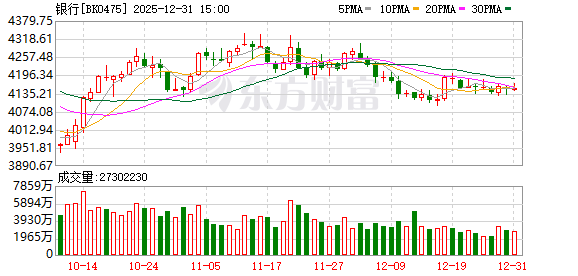
Core Viewpoint - In 2025, A-share bank stocks experienced a "high first, low later" trend, with a total market capitalization exceeding 15 trillion yuan, but overall performance lagged behind the broader market, particularly the CSI 300 index, by over 10 percentage points [2][5][9]. Market Performance - The banking sector's index rose by 7% in 2025, underperforming the CSI 300 index, which reflects a shift from broad-based gains to structural differentiation [2][5]. - The first half of 2025 saw a strong performance, with the banking index increasing by 13.1%, outperforming other major indices, while the second half faced a correction, particularly from July to September, where the index fell by approximately 14% [5][6]. - By the end of 2025, 35 out of 42 bank stocks had risen, with Agricultural Bank of China leading with a 52.66% increase, followed by Xiamen Bank at 35.78% and Shanghai Pudong Development Bank at 24.56% [6][9]. Notable Individual Performances - Agricultural Bank of China emerged as a standout performer, surpassing Industrial and Commercial Bank of China in market capitalization for a brief period, reaching 2.55 trillion yuan [7]. - The overall market capitalization of the banking sector reached 15.7 trillion yuan, with significant contributions from major state-owned banks [5][7]. Valuation and Dividend Appeal - The banking sector's price-to-book ratio (PB) improved to 0.62 by the end of 2025, indicating a marginal recovery from the "broken net" situation, with some banks briefly exceeding a PB of 1 [9][10]. - The average dividend yield for bank stocks was 4.99%, significantly higher than the market average and the yield on 10-year Chinese government bonds, making them attractive for long-term investment [9][10]. Future Outlook - Experts suggest that the banking sector is transitioning from "valuation repair" to "value re-evaluation," with future performance dependent on macroeconomic stability, supportive policies, and confirmation of profit turning points [10]. - Predictions for 2026 indicate a stabilization of net interest margins and overall asset quality, although challenges remain in retail and real estate sectors [10].