
杠铃策略

Search documents
【广发策略港股&海外】HIBOR快速攀升对港股有何影响?
Xin Lang Cai Jing· 2025-08-24 23:17
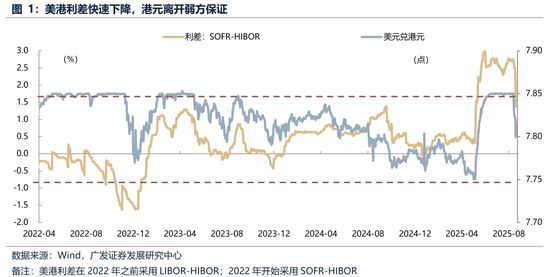
Group 1 - The recent rise in HIBOR is attributed to a contraction in Hong Kong dollar supply and increased demand from southbound capital inflows, leading to a narrowing of the Hong Kong-US interest rate spread and triggering the unwinding of carry trades, which further pushed up HIBOR and the Hong Kong dollar [1][22][23] - Historical data shows that when HIBOR rises by 20 basis points, there is an 81% probability that the Hang Seng Index will decline on the same day, with an average drop of 1.9%, while the Hang Seng Tech Index has a 71% probability of decline with an average drop of 1.1% [4][26][27] - The impact of HIBOR on the Hong Kong stock market is indirect and short-term, primarily affecting financing rates linked to HIBOR, which influences market liquidity and investor behavior [12][39] Group 2 - The current macroeconomic environment, including expectations of US interest rate cuts and a weakening dollar, is favorable for Hong Kong stock market liquidity, supporting the market's performance [15][43] - A "barbell strategy" is recommended for asset allocation, focusing on stable value assets with high AH premium as a long-term base, while also considering growth assets with significant potential [15][47] - Recent trends indicate that southbound capital inflows remain strong, with notable net purchases in major stocks like Alibaba and Meituan, suggesting continued interest in Hong Kong equities [52]

10年高点A股,还能上车吗?
Xin Jing Bao· 2025-08-22 04:37
Market Overview - The A-share market has recently seen a significant rally, with the Shanghai Composite Index surpassing 3600 and 3700 points, reaching 3766.21 points on August 20, marking a 1.04% increase and a new ten-year high in market capitalization [1][3] - The current market sentiment is characterized by a simultaneous rise in high-risk and safe-haven assets, indicating a "double win" scenario for investors [9][10] Comparison with Previous Market Cycles - The current market rally can be compared to the 2015-2016 bull market, which was primarily driven by policy stimulus and aggressive macroeconomic measures, while the current rally is supported by a combination of monetary policy adjustments and emerging technology narratives [4][5] - Key differences include the absence of significant leverage from external sources in the current cycle, with a notable increase in margin trading balances and a shift of bank deposits towards equity markets [4][5] Investment Strategies - The recommended investment strategy is the "barbell strategy," which involves heavy allocation to both risk assets and safe-haven assets, allowing for flexibility in market conditions [10][11] - Investors are encouraged to focus on sectors with strong fundamentals, particularly in technology, healthcare, and military industries, which are expected to continue attracting attention [9][10] Market Dynamics - The current market structure shows a clear shift from real estate-driven growth to technology and manufacturing-led growth, with a focus on "new quality productivity" [9] - The performance of small-cap stocks is driven by a mix of quantitative and market-driven funds, indicating a high level of market activity and rapid rotation of themes [6][9] Future Outlook - The A-share market is expected to maintain its upward trajectory, provided that the underlying fundamentals, liquidity, and technology narratives continue to support the market [5][12] - The potential for further growth exists if retail savings continue to flow into the market and foreign investment increases, although the market remains susceptible to volatility driven by retail investor sentiment [5][6]

十年高点A股还能上车吗?邵宇建议普通投资者这样布局
Bei Ke Cai Jing· 2025-08-22 03:23
连日来,上证指数连续突破3600点、3700点关口,且一度破十年前高点,8月20日,市场主要指数持续走强,上证指数涨1.04%报3766.21点,北证50再次刷 新历史纪录。市场情绪持续高涨,"牛市"之声再起。 站在当前这个关键节点,A股下一步将何去何从?面对如此行情,普通投资者又该如何应对?新京报贝壳财经围绕相关热点话题直播连线国家金融与发展实 验室特聘高级研究员、复旦大学管理学院特聘教授邵宇进行深度解读。 邵宇指出,当前市场出现高风险资产与避险资产齐涨,而债券等资产表现承压的独特现象,股债"跷跷板"效应近日尤为明显,因此推荐投资者采用"杠铃策 略"进行资产配置,其特征在于"进可攻退可守"。 if 国家金融与发展实验室特聘高级研究员、复旦大学管理学院特聘教授邵宇。受访者供图 股市叙事呈现"科技牛"等多元特点 本轮行情起初由政策宽松推动,但随优质科技企业涌现和叙事转向"新质生产力",市场开始分化,具备产业支撑的科技制造板块更具可持续性。 新京报贝壳财经:怎么看待当前的A股市场?与10年前相比,此轮行情有何异同? 邵宇:近期市场行情火热,成交量大幅提高,A股市值也创下新高,引发市场关于"牛市"的讨论。与十年前2 ...

2025 年全球资产配置新趋势解析
Sou Hu Cai Jing· 2025-08-20 08:39
Group 1: Market Overview - The international capital market in August 2025 shows a complex and variable landscape, with stable Federal Reserve interest rate policies impacting major investment categories: stocks, bonds, and gold [1] - The Hong Kong stock market's biopharmaceutical sector continues to perform strongly, with a leading gene editing company experiencing a weekly increase of 12.3%, reaching a year-to-date high [1] - The bond market exhibits a polarized trend, with U.S. ten-year Treasury yields fluctuating between 3.2% and 3.5%, while corporate bonds show significant stratification [1] Group 2: Gold and Alternative Investments - Gold prices have surpassed $2,200 per ounce, marking a historical high, driven by central banks increasing their reserves and a gold mining company reporting a 28% increase in proven reserves, leading to a 17% surge in its stock price [2] - The alternative investment sector is witnessing new trends, with carbon credit derivatives trading volume increasing by 210% month-over-month, and a water rights trading index showing positive growth for three consecutive months [2] Group 3: Fund Flows and Asset Allocation - Cross-border ETFs have seen a record net subscription of 1.5 billion yuan in a week, while REITs products' premium rate has narrowed to 3.2% [3] - Investors are advised to focus on inflation-linked bonds that can effectively hedge against CPI fluctuations, considering three key variables: geopolitical impacts on energy prices, monetary policy divergence among major economies, and the actual productivity gains from artificial intelligence [3] Group 4: Investment Strategies - In response to the complex market environment, professional institutions recommend a barbell strategy, allocating 70% of funds to stable assets and 30% to high-growth sectors, while regularly conducting stress tests to ensure portfolio resilience [4]
法巴银行:美联储9月降息将利好股市,预期恒指下个目标是26500点
Sou Hu Cai Jing· 2025-08-19 01:53
Core Viewpoint - The Federal Reserve is expected to lower interest rates in September under pressure from President Trump and Treasury Secretary Mnuchin, which is likely to benefit the stock market [1] Group 1: Market Outlook - The U.S. money market fund size has reached $7 trillion, and a restart of rate cuts will lead funds to seek new opportunities, aligning with a global rate-cutting cycle that will favor the stock market [1] - The Hang Seng Index's next target is projected to be 26,500 points, with short-term adjustments expected and support around 24,500 points, making it an attractive entry point for investors [1] Group 2: Sector Analysis - Recent earnings and guidance from major tech stocks were positive, which should have been a catalyst for the sector; however, market expectations were high, leading to some stock adjustments, presenting a low-buy opportunity given current valuations are not overly expensive [1] - A barbell strategy is recommended for investors, with recent increases in domestic bank stocks, Chinese telecom stocks, and domestic insurance stocks; however, in a volatile market with ongoing rate cut themes, it remains necessary to hold these related stocks [1]

A股“身价”破100万亿元,是谁在推动市场上涨?
Xin Hua Cai Jing· 2025-08-18 09:28
Market Performance - The Shanghai Composite Index reached a nearly 10-year high, with the Shenzhen Component Index and ChiNext Index also surpassing their previous highs from October 2024, while the North Stock 50 Index set a historical record [1][2] - A-shares' total market capitalization exceeded 100 trillion yuan for the first time, indicating a significant milestone in the market [1][2] Investor Behavior - There is a clear trend of residents accelerating the allocation of wealth towards financial assets, driven by a recovery in market risk appetite and the spread of profit-making effects [1][2] - The number of new A-share accounts opened in July reached 1.9636 million, a 19% increase from June and a 71% increase year-on-year, indicating strong retail investor interest [2] Financing and Deposits - As of August 15, the financing balance on the Shanghai Stock Exchange was 1,037.757 billion yuan, an increase of 3.854 billion yuan from the previous trading day, while the Shenzhen Stock Exchange's financing balance was 1,004.14 billion yuan, up by 3.737 billion yuan [2][3] - The People's Bank of China reported a significant shift in deposits, with household deposits decreasing by 1.1 trillion yuan in July, while non-bank deposits increased by 2.1 trillion yuan, reflecting a "deposit migration" trend [3][4] Institutional Investment - Insurance companies' investment in stocks reached 3.07 trillion yuan by the end of Q2, a 26.38% increase from the beginning of the year, indicating a growing interest from institutional investors [4][5] - The total investment balance of insurance companies was 36.23 trillion yuan, a 17.4% year-on-year increase, highlighting the increasing allocation of funds towards equities [3][4] Market Outlook - The market has seen a shift towards technology growth styles since mid-June, with the Shanghai Composite Index surpassing 3,400 points, indicating a strong bullish trend [5][6] - Analysts suggest focusing on sectors with strong industrial trends, such as innovative pharmaceuticals, resources, communications, military, and gaming, as potential areas for continued growth [7][8]


【财经分析】A股“身价”破100万亿元 是谁在推动市场上涨?
Xin Hua Cai Jing· 2025-08-18 09:15
18日收盘,上证指数创近10年新高,深证成指、创业板指均突破2024年10月8日以来高点,北证50指数 也创历史新高。A股总市值在指数新高中,也首次突破100万亿元大关。 还有近期市场热议的"存款搬家"。8月13日,央行发布的2025年7月金融数据显示,7月人民币存款增加 5000亿元,同比多增1.3万亿,其中住户存款减少1.1万亿元,同比多减7800亿元;非银存款增加2.1万亿 元,同比多增1.4万亿元。 浙商证券首席经济学家李超认为,资本市场回暖与利率下行共同驱动居民存款"搬家",进而带动非银存 款高增,形成居民存款和非银存款的跷跷板效应,1-7月非银存款合计多增4.69万亿元,较去年同期多 增1.73万亿元,7月当月这一结构性趋势延续并放大。此外股票市场活跃,交易量维持高位也使得证券 公司保证金存款增长,对非银存款形成支撑。 天风证券策略首席分析师吴开达表示,非银存款的数据往往能够表征出私人部门在金融市场的配置情 况,在过去的几轮大级别的行情中,非银存款占比都出现显著上行。 从机构资金角度看,险资的"跑步"入场具有一定代表性。近日,国家金融监管总局公布了2025年二季度 保险公司资金运用情况,截至今年二 ...
重阳投资董事长王庆: 应从单一维度转向多元视角看待资本市场
2 1 Shi Ji Jing Ji Bao Dao· 2025-08-18 06:31
Group 1: Market Overview and Trends - The stock market's performance and outlook are analyzed through three dimensions: economic fundamentals, technological innovation, and corporate governance [1][3] - The "9.24" policy has marked a significant turning point for the Chinese capital market, leading to a more rational and diversified understanding of the economy [3][4] - The current market sentiment has shifted towards recognizing technological innovation as a crucial dimension, with China emerging as a global competitor in technology [4] Group 2: Investment Strategies - A "barbell strategy" is suggested as an optimal investment approach, balancing foundational assets that focus on shareholder returns with high-growth sectors like technology, advanced manufacturing, and innovative pharmaceuticals [1][3] - The analysis emphasizes the importance of a multi-dimensional framework for understanding the Chinese economy, incorporating traditional fundamentals, policy support, and technological advancements [4] Group 3: Corporate Behavior and Shareholder Returns - Increasing attention to shareholder returns is noted among listed companies, with a significant rise in dividends and stock buybacks since the second half of 2023 [6] - The concept of net shareholder return rate has been introduced, highlighting that companies are increasingly returning profits to shareholders rather than solely reinvesting [6] - The shift in corporate behavior is attributed to regulatory guidance and proactive measures by companies, reflecting a broader trend observed in European and Japanese markets [6]

杠铃策略转向成长风格ETF止盈资金寻找新方向
Zhong Guo Zheng Quan Bao· 2025-08-17 20:07
Core Insights - The A-share market has shown significant activity, with the Shanghai Composite Index nearing 3700 points, marking a new high since September 2021 [1] - Financial technology, securities, battery, and optical module sectors have performed strongly, while banking and dividend sectors have weakened [2][4] - There is a noticeable trend of profit-taking in ETF investments, with significant outflows from certain technology-focused ETFs [3][4] Market Performance - Over 20 ETFs related to financial technology and other growth sectors saw gains exceeding 10% last week, including those from major fund houses like Huaxia and E Fund [2] - Conversely, several banking and dividend-themed ETFs experienced declines of around 3% [2] ETF Trading Activity - The total trading volume of ETFs approached 2 trillion yuan, with stock and bond ETFs contributing over 500 billion and 700 billion yuan, respectively [3] - The E Fund's Hong Kong Securities Investment ETF reached a record weekly trading volume of nearly 120 billion yuan [3] Fund Flows - There has been a clear trend of profit-taking, with significant outflows from ETFs like Huaxia's STAR 50 and Jiashi's STAR Chip ETFs, despite their price increases [3] - Conversely, funds have flowed into broader market ETFs such as Huaxia's 50 ETF and others focused on non-bank financials and internet sectors [4] Investment Strategy Shifts - The market is shifting from a focus on "banking + micro盘" to a valuation based on fundamental trends, particularly in growth sectors [4] - Analysts suggest a "barbell strategy" is emerging, favoring growth stocks over traditional dividend-paying stocks [4] Future Market Outlook - The market may experience a shift in trading logic, moving from emotion-driven rapid increases to trends supported by fundamentals [5] - Key sectors to watch include technology breakthroughs, high global market share manufacturing, and potentially high-growth areas like pharmaceuticals and new consumption [5]
估值的约束与盈利的潜力
SINOLINK SECURITIES· 2025-08-17 08:24
Group 1 - The report indicates that the current market is approaching a valuation limit, with the PB level of the entire A-share market reaching 1.74, leaving less than 10% space to the historical maximum of 2 times PB during ROE downturns [2][11] - The market has shifted from a focus on banks and micro-cap stocks to a pricing model based on fundamental trends, particularly in growth sectors influenced by industrial trends [2][14] - There is a notable shift from small-cap growth represented by the National Index 2000 to large-cap growth represented by the ChiNext Index, driven by valuation differences and investor focus on profitability [2][16] Group 2 - The domestic economy is currently in a "double weak" phase, with both financial and economic data showing signs of weakness, including a negative growth in loans for the first time since 2005 [3][25] - The report suggests that the decline in investment and production activities is a normal phenomenon during the transition from internal competition to external competition, with a focus on price signals being crucial [3][29] - The report highlights that corporate profitability typically bottoms out before the PPI, indicating a potential recovery in profitability for midstream manufacturing as raw material costs decline faster than factory prices [3][29] Group 3 - The report discusses the inflationary pressures arising from tariffs in the U.S., which have exceeded market expectations, leading to a disturbance in interest rate cut expectations [4][35] - Despite a lower-than-expected CPI, the core CPI slightly exceeded expectations, indicating ongoing inflationary pressures from tariffs [4][35] - The report notes that global manufacturing investment is likely to accelerate, as evidenced by a 3.6% year-on-year increase in Japan's machine tool orders, primarily driven by overseas demand [4][40] Group 4 - The report emphasizes that the core focus of the market remains on profitability, with a shift in investor attention towards fundamental pricing in growth sectors [5][41] - It maintains that the recovery of midstream manufacturing profitability will take time, but the overall direction of fundamental recovery is not in doubt [5][41] - The report recommends focusing on upstream resource products and capital goods that benefit from both overseas manufacturing recovery and domestic policy shifts [5][44]