
地缘政治风险

Search documents
新世纪期货:美联储降息预期升温 金价稳涨逻辑延续
Jin Tou Wang· 2025-12-26 07:05
Macro Messages - The U.S. debt issue has led to cracks in the dollar's monetary credibility, highlighting gold's de-dollarization attributes amid the ongoing process of de-dollarization [1] - In a global high-interest rate environment, gold's role as a zero-yield asset has diminished, reducing its sensitivity to the actual interest rates of U.S. Treasury bonds [1] - Persistent geopolitical risks continue to drive market demand for safe-haven assets, significantly contributing to the short-term rise in gold prices [1] - There has been a notable increase in physical gold demand in China, with the central bank resuming gold purchases since November last year, marking eleven consecutive months of increases [1] Institutional Views - The logic driving the current rise in gold prices remains intact, with the Federal Reserve's interest rate policy and risk aversion likely to be short-term disruptive factors [1] - The Federal Reserve needs to balance employment and inflation indicators, focusing more on job stability; it began a rate-cutting cycle in September, having cut rates three times this year [1] - Recent U.S. data shows mixed signals: November non-farm employment exceeded expectations, while the unemployment rate unexpectedly rose to 4.6% [1] - The September PCE data indicates a decline in inflation, with core PCE year-on-year rising by 2.8%, below market expectations, while November CPI year-on-year increased by 2.7%, lower than expected and down from 3% in September [1] - In the short term, recent U.S. data has strengthened market expectations for rate cuts, with predictions of two rate cuts next year; the Fed's rate-cutting cycle and leadership transition are bullish for gold prices, supported by global central bank gold purchases and geopolitical conflicts [1]
金银铂钯齐创新高!年末流动性、降息周期与地缘风险合力 贵金属市场上演历史性行情
Zhi Tong Cai Jing· 2025-12-26 07:03
Core Viewpoint - The prices of gold, silver, and platinum have reached historical highs due to speculative buying, tightening market liquidity at year-end, expectations of further interest rate cuts by the Federal Reserve, and escalating geopolitical tensions [1][3]. Group 1: Precious Metals Price Movements - As of the latest report, spot gold increased by 0.85% to $4,517.63 per ounce, previously hitting a record high of $4,531.24 per ounce; February futures for gold rose by 0.97% to $4,546.50 per ounce [1]. - Spot silver surged by 4.16% to $74.8705 per ounce, briefly surpassing the $75 mark [4]. - Platinum prices rose over 8% to $2,451.25 per ounce, marking a new historical high, while palladium increased by 5.55% to $1,822.70 per ounce [5]. Group 2: Market Drivers and Future Outlook - The strong performance of gold this year is attributed to the Federal Reserve's shift to a loose monetary policy, geopolitical uncertainties, robust central bank gold purchases, increased ETF holdings, and ongoing de-dollarization, resulting in the largest annual gain since 1979 [5]. - Silver has seen a remarkable increase of 158% this year, significantly outpacing gold's nearly 72% rise, driven by structural supply-demand gaps, its designation as a critical mineral in the U.S., and strong industrial demand [5]. - Looking ahead to the first half of 2026, gold is projected to potentially reach $5,000 per ounce, while silver could approach $90 per ounce [3]. Group 3: Supply and Demand Dynamics - Platinum and palladium prices have surged due to supply tightness, tariff uncertainties, and a shift in some gold investment demand; platinum has risen approximately 165% this year, while palladium has increased over 90% [7]. - The EU's recent adjustment to its 2035 internal combustion engine ban policy, relaxing CO2 emission reduction targets, has bolstered the demand outlook for platinum, a key material in related technologies [7]. - Strong industrial demand is supporting platinum prices, with U.S. inventory holders replenishing stocks due to concerns over sanction-related risks, helping to maintain high price levels [7].

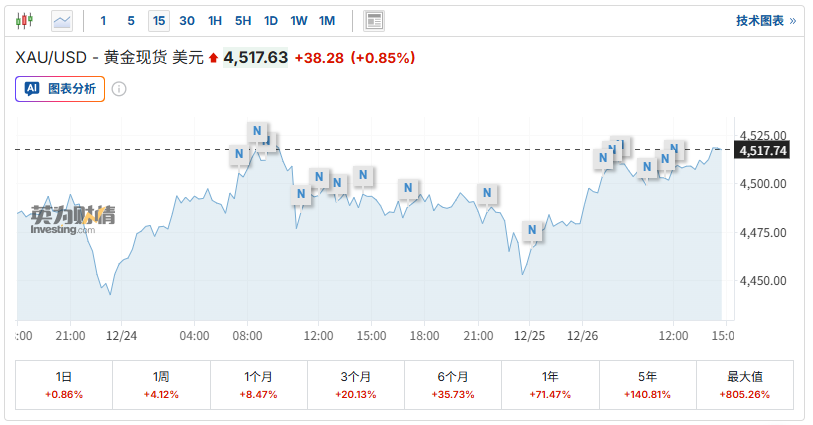
分析师:2026年上半年黄金可能向每盎司5000美元水平迈进
Xin Hua Cai Jing· 2025-12-26 06:42
Core Viewpoint - The combination of thin year-end liquidity, expectations for long-term interest rate cuts by the Federal Reserve, a weakening dollar, and increased geopolitical risks has driven precious metals to new record highs [1] Group 1: Gold Market - Gold is projected to potentially reach $5,000 per ounce by the first half of 2026 [1] Group 2: Silver Market - Silver has the potential to reach approximately $90 per ounce [1]
国投期货综合晨报-20251226
Guo Tou Qi Huo· 2025-12-26 06:03
Oil - The external market was closed due to the Christmas holiday, while domestic oil prices fluctuated. Russian Black Sea port attacks and adverse weather have slowed repair progress, leading to a 14-month low in Kazakhstan's December CPC mixed oil exports. Despite a decline in drilling and fracturing activities in the US shale oil industry, US crude oil production remains high due to production adjustments lagging behind. Geopolitical tensions between the US and Venezuela have raised concerns about oil supply disruptions, but the overall market fundamentals remain loose, suggesting a shift in market focus from geopolitical issues to a long-term supply-demand balance that may lead to a downward adjustment in price levels [1]. Precious Metals - The external market was closed for Christmas, while domestic gold and silver continued a strong trend. The adjustment of minimum opening quantities and trading limits by the Guangqi Exchange has occurred. The prospect of Federal Reserve easing and geopolitical risks have supported the strength of precious metals, with various types reaching new highs, leading to increased market volatility and the need for position control [2]. Copper - The Shanghai copper night market opened high, briefly rising to 98,000. Domestic spot divergence signals have strengthened, with Shanghai and Guangdong discounts expanding to 330 and 185 yuan respectively. SMM social warehouse increased by 25,200 tons to 193,600 tons. Short-term domestic supply and demand pressures may lead to greater adjustment pressure on copper prices, but tight raw material supply may transmit to domestic refined copper, benefiting exports. It is recommended to take profits on previous long positions or adjust the holding position to 95,000 [3]. Aluminum - The Shanghai aluminum market showed a strong fluctuation. The fundamental contradictions in the aluminum market are limited, with social warehouses fluctuating narrowly and apparent demand year-on-year being weak, leading to an expansion of spot discounts. The macro sentiment continues to drive precious metals and various non-ferrous metals to new highs, with Shanghai aluminum primarily following the upward trend and testing previous high resistance levels [4]. Alumina - Alumina production capacity is at a historical high, with a persistent oversupply situation and rising industry inventories. The average complete cost in Shanxi and Henan is 2,850-2,900 yuan, while the spot index has dropped to around 2,700 yuan, indicating profitability at cash cost calculations. A Guinea mining company has lowered its first-quarter long-term contract price by $5, suggesting potential for cost reduction in alumina. The weak trend in alumina is expected to continue before any significant production cuts, with a larger basis for spot price declines [5]. Zinc - Shanghai zinc operates independently with narrow fluctuations, supported by a strong bottom. The domestic consumption outlook for January is not pessimistic, and the price range is expected to rise from December, projected between 22,800-23,800 yuan/ton [7]. Lead - The market remains at a low level, with domestic aluminum social inventories below 20,000 tons and trading activity being average. The import window remains open, with overseas pressure continuing to transmit to the domestic market. Shanghai aluminum is still in a cost and consumption tug-of-war, with a price range expected between 17,000-17,500 yuan/ton [8]. Nickel - The Shanghai nickel market has seen a pullback, with active trading and significant stop-losses leading to market consolidation. Recent news from the Indonesian nickel ore conference has sparked market interest, with a significant reduction in nickel ore quotas for 2026. Current spot prices for high nickel iron are at 888 yuan per nickel point, with upstream price rebounds weakening support, leading to a cautious short-term outlook [9]. Lithium Carbonate - Lithium carbonate opened low and rose, with active market trading. Battery-grade lithium carbonate prices exceeded 110,000 yuan, with a price difference of 2,650. Despite high prices, market confidence in maintaining these levels is low, leading to limited trading enthusiasm. Total market inventory decreased by 1,000 tons to 110,400 tons, with downstream inventory also declining. The latest Australian mining price is $1,385, maintaining strong pricing. The overall market fundamentals for lithium carbonate remain strong, with short positions under pressure [11]. Polysilicon - Polysilicon futures surged above 60,000 yuan/ton. Expectations for tighter industry production quotas in 2026 and collective production cut plans from some companies have strengthened market sentiment. Current mainstream transaction prices are stable between 51,000-53,000 yuan/ton, primarily driven by replenishment demand. Recent increases in silver prices have pushed up non-silicon costs for battery cells, with pressures transmitted upward. The market is advised to monitor the effectiveness of breaking through the 60,000 yuan/ton level [12]. Steel - Steel prices continued to decline, with a slight drop in rebar demand and a small increase in production. Hot-rolled demand is recovering, with inventory reduction accelerating. Iron water production continues to decline, gradually alleviating supply pressure, while steel mill profits are marginally improving. The overall market sentiment remains cautious, with limited rebound momentum expected [13][14]. Iron Ore - Iron ore prices fluctuated overnight, with strong global shipments expected as year-end mine output increases. Domestic port arrivals are also strong, leading to significant inventory accumulation. Demand remains low in the off-season, but previous reductions in iron water production have stabilized prices. The overall fundamentals for iron ore are loose, with short-term price movements expected to remain volatile [14]. Urea - Urea production companies are significantly reducing inventory, leading to improved market sentiment and transactions. Daily production continues to decline due to environmental restrictions, with slight adjustments in industrial downstream demand. The short-term market for urea is expected to strengthen [22]. Methanol - Methanol prices slightly declined overnight due to recovering import unloading speeds and weakening inland demand, leading to significant port inventory accumulation. The overall market is expected to remain weak in the short term, with potential upward drivers in the medium to long term [23]. PX & PTA - PX prices continue to rise, with PTA following suit. Short-term PX supply is expected to increase due to plant restarts, while downstream demand may decline around the Spring Festival. Overall, the strong expectations for PX remain, with limited upward space in the short term [28].
黄金、白银价格再创历史新高
Xin Lang Cai Jing· 2025-12-26 05:11
Core Viewpoint - The surge in gold and silver prices is attributed to geopolitical risks and a shift in the global monetary system, leading to increased demand for gold as a safe-haven asset [1][2][4]. Group 1: Gold and Silver Price Movements - On December 26, spot gold prices surpassed $4500 per ounce, reaching a peak of $4531.284, marking a historical high [1][4]. - Spot silver also saw significant gains, breaking through $75 per ounce and increasing by over 4% during the trading session [1][4]. Group 2: Economic Insights and Trends - The acceleration of a multipolar international monetary system has eroded trust in the safety of dollar-denominated assets, prompting central banks to increase their gold holdings to hedge against geopolitical and monetary uncertainties [2][5]. - The long-term downtrend in dollar credit is expected to challenge the safety of traditional safe-haven assets like U.S. Treasuries, leading many central banks to exchange dollars and Treasuries for gold, which will support gold prices [2][5]. - Current market conditions suggest that the gold market is likely in the mid-phase of a bull market, with no reversal signals observed, supported by ongoing central bank purchases and geopolitical fragmentation [2][5]. Group 3: Future Price Projections - According to JPMorgan's 2026 outlook report, the long-term trend of diversifying into gold by official reserves and investors is expected to continue, with gold prices projected to reach $5000 per ounce by the end of 2026 [3][6].
黄金刷史高2026分歧 冲5000或高位震荡
Jin Tou Wang· 2025-12-26 02:12
Core Insights - Gold prices are expected to continue breaking historical records by the end of 2025, with spot gold briefly surpassing the $4,500 psychological barrier before stabilizing around $4,480 [1] Group 1: Macroeconomic Factors - The strong performance of gold by the end of 2025 is driven by multiple macroeconomic factors and structural demand, including rising expectations for interest rate cuts, which significantly lower the opportunity cost of holding non-yielding assets like gold [1] - A weakening dollar is reducing costs for non-U.S. buyers, thereby increasing demand, with expectations that the dollar's decline will continue into the following year [1] - Geopolitical tensions, including issues in the Middle East and the Russia-Ukraine situation, are heightening risk aversion, further boosting gold's appeal as a safe-haven asset [1] Group 2: Structural Support - Central bank gold purchases and ETF inflows are foundational to the bull market, with global central bank gold purchases expected to reach 850 tons in 2025, reflecting a recognition of gold's value and a weakening reliance on the dollar [2] - Physical support from gold ETFs is projected to attract approximately $82 billion (equivalent to 749 tons), marking the largest inflow since 2020, indicating that both institutions and retail investors view gold as a strategic allocation rather than a short-term hedge [2] Group 3: Future Price Projections - Looking ahead to 2026, gold prices are anticipated to transition from rapid increases to a stable plateau, with forecasts suggesting prices could rise to $4,900 per ounce, driven by central bank demand and potential interest rate cuts [3] - The average price of gold in Q4 2026 is expected to reach $5,055, with a long-term target of $6,000 by 2028, assuming consistent demand from investors and central banks at an average quarterly level of 566 tons [3] - Various banks project a trading range for gold in 2026 between $4,500 and $4,700, with potential upward movement towards $5,000 if macroeconomic uncertainties persist [4]
2026年原油价格如何展望?
2025-12-26 02:12
Summary of Key Points from the Conference Call Industry Overview - The conference call primarily discusses the global oil market outlook for 2026, focusing on factors affecting oil prices, demand, and supply dynamics in the context of geopolitical risks and OPEC's production strategies [1][2][4]. Core Insights and Arguments - **Oil Price Trends**: - Brent crude oil prices are expected to average between $60 and $65 per barrel in 2026, with a higher probability of staying above $60. The lowest price could drop below $55, but below $50 is unlikely. Geopolitical events could push prices up to $77-$80 [2][9]. - **OPEC's Production Strategy**: - OPEC has increased production by a cumulative 2.05 million barrels per day since April 2025, impacting market supply. The organization has a remaining capacity of 3.52 million barrels per day to adjust supply as needed [2][13]. - **Global Oil Demand**: - Global oil demand growth is projected to be 900,000 barrels per day in 2026, which is below historical averages. The demand elasticity related to GDP growth is weakening due to the increasing effect of renewable energy alternatives [1][12][14]. - **China's Oil Demand**: - China's refined oil demand peaked in 2023 and is expected to decline by 4% in 2025. The rapid penetration of electric vehicles is contributing to this decline, with the penetration rate expected to reach 58% in 2026 [15][16][21]. - **Geopolitical Risks**: - Ongoing geopolitical tensions, including sanctions against Russia and potential conflicts involving the U.S. and Venezuela, are significant factors that could influence oil prices and market stability [1][10][11]. Additional Important Insights - **Shipping Costs**: - Shipping costs have surged, with rates from the Middle East to China rising to $2.3 per barrel and potentially reaching $4-$8 by year-end due to compliance shifts and a shortage of new ship orders [7]. - **Global Inventory Levels**: - As of December 2025, global commercial oil inventories stood at 3.1 billion barrels, with levels outside of China being notably low, providing price support [8]. - **Future of Diesel Demand**: - Diesel demand in China is expected to decline by approximately 5% due to the rise of LNG and new energy heavy trucks, alongside a sluggish construction sector [19]. - **Aviation Fuel Growth**: - Aviation fuel is one of the few refined oil products expected to maintain growth, with a projected increase of around 4% in the coming years, driven by international flight demand [20]. Conclusion - The global oil market is entering a phase of moderate growth, with significant shifts in demand patterns, particularly from China. Geopolitical factors and OPEC's production decisions will play crucial roles in shaping the market landscape through 2026 and beyond [21].
帮主郑重:黄金暴涨71%!是末日避险,还是价值回归?
Sou Hu Cai Jing· 2025-12-26 00:27
Core Viewpoint - Gold is experiencing its strongest year since 1979, with New York futures gold prices nearing a 71% annual increase, reflecting historical patterns of market behavior during times of global turmoil [1][3] Group 1: Market Dynamics - Multiple historical factors are converging to create a bull market for gold, including frequent geopolitical tensions and central banks purchasing over 1,000 tons of gold annually, which redefines strategic reserves [3] - Market expectations of continued interest rate cuts by the Federal Reserve are lowering the opportunity cost of holding gold, further driving demand [3] Group 2: Investment Strategy - Gold is transitioning from a mere commodity to a "financial ballast" that hedges against global systemic risks, suggesting a shift in its role in investment portfolios [3] - For ordinary investors, incorporating a portion of gold (such as through ETFs) into long-term asset allocation is recommended to navigate uncertainty, while cautioning against short-term speculation due to volatility [3]

金银农产品集体暴走,2026牛市是“续航”还是“转向”?
Sou Hu Cai Jing· 2025-12-25 23:32
Group 1: Commodity Market Overview - By the end of 2025, the global commodity market is expected to experience a strong upward trend due to factors such as climate anomalies, escalating geopolitical conflicts, and mismatched supply-demand dynamics [1] - Precious metals are continuing their bull market, with COMEX gold futures surpassing $4550 per ounce and COMEX silver exceeding $72 per ounce, both poised for their strongest annual performance since 1979 [1] - Copper prices have reached a historical high of $11,952 per ton, while platinum prices are also rising due to three consecutive years of supply shortages [1] Group 2: Agricultural Products - Agricultural futures prices are showing mixed trends due to dynamic structural supply-demand contradictions, with corn prices continuing to rise while wheat, soybeans, soybean oil, and soybean meal have shown signs of recovery after a phase of decline [1] - Recent geopolitical tensions and extreme weather have contributed to a rebound in U.S. wheat prices, which have risen for five consecutive days as of December 24 [6] - The ongoing Russia-Ukraine conflict has raised concerns about grain and edible oil supply disruptions, particularly affecting the Black Sea region [7] Group 3: Precious Metals Performance - At the beginning of the year, international gold prices fluctuated between $2600 and $2700 per ounce, but have now surpassed $4550, marking an increase of over 60% for the year [3] - Silver has outperformed gold with a year-to-date price increase of approximately 140%, narrowing the gold-silver ratio from 85:1 at the beginning of the year to below 70 [3] - The rise in precious metal prices is driven by two main factors: increased expectations for Federal Reserve interest rate cuts and heightened geopolitical risks that boost market demand for safe-haven assets [4][5] Group 4: Future Market Outlook - Looking ahead to 2026, there are differing opinions on whether the commodity market will continue its bull run or shift direction, with some analysts predicting a decrease in macro volatility that could weaken gold's safe-haven demand [10] - Other analysts believe that the establishment of a Federal Reserve rate-cutting cycle and weakening dollar credit will support precious metals, with ongoing strong demand from central banks and industrial consumption [10] - In the agricultural sector, short-term support for U.S. soybean prices is expected from China's purchases, but uncertainties remain regarding the volume of these purchases and the overall favorable planting conditions in South America [10]

【沥青日报】沥青BU震荡徘徊3000附近,美国表态对委油实施隔离
Xin Lang Cai Jing· 2025-12-25 23:10
Market Performance - The BU 2602 contract experienced intraday fluctuations, closing at 2995 with a gain of 0.17%, reaching a high of 3010 and a low of 2983, with a cumulative increase of 3.6% over the past week [2][29] - The next month contract 2603 saw a slight decline of 0.03%, maintaining a contango structure with lower near-term prices compared to longer-term prices [2][29] Spot Market - The price of heavy asphalt in Shandong remained stable at 2920 yuan/ton, with no change week-on-week and a cumulative increase of 0% over the past week [2][29] - In East China, the heavy asphalt price was 3090 yuan/ton, also unchanged, while the basis in Shandong was -75 yuan/ton, down 101 yuan/ton over the past week [2][29] Crack Spread Changes - The BU-Brent spread recorded -189 yuan/ton, with a cumulative increase of 1 yuan/ton over the past week, while the BU main contract rose by 0.17% and Brent remained unchanged [2][29] - Oil prices are influenced by geopolitical disturbances in Venezuela, leading to short-term price stabilization but with ongoing uncertainty [2][29] Fundamental Changes - Recent developments regarding Venezuelan oil exports remain a key risk factor, with U.S. military orders for a two-month "quarantine" on Venezuelan oil, following a comprehensive blockade initiated by Trump [3][30] - Venezuela's oil exports are hindered by sanctions, forcing oil to be stored on tankers, with China being the primary destination for approximately 80% of Venezuelan oil exports, indicating a high dependency of Chinese refineries on Venezuelan crude [3][30] Supply and Inventory - The dilution asphalt discount widened, with Malaysia's dilution asphalt discount recorded at -14.46 USD/barrel as of December 24, compared to -13.46 USD/barrel a week earlier [4][31] - Total social and domestic inventory data recorded 642,000 tons, reflecting a 0.9% increase week-on-week, indicating a slow inventory reduction [4][31] Short-term Outlook - Asphalt prices have slightly increased since early December, fluctuating around 3000, with significant volatility observed [5][32] - Downstream road demand is in a seasonal lull, maintaining a weak price outlook, constrained by reduced demand and inventory pressures, with attention on winter storage trends [5][32] Strategy - The recommended strategy is to adopt a wide-ranging single-sided trading approach [6][33]
