人民币升值

Search documents
赵伟:机遇叠加、未来可期
申万宏源宏观· 2026-01-13 09:21
Economic Outlook - The core viewpoint emphasizes that 2026 marks the beginning of the "15th Five-Year Plan," which is crucial for understanding future policies and economic environments. The focus will be on "comprehensive efforts" and "strategic initiative" in various sectors [3][4] - "Comprehensive efforts" suggests an acceleration in policy implementation across development and reform areas, while "strategic initiative" indicates an increase in proactive policy measures, particularly in domestic economic management and international trade [3][4] Policy Framework - The central economic work conference has highlighted an increased frequency of terms like "reform" and "opening up," indicating a shift in focus for 2026. The concept of "cross-cycle" has returned, but this does not imply a reduction in growth stabilization efforts [5][6] - Fiscal policy will remain proactive, ensuring necessary spending and debt levels, while monetary policy will emphasize flexibility and efficiency in using tools like interest rate cuts [6][5] Market Dynamics - The analysis of 2025 reveals three significant shifts: the weakening of post-pandemic scars, reduced impact from tariff conflicts, and the establishment of a coherent new policy framework since late 2024 [7][8][9] - The economic recovery in 2026 is characterized as "atypical," with limited volume elasticity and a focus on price normalization, leading to a nominal GDP recovery from approximately 4% in 2025 to around 5% in 2026 [9] Capital Market Insights - The relationship between the ten-year government bond yield and A-share dividend yield illustrates the emotional cycles in the capital market, which have been disrupted since 2022 due to long-term concerns about the Chinese economy [10][11] - Key events influencing market behavior include a policy shift in late 2024 and the introduction of DeepSeek, which has redirected investment thinking from macro to micro perspectives [12][11] Investment Behavior - The new tariff war initiated by the Trump administration has led to a reevaluation of investment strategies, with non-U.S. funds increasingly seeking opportunities in China as the perception of risk shifts [13] - The "anti-involution" policy has gained attention, indicating a structural approach to restoring corporate profitability and nominal GDP growth, which has initiated a domestic "funds rebalancing" process [13] Future Projections - The nominal GDP recovery is expected to continue driving the "funds rebalancing" process into 2026, with a potential rise in bond market interest rates and support for traditional sectors' profitability and valuation [14] - The RMB is anticipated to enter a period of appreciation, with a projected annual increase of 2-3%, which could attract foreign investment and positively impact the stock market [15]


港股科技ETF(513020)涨超1%,近20日资金净流入超1.1亿元,三重因素驱动下港股有望上涨
Mei Ri Jing Ji Xin Wen· 2026-01-13 06:21
Core Viewpoint - The Hong Kong stock market, particularly the technology ETF (513020), is expected to rise due to three driving factors, including a weakening US dollar, appreciation of the RMB, and potential debt relief policies [1] Group 1: Market Performance - The Hong Kong technology ETF (513020) increased by over 1% on January 9, with a net inflow of over 110 million RMB in the past 20 days [1] - The Hong Kong Stock Connect Technology Index (931573) covers core assets in sectors such as "Internet + Semiconductors + Innovative Pharmaceuticals + New Energy Vehicles" [1] Group 2: Future Projections - By 2026, a weaker US dollar is expected to attract international capital to invest in Hong Kong stocks, while the appreciation of the RMB will encourage Chinese capital to return from overseas [1] - Improvements in inflation and economic policies are anticipated to further boost the Hong Kong stock market [1] Group 3: Index Performance - The Hong Kong Stock Connect Technology Index has outperformed the Hang Seng Technology Index, with a cumulative return of 256.46% since the base date at the end of 2014, compared to 96.94% for the Hang Seng Technology Index, exceeding it by nearly 160% [1] - The index has consistently outperformed other similar indices, including the Hang Seng Internet Technology Index and the Hang Seng Healthcare Index [1]
中信证券:站上4100,当下A股的5大要点
Ge Long Hui A P P· 2026-01-13 03:59
Group 1 - The core viewpoint of the report is that the recent surge in the A-share market, with the Shanghai Composite Index surpassing 4100 points, is driven by a concentration of funds entering the market due to a "bullish sentiment" among investors [1] - The current market heat is high based on volume and price indicators, but there are no signs of weakening sentiment indicators yet [1] - The rotation and fluctuation of thematic and small-cap stocks are expected to continue until around the Two Sessions, after which the market will likely return to being driven by fundamentals [1] - For allocation-focused funds, the current market excitement is not the right time to chase hot stocks, with a critical structural adjustment decision window expected from late March to April [1] - It is essential to consider where sustainable "big money" (allocation-focused funds) will flow, and to hold or increase allocations during market volatility [1] Group 2 - The report suggests enhancing allocations in sectors with improved pricing power in resources and traditional manufacturing, while also considering non-bank financials that align with consensus [1] - The firm maintains a strategy focused on "earning from performance rather than expecting valuation gains," favoring industries such as chemicals, non-ferrous metals, power equipment, new energy, and engineering machinery under the logic of improved pricing power [1] - Additionally, the report is optimistic about the insurance and brokerage sectors, given the backdrop of RMB appreciation, improved supply dynamics, and potential for globalization [1]

ETF盘中资讯|港股大爆发!阿里巴巴涨超4%,自带哑铃策略的——香港大盘30ETF(520560)跳空大涨,盘中拉升2%!
Jin Rong Jie· 2026-01-13 02:32
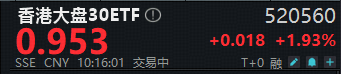
Core Viewpoint - The Hong Kong stock market experienced a significant surge, with major indices rising over 1%, driven by a "technology + dividend" strategy, particularly highlighted by the Hong Kong Large Cap 30 ETF (520560) which saw a jump of over 2.1% during trading [1] Group 1: Market Performance - The Hong Kong stock market indices all rose over 1%, with the Hong Kong Large Cap 30 ETF (520560) showing a mid-session increase of over 2.1% and closing up 1.93% [1] - Key stocks such as BYD, Alibaba, and China Life saw gains exceeding 4%, while China Petroleum and Tencent also contributed to the upward trend [1] Group 2: AI and Dividend Strategies - The AI sector in Hong Kong is gaining traction, with companies like MiniMax and Zhiyu Huazhang entering the capital market, leading to a surge in AI applications [2] - Several banks have launched new asset enhancement activities, allowing users to earn rewards, indicating a focus on dividend strategies in the market [2] Group 3: Investment Rationale - Analysts highlight four main reasons for investing in Hong Kong stocks: global interest rate cuts increasing capital availability, significant net inflows from mainland investors, rising valuations for monopolistic and leading global stocks, and structural differentiation within the market [3] - The Hong Kong stock market is expected to attract more overseas capital due to the appreciation of the Renminbi and anticipated declines in the US dollar index [2][3] Group 4: Investment Strategy - GF Securities recommends a "barbell strategy" for investing in Hong Kong stocks, combining stable value assets with growth-oriented assets, emphasizing the Hong Kong Large Cap 30 ETF (520560) as a flexible investment tool [4] - The ETF includes a mix of high-growth technology stocks like Alibaba and Tencent, alongside stable dividend-paying stocks such as China Ping An and China Construction Bank [4][5]

沪指17连阳,北向资金成交额创互联互通机制开通以来第三高
Huan Qiu Wang· 2026-01-13 01:08
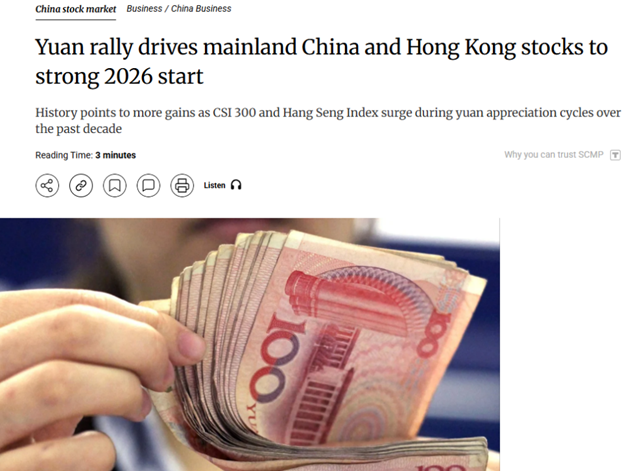
【环球网财经综合报道】1月12日,A股放量上涨,上证指数豪取17连阳,刷新逾10年新高;A股全天成 交3.64万亿元,创单日成交额历史新高;北向资金买入和卖出成交额达3989.80亿元,创互联互通机制开 通以来第三高。 《南华早报》近日发文称,随着人民币突破关键的7元兑1美元水平,2026年以来,人民币计价的中国内 地股市(沪深300指数)和香港恒生指数已上涨超过3%,这是此前两年半以来未见的情况。 报道还提到,历史数据显示,人民币走强有利于中国股市。海通证券Quantile基金研究发现,自2017年 以来,在五次人民币升值周期中,沪深300指数平均上涨18%。方正证券报告也显示,在过去十年的六 次人民币升值期间,恒生指数平均上涨16%。 此外,对中国经济韧性和出口增长的乐观预期,以及对北京提供更多增长稳定措施的期望,助力了人民 币的上涨。汇丰预计,今年年底前美元兑人民币汇率将升至6.95,摩根士丹利预计,2027年升值至 6.80,主要得益于强劲的外部平衡。 方正证券分析师朱晨晨表示:"这一轮人民币升值的空间还有更多。这将进一步提升人民币计价的核心 中国资产,如A股和港股的吸引力,引导海外资本回流进行再配置 ...
3.64万亿!帮主郑重:A股的天花板在哪里?
Sou Hu Cai Jing· 2026-01-12 15:12
Core Insights - A-shares have reached a historic daily trading volume of 3.64 trillion yuan, indicating strong market enthusiasm and participation [1][4] Group 1: Market Dynamics - The record trading volume is driven by multiple factors, including the appreciation of the RMB, which has changed global perceptions of Chinese assets [3] - Clear industrial policies are igniting sectors such as commercial aerospace and AI applications, creating compelling investment narratives [3] - There is a consensus among various market participants, including public and private funds, new retail investors, and northbound capital, all expressing optimism about future market trends [3] Group 2: Investment Strategy - While the strong market trend is encouraging, investors should remain cautious and avoid blindly chasing high prices, especially in stocks that have significantly deviated from their fundamentals [4] - It is essential to review and optimize current holdings, ensuring that companies have solid performance and clear growth logic to support their valuations [4] - Investors should manage their expectations and positions carefully, as historical high trading volumes do not guarantee continued upward momentum [4]

每日投行/机构观点梳理(2026-01-12)
Xin Lang Cai Jing· 2026-01-12 12:34
Group 1: Federal Reserve and Employment Data - Goldman Sachs expects the Federal Reserve to maintain its current policy in January, with two rate cuts anticipated in the remainder of 2026 due to initial signs of labor market stability [1] - JPMorgan has removed its forecast for a rate cut in 2026, now predicting a 25 basis point increase in Q3 2027 [1] - Societe Generale believes the decline in unemployment and rising wages provide a stronger rationale for the Fed to hold rates steady in January [1] Group 2: Oil Prices and Geopolitical Risks - Goldman Sachs indicates that despite ongoing geopolitical risks, oil prices may continue to decline due to ample supply, predicting Brent and WTI crude oil prices to average $56 and $52 per barrel respectively in 2026 [2] Group 3: Chinese Economic Outlook - CITIC Securities forecasts a "mild re-inflation" in China in 2026, driven by a slight increase in PPI and CPI, with core CPI expected to rise due to various factors including food prices and service costs [3] - CITIC Securities also notes that the balance between external and internal demand will be crucial for the A-share market, with a higher probability of upward movement in early 2026 [4] Group 4: Commodity Prices and Market Trends - CITIC Jinpu predicts that copper prices will continue to rise, with the market not yet at an end, and expects significant support for copper prices despite short-term corrections [5] - CITIC Securities anticipates that investment in the power grid during the 14th Five-Year Plan period may reach 3.8 trillion yuan, focusing on high-quality development and stability in the energy sector [6] Group 5: Currency and Market Dynamics - Huatai Securities expects the Federal Reserve to pause rate cuts from January to May, with potential cuts occurring after the new Fed chair takes office [7] - Huachuang Securities highlights the commercialization of brain-computer interfaces, indicating a growing market with significant potential for expansion beyond the medical field [8] - Shenwan Hongyuan predicts that the RMB will appreciate by 2-3% annually over the next few years, with a total appreciation of over 30% in the next decade, benefiting the stock market [10]



分析师:出口商结汇助推人民币持续破7,2026年美元会否反扑|华尔街观察
Di Yi Cai Jing· 2026-01-12 10:10
Core Viewpoint - The article discusses the impact of the Federal Reserve's interest rate cuts in 2026 on the US dollar and the ongoing strength of the Chinese yuan, particularly in the context of exporters' currency conversion activities and hedge fund investments in the yuan [1][6]. Group 1: Exporter Currency Conversion Trends - Exporters began converting large amounts of USD to RMB after the yuan fell below the 7.1 psychological threshold, with a total of $180 billion converted from March to November last year, and expectations to exceed $200 billion by early 2026 [1][4]. - Since 2020, exporters have retained significant USD revenues, estimated at around $700 billion since 2023, with only a portion expected to be converted to RMB if the USD/RMB exchange rate remains between 7.1 and 7.15 [3][4]. - The conversion trend accelerated in September, driven by the psychological threshold of 7.1 and the upcoming Chinese New Year, which typically sees a slowdown in conversion activities [4]. Group 2: Hedge Fund Activities - Hedge funds have contributed to the yuan's appreciation by taking long positions on the currency, particularly as the USD weakened and the Fed cut rates in the latter half of the year [4][5]. - However, recent signs indicate that hedge funds are starting to take profits, as the interest rate differential between the US and China remains significant, making continued long positions on the yuan less attractive [5]. Group 3: Future of the US Dollar - The prevailing view is that a "weak dollar" trend will continue into 2026, although some institutions caution that the market may have overestimated the Fed's rate cut expectations, which could lead to a dollar rebound [6]. - Historical data suggests that during periods of significant capital expenditure growth in the US, the dollar tends to strengthen, with potential GDP growth driven by AI investments [6]. - The upcoming expiration of Fed Chair Powell's term in May may influence monetary policy, with potential implications for interest rate decisions depending on the new appointee's stance [7].

每周投资策略-20260112
citic securities· 2026-01-12 07:16
Group 1: A-Share Market Focus - The export growth for 2025 is expected to reach 5.3%, supported by resilient non-US exports and a potential easing of US tariffs [10][12][11] - The appreciation of the RMB is driven by several factors, including lower-than-expected US inflation data, which has increased market expectations for future Fed rate cuts [13][14] - Key sectors to watch include those sensitive to RMB appreciation, such as aviation, gas, and paper industries, which historically show significant stock price elasticity during appreciation phases [19][14] Group 2: US Market Focus - Economic growth in the US is projected to slow in the first half of 2026, influenced by factors such as the end of preemptive consumption and a slowdown in capital expenditures related to AI [31][35] - The K-shaped recovery in the US economy indicates that high-income consumers are driving growth, while lower-income consumers face increasing financial strain [35][31] - The upcoming Fed leadership change may influence monetary policy, with potential for further rate cuts depending on the new chair's stance [36][41] Group 3: Oil Market Focus - The impact of recent events in Venezuela on oil prices is expected to be limited in the short term, with US oil companies likely to benefit first [49][51] - Venezuela holds the largest proven oil reserves globally but ranks 22nd in production, indicating challenges in translating reserves into output [53]
四箭齐发!2026年A股新增资金大潮,到底有多猛?
Xin Lang Cai Jing· 2026-01-12 06:18
Core Viewpoint - The stock market is expected to enter a "golden period" in 2026, driven by four major factors: the influx of deposits, RMB appreciation, increased insurance funds, and a shift of funds from the bond market to equities [3][11]. Group 1: Influx of Deposits - A significant amount of deposits, approximately 32 trillion yuan, will mature between 2025 and 2026, leading to a potential influx into the stock market [3][11]. - The estimated inflow scenarios for 2026 are: conservative scenario of 800 to 1,000 billion yuan, neutral scenario of 1,500 to 2,200 billion yuan, and optimistic scenario reaching up to 3,000 billion yuan [3][11]. - It is noted that not all matured deposits will flow into the stock market, with 60%-70% potentially diverted to other uses, but even 30%-40% represents a substantial increase [3][11]. Group 2: RMB Appreciation - Starting from the end of 2025, the RMB is expected to enter an appreciation phase, with potential funding sources including northbound capital, foreign trade settlement, and foreign direct investment [4][12]. - The estimated inflow scenarios for RMB appreciation are: conservative scenario of 500 to 600 billion yuan, neutral scenario of 800 to 1,200 billion yuan, and optimistic scenario of 1,500 to 1,800 billion yuan [4][12][13]. - The sustainability of RMB appreciation is deemed more important than the magnitude, with domestic economic recovery being crucial for attracting long-term foreign capital [4][13]. Group 3: Increased Insurance Funds - Insurance capital has already shown its strength by investing in the CSI A500 index fund, indicating a strong commitment to the market [5][14]. - Predictions for insurance capital inflow in 2026 range from 3,000 to 7,700 billion yuan, with estimates from various institutions varying significantly [5][14]. - Insurance funds are characterized as long-term value investors, suggesting a positive outlook for the A-share market in 2026 [5][14]. Group 4: Shift of Funds from Bond Market - A historical shift of funds from the bond market to equities has been observed, which is expected to continue into 2026 due to declining bond yields and the attractiveness of equity returns [6][15]. - The estimated inflow scenarios for bond market funds are: conservative scenario of 800 to 1,000 billion yuan, neutral scenario of 1,500 to 2,200 billion yuan, and optimistic scenario reaching up to 3,000 billion yuan [6][15]. - In total, under a neutral scenario, the combined new funding sources for 2026 could reach 4.1 to 6.17 trillion yuan, with optimistic scenarios exceeding 9 trillion yuan [6][15].