降息周期

Search documents
周热点:如何看待动力煤凌冽涨势?
2025-10-19 15:58
Summary of Conference Call Notes Industry Overview: Coal Market - Historical data indicates significant price increases for thermal coal from late 2020 to early 2021, throughout 2021, in 2022, and from June to October 2023, primarily driven by supply-side constraints such as policy restrictions, safety inspections, and international conflicts, alongside a recovery in demand [1][4][6] - The current thermal coal market is expected to face tight supply due to central safety inspections, with early winter and La Niña phenomena increasing the likelihood of price rises in the autumn [1][6] - There is a demand for stockpiling before the end of October, suggesting a higher probability of price increases in Q4, supported by both commodity and equity sides [1][6] Key Insights and Arguments - The interest rate cut cycle typically benefits commodities, with thermal coal showing strong correlation with copper and aluminum due to high electricity demand [1][7] - The coal sector exhibits low price-to-book (PB) ratios, low trading volumes, and dividend attributes, making it a defensive yet opportunistic investment [2][3] - The price of coking coal has been fluctuating due to overproduction checks, with steel mill profits improving, leading to an expected stable price trend [10] Investment Recommendations - Companies with growth potential and elasticity such as Yanzhou Coal Mining Company (兖矿) and China Power Investment Corporation (电投) are recommended. Yanzhou is expected to increase its equity production by 50% over the next five years, while China Power will benefit from new aluminum production capacity [1][8][9] - Other companies with good price elasticity include Jin控潞安 and Huai Coal, with a focus on bottom reversal opportunities and seasonal price increases [10] Additional Important Points - The coal price increases in the past five years were significantly influenced by supply tightening measures, including production restrictions and geopolitical events like the Russia-Ukraine conflict [4][5] - The current market environment is characterized by a potential for price increases due to supply constraints and seasonal demand, with a focus on the specific demand conditions in November and December [6][10] - The overall sentiment suggests a systemic bull market could emerge if interest rate cuts stimulate economic recovery, particularly benefiting the coal sector [7]
【股指期货周报20251019】风险偏好下降,股指本周继续震荡-20251019
Zhe Shang Qi Huo· 2025-10-19 02:49
Report Industry Investment Rating - Not provided in the given content Core Viewpoints - In the short term, Sino-US frictions deepen, affecting the stock index trend, especially high - valuation technology stocks. The stock index is expected to adjust, but the decline may be weaker than that in April, and there is no need to be overly pessimistic. In the long - term, the domestic market is driven by liquidity, with continuous inflow of incremental funds, and still has upward momentum [3]. - The US is entering a new interest - rate cut cycle, which is beneficial for RMB appreciation, foreign capital inflow, and bringing new incremental funds [9]. - Current policies to stabilize the capital market are positive, with a clear bottom line for the stock index. New technologies and new consumption are promoting the stabilization and recovery of economic expectations [9]. - After the risk - free interest rate drops to a low level, the entry of medium - and long - term funds and residents into the market will enter a new cycle [9]. - Future index performance depends on trading volume. If the trading volume of the two markets can remain above 2 trillion yuan, the index can maintain relative strength [9]. - It is recommended to focus on semiconductor, AI computing power and other technology - growth sectors with certain profitability, and also pay attention to the rotation allocation value of low - valuation defensive sectors such as finance, securities, and consumption [9]. Summary by Directory Market Performance - This week, domestic stock indices declined, with the ChiNext and STAR Market falling significantly. For example, the ChiNext Index dropped 5.71% and the STAR 50 Index dropped 6.16%. The performance of global indices also varied, with the Nasdaq rising 2.14% and the Hang Seng Technology Index falling 7.98% [12][17]. - Among the Shenwan primary industries, the trends were differentiated. A few sectors such as coal, banks, and food and beverages rose, while sectors such as media, electronics, and telecommunications fell significantly [17]. Liquidity - In September, government bonds supported social financing, the return of wealth management funds pushed up M2, while M1 remained sluggish. The "gap" between M1 and M2 continued to narrow. By the end of September, the M2 balance was 209.48 trillion yuan, with a year - on - year increase of 6.8%, and the M1 balance was 82.82 trillion yuan, with a year - on - year decrease of 7.4% [15][18]. - The core support for the increase in social financing in September came from government bond issuance, while weak RMB loans were the main drag. In September, the new social financing increment was 3.76 trillion yuan, with a year - on - year decrease of 372.2 billion yuan. The balance of outstanding social financing was 402.19 trillion yuan, with a year - on - year growth of 8.0% [18]. Trading Data and Sentiment - This week, the trading volume of the two markets decreased, and high - priced stocks adjusted. The trading volume (MA5) of the two markets decreased to around 2 trillion yuan, and liquidity is an important factor supporting the current index and needs continuous monitoring [28]. - The number of new accounts opened showed fluctuations. From January to August 2025, the number of new accounts opened was 1.57 million, 2.86 million, 3.06 million, 1.02 million, 1.555 million, 1.6464 million, 1.9636 million, and 2.6503 million respectively [28]. Index Valuation - As of October 17, 2025, the absolute valuation of the index was at a low level. For example, the latest PB of the Shanghai Composite Index was 16.51, with a percentile of 82.67, and the latest PB of the entire A - share market was 21.95, with a percentile of 83.75 [36]. - The stock - bond ratio and its percentile of major stock indices were also presented, which can be used to evaluate the investment value of stocks relative to bonds [42]. Index Industry Weights - As of June 30, 2025, in the SSE 50 Index, the weights of banks, non - bank finance, and food and beverages were relatively high, at 21.34%, 15.48%, and 13.88% respectively. The electronics industry became the fourth - largest weighted industry [45][46]. - In the CSI 300 Index, the weights were more dispersed, with the top three weighted industries being banks, non - bank finance, and electronics [46]. - In the CSI 500 Index, the top three weighted industries were electronics, pharmaceutical biology, and non - bank finance [46]. - In the CSI 1000 Index, the top three weighted industries were electronics, pharmaceutical biology, and computers [46]. Other Overseas and Domestic Policy Tracking - Domestic policies: In 2025, the government work report and the Two Sessions in March set an economic growth target of 3%, a CPI increase of about 2%, and proposed a moderately loose monetary policy and a more proactive fiscal policy. In May, the reserve requirement ratio was cut by 0.5 percentage points, the policy interest rate was lowered by 0.1 percentage points, and a 500 - billion - yuan loan for service consumption and elderly care was established. In September, the "14th Five - Year Plan" achievements in the financial industry were summarized, and further reforms in the capital market were proposed [51][52]. - US Fed policy: The US is about to enter a new interest - rate cut cycle, with a 25 - BP cut in September. As of October 19, the probability of another rate cut in October exceeded 30%, and there are still two expected rate cuts within the year [53]. - Sino - US relations: China's "long - arm jurisdiction" and strengthened rare - earth control exceeded US expectations, and Trump countered with additional tariffs. A video call was held between China and the US on October 18, which may affect market risk appetite in the short term [54].
沪金期货首破千元大关!金饰克价逼近1300元大关
2 1 Shi Ji Jing Ji Bao Dao· 2025-10-17 09:04
Core Viewpoint - The domestic gold market in China has reached a historic moment, with the Shanghai gold futures main contract breaking the 1000 yuan/gram mark, reflecting a nearly 4% increase and setting a new historical high [1] Group 1: Market Performance - The Shanghai gold futures main contract closed at 999.8 yuan/gram after reaching an intraday high [1] - Physical gold prices have also risen, with brands such as Chow Sang Sang reporting 1281 yuan/gram, an increase of 36 yuan/gram from the previous day [1] - Other brands like Lao Feng Xiang, Chow Tai Fook, and Jin Zun also saw price increases, with respective rises of 35 yuan/gram, 34 yuan/gram, 32 yuan/gram, and 31 yuan/gram [1] Group 2: Market Drivers - Analysts from Guangzhou Futures attribute the rise in gold prices to increased credit risks in U.S. banks, ongoing geopolitical tensions, and persistent policy uncertainties that have heightened demand for safe-haven assets [1] - The Federal Reserve's clear shift towards a rate-cutting cycle, with potential further easing within the year to mitigate economic risks, has significantly improved the holding environment for precious metals [1] - Continuous strategic accumulation by global central banks provides long-term structural support for gold prices, creating favorable conditions for further price increases [1]
铝铜比何时修复?
2025-11-04 01:56
Summary of Conference Call on Aluminum and Copper Market Dynamics Industry Overview - The current copper-to-aluminum ratio is at a historical high of approximately 4.2 times, with expectations for a correction during the latter part of the interest rate cut cycle, suggesting aluminum may replicate copper's upward trend over the next three to five years [1][2][8] - The aluminum sector is currently undervalued, with an average dividend yield of 5-10% and a price-to-earnings (PE) ratio of 8 times, projected to rise from 8-9 times to 10-15 times by 2026, potentially doubling or more [1][2][15] Key Insights and Arguments - The inflation cycle typically sees gold leading, followed by silver, then copper and aluminum; thus, aluminum, which is currently at a low price point, should be a focus [1][3] - The average valuation metrics for the non-ferrous metals sector include a price-to-book (PB) ratio of 2 times, a return on equity (ROE) of 20%, and a PE ratio of 8 times, indicating a combination of resilience and dividend defensiveness [1][3] - The copper-aluminum price bottom usually occurs at the end of an interest rate cut cycle, aligning with economic recovery phases [4][5] Market Dynamics - The supply of electrolytic aluminum in China has reached its capacity ceiling, while uncertainties in overseas energy consumption will gradually restore the copper-to-aluminum ratio to normal levels [1][9] - Fund holdings in the sector are significantly lower than the previous year, with only 4.7% to 4.8% allocation in Q2, indicating a relatively low market crowding and room for recovery [1][7] Future Projections - Aluminum is expected to become a resource commodity similar to copper due to its price elasticity and diverse demand, with a current profit margin of approximately 3,000 yuan per ton [2][8] - The anticipated increase in demand for alternative materials, such as aluminum wire bundles, is expected to further support aluminum's market position [10] - The global energy consumption for electrolytic aluminum production accounts for about 3% to 3.5% of total electricity usage, with potential supply uncertainties due to energy constraints [11][12] Investment Opportunities - Companies with high elasticity, such as Zhongfu, Yun Aluminum, and Tianshan, are recommended for those seeking growth, while more stable options include Hongqiao, Hongchuang Holdings, and China Aluminum [2][15] - The aluminum sector's dividend yield is projected to remain strong, with some companies maintaining a dividend payout ratio of 60% [14] Conclusion - The aluminum sector is poised for significant growth over the next few years, driven by supply constraints and increasing demand for aluminum as a substitute material. The current market conditions present a favorable investment landscape for both growth and income-focused investors [15][18]





境内外医药投融资持续回暖,降息周期内恒生创新药ETF(159316)配置机遇备受关注
Sou Hu Cai Jing· 2025-10-16 06:18
Core Insights - The investment trend in the pharmaceutical sector has shown signs of recovery in September, with both primary and secondary markets attracting investor attention [1] - In September 2025, there were 175 financing events in the global biopharmaceutical sector, with a total disclosed financing amount of $10.2 billion (approximately 72.7 billion RMB), marking a year-on-year increase of 57% and a quarter-on-quarter increase of 179% [1] - The domestic market recorded 68 financing events with a total disclosed amount of approximately $956 million, reflecting a quarter-on-quarter increase of about 1% and a year-on-year increase of 337% [1] Market Performance - The expectation of a rate cut has positively influenced overseas pharmaceutical-related assets, with the NASDAQ Biotechnology Index rising approximately 9% since the Federal Reserve announced the rate cut on September 18 [1] Fundamental Improvements - The fundamentals of the pharmaceutical industry have significantly improved in September [1] - From January to September, the total amount of contracts for Chinese innovative drug patents going abroad exceeded $100 billion, representing a year-on-year growth of 170% [1] - In the domestic market, there were 2,483 new clinical projects added from January to September 2025, which is a 6.8% increase compared to the same period last year [1]
中辉有色观点-20251016
Zhong Hui Qi Huo· 2025-10-16 05:48
Report Industry Investment Ratings - Gold: Buy and hold [1] - Silver: Hold for the long - term [1] - Copper: Hold for the long - term [1] - Zinc: Bearish [1] - Lead: Bearish on rebound [1] - Tin: Bearish on rebound [1] - Aluminum: Bearish on rebound [1] - Nickel: Weak [1] - Industrial Silicon: Bullish on rebound [1] - Polysilicon: Bullish [1] - Lithium Carbonate: Wide - range oscillation [1] Core Viewpoints - Gold and silver prices are rising due to unresolved international issues such as G2 relations, US government shutdown, and uncertain situations in Japan and France. Long - term, gold may continue its bull run benefiting from global monetary easing, weakening dollar credit, and geopolitical restructuring [1][2][3] - Copper is expected to be in high demand in the long - term due to copper concentrate shortages and the booming green copper demand, although short - term, downstream is hesitant due to high prices [1][6][7] - Zinc supply is increasing while demand is decreasing, with domestic demand in the peak season being weak [1][9][10] - Aluminum price rebounds are under pressure, waiting for demand support [1][12][13] - Nickel price is weak due to sufficient supply and uncertain downstream consumption [1][16][17] - Lithium carbonate supply and demand are both increasing, with prices in a wide - range oscillation [1][21][22] Summaries by Related Catalogs Gold and Silver Market Review - Gold prices are strong due to no progress in G2 relations, US government shutdown, and uncertain situations in Japan and France [2] Basic Logic - Sino - US relations have no progress, with the US adding more Chinese entities to the export control list and implementing 301 measures. Fed official Milan calls for interest rate cuts. Long - term, gold benefits from global monetary easing, weakening dollar credit, and geopolitical restructuring [3] Strategy Recommendation - For domestic gold, maintain a long - position mindset both in the short and long term as the 935 support is obvious. For silver, there is support at 11500. Pay close attention to macro - sentiment, market rhythm, US fiscal trends, and Fed policy signals, and consider going long on pullbacks [4] Copper Market Review - Shanghai copper is consolidating in a high - level range, oscillating around 85,000 [6] Industry Logic - Global copper concentrate supply is tight. The copper smelting industry is undergoing changes, with expected production contraction in the fourth quarter. Downstream is hesitant due to high prices, but green copper demand remains resilient [6] Strategy Recommendation - Hold existing long positions and set trailing stops. Long - term, be bullish on copper. Short - term, focus on the range of 83,500 - 88,500 yuan/ton for Shanghai copper and 10,000 - 11,000 dollars/ton for London copper [7] Zinc Market Review - Zinc price is under pressure and its fluctuations are narrowing [9] Industry Logic - Global refined zinc supply is expected to be in surplus. Domestic zinc concentrate supply is abundant, but demand from real estate and infrastructure is weak. Overseas inventory squeeze risk persists, and domestic inventory is increasing [9] Strategy Recommendation - Hold existing short positions and consider selling hedging on rallies. Long - term, zinc is a short - side allocation. Focus on the range of 21,800 - 22,400 yuan/ton for Shanghai zinc and 2,900 - 3,000 dollars/ton for London zinc [10] Aluminum Market Review - Aluminum price rebounds are under pressure, and alumina continues its weak trend [12] Industry Logic - There is still an expectation of interest rate cuts overseas. Domestic electrolytic aluminum production capacity is high, and inventory is increasing. Alumina market is in surplus in the short term [13] Strategy Recommendation - Consider going long on dips in the short term for Shanghai aluminum, and pay attention to the operating rate changes of downstream processing enterprises. The main operating range is 20,500 - 21,500 [14] Nickel Market Review - Nickel price is under pressure, and stainless steel continues its weak trend [16] Industry Logic - Overseas nickel ore supply disturbances are weakening, and domestic pure nickel inventory is accumulating. Downstream stainless steel consumption in the peak season is uncertain [17] Strategy Recommendation - Temporarily adopt a wait - and - see approach, and pay attention to the improvement of downstream consumption. The main operating range for nickel is 120,000 - 123,000 [18] Lithium Carbonate Market Review - The main contract LC2511 rises and then falls, closing slightly lower [20] Industry Logic - In October, the supply - demand balance is tight. Domestic supply and production are increasing, and overseas lithium ore supply is expected to increase in November. Lithium battery and cathode production are growing, and social inventory is expected to decline [21] Strategy Recommendation - Adopt a wait - and - see approach and focus on the range of 72,600 - 73,800 for LC2601 [22]
机构看金市:10月16日
Xin Hua Cai Jing· 2025-10-16 04:31
Core Viewpoint - The current strong upward trend in precious metals is supported by multiple favorable factors, including geopolitical uncertainties, the Federal Reserve's interest rate cuts, and ongoing strategic purchases by global central banks [1][2][3]. Group 1: Market Drivers - The Federal Reserve's initiation of a rate-cutting cycle is identified as the core driver for the rise in gold and silver prices, as it leads to a decline in real interest rates, enhancing the appeal of non-yielding assets like precious metals [2][3]. - Geopolitical risks and global economic uncertainties continue to drive safe-haven demand for precious metals, with significant inflows of capital into these markets [2][3]. - The ongoing U.S. government shutdown and trade tensions are contributing to the upward pressure on gold prices, with expectations of further rate cuts from the Federal Reserve [3]. Group 2: Price Predictions - Tanglewood Total Wealth Management highlights that the rising global sovereign debt is a major factor driving gold demand, as investors seek to protect their wealth amid declining purchasing power of fiat currencies [4]. - ANZ Bank forecasts that spot gold prices will reach $4,400 per ounce by the end of 2025 and peak at $4,600 by June 2026, while spot silver is expected to hit $57.50 per ounce by mid-2026 [5]. - Despite current high prices, gold is considered undervalued compared to the stock market, indicating potential for further appreciation [4].
中资离岸债每日总结(10.15) | 中国水务(00855.HK)、成都中法生态园投发行
Sou Hu Cai Jing· 2025-10-16 02:59
Group 1 - Federal Reserve Chairman Powell indicated a potential 25 basis points rate cut this month, despite the impact of the government shutdown on economic assessments [2] - Market expectations for a rate cut in October remain high, with nearly 100% probability according to federal funds futures data [2] - The Fed's September rate cut was the first since December of the previous year, following a significant slowdown in job growth over the summer [2] Group 2 - The unemployment rate remains relatively low, rising to 4.3% in August [2] - The U.S. Labor Department has delayed the release of the September non-farm payroll report due to the ongoing government shutdown, but is preparing to release the consumer price index data later this month [2] - The Fed is scheduled to meet again on October 28-29, with policymakers' median forecasts indicating two more 25 basis points cuts this year [2] Group 3 - In the primary market, two companies issued bonds today: China Water Affairs Group Limited (5NC3) and Chengdu Sino-French Eco-Park Investment Development Co., Ltd. (3-year term) [4] - Seven companies had their ratings updated by institutions today, including Sunac China Holdings Limited, which reported a successful debt restructuring plan with approximately 98.5% of creditors voting in favor [4] - The announcement from Shougang Group regarding the transfer of shares in Shougang Securities to Jingtou Company aims to optimize shareholder structure and enhance business support [4] Group 4 - As of October 14, the yield on China's 2-year government bonds was 1.49%, while the 10-year yield was 1.84% [6] - The U.S. 2-year government bond yield decreased by 1 basis point to 3.48%, and the 10-year yield also fell by 1 basis point to 4.03% [6] Group 5 - The consumer price index (CPI) in China rose by 0.1% month-on-month in September, with a year-on-year decline of 0.3% [11] - The core CPI, excluding food and energy, increased by 1.0% year-on-year, marking the fifth consecutive month of growth [11] - The People's Bank of China conducted a reverse repurchase operation of 43.5 billion yuan at a fixed rate of 1.40% on October 15, with no reverse repos maturing that day [11]


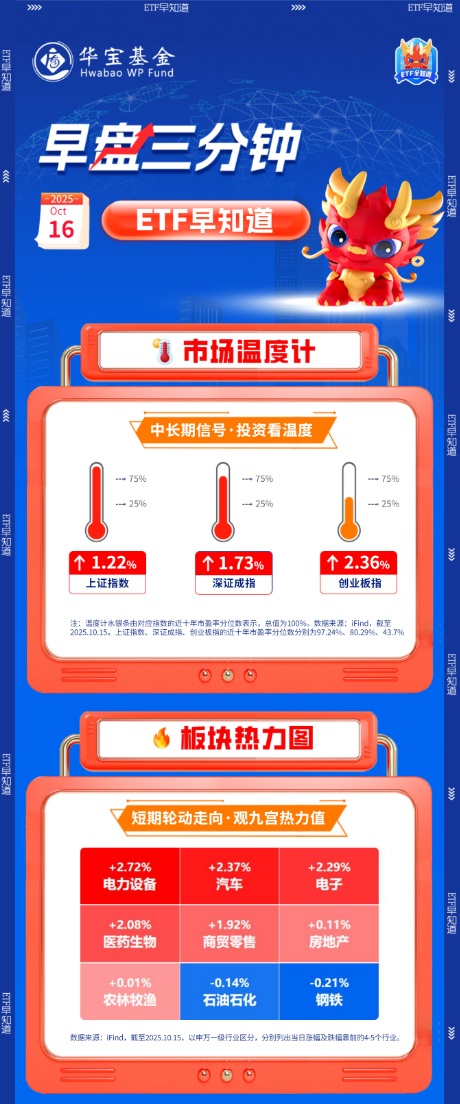
【盘前三分钟】10月16日ETF早知道
Xin Lang Ji Jin· 2025-10-16 01:12
Group 1 - The article highlights a potential rebound in the Hong Kong internet sector, driven by attractive valuations and the influence of AI technology, following indications from the Federal Reserve about possible interest rate cuts [4] - The Hong Kong internet index saw a significant increase of over 2% on October 15, 2025, reflecting a positive market sentiment towards internet stocks [4] - The food and beverage sector continues to show upward momentum, with the food and beverage index recording gains for two consecutive days, indicating a recovery in domestic demand [4] Group 2 - The top three sectors for capital inflow include pharmaceuticals with 2.548 billion, home appliances with 1.591 billion, and food and beverages with 0.597 billion [2] - The sectors experiencing the most significant capital outflow are non-ferrous metals at -4.939 billion, telecommunications at -2.096 billion, and defense and military at -1.717 billion [2] - The article notes that the food and beverage sector is characterized by low base, low holdings, and low expectations, suggesting that any changes in supply and demand could significantly impact stock prices [4]
美联储10月降息概率飙升97.3%:普通人如何守住钱袋子?
Sou Hu Cai Jing· 2025-10-15 09:45
Core Insights - The Federal Reserve is expected to initiate a rate cut cycle, with a 97.3% probability of a 25 basis point cut in October, marking a significant policy shift since 2019 [1][4] - Current economic indicators show a combination of high inflation and weakening employment, suggesting that this rate cut cycle may be more abrupt and intense than in 2019 [4] Group 1: Economic Signals - Powell's speech highlighted three key signals: the ongoing deterioration of the U.S. labor market, the economic impact of a potential government shutdown, and the possibility of halting balance sheet reduction [1] - The core PCE price index stands at 3.7%, significantly higher than the 1.6% recorded in 2019, indicating persistent inflationary pressures [4] Group 2: Impact on Housing and Savings - Historical data suggests that a Fed rate cut typically leads to a decrease in domestic LPR rates within 1-2 quarters, potentially lowering mortgage rates by 0.15%-0.3%, which could reduce monthly payments by 200-400 CNY for a 1 million CNY 30-year loan [5] - Following the initiation of a rate cut cycle, domestic bank deposit rates are expected to decline, with three-year large-denomination time deposits likely falling below 2.5% [6] Group 3: Market Reactions - Based on past experiences, the S&P 500 index has historically risen by 12% within three months following the first rate cut, with potential benefits for A-share consumer and gold sectors [8] - In the 2019 rate cut cycle, gold prices increased by 23%, while the U.S. stock market exhibited a "buy the rumor, sell the news" pattern, suggesting that asset price volatility may be more pronounced in the current environment [11] Group 4: Investment Strategies - It is recommended to allocate 40%-50% of assets to low-risk instruments such as government bonds, with a current 10-year government bond yield of approximately 2.8% [11] - Investors should consider a 1-3 month window for potential rebounds in U.S. tech stocks post-Fed policy shift, while implementing strict stop-loss measures [12] Group 5: Currency and Risk Management - The U.S. dollar index may fall below the 105 mark, prompting investors holding dollar-denominated assets to consider gradual currency conversion [13] - The attractiveness of RMB assets is expected to increase, although monitoring the China-U.S. interest rate differential remains crucial [13] Group 6: Conclusion - The rate cut cycle represents a process of cash devaluation and asset revaluation, with conservative investors advised to increase bond allocations to over 50% [14] - Maintaining liquidity is essential for seizing future opportunities, especially with another potential 50 basis point cut anticipated in December [14]