
M2

Search documents
设备制造业进口量增加
Hua Tai Qi Huo· 2025-05-15 05:16
1. Report Industry Investment Rating No relevant content provided. 2. Core View of the Report The report presents a comprehensive overview of the current situation in various industries, including production, service, upstream, mid - stream, and downstream sectors, as well as market pricing. It also provides data on industry credit spreads and key industry price indicators [1][2][3][4][5][50][51]. 3. Summary by Related Catalogs 3.1 Production and Service Industries - **Production Industry**: In the first four months of this year, the imports of the equipment manufacturing industry in the nine mainland cities of the Guangdong - Hong Kong - Macao Greater Bay Area increased. The total import and export value reached 2.85 trillion yuan, a 5.4% increase, accounting for 96.4% of Guangdong's total. Exports of "new three items" and motorcycles increased by over 40%, while imports of semiconductor manufacturing equipment, computers and components, and some consumer goods grew rapidly [1]. - **Service Industry**: In April, M2 increased year - on - year. Guangzhou issued measures to promote the high - quality development of elderly care finance. At the end of April, the balance of broad money (M2) was 325.17 trillion yuan, a year - on - year increase of 8%. The balance of local and foreign currency loans was 269.54 trillion yuan, a 6.8% year - on - year increase. The balance of RMB loans was 265.7 trillion yuan, a 7.2% year - on - year increase, and RMB loans increased by 10.06 trillion yuan in the first four months [1]. 3.2 Upstream Industries - **Energy**: After the tariff war, international oil prices continued to rise [2]. - **Non - ferrous Metals**: The price of aluminum has been rising recently [2]. - **Ferrous Metals**: The price of glass dropped in the short term [2]. 3.3 Mid - stream Industries - **Chemical Industry**: The PX operating rate declined seasonally, while the polyester operating rate remained high [3]. 3.4 Downstream Industries - **Real Estate**: The sales of commercial housing in second - and third - tier cities decreased [4]. - **Service**: The number of domestic flights decreased compared to the same period [4]. 3.5 Market Pricing - The credit spreads of the entire industry declined slightly recently [5]. 3.6 Industry Credit Spreads - The report provides week - to - week and historical data on the credit spreads of multiple industries, including agriculture, mining, chemical, and others. For example, the credit spread of the agriculture, forestry, animal husbandry, and fishery industry decreased from 77.76 last week to 66.88 this week [50]. 3.7 Key Industry Price Indicators - The report tracks the prices of various products in different industries such as agriculture, non - ferrous metals, ferrous metals, energy, and chemicals. For instance, the spot price of WTI crude oil was $63.7 per barrel on May 14, a 7.75% year - on - year increase [51].
2025年期货市场研究报告
Hua Tai Qi Huo· 2025-05-15 04:30
Import and Export Overview - The import volume of the equipment manufacturing industry has increased, with the Guangdong-Hong Kong-Macao Greater Bay Area's import and export value reaching 2.85 trillion yuan, a growth of 5.4% in the first four months of the year, accounting for 96.4% of Guangdong's total import and export value[1] - Exports of "new three items" and motorcycles increased by over 40%, while imports of semiconductor manufacturing equipment, computers and components, and certain consumer goods grew rapidly[1] Monetary Policy and Financial Services - As of the end of April, the broad money supply (M2) stood at 325.17 trillion yuan, reflecting a year-on-year increase of 8%[1] - The balance of domestic and foreign currency loans reached 269.54 trillion yuan, with a year-on-year growth of 6.8%[1] - The balance of RMB loans was 265.7 trillion yuan, up 7.2% year-on-year, with an increase of 1.006 trillion yuan in RMB loans over the first four months[1] Industry Trends - In the upstream sector, international oil prices have continued to rise following the tariff war, while aluminum prices have recently rebounded[2] - The chemical industry is experiencing a seasonal decline in PX operating rates, while polyester operating rates remain high[3] - In the downstream sector, real estate sales in second and third-tier cities are declining, and domestic flight frequencies have decreased compared to the same period last year[4] Market Pricing and Risks - The credit spread across all industries has recently narrowed slightly[5] - Potential risks include unexpected economic policies and global geopolitical conflicts[5]
四月金融数据怎么看?招商宏观:社融与M2因低基数原因,增速环比明显提升
Sou Hu Cai Jing· 2025-05-15 04:23
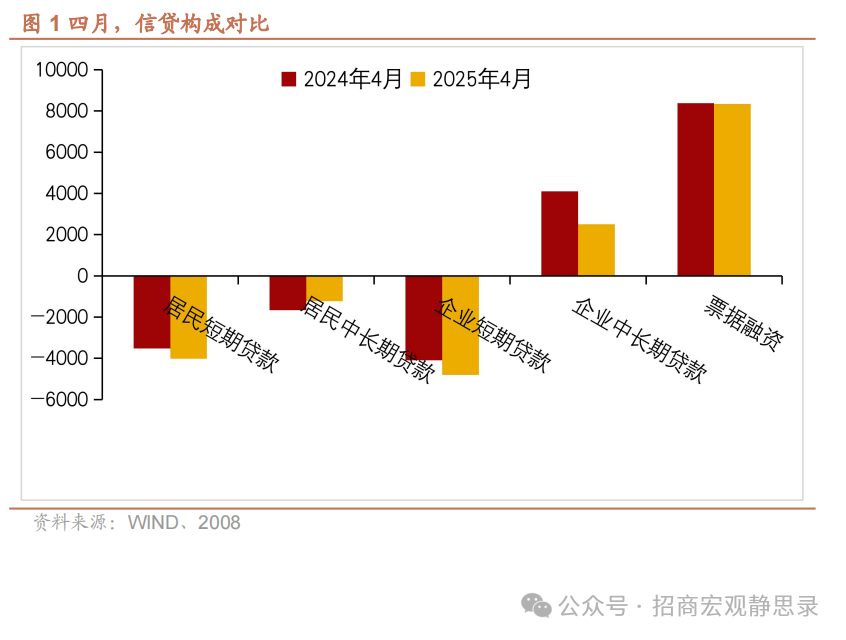
Core Viewpoint - The financial data for April indicates a significant impact on credit due to external factors, with bills becoming a major support for credit growth [2][6]. Group 1: Credit and Loans - New RMB loans in April amounted to 280 billion, a decrease of 450 billion year-on-year, falling short of market expectations [7][11]. - The corporate sector showed a more pronounced impact from tariffs, with corporate loans increasing by 610 billion, down from 860 billion year-on-year [8]. - Bills financing accounted for 297.9% of the new credit in April, highlighting its critical role in supporting credit growth [8][13]. Group 2: Deposits - Total RMB deposits decreased by 440 billion in April, with significant changes in the structure, particularly in non-bank financial institutions which saw an increase of 1.57 trillion [12]. - The increase in non-bank financial deposits is attributed to a shift in investment preferences due to volatility in the bond market [12]. Group 3: Social Financing - Social financing increased by 1.16 trillion in April, with a growth rate of 8.7%, marking a significant rise due to a low base effect [13]. - Government bonds played a crucial role, with new issuance reaching 9.76 trillion, a year-on-year increase of approximately 1.07 trillion [13]. Group 4: Conclusions and Implications - The April data reflects a seasonal decline in credit, exacerbated by tariff impacts, with expectations of a potential decline in growth rates as base effects fade [6][17]. - The central bank is responding by increasing structural relending quotas to stimulate credit demand in the service sector [17].

2025年4月金融数据点评:4月信贷大幅少增,社融、M2增速加快,一揽子金融支持政策将推动金融总量增速持续上行
Dong Fang Jin Cheng· 2025-05-15 03:23
Group 1: Loan and Financing Trends - In April 2025, new RMB loans amounted to 280 billion, a year-on-year decrease of 450 billion, primarily due to the over-issuance in March and ongoing local debt replacement effects[1][4][11] - The total social financing (TSF) in April was 1.1585 trillion, a year-on-year increase of 1.2243 trillion, driven by a low base from the previous year and significant government bond issuance[1][7][11] - The M2 money supply grew by 8.0% year-on-year, an increase of 1.0 percentage points from the previous month, indicating enhanced financial support for the real economy[1][9][11] Group 2: Economic Outlook and Policy Implications - The People's Bank of China announced a series of financial support policies on May 7, including interest rate cuts, which are expected to increase bank lending capacity by approximately 1 trillion[3][12] - The easing of the US-China trade tensions, as noted in the May 12 joint statement, may partially restore bilateral trade, although high tariffs will continue to pose challenges[3][12] - The expectation is for continued year-on-year increases in credit and social financing in May, with M2 growth also anticipated to accelerate[3][12][13] Group 3: Structural Changes in Loan Distribution - From January to April 2025, new loans totaled 10.06 trillion, a year-on-year decrease of 130 billion, largely influenced by local debt replacement factors[1][6][11] - The structure of loans has improved, with the proportion of loans to small and micro enterprises, manufacturing, and key service sectors increasing significantly[1][6]
普林格与盈利周期跟踪:宽货币宽信用,社融脉冲新高
Tianfeng Securities· 2025-05-15 00:15
Core Insights - The report emphasizes that identifying the performance turning point is crucial for the market to move out of the bottom-seeking phase, with market bottoms typically leading performance turning points by 1-2 quarters [2] - The report highlights the importance of combining leading indicators with coincident indicators for better economic bottom assessments, as relying solely on coincident indicators may lead to delayed confirmations [2] - The key to breaking out of the bottom-seeking phase lies in the sustainability of M1 recovery, with household medium and long-term loans being a more critical indicator [2] Economic Indicators - The April manufacturing PMI significantly dropped to 49%, indicating a contraction for the first time since February, down from 50.5% [4] - M1 showed a slight year-on-year decline, while M2 increased, and the total social financing stock rose year-on-year, indicating a rebound in excess liquidity [7] - The total social financing increment in April was 1.16 trillion yuan, which is 12.243 billion yuan more than the same period last year, with a slight recovery in new government bonds but a negative year-on-year change in new RMB loans [9] Leading Indicators - The report notes that M2 leads M1, which in turn leads the stock market bottom, with M2 showing a year-on-year increase of 8% in April, up from 7% [7] - The social financing pulse increased to 26.16% in April, up from 25.41%, with new government bonds showing a slight recovery while new RMB loans turned negative [9] - The report indicates that the decline in household medium and long-term loans is closely related to the real estate sales cycle, with April showing a year-on-year decrease of 12.97% for household medium and long-term loans [12] Monetary Policy and Market Sentiment - The report discusses that the narrowing of the decline in household and corporate loans is essential for market recovery, with the April average DR007 rate marginally dropping to 1.73% [15] - The central bank's recent decision to lower the reserve requirement ratio and policy interest rates is aimed at stabilizing the market [15] - The report mentions that the recovery in social financing and M2, along with improved export performance, reflects a resilient Chinese economy despite the macroeconomic downturn [18]
4月金融总量指标增长稳健
Zhong Guo Zheng Quan Bao· 2025-05-14 20:53
Group 1 - The core viewpoint of the articles indicates that the financial data for April shows a stable and solid growth, reflecting a moderately loose monetary policy aimed at supporting the real economy [1][6] - As of the end of April, the total social financing scale reached 424 trillion yuan, with a year-on-year growth of 8.7%, supported by strong fiscal measures and a rapid issuance of bonds [2][4] - The M2 money supply stood at 325.17 trillion yuan, growing by 8.0% year-on-year, influenced by a low base effect from the previous year [2][3] Group 2 - The growth of RMB loans reached 10.06 trillion yuan in the first four months, with a year-on-year increase of 7.2% as of the end of April, indicating a higher actual support for the economy when adjusting for local debt replacement effects [4][5] - The weighted average interest rate for new corporate loans was approximately 3.2% in April, down about 4 basis points from the previous month and 50 basis points from the same period last year, indicating a downward trend in financing costs [5] - Recent financial policies introduced by the People's Bank of China and other regulatory bodies are expected to boost market confidence and support the recovery of effective demand in the real economy [6]
4月社融、M2增速加快!一揽子金融政策将推动金融总量增速持续上行
Guang Zhou Ri Bao· 2025-05-14 16:33
Group 1 - The central bank released April financial data showing that new RMB loans in April were 280 billion yuan, a decrease of 450 billion yuan year-on-year, influenced by hidden debt replacement and seasonal overdrafts [1][2] - The social financing scale increased by 1.16 trillion yuan in April, significantly up by 1.22 trillion yuan year-on-year, with the end-of-month social financing stock growing by 8.7% year-on-year [1][3] - M2 money supply grew by 8% year-on-year at the end of April, which is 1 percentage point higher than the previous month, indicating enhanced financial support for the real economy [1][3] Group 2 - The acceleration in government bond issuance is the primary driver for the increase in social financing growth, with net financing from government bonds exceeding 500 billion yuan in the first four months, up by approximately 360 billion yuan year-on-year [3] - In April, the issuance of special government bonds and refinancing bonds for replacing hidden debts contributed to a net financing of about 970 billion yuan, raising social financing growth by approximately 0.3 percentage points [3] - The reduction in bond yields in April encouraged enterprises to increase bond financing, thereby lowering overall financing costs [3] Group 3 - A reserve requirement ratio cut of 0.5 percentage points was implemented, expected to release about 1 trillion yuan in long-term liquidity, enhancing credit supply capabilities in specific sectors like automotive finance and financial leasing [4] - Analysts anticipate that monetary policy will remain "appropriately loose" in the second half of the year, with expectations for continued interest rate cuts and an increase in new loans and social financing [4]
【新华解读】4月社融规模新增近1.2万亿元 还原置换影响信贷增速或仍超8%
Xin Hua Cai Jing· 2025-05-14 09:54
Core Viewpoint - The People's Bank of China reported a significant increase in social financing and M2 growth in April, indicating a stable and moderately loose monetary policy environment, with expectations for continued steady growth in financial totals despite short-term uncertainties in effective credit demand [1][2][3]. Group 1: Social Financing and Monetary Supply - In April, the new social financing scale increased by 1.16 trillion yuan, with the total social financing stock reaching 424 trillion yuan, a year-on-year growth of 8.7%, which is 0.4 percentage points higher than the same period last year [2][3]. - The M2 money supply grew by 8% year-on-year, which is 1 percentage point higher than the end of the previous month and 0.8 percentage points higher than the same period last year [5][6]. Group 2: Government Debt and Credit Support - The acceleration of government bond issuance has been a major driver of social financing, with net financing from government bonds exceeding 500 billion yuan in the first four months of the year, significantly higher than the previous year [3][4]. - The issuance of corporate bonds has also increased, with the total corporate bond balance reaching 32.8 trillion yuan, a year-on-year increase of 3.2% [3][4]. Group 3: Loan Growth and Structure - In April, the increase in RMB loans was approximately 280 billion yuan, with the total RMB loan balance reaching 265.70 trillion yuan, a year-on-year growth of 7.2%, which remains significantly above nominal economic growth [3][4]. - The growth rate of inclusive small and micro loans and medium to long-term loans for the manufacturing sector was 11.9% and 8.5% respectively, both exceeding the overall loan growth rate [4]. Group 4: Interest Rates and Future Outlook - The average interest rate for newly issued corporate loans was 3.2%, down about 4 basis points from the previous month and 50 basis points from the same period last year [4]. - Market analysts expect that despite short-term uncertainties in effective credit demand, the implementation of a series of financial policies will positively impact the recovery of effective demand in the real economy, leading to stable growth in financial totals in the near future [4][6].
大增8%!刚刚,央行重磅发布
证券时报· 2025-05-14 09:38
低基数下4月M2大幅增长。 中国人民银行(简称"央行")5月14日发布的金融数据显示,今年前4个月金融总量数据持续向好,4月末M2(广义货币)余额增速同比大幅增长8%,比上月 末高1个百分点,既与去年低基数因素相关,也反映出央行逆周期调节和金融稳经济效果持续显现。 今年前4个月,人民币贷款增加10.06万亿元,其中,4月新增人民币贷款约2800亿元;前4个月社会融资规模增量累计为16.34万亿元,其中,4月社融规模增 量为1.16万亿元,同比多增1.22万亿元。 从前4个月金融总量数据看,社会融资规模存量、广义货币M2、人民币贷款增速分别为8.7%、8%、7.2%,持续高于名义GDP增速,金融对实体经济支持的力 度仍然较大。反映资金活化程度的M1(狭义货币)余额同比增长1.5%,比上月末低0.1个百分点,增速保持平稳。 随着一揽子金融政策出台,金融总量有望保持平稳增长。随着外部环境出现有利转变,适度宽松货币政策有望更快见效。业内人士表示,货币政策适度宽松 的效果将持续体现。有市场信任的基础,政策的实际效果还会进一步放大。 低基数因素下M2大幅增长 今年4月,货币信贷整体保持平稳较好增长势头,在上年低基数效应作 ...
工业品价格增速或有回踩——4月经济数据前瞻【陈兴团队•财通宏观】
陈兴宏观研究· 2025-04-30 11:03
报 告 正 文 预计4月工业增加值同比增长5.8% 。4月全国制造业PMI回落至49%,再度降至线下。主要分项指标中,产 需双双回落,原材料和出厂价格均有下行,原材料和产成品库存同步下降。从4月以来的中观高频数据来 看,汽车半钢胎和全钢胎开工率同比继续下降,化工行业开工率同比降幅均有走扩。六大发电集团耗煤同 比增速因去年同期基数走低而有所上升。整体来看,工业生产景气度保持平稳。我们预计,4月工业增加 值同比增速降至5.8%。 预计4月固定资产投资累计同比增长4.2%。 具体来看三大类投资,基建投资累计同比增速有所上升,制造 业投资累计同比增速有所下降,房地产投资累计同比增速略微下降。我们预计,4月投资累计增速或保持 稳定。 首先, 从基建相关的高频数据来看,水泥价格同比略有上升,螺纹钢累计产量同比降幅收窄,预 计基建投资累计增速有所上升; 其次, 42城地产销量累计同比降幅持续走扩,预计房地产投资额累计降 幅略微下降; 最后 ,乘联会乘用车批发和零售销量累计同比由升转降,预测制造业投资累计增速将有所 下降。我们预计,4月固定资产投资累计同比增速或保持稳定至4.2%。 预计4月社会消费品零售总额同比增长6.4% ...