
大宗商品市场

Search documents
白银再遭“雪崩式”抛售 盘中狂泻17%吞噬两日涨幅!黄金同步下挫、贵金属集体失色
智通财经网· 2026-02-05 06:47
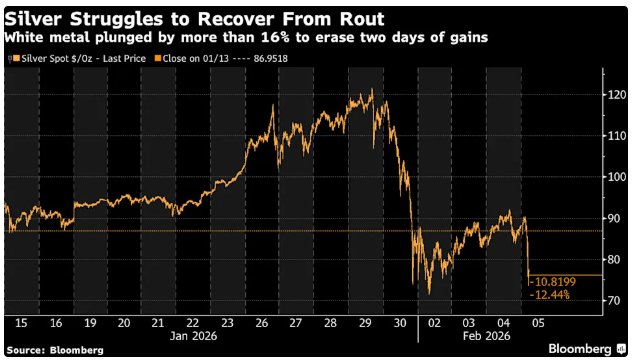
Core Viewpoint - Silver prices experienced a significant decline after a record rebound, with the market struggling to find support, while gold prices also fell in tandem [1] Group 1: Market Performance - Silver saw a maximum intraday drop of 17%, previously reaching nearly $90 per ounce, but has since retreated over one-third from its historical high on January 29 [1] - Gold prices fluctuated, with a maximum intraday drop of 3.5%, currently reported at $4,929.45 per ounce [1] - The decline in precious metals negatively impacted base metal market sentiment, with copper prices dropping over 1% to below $13,000 per ton [1] Group 2: Market Sentiment and Influences - Analysts from ANZ noted that gold struggled to maintain its previous gains due to a lack of further buying catalysts, with a strong dollar dampening investor appetite [1] - Market sentiment across various asset classes, including regional stocks and metals, is low, creating a negative feedback loop amid insufficient market liquidity [2] Group 3: Speculative Activity and Future Outlook - Last month, precious metal prices surged due to speculative funds, geopolitical tensions, and concerns over the independence of the Federal Reserve, but this rally abruptly halted [4] - Analysts from Standard Chartered indicated that gold prices may remain volatile until monetary policy outlooks become clearer, with structural drivers for precious metals still intact [5] - The volatility in silver prices is exacerbated by smaller market size and weaker liquidity, with significant speculative inflows amplifying price fluctuations [5]

PTA:多空消息博弈 短期PTA行情偏稳
Sou Hu Cai Jing· 2026-02-05 02:23
Group 1 - The PTA market experienced fluctuations this week, initially declining before rebounding due to the interplay between rising crude oil prices and accumulating PTA inventory [1] - Concerns over a potential shift in the Federal Reserve's monetary policy led to a broad decline in the commodity market, causing PTA prices to retreat from high levels at the beginning of the week [1] - Geopolitical uncertainties have contributed to the rise in crude oil prices, which in turn has supported the PTA market [1] Group 2 - Downstream polyester operating rates continue to decline, creating a stalemate between cost support and decreasing demand in the market [1] - The short-term outlook for the PTA market is expected to remain stable [1]
尾盘,突然拉升!伊朗,突发威胁!
券商中国· 2026-02-04 09:05
Core Viewpoint - The article discusses the volatile situation in the Middle East, particularly focusing on the ongoing negotiations between the U.S. and Iran, and the potential military actions that could escalate tensions in the region [1][4]. Negotiations - The Trump administration has agreed to hold negotiations with Iran in Oman on February 6, following a request from Iran to change the location from Turkey [2]. - Iranian President Raisi has instructed his foreign minister to engage in fair and dignified negotiations with the U.S. [2]. - Iran's political advisor has stated that while Iran can reduce uranium enrichment levels from 60% to 20%, it will not transfer enriched uranium abroad, emphasizing the peaceful nature of its nuclear program [2] [3]. Incidents and Military Actions - On the same day as the negotiation arrangements changed, Iranian military forces conducted two aggressive actions against U.S. vessels within six hours [4]. - The Iranian Revolutionary Guard attempted to board a U.S.-flagged commercial ship near the Strait of Hormuz, but retreated when U.S. naval forces arrived [5]. - An Iranian drone was shot down by a U.S. F-35 fighter jet after approaching the USS Lincoln aircraft carrier [5]. Market Reactions - The commodity markets reacted to the heightened tensions, with silver prices rising over 4% and Brent crude oil increasing by more than 0.5% [1]. - The A-share market saw a late surge, with the Shanghai Composite Index rising by 0.85% [1]. - Gold prices surged past $5,100 per ounce, reflecting market caution regarding potential conflicts in the Middle East [6].

长江有色:炸盘!伦锡暴涨紧张感拉满成交量持仓量同步攀升 4日锡价或大涨
Xin Lang Cai Jing· 2026-02-04 03:05
Core Viewpoint - The recent surge in tin prices is driven by a combination of global liquidity expectations, supply risks, and geopolitical tensions, with significant price increases observed in both the London and domestic futures markets [1][2][3] Group 1: Market Overview - Global macroeconomic conditions have improved, leading to a positive sentiment in the commodity market, supported by the People's Bank of China's liquidity measures and easing political uncertainties in the U.S. [1] - The London Metal Exchange (LME) tin inventory decreased to 7,095 tons, indicating tightening supply conditions [1] Group 2: Supply and Demand Dynamics - Supply disruptions from Myanmar and the Democratic Republic of Congo (DRC) are contributing to structural tightness in global tin supply, with Myanmar's Wa region accounting for 15%-20% of global tin supply and being a key source for China [2][3] - Demand is showing a bifurcation, with traditional sectors like consumer electronics and home appliances weakening, while emerging sectors such as AI servers, photovoltaics, and electric vehicles exhibit strong resilience [3] Group 3: Industry Chain Status - The upstream mining sector faces production constraints due to policy and natural factors, while the midstream smelting sector is pressured by tight raw material supplies and low processing fees, leading to reduced profits [4] - Downstream sectors, including solder and chemicals, are adopting low inventory strategies due to high tin prices and seasonal demand fluctuations, with restocking needs expected to be postponed until after the holiday [4] Group 4: Current Market Trends - The spot market is experiencing tight supply, with traders reluctant to sell, while downstream buyers are gradually restocking, supporting high price volatility [5] - Short-term tin prices are expected to fluctuate within the range of $49,500 to $50,800 per ton, with ongoing supply-demand tightness and emerging sector demand providing core support for prices [5]

Gold Could Come Crashing Down After Hitting $5,500
Youtube· 2026-01-29 17:52
Group 1: Gold Market Insights - Gold prices have recently reached as high as $5,500 an ounce, but there are concerns about sustainability and potential corrections in the future [2][19] - Unusual activity in the options market for gold and silver has been observed, reminiscent of volatility seen during the financial crisis [5][11] - The influx of retail traders into commodity ETFs has created market conditions that may not be sustainable, leading to unjustifiable price levels [7][9] Group 2: Factors Influencing Gold Prices - The invasion of Ukraine by Russia and subsequent sanctions have prompted a shift in investor sentiment towards gold as a safer asset [14][16] - There is a perception that developed countries are offering lower interest rates on debt compared to the U.S., making gold and silver more attractive alternatives [15] - Historical patterns suggest that gold could see corrections of 30% to 50%, potentially bringing prices down to the range of $2,000 to $3,000 in the next couple of years [19] Group 3: Oil Market Dynamics - Oil prices have recently hit a four-month high at around $65 a barrel, driven by geopolitical tensions, particularly between the U.S. and Iran [20][21] - Despite the recent rally, the oil market has been in a bear phase for several years, with previous rallies often leading to new lows [21][22] - Historical trends indicate that if oil prices fall below $65, there could be a significant drop to levels between $15 and $20 a barrel [25] Group 4: Dollar Market Sentiment - There is a prevailing bearish sentiment towards the U.S. dollar, which has seen a 10% decline over the past year [27][28] - A critical level to watch in the dollar index is 96; if it holds above this level, it could change the narrative for other assets [30][31] - The dollar's performance in the coming weeks will be crucial for determining the direction of gold and silver prices, as a stronger dollar could lead to a reevaluation of current market positions [29][30]

有色日报:铜增仓上行明显-20260129
Bao Cheng Qi Huo· 2026-01-29 10:08
Report Summary 1. Investment Rating - The report does not provide an investment rating for the industry. 2. Core Views - **Copper**: On January 29, 2026, copper prices increased with rising positions, breaking through the upper limit of the trading range since January. The trading volume of SHFE copper reached 700,000 contracts, and the main contract price touched 110,000 yuan. LME copper reached $14,000 per ton, rising over 6,000 yuan per ton during the day. Macroscopically, the US dollar index remained weak, leading to a general increase in precious and non - ferrous metals. Industrially, downstream buyers were hesitant, and the spread between February and March contracts continued to narrow, falling below 400 yuan per ton. In the short term, macro factors drove up copper prices, and the industry followed passively [6]. - **Aluminum**: Aluminum prices showed a strong and volatile trend, with trading volume and prices moving in the same direction. Macroscopically, the weak US dollar index led to a general increase in non - ferrous metals. Industrially, downstream buyers were hesitant, and the spread between February and March contracts continued to narrow, falling below 100 yuan per ton. Similar to copper, macro factors drove up aluminum prices, and the industry followed passively [7]. - **Nickel**: Nickel prices increased with rising positions in the morning and decreased with falling positions in the afternoon, showing an overall strong trend. Macroscopically, the weak US dollar was beneficial to non - ferrous metals. Industrially, the LME nickel 0 - 3 spread continued to narrow, and the domestic February - March spread also fell below 400 yuan per ton, reflecting a situation of strong expectations and weak reality. Macro factors drove up nickel prices, and the expected supply contraction supported nickel prices, while the weak industrial reality put pressure on them [8]. 3. Section Summaries 3.1 Industry Dynamics - **Copper**: On January 29, LME copper prices soared, hitting a record high of $13,965 per ton, with a cumulative increase of nearly 12% this year. Other major base metals also rose, and aluminum prices reached a three - year high. The strong performance of the commodity market at the beginning of the year was due to the weak US dollar, increased demand for physical assets, and geopolitical tensions. The weak US dollar made commodities more attractive to buyers [10]. - **Aluminum**: According to SMM data on January 29, the weekly ratio of molten aluminum in domestic electrolytic aluminum production was 72.64%, a decrease of 2.25 percentage points from the previous week, and a cumulative decrease of 3 percentage points in January [11]. 3.2 Relevant Charts - **Copper**: The report includes charts on copper basis, month - to - month spreads, Shanghai electrolytic copper social inventory, global copper exchange inventory (SHFE + LME + COMEX), LME copper cancelled warrant ratio, and SHFE warrant inventory [12][13][15]. - **Aluminum**: The report includes charts on aluminum basis, month - to - month spreads, domestic social inventory of electrolytic aluminum, overseas exchange inventory of electrolytic aluminum (LME + COMEX), Shanghai - London ratio, and aluminum bar inventory [26][28][30]. - **Nickel**: The report includes charts on nickel basis, LME inventory, LME nickel price trend, SHFE inventory, and nickel ore port inventory [38][40][42].
期市“锵锵谈”:一场与未来市场的深度对话
Qi Huo Ri Bao· 2026-01-29 04:37
Group 1 - The article discusses the rising prices of gold and copper, indicating a significant interest in the commodities market, which is seen as either a response to global risk aversion or a precursor to a new inflation cycle [1][2] - The narrative around copper is evolving, with it being referred to as the "new oil" in the context of energy transition and AI revolution, suggesting a fundamental shift in trading logic [2][4] - The upcoming video interview series "期市'锵锵谈'" aims to bridge the gap between macroeconomic insights and investors, focusing on complex market dynamics and providing a "thinking map" for understanding trends [1][3] Group 2 - The first episode will focus on copper, featuring industry experts who will discuss its transformation from an economic indicator to a strategic asset, and the implications for market participants [2][4] - The discussions will cover various topics, including the changes in trading logic, the truth behind COMEX inventory dynamics, and the identification of key risks and opportunities for 2026 [2][3] - The series intends to balance professional insights with accessible information for a wide audience, covering other core commodities in future episodes [3][5]

长江有色:美联储决议落地市场偏暖避险与看涨交织 29日镍价或小涨
Xin Lang Cai Jing· 2026-01-29 03:16
Core Viewpoint - The nickel market is experiencing a complex interplay of supply constraints and demand dynamics, influenced by macroeconomic factors and geopolitical tensions, leading to a volatile price environment. Supply Side - Global nickel supply is characterized by a stark contrast between international expectations of tightness and domestic realities of abundance, with Indonesia's significant reduction in nickel mining quotas being a key driver of supply contraction [3] - The Indonesian nickel mining quota has decreased by 34%, exacerbating global supply concerns, while short-term factors such as the rainy season in the Philippines and geopolitical disturbances in the Democratic Republic of Congo (DRC) further tighten supply expectations [3] - In contrast, domestic supply remains stable with steady release of smelting capacity and high social inventory levels, leading to a relaxed supply environment [3] Demand Side - Demand for nickel is structurally driven, with stainless steel maintaining stable demand while the electric vehicle battery sector, particularly high-nickel ternary materials, emerges as a strong growth engine [3] - However, high nickel prices are dampening immediate purchasing enthusiasm among downstream enterprises, which are primarily focused on essential stockpiling [3] Industry Dynamics - The industry is increasingly characterized by a dual-core structure where Indonesia dominates resource supply and China leads in smelting and application, resulting in profit concentration at the upstream resource level while midstream smelting companies face rising cost pressures [4] - The futures market reflects concerns over long-term supply through a backwardation structure, although short-term pressures from high inventory levels in exchanges and the spot market persist [4] Price Trend Forecast - The nickel market is undergoing a fundamental restructuring, with short-term price movements expected to remain volatile due to high inventory levels and cautious purchasing behavior from downstream sectors [5] - Core support for medium-term prices remains robust, driven by significant policy support from reduced Indonesian mining quotas, heightened resource supply concerns due to geopolitical risks in the DRC, and ongoing global liquidity easing [5] Future Outlook - Future nickel price movements will largely depend on three key variables: the actual implementation of Indonesian policies, developments in the DRC situation, and the intensity of post-holiday restocking demand from downstream sectors [6] - The nickel market is expected to experience intense short-term volatility, but medium to long-term prospects remain positive due to constrained supply and structurally strong demand [6]
地缘扰动不断短期商品或震荡偏强:大宗商品周报2026年1月26日-20260126
Guo Tou Qi Huo· 2026-01-26 11:07
1. Report Industry Investment Rating - No relevant content provided. 2. Core Viewpoints of the Report - The commodity market rose 2.08% last week, with precious metals leading the increase at 9.08%, non - ferrous metals and energy - chemicals rising 2.96% and 1.95% respectively, while agricultural products and black metals slightly declined by 0.04% and 0.53% [2][7]. - The US PCE data rebounded slightly, cooling the interest - rate cut expectations. The US dollar index significantly corrected last week, and the easing of the Greenland conflict boosted market risk appetite. The uncertainty brought by the Iranian situation is beneficial to precious metals and energy - chemicals, and the short - term commodity market may fluctuate strongly [2]. - In the short term, precious metals will continue to fluctuate upward, but need to beware of post - overbought corrections; non - ferrous metals may fluctuate strongly; black metals may fluctuate; energy prices may rebound but with limited space; the chemical industry may fluctuate strongly; and agricultural products may also fluctuate strongly [2][3][4]. 3. Summary by Related Catalogs 3.1 Market Performance - **Overall Market**: The commodity market rose 2.08% last week. Precious metals led the gain at 9.08%, non - ferrous metals and energy - chemicals rose 2.96% and 1.95% respectively, while agricultural products and black metals slightly declined by 0.04% and 0.53% [2][7]. - **Individual Varieties**: The top - rising varieties were silver, PTA, and gold, with increases of 11.04%, 8.57%, and 7.74% respectively; the top - falling varieties were glass, live pigs, and iron ore, with decreases of 3.54%, 3.46%, and 2.09% respectively [2][7]. - **Volatility**: The 20 - day average volatility of the commodity market continued to rise, with styrene, live pigs, and gold having relatively large fluctuations [2][7]. - **Funds**: The overall market scale increased last week, with only the black metal sector experiencing capital outflows. Gold and silver received capital inflows of 24.4 billion and 12.7 billion respectively [2][7]. 3.2 Outlook for Different Sectors - **Precious Metals**: The US dollar index dropped significantly, and geopolitical disturbances increased market risk - aversion sentiment. The sector continued to fluctuate upward. The low inventory of silver also promoted the silver price. In the short term, the upward trend of the sector is hard to reverse, but post - overbought corrections should be watched out for [2]. - **Non - Ferrous Metals**: The US dollar index was weak, risk - aversion sentiment was high, and domestic policies aimed to expand domestic demand. The supply - side contraction risk supported prices, and the sector may fluctuate strongly in the short term [3]. - **Black Metals**: The apparent demand for rebar slightly declined, production increased, and inventory accumulated again. Steel mill profits were poor, and the resumption of production was affected. Iron ore port inventory increased significantly, and the structural contradiction needed to be resolved. The sector may fluctuate in the short term [3]. - **Energy**: The US Treasury's new sanctions on Iran and the production suspension of two major oil fields in Kazakhstan due to force majeure, along with the cold wave in the US, led to a rise in natural gas prices and increased demand for heating oil. Oil prices may rebound, but the rebound space is limited due to the inventory - accumulation pressure in Q1 [3]. - **Chemical Industry**: For polyester products, terminal demand declined, and there was an inventory - accumulation expectation around the Spring Festival, but supply - contraction expectations and positive market sentiment may lead to short - term strong fluctuations. For building materials, PVC may see capacity reduction and possible export - grabbing, with an expected upward shift in the center of gravity; glass may see seasonal inventory accumulation but may follow macro - sentiment fluctuations [4]. - **Agricultural Products**: The expectation of a South American bumper harvest is the main trading logic, but the slow progress of the new - season Brazilian soybean harvest may increase the pressure on US soybeans and soybean meal. The improvement of China - Canada relations may impact domestic soybean - meal prices. The supply - demand structure of Malaysian palm oil has improved, and the overall oilseeds and oils may fluctuate strongly in the short term [4]. 3.3 Commodity Fund Overview - **Gold ETFs**: Most gold ETFs had a weekly return of around 7.5%. The total scale of gold ETFs was 29.5871 billion yuan, with a 4.42% increase, and the total trading volume increased by 82.85% [36]. - **Other ETFs**: The energy - chemical ETF had a 3.48% return, the soybean - meal ETF had a 0.92% return, the non - ferrous metal ETF had a - 0.52% return, and the silver fund had a 6.72% return [36][38]. The total scale of commodity ETFs was 31.8614 billion yuan, with a 3.99% increase, and the total trading volume increased by 49.13% [36].
国债期货周报:债市情绪修复,但不利因素尚存-20260122
Yin He Qi Huo· 2026-01-22 02:03
Report Industry Investment Rating - Not provided in the content Core Viewpoints of the Report - Recent regulatory cooling of the equity and some commodity markets, along with the unchanged loose monetary policy and the central bank's clear indication of room for increasing aggregate policies this year, have led to a further repair of bond market sentiment. However, the probability of a short - term policy rate cut is low, and the capital side will face more disturbances next week. The long - end is constrained by supply concerns and fundamental expectations, and the downward momentum of yields is insufficient. Therefore, it is recommended that investors wait and see on the single - side and be cautious about chasing up. In terms of arbitrage, the long - end slope has become steeper this week, but at the current term spread level, it is not advisable to over - participate. The spread between new and old 30Y bonds is relatively high, so investors may moderately pay attention to shorting the basis of 30Y active bonds [8]. Summary According to Relevant Catalogs First Part: Weekly Core Points Analysis and Strategy Recommendations - **Comprehensive Analysis** - Last December's foreign trade data showed strong resilience, and the overall financial data was also better than expected. In the financial data structure, the corporate sector performed particularly well, indicating that the corporate sector's expectations may have turned positive first. In contrast, due to weak income expectations and unstable housing prices, the credit expansion of the household sector continued to slow down, and the improvement of the deposit term - deposit trend was also limited [6]. - At the press conference on Thursday, incremental information was released. On the one hand, the structural interest rate cut was implemented, and the central bank lowered the interest rates of various structural monetary policy tools by 0.25 percentage points, increased the quotas of some structural monetary policy tools, and expanded the scope of support. On the other hand, central bank officials clearly stated that there is still room for "reserve requirement ratio cuts and interest rate cuts" this year. The loose tone of monetary policy remains unchanged, and there is still room for increasing aggregate policies, which is friendly to the bond market. However, the implementation of structural "broad credit" reduces the probability of increasing aggregate easing in the short term. The central bank also said it would "guide the overnight interest rate to run around the policy rate," which means the policy rate still restricts the downward movement of short - term bond yields [7]. - **Strategy Recommendations** - **Single - side**: Wait and see [9] - **Arbitrage**: Moderately pay attention to shorting the basis of 30Y active bonds [9] Second Part: Relevant Data Tracking - **Enterprise Sector Social Financing Growth Continues to Recover** - In December, the new RMB loans were 910 billion yuan, 80 billion yuan less than the same period last year; the loan balance increased by 6.4% year - on - year, unchanged from the previous month. Structurally, the household sector continued to "shrink its balance sheet," with loans decreasing by 91.6 billion yuan, 441.6 billion yuan less than the same period last year; enterprises and institutions had new loans of 1.07 trillion yuan, 580 billion yuan more than the same period last year. Among them, medium - and long - term loans related to investment increased by 330 billion yuan, 290 billion yuan more than the same period last year, ending five consecutive months of year - on - year decrease [10][13]. - In December, the social financing scale was 2.2075 trillion yuan, 646.2 billion yuan less than the same period last year; the stock of social financing increased by 8.3% year - on - year, a 0.2 - percentage - point decline from the previous month. Structurally, the government bond financing scale was only 683.3 billion yuan, a significant decrease of 1.0733 trillion yuan compared with the same period last year, which was the main reason for the year - on - year decrease in social financing. The combined financing of corporate bonds, non - financial enterprise stocks, and non - standard financing was 159.5 billion yuan, 246.9 billion yuan more than the same period last year [13]. - **Divergence in M2 and M1 Growth Rates** - In December, M2 increased by 0.5 percentage points year - on - year to 8.5%. In terms of the deposit structure, the seasonal increase in year - end fiscal expenditure led to a significant decrease in fiscal deposits and their conversion into household and corporate deposits, which was one of the important supports for M2. However, the unexpected increase in M2 growth is likely related to the increase in the settlement of foreign exchange by the private sector at the end of the year after the reversal of exchange - rate expectations [18]. - In contrast to the rise in M2 growth, M1 increased by 3.8% year - on - year in December, a 1.1 - percentage - point decline from the previous month. The relatively high base in the same period last year was one of the reasons for the decline in M1 growth. Considering the credit data structure, the decrease in the degree of currency activation may reflect that there are still blockages in the domestic currency circulation in the household sector [18]. - **Foreign Trade Performance Exceeds Expectations** - According to the customs statistics in US dollars, in December last year, China's goods exports increased by 6.6% year - on - year, a 0.7 - percentage - point increase from the previous month; imports increased by 5.7%, a 3.8 - percentage - point increase; the trade surplus rose to 114.14 billion US dollars. Foreign trade continued to show resilience and performed better than expected [25]. - **Regulatory Authorities Guide the Cooling of the Equity Market** - Compared with the relatively high price - earnings ratio, the risk premium shows that compared with the 10 - year Treasury bond yield, the current valuation of the Wind All - A Index is roughly at a neutral level since 2017 and is not overvalued. With the lack of profit elasticity at the numerator end, the low market risk - free rate at the denominator end is an important support for the equity market valuation [27]. - This week, the increase in the margin ratio for margin trading in the equity market and the "anti - monopoly" measures for some commodities last week are specific measures to cool down the risk - asset market at the policy level, which is relatively favorable for the bond market. However, from the perspectives of A - share trading volume, leveraged funds, and rolling price - earnings ratio, the expectations in the equity market are still positive and have not fundamentally changed [32]. - **The Capital Side Tightens First and Then Eases** - This week, the market capital price first rose and then fell. After the central bank's continuous large - scale net injection of short - term liquidity, the capital side became loose again starting from Thursday. As of the close on Friday, DR001 and DR007 were at 1.3199% and 1.4430% respectively. The overnight and 7 - day non - bank capital spreads were 5.35bp and 7.07bp respectively. In terms of long - term funds, the issuance rate of 1 - year inter - bank certificates of deposit of joint - stock banks was generally in the range of 1.63 - 1.65% this week [39]. - Next week, the market capital side will face dual disturbances. First, next Wednesday and Thursday are the peak periods for tax payments, and January is a large tax - paying month, so the potential capital gap is relatively large. Second, local bond issuance will reach a small peak again, and the announced data shows that the net financing scale for the week is about 217.219 billion yuan [39]. - **Change in the Spread between New and Old Ultra - long - term Bonds** - Recently, the spread between the CTD bond of the TL main contract and the active bond of the same term (including tax) has generally fluctuated between 6 - 8bp. It tended to decline in the first four trading days of this week but widened again to above 7bp on Friday. After excluding the impact of value - added tax, the current spread between new and old ultra - long - term bonds is relatively high, which may be related to the relatively large subsequent supply of ultra - long - term government bonds [44]. - **Valuation of the Treasury Bond Futures Market** - Calculated based on the ChinaBond valuation and futures settlement price, as of the close on Friday, the IRRs of the TS, TF, T, and TL main contracts were 1.4206%, 1.5414%, 1.3811%, and 1.9495% respectively. Static analysis shows that the IRR of the TL main contract is significantly high, which may be related to the divergence of its CTD bond's trend from the active bond of the same term on Friday. The valuations of other - term main contracts are relatively reasonable [50].