
期货价格

Search documents
豆粕:暂无驱动,或仍以低位区间运行为主,豆一:现货稳中偏强,盘面跟随市场情绪波动
Guo Tai Jun An Qi Huo· 2026-02-01 07:28
Report Industry Investment Rating - Not provided in the content. Core Viewpoints - In the week of January 26 - 30, 2026, US soybean futures prices fluctuated. The price increase was due to a weak US dollar and dry - hot weather in Argentina, while the decline was caused by the strong harvest pressure in Brazil, a mediocre US soybean export sales report, a rebound of the US dollar, and improved weather in Argentina. There was no report of large - scale US soybean export orders this week. From a weekly K - line perspective, in the week of January 30, the main March 2026 contract of US soybeans fell 0.3% and the main March 2026 contract of US soybean meal fell 2.17% [1]. - In the same week, domestic soybean meal futures prices first rose and then fell, while soybean No.1 futures prices fluctuated and reached a new phased high. The price movement of soybean meal was affected by a slight increase in US soybeans (due to dry - hot weather in Argentina), a strong rebound in domestic rapeseed meal (due to uncertainties in China - Canada trade), and the sentiment of the domestic commodity market. The price movement of soybean No.1 was mainly affected by the domestic commodity market sentiment. From a weekly K - line perspective, in the week of January 30, the main m2605 contract of soybean meal rose 0.58%, and the main a2605 contract of soybean No.1 rose 0.41% [2]. - Next week (February 2 - 6, 2026), it is expected that the futures prices of Dalian soybean meal and soybean No.1 will likely continue to move within a range. For soybean meal, the dry - hot weather in the Argentine production area has eased but there are still concerns, which is expected to support the soybean price. The expected harvest in Brazil will limit the price rebound space, and attention should be paid to the harvest progress. In addition, attention should also be paid to the US soybean export situation. For soybean No.1, the spot price is stable with a slight upward trend. The northeast production area is expected to gradually enter the holiday mode, while the sales area still has pre - holiday stocking demand. The futures price should be monitored in terms of the overall commodity market sentiment and policy sentiment [7]. Summary by Related Content International Soybean Market Fundamentals - US soybean net sales decreased month - on - month, which is a negative factor. In the week of January 22, 2026, for 2025/26 US soybeans, the export shipment was about 1.27 million tons, a month - on - month decrease of 5% and a year - on - year increase of about 89%. The cumulative export shipment was about 20.54 million tons, a year - on - year decrease of about 38%. The current - year (2025/26) weekly net sales were about 820,000 tons (compared to about 2.45 million tons the previous week), and the next - market - year (2026/27) weekly net sales were 0 (compared to 900,000 tons the previous week). The total was about 820,000 tons (compared to about 2.46 million tons the previous week). The current - crop - year (2025/26) weekly net sales to China were about 230,000 tons (compared to 1.3 million tons the previous week), and the cumulative sales were about 9.65 million tons [2]. - The import cost of Brazilian soybeans increased week - on - week, which is a positive factor. As of the week of January 30, 2026, the average CNF premium of Brazilian soybeans for March 2026 delivery increased slightly week - on - week, the average import cost increased week - on - week, and the average crushing profit on the futures market increased week - on - week [2]. - The Brazilian soybean harvest is faster than last year, and the yield is slightly increased, which is a negative factor. As of the week of January 22, 2026, the harvest progress of 2025/26 Brazilian soybeans was 4.9%, compared to 2% the previous week and 3.9% the same period last year. The harvest in Mato Grosso is progressing smoothly, the harvest speed in Paraná has slightly increased, and the harvest work in other states is also advancing or has started. The estimated 2025/26 soybean yield in Brazil is 181 million tons, an increase of about 600,000 tons compared to the forecast on December 22 [2]. - The weather forecast for the main soybean - producing areas in South America shows that in the next two weeks (January 31 - February 13, 2026), precipitation in the main Brazilian soybean - producing areas will be uneven, with some areas having more precipitation, some less, and some being normal. In terms of temperature, most areas will be normal, but the temperature in Rio Grande do Sul will be higher. In the main Argentine soybean - producing areas, precipitation will be less (with an increase around February 6 but then a decrease), and the temperature will be high first and then low. Currently, the dry - hot weather in the Argentine production area has eased from February 7 - 9, but there are still concerns later. There are also concerns about dry - hot weather in Rio Grande do Sul in southern Brazil, so the weather in the production areas still has some positive impacts. Attention should be paid to the persistence of adverse weather [4]. Domestic Soybean Meal Spot Market - The trading volume of soybean meal increased week - on - week, mainly due to an increase in basis trading. As of the week of January 30, 2026, the average daily trading volume of soybean meal in major domestic oil mills was about 310,000 tons, compared to about 190,000 tons the previous week [5]. - The pick - up volume of soybean meal increased week - on - week, affected by pre - holiday stocking. As of the week of January 30, 2026, the average daily pick - up volume of soybean meal in major oil mills was about 194,000 tons, compared to about 188,000 tons the previous week [5]. - The basis of soybean meal increased slightly week - on - week. As of the week of January 30, 2026, the average weekly basis of soybean meal (Zhangjiagang) was about 349 yuan/ton, compared to about 347 yuan/ton the previous week and about 349 yuan/ton the same period last year [5]. - The inventory of soybean meal decreased week - on - week and increased year - on - year. As of the week of January 23, 2026, the inventory of soybean meal in major domestic oil mills was about 820,000 tons, a week - on - week decrease of about 3% and a year - on - year increase of about 111% [5]. - The soybean crushing volume increased week - on - week and is expected to continue to increase next week. As of the week of January 30, 2026, the domestic weekly soybean crushing volume was about 2.3 million tons (compared to 2.1 million tons the previous week and 210,000 tons the same period last year due to the Spring Festival holiday), and the operating rate was about 63% (compared to 58% the previous week and 6% the same period last year). Next week (January 31 - February 6, 2026), the soybean crushing volume in oil mills is expected to be about 2.37 million tons (compared to 470,000 tons the same period last year due to the Spring Festival holiday), and the operating rate will be 65% (compared to 13% the same period last year) [5]. Domestic Soybean No.1 Spot Market - The price of soybean No.1 is stable with a slight upward trend. In the northeast, the purchase price of clean soybeans in some areas is in the range of 4,300 - 4,400 yuan/ton, an increase of 0 - 20 yuan/ton compared to the previous week. In the inner - pass areas, the purchase price of clean soybeans is in the range of 4,980 - 5,240 yuan/ton, an increase of 120 - 160 yuan/ton compared to the previous week. In the sales areas, the selling price of northeast edible soybeans is in the range of 4,720 - 4,880 yuan/ton, an increase of 40 - 80 yuan/ton compared to the previous week [6]. - Farmers in the northeast production area are reluctant to sell, and the state - reserve purchase is gradually completed. The spot price in the northeast production area remains high and firm, with less remaining grain, and farmers are still reluctant to sell. The soybean auctions on various platforms have been well - traded. Some branches of the China National Grain Reserves Corporation have announced the completion of the direct purchase of soybeans from individual farmers in 2025 [6]. - The soybean market in the inner - pass areas has pre - holiday restocking demand. Traders in Shandong, Jiangsu, Anhui, Henan and other places have increased their enthusiasm for purchasing, mainly for rigid - demand restocking before the Spring Festival [6]. - The demand in the sales areas is still supported by the Spring Festival factor. Although the downstream market's acceptance of the rising price of northeast soybeans is average and the trading is slow, as the Spring Festival approaches, the market trading may improve [6].
生猪:需求表现不及预期,供应矛盾扩大
Guo Tai Jun An Qi Huo· 2026-01-29 02:23
Report Summary 1. Report Industry Investment Rating - The trend strength is -2, indicating the most bearish outlook [3]. 2. Report's Core View - The demand for live pigs is underperforming expectations, and the supply contradiction is expanding [1]. 3. Summary by Relevant Catalog 3.1. Pig Fundamental Data - **Prices**: Henan spot price is 12,980 yuan/ton, down 200 yuan; Sichuan spot price is 12,700 yuan/ton, down 150 yuan; Guangdong spot price is 12,560 yuan/ton, down 400 yuan. For futures, the price of pig 2603 is 11,270 yuan/ton, down 15 yuan; pig 2605 is 11,695 yuan/ton, unchanged; pig 2607 is 12,370 yuan/ton, down 5 yuan [2]. - **Trading Volume and Open Interest**: The trading volume of pig 2603 is 51,067 lots, down 18,603 lots, and the open interest is 121,223 lots, down 6,419 lots; pig 2605 has a trading volume of 31,968 lots, down 1,260 lots, and an open interest of 118,843 lots, up 3,128 lots; pig 2607 has a trading volume of 6,225 lots, down 307 lots, and an open interest of 46,367 lots, down 216 lots [2]. - **Price Spreads**: The basis of pig 2603 is 1,710 yuan/ton, down 185 yuan; pig 2605 is 1,285 yuan/ton, down 200 yuan; pig 2607 is 610 yuan/ton, down 195 yuan. The spread between pig 3 - 5 is -425 yuan/ton, down 15 yuan; between pig 5 - 7 is -675 yuan/ton, up 5 yuan [2].
碳酸锂期价冲高回落 “强现实”已兑现?
Qi Huo Ri Bao· 2026-01-29 00:28
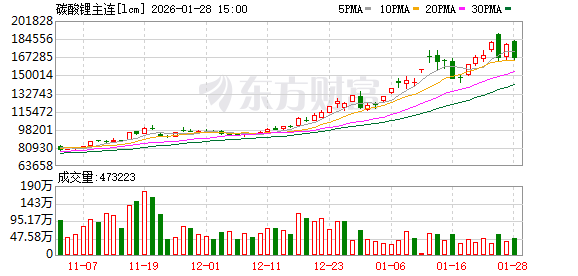
Core Viewpoint - The recent fluctuation in lithium carbonate futures prices reflects a market returning to fundamental trading after digesting previous bullish news, with a notable price drop of 3.9% to 166,280 yuan/ton on January 28 [2] Supply and Demand Dynamics - Lithium carbonate supply remains high but with limited incremental growth, maintaining a weekly production of approximately 22,000 tons [2] - Demand shows a "not weak in the off-season" characteristic, with energy storage batteries operating at full capacity and a "rush to export" phenomenon in power batteries due to export tax rebate policies [2] - Current weekly inventory reduction of lithium carbonate is around 800 tons, indicating a shift back to destocking after a slight accumulation [2][3] Market Sentiment and Price Trends - Analysts note that the rapid price increase has led to a cooling market sentiment, with price fluctuations becoming more pronounced due to increased divergence between bullish and bearish market participants [2][3] - The overall inventory level in the industry is low, particularly among lithium salt manufacturers and downstream industries, while futures traders hold higher inventory levels [3] - The market is expected to experience high volatility, with prices likely to oscillate at high levels until new driving factors emerge [3][4] Risk Management and Regulatory Measures - The exchange's risk management measures, including adjustments to margin ratios and trading limits, are crucial for maintaining market order and mitigating irrational short-term price fluctuations [4] - Regulatory bodies emphasize the importance of compliance and risk management in trading activities to ensure market stability [3][4] Future Outlook - Analysts suggest that while there is strong demand support for lithium carbonate prices, the current high price levels warrant caution regarding potential price corrections [4][5] - The market is transitioning into a phase of "weak expectations" versus "strong expectations," with the future balance of supply and demand remaining uncertain [5]

沪锡库存继续回升 刷新逾九个月最高位
Wen Hua Cai Jing· 2026-01-28 08:45
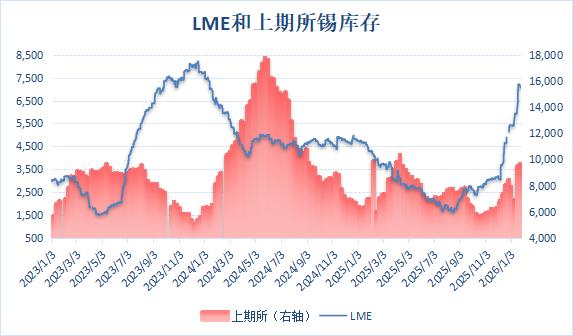
Group 1 - The London Metal Exchange (LME) reported that tin inventory initially increased and then decreased last week, with the latest inventory level at 7,085 tons, which is relatively high compared to the past two years [1] - The Shanghai Futures Exchange indicated that during the week of January 23, tin inventory rose by 1.79% to 9,549 tons, reaching a nine-month high [1] - Generally, a continuous decline in inventories on domestic and international exchanges supports price levels, while an increase may exert downward pressure on prices [3] Group 2 - A comparison of LME and Shanghai Futures Exchange tin inventories since January 2026 shows fluctuations in inventory levels [4] - As of January 27, 2026, LME inventory was 7,085 tons, while the previous days showed varying levels, with a peak of 7,195 tons on January 23, 2026 [5] - The Shanghai Futures Exchange inventory data indicates a significant increase from 6,935 tons on January 9, 2026, to 9,549 tons by January 16, 2026 [5]
黑色产业链日报-20260127
Dong Ya Qi Huo· 2026-01-27 11:11
Report Industry Investment Rating No relevant content provided. Core Viewpoints - Steel: The supply - side has stable blast furnace profits and rising disk profits, so steel mills may continue to increase production with a low probability of significant reduction. The demand - side is affected by winter cold, with seasonal weakening of rebar demand and inventory accumulation, and hot - rolled coil demand may slow down and turn to inventory accumulation. The fundamentals are neutral, and prices will fluctuate within a range [3]. - Iron Ore: Overall, the fundamentals of iron ore are weak, but the downside is supported by the healthy fundamentals of steel, good profits of steel mills, and inventory replenishment expectations. Additionally, attention should be paid to the impact of rainy seasons in Australia and Brazil on shipments. It is expected that the price decline space is limited [23]. - Coal and Coke: Coking coal is in a pattern of "strong spot, weak disk" with a high basis. Without strong policy expectations to boost the disk, as winter storage enters the second half, the demand sustainability is limited, and the spot price of coking coal may face downward pressure in the short term. In the medium - to - long term, if there is a combination of "exceeding - expected domestic supply recovery" and "weakening macro - sentiment", the prices of coal and coke will face significant downward pressure [36]. - Ferroalloys: Ferroalloys are supported by the cost side. The upper limit of silicon - manganese is restricted by high inventory, and the fundamentals of silicon - iron are slightly better than those of silicon - manganese. In the short term, ferroalloys will fluctuate within a range between the cost line and the previous pressure level [52]. - Soda Ash: The short - term commodity sentiment is warming up, which may drive some low - valued varieties. If the disk rises, there is some inventory replenishment space for middle and downstream players, but the demand is average with limited elasticity. In terms of fundamentals, as new production capacity gradually releases output, the daily production of soda ash reaches a new high, and the oversupply expectation is intensifying. The export of soda ash remains high, which alleviates the domestic pressure to some extent. The high - level inventory of the upper and middle reaches restricts the price of soda ash [66]. - Glass: Although the daily melting of float glass has dropped to a certain low level, the demand reality and expectation are also weak. Under the pattern of weak supply and demand, there is no trend - based movement. Before the Spring Festival, there are still some glass production lines for cold - repair and ignition, which may affect the far - month pricing and market expectation. Currently, the high inventory of the middle reaches of glass needs to be digested, and the spot pressure still exists [90]. Summary by Related Catalogs Steel - **Prices and Spreads**: On January 27, 2026, the closing prices of rebar and hot - rolled coil contracts changed compared with the previous day. For example, the rebar 01 contract closed at 3199 yuan/ton (down 20 yuan from January 26), and the hot - rolled coil 01 contract closed at 3330 yuan/ton (down 11 yuan from January 26). The basis and month - spreads also had corresponding changes [4][10][12]. - **Ratio Analysis**: The ratios of rebar to iron ore and rebar to coke remained stable on January 27, 2026, compared with the previous day. For example, 01 rebar/01 iron ore was 4, and 01 rebar/01 coke was 2 [20]. Iron Ore - **Price Data**: On January 27, 2026, the closing prices of iron ore contracts increased slightly compared with the previous day. For example, the 01 contract closed at 757 yuan/ton (up 2 yuan from January 26). The basis also increased, and the prices of various iron ore varieties such as Rizhao PB powder also rose [24]. - **Fundamental Data**: From January 16 - 23, 2026, the daily average pig iron output increased slightly, the 45 - port desilting volume decreased, the global and Australia - Brazil shipments increased, the 45 - port inventory and 247 - steel mill inventory increased, and the available days of 247 steel mills also increased [30]. Coal and Coke - **Price Spreads**: On January 27, 2026, compared with the previous day, the month - spreads of coking coal and coke contracts changed. For example, the coking coal 09 - 01 month - spread was - 178 (down 12.5 from January 26). The disk coking profit increased, and the ratios such as the main ore - coke ratio also changed [39]. - **Spot Prices**: The spot prices of coking coal and coke in various regions remained relatively stable on January 27, 2026, with some slight changes in the import profit of different types of coal [42]. Ferroalloys - **Silicon - Iron**: On January 27, 2026, compared with the previous day, the basis of silicon - iron in Ningxia increased, the month - spreads changed, and the spot prices in some regions decreased slightly. The prices of raw materials such as semi - coke and动力煤 decreased slightly, and the number of silicon - iron warehouse receipts decreased [53]. - **Silicon - Manganese**: On January 27, 2026, the basis of silicon - manganese in Inner Mongolia increased, the month - spreads changed slightly, the spot prices in various regions remained stable, and the prices of some manganese ores decreased slightly. The number of silicon - manganese warehouse receipts increased slightly [54][56]. Soda Ash - **Prices and Spreads**: On January 27, 2026, the prices of soda ash contracts decreased. For example, the soda ash 05 contract closed at 1194 yuan/ton (down 11 yuan from January 26). The month - spreads and basis also had corresponding changes [67]. - **Production and Inventory**: The daily production of soda ash reaches a new high, and the overall inventory of the upper and middle reaches remains high, restricting the price [66]. Glass - **Prices and Spreads**: On January 27, 2026, the prices of glass contracts decreased. For example, the glass 05 contract closed at 1066 yuan/ton (down 21 yuan from January 26). The month - spreads and basis changed [91]. - **Sales and Production**: The daily sales - to - production ratios in different regions such as Shahe, Hubei, East China, and South China fluctuated in the period from January 17 - 23, 2026 [92].
下游开工率季节性震荡 聚丙烯呈区间震荡格局
Jin Tou Wang· 2026-01-22 08:08
Market Overview - As of January 21, the top 20 futures companies for polypropylene (PP) had a total long position of 462,700 contracts and a short position of 525,400 contracts, resulting in a long-to-short ratio of 0.88. The net position decreased by 1,288 contracts to -62,800 contracts compared to the previous day [1] - The operating rate of PP petrochemical enterprises in China is at 75.62%, which is an increase of 0.15 percentage points from the previous week. Weekly production of PP granules reached 775,800 tons, down 0.44% week-on-week, while PP powder production fell to 56,900 tons, a decrease of 15.62% week-on-week [1] Profit Margins - The production margins for various methods of PP production are as follows: oil-based PP has a margin of -430.13 CNY/ton, coal-based PP -314.73 CNY/ton, methanol-based PP -970.67 CNY/ton, propane dehydrogenation -1,297.8 CNY/ton, and externally sourced propylene -435.4 CNY/ton [1] Institutional Insights - According to Xinda Futures, the current PP market is characterized by a balance of bullish and bearish factors, with short-term low inventory, maintenance of some facilities, and rising costs from refined oil providing support. However, long-term concerns include excess crude oil supply, increased post-holiday supply, weak downstream demand, and the substitution effect of granules, leading to a lack of clear directional movement and an overall range-bound market [3] - Minmetals Futures notes that the rise in futures prices is supported by a slight reduction in global oil inventories as predicted by the EIA monthly report, alleviating supply excess. There are no new capacity additions planned for the first half of 2026, which reduces pressure. Seasonal fluctuations in downstream operating rates contribute to a high overall inventory pressure, with no significant contradictions in the short term. The historical high level of warehouse receipts suggests that prices may stabilize as the supply excess situation changes in the first quarter of next year, with a shift from cost-driven declines to mismatched production leading to opportunities for low-price buying of PP spreads [4]

20260121申万期货有色金属基差日报-20260121
Shen Yin Wan Guo Qi Huo· 2026-01-21 02:54
Report Summary 1. Report Industry Investment Rating - Not provided in the given content 2. Core Viewpoints - Copper: The copper price closed 1.28% lower overnight. The concentrate supply remains tight, and smelting profits are on the verge of profit and loss. Although smelting output decreased month - on - month, it generally continued to grow at a high rate. Power investment is stable, automobile production and sales are growing positively, home appliance production is in negative growth, and the real estate market remains weak. Due to supply disruptions in mines, the global copper supply - demand outlook has shifted to a deficit. After the release of optimistic sentiment, the copper price may experience a phased correction. Attention should be paid to changes in the US dollar, copper smelting output, and downstream demand [2]. - Zinc: The zinc price closed 1.0% lower overnight. The processing fee for zinc concentrates has declined, and the concentrate supply is in a stage of tightness, while smelting output continues to grow. The inventory of galvanized sheets is generally at a high level. The cumulative growth rate of infrastructure investment is slowing down, automobile production and sales are growing positively, home appliance production is in negative growth, and the real estate market remains weak. The overall difference in zinc supply and demand is not obvious. After the release of the overall optimistic sentiment in the non - ferrous metals market, the zinc price may experience a phased correction. It is recommended to pay attention to changes in the US dollar, smelting output, and downstream demand [2]. 3. Summary by Related Catalogs Metal Price and Market Data - **Copper**: Domestic previous - day futures closing price is 100,940 yuan/ton, domestic basis is - 155 yuan/ton, previous - day LME 3 - month contract closing price is 12,754 dollars/ton, LME spot premium (CASH - 3M) is 101.84 dollars/ton, LME inventory is 147,425 tons, and the daily change in LME inventory is 3,850 tons [2]. - **Aluminum**: Domestic previous - day futures closing price is 23,880 yuan/ton, domestic basis is - 160 yuan/ton, previous - day LME 3 - month contract closing price is 3,108 dollars/ton, LME spot premium (CASH - 3M) is - 12.62 dollars/ton, LME inventory is 485,000 tons, and the daily change in LME inventory is - 3,000 tons [2]. - **Zinc**: Domestic previous - day futures closing price is 24,365 yuan/ton, domestic basis is - 5 yuan/ton, previous - day LME 3 - month contract closing price is 3,173 dollars/ton, LME spot premium (CASH - 3M) is - 43.57 dollars/ton, LME inventory is 105,050 tons, and the daily change in LME inventory is - 1,475 tons [2]. - **Nickel**: Domestic previous - day futures closing price is 141,360 yuan/ton, domestic basis is - 2,740 yuan/ton, previous - day LME 3 - month contract closing price is 17,614 dollars/ton, LME spot premium (CASH - 3M) is - 200.23 dollars/ton, LME inventory is 285,708 tons, and the daily change in LME inventory is - 24 tons [2]. - **Lead**: Domestic previous - day futures closing price is 17,165 yuan/ton, domestic basis is - 140 yuan/ton, previous - day LME 3 - month contract closing price is 2,029 dollars/ton, LME spot premium (CASH - 3M) is - 46.32 dollars/ton, LME inventory is 203,500 tons, and the daily change in LME inventory is - 2,850 tons [2]. - **Tin**: Domestic previous - day futures closing price is 399,000 yuan/ton, domestic basis is - 5,810 yuan/ton, previous - day LME 3 - month contract closing price is 49,412 dollars/ton, LME spot premium (CASH - 3M) is - 92.00 dollars/ton, LME inventory is 6,440 tons, and the daily change in LME inventory is 505 tons [2].
基本面压力突出 纯碱依旧可作为空配标的
Jin Tou Wang· 2026-01-20 07:57
Group 1 - The domestic soda ash production reached 775,300 tons during the week of January 9 to January 15, 2026, representing a month-on-month increase of 2.88% and a year-on-year increase of 8.16% [1] - On January 20, the light soda ash price from Jiangsu Kunshan Jinggang was reported at 1,280 yuan per ton, while the heavy soda ash price was not quoted; Jiangsu Jingshen Chemical's light soda ash was quoted at 1,270 yuan per ton due to reduced production and maintenance [1] - As of January 19, the inventory of soda ash recorded was 1,544,200 tons, a decrease of 30,800 tons compared to the previous trading day [1] Group 2 - New Lake Futures indicated that the oversupply situation is significantly suppressing prices, and due to the capacity expansion cycle, soda ash prices are unlikely to rise, suggesting a short-selling strategy [3] - Everbright Futures noted that while some enterprises have reduced production, the overall industry operating rate has dropped to 84.94%, but stable production from Alashan's second phase will offset short-term supply declines [3] - The demand side remains cautious, with downstream sectors primarily engaging in low-price inventory replenishment; the overall pressure on soda ash fundamentals remains significant, with short-term futures prices expected to maintain a weak trend [3]

豆粕:靴子落地,价格或有反弹;豆一:现货稳中偏强,盘面反弹震荡
Guo Tai Jun An Qi Huo· 2026-01-18 12:29
Report Summary 1. Report Industry Investment Rating No relevant content provided. 2. Core View of the Report - Next week (01.19 - 01.23), it is expected that the prices of Dalian soybean meal and soybean futures may rebound. For soybean meal, although the January USDA report and the progress of China - Canada consultations had a bearish impact on prices, the market has already factored them in. After these events, there is no further negative news, so the soybean meal price is expected to rebound from a low level. For soybeans, the spot price is stable with a slight upward trend, and the futures price depends on the sentiment of the soybean market [6]. 3. Summary by Related Content International Soybean Market - **US Soybean Futures Prices**: Last week (01.12 - 01.16), US soybean futures prices first declined due to the bearish USDA report and then rose because of Chinese purchases and the increase in US soybean oil prices (due to the possible formulation of 2026 biofuel blending quotas in March in the US). From a weekly K - line perspective, in the week of January 16, the main March 2026 contract of US soybeans had a weekly decline of 0.61%, and the main March 2026 contract of US soybean meal had a weekly decline of 4.58% [2]. - **Fundamental Factors**: - **Chinese Purchases**: From January 12 to January 16, the cumulative large - scale orders of US soybeans sold to China, Mexico, and unknown destinations were about 1.4 million tons (mostly for 2025/26 delivery, and a few for 2026/27 delivery) [2]. - **USDA Export Sales Report**: In the week of January 8, 2026, for 2025/26 US soybeans, the export shipments were about 1.64 million tons, with a week - on - week increase of 47% and a year - on - year increase of about 16%; the cumulative export shipments were about 17.98 million tons, with a year - on - year decrease of about 42%. The current - year (2025/26) weekly net sales were about 2.06 million tons (about 0.88 million tons in the previous week), and the next - market - year (2026/27) weekly net sales were 10,000 tons (0 in the previous week), with a total of about 2.07 million tons (about 0.88 million tons in the previous week). The current - crop - year (2025/26) weekly net sales to China were about 1.22 million tons (0.47 million tons in the previous week), and the cumulative sales were about 8.12 million tons [2]. - **Brazilian Soybean Import Cost**: As of the week of January 16, the average CNF premium of Brazilian soybeans for February 2026 delivery increased slightly week - on - week, the average import cost decreased week - on - week, and the average crushing profit on the futures market increased week - on - week [2]. - **USDA Reports**: The January USDA monthly supply - demand report showed an increase in the ending stocks of US and Brazilian soybeans in 2025/26, while those of Argentina and China remained unchanged. According to the USDA quarterly grain inventory report, as of the quarter ending December 1, 2025, the total US soybean inventory was about 3.29 billion bushels, a year - on - year increase of about 6%, slightly higher than the market expectation of 3.25 billion bushels. These two reports had a short - term bearish impact on soybean prices [2]. - **South American Weather Forecast**: According to the January 17 weather forecast, in the next two weeks (January 18 - February 1), the precipitation in the main soybean - producing areas of Brazil will be slightly less, and the temperature will be basically normal. In Argentina, the precipitation will be less, and the temperature will be higher in some periods (January 24 - February 1). Currently, the weather in the Argentine产区 has a bullish impact and needs to be monitored [2][3]. Domestic Soybean Meal Market - **Futures Prices**: Last week (01.12 - 01.16), domestic soybean meal futures prices were weak, mainly affected by the bearish January USDA report and the progress of China - Canada trade consultations. From a weekly K - line perspective, in the week of January 16, the main May 2026 contract of soybean meal (m2605) had a weekly decline of 2.12% [2]. - **Spot Market**: - **Trading Volume**: The trading volume of soybean meal increased week - on - week, with more long - term basis contracts traded. As of the week of January 16, the average daily trading volume of soybean meal in major domestic oil mills was about 670,000 tons, compared with about 360,000 tons in the previous week [4]. - **Pick - up Volume**: The pick - up volume of soybean meal increased week - on - week. As of the week of January 16, the average daily pick - up volume of soybean meal in major oil mills was about 186,000 tons, compared with about 174,000 tons in the previous week [4]. - **Basis**: The basis of soybean meal increased week - on - week. As of the week of January 16, the average weekly basis of soybean meal in Zhangjiagang was about 372 yuan/ton, compared with about 344 yuan/ton in the previous week and about 247 yuan/ton in the same period last year [4]. - **Inventory**: The inventory of soybean meal decreased week - on - week and increased year - on - year. As of the week of January 9, the inventory of soybean meal in major domestic oil mills was about 930,000 tons, a week - on - week decrease of about 13% and a year - on - year increase of about 66% [4]. - **Crushing Volume**: The soybean crushing volume increased week - on - week and is expected to continue to rise next week. As of the week of January 16, the weekly soybean crushing volume in domestic oil mills was about 1.99 million tons (1.77 million tons in the previous week and 2.41 million tons in the same period last year), with an operating rate of about 55% (49% in the previous week and 68% in the same period last year). Next week (January 17 - January 23), the soybean crushing volume of oil mills is expected to be about 2.2 million tons (2.08 million tons in the same period last year), with an operating rate of 61% (58% in the same period last year) [4]. - **Imported Soybean Auction**: On January 13, the National Grain Trading Center planned to auction 1.1396 million tons of imported soybeans, all of which were sold at an average transaction price of 3,812 yuan/ton, with a premium of 0 - 170 yuan/ton [4]. Domestic Soybean Market - **Futures Prices**: Last week (01.12 - 01.16), domestic soybean futures prices fluctuated, mainly affected by the bearish atmosphere in the soybean market, but the stable and slightly upward spot price provided support. From a weekly K - line perspective, in the week of January 16, the main May 2026 contract of soybeans (a2605) had a weekly decline of 1.23% [2]. - **Spot Market**: - **Prices**: In Northeast China, the net grain purchase price of soybeans (the mainstream purchase price of clean grain passing through a 4.5 - mesh sieve) was in the range of 4,280 - 4,380 yuan/ton, an increase of 20 yuan/ton compared with the previous week. In inland areas, the net grain purchase price of soybeans was in the range of 4,860 - 5,100 yuan/ton, the same as the previous week. In the sales areas, the sales price of Northeast edible soybeans was in the range of 4,640 - 4,840 yuan/ton, an increase of 0 - 20 yuan/ton compared with the previous week [5]. - **Farmer and Market Sentiment**: In the Northeast production area, farmers are reluctant to sell, and the market is cautious. Many grass - roots farmers still expect prices to rise and ask for high prices. Most traders are cautious about purchasing and consume their inventories, and the speed of goods flowing to the market is slow. High prices suppress transactions, and there is a situation of "high prices but no trading" in some markets. In the sales areas, the soybean price increased slightly, but the downstream acceptance is low. Many dealers said that the loading price at the origin increased, the arrival cost continued to rise, and the selling price was adjusted accordingly. However, limited by the low acceptance of the downstream market, the price increase was smaller than that at the origin. The new demand for terminal soy products was limited, which suppressed the overall trading speed of the market [5].
农产品日报-20260116
Guang Da Qi Huo· 2026-01-16 05:08
Group 1: Report Industry Investment Rating - No relevant content found Group 2: Core Views of the Report - Corn: The 2603 contract of corn resumed rising, with near - month contracts leading the increase and forward contracts following. The spot market is supported by pre - holiday stocking. The domestic average corn price is 2321 yuan/ton, remaining stable. The overall view is that corn is in an oscillatory state. Short - term long positions should pay attention to the pressure at the previous high, and medium - and long - term investors should focus on the strong performance of surrounding commodities. [2] - Soybean Meal: CBOT soybeans rose on Thursday due to strong domestic demand and a sharp rise in soybean oil futures. The U.S. soybean single - week net sales were 2.0619 million tons, which is positive. Domestically, protein meal continued to weaken, with rapeseed meal falling more than soybean meal. The overall view is that soybean meal is oscillatory, and a double - selling strategy is recommended. Rapeseed meal should pay attention to Canada's visit to China, and an option double - buying strategy is suggested. [2] - Oils: BMD palm oil fell on Thursday, following the decline in the surrounding market. CBOT soybean oil rose sharply, and Canadian rapeseed prices increased. The domestic oil market was weak but rose sharply at night, with rapeseed oil leading the increase. The overall view is that oils are oscillatory, and a strategy of selling put options is recommended. [2] - Eggs: The egg futures rebounded on Thursday, with the 2603 contract rising 1.96%. The spot price of eggs increased slightly. Terminal demand is stable, and the overall view is that eggs are oscillatory and slightly bullish. Short - term long positions can be moderately participated in, and the influence of funds and sentiment on the market should be continuously monitored. [2][3] - Pigs: The 2603 contract of live pigs rebounded during the session on Thursday and then declined in the afternoon. The spot price of live pigs was relatively stable. Terminal demand is stable, and the overall view is that live pigs are oscillatory and slightly bullish. Long positions should be held cautiously, and short - term market sentiment changes and the impact of spot prices on the futures market should be monitored. [3] Group 3: Summary According to Relevant Catalogs Market Information - On the 12th noon, MPOB announced the Malaysian palm oil data for December. The production was 1.83 million tons, a 5.46% month - on - month decrease; exports were 1.3165 million tons, an 8.52% month - on - month increase; apparent demand was 331,000 tons, slightly less than the previous month; and inventory was 3.05 million tons, all within market expectations. The 1 - 2 month production is expected to decline seasonally, and with India's festival stocking demand approaching, Malaysian palm oil may gradually reach a high - inventory inflection point. Later, attention should be paid to the implementation of Indonesia's slight increase in export LEVY and the implementation of the U.S. RVO policy. [4] Variety Spreads Contract Spreads - The report provides charts of 5 - 9 spreads for various agricultural products, including corn, corn starch, soybeans, soybean meal, soybean oil, palm oil, eggs, and live pigs, but no specific analysis of these spreads is given. [5][6][8][9][12] Contract Basis - The report provides charts of the basis for various agricultural products, including corn, corn starch, soybeans, soybean meal, soybean oil, palm oil, eggs, and live pigs, but no specific analysis of these bases is given. [14][15][18][20][25] Introduction of the Agricultural Product Research Team - Wang Na, the director of the agricultural product research at Everbright Futures Research Institute, has won the "Best Agricultural Product Analyst" title multiple times. She led the team to win the title of the top ten research and investment teams of DCE in 2019 and the special prize of the "Sailing in the Futures Sea" college student practice competition of DCE in 2023. [27] - Hou Xueling, a soybean analyst at Everbright Futures, has more than ten years of futures experience, has won the "Best Agricultural Product Analyst" title multiple times, and her team has won many awards. [27] - Kong Hailan, an analyst for eggs and live pigs at Everbright Futures, has a master's degree in economics. Her team has won many awards, and she has been interviewed by many mainstream media. [27]