
科技行情

Search documents
预见2026|从技术竞赛到价值落地 人工智能产业规模持续增长
Xin Hua Cai Jing· 2025-12-29 12:45
Core Insights - The core theme for AI in the capital markets by 2025 is the transition from a "technological race" to a pragmatic "value realization" phase, with rapid industry expansion and capital focusing on segments with clear commercialization prospects [1][2] - The investment focus is shifting from infrastructure to application layers, driven by the implementation of the "AI+" action plan by the State Council, promoting deep integration of AI across various sectors [1] Industry Overview - The AI industry is expected to grow rapidly, with companies in the application sector seeing significant revenue increases, particularly in B-end AI applications, which are projected to reach between 100 million to 1 billion [4] - The structure of the AI industry is described as an inverted pyramid, with chips at the base, models in the middle, and applications at the top, indicating a growing market size [2] Market Dynamics - Concerns about an "AI bubble" stem from fears of overvaluation and imbalanced investment returns, but experts believe the industry is still far from a bubble due to ongoing demand for AI computing power and the iterative development of large models [3] - The current focus on chip investments is high, with significant returns expected, while the competition among foundational model providers is anticipated to consolidate over time [6] Value Chain Insights - The AI industry's growth is heavily reliant on foundational computing power, with leading chip manufacturers benefiting from their technological advantages and market dominance [5] - The current market emphasizes "certainty premiums" for upstream chips, while the future value distribution will depend on the ecological control of models and the explosive growth potential of applications [5] Future Outlook - The AI application sector is accelerating, particularly in B-end applications, and is expected to integrate into various business processes, making it a key area for investment [7] - The A-share market is predicted to transition from valuation-driven to profit-driven dynamics, with a structural market characterized by technology growth led by AI, alongside a recovery in economic conditions [8]
私募定增浮盈超27亿元 最高浮盈比例达274%
Zheng Quan Shi Bao Wang· 2025-12-24 09:52
在A股市场回暖背景下,私募今年参与定增热情高涨并且获利颇丰。私募排排网统计数据显示,按定增 上市日统计,截至2025年12月23日,全年共有52家私募机构积极参与定增,投资覆盖17个申万一级行业 中的58只A股,合计获配金额高达59.80亿元,较去年同期的48.43亿元显著增长23.48%。以当日收盘价 计算,私募在这些定增项目上的整体浮盈金额已达27.24亿元,整体浮盈比例达到45.55%。 在2025年火热的定增市场中,私募机构展现了高度的参与热情。年内参与定增获配的52家私募机构中, 18家私募机构获配金额均超过1亿元。同时,私募参与定增获利颇丰,高达50家实现浮盈,占比超九 成。在众多机构中,中小型私募展现了精准把握高成长机会的能力,业绩尤为突出。例如,聚力基金与 信持力资产通过参与德明利的定增,均实现了高达274.19%的可观浮盈。同时,量利私募、上海洪毅私 募和广东广金共同把握住ST松发的投资机遇,均获得了超过120%的浮盈。 值得注意的是,在获配金额较高的个股中,电子行业表现突出。例如,德明利(001309)虽仅获配1.61 亿元,但当前浮盈比例高达274.19%,为私募贡献了近4.41亿元的浮 ...
主动量化周报:年末资金面扰动:逢低建仓,优先小盘-20251221
ZHESHANG SECURITIES· 2025-12-21 10:12
- The report discusses the impact of year-end liquidity disturbances on the market, suggesting that the recent adjustments are temporary and do not alter the upward trend[1][10] - The main investment theme is shifting from technology to cyclical sectors, with recommendations for chemical ETFs, dividend ETFs, and brokerage ETFs[1][10] - The report highlights the importance of the dollar depreciation as a key factor supporting the A-share market's slow bull trend[1][10] - The report mentions the use of a fund position monitoring model to track the allocation of funds, noting increased allocations in sectors like non-ferrous metals, chemicals, and transportation[1][11] - The report indicates that the technology sector's internal growth rate is slowing down, and the market is transitioning to cyclical sectors[1][11] - The report suggests that the recent market adjustments are due to year-end liquidity disturbances, with quantitative private equity products reducing their risk exposure significantly[1][12] - The report notes that the dollar depreciation trend, supported by lower-than-expected US CPI data, will continue to provide effective support for the A-share market's upward movement[1][13] - The report includes a section on timing strategies, mentioning the use of price segmentation systems and insider trading activity indicators[14][15] - The report provides industry monitoring data, including analysts' industry sentiment expectations and financing and securities lending trends[19][21] - The report discusses the performance of BARRA style factors, noting changes in market preferences and the performance of various factors such as turnover, financial leverage, and profitability volatility[24][25]
晨会纪要:2025年第201期-20251127
Guohai Securities· 2025-11-27 00:36
Group 1 - The report highlights a shift in investment style, with the banking sector receiving increased capital inflows, indicating a positive outlook for the industry [2][3] - In the equity market, technology sector ETFs saw a significant net inflow of 755 billion yuan, with semiconductor, battery, and robotics themes being particularly favored [3] - The banking ETF recorded a net inflow of 58 billion yuan in October, marking a new monthly high for 2025, following a net inflow of 32 billion yuan in September [3] Group 2 - The bond market is experiencing growth in bond ETFs, particularly in sci-tech bonds, corporate bonds, and government bonds, indicating strong investor interest [4] - The report notes a substantial increase in the buying of long-term government bonds by major banks, while insurance companies are also increasing their allocation to long-term bonds [4] - In the commodity market, there has been a shift in domestic investor preferences from gold stock ETFs to gold ETFs, with a notable net inflow of 337.82 billion yuan in October [4]
盘前必读丨美股强劲反弹谷歌大涨超6%;工业富联澄清未下调四季度利润目标
Di Yi Cai Jing Zi Xun· 2025-11-24 23:24
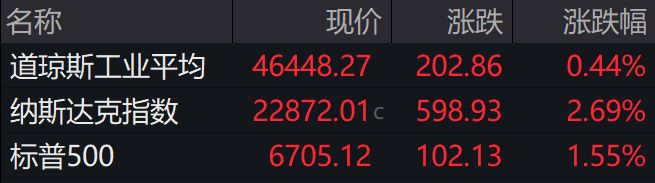
【财经日历】 华为Mate 80系列丨Mate X7及全场景新品发布会 阿里巴巴、蔚来发布财报 | 名称 | 现价 | 涨跌 | 涨跌幅 | | --- | --- | --- | --- | | 道琼斯工业平均 | 46448.27 202.86 | | 0.44% | | 纳斯达克指数 | 22872.01c 598.93 | | 2.69% | | 标普500 | 6705.12 | 102.13 | 1.55% | 当地时间周一,美股三大股指延续反弹,截至收盘,道指涨0.44%,纳指涨2.69%,标普500指数涨 1.55%。 科技股全线拉升,特斯拉涨6.8%,亚马逊涨2.5%,Meta涨3.2%,苹果涨1.6%,英伟达涨2.05%,甲骨文 涨0.78%,微软涨0.4%。 个股方面,谷歌母公司Alphabet大涨6.3%,市值逼近4万亿美元。谷歌上周发布了升级版AI模型Gemini 3。这家科技巨头旗下的谷歌云业务部门透露,已与北约通信与信息局签署一份合同,将为其提供安全 的主权云服务能力。 博通上涨11%,为标普500指数和纳斯达克综合指数成分股中最大涨幅。汇丰银行将该股目标价从400美 元上调至5 ...


永赢基金多名百亿级老将卸任
Shen Zhen Shang Bao· 2025-11-20 01:33
Group 1 - Yongying Fund has seen a "clean sweep" resignation of four billion-level fund managers this year, with the latest being Yang Fanying, who managed a total of 12.291 billion yuan in assets before her departure [1] - Yang Fanying's tenure lasted 8 years and 34 days, during which she achieved a cumulative return of 20.23% for the Yongying Huajia Credit Bond A fund, marking the best performance record for public fund management [1] - Other funds managed by Yang Fanying mostly yielded positive returns, although the Yongying Stable Enhanced Bond A fund experienced a decline of nearly 5% over her management period [1] Group 2 - The new generation fund manager, Ren Jie, successfully captured the current technology market trend with the Yongying Technology Smart Selection Mixed Fund, which has significantly outperformed competitors and is on track to secure the annual championship [2] - Several actively managed equity products under Yongying Fund, including Yongying Advanced Manufacturing Smart Selection, Pharmaceutical Innovation Smart Selection, Semiconductor Industry Smart Selection, Digital Economy Smart Selection, and Emerging Consumer Smart Selection, have also shown strong annual returns [2]
富国银行押注科技行情延续:Q3增持“七巨头” 大举买入纳指看涨期权
智通财经网· 2025-11-14 09:35
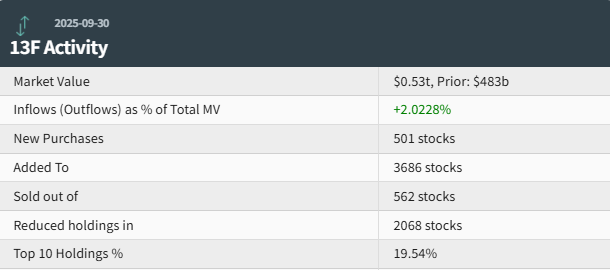
Core Insights - Wells Fargo (WFC.US) reported a total market value of $530 billion in its Q3 2025 13F filing, reflecting a 2.02% increase from the previous quarter's $483 billion [1][2] Holdings Summary - The bank added 501 new stocks and increased holdings in 3,686 stocks while reducing positions in 2,068 stocks and completely selling out of 562 stocks [1][2] - The top ten holdings accounted for 19.54% of the total market value [1][2] Top Holdings - Microsoft (MSFT.US) is the largest holding with approximately 33.72 million shares valued at about $17.47 billion, representing 3.32% of the portfolio [3][4] - Apple (AAPL.US) follows with around 59.99 million shares valued at approximately $15.27 billion, making up 2.90% of the portfolio [3][4] - The iShares S&P 500 ETF (IVV.US) ranks third with about 18.75 million shares valued at around $12.55 billion, accounting for 2.39% of the portfolio [3][4] - Nvidia (NVDA.US) is fourth with approximately 59.79 million shares valued at about $11.16 billion, representing 2.12% of the portfolio [3][4] - The iShares Core S&P Total U.S. Stock Market ETF (ITOT.US) is fifth with around 63.19 million shares valued at about $9.20 billion, making up 1.75% of the portfolio [3][4] Notable Changes - Wells Fargo increased its holdings in major tech companies, with Google (GOOGL.US) up by 17.96%, Amazon (AMZN.US) by 4.28%, Meta (META.US) by 11.89%, and Tesla (TSLA.US) by 24.07% [4] - The bank significantly increased its holdings in call options for the Invesco QQQ Trust (QQQ.US) by 66.40%, while reducing put options by 1.96% [4] Top Buys and Sells - The top five purchases included Apple, Google, Invesco QQQ Trust call options, Nvidia, and Broadcom (AVGO.US) [5] - The top five sales included SPDR S&P 500 ETF (SPY.US), Accenture (ACN.US), iShares Russell 2000 ETF (IWM.US), Vanguard Russell 2000 ETF (VTWO.US), and Chubb Limited (CB.US) [5]






中信证券最新研判:A股迈向“低波动慢牛” 2026年聚焦三主线
Zhong Guo Jing Ying Bao· 2025-11-12 07:10
Group 1: Market Transition and Outlook - A-share listed companies are transitioning from domestic-focused enterprises to global multinational corporations, indicating a shift in China's capital market from emerging to mature status [1][4] - During the "14th Five-Year Plan" period, Chinese companies are expected to enhance their position in the global value chain, converting share advantages into pricing power, which forms the basis for a low-volatility slow bull market in A-shares [1][4] Group 2: Economic Growth Projections - China's economy is anticipated to continue a recovery trend, with growth projected at around 5% in 2025 and 4.9% in 2026, potentially showing a pattern of lower growth in the first half and higher growth in the latter half of 2026 [2] - Fiscal policy in 2026 is expected to be more proactive, maintaining a deficit ratio around 4%, with an increase in special bond quotas directed towards project construction [2] Group 3: Investment Strategy and Focus Areas - The investment strategy for 2026 should focus on three main lines: 1. The re-evaluation of pricing power in China's manufacturing sector, with an emphasis on industries like non-ferrous metals, chemicals, and new energy [6] 2. The deepening of enterprises' international expansion, particularly in sectors such as machinery, innovative pharmaceuticals, and military equipment [6] 3. The continuation of the technology market, with a focus on breakthroughs in AI commercialization and related hardware and applications [6] Group 4: Market Liquidity and Asset Allocation - The capital market is expected to see a continued influx of absolute return funds, contributing to a long-term downward trend in the volatility of broad-based A-share indices [6] - In terms of asset allocation, the global macro environment is generally accommodative, with expectations of a mild appreciation of the RMB and ongoing attractiveness of gold as a long-term investment asset [7]

申万宏源:A股牛市还有纵深,四季度还有科技引领的行情
Xin Lang Cai Jing· 2025-10-19 11:29
Core Viewpoint - The current long-term cost-performance ratio of the technology sector is considered low, but short-term cost-performance issues have been sufficiently digested, suggesting a potential new round of technology market rally driven by industrial catalysts [1] Group 1: Market Outlook - Spring 2026 is anticipated to be a phase peak for the A-share market, facing three challenges: 1) A critical verification period for demand-side dynamics may arise, where supply growth returns to low levels, potentially improving supply-demand balance, but weak demand could delay the supply-demand turning point [1] - The improvement in supply-demand dynamics in 2026 is expected to be "delayed" rather than "disproved," with a further strengthening of the global easing framework, leading to a sequential recovery of the "policy bottom, market bottom, economic bottom" in the A-share market [1] - The emergence of new structural highlights may require time, as the decisive catalysts for the domestic technology industry trends and the verification period for anti-involution effects will take time to materialize, suggesting that Spring 2026 may still lack new leading themes [1] Group 2: Investment Strategy - The long-term cost-performance ratio of the technology sector may reach extremely low levels by Spring 2026, reminiscent of the end of 2013 for the ChiNext and the end of 2019 for the food and beverage sector, potentially leading to a mid-term consolidation phase for the market [1] - After a short-term adjustment, the technology-led market rally is expected to continue into Q4 2025, with Spring 2026 likely being a phase peak but not the peak for the entire year or the peak of the current comprehensive bull market [1] - The conditions for a comprehensive bull market are expected to become increasingly sufficient over time, indicating further depth in the bull market ahead [1]

每日市场观察-20251013
Caida Securities· 2025-10-13 05:48
Market Performance - On October 13, the market experienced a significant decline with a trading volume of 2.53 trillion, down approximately 140 billion from the previous trading day[1] - The semiconductor and new energy sectors showed weakness, while non-tech sectors like building materials and coal performed better[1] - The Shanghai Composite Index fell by 0.94%, closing below 3900 points, with the Shenzhen Component down 2.70% and the ChiNext Index down 4.55% on October 10[3] Sector Analysis - The adjustment in the tech sector is expected to create a capital spillover effect, leading to potential gains in non-tech sectors such as non-bank financials and chemicals[1] - Major outflows were noted in the semiconductor, battery, and software development sectors, while inflows were seen in grid equipment, infrastructure, and securities[4] Economic Indicators - The Ministry of Civil Affairs announced a first batch of elderly care service subsidies amounting to 1.16 billion yuan, aimed at supporting elderly individuals with moderate to severe disabilities[5] - The World Trade Organization revised its global trade growth forecast for 2025 from -0.2% to 2.4%, but lowered the 2026 forecast from 2.5% to 0.5% due to anticipated tariff impacts[7] Investment Trends - Public funds have shown increased enthusiasm for participating in private placements, with total subscriptions exceeding 30 billion yuan this year, surpassing last year's total[13] - Private equity firms remain optimistic about market continuity but advise caution regarding valuation pressures on certain tech stocks[14]