经济基本面

Search documents
深度|人民币“破7”冷思考
2 1 Shi Ji Jing Ji Bao Dao· 2026-01-04 14:18
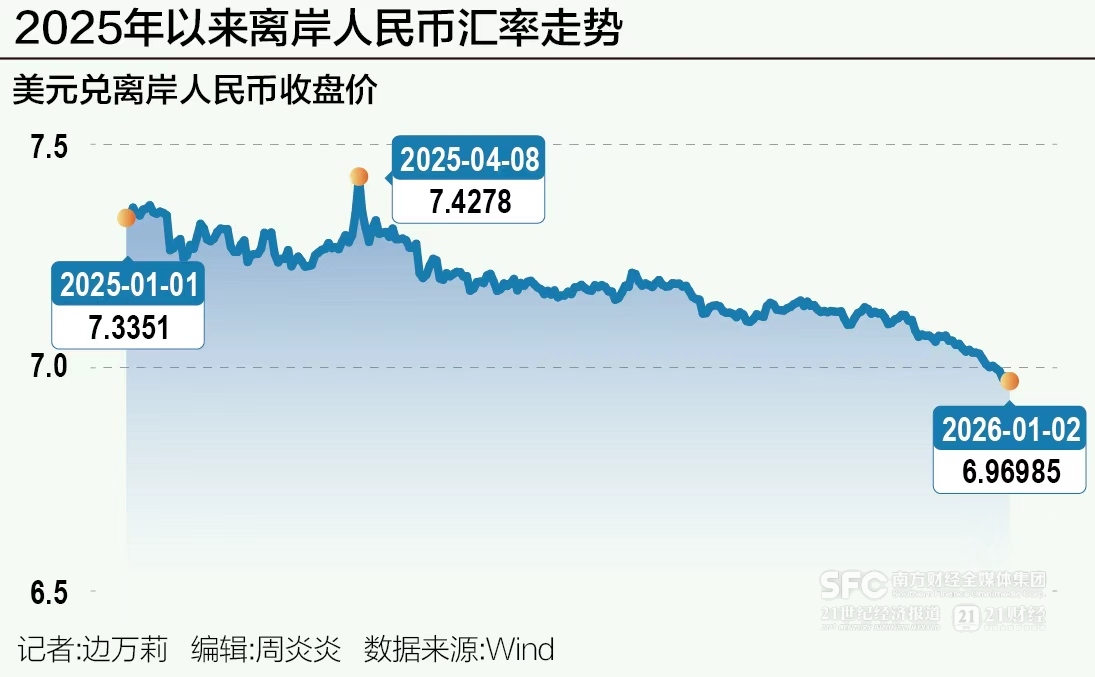
Core Viewpoint - The RMB/USD exchange rate is expected to exhibit a "weak first, strong later" trend in 2025, with a significant appreciation towards the end of the year, breaking the key psychological level of "7" due to multiple factors including a weakening dollar and a stable Chinese economy [1][5][10]. Group 1: Exchange Rate Trends - From early 2025 to early April, the RMB/USD exchange rate fluctuated weakly around 7.30-7.35, before turning to a trend of appreciation starting in April [1][4]. - By December 25, the offshore RMB broke the 7 mark, reaching a new high since September 2024, while the onshore RMB also surpassed 7.0, marking its highest level since May 2023 [4][5]. - The RMB's appreciation is attributed to a weakening dollar, a stable economic performance in China, and increased demand for currency settlement at year-end [5][6]. Group 2: Factors Influencing Exchange Rate - The weakening of the dollar is identified as a primary driver for the RMB's appreciation, with the dollar index dropping significantly in the latter part of 2025 [5][6]. - Seasonal factors also play a role, as historical trends show that the RMB tends to appreciate at the end of the year due to increased settlement needs from exporters [6][7]. - The interplay between the RMB's appreciation and the settlement behavior of export enterprises creates a positive feedback loop, further supporting the currency's strength [7][8]. Group 3: Future Outlook - The People's Bank of China aims to maintain the RMB's stability at a reasonable and balanced level, with a focus on preventing excessive fluctuations and ensuring a dual-directional volatility in the exchange rate [8][9]. - In 2026, the RMB is expected to experience dual-directional fluctuations, influenced by the relative strength of the US and Chinese economies, changes in dollar interest rates, and the evolution of China's foreign trade relationships [1][10]. - Analysts predict that the RMB will likely remain within the range of 6.9-7.3, with various factors contributing to its stability and potential appreciation [10][11].

外汇汇率波动的主要影响因素是什么?
Sou Hu Cai Jing· 2026-01-01 08:19
Group 1 - The core viewpoint emphasizes that foreign exchange rates are crucial indicators in the international financial market, affecting cross-border trade costs, multinational companies' financial conditions, and individual investors' asset allocation choices [1] - Economic fundamentals, including economic growth, inflation rates, and unemployment rates, are identified as key long-term determinants of exchange rate trends [1] - Central bank monetary policy, particularly adjustments in benchmark interest rates and money supply, has a direct and short-term impact on exchange rates [1] Group 2 - The balance of international payments, particularly the current account, directly influences exchange rate stability, with a surplus indicating stronger currency support [2] - Geopolitical changes can lead to sudden impacts on exchange rates, as political conflicts or increased policy uncertainty can weaken market confidence in a currency [2] - Market sentiment and investor risk appetite significantly guide capital flows, affecting currency valuations during periods of heightened risk aversion [2] Group 3 - For countries reliant on commodity exports, fluctuations in international commodity prices are closely linked to currency exchange rates, with rising prices supporting currency strength [3] - Technical factors, such as the prevalence of algorithmic trading, can exacerbate short-term exchange rate volatility due to rapid execution of trades triggered by specific signals [3]
经济运行显韧性 人民币温和回升有支撑
Sou Hu Cai Jing· 2025-12-29 21:56
Core Viewpoint - The recent appreciation of the Renminbi (RMB) against the US dollar is primarily driven by short-term factors rather than indicating the start of a new appreciation cycle. The RMB is currently within a reasonable equilibrium range, supported by a trade surplus and stable economic fundamentals [1][3]. Group 1: RMB Exchange Rate Dynamics - The offshore RMB against the US dollar broke the 7.0 mark on December 25, reaching a high of 6.9985, the highest in 15 months, while the onshore RMB also strengthened to 7.0066, marking a new high since September 2024 [1]. - The RMB's recent strength is attributed to a weakening US dollar, which has declined nearly 10% this year due to various factors including trade tensions and uncertainties surrounding Federal Reserve interest rate policies [3]. - Analysts expect the RMB to continue a pattern of "two-way fluctuations and moderate recovery" in the coming year, influenced by the Fed's interest rate cuts and a potential narrowing of the interest rate differential between China and the US [2]. Group 2: Economic Fundamentals and Policy Support - China's trade surplus reached approximately $1.0758 trillion in the first eleven months of 2025, providing a solid foundation for the RMB's exchange rate stability [1]. - Policies aimed at stimulating consumption and expanding domestic demand are expected to support the RMB, with a focus on proactive fiscal and moderately accommodative monetary policies [4][5]. - The RMB is projected to fluctuate within the range of 6.8 to 7.2 against the US dollar in 2026, contingent on the performance of the US economy and inflation levels [5]. Group 3: Market Reactions and Corporate Strategies - A stable or appreciating RMB can enhance international capital confidence in Chinese assets, positively impacting financial market sentiment [6]. - However, the appreciation may increase operational pressures on export-oriented companies by reducing their price competitiveness, prompting a need for innovation and efficiency improvements [6]. - Companies are advised to adopt risk management strategies to hedge against exchange rate fluctuations, focusing on core business operations and securing trade profits [6].

金融期货早评-20251225
Nan Hua Qi Huo· 2025-12-25 03:42
1. Report Industry Investment Ratings No industry investment ratings are provided in the content. 2. Core Views of the Report Financial Futures - Overseas: The US GDP in Q3 grew by 4.3% year - on - year, and the job market recovered with the initial jobless claims falling to 214,000 last week, which weakened the rate - cut expectation [1]. - Domestic: The government will continue a proactive fiscal policy and a moderately loose monetary policy. The key task in 2026 is to expand domestic demand, but the domestic demand in November was weak [1]. RMB Exchange Rate - In the short term, the USD/CNY spot exchange rate may approach and briefly break through 7.0. In 2026, it is expected to break through 7.0 and depreciate moderately, driven by factors such as the narrowing of the monetary policy cycle gap, the strengthening of domestic economic fundamentals, and the inflow of international capital [3]. Stock Index - The upward drive of the stock index has strengthened, but there is still pressure above. It is expected to be oscillatory and bullish in the short term [4]. Treasury Bonds - Maintain a non - pessimistic view on the medium - term bond market, and use a mid - line strategy to bet on monetary policy support. Adopt a band - trading strategy for short - term trading. Hold mid - term long positions and consider taking profits on short - term long positions [5]. Container Shipping on the European Line - The spot price increase has encountered resistance, and the futures price has fallen under pressure. There are both positive and negative factors in the market, and the future trend is uncertain [5][6]. Commodities - **Platinum and Palladium**: In the medium - long term, the bull market foundation of platinum remains. In the short term, beware of adjustment risks due to the rapid expansion of the spot - futures price difference [9][10]. - **Gold and Silver**: In the short term, gold and silver are oscillating at high levels. Gold is still in a relatively strong state, while silver has high price risks. In the medium - long term, they are expected to rise [11][12]. - **Copper**: The multi - empty game in the 96,000 - 97,000 range has intensified. Consider different trading strategies according to different situations [12][13]. - **Aluminum Industry Chain**: Aluminum is expected to be oscillatory and bullish in the medium term; alumina is in an oversupply situation; casting aluminum alloy is recommended to pay attention to the price difference with aluminum [14][15]. - **Zinc**: It will maintain a wide - range oscillation in the short term [15]. - **Nickel - Stainless Steel**: They are operating strongly, but beware of the height [16]. - **Tin**: It will be in a wide - range oscillation, and use an interval - trading strategy [18]. - **Lead**: It will oscillate in the range of 16,700 - 17,500 in the short term [19]. Black Metals - **Rebar and Hot - Rolled Coil**: They are oscillating at a low level, with support below and pressure above [20]. - **Iron Ore**: The price fluctuation has decreased, and it will run in an interval [20][21]. - **Coking Coal and Coke**: The inventory structure of coking coal is expected to improve, and the downside space of the coking coal futures is limited. The valuation repair drive of coke may weaken [22]. - **Silicon Iron and Silicon Manganese**: They are expected to be oscillatory and bullish in the short term, but the upward space is limited [22]. Energy and Chemicals - **Pulp - Offset Paper**: The current market is slightly bullish. Consider short - term low - buying operations [24][25][26]. - **Crude Oil**: The tense situation between the US and Venezuela has brought upward drive to short - term oil prices [26][27][28]. - **LPG**: The near - term is supported, while the expectation is under pressure [29][30]. - **PTA - PX**: PX has a good supply - demand pattern and is expected to be easy to rise and difficult to fall. PTA's processing fee is expected to rise, but the space is limited [31][33]. - **MEG - Bottle Chips**: The supply - demand balance has improved slightly, but the inventory and cost factors still suppress the valuation [35][36]. - **Methanol**: The fundamentals are mixed, with a near - term weak and far - term strong expectation [37]. - **PP**: The supply pressure is expected to be relieved in January, and it can be considered to go long at a low price [39][40]. - **PE**: The supply pressure may be relieved, and the spot price has rebounded [42][43]. - **Pure Benzene - Styrene**: Pure benzene is in an oversupply situation, and styrene is oscillating [43][44]. - **Asphalt**: The market is oscillating and bullish in the short term, and pay attention to the winter - storage policy and geopolitical factors [44][45][46]. - **Rubber**: The rubber price is oscillating under the influence of emotions, and the overall fundamental pressure is high [47]. - **Urea**: It is expected to oscillate in the short term, with support below and pressure above [50]. - **Soda Ash and Caustic Soda**: Soda ash is waiting for supply variables, glass needs to digest inventory, and caustic soda is expected to oscillate weakly [50][51][53]. - **Log**: It is in an oscillatory market, and consider double - selling strategies [53]. - **Propylene**: It is expected to oscillate at a low level before more overhauls occur [55]. Agricultural Products - **Pigs**: In the long - term, it can be bullish, but in the short - to - medium term, focus on the fundamentals. The near - month has high supply pressure [57]. - **Oilseeds**: The outer - market soybean will oscillate in the short term, and the inner - market soybean meal depends on the reserve - release supply [58][59]. - **Oils and Fats**: They are in a wide - range oscillation, with palm oil being relatively strong [59][60]. - **Cotton**: In the short term, the hedging pressure on cotton prices is being digested. In the long - term, the supply - demand may be tight, and pay attention to pre - holiday orders [61][62][63]. - **Sugar**: The short - term basis has been repaired, and the domestic price may oscillate [63][64]. - **Eggs**: The long - term egg - laying hen capacity is still excessive, and the price is under pressure. Consider light - position long positions for rebound [64]. - **Apples**: The near - term is strong, and the far - term is weak. Wait for the retracement to go long [65][66]. - **Red Dates**: The short - term price is oscillating at a low level, and pay attention to pre - holiday procurement. The long - term supply - demand is loose, and the price is under pressure [67]. 3. Summaries According to Relevant Catalogs Financial Futures - **Macro**: The US job market has recovered, and the GDP in Q3 grew strongly. In China, the government will continue a proactive fiscal policy and a moderately loose monetary policy, but the domestic demand in November was weak [1]. - **RMB Exchange Rate**: The on - shore RMB against the US dollar rose, and the central bank's fourth - quarter meeting emphasized maintaining the stability of the capital market [2]. Stock Index - The stock index was generally strong except for the Shanghai 50 index. The Beijing property - market policy is beneficial to the real - estate sector, but the index still faces pressure above [4]. Treasury Bonds - The trading volume of treasury bonds decreased, and the rebound momentum was not sustained. Adopt a mid - line strategy for the medium - term and a band - trading strategy for the short - term [5]. Container Shipping on the European Line - The futures price of the container shipping on the European line fell under pressure. There are positive factors such as the Spring Festival capacity reduction plan and negative factors such as the poor implementation of the price increase [5][6]. Commodities - **Platinum and Palladium**: The prices of platinum and palladium fluctuated, and the trading of futures was affected by factors such as the Fed's policy and the supply - demand fundamentals [9]. - **Gold and Silver**: The prices of gold and silver were oscillating at high levels. The market was affected by factors such as the Fed's interest - rate expectation and the supply - demand situation [11]. - **Copper**: The price of copper was in a multi - empty game in the 96,000 - 97,000 range, and different trading strategies were recommended [12][13]. - **Aluminum Industry Chain**: The supply of electrolytic aluminum is expected to be stable in the short term, alumina is in an oversupply situation, and casting aluminum alloy has a strong follow - up with aluminum [14][15]. - **Zinc**: The price of zinc was oscillating widely, affected by factors such as the LME inventory and the supply - demand situation [15]. - **Nickel - Stainless Steel**: The prices of nickel and stainless steel were rising, but the fundamental improvement was limited [16]. - **Tin**: The price of tin was oscillating widely and was under pressure at night. It is expected to be in an interval - trading range [18]. - **Lead**: The price of lead was rebounding slightly, affected by factors such as the LME inventory and the supply - demand situation [19]. Black Metals - **Rebar and Hot - Rolled Coil**: The prices of rebar and hot - rolled coil were oscillating, affected by factors such as the cost of raw materials and the demand [20]. - **Iron Ore**: The price of iron ore was oscillating, with supply pressure and demand support [20][21]. - **Coking Coal and Coke**: The production of coking coal is expected to decline, and the demand for coke is weakening. The inventory structure of coking coal is expected to improve [22]. - **Silicon Iron and Silicon Manganese**: The prices of silicon iron and silicon manganese were oscillating, affected by factors such as the supply - demand situation and the cost [22]. Energy and Chemicals - **Pulp - Offset Paper**: The prices of pulp and offset paper were oscillating at a low level. The supply of pulp was affected by factors such as the Indonesian flood, and the demand for offset paper was expected to improve [24][25][26]. - **Crude Oil**: The price of crude oil was affected by the tense situation between the US and Venezuela, and it is expected to rise in the short term [26][27][28]. - **LPG**: The LPG price was affected by the supply - demand situation and the international market, with a near - term support and a far - term pressure [29][30]. - **PTA - PX**: The supply - demand situation of PX and PTA was complex, and the prices were expected to be affected by factors such as the production capacity and the demand [31][33]. - **MEG - Bottle Chips**: The supply - demand balance of MEG and bottle chips has improved slightly, but the inventory and cost factors still suppress the valuation [35][36]. - **Methanol**: The fundamentals of methanol were mixed, with a near - term weak and far - term strong expectation [37]. - **PP**: The supply pressure of PP is expected to be relieved in January, and the price is expected to rise [39][40]. - **PE**: The supply pressure of PE may be relieved, and the spot price has rebounded [42][43]. - **Pure Benzene - Styrene**: Pure benzene is in an oversupply situation, and styrene is oscillating [43][44]. - **Asphalt**: The asphalt market is oscillating and bullish in the short term, affected by factors such as the winter - storage policy and geopolitical factors [44][45][46]. - **Rubber**: The rubber price is oscillating under the influence of emotions, and the overall fundamental pressure is high [47]. - **Urea**: The urea market is expected to oscillate in the short term, with support below and pressure above [50]. - **Soda Ash and Caustic Soda**: Soda ash is waiting for supply variables, glass needs to digest inventory, and caustic soda is expected to oscillate weakly [50][51][53]. - **Log**: The log market is oscillating, and double - selling strategies can be considered [53]. - **Propylene**: The propylene price is expected to oscillate at a low level before more overhauls occur [55]. Agricultural Products - **Pigs**: The price of pigs is affected by factors such as the supply - demand situation and policies. The long - term is bullish, and the short - to - medium term focuses on the fundamentals [57]. - **Oilseeds**: The outer - market soybean is oscillating, and the inner - market soybean meal depends on the reserve - release supply [58][59]. - **Oils and Fats**: The prices of oils and fats are oscillating widely, with palm oil and rapeseed oil rebounding [59][60]. - **Cotton**: The cotton price is affected by factors such as the supply - demand situation and policies. Pay attention to pre - holiday orders [61][62][63]. - **Sugar**: The short - term basis of sugar has been repaired, and the domestic price may oscillate [63][64]. - **Eggs**: The long - term egg - laying hen capacity is still excessive, and the price is under pressure. Consider light - position long positions for rebound [64]. - **Apples**: The near - term apple price is strong, and the far - term is weak. Wait for the retracement to go long [65][66]. - **Red Dates**: The short - term red - date price is oscillating at a low level, and pay attention to pre - holiday procurement. The long - term supply - demand is loose, and the price is under pressure [67].
人民币破“7”在望 影响几何?
Zheng Quan Shi Bao· 2025-12-24 09:37
Group 1 - The recent appreciation of the RMB has reached a 14-month high, with expectations of breaking the "7" level soon due to strong economic data and increased willingness of exporters to settle in RMB [1][2] - China's current account surplus is substantial, reaching $600 billion, which supports the positive outlook for the economy and the RMB's strength [2] - The People's Bank of China is managing market expectations through the RMB central parity rate and adjusting the interest rates in the swap market to influence foreign capital inflows [2][3] Group 2 - The central economic work conference emphasizes the importance of domestic demand, which could support the RMB's appreciation if policies are effectively implemented to reverse weak domestic demand and low credit needs [3] - Short-term RMB appreciation may boost stock market performance, with a historical correlation indicating that a 0.1% increase in exchange rate could lead to a 3%-5% rise in stock valuations [3] - The appreciation of the RMB may increase the cost of currency exchange for cross-border investments, potentially affecting the returns on investments in Hong Kong stocks and other cross-border financial products [3]
南华期货早评-20251224
Nan Hua Qi Huo· 2025-12-24 05:29
Report Industry Investment Ratings - Not provided in the content Core Views of the Report - In the short term, the USD/CNY spot exchange rate may approach the 7.0 key level and could potentially break through it briefly. In 2026, it is expected to "break 7" and experience mild depreciation. For stocks, they are expected to fluctuate in the short term. For bonds, there may be speculation on next year's monetary policy, and mid - term long positions can be held while short - term long positions may be closed for profit as appropriate. For shipping, the container shipping European route futures price is expected to fluctuate at a high level. For commodities, different varieties have different trends, such as platinum and palladium reaching new highs, gold and silver remaining strong in the short term, copper breaking through key levels, and various metals and energy - chemical products having their own supply - demand and price characteristics [4][6][7][8] Summaries by Relevant Catalogs Financial Futures - **Macro**: The US GDP in the third quarter exceeded expectations, growing by 4.3%, which hit the interest - rate cut expectation to some extent. Domestically, policies continue to be proactive in finance and moderately loose in currency. The key task for next year is to expand domestic demand. The RMB exchange rate has shown an upward trend, and the USD/CNY spot exchange rate is approaching 7.0 [1][2][3] - **Stock Index**: The stock index is under pressure above and supported below, and is expected to fluctuate in the short term. The strong US GDP data has affected the interest - rate cut expectation, and Trump's call for interest - rate cuts has also caused fluctuations in the expectation, but the overall impact on A - shares is limited [5][6] - **Treasury Bonds**: The trading behavior of institutions may be related to speculating on next year's monetary policy. If the market rebounds, long - term varieties may have greater elasticity, but it is not recommended to chase high. Mid - term long positions can continue to be held, and short - term long positions can be closed for profit as appropriate [7] - **Container Shipping European Route**: The futures price is at a high - level and fluctuating. The main point of the game is the future peak freight rate and the time to reach the peak. There are both long and short factors in the market [8][9] Commodities Non - ferrous Metals - **Platinum & Palladium**: The prices have reached new highs. The price movements are related to the Fed's monetary policy, supply - demand fundamentals, and short - term speculation. In the long - term, platinum's bull market foundation remains, but in the short - term, there is a risk of adjustment [10][11][12] - **Gold & Silver**: They have reached new highs. The US GDP data and geopolitical factors have affected the prices. In the short - term, they remain strong, with gold potentially accelerating upward after breaking through the previous high, and silver should be held with caution due to high volatility [12][13][14] - **Copper**: The price has broken through the 95,000 level. The spot market demand is weak, and the futures market has increased in volume at night. Whether it can stand firm at 95,000 remains to be seen. Attention can be paid to the volume of a second breakthrough [16][17] - **Zinc**: The price opened higher at night driven by LME and then fell back. The macro sentiment is warm, the short - term domestic raw material supply is tight, and the price is expected to fluctuate within a range in the future [18][19][20] - **Nickel - Stainless Steel**: The prices are oscillating strongly. The nickel ore is expected to be stable and slightly strong, and the new energy and nickel - iron markets have their own characteristics. The stainless - steel market is affected by export control and other factors [21] - **Tin**: The price is oscillating at a high level. The macro sentiment is warm, and the supply from Myanmar and Indonesia is expected to increase in December. It is necessary to be cautious about chasing high above 340,000 [22] - **Lead**: The price is oscillating narrowly. The macro sentiment is warm, the domestic smelting supply is decreasing, and the demand lacks new drivers. It is expected to oscillate around 16,700 - 17,500 in the short term [22] Black Metals - **Rebar & Hot - Rolled Coil**: The prices are under pressure above and supported below, and are oscillating at a low level. The cost of furnace materials provides support, but the demand is weak in the off - season [24][25] - **Iron Ore**: The price is continuing to decline, and the port inventory is accumulating. The supply pressure is significant, but there is also support from the demand for restocking by steel mills. It is expected to run within a range [25] - **Coking Coal & Coke**: The prices lack driving forces and are oscillating within a range. The coking coal inventory structure is deteriorating, and the coke fundamentals are deteriorating marginally [26][27] - **Silicon Iron & Silicon Manganese**: The prices are oscillating strongly in the short term, with limited upward space. The supply and demand are both weak, and the prices may follow the changes in steel prices [27][28] Energy - Chemicals - **Pulp - Offset Paper**: The pulp futures price is oscillating at a high level as expected. The supply of pulp is restricted by the flood in Indonesia, and the inventory is decreasing. The offset paper market sentiment is improving, and both can be observed first or short - term long positions can be tried [29][30] - **Crude Oil**: The price has rebounded due to the tense situation between the US and Venezuela. Geopolitical factors have brought upward driving forces for short - term oil prices [30][31] - **LPG**: The price is affected by the alternation of reality and expectations. The supply is relatively tight in the near term, and the demand is relatively stable. The near - term is supported, and the expected is under pressure [32][33] - **PTA - PX**: The PX supply is expected to remain high, and the PTA has reduced production significantly. The PX - TA structural contradiction has been alleviated. PX is expected to be in a tight supply - demand situation in the first half of 2026, and PTA processing fees have room for upward adjustment but are limited [33][34][35] - **MEG - Bottle Chips**: The demand for ethylene glycol is weakening, and the supply has shown some support signals. The cost of oil and coal is weak, and the inventory is accumulating. The overall situation is still under pressure [37][38] - **Methanol**: The fundamentals are mixed, with a near - term weak and long - term strong expectation. The 1 - 5 reverse spread can be held [39] - **PP**: The price is under pressure from the spot market, but the supply is expected to decrease in January due to low production profits. The demand is resilient, and short - term long positions can be considered at low prices [41][42] - **PE**: The spot price is continuously falling, and the demand is in the off - season. However, the supply pressure may be alleviated to some extent, and the downward space of the futures price is limited [43][44] - **Pure Benzene - Styrene**: The prices are oscillating. The supply of pure benzene is increasing slightly, the demand is weak, and the inventory is at a high level. The styrene is changing from a strong reality to a weak expectation [45][46] - **Fuel Oil**: The high - sulfur fuel oil supply is abundant, and the short - term cracking driving force is downward. The low - sulfur fuel oil supply has decreased, and the cracking driving force is upward [46][47] - **Asphalt**: The price is affected by the price adjustment in the South and geopolitical factors. The winter - storage policy has been introduced, and the price is expected to be oscillating strongly in the short term [48][49][51] - **Rubber**: The natural rubber price is oscillating under pressure, and the overall demand is weak. The synthetic rubber is oscillating, with increasing differences between long and short positions [52][53][54] - **Soda Ash & Caustic Soda**: The soda ash is in a situation of increasing over - supply expectation, and the price is breaking through the cost. The glass has high inventory, and the caustic soda is expected to oscillate weakly [55][56][57] - **Log**: The spot market is weak, and the price is affected by inventory changes. The 03 contract is undervalued, and interval operations can be considered [57][58][59] - **Propylene**: The price is oscillating. The supply is relatively loose, and the demand is under pressure. It is expected to oscillate at a low level [59][60] Agricultural Products - **Hogs**: The supply and demand in the peak season need to be verified. In the long - term, the supply may be affected by policies, but in the short - term, the supply pressure in the near - month is still high [61][62] - **Oilseeds**: The external market has stopped falling. The supply of imported soybeans and rapeseeds has different situations, and the domestic soybean meal and rapeseed meal have their own supply - demand characteristics. It is recommended to try long positions in the near - month [63][64] - **Oils**: The prices are oscillating weakly. Palm oil, soybean oil, and rapeseed oil have different supply - demand situations. It is necessary to pay attention to production and biodiesel market information [64][65][66] - **Cotton**: The price is firm. The domestic new - year cotton supply is expected to be tight in the long - term, but there is hedging pressure in the short - term. Attention should be paid to downstream orders before the festival [67][68] - **Sugar**: The price is continuing to rebound to repair the basis. The international and domestic sugar markets have different supply - demand situations, and the original sugar price is expected to return to the Brazilian cost line [68][69][70] - **Eggs**: The long - term egg - laying hen capacity is in surplus, and the price is under pressure. In the short - term, some farmers are culling chickens. It is recommended to participate in long positions with a light position if speculating on a rebound [70][71] - **Apples**: The price is oscillating strongly. The consumption slowdown has a phased impact on the price, and opportunities to buy on dips can be waited for [71][72] - **Jujubes**: The price is expected to oscillate at a low level in the short term. Attention should be paid to downstream pre - festival purchases, and the price will be under pressure in the long - term due to loose supply and demand [73]
创14个月新高 人民币汇率破“7”在望 影响几何?
Zhong Guo Jing Ji Wang· 2025-12-24 00:14
来源:证券时报 综合以上观点来看,首先要考虑到我国出口对经济的影响,央行是否会允许人民币汇率破"7"?12月23 日,我国人民币对美元汇率中间价较前一交易日调升49个基点,报价7.0523。可以合理猜测,人民币汇 率升值的趋势可能延续,但速度大概率是缓慢的。其次是基本面是否支持人民币汇率走强?中长期来 看,中央经济工作会议提出坚持内需主导,建设强大国内市场,若增量政策加持,内需疲软与信贷需求 低迷的状况得以逆转,人民币汇率升值则具备经济基本面支撑。 值得关注的是,人民币升值如何对资本市场形成影响。短期内,股市表现可能会获得提振,使得以人民 币计价的资产出现同向升值,前提是基本面不发生背离。国际投行高盛曾就美股做过一个复盘研究,显 示汇率上涨0.1个百分点,股票估值则提升3%~5%。 此外,人民币升值还可能带来跨境投资的换汇成本增加。比如,港股通、跨境理财通、互认基金等资金 跨境投资,持股期间人民币汇率升值,最终收益率可能会打折扣。 (责任编辑:叶景) 探究2025年人民币汇率的波动,离不开经济基本面的预期和美元走弱的影响。一方面,我国出口强劲, 超出了市场预期,具备经济基本面向好的支撑;另一方面,美元信用走弱 ...
NCE外汇:解读金属牛市 就业超预期但内需疲软
Xin Lang Cai Jing· 2025-12-17 10:28
Economic Overview - The current economic fundamentals are at a delicate turning point, with the latest non-farm payroll data showing an increase of 64,000, surpassing the market expectation of 51,000, but underlying signals indicate a cooling trend [1][3] - The unemployment rate unexpectedly rose to 4.6%, suggesting a loosening of the previously tight labor market, adding significant uncertainty to future monetary policy directions [1][3] Employment Structure Analysis - Recent revisions of employment data indicate that growth momentum has been overestimated, with August's figures revised down to -26,000 and September's to 108,000 [4] - The average hourly wage growth in November was only 0.1%, falling short of expectations, which may erode residents' real purchasing power amid inflation [4][5] Business Activity and PMI - The S&P Global Composite PMI index fell from 54.2 to 53, with the services PMI dropping to 52.9, reflecting a loss of momentum in business activity expansion [5] - Although all sectors remain above the 50 mark, the downward trajectory raises widespread concerns about the sustainability of growth [5] Commodity Market Insights - The commodity market is experiencing significant structural differentiation, with platinum emerging as a leading asset, surging 3.22% to $1,874.30, indicating its safe-haven asset characteristics and expectations of supply-demand gaps in industrial manufacturing [5] - Silver has slightly retreated to $63.795, but its substantial gains since August suggest that the current consolidation may represent a high-level bottoming process [5] Gold Market Dynamics - Gold prices are hovering around $4,331.20, reflecting a cautious investor sentiment as they digest conflicting information [6] - The rise in unemployment provides support for safe-haven assets, while the better-than-expected job growth suppresses bullish momentum [6] - The strong breakout of platinum and the high-level consolidation of gold create a market landscape driven by both safe-haven and industrial demand, with the metal sector's independent trends likely to be a focus in the near term [6]

汇率新动向!12月11日人民币兑美元中间价上调
Sou Hu Cai Jing· 2025-12-11 19:15
Group 1: Core Insights - The Chinese Yuan (RMB) has shown a continuous appreciation against the US Dollar, with the central parity rate reported at 7.0753, marking a rise of 20 basis points from the previous day, indicating positive market supply and demand dynamics [1] - The onshore RMB closed at 7.0638, appreciating by 55 points, with a trading volume exceeding 28.7 billion USD, reflecting increased market activity [1] - The offshore RMB also appreciated, closing at 7.0622, with the spread between onshore and offshore rates narrowing to 16 basis points, reducing opportunities for cross-border arbitrage [1] Group 2: Yearly Review - The RMB exchange rate experienced significant fluctuations in 2025, initially declining to 7.35 due to escalated US tariff strategies, but began to appreciate from October, with a cumulative increase of over 3.5% in the second half of the year [3] - The CFETS RMB exchange rate index reached 99.2, reflecting a 1.8% increase from the beginning of the year, indicating improved stability against a basket of currencies [3] Group 3: Driving Factors - Three main factors contribute to the strong performance of the RMB: 1. Decreasing inflation in the US, with a high probability (87.6%) of the Federal Reserve lowering interest rates in December, which could reduce depreciation pressure on the RMB [4] 2. Improvement in domestic economic fundamentals, with a narrowing decline in PPI, a return of manufacturing PMI to expansion, and a 3.8% month-on-month increase in exports [4] 3. Enhanced policy tools, including improved counter-cyclical adjustments and expanded pilot programs for cross-border trade settlements in local currencies [4] Group 4: Future Outlook - The RMB exchange rate is expected to maintain a strong oscillation towards the end of the year, with a potential fluctuation center moving to between 7.05 and 7.10 [8] - The long-term outlook for the RMB remains optimistic, contingent on the effectiveness of domestic growth strategies and the pace of US monetary policy adjustments [8]

密切观察增量资金持续性
鲁明量化全视角· 2025-12-07 01:41
Core Viewpoint - The article emphasizes the need to closely observe the sustainability of incremental capital in the market, highlighting a cautious stance on investment due to mixed signals from both domestic and international economic conditions [3][4]. Market Performance - Last week, the market continued its technical rebound with the CSI 300 index rising by 1.28%, the Shanghai Composite Index increasing by 0.37%, and the CSI 500 index up by 0.94% [3]. - Most stocks experienced a four-day adjustment before a mid-day surge on Friday, driven by policy benefits in the non-bank sector [3]. Economic Conditions - In the U.S., economic structural divergence persists, with consumer confidence data hitting a 70-year low [3]. - Domestic expectations for loosening regulations in the securities and insurance asset management sectors rose last Friday, but there are no significant signs of liquidity improvement from the economic fundamentals and bond market performance [3][4]. - The article notes the ongoing geopolitical tensions, including the EU's proposal to ban Russian natural gas, which reflects the enduring global influence of the U.S. since World War II [3]. Technical Analysis - Incremental capital has shown signs of breaking through, but its sustainability remains uncertain. Despite a second week of rebound in A-shares, the inflow of incremental capital is still insufficient compared to the outflow levels seen in November [4]. - The main board's timing perspective remains cautious, with a low position maintained while closely monitoring the movements of incremental capital [4]. - The small and mid-cap sector has shown weak performance, with a low position also maintained, favoring the main board style [4]. Sector Focus - Short-term momentum models suggest focusing on industries such as automotive and home appliances [4].