
美元指数走弱

Search documents
人民币汇率破7!接下来股市、楼市和你手里的资产都会怎么走?
Sou Hu Cai Jing· 2025-12-26 11:43
Core Viewpoint - The recent appreciation of the RMB against the USD, crossing the 7.0 mark, signals a significant shift in market dynamics, impacting various sectors and consumer behavior [1][3]. Exchange Rate Dynamics - The RMB has experienced a steady rise since hitting a low of 7.3498 in April, culminating in a peak of 6.9965 on December 25, marking a 14-month high [1][3]. - The decline of the USD index, dropping over 8% this year, has diminished the attractiveness of USD-denominated assets, prompting capital to seek new opportunities [3][5]. Capital Flows and Market Reactions - Export companies are accelerating their currency conversion ahead of the year-end, contributing to increased demand for RMB as they prepare for the new year [5]. - There is a noticeable trend of foreign capital returning to the A-share market, particularly in technology, consumer, and financial sectors, with blue-chip stocks gaining favor due to their liquidity and reasonable valuations [5][10]. Stock Market Implications - The appreciation of the RMB is expected to benefit the stock market, with estimates suggesting that a 1% increase in the RMB could enhance A-share returns by approximately 3% [8]. - However, not all sectors will benefit equally; foreign capital is favoring core assets and blue-chip stocks, while industries reliant on imported materials, such as aviation and paper manufacturing, are experiencing cost reductions and improved financial performance [10][12]. Real Estate Market Impact - The direct impact of RMB appreciation on the real estate market is limited, as foreign investment faces regulatory hurdles and the overall market is influenced more by policy and demographic factors [14][16]. - While RMB appreciation may enhance the attractiveness of RMB-denominated assets, it does not directly drive up property prices, which remain under pressure in major cities [16][17]. Consumer Behavior and Purchasing Power - The appreciation of the RMB enhances purchasing power for consumers, making overseas education, travel, and imported goods more affordable [19][21]. - However, individuals holding USD-denominated assets may face challenges, as currency fluctuations can offset interest earnings, highlighting the importance of considering broader trends in investment decisions [21][23]. Strategic Investment Considerations - Investors are encouraged to diversify their asset allocations rather than concentrating on a single currency or asset type, as this approach mitigates risks associated with currency fluctuations [25]. - The recent RMB appreciation reflects a broader reassessment of risks and opportunities in the global market, indicating a potential shift in capital flows towards Chinese assets [25][27].


突发!人民币“破7”大关 | 市场观察
私募排排网· 2025-12-26 10:00
Core Viewpoint - The article discusses the recent strengthening of the Renminbi (RMB) against the US dollar, highlighting the factors contributing to this trend and its implications for the capital market and investment opportunities in China [4][6]. Group 1: Reasons for RMB Strengthening - The recent appreciation of the RMB is attributed to a combination of external and internal factors. Externally, the weakening of the US dollar has acted as a catalyst, driven by expectations of a shift towards looser monetary policy from the Federal Reserve, leading to a decline in the dollar index since mid-December [7]. - Internally, the supply and demand dynamics for foreign exchange have supported the RMB. High trade surpluses and seasonal demand for currency exchange towards the year-end and Chinese New Year have historically resulted in a strong RMB [7][8]. Group 2: Implications for Capital Markets - From a mid-term perspective, the macroeconomic fundamentals of China may become relatively favorable compared to the US, as the US economy shows signs of slowing growth while China maintains clear growth targets [9]. - The strengthening of the RMB may enhance the attractiveness of RMB-denominated assets for foreign investors, potentially improving market sentiment and risk appetite in the domestic capital market [9]. Group 3: Investment Opportunities - Core A-shares and high-dividend sectors are highlighted as areas of interest, with stable exchange rates likely to improve risk preferences and attract foreign investment. Key indices such as the CSI 300 and related ETFs are recommended [12]. - Domestic demand-driven sectors, including consumption, healthcare, and utilities, are suggested as suitable for long-term investment, given their alignment with RMB-denominated asset performance [13]. - Technology growth assets, particularly in areas like artificial intelligence and renewable energy, are noted for their high investment value during a weak dollar period, with specific funds recommended for consideration [14][15].

人民币,升了
Sou Hu Cai Jing· 2025-12-26 07:46
Core Viewpoint - The recent strengthening of the Renminbi (RMB) against the US dollar is attributed to both external and internal factors, with the RMB exchange rate approaching the 6 range, marking a significant shift in currency dynamics [1][3][8]. External Factors - The US dollar index has been declining, having fallen below 100 since late November and currently trading below 98, which has led to a general appreciation of non-US currencies [4][5]. - The expectation of interest rate cuts by the Federal Reserve has decreased the attractiveness of the US dollar, contributing to its weakness [5]. Internal Factors - China's economy has shown resilience, particularly in exports, which grew by 5.7% in November, reversing a previous decline [6]. - There is an increasing demand for currency conversion by enterprises as the year-end approaches, driven by the expectation of RMB appreciation to avoid exchange losses [7]. Global Confidence in Chinese Assets - International institutions have raised their growth forecasts for China, with the IMF predicting a 5% growth rate for 2025, followed by similar adjustments from the World Bank and major investment banks like Goldman Sachs and Deutsche Bank [9][10]. - As of the third quarter of 2025, foreign holdings of RMB assets reached 10.42 trillion yuan, the highest in nearly 43 months, indicating strong global confidence [13]. Implications of RMB Appreciation - The appreciation of the RMB has mixed effects; while it benefits imports and consumer spending, it may pressure exports by increasing the foreign currency prices of Chinese goods, potentially squeezing profit margins for exporters [14]. - Maintaining a stable RMB exchange rate is a key policy goal, as emphasized in recent economic meetings, to prevent excessive fluctuations and ensure market stability [16][17][18].
人民币汇率大幅升值,离岸人民币盘中升破7.0大关
Sou Hu Cai Jing· 2025-12-26 02:55
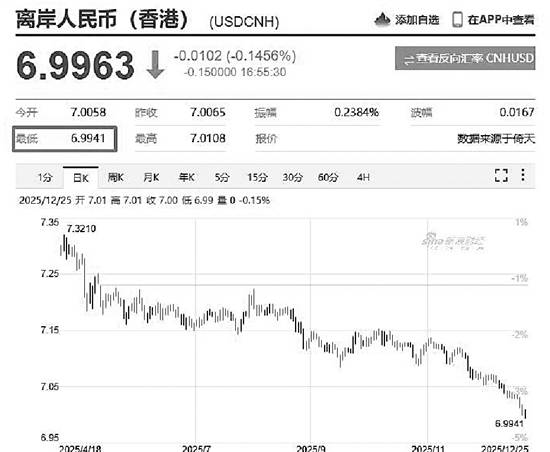
Core Viewpoint - The offshore RMB against the US dollar has broken the "7" mark for the first time since October 2024, reaching a high of 6.9985, marking a 15-month peak, while the onshore RMB also strengthened, nearing the "7" mark at 7.0066, a new high since September 2024 [2][4]. Group 1: Factors Driving RMB Appreciation - The appreciation of the RMB against the US dollar is driven by four main forces: a weakening US dollar index, a strong Chinese stock market increasing the attractiveness of RMB assets, rising demand for currency settlement from export companies, and the People's Bank of China's efforts to maintain stability in the RMB against a basket of currencies [2]. - The weakening of the US dollar index, particularly around the Federal Reserve's interest rate cut on December 11, has led to a general appreciation of non-USD currencies, including the RMB [4]. - Seasonal factors, such as increased currency settlement demand from enterprises as the year-end approaches, have also contributed to the RMB's strength [4]. Group 2: Implications for Capital Markets and Trade - The continuous appreciation of the RMB is expected to enhance the attractiveness of domestic capital markets to foreign investors, potentially increasing foreign exchange gains [4]. - For export companies, the recent RMB appreciation may reduce exchange profits, while import companies will benefit from lower costs [4]. - Experts recommend that foreign trade companies avoid betting on a one-sided RMB exchange rate trend and focus on their core business, utilizing foreign exchange derivatives to manage risks [4][6]. Group 3: Future Outlook - Experts anticipate that the RMB exchange rate will maintain a moderate appreciation trend through 2026, with a potential key level at 6.8 against the US dollar [5][6]. - The central bank's policy is expected to balance stability and flexibility, enhancing the resilience of the RMB exchange rate [5].
老张的8400美元存一年 算算账反而“亏”了一笔
Sou Hu Cai Jing· 2025-12-25 23:36
Core Viewpoint - The appreciation of the Renminbi (RMB) against the US dollar has led to negative returns on US dollar deposits, impacting individuals' investment decisions and costs for families with students studying abroad [4][5][6]. Exchange Rate Trends - The offshore RMB has appreciated against the US dollar, surpassing the 7 mark for the first time in nearly 15 months, with a maximum rate of 6.9941 [4]. - As of December 31, 2024, the offshore RMB exchange rate was 7.3338, reflecting a year-on-year increase of 4.63% [4]. Impact on Investments - The significant appreciation of the RMB has resulted in negative returns for US dollar deposits. For instance, an individual who deposited 8,400 USD at a 2.8% interest rate earned 254.8 USD, but the RMB equivalent decreased by 1,071 RMB compared to the beginning of the year [5]. - Another individual holding US Treasury bonds with a 5% yield saw their returns diminish when converted to RMB, yielding only 6,710 RMB, which is slightly above the return from a one-year RMB fixed deposit [5]. Cost Implications for Families - The appreciation of the RMB has reduced the cost of studying abroad for families. For example, a family preparing to pay tuition found that the exchange rate had improved, saving them over 17,000 RMB compared to earlier in the year [6]. Economic Factors Influencing Exchange Rates - The continuous appreciation of the RMB is attributed to several factors, including an expanding trade surplus, increased demand for RMB due to export companies needing to settle accounts, and a weakening US dollar index, which has declined by 9.74% this year [7]. - The euro, pound, and Australian dollar have all appreciated against the US dollar, indicating a broader trend of dollar depreciation [7]. Future Outlook - Experts suggest that the current period is a favorable time for currency exchange for families with immediate needs, although the long-term outlook for the RMB will depend on economic fundamentals and monetary policies from central banks, including the Federal Reserve [7].
快评年末人民币强势“破7”:南华人民币汇率热点
Nan Hua Qi Huo· 2025-12-25 09:36
Group 1: Report Industry Investment Rating - Not provided Group 2: Core Viewpoints of the Report - The RMB showed a significant strong performance against the US dollar at the end of 2025, with the offshore RMB exchange rate breaking through the key psychological level of 7.00, indicating a re - emergence of strong appreciation momentum [2]. - The appreciation of the RMB at the end of 2025 is driven by the resonance of internal and external factors, including the weakening of the US dollar index, the narrowing of the Sino - US interest rate spread, and the concentrated release of seasonal year - end settlement demand [5][6]. - Although there are expectations for the RMB to appreciate and break through 7 and enter the 6 range in 2026, there are also potential risks such as geopolitical black - swan events, the domestic economic recovery falling short of expectations, and central bank foreign exchange policy adjustments [13]. Group 3: Summary by Relevant Catalogs I. RMB's Strong Year - End Performance: Symbolic "Breaking 7" and Its Market Characteristics - **Offshore RMB "Breaking 7": The First Time Since September 2024** - At the end of 2025, the offshore RMB exchange rate broke through 7.00 during intraday trading on December 25, the first time since September 2024, attracting high market attention and indicating enhanced market confidence in the RMB [2]. - **Market Volatility Characteristics: Strong but Low - Volatility, Contrasting with the September 2024 Market** - The implied volatility of the RMB is at a historically low level, indicating a more rational and orderly appreciation process and providing a stable foreign - exchange environment for enterprises and investors [2]. - The RMB's strong performance at the end of 2025 is fundamentally different from the 2024 market fluctuations. The latter was driven by the global yen carry - trade unwind, while the former is based on the resonance of internal and external supply - demand factors [2][5]. II. Driving Forces for RMB Appreciation: Resonance of Internal and External Factors - **External Factors: Weakening US Dollar Index and Narrowing Sino - US Interest Rate Spread** - The Fed's interest - rate cuts led to the downward trend of the US dollar index, narrowing the Sino - US interest rate spread and providing an external environment for the RMB's appreciation [6]. - The seasonal contraction of market liquidity during the Christmas holiday exacerbated the weakness of the US dollar, contributing to the year - end situation of a weak US dollar and a strong RMB [6]. - The market is generally pessimistic about the US dollar's trend in 2026, and the divergence in the Fed's expected interest - rate cuts, the change of the Fed chairman, and the "de - dollarization" trend all add uncertainty to the long - term prospects of the US dollar [7]. - **Internal Factors: Concentrated Release of Seasonal Year - End Settlement Demand** - The concentrated settlement of foreign - trade enterprises at the end of the year is a more direct and strong driving force for the RMB's appreciation, as evidenced by the fact that the RMB's appreciation amplitude is greater than the US dollar index's depreciation amplitude [8]. - China has maintained a trade surplus for seven consecutive months, and there is still a large amount of pending settlement funds being digested, which supports the RMB's appreciation [8]. III. A Cold - Blooded Reflection under the Market's Optimistic Expectations: Appreciation Space and Potential Risks - **Appreciation Space** - Huang Qifan's view that the RMB will appreciate to 6.0 in the next ten years is based on rational deductions of China's economic fundamentals, trade - structure optimization, and RMB internationalization [9]. - The RMB's actual effective exchange rate shows significant appreciation potential, as the gap between the nominal and real effective exchange rates indicates that the RMB's real purchasing power is undervalued [10]. - The narrowing Sino - US interest rate spread, the central bank's monetary - policy stance, and the increasing attractiveness of the A - share market are all factors that support the RMB's appreciation [11][12]. - **Potential Risks** - Geopolitical black - swan events, the domestic economic recovery falling short of expectations, and central bank foreign - exchange policy adjustments are potential risks for the RMB's appreciation [13].
金银铜铂集体创历史新高
Di Yi Cai Jing Zi Xun· 2025-12-24 15:35
Core Viewpoint - The metal market is experiencing a significant price surge, with various metals reaching historical highs due to a combination of macroeconomic factors, geopolitical tensions, and supply-demand dynamics [2][4][6]. Group 1: Price Movements - On December 24, 2023, gold reached a peak of $4,525.83 per ounce, while silver hit $72.701 per ounce, and copper reached $12,282 per ton [2][4][5]. - Domestic futures for gold and silver also saw significant increases, with gold futures peaking at 1,022.88 yuan per gram and silver at 17,671 yuan per kilogram [2][5]. - Platinum and palladium futures also surged, with platinum reaching 675.65 yuan per gram and palladium at 578.45 yuan per gram [2][5]. Group 2: Market Drivers - The price increases are attributed to a combination of a declining interest rate environment, geopolitical tensions, and structural changes in supply and demand [2][6]. - Analysts suggest that the weakening of the dollar and the expansion of U.S. government debt are contributing to the rise in metal prices, as metals are typically priced in dollars [6][7]. - The demand for metals is also being driven by the growth of the AI industry, which requires substantial amounts of metals for infrastructure development [6][7]. Group 3: Supply and Demand Dynamics - Supply constraints and rising demand are creating a favorable environment for price increases, particularly for copper, which is experiencing a supply crisis [8][9]. - The global inventory of many base metals is at historically low levels, which reduces the market's ability to respond to supply-demand shocks [8]. - Specific factors affecting copper prices include anticipated supply shortages and increased demand from the AI sector, as well as geopolitical factors affecting supply chains [8][9]. Group 4: Future Outlook - Analysts predict that the upward trend in metal prices is likely to continue, although there may be short-term volatility due to profit-taking and market corrections [10][11]. - The copper market, in particular, is expected to face pressures from high prices and weak demand, but the long-term outlook remains positive due to structural supply-demand imbalances [12]. - The market is advised to remain cautious of potential corrections, especially if macroeconomic conditions change, such as shifts in interest rate expectations [11][12].

美元指数走弱,黄金ETF上涨空间持续打开
Sou Hu Cai Jing· 2025-12-24 03:44
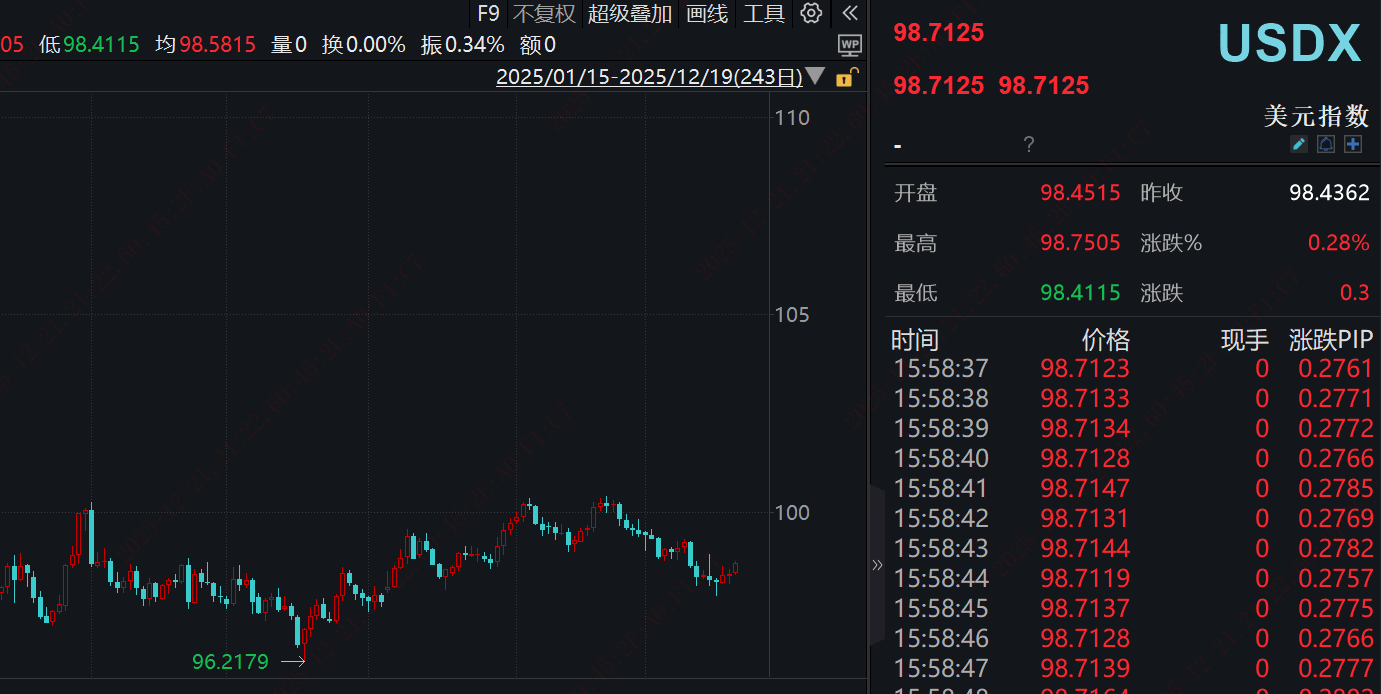
在全球宏观经济格局不断调整的背景下,美元指数的走势始终是影响各类资产配置的关键变量。近期美元指数走弱趋势愈发明确且力度显著,具体来看,11 月下旬以来便开启震荡下行模式,连续跌破100、99两大整数关口,截至12月17日收盘,期间累计下行幅度达到1.72%,最新收盘报98.71,再次逼近98整数 关口。拉长时间维度观察,今年以来美元指数整体下行态势清晰,年内下行幅度已达到9.30%,其中上半年跌幅更是达到10.8%,即便年中出现阶段性反 弹,也未能扭转整体弱势格局。这一明确的走弱变化不仅重塑了全球资产的风险偏好,更让黄金这一传统避险资产的价值再度凸显。对于普通投资者而言, 黄金ETF凭借其便捷性与高效性,成为把握这一轮市场机遇的优质选择。以下将从核心逻辑与配置价值两方面,解析美元走弱背景下黄金ETF的投资机遇。 图:美元指数近期下行 | 05 低98.4115 均98.5815 量0 换0.00% 振0.34% 额0 | F9 不复权 超级叠加 画线 工具 Q | | 98.7125 | | | --- | --- | --- | --- | --- | | 2025/01/15-2025/12/19(243 ...
镍持续增仓上行
Bao Cheng Qi Huo· 2025-12-23 09:29
Group 1: Investment Ratings - No investment ratings are provided in the report. Group 2: Core Views - **沪铜**: The Shanghai copper market maintained a volatile trend today with a slight decline in open interest. The weakening US dollar index is favorable for non - ferrous metals, but there is strong downstream wait - and - see sentiment. The London copper is approaching the $12,000 mark, and the Shanghai copper is approaching the high of early December, facing strong technical pressure and high willingness of long - position holders to close positions. Pay attention to the support of the 5 - day moving average during the correction [6]. - **沪铝**: In the morning, the Shanghai aluminum market saw a sharp decline with reduced positions, followed by a V - shaped rebound, and the overall open interest decreased significantly. The weakening US dollar index is positive for non - ferrous metals, but the basis and calendar spread remain weak, with strong industrial constraints. The aluminum price has rebounded to the previous high, and technical pressure should be noted [7]. - **沪镍**: The Shanghai nickel market increased positions and rose again today, with the main contract price reaching the 123,000 mark. After the Bank of Japan's interest rate hike, non - ferrous metals generally rose. The Indonesian Nickel Miners Association (APNI) revealed that the Ministry of Energy and Mineral Resources (ESDM) will revise the benchmark price formula for nickel ore commodities in early 2026, increasing the expectation of industrial policy disruptions and driving up the nickel price. The strong spot premium also supports the nickel price. The Shanghai nickel has changed from a position - reducing rebound to a position - increasing rebound, breaking through the high of early December, and has strong upward momentum in the short term [8]. Group 3: Industry Dynamics - **Copper**: On December 22, the China Household Electrical Appliances Association stated that due to the soaring copper price, the "aluminum - for - copper" in the household air - conditioning industry has become a hot topic. The association put forward five initiatives, including scientific division of promotion areas and price ranges for aluminum - for - copper products, strengthening industry self - discipline, accelerating the formulation of standards for aluminum heat exchangers in household air conditioners [10]. - **Nickel**: On December 23, the SMM1 electrolytic nickel price was 121,500 - 129,000 yuan/ton, with an average price of 125,250 yuan/ton, up 3,450 yuan/ton from the previous trading day. The average premium of Jinchuan 1 electrolytic nickel was 6,900 yuan/ton, up 200 yuan/ton from the previous trading day. The domestic mainstream brand electrowon nickel spot premium and discount ranged from - 200 to 400 yuan/ton. On December 19, Mysteel reported that the APNI revealed the ESDM will revise the benchmark price formula for nickel ore in early 2026, and one of the revision points is to levy royalties on cobalt as an independent commodity [11]. Group 4: Related Charts Copper - **Copper basis**: Chart 1 shows the copper basis [12]. - **Domestic visible inventory**: Chart 3 shows the domestic visible inventory of electrolytic copper (social inventory + bonded area inventory) [13]. - **LME copper cancelled warrant ratio**: Chart 5 shows the LME copper cancelled warrant ratio [14]. - **Overseas copper exchange inventory**: Chart 4 shows the overseas copper exchange inventory [19]. - **SHFE warrant inventory**: Chart 6 shows the SHFE warrant inventory [20]. Aluminum - **Aluminum basis**: Chart 7 shows the aluminum basis [24]. - **Domestic social inventory of electrolytic aluminum**: Chart 9 shows the domestic social inventory of electrolytic aluminum [26]. - **SHFE - LME ratio**: Chart 8 shows the SHFE - LME ratio [28]. - **Aluminum calendar spread**: Chart 10 shows the aluminum calendar spread [30]. - **Overseas exchange inventory of electrolytic aluminum**: Chart 11 shows the overseas exchange inventory of electrolytic aluminum (LME + COMEX) [32]. - **Aluminum rod inventory**: Chart 12 shows the aluminum rod inventory [34]. Nickel - **Nickel basis**: Chart 13 shows the nickel basis [36]. - **LME inventory**: Chart 15 shows the LME inventory [38]. - **LME nickel trend**: Chart 17 shows the LME nickel trend [40]. - **Nickel calendar spread**: Chart 14 shows the nickel calendar spread [42]. - **SHFE inventory**: Chart 16 shows the SHFE inventory [44]. - **Nickel ore port inventory**: Chart 18 shows the nickel ore port inventory [46].
黄金收评|非农就业数据公布在即,做多情绪谨慎,金价震荡回调
Mei Ri Jing Ji Xin Wen· 2025-12-16 08:26
12月16日,非农数据公布前市场情绪谨慎,俄乌和谈取得进展,避险情绪降温,金价跌破4320美元/盎 司关口,截至A股收盘,COMEX黄金期货交投于4315美元/盎司附近,黄金ETF华夏(518850)跌1.19%, 黄金股ETF(159562)跌3.65%,有色金属ETF基金(516650)跌2.49%。 (文章来源:每日经济新闻) 专业分析指出,当前金价的核心支撑来自市场对美联储进一步降息的持续押注,叠加美元指数走弱,共 同强化了黄金的短期上行态势。然而,随着地缘局势趋于缓和,避险情绪有所降温,市场关注点正向利 率路径等宏观因素集中回归。后续需重点关注美国非农等关键数据的发布,若数据强化降息预期,则金 价有望延续强势;若数据推迟宽松节奏,则需警惕波动加剧与阶段性回调风险。整体来看,金价短期整 理过程中仍具备配置价值。 消息方面,周二晚间,美国劳工部劳动统计局将公布美国10-11月非农就业报告。交易者和经济学家预 计NFP报告将显示美国净新增就业5万个岗位,平均时薪月环比上升0.3%(年同比3.7%),U3失业率小 幅升至4.5%。地缘政治方面,特朗普表示与俄罗斯总统普京进行了多次对话,还得到了欧洲领导人的 ...