货币政策宽松

Search documents
Zervos: The market has been extremely resilient despite rising trade tension
Youtube· 2025-10-16 12:07
Market Sentiment and Trade War - The equity market has shown resilience despite significant escalation in trade war rhetoric between the US and China [2][3] - Investors appear to be fatigued by ongoing discussions about the trade war, indicating a shift in sentiment [4][5] Economic Indicators and Consumer Impact - The Fed Beige Book noted that tariffs are raising prices, particularly affecting lower and middle-income consumers [6] - Concerns arise regarding the potential impact of tariffs on earnings, revenue, and consumer spending [7] Interest Rates and Monetary Policy - Expectations for interest rates have decreased, with the 10-year yield dropping below 4%, reflecting a positive tailwind for the market [9] - There is speculation that rates could further decline to around 2.25%, similar to levels seen in 2019 [10] Corporate Sector Insights - Discussions with CEOs indicate that while the lower end of the market is struggling, the upper end remains stable across various sectors [11] - Notable investment activity includes JP Morgan's commitment of $1.5 trillion in the US, suggesting confidence in certain market segments [14] Credit Market Concerns - BlackRock and Fidelity are shorting corporate bonds, indicating concerns about tight spreads and potential distress in the corporate bond market [13] - The current tight credit spreads raise questions about the market's vulnerability to a risk-off scenario [15]


【财经分析】贸易局势催生避险情绪 债市或迎布局契机
Xin Hua Cai Jing· 2025-10-16 08:05
Core Viewpoint - The bond market sentiment has shown signs of recovery following the National Day holiday, influenced by various economic factors and trade tensions, leading to increased risk aversion in the market [1][2]. Group 1: Market Sentiment and Trends - After the National Day holiday, the bond market sentiment improved significantly, with the yield curve flattening and moving downward [2]. - The 10-year government bond yield fell to around 1.82% by October 11, down from 1.89% before the holiday, indicating a recovery in market sentiment [2]. - Market expectations for a potential interest rate cut by the central bank are rising as the year-end approaches, which could further support the bond market [3][5]. Group 2: Economic Factors and Predictions - The ongoing trade tensions, particularly between China and the U.S., are expected to create a cautious environment, but the overall situation is likely to remain manageable [4]. - Analysts suggest that the speed and extent of bond market recovery in the fourth quarter may not replicate the rapid recovery seen in April, as investors are focused on turning previous losses into profits [4]. - The central bank's liquidity support has been consistent, with net injections through reverse repos, which is crucial for the bond market's stability [2][4]. Group 3: Investment Strategies - Institutions with an optimistic outlook believe that the bond market is in a favorable position, despite ongoing trade frictions, and suggest maintaining a bullish stance [6]. - The potential for a decline in the 10-year government bond yield to challenge the 1.7% level is noted, indicating that bonds currently hold investment value [6]. - Caution is advised for short-term bond investments, with recommendations to focus on credit bonds with shorter durations and higher liquidity for more stable returns [7].
中泰期货晨会纪要-20251016
Zhong Tai Qi Huo· 2025-10-16 02:36
1. Report Industry Investment Ratings No relevant content provided. 2. Core Views of the Report - For stock index futures, consider a strategy of buying on dips and pay attention to index rotation. It is believed that fiscal policy may reach a bottleneck, and there is a strong need for monetary policy to be further loosened in the fourth quarter [12][13]. - For treasury bond futures, it is also considered that fiscal policy may reach a bottleneck, and monetary policy is likely to be further loosened. The market is slightly pressured as the stock market rises with shrinking trading volume [14]. - In the black market, steel may experience shock adjustments, and it is recommended to hold short positions in iron ore or reduce positions on dips. The prices of coking coal and coke may continue to fluctuate in the short - term. For ferroalloys, it is recommended to close out short positions on dips and consider going long on dips [16][17][18]. - In the non - ferrous and new materials market, aluminum is expected to fluctuate at a high level, and it is recommended to short on rallies; alumina is expected to continue to seek a bottom, and it is advisable to short on rallies. Carbonate lithium will mainly fluctuate, and industrial silicon will fluctuate weakly in a range [23][26][27]. - In the agricultural products market, for cotton, adopt a short - on - rallies strategy; for sugar, consider short - term short operations or stay on the sidelines; for eggs, short on rallies for near - month contracts; for apples, go long on dips; for corn, buy the 07 contract on dips or sell out - of - the - money call options on the 01 contract; for red dates, stay on the sidelines; for live pigs, hold short positions in near - month contracts and pay attention to the 1 - 3 positive spread strategy [30][32][34]. - In the energy and chemical market, for crude oil, hold existing short positions; for fuel oil, its price follows that of crude oil; for plastics, expect a weak and narrow - range fluctuation; for rubber, it may fluctuate strongly in the short - term, and consider short - selling call options after a rebound; for methanol, wait for a rebound to go long; for caustic soda, expect price fluctuations; for asphalt, it follows the price of crude oil; for liquefied petroleum gas, maintain a bearish view in the long - term [41][42][51]. 3. Summaries According to Relevant Catalogs 3.1 Macro Information - The US threatens to impose 100% tariffs on China, and the Chinese Foreign Ministry urges the US to correct its wrong actions. China opposes the EU's protectionist and discriminatory practices [8]. - China has achieved key breakthroughs in high - end electronic measurement instruments and filled the gap in high - end electronic design industrial software [8]. - In September 2025, China's CPI rose 0.1% month - on - month and fell 0.3% year - on - year, while the core CPI rose 1% year - on - year. PPI remained flat month - on - month and fell 2.3% year - on - year [8]. - In September 2025, China's M2 increased 8.4% year - on - year, M1 increased 7.2% year - on - year, and the "scissors gap" between M1 and M2 reached a new low for the year. The increase in RMB loans in the first three quarters was 14.75 trillion yuan, and the cumulative increase in social financing scale was 30.09 trillion yuan [9]. - The Fed's "Beige Book" shows that economic activity has changed little, consumer spending has declined slightly, and employment has remained stable. A Fed official suggests that the Fed should cut interest rates twice this year [10]. 3.2 Stock Index Futures - On Wednesday, the A - share market rebounded with shrinking trading volume. The inflation data was in line with expectations, with food and energy prices dragging down CPI. Core CPI continued to rise. PPI improvement was unbalanced, and financial data showed a decline in social financing and M2, while M1 increased significantly [12]. - It is recommended to continue the strategy of buying on dips and pay attention to index rotation [12]. 3.3 Treasury Bond Futures - The market is slightly pressured as the stock market rises with shrinking trading volume. The inflation data is in line with expectations, and financial data shows a decline in social financing and M2, while M1 increases significantly [14]. - It is believed that fiscal policy may reach a bottleneck, and there is a strong need for monetary policy to be further loosened in the fourth quarter [14]. 3.4 Black Market 3.4.1 Steel - From a macro perspective, Sino - US trade frictions have a negative impact on sentiment, but the impact on actual supply and demand is expected to be small. The market should focus on supply - demand fundamentals [16]. - During the "Golden September and Silver October" peak season, the real demand for steel downstream has improved limitedly, and the inventory of some varieties is high, which may lead to a shock or off - peak market [16]. - Steel may experience shock adjustments, and it is recommended to hold short positions in iron ore or reduce positions on dips [17]. 3.4.2 Coking Coal and Coke - In the short - term, the prices of coking coal and coke may continue to fluctuate. The supply of coking coal and coke is gradually recovering, but there are still expectations of "anti - involution" and environmental protection restrictions [18]. - In the medium - term, the resumption of coking coal supply is hindered. The demand from steel mills for coking coal and coke is strong, but the current inventory level of downstream coking coal and coke is high, and the short - term demand support is weak [18]. 3.4.3 Ferroalloys - The cost of ferrosilicon may decline slightly in the fourth quarter, and the cost support of silicomanganese is stronger than that of ferrosilicon. It is recommended to close out short positions on dips and consider going long on dips [20]. - The price of ferrosilicon rose significantly during the day but then fell back, mainly due to the influence of the increase in thermal coal prices on sentiment [20]. 3.4.4 Soda Ash and Glass - The soda ash and glass industry chain is operating weakly. It is recommended to hold a bearish view on soda ash or take profits in the short - term, and stay on the sidelines for glass [21]. - The supply of soda ash is at a high level, and the new production capacity of leading enterprises is expected to be postponed. The supply of glass is affected by the decline in the market, and the inventory of the middle - stream is high [21]. 3.5 Non - Ferrous and New Materials Market 3.5.1 Aluminum and Alumina - Aluminum is expected to fluctuate at a high level, and it is recommended to short on rallies. Alumina is expected to continue to seek a bottom, and it is advisable to short on rallies [23]. - The inventory of aluminum is decreasing, and the spot premium is rising. The supply of alumina is in a state of high - opening and high - supply, and the inventory is increasing [23]. 3.5.2 Zinc - The spot trading of zinc in the three major domestic markets is weak, and the inventory is increasing. It is recommended to hold short positions [24]. - The price of zinc is affected by trade disputes and weak demand. The domestic and overseas markets have different operating logics, and there are signs of a resonance decline in global zinc prices [25]. 3.5.3 Carbonate Lithium - Carbonate lithium will mainly fluctuate. The supply is increasing, and the demand is in a state of de - stocking, which supports the current price [26]. - The impact of lithium battery export controls on short - term demand is limited, and the high level of warehouse receipts has limited impact on prices [26]. 3.5.4 Industrial Silicon - Industrial silicon will fluctuate weakly in a range, and it is advisable to sell call options. The recent decline in the price is mainly due to the expected weakening of supply and demand [27]. - The supply of industrial silicon is expected to increase in October, but there is also an expected decline in inventory due to the dry season in the southwest, resulting in a loose balance of supply and demand [27]. 3.5.5 Polysilicon - The spot price of polysilicon is firm, which supports the lower space of the futures price. It is expected to continue to fluctuate in a narrow range [28]. - The market was affected by rumors of a new cost benchmark for polysilicon on October 15, and the price rebounded due to valuation correction [28]. 3.6 Agricultural Products Market 3.6.1 Cotton - Adopt a short - on - rallies strategy. The upstream - downstream game is complex, with increasing supply pressure and weak demand [30]. - The price of domestic cotton is affected by the international market and the increase in supply, and the demand is uncertain [30][31]. 3.6.2 Sugar - Consider short - term short operations or stay on the sidelines. The global sugar market is expected to have a surplus, and the domestic sugar supply is under pressure [32]. - The price of sugar is affected by supply and cost factors, and the new sugar production is expected to increase [32][33]. 3.6.3 Eggs - Short on rallies for near - month contracts. The inventory of laying hens is high, and the demand is in the off - season, resulting in a loose supply - demand situation [34]. - The spot price of eggs has rebounded slightly, and the price may be affected by vegetable prices [34]. 3.6.4 Apples - Go long on dips. The late - maturing Fuji apples in the eastern and western regions are gradually on the market, and the price in the western region is firm [36]. - Pay attention to the impact of continuous rainfall on the quality of new - season apples [36]. 3.6.5 Corn - Buy the 07 contract on dips or sell out - of - the - money call options on the 01 contract. The spot price of corn is weak, and the new - season supply is increasing [37]. - The price of corn may be supported by the purchase of the central reserve, and attention should be paid to the harvest and grain quality in North China and the selling intention of farmers [37][38]. 3.6.6 Red Dates - Stay on the sidelines. The market price of red dates is stable, and the consumption is poor, but the opening price is expected to be high [39]. - Pay attention to the opening price of new - season red dates [39]. 3.6.7 Live Pigs - Hold short positions in near - month contracts and pay attention to the 1 - 3 positive spread strategy. The market is in a situation of strong supply and weak demand after the double festivals [39]. - The supply of live pigs is sufficient, and the demand is weak after the festivals, which drags down the price [39]. 3.7 Energy and Chemical Market 3.7.1 Crude Oil - Hold existing short positions. The supply of crude oil is increasing, and the demand is weakening, resulting in a downward trend in the price [41]. - The price of crude oil is affected by API inventory, trade wars, and geopolitical risks, and there may be a price repair in the future [41]. 3.7.2 Fuel Oil - The price of fuel oil follows that of crude oil. The supply - demand structure of fuel oil is loose, and the demand is flat [42]. - The price of crude oil is affected by geopolitical risks and weak macro - expectations, and the price of fuel oil is also affected [42]. 3.7.3 Plastics - Expect a weak and narrow - range fluctuation. The supply pressure of polyolefins is large, and the demand is weak [43]. - It is recommended to wait for a rebound to short, as the current price is slightly low [43]. 3.7.4 Rubber - It may fluctuate strongly in the short - term, and consider short - selling call options after a rebound. The supply is expected to increase, but it is affected by the NR near - month contract [44]. - The price of rubber is affected by the Fed's interest rate cut signal and the cancellation of NR warehouse receipts [44]. 3.7.5 Methanol - Wait for a rebound to go long. The main contradiction of methanol is the high inventory pressure in ports, and there are also factors such as the impact of winter gas restrictions on production [45]. - The price of methanol is affected by the arrival of Iranian goods in ports, and attention should be paid to the inventory removal process [45]. 3.7.6 Caustic Soda - The price of caustic soda futures is expected to fluctuate. The short - term strength of the fundamentals and the weakness of alumina affect the price [46]. - The spot price of caustic soda has changed, and the price of alumina and liquid chlorine also has an impact on the futures price [46]. 3.7.7 Asphalt - Asphalt follows the price of crude oil. The price of crude oil is affected by geopolitical risks and weak macro - expectations [47]. - The spot price of asphalt has declined, and the demand is in the peak season. Attention should be paid to the inventory removal speed in October [48]. 3.7.8 Liquefied Petroleum Gas - Maintain a bearish view in the long - term. The supply of LPG is abundant, and the demand is difficult to strengthen beyond expectations [51]. - The price of LPG is affected by trade wars, OPEC+ production increases, and the peak season for blending oil is over [51]. 3.7.9 Polyester Industry Chain - The polyester industry chain is expected to follow the cost side and fluctuate weakly. The overall fundamentals lack a clear driving force [50]. - The supply and demand of PX are relatively stable, the supply of PTA increases, and the far - month inventory of ethylene glycol is expected to increase [50].
芦哲:每周宏观经济和资产配置研判
Sou Hu Cai Jing· 2025-10-15 04:03
Domestic Macro Perspective - The impact of the new round of tariffs on the domestic economy is expected to be limited, as evidenced by a 16.9% year-on-year decline in exports to the US, while overall exports still achieved a 6.1% year-on-year growth in the first nine months of the year [1][2] - Since the third quarter, domestic economic pressures have increased, necessitating new growth stabilization policies, with investment growth slowing to 0.5% year-on-year in August and retail sales growth at 3.4% [1][2] - The new round of growth stabilization policies is expected to be moderate, focusing on maintaining stability rather than aggressive stimulus, with projected economic growth for the third quarter at 4.7%-4.9% [2] Overseas Macro Perspective - The US economy is expected to remain resilient in the fourth quarter, with the Federal Reserve likely to implement two more rate cuts, although these expectations may be influenced by economic data and tariff developments [3] - Market sentiment is divided regarding tariffs, with optimistic views suggesting a quick rebound in US and Chinese stock markets, while pessimistic views highlight the lack of substantial concessions [3] Equity Market Perspective - The market experienced significant adjustments due to tariff impacts, with expectations that the adjustments are short-term emotional responses, leading to capital inflows into sectors benefiting from international relations fluctuations, such as rare earths and defense [4] - The market is likely to enter a consolidation phase from October to November, with a potential shift from AI hardware to defensive sectors and industries supported by performance logic [4] Bond Market Perspective - External risks have created trading opportunities, with limited downward space for rates, as the 10-year yield has returned to the 1.70%-1.75% range due to recent developments in US-China relations [5] - The bond market is expected to experience a transitional period in October, with potential for monetary policy easing and stable funding rates, despite ongoing supply pressures [6]
鲍威尔暗示再次降息,央行开展了910亿元7天期逆回购操
Dong Zheng Qi Huo· 2025-10-15 00:47
1. Report Industry Investment Ratings No relevant content provided. 2. Core Views of the Report - Powell's latest remarks suggest that the Fed needs to cut interest rates again and stop balance - sheet reduction, indicating a non - changing trend of monetary policy easing and a weakening US dollar index [14]. - On October 14, the stock market closed lower again with significant trading volume. Due to the lag and long - tail effects of the tariff war and more upcoming negotiations, the situation needs to be observed [2]. - Sino - US trade relations are an incremental positive for the bond market. If the equity market is confirmed to be in high - level consolidation, the bond market will see a slight upward trend [3]. - Steel prices continue to be weak, with iron ore price declines bringing cost - side risks. There is still inventory pressure on finished products, and caution is advised regarding steel prices [4]. - In the short term, lithium prices may show a combination of strong reality and weak expectations, with narrow - range fluctuations. It is advisable to focus on short - selling opportunities on price rallies [5]. - The IEA monthly report slightly lowers the global demand growth forecast, and concerns about oversupply have pushed oil prices down [6]. 3. Summary by Directory 3.1 Financial News and Comments 3.1.1 Macro Strategy (Foreign Exchange Futures - US Dollar Index) - Trump announced the end of the war, but the path to peace in the Middle East remains fragile. The US government shutdown has entered its 14th day, and the White House vows to continue layoffs [12][13]. - Powell suggests that the Fed may cut interest rates by 25 basis points later this month and stop balance - sheet reduction in the coming months. This indicates a non - changing trend of monetary policy easing and a weakening US dollar index [14]. - Investment advice: Expect the US dollar index to weaken [15]. 3.1.2 Macro Strategy (Stock Index Futures) - The National Development and Reform Commission issued a management method to support energy - saving and carbon - reduction renovations in key industries [16]. - The Premier of the State Council held an economic situation symposium. On October 14, the stock market closed lower with significant volume. Due to the tariff war uncertainties and more upcoming negotiations, the situation needs to be observed [17][18]. - Investment advice: Allocate evenly among stock indices [19]. 3.1.3 Macro Strategy (US Stock Index Futures) - Powell leaves the door open for interest rate cuts and may stop balance - sheet reduction in the future. Fed Governor Bowman expects two more interest rate cuts by the end of the year [20][21]. - Goldman Sachs' Q3 revenue reached a record high for the same period. Fed officials' dovish remarks support market sentiment, and the 10 - month interest rate meeting is expected to cut rates [22]. - Investment advice: Given the lingering tariff threat, pay attention to negotiation progress and look for opportunities to enter the market on dips [23]. 3.1.4 Macro Strategy (Treasury Bond Futures) - The central bank conducted 600 billion yuan of 6 - month (182 - day) outright reverse repurchase operations on October 15 and 91 billion yuan of 7 - day reverse repurchase operations on October 14 [24][25]. - Sino - US trade relations are positive for the bond market. However, factors such as the stock market adjustment rhythm, policy expectations, and the fund fee rate new regulations may affect the bond market. - Investment advice: Hold existing long positions, be cautious about adding new long positions. There will be opportunities to buy on dips after the fund fee rate new regulations are implemented [26]. 3.2 Commodity News and Comments 3.2.1 Black Metals (Coking Coal/Coke) - The coking coal market in Hebei is stable. Coal mine production is stable, and high iron - water production supports coking coal demand. However, the steel market still faces supply - demand pressure, and short - term steel prices may be under pressure [27]. - Investment advice: In the short term, the coking coal fundamentals are weak. Pay attention to future demand [28]. 3.2.2 Agricultural Products (Soybean Meal) - ANEC predicts that Brazil's soybean exports in October will be 731 million tons. The estimated soybean crushing volume of NOPA members in September is 186.34 million bushels. CONAB predicts an increase in Brazil's soybean production and exports in the 25/26 season [29][30][31]. - Investment advice: The domestic and international futures prices are expected to remain weak and volatile. Pay attention to Brazilian weather, Sino - US relations, and whether the M2601 contract can find support at 2900 [31]. 3.2.3 Agricultural Products (Cotton) - In Xinjiang, the purchase price of cottonseed in the northern region has stabilized, and the "fixed - price" sales model is becoming more popular. The global textile industry is facing challenges, and China's textile and clothing exports from January to September decreased by 0.3% year - on - year [32][33][34]. - Investment advice: In the short term, Zhengzhou cotton is expected to be weak and volatile. Pay attention to new cotton purchases, Sino - US relations, and macro - level dynamics [35]. 3.2.4 Agricultural Products (Soybean Oil/Rapeseed Oil/Palm Oil) - Indonesia is considering regulating palm oil exports to meet B50 demand, which may reduce global edible oil supply [36]. - Investment advice: The B50 policy in Indonesia will cause supply shortages. Unless the policy fails, it is advisable to buy on dips [37]. 3.2.5 Black Metals (Rebar/Hot - Rolled Coil) - The world steel demand in 2025 is expected to be about 1.75 billion tons, and it will rebound by 1.3% in 2026. In early October, the daily output of crude steel by key steel enterprises was 2.032 million tons, and the inventory increased [38][39]. - Investment advice: In the short term, adopt a weak - volatility mindset, short on price rebounds, or wait for price drops [41]. 3.2.6 Agricultural Products (Red Dates) - The price of red dates in the Guangzhou Ruyifang market is stable. The futures price of the main contract slightly declined. The Xinjiang production area is in the drying - on - the - tree period, and the demand in distribution areas is stable [42][43]. - Investment advice: Before the main trading logic becomes clear, it is advisable to wait and see. Pay attention to price negotiations and purchase progress in the production area [43]. 3.2.7 Agricultural Products (Corn Starch) - On October 14, 2025, the theoretical profits of corn starch enterprises in Heilongjiang, Jilin, Hebei, and Shandong were 12 yuan/ton, 56 yuan/ton, 69 yuan/ton, and 57 yuan/ton respectively, with an increase in losses [44]. - Investment advice: Continue to look for opportunities to narrow the spot rice - flour price spread in the long - term. If the deterioration of the real - world fundamentals is slow, the 11 - contract rice - flour price spread may still have room for upward correction [44]. 3.2.8 Black Metals (Steam Coal) - In September, brown coal imports were 46 million tons, a year - on - year decrease of 3.3%. From January to September 2025, the cumulative coal imports decreased by 11.1% year - on - year [45][46]. - Investment advice: Due to supply reduction, strong thermal power demand, and winter storage, steam coal prices are unlikely to fall significantly in the short term, and there is strong support around 700 yuan/ton [46]. 3.2.9 Black Metals (Iron Ore) - Rio Tinto's Pilbara iron ore production in Q3 2025 was 84.1 million tons. Iron ore prices may fluctuate narrowly between 100 - 110 US dollars due to insufficient finished - product demand and stable iron - water production [47]. - Investment advice: Iron ore is expected to fluctuate narrowly between 100 - 110 US dollars. Maintain a volatility - market mindset [47]. 3.2.10 Agricultural Products (Corn) - Domestic corn prices are weak. The futures price of the main contract has fallen below 2100 and then rebounded. The basis is expected to weaken, and the futures price may gradually outperform the spot price [48]. - Investment advice: Hold existing short positions and closely monitor market sentiment. Do not enter long positions too early for a rebound [49]. 3.2.11 Non - Ferrous Metals (Polysilicon) - South Korea's OCI acquires a Vietnamese silicon wafer factory. The spot price of polysilicon is stable, and the production in October is expected to increase. The prices of silicon wafers and battery cells are stable, and the component price may fluctuate [50][51][52]. - Investment advice: The progress of platform companies may cause market fluctuations. It is advisable to consider going long on the PS2512 contract when it is at a discount to the spot. Look for reverse - arbitrage opportunities between the PS2511 - PS2512 contracts at around - 2000 yuan/ton [53]. 3.2.12 Non - Ferrous Metals (Industrial Silicon) - Dongyue Silicon Materials' net profit in the first three quarters of 2025 is expected to decline significantly. The start - up of northern silicon plants is increasing, while southern plants may reduce production. There may be seasonal inventory accumulation and depletion, but the supply - demand contradiction is not obvious [54]. - Investment advice: It is more advisable to go long on industrial silicon at low prices, but be cautious about chasing up [55]. 3.2.13 Non - Ferrous Metals (Lead) - On October 13, the LME 0 - 3 lead was at a discount of 45.35 US dollars/ton. The Shanghai lead futures price fluctuated downward, and the LME lead price was weak. The domestic lead - ingot import window opened briefly, and the social inventory decreased [56]. - Investment advice: For single - side trading, look for opportunities to buy on dips and beware of delivery risks. For arbitrage, look for positive - arbitrage opportunities in the month - spread and short - term internal - external reverse - arbitrage opportunities [56]. 3.2.14 Non - Ferrous Metals (Zinc) - On October 13, the LME 0 - 3 zinc was at a premium of 201.6 US dollars/ton. The zinc - ingot export window has opened, and the LME inventory has increased. The domestic demand improvement is limited [57][58]. - Investment advice: For single - side trading, it is advisable to wait and see. For arbitrage, look for medium - term positive - arbitrage opportunities and maintain a positive - arbitrage mindset for internal - external trading, and take profits on positive - arbitrage positions in batches on dips [58]. 3.2.15 Non - Ferrous Metals (Lithium Carbonate) - In September, the combined production of power and other batteries in China increased by 35.4% year - on - year. Currently, the lithium carbonate market is in the peak - season inventory - depletion phase, but the supply is expected to remain high, and the demand may face a decline [59]. - Investment advice: In the short term, lithium prices may fluctuate narrowly. It is advisable to focus on short - selling opportunities on price rallies and look for reverse - arbitrage opportunities between the LC2511 - 2512 contracts [59]. 3.2.16 Non - Ferrous Metals (Nickel) - A fire occurred at an HPAL project in Indonesia, but it does not affect the project progress. Short - term macro factors are volatile. The nickel ore price is expected to rise in Q4, and the refined nickel may face inventory accumulation pressure in Q4 [60][61]. - Investment advice: Consider going long on nickel after macro risks stabilize [61]. 3.2.17 Energy Chemicals (Crude Oil) - The IEA monthly report slightly lowers the global demand growth forecast, and concerns about oversupply have pushed oil prices down [6]. - Investment advice: Oil prices are expected to be weak and volatile in the short term [63]. 3.2.18 Energy Chemicals (Carbon Emissions) - On October 14, the CEA closing price was 55.82 yuan/ton, a decrease of 2.33% from the previous day. The carbon market trading volume has not increased significantly, and the price is under pressure [63]. - Investment advice: The CEA price is expected to be weak and volatile in the short term [64]. 3.2.19 Energy Chemicals (Caustic Soda) - On October 14, the price of high - concentration caustic soda in Shandong decreased. The supply has increased, and the demand is average [66]. - Investment advice: Due to the weakening of the Shandong spot price and the poor performance of the macro - economy and coal market, be cautious about bottom - fishing [66]. 3.2.20 Energy Chemicals (PVC) - On October 14, the domestic PVC powder market price decreased, and the trading volume was weak. The supply pressure is increasing due to new capacity releases, and the demand is pessimistic due to anti - dumping measures [67][68]. - Investment advice: The PVC fundamentals are weak, and the inventory is accumulating. The price is expected to remain weak and volatile in the short term, with limited room for further decline [68]. 3.2.21 Energy Chemicals (Bottle Chips) - Bottle - chip factory export prices continue to decline. Polyester raw material prices have fallen, and bottle - chip factories have lowered their prices. The short - term supply - demand contradiction is not prominent, but it may accumulate in Q4 [69][71]. - Investment advice: Pay attention to the resumption of factory production and new capacity releases. The supply - demand contradiction may increase in Q4, putting pressure on processing fees [71]. 3.2.22 Energy Chemicals (Soda Ash) - On October 14, the soda ash market in Shahe was volatile. The futures price decreased due to the overall risk - appetite decline in the commodity market. The new capacity of Yuangxing's Phase II project is delayed, but the supply is high, and the demand is average [72]. - Investment advice: In the medium - term, maintain a short - selling mindset on price rallies and pay attention to new capacity releases [72]. 3.2.23 Energy Chemicals (Float Glass) - On October 14, the float glass price in the Shahe market decreased. The glass futures price continued to fall, mainly due to the delay in the coal - to - gas conversion of several coal - fired production lines in Shahe [73]. - Investment advice: The glass market shows a lack of peak - season strength. Due to supply - side uncertainties, single - side trading is risky. It is recommended to look for arbitrage opportunities by going long on glass and short on soda ash when the price spread widens [74]. 3.2.24 Energy Chemicals (Urea) - In September 2025, China's fertilizer imports were 122,400 tons, and exports were 5.438 million tons. From January to September, imports decreased by 6.7% year - on - year, and exports increased by 45.4% year - on - year [75]. - Investment advice: Due to weather - related demand delays, pay attention to whether the demand in Northeast China can be released. When the 2601 contract falls below 1600 yuan/ton, gradually close out short - selling positions. Reserve entities are advised to continue with a dispersed purchasing strategy [77].
期债修复窗口开启
Qi Huo Ri Bao· 2025-10-14 20:00
Core Viewpoint - The bond futures market has experienced fluctuations driven by policy expectations and risk aversion, with significant performance in the 10-year and 30-year bonds [1] Group 1: Market Dynamics - Since September, the bond futures market has gone through a cycle of "volatile decline → rebound driven by policy expectations → increase driven by risk aversion" [1] - The 30-year bond futures contract hit a six-month low on September 24, while the 10-year bond futures fluctuated around 107.7 yuan [1] - After the National Day holiday, a relaxed funding environment helped the bond market recover, with the 10-year bond yield dropping by 3.2 basis points to 1.743%, marking a new low for the period [1] Group 2: Trade Tensions Impact - The escalation of trade tensions has introduced new shocks to the market, with "TACO trading" being the main theme prior to late September [2] - Historical patterns indicate that trade tensions affect the real economy primarily through inventory cycles, with U.S. importers stockpiling goods before new tariffs take effect [2] - The Nasdaq Composite Index's price-to-earnings ratio has increased from 24 times in April to 31 times currently, suggesting a higher likelihood of market volatility [2] Group 3: Domestic Asset Allocation - The logic of under-allocation in domestic assets continues, with expectations of seasonal declines in credit issuance as the "golden September and silver October" peak season passes [3] - The insurance industry is projected to generate over 3 trillion yuan in new premiums by 2025, creating a rigid allocation gap for long-term bonds [3] - The expectation of the inclusion of Chinese government bonds in global indices may lead to a cessation of foreign capital reduction, prompting increased allocation to government and local bonds, particularly 30-year and 50-year bonds [3] Group 4: Monetary Policy Outlook - The central bank is expected to maintain a moderately loose monetary policy, with a projected 0.5 percentage point reserve requirement ratio cut in the fourth quarter to support economic growth [3] - The central bank will utilize open market operations and other tools to ensure ample liquidity, with the DR007 rate likely to remain between 1.5% and 1.6% [3] - A downward testing of the 10-year bond yield towards 1.70% is possible if credit expansion remains weak, with the policy mix potentially shifting to a "loose + hedging" model [3]
美联储理事鲍曼预计年内还将降息两次 以应对劳动力市场疲软
智通财经网· 2025-10-14 15:45
Core Viewpoint - The Federal Reserve is expected to continue lowering interest rates in the remaining two policy meetings of 2025 to address a slowing labor market and weakening economic growth [1][2] Group 1: Interest Rate Outlook - Federal Reserve Governor Bowman anticipates two more rate cuts before the end of the year, with the current benchmark rate set between 4.00% and 4.25%, marking the first cut since December of last year by 25 basis points [1] - The futures market is betting on a 25 basis point cut in each of the upcoming meetings on October 28-29 and in the second week of December [1] Group 2: Economic Conditions - The labor market is showing signs of weakness, prompting a consensus among Federal Reserve officials for further monetary easing [1] - Philadelphia Fed President Harker supports two additional 25 basis point cuts this year, emphasizing that current policies are still "slightly tight" and that further easing aligns with the latest economic forecasts [2] - Harker warns that the momentum in the U.S. labor market is diminishing, with third-quarter growth above trend but consumer spending increasingly reliant on high-income groups [2]
每周宏观经济和资产配置研判-20251014
Soochow Securities· 2025-10-14 09:12
Domestic Macro Viewpoints - The impact of the new round of tariffs on the domestic economy is expected to be limited, with a 16.9% year-on-year decline in exports to the U.S. in the first nine months, yet overall exports still achieved a 6.1% year-on-year growth[3] - Since Q3, domestic economic pressure has increased, with fixed asset investment growth dropping to 0.5% year-on-year in August and retail sales growth at 3.4% year-on-year, indicating a need for new growth stabilization policies[3] - The anticipated new growth stabilization policies are expected to be moderate, focusing on support rather than strong stimulus, with Q3 economic growth projected between 4.7% and 4.9%[3] U.S. Economic Outlook - The U.S. economy is expected to remain resilient, with the Federal Reserve likely to implement two more rate cuts, although the market has already priced in approximately 4.7 rate cuts by the end of next year, limiting further rate reduction space[3] - Market sentiment regarding tariffs is divided, with optimistic views suggesting a quick rebound in U.S. and Chinese stock markets, while pessimistic views foresee potential corrections due to a lack of substantial concessions[3] Market Trends - Following the tariff-related adjustments, the market is expected to enter a consolidation phase from October to November, with a potential shift from AI hardware to defensive sectors and industries supported by performance logic[3] - The bond market is experiencing a temporary downward adjustment in rates, with the 10-year yield expected to stabilize between 1.70% and 1.75% due to external risks and domestic economic fundamentals[4]
黄金交易提醒:金价狂飙破4100美元!
Sou Hu Cai Jing· 2025-10-14 06:18
Core Viewpoint - The recent surge in gold prices, reaching a historic high of $4116.87 per ounce, is driven by escalating international trade tensions, geopolitical uncertainties, and expectations of loose monetary policy, with gold prices up 56% year-to-date [1][3][4]. Group 1: Market Dynamics - Gold's price increase is directly linked to the deterioration of international trade relations, particularly following President Trump's recent trade provocations, which have prompted investors to seek gold as a safe haven [3][4]. - The Federal Reserve's anticipated interest rate cuts are a significant catalyst for gold's rise, with a 97% probability of a 25 basis point cut in October and a 100% chance of a cut in December [4][5]. - The strong demand from central banks and the inflow of ETF funds provide structural support for the gold market, reinforcing its upward trajectory [5][7]. Group 2: Institutional Forecasts - Multiple international financial institutions have raised their gold price forecasts, with Bank of America projecting a target of $5000 per ounce by 2026, and Societe Generale predicting an average price of $4488 per ounce next year [7][8]. - Analysts emphasize that the current market dynamics, including central bank purchases and ETF inflows, are based on empirical data, supporting the bullish outlook for gold [7][8]. Group 3: Currency and Gold Relationship - The recent rebound of the US dollar, which typically inversely correlates with gold prices, highlights the volatility driven by trade tensions, suggesting that any renewed trade threats could lead to a decline in the dollar and a corresponding rise in gold [5][9]. - The interplay between the dollar and gold remains complex, with the dollar serving as a primary safe haven, yet trade uncertainties amplifying its fluctuations [9].

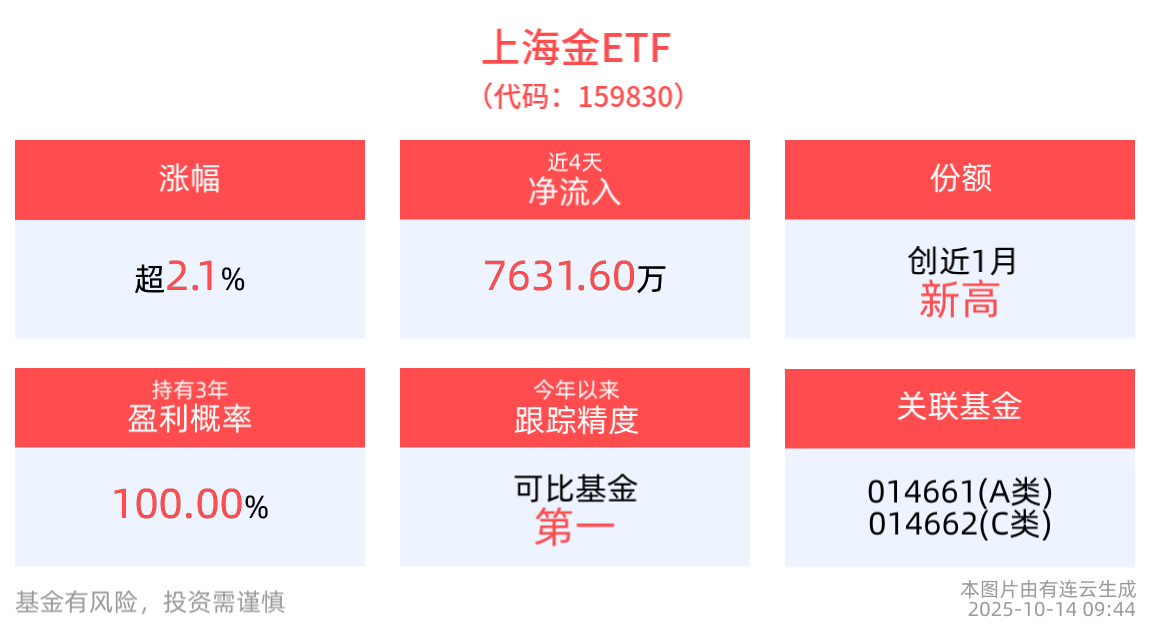
黄金,涨疯了!国际金价破顶,上海金ETF(159830)暴涨超2%,避险狂潮席卷
Sou Hu Cai Jing· 2025-10-14 02:20
Core Insights - The Shanghai Gold ETF (159830) has seen a significant increase of 2.16%, reaching a new high since its launch, with a trading volume of 12.85 million yuan [3] - The total shares of the Shanghai Gold ETF have reached 158 million, marking a one-month high, with a net inflow of 11.02 million yuan recently [3] - The China A500 ETF Tianhong (159360) has also risen by 0.97%, with notable increases in constituent stocks such as Sanhuan Group and Trina Solar [3] Product Highlights - The Shanghai Gold ETF (159830) closely tracks the Shanghai Gold index and has a management fee of 0.25% and a custody fee of 0.05%, both lower than the average for similar products, and supports T+0 trading [4] - The China A500 ETF Tianhong (159360) covers 35 secondary industries and tracks 500 core assets of the Chinese economy, serving as a stabilizing investment to hedge against rotation risks [4] Market Trends - On October 14, both international and domestic gold markets experienced a surge, with spot gold prices breaking the $4,140 per ounce mark, reflecting a strong correlation between domestic and international markets [5] - The strong rise in gold prices is driven by two main factors: the dovish signals from the Federal Reserve and a shift in market sentiment towards safe-haven assets due to recent stock market declines [6] - The U.S. government shutdown and renewed tariff concerns have increased demand for gold as a safe-haven asset, further supported by expectations of interest rate cuts [6]